RIP Margaret Ross
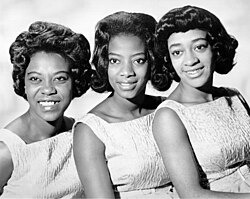
Margaret Ross was still in high school when she joined her cousin Dorothy Jones and their friend Earl-Jean McRea in the Cookies, a vocal group from Coney Island who became the favourites of the hit-making songwriters in Aldon Music’s Brill Building offices in the early ’60s. They sang on countless demos and provided backup on many hits by other artists.
On their own records, such as “Chains”, “Don’t Say Nothing Bad About My Baby” and “Girls Grow Up (Faster Than Boys)”, they shared the lead vocals between them. But in 1964 it was Margaret who sang lead on the sublime “I Never Dreamed”, a song written by Gerry Goffin and Russ Titelman, one of my three all-time favourite records in the beloved girl-group genre. Arranged by Carole King, it was produced by Goffin, King’s then-husband, and Titelman.
I saw the news of her death at the age of 83 today on Titelman’s Facebook page, which shows how long some old loyalties last. In the same year as “I Never Dreamed”, Margaret also sang lead on two almost equally fine records released under the fictitious name of the Cinderellas: “Baby Baby (I Still Love You)” and “Please Don’t Wake Me”, both written by Titelman with Cynthia Weil, and produced by Titelman with Barry Mann, Weil’s husband and usual writing partner.
Who were the greatest of all the girl-group lead singers? For me it’s Shirley Owens of the Shirelles and Judy Craig of the Chiffons. But Margaret Ross had something special: she could capture the innocence that people like Goffin, Weil and Ellie Greenwich wrote into their stories of young love. She, above all, sounds like a teenager singing on behalf of other teenagers — but with a fine vocal technique that, when matched with the other members of the group, explained their popularity with the writers. “Their ears were so good,” said Neil Sedaka, for whom they sang the background to “Breaking Up Is Hard to Do”.
That day Sedaka took them from Coney Island to the session at RCA studios on East 24th Street in a taxicab. As Ross told Laura Flam and Emily Sieu Liebowitz, the authors of But Will You Love Me Tomorrow?, an oral history of the girl groups: “We learned the song in the taxi. Only took a few minutes to put it together, and once we got in the studio, naturally that’s how it came out.”
It was the Beatles who called time on the girl-group era — ironically, because Lennon and McCartney had been inspired and influenced by those very records, and they covered “Chains”, along with the Shirelles’ “Baby It’s You”, on their first album. Ross was not pleased. “We were furious. Oh, we were mad. I mean, they came over here and they just took over and they pushed us out. And that’s when everything slowed down. They just knocked all of us out.”
She left the music business, got married, had two children, and went to work for the New York City Health Department until her retirement in 1998. In her later years she performed sometimes with a new group of Cookies and sometimes with Louise Murray of the Jaynetts, Lillian Walker-Moss from the Exciters, Beverly Warren from the Raindrops and Nanette Licari from Reparata and the Delrons.
“I love to sing,” Margaret told Flam and Liebowitz. But the schoolgirl could not have imagined, as “I Never Dreamed” went on to the tape in 1964, that she was singing her way into a kind of immortality.
* But Will You Love Me Tomorrow? was published in 2023 by Hachette Books. The Cookies: Chains / The Dimension Links 1962-64 was issued in 2009 on RPM Records and contains their important recordings, under the group name and those of the Cinderellas, Earl-Jean, the Palisades, Darlene McRea and the Honey Bees.

 thebluemoment.com