Skip to content

Posts tagged ‘Alex Bonney’

In the Unreal City

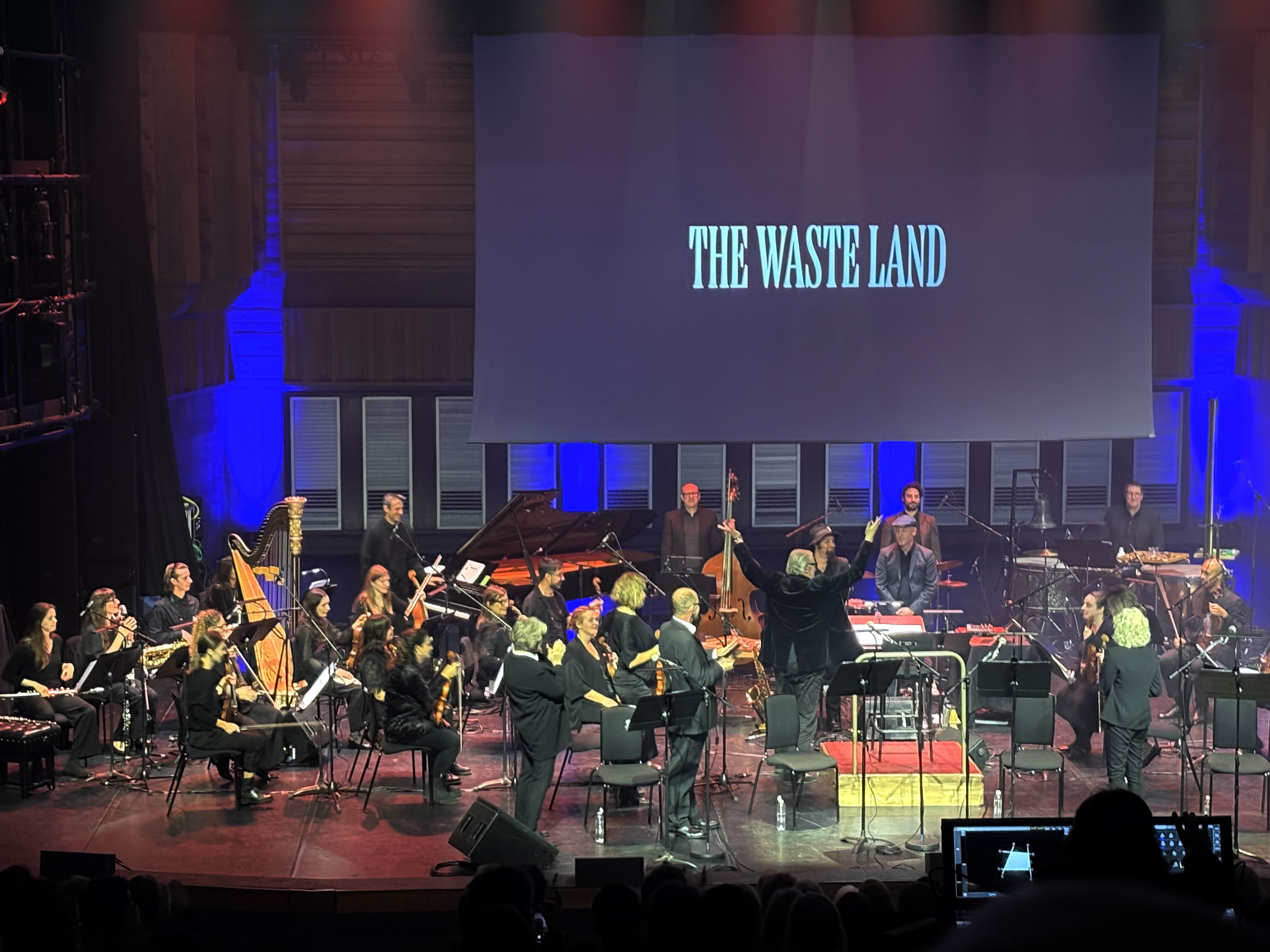
Snow fell in London yesterday morning. It seemed the right sort of day for a performance of T. S. Eliot’s The Waste Land at the Queen Elizabeth Hall. Although the poem contains all kinds of weather in all kinds of places, from the cracked earth of endless plains to thunder in the mountains and a summer shower on a Bavarian lake, taking the short walk from Waterloo station in a cold and dark London (the poet’s “Unreal City”) was like strolling straight into its heart.

Mounted as part of the EFG London Jazz Festival, the performance offered an expanded version of the treatment commissioned 10 years ago by the Beckett festival in Enniskillen from the Irish actor Adrian Dunbar. With the permission of the famously strict Eliot estate, Dunbar was able to devise an arrangement of the poem for four actors (two women and two men) plus a jazz quintet playing music by the saxophonist and composer Nick Roth.

I was 15 when an English teacher named Keith Yorke took us through The Waste Land, decoding its mysteries. I could never thank him enough. Dunbar, introducing last night’s performance, in which the quintet was augmented by a 25-piece orchestra, said he had encountered it while studying at the Guildhall School of Music and Drama 40 years ago; clearly, its impact on him was similarly profound. My previous experience of a live performance of the poem was the actress Fiona Shaw reciting it from memory beneath a single bare lightbulb on stage at the historic Wilton’s Music Hall in the East End on New Year’s Eve, 1998. In my eyes, that gave Dunbar and his crew a lot to live up to.

The readers were Anna Nygh, Orla Charlton, Frank McCusker and Stanley Townsend. Dunbar divided the lines between them, as appropriate to Eliot’s shifting cast of characters. Passages were rendered with German, Irish, American and Cockney accents. I was worried to begin that it might all seem a bit contrived, a bit stagey. That unease evaporated within a few minutes. The polyphony of the reading brought a different kind of life to an already highly polyphonic poem.

Ross’s music was used as an overture and as interludes between the five episodes. The overture, scored for the Guildhall Sessions Orchestra, evoked the European modernist classical music of the inter-war years: bold gestures, hints of dissonance. The first interlude had a ragtime flavour (“that Shakespeherian Rag… so elegant… so intelligent”). For the second, the quintet — Alex Bonney (trumpet), Roth (saxophones), Alex Hawkins (piano), Oli Hayhurst (bass) and Simon Roth (drums) — brilliantly created something that sounded like one of Charles Mingus’s bands paying homage to the pre-war Ellington small groups, or possibly vice versa. The third found the group moving towards free jazz, with Hawkins flailing the keyboard à la Cecil Taylor. The fourth exploited Bonney’s expert manipulation of electronic sound. Did that chronological progression echo something buried within the text? If certainly added a new perspective and a contemporaneity.

Nothing will ever dim the memory of Shaw’s spellbindingly majestic recitation, but Dunbar’s gamble paid off. The drama intensified until, by the time the closing lines of the fifth and final section were reached — “These fragments have I shored against my ruins / Why then Ile fit you / Hieronymo’s mad againe / Datta. Dayadhvam. Damyata. / Shantih shantih shantih” — the words and sounds had transformed the climate of a well-warmed hall and I felt a shiver run through me.
Olie Brice / JLG

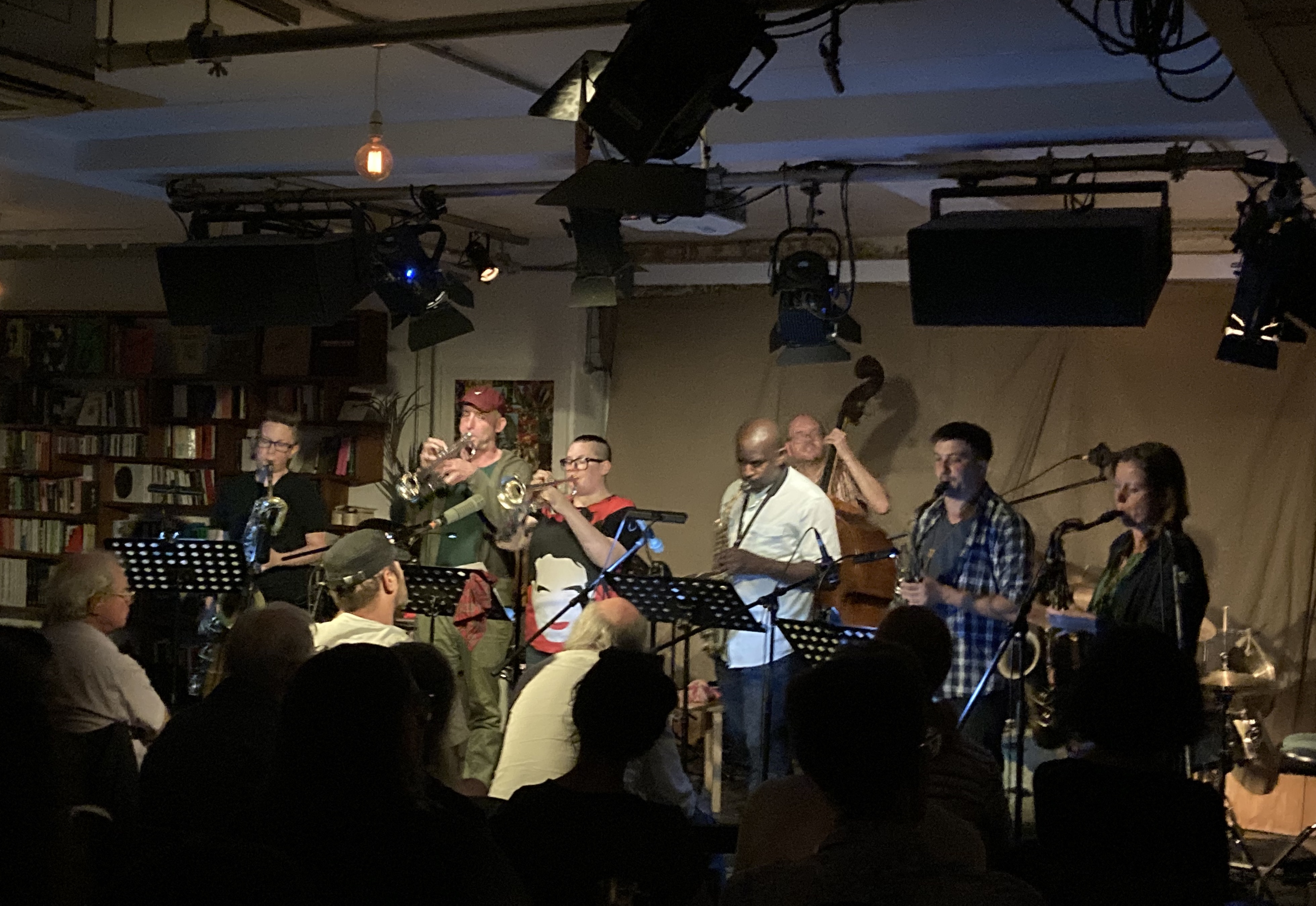
Jean-Luc Godard once compared watching the great Hungarian football team of the 1950s to listening to free jazz. A few hours after the announcement of the great director’s death, it was possible to reflect on the meaning of his comparison during a performance at the Café Oto by the trio and octet of Olie Brice, launching the bassist’s new double album, Fire Hills.

Nowadays when we use the term free jazz we tend to mean music created from scratch, on the spot, with no prepared material. Back in the early ’60s, it tended to mean the use of composition to inspire improvisers to stretch the traditional boundaries, using the material as a launch-pad rather than a template while freeing soloists and accompanists to exchange roles. All that could be heard in the music made by Brice’s groups, both of them benefitting from his ability to use his role as a composer to guide rather than prescribe.

The first half featured the trio, completed by the tenor saxophonist Tom Challenger and the drummer Will Glaser, moving with great empathy through compositions dedicated to Johnny Dyani, Eric Dolphy and Andrew Hill. Linking two of the pieces, Glaser delivered a extraordinary solo that began with mallets rolling fast around his snare drum and two tom-toms, using the three pitches to produce something that had the quality of a song, before reversing one of the mallets to introduce a kind of counter-line. Drum solos are seldom poetic, but this was.

Between the two sets, the Oto sound system quietly played selections from the soundtracks of Godard’s movies, including Georges Delerue’s gorgeous orchestral compositions for Le Mépris: a nice touch on a day when a key figure of contemporary culture left the scene.

The six horns of Brice’s octet were assembled in a single line, but it soon became apparent that he would be using them as two units: a pair of trumpets (Kim Macari and Alex Bonney) and a baritone saxophone (Cath Roberts) to the left, an alto saxophone (Jason Yarde) and two tenors (George Crowley and Rachel Musson) to the right, with the drummer Johnny Hunter joining Brice in the rhythm section.

The short ensemble passages — sometimes just punctuations between the improvisations — had the kind of loose-woven, slightly ragged ebullience that could remind you of Mingus’s bands or Charlie Haden’s Liberation Music Orchestra, without borrowing moves from either. That made sense, since Mingus and Haden also figure strongly as inspirations for Brice’s own playing, in which virtuosity and passion are equally mixed.

The first two solos, by Macari and Musson, were the kind you want to wrap up and take home: on-the-nose power from the trumpet, beautifully controlled tonal distortion from the tenor. There were many duets, notably one between the soaring Yarde and the agile Bonney. One or two of the solos outstayed their momentum, but with this music that’s a risk worth taking. And what the evening showed was that Brice has his own way of applying organisation to music, shaping it in interesting ways without compromising the crucial spontaneity of expression and interaction.

* Olie Brice’s Fire Hills is on the West Hill label: https://westhill.bandcamp.com/album/fire-hills

Doubling Downes

Vyamanikal 2

Vyamanikal + 2: Tom Challenger, Alex Bonney, Lucy Railton, Kit Downes

The profound sense of peace that descended over Hall 2 of Kings Place last night as the set by an expanded version of Vyamanikal glided towards its close was unlike anything I’ve encountered all year. The pianist Kit Downes and the tenor saxophonist Tom Challenger, normally a duo in this guise, were joined on the stage by the cellist Lucy Railton and by Alex Bonney, who sat at a laptop. Bonney was processing the music and sounds recorded by Downes and Challenger in 2015 in the small churches of five Suffolk villages, collecting the sounds of organs in various states of repair for an album released last year, and feeding it into the live performance.

In the absence of a church organ, Downes alternated between a piano and a small hand-pumped harmonium. For the better part of an hour the musicians wove tapestries of sound in which individual elements blended seamlessly. There were certainly gorgeous details, but they fade in the memory next to the overall impression of a glowing organic whole.

If there was a kind of English pastoral vibe in the air, it was implicit rather than declarative, and never suffocating. I suppose the most obvious precedent might be some of John Surman’s recordings, from Westering Home onwards, but really this music seemed to stand alone, without need for comparison. As they neared the end, the three instrumentalists stopped playing but the music continued, thanks to Bonney, in a many-layered drone which seemed to distill everything that had been played in the previous 50 minutes. And then came a few moments of silence in which we could find our own way out of the trance.

The first half of the evening had featured Tricko, the duo in which Railton and Downes perform a kind of sui generis cello-and-piano chamber music that manages to be intricate without inducing strain and immediately attractive without becoming winsome. “I’m aware that this music is cripplingly quiet,” Downes said at one point. “If I were listening, I’d probably be asleep by now.” That might indeed be the initial impression. But the longer you listen to them, the more awake you feel.

* Vyamanikal’s album is on the Slip Imprint label. Downes’s solo organ album, Obsidian, will be released by ECM early next year.