Skip to content

Posts tagged ‘Airto Moreira’

Passion / Compassion

Back in the early 1970s, Santana were my favourite live band. I saw the original line-up — more or less as heard at Woodstock — at the Albert Hall in 1970 and twice the following year, at Hammersmith Odeon and the Olympia in Paris. They were thrilling, and surrounded by a sense of excitement; before the show in Paris, I remember Mick Jagger and Bianca Pérez-Mora Macias sweeping through the backstage bar, a week ahead of their wedding.

Then the music changed, and they became even better. Carlos Santana and Michael Shrieve had been listening to John Coltrane and Elvin Jones and to Miles Davis’s Sketches of Spain and Bitches Brew. Santana’s fourth album, Caravanserai, brimmed over with the effect of those influences, starting with an unaccompanied solo by the saxophonist Hadley Caliman and culminating in the ecstatic nine-minute “Every Step of the Way”, a Shrieve composition. Clive Davis, the president of their record company, called it “career suicide”. At the Wembley Empire Pool in November 1972, just after the album’s release, an expanded line-up rose to a different level, musically and spiritually.

After Wembley they went off to play some concerts in Europe before returning towards the end of the month for dates in Manchester, Newcastle and Bournemouth. On Thursday, November 23 they had a day off in London, and, being American, arranged a small Thanksgiving Day dinner in the private room of a restaurant on Davies Street in Mayfair. I’d raved about Caravanserai in the Melody Maker, so they were kind enough to invite me to join them for what turned out to be a very pleasant evening.

While they were in London I interviewed Shrieve, who talked eloquently and passionately about the changes they’d made in the music, and about the jazz influences inspiring them. He spoke of his admiration for Elvin, Roy Haynes, Philly Joe Jones and Tony Williams and of studying their playing with his friend Lennie White, who had just joined Chick Corea’s Return to Forever. And he said something that struck me when I read the piece again the other day: “What’s so beautiful about the band, apart from the popularity which we know we’re fortunate to have and which we’re grateful for, is that right now it’s the perfect situation to be open. Specially at our age, because we realise that there’s still a lot of time.” Fifty years later, it’s clear the time hasn’t been wasted.

I loved Shrieve’s playing from the start, the way he meshed perfectly with the percussionists José “Chepito” Areas, Mike Carabello, Armando Peraza, Coke Escovedo and James Mingo Lewis. Since then I’ve followed his career mostly from a distance, although we reconnected when I was at Island Records in the mid-70s and he and Steve Winwood were part of Stomu Yamash’ta’s Go project, and then when the label signed Automatic Man, a rock band he was in with the singer/keyboards player Bayeté (Todd Cochran) and the guitarist Pat Thrall, and whose 1976 single “My Pearl” sounds today like a presentiment of Prince. Of his solo albums, I’ve always loved Stiletto, released in 1989 on RCA’s Novus imprint, in which he and a band including the trumpeter Mark Isham and the guitarists David Torn and Andy Summers created a very fine version of Gil Evans’s “Las Vegas Tango”.

If you have a copy of Lotus, the live triple album recorded in Osaka during the Caravanserai tour, you’ll know the 10-minute drum solo called “Kyoto” that shows what a superlative drummer he had already become, at the age of 23. It has none of the bombast of his rock contemporaries and much of the fluency of his jazz heroes. It’s music.

His new album, recorded over a period of years, is called Drums of Compassion — a reference to the hugely popular album titled Drums of Passion recorded in 1959 by the great Nigerian drummer Michael Babatunde Olatunji, who died at his home in Northern California 2003, aged 75, but whose voice is the one you hear first and again from time to time on an album that has been long in the making. Shrieve says that the title is also an acknowledgement of the Dalai Lama’s call for a Time of Compassion.

Of course, percussion instruments play an important role in this music. But the whole thing, although its 39 minutes are sub-divided into nine pieces, some with different composers, is like a lush, constantly shifting sound painting in which other instruments — guitar, saxophone, oud, electronic keyboards — emerge with utterances that seem less like solos than simply part of the fabric.

Shrieve can put together a multi-faceted track (“The Call of Michael Olantunji”) including himself, Jack DeJohnette, Airto Moreira and Zakir Hussain on various percussion instruments without making it sound for a second like an old-fashioned drum battle or a display of egos and techniques, even when Shrieve’s orchestral tom-toms come to the fore. The percussionists’ work is blended into the overall picture, here creating an armature for Olantunji’s voice and Trey Gunn’s guitar.

Shrieve can make the space for one performer alone on the eponymous “The Euphoric Pandeiro of Airto Moreira” (chanting and Brazilian percussion) and “Zakir Hussain” (tablas). He shares another track, the sultry, drifting “Oracle”, in a duet with another Brazilian, the electronic musician Amon Tobin. The ambience swirls and drifts without relaxing its subtle grip.

A steamy tone poem titled “On the Path to the Healing Waters” features the tenor saxophone of Skerik (Eric Walton), a Seattle-based musician who has played with Wayne Horvitz and Charlie Hunter, and who here plays a Wayne Shorter-ish less-is-more role. And I’m particularly happy to lose myself inside “The Breath of Human Kindness”, five minutes of one-chord jam in which the oud of Tarik Banzi makes its single eloquent appearance, a voice from ancient Al-Andalus amid the glistening keyboards of Pete Lockett and Michael Stegner, paced by Farko Dosumov’s stealthy bass guitar riff.

There’s a rare combination of majesty and humility at work in this music, something that speaks of the deep and lasting impact of Coltrane’s influence on Shrieve’s instincts and decisions. More than half a century after Caravanserai, this is an album for listeners who followed Shrieve and Santana on that journey into a wider world, one where frontiers and prejudices dissolve.

* Michael Shrieve’s Drums of Compassion is out now on the 7D Media label and available via Bandcamp: https://michaelshrieve7d.bandcamp.com/album/drums-of-compassion
On August 29, 1970

IoW Miles 2

Saturday at the 1970 Isle of Wight Festival started at lunchtime with a two-hour solo set by John Sebastian during which, after delivering “Daydream”, “Nashville Cats”, “You’re a Big Boy Now” and others, he was unexpectedly joined by his former Lovin’ Spoonful colleague Zal Yanovsky, who had sent a note up to the stage asking to be invited to join in. Together they ran through some more of the Spoonful’s hits, including “Do You Believe in Magic” and the gorgeous “Darling Be Home Soon”. Sebastian finished off with “Younger Girl” and “Red-Eye Express”, leaving the crowd feeling beatific at the start of a day of unbroken sunshine.

An hour and half later came a different kind of singer-songwriter: Joni Mitchell, three albums into her career, already known for “Chelsea Morning”, “Both Sides, Now”, “Woodstock” and “Big Yellow Taxi”, wearing a long dress the colour of goldenrod, a few shades darker than her hair, and a discreet assortment of silver and turquoise jewellery. And she was about to face an ordeal that no one present would forget.

She came on with her guitar and began with “That Song About the Midway”. “Chelsea Morning” was next, but as she started the third verse she appeared to lose her way. After strumming on for a few more bars, she announced: “I don’t feel like singing that song so much.” She gave a little laugh and got a round of sympathetic applause, but already the strain of being alone on the stage in front of more than half a million people, delivering such intimate music, was beginning to tell, and her unease seemed to communicate itself to the crowd.

It’s hard to get that many people to be completely silent on a sunny afternoon. Her next little speech expressed annoyance. “When I hear someone saying, ‘Joni, smile for Amsterdam!’ it really puts me off and I get uptight and I forget the words and I get really nervous and it’s a drag. Just give me a little help, will you?” And then just as announced that she was going to play “Woodstock”, a disturbance in front of the stage led her to stand up and move away as a stoned boy was removed from the crowd.

She sat back down and started again. As she finished the song, a bearded man in a dark T-shirt who had been crouching behind the piano rose to his feet and asked if he could use her microphone. He wanted to make an announcement to the people in the encampment on the hill beyond the perimeter fence. Elliot Roberts, Mitchell’s manager, led a group of half a dozen people who quickly surrounded him and moved him away from the singer.

All the tensions of the weekend were coming to the surface. Some of the people in the crowd had chanted “Let him speak!” Was a rock festival a commercial enterprise or a free-for-all? Were the anarchists and situationists and freaks right to try and tear down the fences? Rikki Farr, the organisers’ spokesman, sensibly ordered the uniformed security guards to leave the stage. But how, in 1970, were you supposed to deal with a moment like that? For a minute, even in that brilliant Saturday sunshine, the atmosphere was closer to Altamont than Woodstock.

Shaken but determined to continue, Mitchell tried to resume her performance. Behind her back, the bearded man was finally being dragged away, and the crowd didn’t like the way it was done. So she stopped and made another speech, an angry and distressed plea for the chance to do her work: “Last Sunday I went to a Hopi ceremonial dance in the desert and there were a lot of people there and there were tourists who were getting into it like Indians and Indians who were getting into it like tourists, and I think that you’re acting like tourists, man. Give us some respect!”

It was brave, and it worked. She was able to complete her performance in relative peace, the crowd now more attentive and the atmosphere lightened appreciably by “Big Yellow Taxi”. Having been led away by Roberts at the end of the set, the sound of cheering brought her back for encores that washed away the memory of the earlier interruptions.

And that was just the start of an extraordinary sequence. Here’s what I wrote in the Melody Maker about the next performer: “Mr Herbert Khaury, alias Tiny Tim, alias Larry Love the Singing Canary, bounded on stage to sing ‘a few tunes from the early part of the century.’ Blowing kisses to the audience and strumming his ukelele, he seemed unlikely to retain the audience’s interest for long. But his rock and roll medley, with some of the most untogether playing ever heard (‘This is my wonderful English band… my wonderful English band’) was very amusing. The master stroke was his final medley of ‘There’ll Always Be an England’ and ‘Land of Hope and Glory’, which somehow got the audience on its feet to sing these ridiculously patriotic songs.”

Tiny Tim’s bizarre bonhomie had removed the last trace of bad vibes. While the road crew rearranged the stage, Jeff Dexter, the festival’s DJ, made two crowd-pleasing choices: Otis Redding’s “Respect” and Free’s “All Right Now”, during which a multicoloured hot-air balloon floated above the crowd, its two occupants exchanging peace signs with the mass of humanity below.

Now it was late afternoon, and into the last rays of the sun slid Miles Davis, a 44-year-old jazz trumpeter who had served his apprenticeship almost a quarter of a century earlier with Charlie Parker and now faced the challenge of captivating 600,000 hippies. He took the stage in a thin red leather jacket over an orange knitted top, with studded blue jeans and silver boots. His sidemen — the saxophonist Gary Bartz, Chick Corea and Keith Jarrett on electric keyboards, Dave Holland on bass guitar, Jack DeJohnette on drums and Airto Moreira on percussion — had come as they were.

In August 1970 Miles was moving from a freer version of the complex music his quintet played in the second half of the ’60s to a direct engagement with funk. He’d already played to young audiences at the Fillmores in San Francisco and New York, on bills with the Grateful Dead and the Steve Miller Band. But the ties to the earlier music were not yet cut. The rhythm section he brought to the Isle of Wight ensured that however groove-centred the music became, it retained its freedom and complexity.

An unbroken set alluded to five compositions from the previous couple of years — “Directions”, “Bitches Brew”, “It’s About that Time”, “Sanctuary” and “Spanish Key” — before finishing with a fragment of his usual fanfare. Shrewdly, he played for barely 35 minutes: enough to intrigue and even beguile the hippies who didn’t know his music, not enough to try their patience.

The opening salvo took no prisoners. Miles wanted the music to burn, and he was concentrating hard as he led the way with fierce stabs and insolent runs on his lacquered instrument. The stage was bracketed by Jarrett, on an RMI keyboard that gave him the sounds of an electric piano and an organ, and Corea, who had what looks like a ring modulator on the top of his Hohner instrument and used it to make bleeps and squiggles of sound. Holland brought a jazz musician’s inventiveness to the funk bass lines, which was not what Miles would ultimately want, but there was a passage when he and DeJohnette meshed into a kind of broken second-line rhythm that lifted the music right up. Bartz flighted his brief soprano and alto solos with a keening sound and a striking trajectory, while Airto added the exotic noises of the shaker, the pandeira, the agôgo, and the cuica, a Brazilian friction drum with a distinctive whooping sound.

Miles prowled the stage, never far from the action. A quarter of an hour in, midway through “It’s About that Time”, virtually unrecognisable from its treatment on In a Silent Way a year earlier, the music took off. As it seethed and roiled, Miles returned to centre-stage and played two short, quiet phrases that redirected everything. Then he sketched the exposed theme of “Sanctuary” before cueing up the riff of “Spanish Key”.

He let the band get on with it for five minutes before raising his horn and lowering it back to the microphone, the signal for the funk to back off and textures to be laid over the simmering pulse behind his exquisite open-horn phrases, some of the them hinting at old Moorish influence. As he returned to the staccato jabs, the rhythm section, which had been simmering quietly, rose up again in response, coming back to the boil.

And suddenly the time was up. The music shuddered towards a halt. While the rhythm section wound down, Miles bent down to pick up his silver mute, waved his trumpet once to the crowd, grabbed his shoulder bag and his jacket, and was gone, into the dusk, leaving us to talk about the extraordinary nature of what we’d heard, and what it meant to hear it in the context of a giant rock festival. When they asked him the names of the pieces he’d played, he said, “Call it anything.”

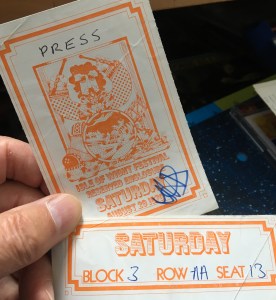
IoW tickets

* The full sets by Joni Mitchell and Miles Davis are on YouTube, filmed by Murray Lerner for his documentary on the festival. Miles’s set can also be found on the album Bitches Brew Live, released in 2011 by Columbia Legacy, and on Electric Miles: A Different Kind of Blue, an Eagle Rock DVD from 2004.