Skip to content

Huntsville in Dalston

HuntsvilleThe Cafe Oto wasn’t exactly thronged for the return of Huntsville to Dalston last night, but the audience was highly attentive and rewarded the Norwegian trio with warm and sustained applause at the end of their unbroken 75-minute set. Those of us who had missed their previous visit to London in their present incarnation, when they played the nearby Vortex in 2009, and knew their music only from records, couldn’t help but be impressed by the sense of interplay developed by these three improvisers over the course of their years together, and by their command of the music’s overall shape and its intimate textures.

Ivar Grydeland plays guitar and laptop, Tonny Kluften plays bass guitar and Ingar Zach plays percussion — including, as the publicity puts it, “sruti box, tabla machine and drone commander”, as well as several of the basic elements of a conventional drum kit. Stig Ringen, their sound engineer, acts as a fourth member of the group.

If the process of Huntsville’s music is a little bit like that of the Necks, in that both groups tend to use the slow modification of regular pulses and repeated figurations as the basis of extended collective improvisations, the sound they make is very different. Grydeland’s Jazzmaster is not just plucked and strummed but struck with a small mallet, modified with various devices and otherwise manipulated to produce a dramatic variety of metallic clanging and whining sounds (when he lets single notes hang in the air or bends an arpeggio out of shape, the effect is like that a Japanese koto). Kluften makes considerable use foot pedals to adjust the tone and volume of his nimble lines. Zach spends a lot of time occupying himself with arcane devices — one of them attached to an iPad — whose effects are often difficult to disentangle from the overall mass of the sound to which he is contributing, but there were two lengthy passages last night in which he used wire brushes on his snare drum to produce an up-tempo shuffle rhythm of phenomenal momentum.

Their first two albums, For the Middle Class (2006) and Echo, Arches & Eras (2008, featuring the singer Sidsel Endresen on one tune and Wilco’s Nels Cline and Glenn Kotche on a long improvisation recorded at the Kongsberg Jazz Festival), were released by Rune Grammofon. A couple of years ago they moved to the Hubro label, which shares an office in Oslo with Rune Grammofon, and for whom they made their debut with For Flowers, Cars and Merry Wars (2011), which also featured the voice of Hanne Hukkelberg. Their fourth album, released a couple of weeks ago, is just the three of them. Called Past Increasing Future Receding, it was recorded in Oslo in a dimly lit barrel-vaulted studio (formerly an artist’s mausoleum) with a 20-second reverberation. There are three tracks: the opener, “Presence in Absence”, contains one or two violent shocks for the unwary listener who might be lulled by its apparent quietness into turning up the volume control; “The Flow of Sand” explores their fondness for playing over tamboura-like drones; and “In an Hourglass” is glowingly contemplative, featuring that koto effect from Grydeland.

Here’s a two-minute clip that gives some idea of the making of the album and a tiny glimpse into what they’re about (there are more extended examples to be found on their website: http://www.huntsville.no). I left Cafe Oto feeling my time had been well spent; it’s always a pleasure to be with musicians whose imagination, spirit of inquiry and disdain for generic boundaries ensure that the future will be as exciting as the past.
Dionne Warwick: the lost years…

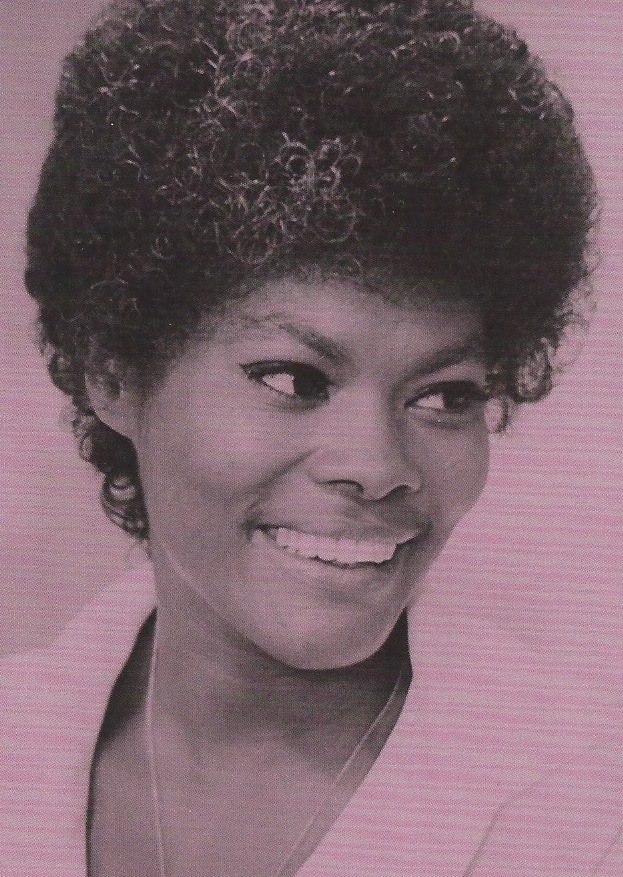
Dionne WarwickThere are days, even now, when only the sound of Dionne Warwick will do. How strange, then, that between 1972 and 1978, when she was in her prime and had the strength of a major record company behind her for the first time, she couldn’t buy a hit.

Try to put yourself in her shoes on the day in 1977 when she sat in the control room of A&R Studios in New York City with her new producers, Steve Barri and Michael Omartian, listening to this final mix. There would have been just a single thought in your head: whatever it is that makes a hit, this one’s got it.

Dionne had already been with Warner Bros for five years, after leaving the independent Scepter Records, where she had spent a decade and enjoyed that astonishing string of hits with Burt Bacharach and Hal David, to sign a $3m contract with a major label in the clear and reasonable expectation of further and even greater success. But her move coincided with the acrimonious sundering of the Bacharach/David partnership, which gave her new label a very nasty shock. The trio made one more album together — Just By Myself, released in 1973 — before a row between the two songwriters resulted in a prolonged series of lawsuits all round.

The hasty search to find new collaborators saw her shuffled, over the next six years, between Holland-Dozier-Holland, Nickolas Ashford and Valerie Simpson, Jerry Ragovoy, Thom Bell, Randy Edelman and Joe Porter. Amazingly, none of them could come up with the hit for which she was so anxiously waiting in order to prove that her early success had not been completely dependent on her original Svengalis. The sessions with the Barri-Omartian team represented the last throw of the dice.

“Do You Believe in Love at First Sight” — which you’ll have heard if you clicked on the first link — is included in a compilation called The Complete Warner Bros Singles, which came out earlier this year on the Real Gone Music label, a Warner/Rhino offshoot. It astonishes me now, as it did then, that it failed to give her another  hit. Curiously, the song — written by Frank McDonald, Chris Rae, Ron Roker and Gerry Shury — had been Britain’s entry in the previous year’s Eurovision Song Contest, when Polly Brown, late of Pickettywitch, brought it home in 10th place.

Polly Brown was a pretty good pop singer, but she wasn’t Dionne Warwick. This version of “Do You Believe in Love at First Sight” is irresistible: three minutes of pop perfection. If it lacks the emotional depth and musical inventiveness of a great Bacharach/David song, it is nevertheless beautifully constructed and performed, full of good things like a great hook, a bubbling bass line, an exultant lead vocal.

The earlier sessions with Jerry Ragovoy produced a track that is among my all-time Dionne favourites: in my view, her exquisitely sultry version of “I Can’t Wait to See My Baby’s Face” shades earlier treatments of this fine song by Baby Washington, Pat Thomas, Aretha Franklin, Dusty Springfield and even Dee Dee Warwick, Dionne’s sister — all of them terrific in their own right, with Dee Dee’s being the closest contender.

Dionne’s album with Thom Bell, Track of the Cat, contained some piercingly lovely songs, such as “His House and Me”, “Ronnie Lee”, “Love Me One More Time” and “Once You Hit the Road”, exposing the incomparable Philadelphia producer/arranger/composer’s debt to Bacharach, in particular the use of syncopation to create hooks. But Bell couldn’t repeat the formula that delivered “Then Came You”, with which he had given Warwick a No 1 in collaboration with the Spinners.

Fortunately, that wasn’t the end of the the story. After Dionne and Warner Bros parted company in 1978, a move to Arista and collaborations with Barry Manilow and Barry Gibb propelled her back into the charts. The preceding period was quietly forgotten as the Manilow-produced “I’ll Never Love This Way Again” and the Gibb-composed “Heartbreaker” lengthened the list of her greatest hits.

Now, in addition to the complete Warners singles collection, Dionne’s unhappy time with the Burbank label is commemorated by We’ve Got to Go Back, a new Real Gone Music compilation containing 19 songs that never found their way on to the release schedule. It’s aimed at completists and obsessives like me, I suppose, but the Holland-Dozier tracks “Too Far Out of Reach” and “It Hurts Me So” are fine examples of early-70s soul, and “Am I Too Late” and “I’ll Never Make It Easy (To Say Goodbye)”, supervised by Joe Porter, are gorgeous grown-up ballads. I wouldn’t want to be without them.

It was sad to read about the financial problems that drove her to declare bankruptcy earlier this year. She deserves better than that.

* The photograph of Dionne Warwick is from the sleeve of We Need to Go Back: The Unissued Warner Bros Masters and is uncredited.

Bossa nova from a different beach

AldeburghNo, you’re right, that isn’t Ipanema or Copacabana. It’s the seafront at Aldeburgh in Suffolk, in a picture taken by me this afternoon, a couple of hours before the Flipside festival of Brazilian culture began just up the road at Snape Maltings, with a concert devoted to the origins and techniques of the bossa nova.

I made the 250-mile round trip from London in order to see Paula Morelenbaum, who is not only my favourite Brazilian singer but one of my favourite singers irrespective of nationality. I discovered her by accident in 2004, when I was loitering in the CD section of a Lisbon department store, browsing the content of their listening posts. I’d never heard of Morelenbaum, but her album Berimbaum caught my ear from the opening half-dozen bars, and it’s been probably my most played disc of the past 10 years.

It’s a recital of a dozen songs written by the great Brazilian poet Vinicius de Moraes, either by himself or in collaboration with others, including Tom Jobim, Baden Powell and Carlos Lyra. What’s different about the project — apart from the obvious matter of Morelenbaum’s voice, which has all the coolness of better known Brazilian female singers, but with just a little more expression and a whole lot more musicality — is the way her producers and musicians, including Antonio Pinto (who wrote the soundtrack for Senna), Leo Gandelman, Celso Fonseca and her husband, the cellist and arranger Jacques Morelenbaum, apply modern techniques, particularly those of trip-hop, to these well known songs. It infuses them with new vibrancy, as you’ll hear if you spend just seven minutes listening to these extracts from four of the tracks.

Tonight’s concert was something different: an intimate masterclass in the work of Jobim and de Moraes, 20 compositions performed either in part or in full by Morelenbaum with the pianist-singer Jose Miguel Wisniak and the guitarist Arthur Nestrovski, who analysed them for they could tell us about why bossa nova was so different, so refreshing, when it appeared half a century ago. So “Desafinado” was deconstructed for its artful dissonances, “Garota de Ipanema” for the meaning of the contrast between its crisp main melody and its legato bridge, “Gabriela” for the way Jobim manufactured an entire melody out of a simple C-major scale, “Samba de Uma Nota So” for its minimalistic brilliance, and the ever-astonishing “Aguas de Marco” for the meaningful tension between Jobim’s almost absurdly simple diatonic melody and the undercurrent of emotion implied by a descending chromatic bass line.

Wisnik, a professor of Brazilian literature at the University of Sao Paulo, gave his explanations in Portuguese, translated by Nestrovski, who has degrees in music from York University and literature from Iowa State, is now the artistic director of the Sao Paulo State Symphony Orchestra. Sitting between them, the black-gowned Morelenbaum simply sang.

Just when it seemed that the evening might be getting a little too didactic, Wisnik played a Chopin prelude that mutated seamlessly into a full performance of “Insensatez”, revealing not just the source of Jobim’s inspiration but the power behind the perfect restraint of Morelenbaum’s delivery. “Amor em Paz”, better known to most of us as “Once I Loved”, needed no explanation and was the evening’s highlight. Or maybe that was the quick-witted medley of “Consolacao” and “Berimbau”. Anyway, it was all good, and greatly enjoyed by an audience including the guitarist Phil Manzanera, the poet Blake Morrison and the novelist Ian McEwan.

“That was the best lecture I’ve ever been to,” the photographer Eamonn McCabe said, which just about summed it up.

The Road to Jajouka

Scan 132760001The Master Musicians of Jajouka came to London’s Commonwealth Institute in September 1980 and, over the course of five nights, practically blew the place apart through the force of their sound. That was the initial shock: the sheer volume and energy produced by eight men playing rhaitas — a double-reed instrument — and five others playing side drums. It was the first chance most of us had been given to see and hear these Sufi musicians from a village in the Rif mountains, and they more than lived up to their legend. The use of circular breathing and layered rhythms was a revelation, as was their casual mode of presentation. “The musicians did not treat their work with undue reverence,” I wrote in The Times. “They shared jokes and exchanged winks with members of the audience, who were encouraged to participate in displays of come-as-you-are dancing.”

The short season was part of a tour arranged to raise funds to ensure the preservation of their ancient culture and way of life. Three decades later the struggle seems to be continuing, to judge by the appearance of a new CD, The Road to Jajouka, in which recordings of their music are blended — by way of sampling, remixing and juxtaposition — with that of various western musicians. “One hundred per cent of the net profits will go to the Jajouka Foundation,” the sleeve informs us.

The album is produced by Billy Martin, the drummer with Martin, Medeski and Wood, whose entire membership appears on the opening track, together with the guitarist Marc Ribot. Others who turn up on subsequent pieces include the alto saxophonist Ornette Coleman, drummer Mickey Hart, the bass guitarists Bill Laswell and Flea, the guitarist Lee Ranaldo, the Sirius Quartet and  the London Philharmonic Orchestra, conducted by Howard Shore, the Canadian composer who is credited as an executive producer of the album. Shore’s interest in this music probably has its origin in his collaboration with Coleman on the score for David Cronenberg’s 1991 film of William Burroughs’ The Naked Lunch, in which the Jajouka musicians were featured.

This is not the album to buy if you’re after a full-strength blast of the Boujeloud rite of the Jajouka musicians. In general, however, the mash-ups work well. I love the sound of Ribot’s squibbling guitar and the string quartet against the massed rhaitas on “Into the Rif”. Coleman’s alto improvisation against the layered rhaitas of Bachir Attar on “Jnuin” recalls the visit to Morocco that produced the track “Midnight Sunrise”, included on the album Dancing in Your Head, released in 1977, with a fragment repeated on the Naked Lunch soundtrack (if there ever was a western musician attuned to the vision of these Sufis, it’s surely Ornette).

Many of us know a great deal more about the sounds of the world than we did in 1968, when Brion Gysin took Brian Jones to Jajouka, or in 1980, when Jajouka came to London. Or, indeed, when Burroughs called them “the 4,000-year-old blues band” (we now know their music dates back a mere 1,300 years). The new CD is a reminder that increased familiarity hasn’t robbed this particular music of its power to astonish and mesmerise.

* The photograph of the Master Musicians of Jajouka is from the CD insert and was taken by Cherie Nutting. Jajoukafoundation.org is the relevant website for information and donations. There’s a fine chapter on Jajouka in Blues & Chaos, a collection of pieces by the late Robert Palmer, edited by Anthony DeCurtis and published by Scribner in 2009.

Old apple, new garden

The Serpent TailThe only time I visited Wilton’s Music Hall, in the old streets just north of Tower Bridge, was on New Year’s Eve in 1998, to hear the actress Fiona Shaw recite The Waste Land, an experience rendered all the more unforgettable by taking place close to several of the locations mentioned in Eliot’s poem (“The river sweats / Oil and tar / The barges drift / With the turning tide…”).  I wish I were able to return there tomorrow night, to see Kate and Mike Westbrook perform their new song cycle.

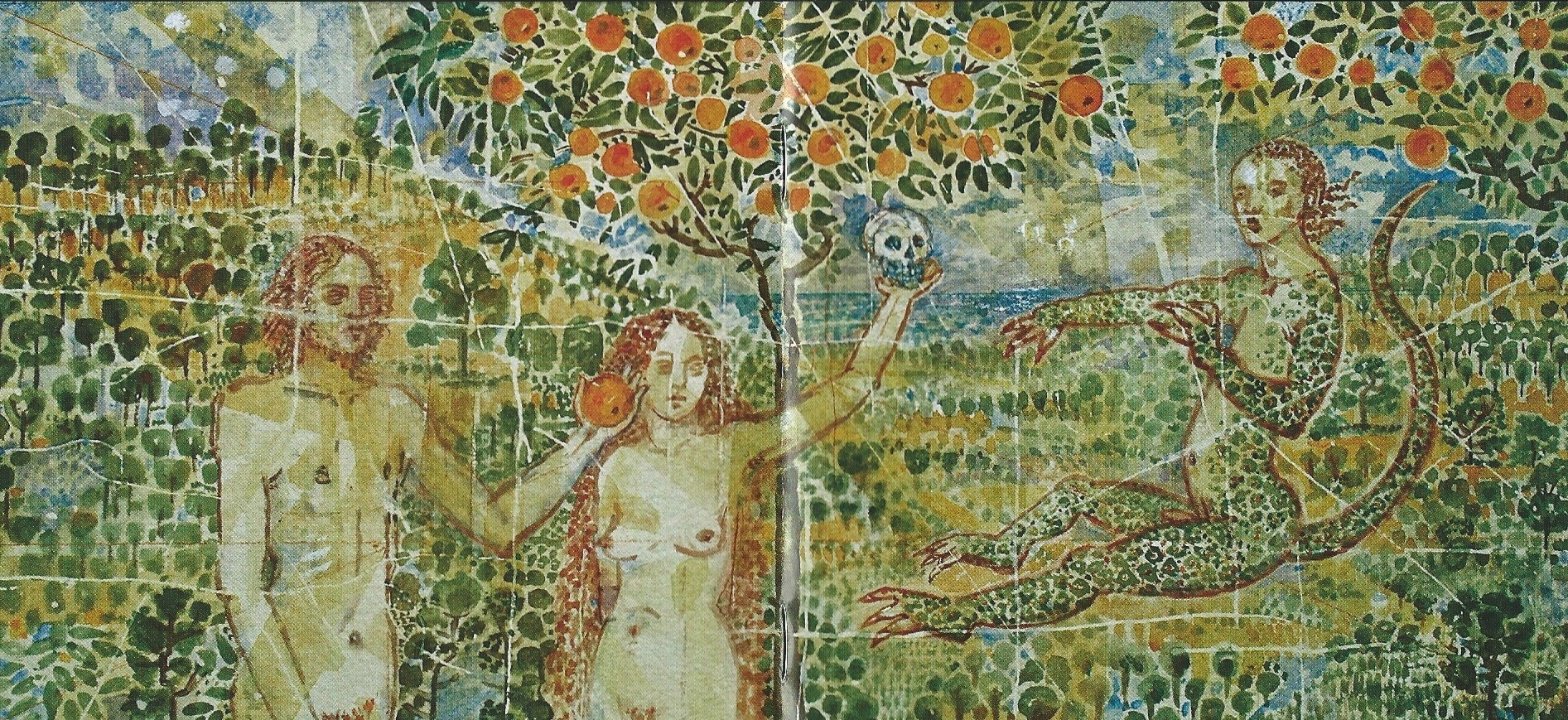
The Serpent Hit is its title, and also that of Kate Westbrook’s painting (above), the illustration on the cover of the CD, just released on the their own label. The piece deals with a big theme: mankind’s continuing fall from a state of grace, through the careless disregard of warning voices.

Five of the six individual pieces making up The Serpent Hit are written for Kate’s voice, a saxophone quartet (Andy Tweed, Chris Biscoe, Karen Street and Chris Caldwell) and a drummer (Simon Pearson); the sixth is an instrumental interlude. The music is Mike’s, and reminds us of his very personal gift for voicing: there are passages that echo his very earliest recordings, Celebration and Release, which were made with his big band in the late ’60s and still sound startlingly fresh. He writes beautifully for the saxophones, and in turn the soloists — notably Biscoe on alto and Caldwell on baritone — rise to the occasion, driven by the tireless Pearson. The effect of the ensemble is somewhere between the Ellington reed section and a Southern European marching band, but dominated by that pungent Westbrook flavour.

No less striking are Kate’s lyrics, spoken and sung in a theatrical style that has its roots in Lotte Lenya’s work with Brecht and Weill. It is an approach built for music of protest, and those three would have appreciated this harsh and bitter tirade against those who would rob the world of its innocence, its fruit and its future.

So, perhaps, would Eliot. And I can imagine Wilton’s — said to be the world’s oldest surviving music hall, with origins as an alehouse going back to the early 18th century — providing the perfect ambiance.

Making the wiseguys dance

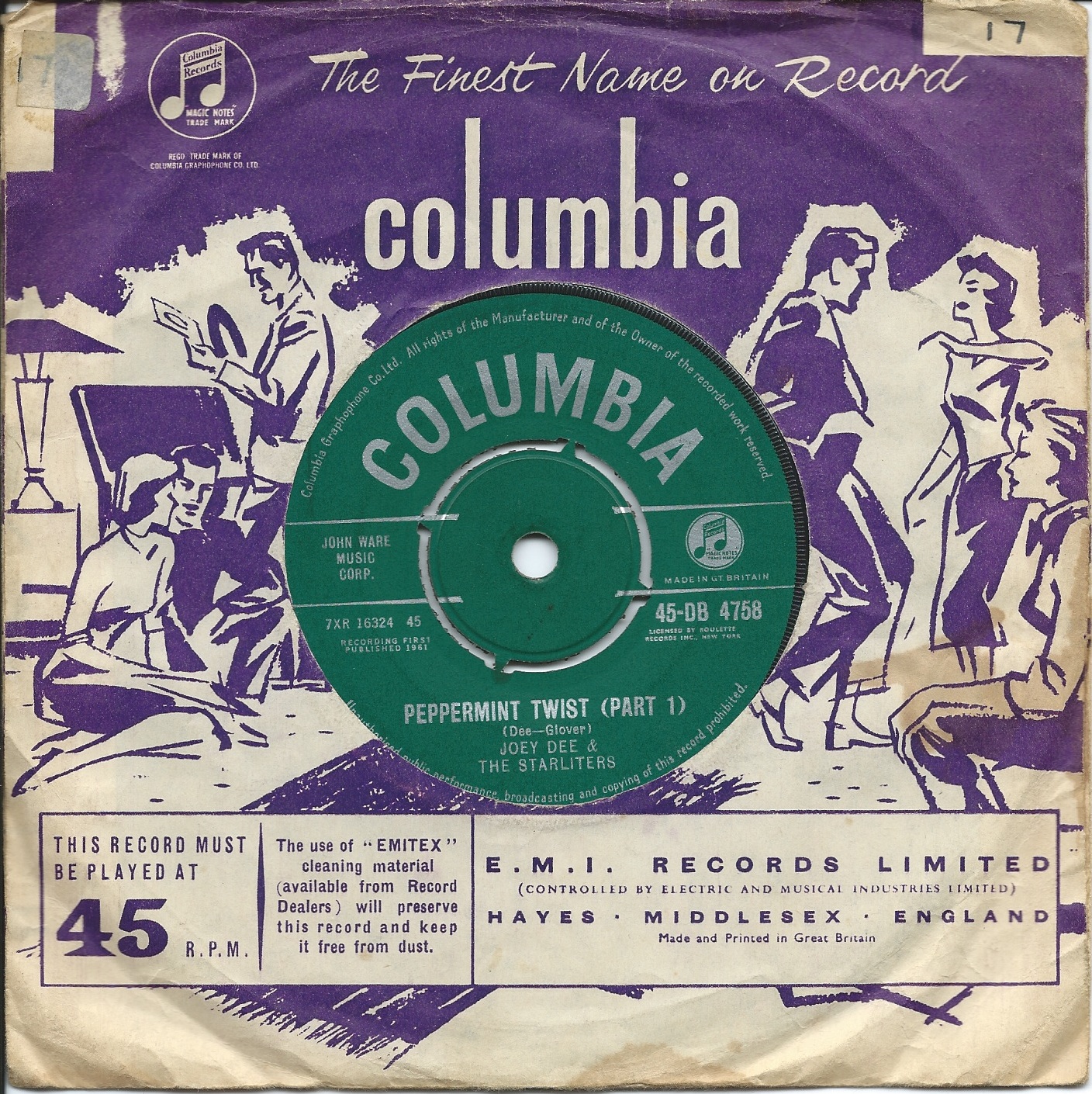
Peppermint TwistWas Ringo Starr genuinely lucky not to get whacked by a Mafia hitman named Romeo “Scarface” Martin when the Beatles visited the Miami branch of the Peppermint Lounge in 1964? That’s what John Johnson Jr and Joel Selvin, the authors of Peppermint Twist, would like you to believe.  Their new book, which tells the story behind the club where the Twist first became a sensation, comes complete with a colourful endorsement from Ronnie Spector, who danced there before she became a Ronette: “The Sopranos meets American Bandstand!”

That’s not an entirely misleading summary. In the end Romeo Martin, despite being infuriated by his girlfriend’s crush on Ringo, didn’t try to whack the mop-topped drummer. But plenty of others meet an unpleasant end in the course of the story, not least Johnny Biello, a caporegime with the Genovese crime family. Biello was the undeclared owner of the Peppermint Lounges in New York and Miami and the father-in-law of Dick Cami, who managed the two clubs during their heyday, before they were sold in the mid-60s. It is Cami (born Camillucci) whose testimony provides the authors with the bulk of their material. He, of course, never whacked anyone, although he considered it once or twice.

A couple of years ago I had some fun marking the 50th anniversary of the Twist’s rise to prominence by writing this feature for the Guardian‘s Weekend magazine. I can remember back in 1962 going to see the exploitation film Hey, Let’s Twist, which featured Joey Dee and the Starliters performing the hit that made the 45th Street club famous — or, rather, even more famous, since it had already acquired gossip-column notoriety for attracting an A-list clientele including Marilyn Monroe, Truman Capote, Greta Garbo and Norman Mailer to a joint that could accommodate fewer than 200 people and had formerly doubled as a leather bar and Mob meeting place. The book’s authors add as much detail as they can unearth to a rather slender story, fleshing it out with a lot of true-crime material gleaned from Cami.

Interesting musical figures flit in and out, including Hank Ballard, the first man to record “The Twist”; Chubby Checker, who had the hits; the great guitarist Lonnie Mack, who backed the singer Troy Seals at the Miami club; Atlantic Records founder Ahmet Ertegun, unsuccessfully trying to replace the fading Twist with a Ska craze in 1964; and Nat King Cole — who, according to the authors, spent a week sitting in on keyboards with the Peppermint Lounge house band in Florida in order to learn how to play rock and roll.  But they are seriously outnumbered by the wiseguys.

* Peppermint Twist is published in the US by Thomas Dunne Books/St Martin’s Press. The title of this piece is adapted from Making the Wiseguys Weep, David Evanier’s excellent biography of the New Jersey-born singer Jimmy Roselli (1925-2011), a perennial favourite with mobsters. The copy of “Peppermint Twist Pts 1 and 2” is from the author’s collection.

In Flanders fields the jazzmen blow

Stan Tracey 2

In Flanders fields the poppies blow / Between the crosses, row on row, / That mark our place; and in the sky / The larks, still bravely singing, fly / Scarce heard amid the guns below…

Those lines, the opening of the much loved poem written in 1915 by John McCrae, a Canadian soldier and physician who had fought in the Second Battle of Ypres, came to mind while I was listening to The Flying Pig, Stan Tracey’s new album. Those who know about such things will recognise Tracey’s chosen title as an allusion to a particular type of gun used by British forces during the Great War. Indeed the titles of all the six original compositions on the CD, played by the pianist’s current quintet, make such references, either to wartime weapons or places or soldiers’ sayings. The inspiration is the experience of Stan’s father, who served in the East Kent Regiment and, still only 18, was wounded on a Flanders battlefield in the year McCrae wrote the poem (he survived capture and imprisonment by the enemy and died in 1957, aged 60).

For those uncertain about the most suitable way to acknowledge next year’s centenary of the start of the war to end all wars, and perhaps ambivalent about the British government’s apparent determination to turn the event into a great patriotic celebration, here’s a solution: buy a poppy, by all means, but also spend some time listening to The Flying Pig.

There is nothing programmatic, overtly descriptive or propagandist about the music. This is not a jazz version of Joan Littlewood’s Oh! What a Lovely War, but simply a very fine contemporary version of the sort of post-bop jazz associated with the Jazz Messengers and the Horace Silver Quintet in the late 1950s and early 1960s. There are no pretensions, no extraneous flourishes: just music of real substance, played by Tracey with his son Clark on drums, Andy Cleyndert on bass, Mark Armstrong on trumpet and flugelhorn and Simon Allen on saxophones.

Given that the two Traceys and Cleyndert have formed a regular trio for several years, it’s not unexpected to find that the rhythm section runs on well lubricated ball-bearings. The surprise for me is Armstrong, whose solos evoke the best work of the young Freddie Hubbard, characterised by a gloriously burnished tone and a relaxed intensity but without Hubbard’s occasional tendency to get hung up on repeated phrases. He and Allen (whose alto saxophone solos are particularly enjoyable) combine to create the kind of lean front-line blend that is ideal for this material.

One of the pieces is called “Ballad for Loos”: a reference to the particular battlefield in northern France where Stan’s father was wounded. That’s the location of the photograph above, which shows Stan (centre) and Clark (right) with Ben Tracey, Stan’s grandson. (A couple of years ago Ben contributed the narration to an album of Stan’s inspired by and titled after Dylan Thomas’s A Child’s Christmas in Wales.)

In an interview with Alyn Shipton in the latest issue of Jazzwise, Stan says that nowadays he prefers working with the trio or his quartet; those line-ups, he says, offer him more space to play. But no sense of restraint or restriction afflicts The Flying Pig, which is released on the pianist’s own Resteamed label and surely deserves a place among the most satisfying products of a recording career that is now in its seventh decade. At 86, Stan is three years older than Ahmad Jamal, whose longevity is held to be a thing of wonder; just listen to the long piano solos on the title track or “Silent Percy”, as full of character, wisdom and sharply focused energy as ever.

Oh, what a sound (September 1963)

September 1963For me, music changed exactly 50 years ago this month. It was in September 1963 that, as a 16-year-old schooolboy, I first heard all the 45s you can see in the photograph above. They are, clockwise from top left: “You’re No Good” by Betty Everett,”The Monkey Time” by Major Lance, “Heat Wave” by Martha and the Vandellas, “Anyone Who Had a Heart” by Dionne Warwick, “Can I Get a Witness” by Marvin Gaye,”It’s All Right” by the Impressions, “You Lost the Sweetest Boy” by Mary Wells, and “Hello Stranger” by Barbara Lewis.

When you’re 16, everything seems important. But these records really were. All of them were brand new; together they rearranged the possibilities inherent in a fusion of R&B, gospel and pop. Beamed in from Detroit, Chicago and New York, they announced the birth of soul music.

“Heat Wave” was the first, and it remains the closest to my heart. I can remember the feeling of being transfixed as those guitar and piano chords and that driving snare-drum came out of the radio. But each of them was a lesson of its own.

As you can see, I preserved the original copies, each in its proper seven-inch bag. They’re the ones I bought back then — with a single exception. One summer night in 1967, during a party at my parents’ house on the day my sister got married, someone stole my complete run of Martha and the Vandellas’ Stateside 45s, half a dozen of them, from “Heat Wave” to “Wild One”. Nothing else; just those. A thief with impeccable taste, obviously.

Jackie Lomax: more than a footnote

Jackie LomaxJackie Lomax died on Monday, while visiting England from Southern California for the wedding of one of his daughters. He was 69, and my obituary for the Guardian is here. I suppose he’ll go down as a footnote in Beatle history, having made a handful of singles and an album for Apple; it’s a pity none of the solo records he made during a long career ever captured the public’s imagination.

I met him a few times at the end of the ’60s and the start of the ’70s, when the Apple relationship had just finished and he was involved with a band called Heavy Jelly, who had their origin in a hippie hoax.

It was in the autumn of 1968 that John Leaver, one of Tony Elliott’s early colleagues on the fledgling Time Out, published a favourable review of a wholly fictitious group, with the notion of seeing whether the freaks among the readership could be induced to flock to the record shops just on the basis of a magazine piece. He called the group Heavy Jelly — “originally an eight-piece soul band, now operating as an acid-rock quartet” — and accompanied his words with a specially taken Keith Morris photograph of the guitarist John Morsehead, formerly of the Pirates and Shotgun Express and then of Aynsley Dunbar’s Retaliation, accompanied by three anonymous long-haired mates (“a dope dealer, an antique dealer and a colour attacher,” according to Morris).

The spoof worked, to the extent that a buzz started and a group was hastily formed around Moreshead. They recorded a single, amusingly called “Time Out” and released in the spring of 1969 on Head Records, run by the promoter John Curd. Just to confuse matters, the Island label simultaneously took their group Skip Bifferty, rechristened them Heavy Jelly, and recorded a track that was promptly featured on one of their famous cheapo sampler albums. By this time, however, Curd owned the rights to the name and persuaded Island to desist. Meanwhile a couple of Island artists, Traffic’s Chris Wood and Jim Capaldi, briefly joined Moreshead in the “real” Heavy Jelly, only to make a swift withdrawal in favour of an offer to rejoin Steve Winwood. Next came Lomax, freed from his commitment to Apple, who joined the line-up and brought with him a bunch of new songs, eight of which were recorded for what was intended to be their debut album.

In the fashion of the day, various luminaries were called upon to assist in the studio, not least because Heavy Jelly had already begun to be afflicted by the personnel changes that would eventually kill them off. Mike Kellie of Spooky Tooth played drums on a couple of tracks, joined on one of them by Ric Grech on bass and Peter Bardens on keyboards; Jim Price and Bobby Keys added trumpet and tenor saxophone to one song; and harmonies were added to the final track by Pete Ham and Tommy Evans of Badfinger, Lomax’s erstwhile Apple labelmates.

It was while they were in the process of making the album that they played the Country Club in Belsize Park, and a couple of days later I interviewed Jackie for the Melody Maker. The gig had been good but he was a little downbeat, just as I had found him to be on our previous encounters; the consequent piece, published under the headline “Born Under a Bad Sign?”, pondered his seeming attraction to projects dogged by bad luck.

Heavy JellyA few months later Heavy Jelly completed their album. Curd pressed up some promotional copies with white labels and sent them to people in the media. I got one, played it, wasn’t greatly impressed, and filed it away. Such were the internal upheavals — musicians coming and going, including the Grease Band’s drummer Bruce Rowland and John Mayall’s bassist Steve Thompson — that the band simply fell apart, and the album never got beyond that white-label stage.

After that rather dispiriting experience Lomax spent a couple of weeks with Denny Laine, Trevor Burton and Alan White in a band called Balls before answering a call from John Simon, the Band’s producer, to make an album for Warner Brothers in the US.

It occurs to me now that the pattern of his career resembles that of Van Morrison: early days with a British-based R&B band before a solo career in America, first in Woodstock and then in California. Jackie made some pleasant records, and it will be interesting to see how the album he completed just before his death — his first in a dozen years — turned out, but he never had a “Brown Eyed Girl”, a “Madame George”, a “Moondance” or a “Domino”. In the end, that’s usually what makes the difference.

* The photograph of Jackie Lomax is from the insert to the 2010 reissue of his Apple album, Is This What You Want? It is uncredited.

Mulatu Astatke’s Sketches of Ethiopia

Mulatu AstatkeThere’s a party scene in Paolo Sorrentino’s The Great Beauty — a film I like a great deal, although if Fellini’s La Dolce Vita, its spiritual and stylistic ancestor, is universally known by its Italian name, then so should be La Grande Bellezza — in which an elegant woman of a certain age says something like: “Everybody knows that Ethiopian jazz is the only kind worth listening to these days.”

She’s trying to be superior, but there’s something to what she says. Lots of kinds of contemporary jazz are worth listening to, of course. But when I first encountered the saxophonist Getatchew Mekurya on one of the volumes of Francis Falceto’s Ethiopiques series, it was like walking into a parallel universe, one in which Albert Ayler had been born and spent his entire life in the Horn of Africa. Like discovering jazz all over again, in a way.

Falceto’s series began its schedule of releases in 1998, became a favourite of hipsters and is now up to Vol 28. The extraordinary Mekurya — The Negus of Ethiopian Sax, to quote the title of Vol 14, which is devoted to his work — was the one who caught my ear, while others were knocked out by Mulatu Astatke, the vibraphone player and bandleader. Now Astatke has a brand-new album on the Jazz Village label, titled Sketches of Ethiopia, mostly recorded in London and featuring a basic band including names that will be familiar to followers of the contemporary British jazz scene — the trumpeter Byron Wallen, the pianist Alexander Hawkins, the bassist John Edwards and the drummer Tom Skinner — alongside others from Africa, France and elsewhere, such as the singers Tesfaye and Fatoumata Diawara, plus a chorus.

The album is very far from being a showcase for Astatke’s vibes-playing: it’s all about interlocking rhythms (he also plays congas) and shifting instrumental combinations. His best moment on his main instrument comes during a piece based on a traditional tune called “Hager Fiker” in which the vibraphone rides a sinuous conga-driven rhythm quite beautifully before giving way to two traditional instruments: first Messale Asmamow’s krarr, a five-string instrument, then Yohanes Afwork’s washint, an end-blown flute. His mallets also provide a sound-bed for  a glorious out-of-tempo introduction to an original titled “Gambella”, the metre gradually seeping in before the piece evolves into one of the irresistible funk grooves in which the album abounds. But the highlight is “Motherland Abay”, written by Astatke: eight and a half minutes of constantly changing textures, in which Wallen’s fine muted solo is shadowed by a wonderfully subtle horn arrangement.

At such a moment, as Kevin Le Gendre notes in his review of the album in the new issue of Jazzwise, what we’re hearing is music that seems to exist “right on the cusp of African and Arab culture” — but, I’d add, with a seemingly limitless horizon. It’s the music, in some respects, that I was always disappointed Weather Report didn’t quite get around to making. A terrific album.

* The photograph of Mulatu Astatke is by Alexis Maryon and is taken from the insert to Sketches of Ethiopia.