Skip to content

2024: The best bits

I like street musicians, as long as they’re not using amplification or pre-recorded assistance. Some of them live on in my head. A clarinetist in a tiny garden near Taksim Square in Istanbul in 1968. A singer and an accordionist paying tribute to Carlos Gardel outside a Rosario shopping mall in 1994. A fluently boppish alto saxophonist outside a hamburger joint in downtown Atlanta that same year. An elderly quartet in a park in Sofia 25 years ago.

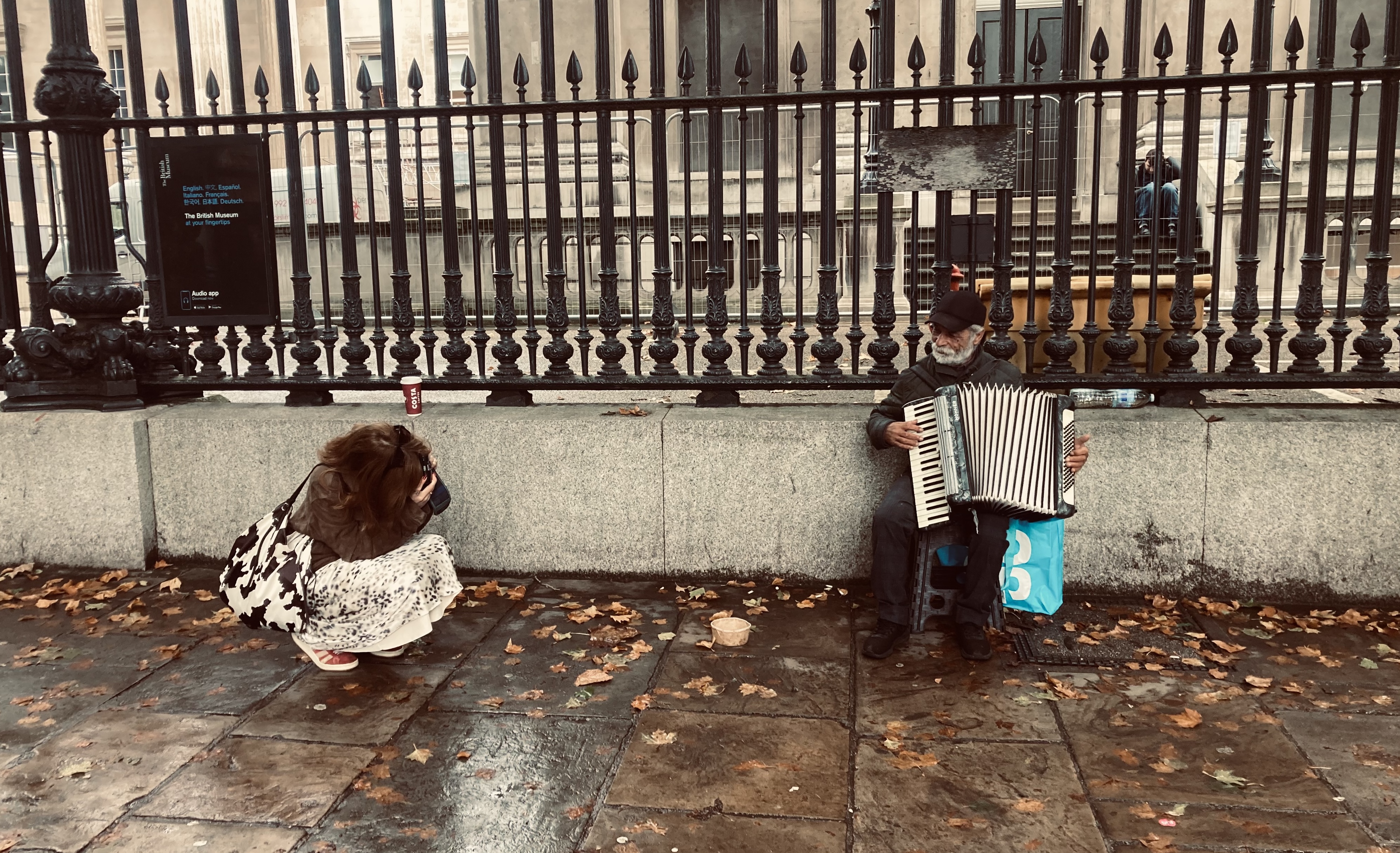
The accordionist pictured above has a regular pitch outside the British Museum in Bloomsbury. He’s from Romania. One day this autumn I heard him while on my way from a quick lunch at Caffè Tropea, the Italian restaurant inside the park in Russell Square. Probably my favourite un-fancy eating place in London, it’s been run for 40-odd years by a family with roots in Calabria. Immigrants, eh?

On this day the accordionist was playing Nino Rota’s theme from The Godfather. While I was listening, a young woman walked past, stopped, took a small camera out of her bag, and crouched down to take his photograph with a swift economy of movement that suggested she knew what she was doing. I took a single frame with my iPhone and it records one of the year’s happier moments.

NEW ALBUMS

1 Michael Shrieve: Drums of Compassion (7D Media)

2 Meshell Ndegeocello: No More Water: The Gospel of James Baldwin (Blue Note)

3 Wadada Leo Smith / Amina Claudine Myers: Central Park (Red Hook)

4 Beth Gibbons: Lives Outgrown (Domino)

5 Bill Frisell: Orchestras (Blue Note)

6 Alice Zawadski / Fred Thomas / Misha Mullova-Abbado: Za Górami (ECM)

7 Ohad Talmor: Back to the Land (Intakt)

8 Manu Chao: Viva Tu (Radio Bemba)

9 Silkroad Ensemble w/ Rhiannon Giddens: American Railroad (Nonesuch)

10 Giovanni Guidi: A New Day (ECM)

11 Pat Thomas: The Solar Model of Ibn Al-Shatir (Otoroku)

12 The Smile: Wall of Eyes (XL)

13 Mike Westbrook: Band of Bands (Westbrook Music)

14 Daniel Sommer / Arve Henriksen / Johannes Lundberg: Sounds & Sequences (April)

15 The Henrys: Secular Hymns & Border Songs (bandcamp)

16 Gillian Welch & David Rawlings: Woodland (Acony)

17 Lady Blackbird: Slang Spirituals (BMG)

18 Shabaka: Perceive Its Beauty, Acknowledge Its Grace (Impulse)

19 Johnny Blue Skies (Sturgill Simpson): Passage du Desir (High Top Mountain)

20 Kit Downes: Dr Snap (Bimhuis)

REISSUE / ARCHIVE

1 Miles Davis Quintet: Miles in France 1963 & 1964 (Sony Legacy)

2 Art Tatum: Jewels in the Treasure Box (Resonance)

3 Alice Coltrane: The Carnegie Hall Concert (Impulse)

4 Charlie Parker: Bird in Kansas City (Verve)

5 Anne Briggs: Anne Briggs (Topic)

6 Peter Hammill: Incoherence (Esoteric)

7 Bob Dylan and the Band: The 1974 Live Recordings (Sony Legacy)

8 The History of Les Cousins (Cherry Red)

9 Vanilla Fudge: Where Is My Mind? (Esoteric)

10 The Waterboys: 1985 De Luxe Edition (Chrysalis)

SUI GENERIS

Evan Parker: The Heraclitean Two-Step, etc. (False Walls)

LIVE PERFORMANCE

1 Manu Chao (Brixton Academy, September)

2 Bob Dylan (Royal Albert Hall, November)

3 Steve Lehman / Orchestre National de Jazz (Vortex, June)

4 The Necks (Cafe Oto, April)

5 Django Bates (Vortex, January)

6 Sylvie Courvoisier’s Poppy Seeds (JazzFest Berlin, November)

7 Bruce Springsteen (Wembley Stadium, July)

8 Marilyn Crispell (JazzFest Berlin, November)

9 Bill Frisell Trio (St George’s, Bristol, May)

10 Alexander Hawkins / Marco Colonna (Vortex, October)

MUSIC BOOKS

1 Joe Boyd: And the Roots of Rhythm Remain (Faber & Faber)

2 Brad Mehldau: Formation: Building a Personal Canon Vol. 1 (Equinox)

3 Neneh Cherry: A Thousand Threads (Vintage)

4 David Toop: Two-Headed Doctor: Listening for Ghosts in Dr John’s Gris-gris (Strange Attractor Press)

5 Philip Freeman: In the Brewing Luminous (Wolke)

FICTION

Samantha Harvey: Orbital (Vintage)

AUTOBIOGRAPHY

Al Pacino: Sonny Boy (Century)

NON-FICTION

Ekow Eshun: The Strangers (Faber & Faber)

FILMS

1 La Chimera (dir. Alice Rohrwacher)

2 About Dry Grasses (dir. Nuri Bilge Ceylan)

3 Conclave (dir. Edward Berger)

DOCUMENTARIES

1 Dahomey (dir. Mati Diop)

2 Soundtrack to a Coup d’Etat (dir. Johan Grimonprez)

3 Road Diary: Bruce Springsteen & the E Street Band (dir. Thom Zimny)

RADIO

Composer of the Week: Bud Powell (BBC Radio 3/BBC Sounds)

PODCAST

Kate Lamble’s Grenfell: Building a Disaster (BBC Sounds)

THEATRE

Carwyn by Owen Thomas (London Welsh RFC, October)

EXHIBITIONS

1 Pauline Boty (Gazelli Art House)

2 Yoko Ono: Music of the Mind (Tate Modern)

3 John Singer Sargent: Sargent & Fashion (Tate Britain)

4 Gerhard Richter (Neue Nationalgalerie, Berlin)

5 Beyond the Bassline (British Library)

Evan Parker at 80

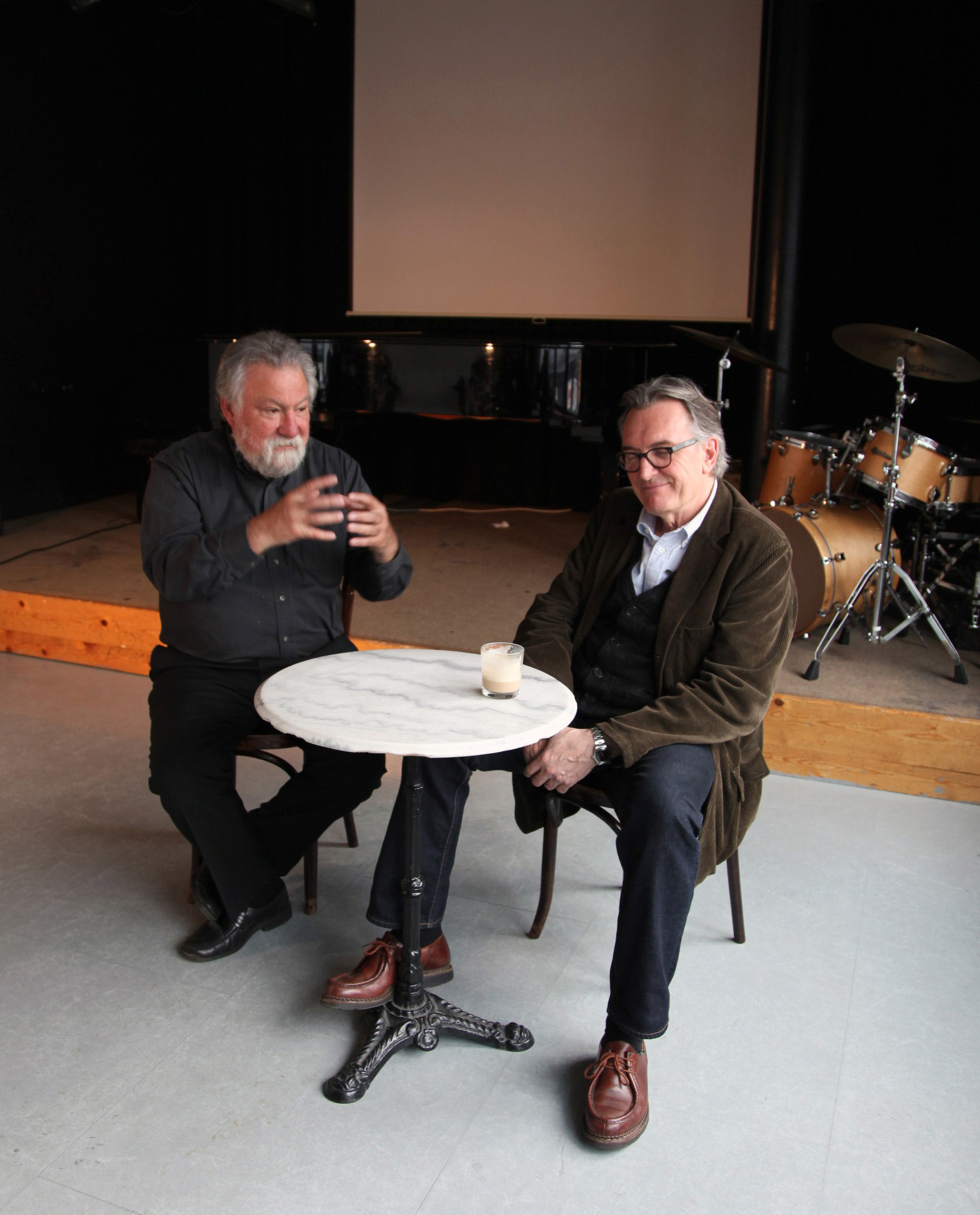
Evan Parker (left) explains the meaning of the universe to the author of this blog

If I write often about Evan Parker in this space, it’s because he’s one of the most original and compelling musicians of my lifetime. He’s also one of the most prolific, always up to something, usually something new. He turned 80 earlier this year, and by way of a slightly belated celebration comes a box set titled The Heraclitean Two-Step, etc., based around four CDs of previously unreleased solo soprano saxophone improvisations with a book containing interviews, musings, his own and other people’s memories, and a section devoted to his very nice collages, made during lockdown on the blank pages of a necessarily unused Musicians’ Union diary.

The first CD opens with a continuous 22-minute improvisation, an extract from a concert in 1994 at the Unitarian Chapel in Warwick. Parker remembered liking it, and decided to pair it on the disc with 40 minutes of new and shorter pieces recorded in 2023 at the same venue. That gave him the idea for the title of the box: it was the Greek philosopher Heraclitus who was reported to have said that you never step in the same river twice. The Unitarian Chapel was indeed not quite the same river: the floor had been renewed. But you get the higher point.

The second of those new pieces, titled “Orwell”, winds itself up to a pitch at which it almost blows your head off. And there are many such outstanding moments throughout these discs, the rest of which were recorded between 2018 and this year at Filipe Gomes’s Arco Barco studio, a converted old harbourside building in Ramsgate, Kent (Parker lives not far away, in Faversham). During “Blériot’s Handshake”, for example, I seemed to feel the ground sliding under my feet — the sensation I sometimes get when listening to Carlo Gesualdo’s choral music.

But the one that I loved most is the 31-minute piece taking up the whole of the second disc, in which Parker approaches the improvisation from several different trajectories, taking his time to pause before switching angle or pace. It’s called “The Path Is Made By Walking”: a most appropriate choice for a man who has followed his own route through the trackless expanses of improvised music for 60 years.

Although the accompanying book isn’t an autobiography, we do learn a lot throughout its various sections. We hear about his relationship with his saxophones, from the first purchase of an old alto at the age of 14, and there’s a semi-technical passage which gives even a non-professional a glimpse of the discipline and study it took to achieve his virtuosity, and still takes to maintain and deepen it. On relationships with other musicians, there are vignettes of Phil Seaman, Dudu Pukwana, Paul Rutherford, Henry Lowther and others, sometimes only a sentence or two but always memorable (“Eat when you can, sleep when you can” was Henry’s valuable early advice about life on the road). When I told Evan he’d made me think about John Stevens, who welcomed him into the SME and the world of the Little Theatre Club in 1967, soon after his arrival in London, and who died 30 years ago, he said: “I think about him just about every day.”

Since Evan has a wider conversational range than almost anyone I know, it’s hardly a surprise to find the text sprinkled with quotes from Borges, Buckminster Fuller, Simone Weil, Idris Shah, Dag Hammarskjöld, Kafka, Iain Sinclair, Chesterton, Koestler, Marcus Aurelius, Hogarth, De Quincey and the Iroquois nation’s address to the 1977 UN Conference on Indigenous Peoples, as well as Eric Dolphy, Steve Lacy and Booker Little. They’re used to support conclusions that are sometimes contentious, always stimulating.

Then I go back and listen again to “The Path Is Made By Walking”. In this wonderful half-hour we hear not just the use he’s made of his evolving technique to create fantastic, mindbending patterns of sound, often mesmerising and sometimes transcendent, but also how he can so fruitfully exploit the acoustical properties of his environment, in this case Arco Barco, and particularly its resonance; he really is “playing the room”, and the result is spellbinding.

Of course I love hearing Evan playing tenor, whether it’s on Tony Oxley’s classic 1969 recording of Charlie Mariano’s “Stone Garden”, or with Spring Heel Jack (John Coxon and Ashley Wales), or with the Necks, or in a big ensemble like the Globe Unity Orchestra. But I’m pretty sure it’s for the solo work on soprano that he’ll be most lastingly remembered. Here, in a fine package benefiting from David Caines’ elegantly austere design, is the evidence of his singularity.

* The photograph of Evan Parker and me was taken by Miranda Little. The Heraclitean Two-Step, etc. is on the False Walls label: http://www.falsewalls.co.uk

Remaining Intakt

Independent record labels are one of jazz’s indispensible support systems, fuelled by the brave willingness of the enthusiasts who run them to buck the odds. My own early tastes were largely shaped in the 1960s by the work of Alfred Lion and Francis Wolff at Blue Note, Bob Weinstock at Prestige, Dick Bock at Pacific Jazz, Lester Koenig at Contemporary and Orrin Keepnews at Riverside. It’s now more than 50 years since Manfred Eicher reimagined what an independent jazz label could be in terms of focus, identity and appeal, and today we have International Anthem, Pi, Rune Grammofon, Hubro, ACT and others swimming lustily against the current.

And there’s the outstanding Intakt Records, founded in 1984 by Patrik Landolt, who stepped back in 2021 after 37 years of producing records and, in retirement, has just received the honorary award of the Deutsche Schallplattenkritik — the organisation of German record critics. His story of those years is contained in a new book, (A)tonal Adventures, containing short extracts from his journals, vividly describing the pleasures and problems of running such a label, travelling between Europe and America.

Intakt’s catalogue of about 400 releases captures a hefty slice of the creative music of our time, from the first release by the great Swiss pianist Irene Schweizer through many recordings by Barry Guy’s London Jazz Composers Orchestra, Cecil Taylor’s epic Willisau concert, the Globe Unity Orchestra and the great solo sessions of its leader, Alexander von Schlippenbach, plus Anthony Braxton, Oliver Lake and Elliott Sharp and a galaxy of drummers including Pierre Favre, Gunter Baby Sommer, Andrew Cyrille, Louis Moholo, Han Bennink and Lucas Niggli, to newer generations of artists including Ingrid Laubrock, Chris Speed, Sylvie Courvoisier, Alexander Hawkins, James Brandon Lewis, Angelika Niescier, Tomeka Reid and the mindbending trio Punkt.Vrt.Plastik (Kaja Draksler, Petter Eldh and Christian Lillinger).

In presentational terms, Intakt’s releases conform to no house style (à la Blue Note or ECM), but the sense of strong graphic design is very evident. Despite the absence of visual uniformity, somehow they speak with the same voice. And equal care is taken with the sound. Again, there’s no equivalent here of the signature (and very effective) reverb penumbra of Blue Note or ECM. Just clarity.

Among the newer artists there’s Ohad Talmor, the American/Swiss tenor saxophonist whose new album, Back to the Land, is one of the highlights of the year. Over two CDs, Talmor reimagines compositions and motifs from the work of Ornette Coleman in a variety of settings: trios for tenor, bass (Chris Tordini) and drums (Eric McPherson), quartets (one with tenor, two trumpets and drums), the duo of Joel Ross on vibes and David Virelles on piano, and a couple of tracks for a septet including sparing use of electronics.

The music is full of air and light, evoking without mimicry some of the south-western feeling Ornette brought to the music. Joy and pain are both present, always delineated with subtlety. The playing is sensationally good by all concerned (particularly Tordini), and the programming retains the listener’s attention without resorting to tricks. In his short preface to the sleeve notes, Talmor mentions the influence on his own playing of Lee Konitz, Dewey Redman and Wayne Shorter; his solos are extruded without apparent effort but with a notable richness of melodic and rhythmic ideas. This is his third album for the label, and it would be a surprise if he were not to become one of the artists to whom Intakt’s commitment is for the long term.

Since Landolt’s retirement, the label’s reins have passed to a team including Florian Keller, whose postscript to (A)tonal Adventures takes us out on a note of optimism. “Intakt Records has never been an ivory tower,” he writes. “It is about setting topicality to music, where the political and social issues framing the music are also considered.” With albums as thoughtful and eloquent as Back to the Land, it’s fair to assume that the mission is in safe hands.

* Ohad Talmor’s Back to the Land was released in October: https://www.intaktrec.ch/408.htm. (A)tonal Achievements is published in English and German editions by Versus Verlag: bit.ly/49rIjla

Andy Paley 1951-2024

The first time I heard Andy Paley’s name was when my New York friends Richard and Lisa Robinson gave me a copy of the first album by a group called the Sidewinders in 1972. It had been produced by their friend — soon to be mine, too — Lenny Kaye. It was on RCA, where Richard had taken a job as an A&R man.

“Listen to the song called ‘Rendezvous’,” Lisa and Richard told me. I did. I loved it. A sweet slice of early power-pop, inspired by the girl groups of the ’60s. Easy to imagine with a full Wall of Sound production and a Darlene Love vocal. It sounded like a hit, but it wasn’t. Anyway, it’s still in my head today.

A year or so later, Andy came to see me at Island Records in Hammersmith, where I was in A&R. It was just a social call, but he left me with two things: an impression of the charming, very handsome young man he was, and a C60 cassette on which he’d put some of his favourite stuff, as a gift.

I’ve still got it somewhere, but the track that I had to get on vinyl became one of my all-time three favourite girl-group records: the Inspirations’ “What Am I Gonna Do With You (Hey Baby)”, written by Russ Titelman and Gerry Goffin. (And don’t tell me that the Chiffons’ version was better, or the Fleetwoods’, or Skeeter Davis’s, or Lesley Gore’s, or even Carole King’s lovely demo, because you’re wrong.)

The Sidewinders didn’t happen, and Andy just missed being a teenbopper sensation with his brother Jonathan in the Paley Brothers, but he went on to do lots of things in the music business, including working with Jonathan Richman and writing songs for Jerry Lee Lewis and Madonna. But probably the most important contribution he made was to Brian Wilson’s return to action in 1988. Andy and Brian became close, and together they wrote and co-produced some of the songs on the comeback album (Brian Wilson, Sire Records). You can hear the pop sensibility they shared on “Meet Me in My Dreams Tonight” and “Night Time”.

Andy died of cancer last week at his home in Vermont. He was 73. Lenny went up to see him in the last hours. Andy wasn’t conscious, but Lenny sang to him. Among the songs he sang was “Rendezvous”.

* The photo of Andy Paley was taken at CBGB in 1977. I’m afraid I’m unable to credit the photographer.

Outer and inner space

On the 243 bus ride to yesterday’s matinee show at Cafe Oto, I finished Samantha Harvey’s short novel Orbital, the winner of this year’s Booker Prize. Starting as a description of the lives of six astronauts aboard a space station, it finishes as a meditation on the world — the planet, the universe — and our place in it.

With that in my head, listening to Evan Parker, Matthew Wright and their four colleagues in this edition of Transatlantic Trance Map create their intricate musical conversations was like zooming in on the smallest level of earthly detail: an example of our human potential, in the face of cosmic irrelevance.

For two shortish sets of unbroken free improvisation, Parker (soprano saxophone) and Wright (turntables and live sampling devices) were joined by Hannah Marshall (cello), Pat Thomas (electronics), Robert Jarvis (trombone) and Alex Ward (clarinet). The music was calm, collective, and often very beautiful in its constant warp and weft. Maybe it was the occasional (very subtle and always appropriate) pings and hums from the electronics that reinforced the connection in my mind with Orbital: the whoosh of a closing airlock, the light clang of a piece of space junk against a titanium hull. But that was obviously just me.

Many years ago I went to interview Evan at his home in Twickenham. One thing I noticed was that his shelves of LPs had a particularly long stretch of orange and black spines: John Coltrane on the Impulse label, of course. Evan has never sounded like Coltrane, but his study of the great man was foundational to his own development and his interest remains deep. Yesterday, for example, he was keen to tell me about the extraordinary sound quality of the reissue of the 1962 Graz concert by Coltrane’s classic quartet on Werner Uehlinger’s ezz-thetics label. “You can hear the ping of Elvin’s ride cymbal,” he said.

So it was by an interesting coincidence that I went on from Dalston to another event on the last day of the EFG London Jazz Festival, a concert at the Queen Elizabeth Hall called Coltrane: Legacy for Orchestra. For this performance of arrangements by various hands of some of Coltrane’s compositions (“Impressions”, “Central Park West”, “Giant Steps”, “Naima” etc), and a few other pieces that he recorded (including “So What”, “Crepuscule with Nellie” and “Blue in Green” and a handful of standards, including “My Favourite Things”), the full BBC Concert Orchestra, conducted by Edwin Outwater, was joined by two horn soloists, the young American trumpeter Giveton Gelin and the experienced British saxophonist Denys Baptiste, and the trio of the pianist Nikki Yeoh, with Shane Forbes on drums and Ewan Hastie on bass.

Inevitably, I suppose, there were times when it felt as though Coltrane was being reduced to something close to light music; there was certainly no attempt to get to grips with the turbulence of the music he made in the last three years of his life in albums such as Interstellar Space. But there were moments of distinction, too. Baptiste tore into “Impressions”, while Gelin — a New York-based Bahamian in his mid-twenties — earned ovations for his poised reading of “My One and Only Love” and for a lovely coda to “In a Sentimental Mood”, mining the elegant post-bop tradition of Clifford Brown, Lee Morgan and Freddie Hubbard.

In terms of the response from a full house, it was a great success. But there was one moment when the music went deeper, closer to what Coltrane was really about, and it came in the arrangement of “Alabama” by Carlos Simon, a composer in residence at the John F. Kennedy Centre for the Performing Arts in Washington DC, and the principal begetter of this project.

“Alabama” is Coltrane’s most sacred song, a slow, heavy hymn to the memory of the four African American schoolgirls murdered by racists in the bombing of a church in Birmingham, Alabama on September 15, 1963. Simon chose to orchestrate it in the way Eric Dolphy and McCoy Tyner might have done, had it been written in time for inclusion in 1961 in Coltrane’s first Impulse album, Africa/Brass, on which Dolphy and Tyner made dramatic use of low brass.

Here, Simon added trombones and French horns, using tympani and a gran cassa to augment Shane Forbes’s mallets on his tom-toms, thus amplifying the effect of Elvin Jones’s original rolling thunder behind Baptiste’s emotionally weighted statements of the rubato theme. Like the tenorist’s extended but carefully shaped solo on the in-tempo passage, it honoured not only Coltrane’s memory but his intentions, and will be worthy of special attention when Radio 3 broadcasts the concert later this week.

* Transatlantic Trance Map’s album Marconi’s Drift is out now on the False Walls label (www.falsewalls.com), which is also about to release a four-CD box set of Evan Parker’s solo improvisations, titled The Heraclitean Two-Step, Etc. The live recording of Coltrane: Legacy for Orchestra will be broadcast on BBC Radio 3 between 19:30 and 21:45 on Thursday 28 November, thereafter available on BBC Sounds.

A box of Fudge

Vanilla Fudge, London 1967: Mark Stein, Carmine Appice, Vinnie Martell & Tim Bogert

The first Vanilla Fudge album saved me a lot of time. I loved it, but afterwards I didn’t want or need to listen to anybody who might have been influenced by it. So no heavy metal, no pomp rock, not ever. Their elaborate, slowed-down rearrangements of other people’s classics (“Ticket to Ride”, “People Get Ready”, “She’s Not There”, “Bang Bang”, “You Keep Me Hanging On”, “Take Me For a Little While” and “Eleanor Rigby”), shaped and guided by the ephemeral genius of their producer, George “Shadow” Morton, were enough in themselves to satisfy my limited appetite for bombast.

But there was much more to Vanilla Fudge than that. Everything the Long Island quartet did, particularly in the vocal department, was infused with the strain of East Coast blue-eyed soul exemplified by New Jersey’s Young Rascals, their principal influences (along with all the British invasion bands). They had a great lead singer in Mark Stein, and the other three members contributed fully to their soulful harmonies (particularly on Curtis Mayfield’s “People Get Ready”).

They were good players, too. Stein was as effective an exponent of the Hammond B3 as Stevie Winwood, while the guitarist Vinnie Martell, the bassist Tim Bogert and the drummer Carmine Appice all had the chops to contribute to the multi-section arrangements and to sustain the solo passages featured in the 20-minute-plus “Break Song”, a highlight of their live act.

I bought that first album and went to Leicester in early October 1967, hoping to see them at the De Montfort Hall on a bill with Traffic (then a three-down after the departure of Dave Mason), Keith West and Tomorrow, and (yes, really) the Flowerpot Men. But they’d cancelled their appearance — illness, I believe — and I had to wait a few weeks to see them at Nottingham University. I wasn’t disappointed: they were impressively dynamic and highly exciting.

One small thing I remember is the way Stein, while holding a particularly dramatic note with his right hand, occasionally threw his left arm up, his hand open and fingers spread — a seemingly spontaneous gesture of exultant emphasis. From an essay by Mark Powell that accompanies the nine CDs of Where Is My Mind?, a box set he’s compiled of the Fudge’s recordings for Atlantic’s Atco subsidiary between 1967-69, I learn that this became Stein’s signature. It must have been a good one, because it certainly made an impression on me.

During that month-long visit to the UK, their audience at the Speakeasy, then becoming London’s leading rock and roll hangout, included Eric Clapton, Jeff Beck, P. P. Arnold and Alan Price. In a formal concert at the Savile Theatre on Shaftesbury Avenue, they shared the bill with the Who. After returning home, in early December they played the Convention Hall in Asbury Park, and I’d love to know if Bruce Springsteen and Steve Van Zandt were there, because there’s a little bit of Vanilla Fudge in the E Street Band.

The box set includes mono and stereo versions of their first two albums, three more studio albums from that period (Renaissance, Near the Beginning and Rock & Roll), and two discs of live recordings from the Fillmore West in San Francisco on December 31, 1968, plus various bonus tracks, including edited 45s. The live stuff corresponds very closely to my memory of seeing them.

What’s most fascinating, though, is a chance to reassess their disastrous second album, The Beat Goes On. Devised and constructed by Shadow Morton seemingly as a survey of the entire history of Western music, built around the Sonny Bono song which had been a hit for Sonny and Cher, the album is a mosaic of music and voices incorporating the band’s capsule renderings of Mozart and Beethoven as well as ragtime, swing, Elvis and the Beatles, plus snatches of historic speeches from the archives: Roosevelt, Churchill, JFK and so on. Hugely ambitious, divided into four portentously announced “phases”,.it flopped for the simple reason that, as Stein tells Powell, there was nothing on it that could be played by AM radio, and the hip FM stations — happy to take a chance on the unorthodox — had yet to begin to exert their influence.

“We should have released The Beat Goes On eight albums down the line,” Stein says. He’s right. Although the subsequent studio albums still sound respectable, containing fine applications of their trademarked cover-version formula to “Season of the Witch” (on Renaissance) and “Shotgun” and “Some Velvet Morning” (on Near the Beginning), the band never regained the momentum established by their debut album and its hit single, “You Keep Me Hanging On”, which reached the US top 10 and the UK top 20.

For just over 50 quid, which is what I paid for it at Sister Ray in Soho, the box set is excellent value. I’m particularly glad to have the confirmation of their quality as a live band from a concert in which they performed “Like a Rolling Stone” as well as their established favourites to a hallucinogenically enhanced Fillmore West audience celebrating the arrival of 1969. “That was an incredible night,” Stein says. “The whole place was tripping out.”

And they’re still touring, with Stein, Martell and Appice joined by Pete Bremy, replacing Bogert, who died three years ago. If they came this way again, I’d go to see them, if only to witness Stein flinging his arm high as “She’s Not There” or “Bang Bang” reach their many climaxes. Vanilla Fudge did just one thing, really, but it was worth doing and they did it brilliantly.

* Vanilla Fudge’s Where Is My Mind? The Atco Recordings 1967-69 is released on Esoteric Recordings via Cherry Red.

Almost like a scientist

“Almost like a scientist.” That’s what someone says near the beginning of Ingredients for Disaster, Julian Phillips’s new 67-minute documentary about the music of the Swiss composer, pianist and bandleader Nik Bärtsch. Almost like a scientist. Well, yes. When Bärtsch talked after a screening in London this week, words like “architectonics” and “topography” entered the conversation. And Phillips chooses to illustrate the polymetric structures of the music through cunningly devised computer graphics that actually illuminate the interior design of pieces which tend have the four players working in different time signatures simultaneously.

On the other hand, not like a scientist at all. Not in effect, anyway. Listening to Bärtsch’s bands, either the “Zen funk” of Ronin or the “ritual groove music” of Mobile, can be a profoundly emotional experience, particular when he gives one of his shouted cues and the whole band changes gear like a sudden shot of adrenalin.

But it’s certainly complex music, particularly in its layered polyrhythms. He made me laugh yesterday when he briefly turned the conversation to good old 4/4. If you work all the time in less conventional metres, he said, then you decide to play something that superimposes 4/4 on, say, 5/4, it’s 4/4 that ends up sounding odd, implying that it gives you something new to work with.

In the film, he talks about some of his influences: the pianists Lennie Tristano (whose polymetric “Turkish Mambo” he recorded on one of his early albums), Ran Blake and Monk, and Stravinsky. In the discussion after the film there was also mention of James Brown’s band and of Zigaboo Modeliste, the drummer with the Meters (drummers are important to Bärtsch; that’s how he started out). But his great success is to have metabolised his influences so thoroughly that they became invisible as, over the years, he developed a music of true and complete originality.

This month marks 20 years since he began his Monday night sessions at the Exil club in Zurich, where the music has taken gradually shape. Ronin currently consists of Sha (Stefan Haselbacher) on bass clarinet and alto saxophone, Jeremias Keller on bass guitar, and the drummer Kaspar Rast, with whom Bärtsch has been working since they were nine or 10 years old. Each of them has something illuminating to say in the film, none more so than Sha, master of the bass clarinet, who demonstrates how one of the parts written for his instrument can lead, as the piece unfolds in its long narrative, to variations such as “ghost notes” and percussive tapping.

Like the Quintet of the Hot Club of France, the MJQ, the MGs, Astor Piazzolla Quintet and the Chieftains, Ronin is a band with a highly evolved, distinctive and patented character. There’s a new album by the basic quartet, called Spin. With the addition of three horns and a guitar, it becomes the Ronin Rhythm Clan, which performed at Kings Place in London a few years ago. I liked that line-up very much, and Bärtsch guided me to a couple of tracks released on Bandcamp earlier this year.

I wrote about Nik when he performed with the London-based visual artist Sophie Clements at the Barbican in 2019, and when Ronin played a night at Ronnie Scott’s last year. Tonight I’m going to see him playing piano duets with Tania Giannouli at the Wigmore Hall, as part of the EFG London Jazz Festival. He’s one of the most interesting musicians around, and it’s a pleasure to keep up with him.

* Ronin’s Spin is released on November 24 on the Ronin Rhythm Records label. The film Ingredients for Disaster will be available to stream on Amazon Prime and Apple+ from November 29. Bärtsch’s book Listening: Music Movement Mind is published by Lars Müller Publishers.

‘Soundtrack to a Coup d’état’

Sixty years ago Archie Shepp wrote a provocative column for Down Beat magazine in which, if memory serves, he compared his tenor saxophone to a machine gun in the hands of a Vietcong guerrilla. In the early ’60s it seemed that jazz’s New Thing, or whatever you wanted to call it, possessed a powerful political dimension, exemplified by Max Roach and Abbey Lincoln’s Freedom Now Suite, John Coltrane’s “Alabama”, and Shepp’s own “Malcolm, Malcolm — Semper Malcolm”. Even the music that had no explicit political content, such as Ornette Coleman’s “Free Jazz”, somehow seemed to express revolutionary feelings.

It’s with great brilliance that the Belgian film director Johan Grimonprez makes that music (and indeed those very pieces, plus others) into an integral component of his award-winning documentary Soundtrack to a Coup d’état. The two-and-a-half-hour film’s subject is the murder in 1961 of the activist and politician Patrice Lumumba, whose tenure as the first prime minister of the newly independent Republic of Congo — formerly the Belgian Congo — was ended after only three months by a military coup fomented by those with interests in the country’s rich deposits of rare minerals, notably Belgium, the withdrawing colonial power, the United States government of President Eisenhower, and the British government of Harold Macmillan.

Lumumba was a symbol not just of the independence of former colonies but of pan-Africanism. Given the activities of the CIA and the British and Belgian intelligence services, it was no surprise that he welcomed support from Castro’s Cuba and Khrushchev’s Soviet Union, or that he should pay the ultimate price for it, his body hacked to pieces and dissolved in acid by the mercenaries who killed him. Names familiar to those of my generation — Moïse Tshombe, Joseph-Désiré Mobutu, Joseph Kasa-Vubu, Dag Hammarskjöld — stud the narrative, while Grimonprez deploys archive interviews of varying degrees of blatant or sly self-incrimination with participants including Larry Devlin, the CIA station chief, and the MI6 officer Daphne Park.

What makes this film different is the use of music. Grimonprez has spotted the US government’s soft-power deployment of jazz during the Cold War through State Department-sponsored international tours. In 1956 Dizzy Gillespie and an 18-piece band spent 10 weeks touring Europe, Asia and South America. A year earlier Louis Armstrong had pulled out of what would have been the inaugural tour in protest against racial segregation in schools in the Southern states, but in 1960 he travelled to Congo, where he played to an audience of 100,000 people in Léopoldville (as Kinshasa was then known) in the middle of the political disturbances, before returning to Africa in 1961 to perform in Senegal, Mali, Sierra Leone, Liberia, Sudan and the United Arab Republic.

We see Armstrong in Africa in the film, but more novel and powerful is the juxtaposition of the avant-garde jazz of the time with footage of the political events: not so much a soundtrack as an active commentary. So we hear Abbey Lincoln’s anguished screaming, Max Roach firing off snare-drum fusillades, the contorted sounds of Eric Dolphy’s bass clarinet (with Charles Mingus’s group, shortly before his death), Nina Simone simmering through Bob Dylan’s “Ballad of Hollis Brown”, and Coltrane, on fire in “My Favourite Things” and intoning the sorrow of “Alabama”. Fast cutting is usually the enemy of understanding, but Rik Chaubet’s shrewdly paced editing creates a non-stop tapestry of emotions, making the rhythms and the cry of the music mirror the events being depicted.

Direct action also played a part, and if you see this extraordinarily compelling film, you won’t forget the spectacle of Lincoln, Roach and dozens of others courageously disrupting a session of the UN Security Council in New York to protest against the assassination of the figure Malcolm X called “the greatest black man who ever walked the African continent.”

Lumumba’s death was a crime and a tragedy of enormous significance. Grimonprez alludes to its enduring importance through reminding us that the Democratic Republic of Congo, whose mines produced the uranium for the atom bombs that fell on Hiroshima and Nagasaki, remains the world’s major source of coltan, the rare and precious commodity that powers our iPhones. In other words, a country of 100 million people, whose mineral deposits are said to be worth $24 trillion, but where two million children are at risk of starvation, and which currently ranks 179th out of 191 countries in the UN’s Human Development Index, is safe for civilisation.

* Soundtrack to a Coup d’etat is being screened at various independent cinemas.

Rougher and rowdier (take 2)

So many people told me how much they’d loved the first of Bob Dylan’s three nights in London this week that, having written a rather grumpy response to his performance in Nottingham last Friday, I went on the secondary market to buy tickets for the third and final night, also the last show of the 2023-24 edition of the Rough and Rowdy Ways Tour.

The most telling words came in an email from the historian David Kynaston, who expressed “a powerful sense of gratitude that here I was seeing him at the Albert Hall in 2024, some 55 years after he’d been a speck in the distance at the Isle of Wight, and with all sorts of thoughts about the intervening years – the ups and downs of his different phases, how they rhymed or didn’t rhyme with my own life, his constant presence in one’s interior landscape – coursing through my mind.”

His constant presence in one’s interior landscape. That did it for me. And because I thought it might help give me a different perspective, this time I left my notebook and pen at home, setting aside the working habit of a lifetime.

Buying those tickets turned out to be the year’s best decision. In the warm and dignified surroundings of the Albert Hall, almost everything I found frustrating about the Nottingham show, rooted in a sonic harshness, was smoothed away. The sound was perfect, the vocals were clear and perfectly balanced against the instruments, Dylan’s piano-playing was always relevant to the song, he made each note of every harmonica solo count, and in the moody lighting of those old tungsten lamps the musicians clustered around him as if they were playing together in someone’s front room.

One thing he does is allow the audience to see the music’s working processes. Nowadays he has a set-list that seldom varies, but last night there was an unusually strong sensation of being invited in to watch and hear decisions being made on the fly, in the moment.

At times it had the delicacy of chamber music. “Key West” — a song whose setting he’s played around with throughout the tour — was particularly exquisite in that respect. So was “Mother of Muses”. The new arrangements of “All Along the Watchtower” and “Desolation Row” came into much clearer focus. The music ebbed and flowed with freshness and grace. “Goodbye Jimmy Reed” and “False Prophet” located the Chicago blues sound so fundamental to Dylan’s feelings about how a band should be organised. The spare treatment of “It’s All Over Now, Baby Blue” was heartstopping. The closing “Every Grain of Sand” was a serene benediction.

Without his refusal to be consistent or predictable, he wouldn’t be what he is. But last night he drew us in, and I think most people there would have felt unusually close to him. If I really was seeing him for the last time, it ended with seeing him at his best.

Rougher and rowdier (take 1)

Almost as soon as Bob Dylan and his musicians emerged on to the half-darkened stage of the Motorpoint Arena last night, a jangle of discordant electric guitars made me uneasy. It turned out that the discordance was chiefly coming from the guitar of Dylan himself, who was already sitting at his piano bench, with his back turned to the audience. Within a few seconds that jangle had somehow formed itself into the opening of “All Along the Watchtower”, the first of the 17 songs — nine of them from Rough and Rowdy Ways — he’d give us.

For me, it was a strange concert from several perspectives. It was certainly far from the poised, concentrated, finely detailed performance he’d presented at the same venue in Nottingham two years earlier, which had been a measurable level up even from the two fine shows I’d seen him give at the London Palladium a week before that. Quite often I found myself thinking we were back in the ’90s, when the thing I seemed to say most frequently after one of his concerts, while defending him to sceptics, was, “Well, they’re his songs, he can do what he likes with them.”

Another early warning sign: he repeated the first verse of “Watchtower”, meaning that the song no longer ended with “Two riders were approaching / The wind began to howl” — among the most effective closing lines in popular music — but with “None of us along the line / Know what any of it is worth.” I have no better idea of why he’d choose to do that than of why he’d rearrange a full-band version of “Desolation Row” to the galloping tom-tom beat of “Johnny, Remember Me” or decide to extend the same song with a meaningless piano solo.

The sound was much worse than two years earlier in the same hall. It was louder and harsher, and yet somehow less powerful, and with a much more distracting echo on the voice. Sometimes I flinched involuntarily when he put exaggerated emphasis on a particular syllable, as he so often does. The harmonica, which appeared on several songs, had mislaid its customary poignancy and what he played on it was, unusually, not particularly interesting, even on the closing “Every Grain of Sand”.

His current modus operandi is to start many songs — “I’ve Made Up My Mind to Give Myself to You”, for instance — standing near the back of the stage, singing into a handheld microphone. After a verse or two he advances to the baby grand piano, leans over it, and sings another verse or two, reading from the book of lyrics resting on top of the instrument. So far, so good. But then he sits down and clogs up the music by adding his wilful and often wayward piano-playing to the guitar interplay of Bob Britt and Doug Lancio. There’s no finesse in his keyboard contribution this time round, which is another contrast with 2022. It’s a form of interference, which of course may be what he’s after.

“My Own Version of You” closed with a chaotic ending that suggested that this was the first time they’d played it, rather than the two-hundred-and-twenty-somethingth. “To Be Alone With You” was such a mess that I couldn’t help thinking, “What on earth does he imagine he’s doing?” The drumming of “the great Jim Keltner” — as Dylan quite justifiably introduced him — never seemed as well integrated into the band as that of his precedessor in 2022, Charley Drayton, or George Receli from further back.

During the boogie of “Watching the River Flow” it was tempting to conclude rather irritably that the Shadow Blasters, Dylan’s first band, probably sounded better doing something similar at the Hibbing High School talent contest in 1957. For the first time in 59 years of going to see him on a fairly regular basis, I felt that I could have left my seat, gone to buy a beer, and returned without having missed anything important.

Of course that’s not true. There were moments of grace, mostly when the instrumentation was reduced to voice and piano, as in “Key West”, or voice and guitars, as in “Mother of Muses”. The first two verses of “Made Up My Mind” were lovely, as were the out of tempo bits of “It’s All Over Now, Baby Blue”, delivered against Tony Garnier’s bowed bass. By the time Dylan got to “Goodbye Jimmy Reed”, the penultimate item on the set list, he was singing beautifully, with clarity and marvellous timing.

Every time you see him now, you think it might be the last. So this one wasn’t great. But that doesn’t really matter, even if there aren’t any more. Time past, time present: lucky to have it at all, all of it.