Bernard Stollman and ESP-Disk’
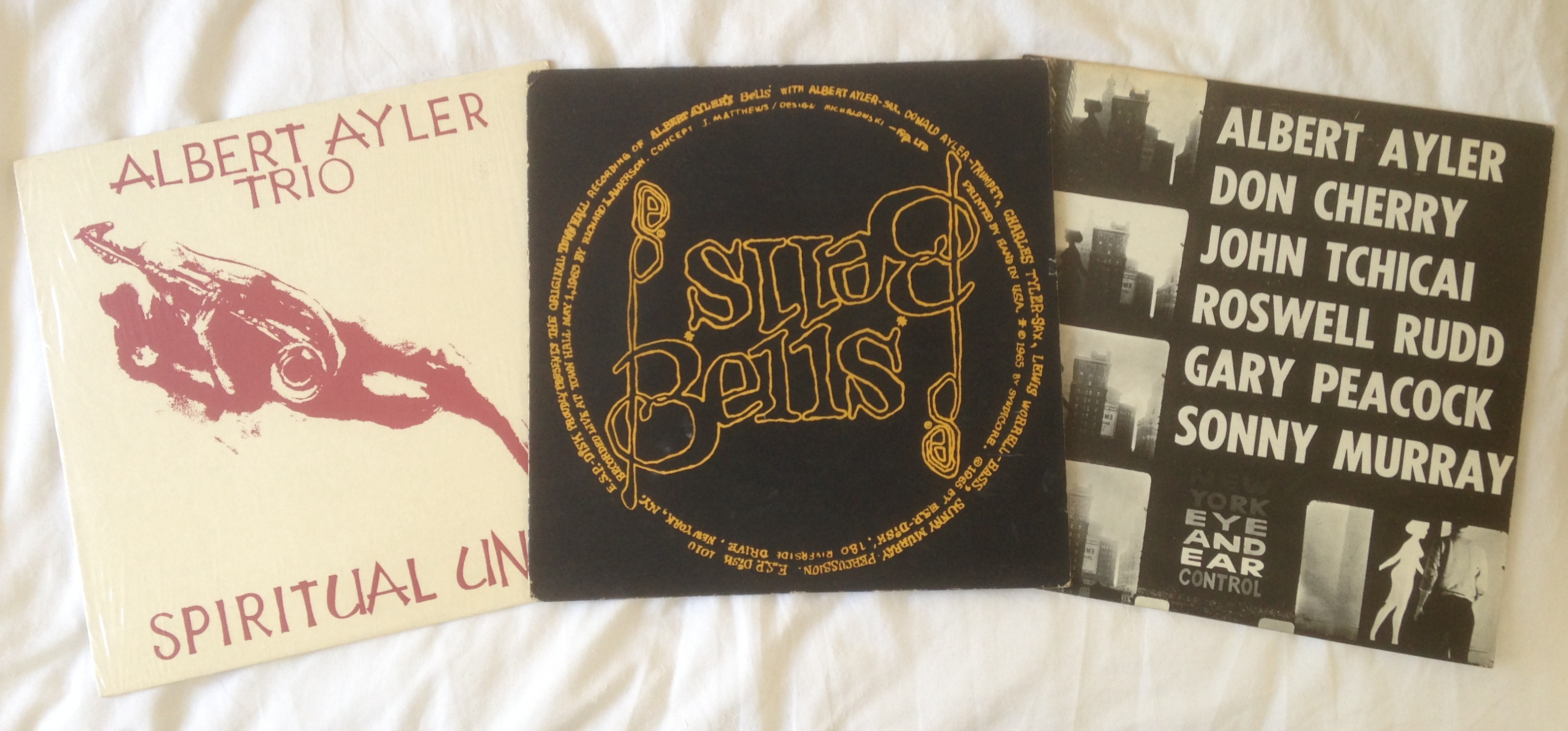 On Friday it will be exactly 50 years since Albert Ayler and his musicians appeared at Town Hall in New York City. On May 1, 1965 Ayler’s quintet gave a performance that was released in part on an album titled Bells: a single-sided 12-inch 33rpm disc pressed on transparent plastic, with the title and the artist’s name overprinted in white. The album comprised two untitled pieces together amounting to a few seconds short of 20 minutes. If you wanted to buy it in Britain, not only did you have to pay the considerable premium demanded for records imported from the United States, in this instance you were paying for something that contained half of the standard amount of music. But what music it was.
I bought it by mail order, and I remember the thrill of opening the package. That was the effect of just about any record on ESP-Disk’, the small independent label that issued albums by Ayler, Sun Ra, the New York Art Quartet, Giuseppi Logan, Gato Barbieri, the Fugs, Pearls Before Swine and other names from the New York avant-garde scene. If the visual style of a Blue Note or a Riverside album perfectly reflected the crisp, clean sound of hard bop, the look of an ESP record reflected a wilder sensibility.
Bernard Stollman, the lawyer who founded ESP-Disk’ in 1964, died last week, aged 85. He had run it throughout the 10 years of its original lifetime and then in its subsequent, rather half-hearted, reincarnations. Stollman was a kind of cultural and political idealist — the label’s name came from his belief in the universal language of Esperanto, and he later claimed that ESP was brought down by the US government “because of our opposition to the (Vietnam) war” — but he came in for criticism from musicians who felt he had not properly rewarded them, particularly in terms of royalties.
During the course of an interview with Jason Weiss, the author of Always in Trouble: An Oral History of ESP-Disk’, The Most Outrageous Record Label in America (Wesleyan University Press, 2012), Stollman explained that for each recording he paid $300 to the leader and $50-100 to the other musicians. “They all shared ownership of the album,” he added, and therein, or so one imagines, lay a world of trouble once licensing agreements started to be made with record companies outside the US. He also claimed: “There is no ESP musician today with whom I can’t communicate amicably.”
Some unquestionably resented him for seeming to profit from their art. But Milford Graves, the great drummer who was a member of the New York Art Quartet on their classic ESP album, and who would start his own label (SRP, with the pianist Don Pullen) later in the decade, put an interesting viewpoint to Weiss:
I look at the positives, he said, because I can’t deal with the negatives of Bernard Stollman. I just know one thing: nobody was recording us in the ’60s other than ESP! And the pay that maybe you didn’t get from Bernard, it neutralises itself because if you had to hire a public-relations person, you were going to have to pay him. So you’re still going to come out to zero. It balances out, a plus and a minus. Now, ESP puts you out. What are you going to do after that? Albert Ayler became what, he started putting out — that’s all through ESP. Myself, through ESP, I came out… Look, ESP publicised us all over the planet, so anybody complaining about Bernard, I have to ask people, You’ve got to check yourself out. That’s over, man. Bernard was a businessman — he wasn’t a charitable organisation… With Bernard, you’ve got to say, “Hey, man, you started something, Look, you did what you did.”
ESP albums had a real counter-cultural charisma, and Bells — poorly recorded and bizarrely packaged (the sleeve of my copy has the word “stereo” redacted by someone with a marker pen in the company’s offices) — had more than most. Its sequence of blaring unison themes, wild collective improvisation and emotionally audacious solos by Ayler, his brother Don on trumpet and Charles Tyler on alto saxophone, with Lewis Worrell almost inaudible on bass through the firestorm set up by the astonishing Sunny Murray on drums, retains every ounce of the impact it must have made on the Town Hall audience half a century ago, and certainly on a teenager opening a package a few months later and three thousand miles away.






 thebluemoment.com