‘The Nightfly’ at Milton Court
 Even though it meant missing the first set of Michael Gibbs’ 80th birthday concert at the Vortex, the idea of hearing Donald Fagen’s first solo album played by the new intake of students on the jazz course at the Guildhall School on Monday night was impossible to resist. The Nightfly is a wonderful album, made by a man in early middle aged in the era of Reagan looking back at how things felt as the era of Eisenhower shaded into that of Kennedy, in that brief period of illusory optimism when prosperity and progress seemed to be the prevailing forces, before the Cuban missile crisis, the civil rights marches and the Vietnam protests took over. I thought it might be interesting to see how it sounded in the era of a president whose name I don’t even want to type out on this blog.
Also I wanted to hear a bunch of young players. And first, as an hors d’oeuvre, came a succession of seven small groups under the supervision of their tutors — Tom Challenger, Yazz Ahmed, Gareth Williams, Gareth Lockrane, Robbie Robson, Barak Schmool and Stuart Hall — playing short pieces based on ideas suggested by the album, each group having the benefit of a mere three hours’ preparation. All were interesting, but my ear was caught most readily by a lovely Mingusian variation on a phrase from “New Frontier” played by Challenger’s septet and by Williams’s sextet arrangement of “Ruby Baby”, which soured the harmonies in a George Russell-ish way and provided space for cracking solos by the altoist saxophonist Albert Hills Wright and the trumpeter James Beardmore.
Introducing the evening, Scott Stroman, a professor in the jazz department since 1983, had reminded us: “These guys didn’t even know each other last week” — the start of the academic year. It hardly seemed possible. There were also fine individual contributions from the fiery tenor saxophonist Asha Parkinson, the astonishingly eloquent pianist Jay Verma, and the assured drummer Zoot Warren.
After the interval came the main course. Malcolm Edmonstone, the head of the Guildhall’s jazz programme, had transcribed and arranged the entire album for a group of 57 students, including 13 singers who shared the lead around and fleshed out the close harmonies, and a load of pianists, guitarists, bassists and drummers who alternated the rhythm section roles.
Under the precise, assertive and invigorating baton of Giles Thornton, the band soared through “I.G.Y.” on Mark Fincham’s confident bass lines, articulated the strut of “Green Flower Street” with crisp power, absolutely nailed the sublime hip-swinging arrangement of “Ruby Baby” (with Parkinson’s tenor again making its mark), glided through the yearning “Maxine”, hustled through “New Frontier” (although there doesn’t seem to be a chromatic harmonica player in the class of ’17), locked into the fingerpopping groove of “The Nightfly”, and sauntered and shuffled through “The Goodbye Look” and “Walk Between Raindrops”.
When you think about it, these young musicians were pitting themselves against the achievements of Marcus Miller, Jeff Porcaro, Larry Carlton, Dean Parks, the Brecker brothers, Greg Phillinganes, James Gadson and the rest of the crew of first-call virtuosi assembled by Fagen back in 1982. The result was joy and exhilaration all the way, delighting the large audience of friends and family assembled in the concert hall at Milton Court.
(And I made it to the Vortex for the second half of Mike Gibbs’ birthday celebration with his 14-piece band, a glorious series of glowing set-ups for soloists like the trumpeter Percy Pursglove, the altoist John O’Gallagher and the guitarist Mike Walker. It was nice to think that some of this year’s Guildhall students will be carving out similar reputations before too long.)

 Two years ago I presented Cécile McLorin Salvant and her trio at the Berlin jazz festival. At that point, most of the audience hadn’t heard of the young Franco-Haitian singer who was brought up in Miami before studying classical and baroque music at the conservatory in Aix-en-Provence. To say they were impressed by her performance would be an understatement.
 It had been an enjoyable enough concert for the first 40 minutes or so, but when Lucinda Williams dismissed her band and introduced “The Ghosts of Highway 20”, the mood of the evening deepened. “I’ve been filled with the need when I’ve sung this song lately to say that not everybody from the South is a bad person,” the woman brought up in Louisiana, Mississippi and Arkansas told the crowd at the Shepherd’s Bush Empire. They knew what she was getting at.
 If you were to draw a straight line connecting Hank B. Marvin to Jimi Hendrix and then extend it a bit further, the next point on the line would be Terje Rypdal, the Norwegian guitarist and composer who celebrated his 70th birthday this weekend with a couple of concerts at Oslo’s Victoria Nasjonal Jazzscene, an old cinema converted into a 300-capacity theatre for improvised music. I went to the first of the concerts, in which Rypdal was joined by the trumpeter Palle Mikkelborg, the keyboardist Ståle Storløkken and the drummer Pål Thowsen. It was an unforgettable evening, and a reminder of his singular importance.
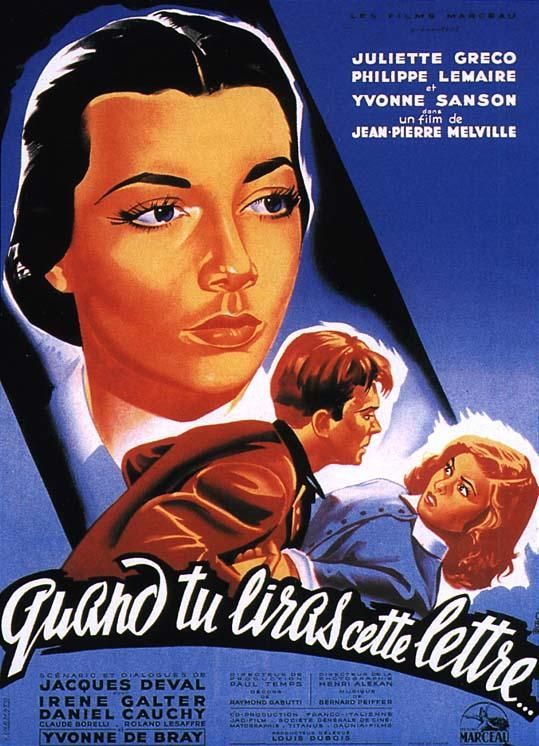 To be frank, I went to see Jean-Pierre Melville’s Quand tu liras cette lettre (When You Read This Letter) at the BFI last night simply out of curiosity to see what sort of a leading actress Juliette Gréco was in 1953. Screened in a beautifully restored 35mm print, the film is an old-fashioned melodrama in which Gréco plays a novice nun who leaves the convent in order to look after her younger sister, the naive victim of a handsome, libidinous rotter. There’s a rape, a murder, an accidental death under the wheels of an express train, a very nice Cadillac Series 62 convertible, and some lovely scenes of the Cannes waterfront before it all got spoiled.

 thebluemoment.com