Skip to content

‘The Ballad of Wallis Island’

It’s a phenomenon you don’t hear a lot about because it’s slightly embarrassing, but many top artists play ludicrously well-paid private gigs for rich people. In the business such shows are known, with a suitable lack of poetry, as “corporates”. The Ballad of Wallis Island is about one such engagement, in which a slightly barmy middle-aged widower uses his lottery-jackpot winnings to persuades a British folk-pop duo, long acrimoniously sundered, to reunite for a single gig at his home on a small Welsh island, at which the audience will consist of him alone.

Tim Key plays the widower with gentle charm. He wrote the story and the screenplay with Tom Basden, who plays the male half of the duo with a barely suppressed resentment at his treatment by the music business. His erstwhile partner is played by Carey Mulligan, who manages to be both beatific and beady-eyed and turns up from Portland, Oregon, where she makes chutney, with her American husband, played by Akemnji Ndifornyen (who doesn’t say much but, close to the end, has the film’s most striking speech).

I saw it the other night and came out of the cinema having been charmed to bits by the whole thing but particularly struck by a scene in which the spectre of the duo’s former romantic engagement is evoked, summoning a sudden irruption of old artistic jealousies and resentments, all unresolved. It reminded me of so many music business stories. And the songs we hear, written by Basden, are very precisely not-quite-good-enough, making you understand how, in a different era, the duo could have enjoyed a brief, perhaps almost accidental popularity without managing to turn it into anything more substantial.

Apparently the film, directed by James Griffiths, cost just over a million and a half dollars to make. There should be many more like it: modest in scope and scale, formally unadventurous but intellligent, witty and well made, and aimed at no particular niche. Go and see it; you won’t be wasting your time.

* The Ballad of Wallis Island came out at the end of May and is still in cinemas. The photo shows Carey Mulligan and Tom Basden.

The last of the Blue Notes

Louis Moholo-Moholo died on Thursday at his home in Cape Town, aged 85. He was the last survivor of the Blue Notes, the group — also including the trumpeter Mongezi Feza, the alto saxophonist Dudu Pukwana, the pianist Chris McGregor and the bassist Johnny Dyani — who arrived in Europe in 1964, fleeing South Africa’s apartheid regime. Once settled in London, they infused the British jazz scene with the warmth and directness of their playing, leaving an impression that continues to be heard in the music of later generations. Now they’re all gone.

Nobody cracked the whip from the drum stool like Louis, with the most benign of intentions. Until you saw him live, you could have only the haziest impression of his invigorating and sometimes electrifying effect on those around him — whether the other member of a duo (perhaps the pianists Keith Tippett, Livio Minafra or Alexander Hawkins) or the massed ranks of McGregor’s Brotherhood of Breath or Pino Minafra’s Canto Generàl. I treasure memories of Mike Osborne’s incendiary trio with Louis and the bassist Harry Miller, another of the South African emigré cadre. Miller’s sextet, Elton Dean’s Ninesense and later on, the extraordinary quartet Foxes Fox were other bands whose fires he stoked.

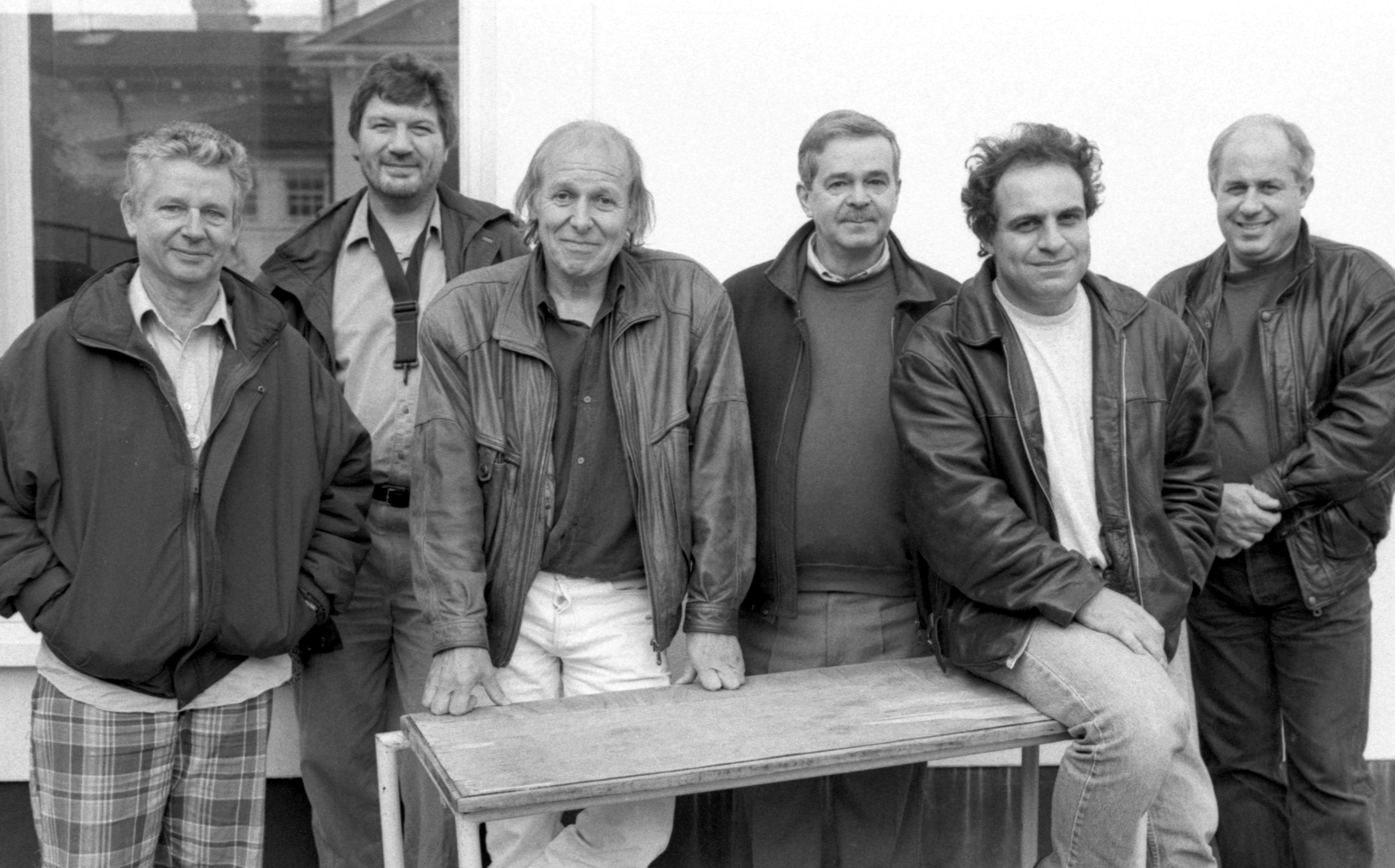
And, of course, there was Four Blokes, his own final band, with Hawkins, Jason Yarde on saxophones and the bassist John Edwards. I had the thrill, when presenting the quartet at JazzFest Berlin in 2015, of hearing them start a fire the instant Louis was settled behind his kit. The effect, as always, was indescribably exhilarating. Because that’s what Louis did: he showed you what this music could do, where it could go, how it could touch your soul. Now may he rest in peace.

* The photograph of Louis Moholo-Moholo was taken at the Haus der Berliner Festspiele in 2015 by Camille Blake.

A point of stillness

There is a balm in Gilead, according to an African American spiritual whose lines were borrowed from the Old Testament Book of Jeremiah, and there is a profound sense of healing in Solace of the Mind, the new solo album by the pianist and organist Amina Claudine Myers.

Born 83 years ago in Blackwell, Arkansas, Myers moved to Chicago after graduating from music college and became a member of the Association for the Advancement of Creative Musicians in 1966. Ten years later she moved to New York. Before this new album, her last one was as a duo with the trumpeter Wadada Leo Smith, a dedication to Central Park, released a year ago. Her early albums for the Leo label, Song for Mother E and a tribute to Bessie Smith, recorded in 1979 and 1980 respectively, were recently made available on Bandcamp.

She is a musician of great sophistication, rich in imagination and technical resources, but in this recital she pares everything back to the essence and what we hear is her soul. Like Abdullah Ibrahim, she can take an ancient structures and allow it to glow from somewhere deep within. The simpler the hymn and the more straightforwardly it’s played, the great the inner strength it exudes. As long, of course, as the playing is done by an Ibrahim or a Myers.

There are nine original pieces here, starting with a delicately surging reinterpretation of “Song for Mother E”. Others include the brief and stately “Hymn for John Lee Hooker” — more hymn than Hooker — and the rhapsodic “Twilight”. On “Ode to My Ancestors”, recorded at her home, she moves to her Hammond B3 and recites a poem over sustained organ notes which, thanks to a phasing effect, seem to be fluttering in a breeze. The only non-original is the lovely spiritual “Steal Away”, which gently summons a whole world of African American culture; the whole recital seems to pivot around it. The closing benediction is a study in patience and exquisite phrasing titled “Beneath the Sun”.

What you won’t find here is anything remotely resembling a display of virtuosity. What you might discover, amid an increasingly maddened world, is a welcome point of stillness. Highly recommended.

* Amina Claudine Myers’ Solace of the Mind is released on June 20 on the Red Hook label (redhookrecords.com). The uncredited photograph is borrowed from Myers’ website.

‘What dives!’ Soho, 2/11/63

While clearing out the other day, I came across a brief attempt to keep a narrative diary during the winter of 1963/64. I was 16 years old and a few months away from being invited to leave school, to put it politely. Most of the diary was about girls, so toe-curling that it went straight to the shredder. But this page seemed worth preserving. It describes a school trip from Nottingham to London, arranged by one of our English masters, to see Joan Littlewood’s new musical Oh, What a Lovely War!, which had had just transferred from its first run at the Theatre Royal Stratford East to Wyndham’s Theatre on Charing Cross Road, Soho’s eastern border. As the diary entry describes, we arrived in Soho and were left to our own devices. Samuel Pepys it is not, but it is a little snapshot of something. Further notes below.

As you’ll see, the day before the trip I skipped the school orchestra rehearsal, visited a local coffee bar whose full name was the Don Juan, had a double bass lesson, and bought a Beatle jacket (brown, round neck, some kind of decorative buttons, 19/6d or thereabouts from C&A, I think). That night a friend and I went to the Rainbow Rooms, an occasional venue for beat groups, to see the Renegades, a band from Birmingham, and the Rocking Vulcans, a local outfit, and to dance with a couple of girls called Anne and Jean.

Once in Soho, the ambition seemed to be to visit as many coffee bars as possible, notably the 2i’s and Heaven & Hell, next door to each other on Old Compton Street. I remember (but didn’t write down) that as we stood outside, a couple naked from the waist up (at least) poked their heads out of a first floor window to chat with someone across the road; this, I thought, must be the life. We also visited Act 1 — Scene 1, directly across the road, and Le Macabre, on Meard Street, where the customers sat on coffins.

And there were record shops, including Ronnie Scott’s short-lived effort on Moor Street and, inevitably, Dobell’s. It must have been at Harlequin on Berwick Street (opened two years earlier) that I bought a Prince Buster 45 on the Blue Beat label (which gave its name to the idiom later known as ska) and “Orange Street” b/w “JA Blues” by the Blue Flames. That was on the R&B label, which I now know to have been named after its founders, Rita and Benny King (formerly Isen or Issel), who ran a record shop in Stamford Hill and had a label on the side, catering to the many West Indians who had recently populated the area.

After the brilliant and very moving show at Wyndham’s, performed by the original cast, including Barbara Windsor and Victor Spinetti, we wandered to the bottom end of Wardour Street to discover that the Whisky A Go-Go and the Flamingo’s All Nighter were out of our price range. But somewhere called Meg’s provided the “best hamburger I ever tasted” — almost certainly the first one that wasn’t a Wimpy.

The “Jeff” who accompanied me on these little adventures was Jeffrey Minson, a fellow member of our folk trio and eventually the author of Genealogies of Moral: Nietzsche, Foucault, Donzelot and the Eccentricity of Ethics. I just wish I could remember which two members of the Rolling Stones we spotted in Act 1 — Scene 1 that afternoon; their second single, “I Wanna Be Your Man”, had been released the day before.

(The missing word at the end of the page is “coach.”)

Songs for summer days and nights

I first got to know Philippe Auclair, a Frenchman living in London since 1986, as someone who wrote about football in both French and English with rigour, authority and elegance. His biographies of two celebrated fellow exiles, Eric Cantona and Thierry Henry, are unlikely to be bettered. The elegance I mentioned is the quality he brings to his other career as a musician, using the alias Louis Philippe.

The latest album by Louis Philippe & the Night Mail, The Road to the Sea, is a beauty. I’ve always known of his love for Brian Wilson and the Beach Boys, and that his past collaborators have included Sean O’Hagan of the High Lamas and Stuart Moxham of Young Marble Giants, which gives some idea of his orientation. So we have sunshine pop, chanson, a hint of the baroque (maybe with a nod to the Left Banke), and open ears in general, perhaps with a bit of Francis Lai and Paddy McAloon thrown in, but also with a strong enough personality to ensure freshness.

The strain of Beach Boys influence I get here is the period taking in Smiley Smile, Wild Honey and Friends, post-surf and mingling hippie serenity with a barely perceptible hint of unease. This isn’t retro music in any way — there are modern trimmings throughout, used sparingly — but Auclair’s carefully wrought arrangements sometimes throw in an unexpected tone or texture, like the sudden appearance of a Hammond organ on “Watching Your Sun Go Down”, a theremin effect on “All at Sea” and a melodica on “Always”.

Unfashionably, he writes chromatic melodies, like the shapely “Song for Paddy (Wings of Desire)”. Overall there’s a lightness of spirit that might represent the influence of Brazil, although perhaps I’m thinking that because I’m listening to “Where Did We Go Wrong”, which races along to a rapid samba rhythm.

His singing voice is calm and unaffected, sometimes rising effectively to the falsetto register; he could be the late Carl Wilson’s French penfriend. There are three songs in his native language, of which “Le Baiser” might well be the loveliest new song I’ll hear this year, with delicious, heartlifting background harmonies and an insouciant jazz piano playout. For sheer beauty, it’s almost matched by one of the English songs, “A Friend”.

The sun and the sea feature prominently in the lyrics, along with a feeling of life drifting along, as it can tend to do. As the days lengthen and June approaches, this is my album for summer days and summer nights.

* The Road to the Sea by Louis Philippe & the Night Train is released on the Tapete Records label: http://www.tapeterecords.com

On Kate Mossman’s ‘Men of a Certain Age’

(For the last decade and a half, Kate Mossman has written clever, funny, perceptive and quite candid interviews with ageing rock stars. They are, she admits, her speciality. Discussing Journey’s Steve Perry, she says: “I was drawn to him for his ageing vulnerability, his giant ego and his extreme oddness… the perfect combination for me.” She’s just published a collection of the interviews, with commentary and reflections. But I wasn’t very interested in my own opinion of her book. I wanted to know what a woman music journalist of my generation, who interviewed some of the same musicians when they were in their young prime, and for whom being hit on by male musicians was a largely unremarked fact of life, made of the views of a woman born in 1980. So I invited a friend whom I first met in 1969, when I’d just arrived at the Melody Maker and she was already well established along the corridor at Disc & Music Echo, to read the book and, if so moved, to give me her thoughts. She said yes, and here they are. — RW)

By CAROLINE BOUCHER

Is it a good idea to meet your heroes? I’ve met most of mine and the jury’s still out, and I think it’s probably the same for Kate Mossman.

In Men of a Certain Age Mossman meets 19 of them – pieces  previously published in The Word and the New Statesman. The subjects are all elderly, as were those chosen by Rolling Stone’s founding editor, Jann Wenner, when he published a selection of interviews claiming, justifiably, that only in their senior years do rock stars attain articulacy and eloquence (and, rather more controversially, that no women at all qualified under those criteria).

Mossman kicks off with the unashamed obsession with Queen’s drummer, Roger Taylor, that meant her teenage family holidays in Cornwall became a pilgrimage to every site connected with him, so that when she was finally granted an interview at his house she could have found it blindfold. Fortunately she reeled away from that confrontation still enamoured.

As she points out: “Rock journalism is unique in that it’s the only place where writers are also obsessive fans, though part of the art is pretending not to be.” A chunk of her early wages was spent on airfares to America where she’d travel to gigs by Greyhound buses or, in the case of a 5,000-mile pilgrimage to meet Glen Campbell in California, walking for three hours down the edge of a freeway.

I’m in awe of her fluid writing style, and jealous of the editorial freedom that now allows her to tell it like it is. By the time she meets Gene Simmons, Kiss have been in the business for 44 years. She likens his hair to “loft insulation”. Or on Trans-Siberian Orchestra’s Paul O’Neill (I know, who he?), who has amassed an extraordinary collection of first-edition books (one signed by Queen Victoria to Kitchener): “He wanders out on to the patio, where the sun beats down so strongly that he must be melting in his leathers… and for a moment he epitomises the contradiction at the heart of rock ‘n’ roll wealth: the baby boomers who bought the lifestyles of the landed aristocracy but insist on looking like pickled versions of the boys they were when they first picked up a guitar.”

Her subjects are a fascinating mix – not all of them out front onstage. For me, the most interesting was Cary Raditz, Joni Mitchell’s former lover and “mean old daddy” from “Carey”, the song named after him. It’s a vivid and fascinating portrayal of the two characters– who initially lived in a cave, and drifted in and out of each other’s lives as Mitchell’s star ascended.

When I was on a music paper in the late Sixties we helped peddle lies. I can still feel the boiling disappointment after an interview with the Byrds who were rude, arrogant and condescending, yet I wrote a bland piece. Syd Barrett was slumped out cold for the entire hour of my interview slot; he couldn’t utter a word. I can’t remember how I got round it, but my editor insisted on filling half a page and afterwards EMI sent me a congratulatory telegram.

An Engelbert Humperdinck review bore no mention of his chauffeur chasing me down the seafront to bring me back for some “entertainment’” Nor did a Mick Jagger interview betray my difficulty taking shorthand notes as his head was resting on my (fully clothed) chest.

As Mossman is meeting her idols in the twilight of their careers the testosterone has ebbed somewhat, although Kevin Ayers gives it a half-hearted try at his dusty French home. His self-belief seemed to be as strong as ever and I can wholeheartedly attest to how irritating he was when I had briefly turned gamekeeper from poacher and was doing PR for Elton John’s office. At the time Elton’s manager, John Reid, signed Ayers, so I flew some journalists out to Paris to see him perform and then talk to him over supper. I knew things were about to go spectacularly wrong when, from my balcony seat, I could see a blonde, cloaked figure at the side of the stage and recognised Richard Branson’s wife, Kristen, with whom Ayers was having an affair. We were spared a Daily Mail front page as fortunately none of the hacks knew who she was and were anyway spared interviews as he went straight back to the hotel with her.

Mossman’s original interviews are pre-Covid, each topped with an explanatory introduction, and many of the subjects have since died, but it’s an excellent read. Previously I had had no interest in many of  her heroes — Terence Trent D’Arby, Bruce Hornsby, Jon Bon Jovi, and I’d never even heard of the Trans-Siberian Orchestra — yet those, for me, were the most interesting and insightful pieces.

* After Caroline Boucher left Disc, she worked at Rocket Records and was then for many years at the Observer. Kate Mossman’s Men of a Certain Age is published by Nine Eight Books (£22). The photograph of Mossman with Kiss is from the book jacket.

Rainbows for Terry Riley

Terry Riley has been living in Japan for the past few years, passing on the teachings of Pandit Pran Nath in Kamakura, the country’s medieval capital, and Kyoto, the city of temples. Ahead of his 90th birthday on June 24, he announced this week that he’ll be scaling back his activities, handing his classes over to an acolyte while restricting himself to private lessons with advanced pupils.

On Thursday night the New York ensemble Bang on a Can All Stars, longtime performers of Riley’s work, arrived at the Barbican to celebrate his birthday by presenting two of his most famous compositions, with the help of several guests. Riley, of course, was 6,000 miles away, but he welcomed the audience warmly with a recorded video message transmitted via large screens.

The evening began with the basic band — keyboard, clarinet/bass clarinet, electric guitar, cello, double bass and drum kit/vibes — performing A Rainbow in Curved Air, such a strong influence when it appeared in 1969 on the likes of Pete Townshend, Brian Eno and others experimenting with early synthesisers, although the original work itself was performed by Riley on organ, electric harpsichord, rocksichord, dumbec and tambourine, via overdubs.

Arranged for the sextet by Gyan Riley, Terry’s son, and slightly stretched from the original 19 minutes to 25, it preserved the sense of genially interlocking patterns, although Riley’s 14-beat measures seemed to have become a distinct 7/4, strongly articulated by the group’s drummer, David Cossin, before he switched to vibes for the later passages. The sudden halts and resumptions were as gently startling as they seemed on the album five and a half decades ago.

In C, first performed in 1964 and recorded in 1968, is the piece that made Riley’s reputation in the world of contemporary classical music. A remarkably versatile composition, open to any number of players and all musical instruments in any combination, its 53 modules — short musical phrases using all 12 tones of the tempered scale except C sharp and E flat — must be played in order but can be repeated according to each performer’s feeling for the piece’s overall collective development. For last night’s 65-minute performance, Bang on a Can were joined by Shabaka on flutes, Valentina Magaletti on marimba, Soumik Datta on sarod, Portishead’s Adrian Utley on guitar, Raven Bush on violin, Gurdain Rayatt on tablas and Jack Wyllie on soprano saxophone. (Pete Townshend was billed to appear but withdrew following a knee operation.)

I found the result entirely true to the original spirit of the composition, preserving the constant momentum and the sense of conversation without the presence of a conductor. The instrumentation produced wonderful fluctuations of density and shifting polyrhythmic layers; there were beautiful isolated moments, like a brief sarod/cello combination and the emergence of a clarinet melody, and the general lightness of tone brought the closing passage close to the texture of baroque music.

It was like lying on your back and watching clouds moving at a variety of altitudes across a busy but unthreatening sky, endlessly mutating and utterly absorbing until it was brought, with an act of intuitive collective decision, to the most graceful close. Happy birthday, Mr Riley.

Meet the house band

Before the evening show on the first of their two days at Cafe Oto on Saturday, the Necks were announced to the audience as “the house band”. We laughed, and so did they. But it seemed to fit. The Australian improvising trio have played in many London venues, but the little space on Ashwin Street in Dalston seems to suit them best.

Once the house was quiet, they began with Chris Abrahams picking out short melodic phrases in the piano, lightly hammering each note with the two fingers: the index finger of each hand. It was a lovely effect, almost like a santur or cimbalom. The phrases sounded vaguely Moorish, which might seem a bit vague and superficial as a description but is intended to suggest that they felt like fragments of ancient wisdom, conveyed without adornment.

Tony Buck was rubbing two old cymbals on the heads of his snare drum and floor tom-tom. They he began playing a medium fast 1-1-1-1 rhythm with his left hand on the top cymbal of his hi-hat, using a long slender stick. That cymbal stroke formed the basis of his contribution over the next 40 minutes, building in volume and density but retaining a silvery delicacy.

Meanwhile Lloyd Swanton plucked the open D string on his bass with emphasis, letting it ring. That became the tonal centre of the entire collective improvisation, the only fixed point as each of the three explored his own avenue of rhythmic and melodic creation, the symbiosis built up over 30 years enabling them to operate in seeming independence of each other and yet in complete communion. It takes the idea of listening to each other to a different place: listening without listening.

As is usual, but not inevitable, the music gathered power and volume until, by some unspoken intuition, the musicians broke it down, stripping back all the chosen materials until we were returned to the silence.

It’s always tempting to search for analogies and metaphors. Tempting, but unnecessary. Still, on Saturday I thought of the sea breaking on a shore, composed of countless waves and wavelets, all surging and cresting according to their own individual strengths and sub-trajectories, yet responding to a single tidal pulse. It’s an amazing thing to witness in person, when you see how these musicians never even look at each other in performance (Abrahams actually sits side-on, facing offstage) but are linked by something unique.

* The Necks are at Band on the Wall in Manchester tomorrow night (May 13), the Empire, Belfast (14), the Sugar Club, Dublin (15), and thereafter in Switzerland, Portugal, the Netherlands, Croatia, Greece, Poland, Spain, Italy and Belgium: https://shop.thenecks.com/tour-dates

Noah Davis at the Barbican

Sometimes painting really does, as the saying goes, approach the condition of music. Today I had that feeling pretty well all the way round the Barbican’s exhibition of work by Noah Davis, the African American artist who died of cancer aged 32 in Los Angeles, where he’d spent his last years setting up the Underground Museum, a place for showing art — not just his own — to people who’re not exposed to it on a regular basis. It occupied four adjacent storefronts on a street in Arlington Heights, a historically black and Latino/Latina district in Central LA.

Thinking about his own work, and his desire to “make something normal”, he said: “Does it have to be about hip-hop and that stuff to get people interested?” But also: “I wanted it to be more magical, not stuck in reality.” So you get a man reading the paper, or people splashing around in a pool, or three young people clustered in a doorway. Normal. But because of what Davis brings, painting over a base layer of rabbit-skin glue like Mark Rothko did, creating a kind of transparency even when the paint is dense, moving blocks of colour like blocks of sound, also magical.

There are explicit references to music in some of the paintings, like the one above, which is called “Conductor”; it stopped me in my tracks. Magical realism right there. He painted it in 2014, the year before he died. Or there’s one called “The Year of the Coxswain”, from 2009, which shows oarsmen carrying a boat out of the water; behind and alongside them is a black-clad figure holding a trumpet.

If you want to see and know more, there’s a Barbican trailer for the exhibition here and an Art News piece here. I’m afraid you only have until May 11, which is this coming Sunday, to see it in London. Sorry about that. Thereafter it can be seen at the Hammer Museum in Los Angeles (June 8-August 31).

I found it unforgettable. I could show you another picture, probably the three young people in the doorway, but because “Conductor” struck me so hard, here’s a closer look.

Everybody Loves a Train

About twenty years ago, my friend Charlie Gillett was compiling a series of themed CDs for a Polygram label called Debutante, under the aegis of the former Island A&R head Nick Stewart. Charlie asked me if I’d like to put one together, and if so, what the theme might be. “Trains,” I said, after about ten seconds’ thought, and then I went away to assemble a running order. It took a while, because I enjoyed the process so much.

Sadly, the series came to a sudden end before my contribution could see the light of day. But I’d edited together a disc of how I wanted it to go. I called it Everybody Loves a Train, after the song by Los Lobos. It has all sorts of songs, some of which speak to each other in ways that are obvious and not. I avoided the most obvious candidates, even when they perfectly expressed the feeling I was after (James Brown’s “Night Train” and Gladys Knight’s “Midnight Train to Georgia”) and instrumentals, too (see the footnote).

Every now and then I take it out and play it, as I did this week, with a sense of regret that it never reached fulfilment. Here it is, with a gentle warning: not all these trains are bound for glory. Remember, as Paul Simon observes, “Everybody loves the sound of a train in the distance / Everybody thinks it’s true.”

  1. Unknown: “Calling Trains” (From Railroad Songs and Ballads, Rounder 1997) Forty-odd seconds of an unidentified former New Orleans station announcer, recorded at Parchman Farm, the Mississippi state penitentiary, in 1936, calling from memory the itinerary of the Illinois Central’s “Panama Limited” from New Orleans to Chicago: “…Ponchatoula, Hammond, Amite, Independence… Sardis, Memphis, Dyersburg, Fulton, Cairo, Carbondale…” American poetry.
  2. Rufus Thomas: “The Memphis Train” (Stax single, 1968) Co-written by Rufus with Mack Rice and Willie Sparks. Produced by Steve Cropper. Firebox stoked by Al Jackson Jr.
  3. Los Lobos: “Everybody Loves a Train” (from Colossal Head, 1996) “Steel whistle blowin’ a crazy sound / Jump on a car when she comes around.” Steve Berlin on baritone saxophone.
  4. Bob Dylan: “It Takes a Lot to Laugh, It Takes a Train to Cry” (from Highway 61 Revisited, 1965) “Don’t the brakeman look good, mama, flaggin’ down the Double E?”
  5. Joe Ely: “Boxcars” (from Honky Tonk Masquerade, 1978) A Butch Hancock song. Ponty Bone on accordion, Lloyd Maines on steel guitar.
  6. Counting Crows: “Ghost Train” (from August and Everything After, 1993) “She buys a ticket ’cause it’s cold where she comes from / She climbs aboard because she’s scared of getting older in the snow…”
  7. Rickie Lee Jones: “Night Train” (from Rickie Lee Jones, 1979) It was a plane she took from Chicago to LA to begin her new life in 1969, and an old yellow Chevy Vega she was driving before she cashed the 50K advance from Warner Bros ten years later. But, you know, trains.
  8. The Count Bishops: “Train, Train” (Chiswick 45, 1976) London rockabilly/pub rock/proto-punk. Written by guitarist/singer Xenon De Fleur, who died a couple of years later in a car crash, aged 28, on his way home from a gig at the Nashville Rooms. Note that comma. I like a punctuated title.
  9. Julien Clerc: “Le prochain train” (from Julien, 1997) My favourite modern chansonnier. Lyric by Laurent Chalumeau.
  10. Blind Willie McTell: “Broke Down Engine Blues” (Vocalion 78, 1931) Born blind in one eye, lost the sight in the other in childhood. Maybe he saw trains in time to carry their image with him as he travelled around Georgia with his 12-string guitar.
  11. Laura Nyro: “Been on a Train” (from Christmas and the Beads of Sweat, 1970) One song she didn’t do live, as far as I can tell. Too raw, probably.
  12. Chuck Berry: “The Downbound Train” (Chess B-side, 1956) When George Thorogood covered this song, he renamed it “Hellbound Train”. He didn’t need to do that. Chuck had already got there.
  13. Bruce Springsteen: “Downbound Train” (from Born in the USA, 1984) “The room was dark, the bed was empty / Then I heard that long whistle whine…”
  14. Dillard & Clark: “Train Leaves Here This Morning” (from The Fantastic Expedition of Dillard & Clark, 1968) Written by Gene Clark and Bernie Leadon: “1320 North Columbus was the address that I’d written on my sleeve / I don’t know just what she wanted, might have been that it was getting time to leave…”
  15. Little Feat: “Two Trains” (from Dixie Chicken, 1973) In which Lowell George extends the metaphor of Muddy Waters’ “Still a Fool (Two Trains Running)”: “Two trains runnin’ on that line / One train’s for me and the other’s a friend of mine…”
  16. B. B. King: “Hold That Train” (45, 1961) “Oh don’t stop this train, conductor, ’til Mississippi is out of sight / Well, I’m going to California, where I know my baby will treat me right”
  17. Paul Simon: “Train in the Distance” (from Hearts and Bones, 1983) Richard Tee on Fender Rhodes. “What is the point of this story? / What information pertains? / The thought that life could be better / Is woven indelibly into our hearts and our brains.”
  18. Vince Gill: “Jenny Dreams of Trains” (from High Lonesome Sound, 1996) Written by Gill with Guy Clark. Fiddle solo by Jeff Guernsey. Find me something more beautiful than this, if you can.
  19. Muddy Waters: “All Aboard” (Chess B-side, 1956) Duelling harmonicas: James Cotton on train whistle effects, Little Walter on chromatic.
  20. Darden Smith: “Midnight Train” (from Trouble No More, 1990) “And the years go by like the smoke and cinders, disappear from where they came…”
  21. The Blue Nile: “From a Late Night Train” (from Hats, 1989) For Paul Buchanan, the compartment becomes a confessional.
  22. Tom Waits: “Downtown Train” (from Rain Dogs, 1985) “All my dreams, they fall like rain / Oh baby, on a downtown train.” A New York song.

Closing music: Pat Metheny’s “Last Train Home” (from Still Life (Talking), 1987) to accompany the photo of the Birmingham Special crossing Bridge No 201 near Radford, Virginia in 1957 — taken, of course, by the great O. Winston Link. Other appropriate instrumentals: Booker T & the MGs’ “Big Train” (from Soul Dressing, 1962, a barely rewritten “My Babe”) and Big John Patton’s “The Silver Meter Pts 1 & 2” (Blue Note 45, 1963, a tune by the drummer Ben Dixon whose title is a misspelling of the Silver Meteor, a sleeper service running from New York to Miami).