Skip to content

Farewell to Bra Tebs

There used to be a civilised convention that normal reviewing practice should be suspended for certain kinds of musical events: those put on for charity, or memorials. Of the celebration of the life of Louis Tebogo Moholo-Moholo at a packed 100 Club last night, it need really only be said that the whole evening was suffused with the indomitable spirit of the great South African drummer, who died in June, aged 85.

The trumpeter Claude Deppa, his friend and frequent bandmate in Viva La Black, started the proceedings at the head of his warm-hearted quartet. Then the pianist Steve Beresford and the drummer Mark Sanders took over for an intricate and absorbing free conversation. Evan Parker brought out his soprano saxophone, removed its mouthpiece, and tapped the keys to produce a quite extraordinary 10-minute percussion solo which managed to be both a shadow commentary on what he might have played with the mouthpiece in place and a unique tribute to his former colleague in the band Foxes Fox. The trio of Larry Stabbins on alto saxophone, Paul Rogers on bass and Sanders again on drums played a set notable for Rogers manoeuvring his bespoke seven-string instrument into the expressive space between a Celtic harp and a cello.

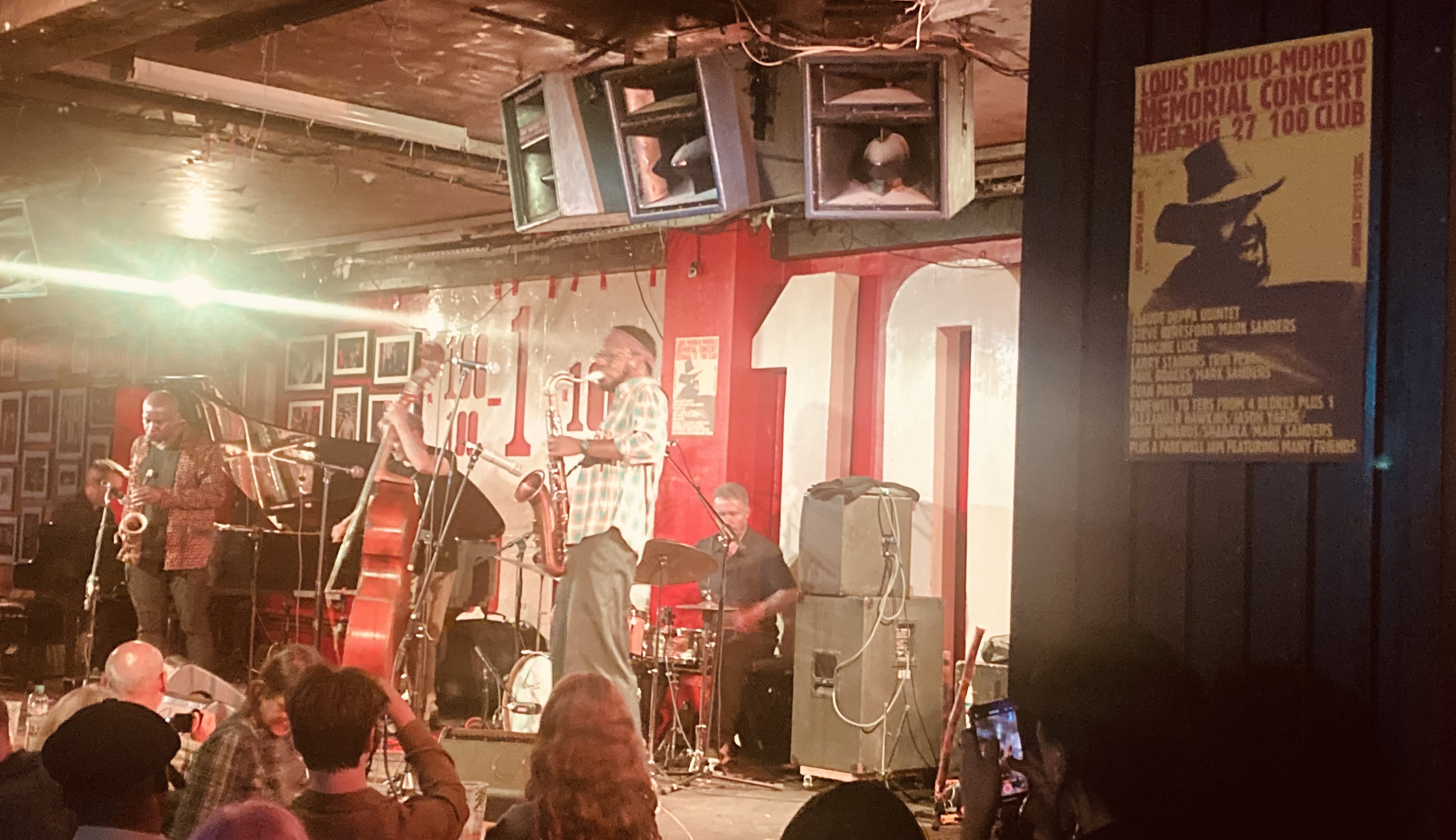
The heart of the celebration of Bra Tebs (as his friends knew him), which was organised by Hazel Miller and Mike Gavin of Ogun Records, came in the set by Four Blokes + 1, his last London-based band. Pictured above, this featured Jason Yarde and Shabaka on saxophones, Alex Hawkins on piano and John Edwards on bass, with the superb Sanders once more on the drum stool, embodying rather than imitating the characteristics of Louis’s playing. They came out roaring, and that’s how they were still sounding as I had to make my departure, with the darkly ecstatic closing cadences of “Dikeledi Tsa Phelo” accompanying me up the stairs and into the night.

Major dudes, minor ninths

The implied flavour of much of the music made by Donald Fagen and the late Walter Becker might be read as that of hard bop as played on the West Coast: laconic, brainy, slyly coded, but also somehow sunlit. By contrast with the jazz musicians they admired, the Steely Dan duo were afforded the sort of time and effort needed to make their records as immaculate as possible, successfully substituting wit and taste for spontaneity. The result, almost airtight in its perfection, would seem to render any attempt at recreation by third parties not just superfluous but doomed from the outset.

There are, nevertheless, several Steely Dan tribute outfits of high repute, existing to satisfy the appetite in particular of those never fortunate enough to hear the original band in person. I haven’t seen any of them, although I was sorry to miss the 14-piece Royal Scammers when they played the 606 Club in Chelsea last year, having heard good reports from reliable sources.

But if tribute bands live are one thing, offering at least a partial guarantee of satisfaction, an album of reinterpretations is a great deal riskier. The British singer and pianist Chris Ingham brings it off with Walter / Donald, his rearrangements of 13 songs performed by a quintet in which he’s joined by the trumpeter Paul Higgs, the saxophonist Harry Greene, the double bassist Geoff Gascoyne and the drummer George Double.

Ingham is a former music journalist (for Mojo, mostly) and author of books on the Beatles, Billie Holiday and others. Now he writes TV soundtracks and leads a band that has also recorded and toured its surveys the music of Hoagy Carmichael, Dudley Moore and Stan Getz. A fine pianist, he has a light, pleasant singing voice, totally lacking in affectation but not in character, wisely avoiding attempts to imitate Fagen’s distinctive sardonic croon. It’s a little like listening to Georgie Fame singing Mose Allison’s songs: a intelligent take, full of the sort of implicit affection and respect which, along with the musicianship involved, make it stand up as a valid adjunct to the originals.

There are some fine moments, many of which bring the latent jazz to the surface. “Your Gold Teeth II” has a lovely two-horn unison intro, a little like a gentler Horace Silver arrangement, and “I Got the News” finds a hint of Monk in the melody’s staccato phrases. The choice of material also veers into less obvious areas, as with “The Last Mall”, a warped blues-with-a-bridge from Everything Must Go, the last Dan album, released in 2003, which has its chords straightened out and is enlivened by the smart addition of the irresistible horn riff from Fagen’s cover of “Ruby Baby”, from The Nightfly. And I think I might even prefer Ingham’s reading of the quietly heartbreaking “Paging Audrey” to that on Becker’s second solo album, Circus Money (2008).

There are fine horn solos throughout, Higgs displaying an almost cornet-like brightness and an adroit use of cup or plunger mute on the brief coda to “Your Gold Teeth II” and the intro and solos on “Haitian Divorce”, while Greene’s tenor has a fluent mobility reminiscent (to me, anyway) of Hank Mobley, excelling on “What a Shame About Me”, a really great song — a John Cheever short story in five verses.

Honestly, if you walked into a club and found yourself listening to this band playing this material, you’d be extremely happy. It might not be a revelation but you’d be hearing wonderful songs carefully turned so as to catch the light from a different angle, in the process drawing out their humanity.

* The Chris Ingham Quintet plays a launch gig for Walter / Donald at the Pizza Express in Soho on September 17. The album is out now on Downhome Records, available from https://www.chrisingham.co.uk/shop

Aces high in Camden Town

On the first floor at the Hawley Arms, a pub in Camden Town, Ted Carroll is spinning the discs. He’s started the session with the Bobbettes’ “Mr Lee”, a record that changed his life when he bought an original copy on the London label. He’ll go on to play Bo Diddley’s “Bo Diddley”, Inez and Charlie Foxx’s “Mockingbird” and other choice stuff before resuming his conversations with guests at last night’s 50th birthday celebration for Ace Records, which he and his co-founders, Roger Armstrong and Trevor Churchill, turned into the most prolific and consistently rewarding of reissue labels.

I used to visit Ted’s stall at the back of 93 Golborne Road, up at the then-untrendy north end of Portobello Road, soon after he opened it in 1971 with a stock built around 1,800 London 45s from the ’50s and ’60s. The equivalent of New York’s Village Oldies and House of Oldies, it attracted a clientele of people — some of them famous — looking for rare old R&B, rock and roll and doo-wop vinyl. He added a stall in Soho later in the decade before opening the Rock On shop on Kentish Town Road, next door to Camden Town tube station, from where he also ran the Chiswick label.

Ace began with the acquisition of Johnny Vincent’s label of the same name, out of Jackson, Mississippi. That was the first of many such deals made with some of the great American post-war record men, including Art Rupe of Specialty, Hy Weiss of Old Town and the Bihari brothers of Modern, a species now extinct. Carroll, Armstrong and Churchill had set off on their mission of creating high-class reissues of neglected music, assembled with love, care, and thousands of hours spent in tape vaults across the US. Among later additions would be the Fantasy group of labels, which included Stax/Volt, thus enabling Armstrong, as he told me last night, to stumble open-mouthed upon the session tapes of “Sitting on the Dock of the Bay”.

Personally, I’m profoundly grateful to such compilers as Mick Patrick, Ady Croasdell, Tony Rounce, John Broven, Dean Rudland and Alec Palao for the enthusiasm and scholarship behind dozens of wonderful CDs devoted to stuff I care about. There’s the imaginatively programmed songwriters’ and producers’ series, covering the works of Goffin & King, Leiber & Stoller, Greenwich & Barry, Mann & Weil, Jackie DeShannon, Randy Newman, Laura Nyro, P. F. Sloan & Steve Barri, Bob Gaudio, Dan Penn & Spooner Oldham, Bert Berns, Jerry Ragovoy, and others. There’s the four-volume Sue story, put together by Rob Finnis, and the epic five discs of the late Dave Godin’s Deep Soul Treasures. There’s Ady Croasdell’s beautiful Lou Johnson anthology, his two-volume This Is Lowrider Soul, and his compilation of Doré label tracks called L. A. Soul Sides, including Rita and the Tiaras’ magical “Gone With the Wind Is My Love”. There’s Mick Patrick’s collection of Teddy Randazzo’s great productions and, going back to 1984, Where the Girls Are, his first compilation and one of many devoted to the beloved girl-group genre.

That’s just scratching the surface. And whether pop, blues, R&B, Northern Soul, funk, gospel or jazz, the packaging of Ace’s releases has always been exemplary, thanks to the informative and enjoyable annotations and picture research by the compilers, and to intelligent artwork by designers including Neil Dell, who worked on many of the CDs I’ve mentioned.

The label was sold a couple of years ago. Its new owners, a Swedish company called Cosmos Music, seem committed to continuing on the same path, with the same managers and contributors. A lot of them were at last night’s very convivial party, which started well for me when I walked in to the sound of Dean Rudland playing Oscar Brown Jr’s “Work Song” off a French EP, followed by Ray Charles giving the Raelettes’ Margie Hendrix her finest hour — well, 16 bars — on “You Are My Sunshine”.

Ted, who followed Dean on the decks, now runs a new incarnation of Rock On in the lovely market town of Stamford in Lincolnshire, just off the A1; a bit different from Camden Town — where, as I walked back to the tube, a trio called Thistle were trying to convince their audience that the ground-floor room of the Elephants Head pub was CBGB, this was 1975, and the next band on the bill would be the Patti Smith Group.

Fifty years ago Ted, Roger, Trevor and their helpers did a great thing by starting Ace. When a label introduces you to such gems as Margaret Mandolph’s ” I Wanna Make You Happy” (on Croasdell’s Tears in My Eyes compilation from 1985) and the Vogues’ “Magic Town” (on Glitter and Gold, the first of Patrick’s two Mann & Weil CDs), you can only raise a glass to the work they’ve done and thank them for the happiness it continues to bring.

Too much, too late

Once upon a time there was a phenomenon called the rip-off, a form of commercial exploitation that could be defined as being overcharged for something you really wanted and had to have. I guess that was back in the ’60s. You knew it when you saw it. Now we live in a rip-off culture, where the price of things is calculated not on the cost of the parts plus a bit of profit for the maker and distributor but on what a sufficient number of buyers can be induced to pay.

I’m writing this while wincing from the pain of having parted with £229 for Bruce Springsteen’s Tracks II: The Lost Albums. This, as you may be aware, is a set of seven CDs recorded between 1983 and 2014, six of them conceived and recorded at the same time and one assembled from bits and pieces. I’ve loved Springsteen since reviewing Greetings from Asbury Park, N. J. for the Melody Maker in early 1973, I bought bootlegs like You Can Trust Your Car to the Man With the Star and the Roxy tapes in the early days, and the last of the many times I’ve seen him, at Wembley in the summer of 2024, is a cherished memory. So I was looking forward to hearing these “lost albums” (which, of course, weren’t lost at all, merely filed away in Bruce’s personal tape store).

Their arrival was a bit disconcerting. They came in a container of very large dimensions, carefully packaged up, opening to reveal a box big enough to hold seven 12-inch vinyl albums, never mind seven little silver discs. The reason for the use of the outsized packaging seems to be the inclusion of a large-format 100-page hardback book containing a lot of impressionistic black and white photographs — Fender Esquire headstock, Twin Reverb amp, Bruce on horseback, Bruce on a motorbike, Bruce in the studio — and a series of short essays explaining the making of each of the CDs.

Despite this early evidence of art-director overkill, I was still looking forward to hearing the music. Gradually, though, as I worked my way through the CDs in sequence, it became obvious that their maker had made the right decision to put them on the shelf. There is virtually nothing here that reaches the level of his best officially released music. What it shows most clearly is that he’s written and recorded a lot of songs over the years in his various home studios, and some of them aren’t very good, which is why they were left on the shelf.

That’s most clearly apparent on the first disc, LA Garage Sessions ’83, where he sounds uncomfortably like the guy of limited horizons gently satirised by Prefab Sprout on “Cars and Girls” in 1988. Streets of Philadelphia Sessions is no better: one-paced and somehow enervated. Faithless, commissioned as the soundtrack for an “as-yet unmade” movie, is better: a well-turned essay in Americana with atmospheric instrumentals and lots of acoustic slide guitar and harmonica, a bit like one of Ry Cooder’s soundtracks, or Dylan’s Pat Garrett and Billy the Kid, with a strong song in “My Master’s Hand”, making it an album you can put on and quite enjoy from beginning to end.

Of Somewhere North of Nashville, a quite lavish but ultimately heavy handed production with lots of Soozie Tyrell’s fiddle and Marty Rifkin’s steel guitar, you can only say that if it were a bunch of demos it wouldn’t get him a publishing contract on Music Row, not when the best of the dozen songs is “Poor Side of Town”, written by Johnny Rivers and Lou Adler, here delivered in a version that lacks the charm of Rivers’ original, a No 1 hit on its release in 1966. Bruce’s stab at a Tex-Mex album, titled Inyo, is fresher, but still not really convincing, despite the occasional use of mariachi musicians, the pleasant textures and the attempt to create complex, poetic lyrics; you merely end up wishing he’d make an album with Los Lobos.

The worst, by a distance, is Twilight Hours, his stab at writing and recording a sumptuously upholstered album of saloon songs, laments for lost love glimpsed in the bottom of a whisky glass in a dimly lit cocktail bar while car tyres hiss by in the rain and neon signs glow in the puddles. That sort of thing. When Sinatra patented the genre, he had the benefit of repertoire composed by likes of Sammy Cahn and Jimmy Van Heusen, Harold Arlen and Johnny Mercer, Jerome Kern, Yip Harburg, Richard Rodgers, Lorenz Hart, Jule Styne and Gordon Jenkins — people who could fit together richly chromatic melodies and highly literate lyrics. And just as none of them could have written “Thunder Road” or “Badlands”, so Springsteen couldn’t write “Angel Eyes” or “Violets for Your Furs”. His decision not to release this album six years ago shows that he knew the results were not satisfactory.

The final album, Perfect Days, although cobbled together from various sessions, is paradoxically quite the most coherent of all the discs, with some songs that would have taken their places happily in second-rank Springsteen albums like Working on a Dream or High Hopes. Big and beefy in an E Street Band way, “Another Thin Line” is a fine take on the “Gloria” template, while “The Great Depression” is a particularly attractive strummed ballad.

If you told me that Dylan often leaves great stuff in the vault until it finds its way into a volume of his Bootleg Series, I’d answer that there’s no “Blind Willie McTell”, “Red River Shore” or “Cross the Green Mountain” here. If you were to say that Dylan often tries on costumes, whether for Nashville Skyline or Shadows in the Night, as Springsteen does here, I’d reply that the older artist made important strategic use of those genre-hopping adventures, allowing them to condition the music that came next. Dylan may have recorded “Autumn Leaves”, but he didn’t make the mistake of thinking he could write something like it; instead he used the experience of delivering it to redirect his approach to singing his own songs.

So I dunno. Previous dives into Springsteen’s vaults have delivered excellent official versions of much loved and often bootlegged songs such as “Santa Ana”, “Thundercrack” and “The Promise”. When it comes to this set, I admire him for exercising good judgment when it came to making an initial assessment of the material. I suppose it ought to be interesting to hear the stuff that didn’t work — but at more than 30 quid a disc? I really don’t think so.

A salute to Tom Lehrer

Once the rockets are up, who cares where they come down? / That’s not my department,’ says Wernher von Braun.

The songs of Tom Lehrer presented me, in my early teens, with my first exposure to the art of modern satire. He was some kind of genius, a Randy Newman with sharper teeth, achieving popularity in the 1950s and ’60s and then giving it all up to pursue his career as a teacher of mathematics at Harvard, MIT and elsewhere. In 2020 he announced that all his work was henceforward free from copyright considerations; anybody could do whatever they wanted with it.

He died the other day, aged 97, at his home in Cambridge, Massachusetts. I’ve read some good obituaries, particularly one in the Guardian by Francis Beckett, whose play Tom Lehrer Is Teaching Math and Doesn’t Want to Talk to You will be performed at the OSO Arts Centre in Barnes, south-west London, in November. But none of those I’ve seen mentioned the couplet at the top of this piece. It comes from his song “Wernher von Braun”, about the German scientist who helped create the V2 for Hitler before working on ballistic missiles for the US Army and rockets for NASA. These lines have stayed with me all my life, helping in a small but not insignificant way to form a view of the world.

The return of Larry Stabbins

Not often does a jazz club dedicate an evening to the memory of a regular customer. Last night’s show at the Vortex was dedicated to Shirley Thompson, who died earlier this year, aged 87. For many years Shirley and her partner, John Jack, the founder of Cadillac Records, were fixtures at a table for two alongside the left-hand wall; the seating arrangements have recently changed, but a photograph of the couple and a bottle of wine were placed on a table in their old location.

As it happens, a lot of emotions were floating around the Vortex last night. The event also commemorated the late Louis Moholo-Moholo by functioning as the launch of a new CD, recorded live in Foggia during a short Italian tour 40 years ago, by a special trio: Louis on drums, Keith Tippett on piano, and Larry Stabbins on tenor and soprano saxophones and flute.

Stabbins was the featured attraction last night, leading a trio completed by the most suitable replacements possible: Alexander Hawkins on piano and Mark Sanders on drums. Having made his reputation alongside Tippett, his fellow Bristolian and mentor, in Centipede and Ark, and confirmed it with the the SME, the LJCO and others, as well the band Working Week, the saxophonist left music for 20 years. His return to activity is greatly to be applauded.

Last night he led off with “Ismite Is Might”, a beautiful Chris McGregor composition that he remembered from his experience of depping for Alan Skidmore in the Brotherhood of Breath. A sober, hymn-like piece, it displayed the strength of his tenor tone and the sharp focus of his phrasing: stronger and sharper than I remembered, indeed. There were other evocations of the South African influence throughout the set I heard, most obviously in a marvellously powerful Hawkins solo. Sanders kept the pots boiling throughout in a way that Louis would have admired. This was life-enhancing music.

* Live in Foggia is out now on the Ogun label (Ogunrecording.co.uk). There will be a full-scale tribute to Louis Moholo-Moholo at the 100 Club on August 27, featuring many musicians with whom he worked, including Claude Deppa, Evan Parker and Shabaka Hutchings, and members of his band Four Blokes (tickets: https://wegottickets.com/event/669285).

Olie Brice at the Vortex

Almost a year ago I wrote warmly about the debut of the bassist and composer Olie Brice’s new quartet at Cafe Oto, noting that they’d be going into a studio the following day to record an album. That album — titled All It Was — is now out, its release celebrated at the Vortex last night with an evening of powerfully emotional music.

The tenor saxophonist Rachel Musson, the pianist Alexander Hawkins and the drummer Will Glaser are Brice’s accomplices in a project that takes all the lessons the four of them have ever learnt about how to play this music and puts the result at the service of a set of distinctive and memorable compositions.

Brice tends to lead off in the way Charles Mingus used to, with solo bass statements of attention-grabbing clarity and strength before the others dive into the structures of pieces such as “Listening Interntly to Raptors” (which began the set with a Monkish prowl), the soaring, hard-swinging “Happy Song for Joni”, the hypnotic “And We Dance on Firm Earth”, and the pointilliste “After a Break”.

A couple of of the pieces referred to recent losses. “Morning Mourning” was an elegy for Brice’s father, while Don Cherry’s “Awake Nu” was included as a tribute to Louis Moholo-Moholo, who died in South Africa last month. Fittingly, Glaser’s playing throughout the evening was lit by Louis’s fire: dense but never oppressive, building to ecstatic climaxes, particularly in several duet passages with Hawkins, who occasionally infiltrated almost subliminal elements of barrelhouse and boogie-woogie into his strongly percussive inventions.

Once again Musson impressed as one of the most creative saxophonists on the UK scene, employing a striking variety of tone and trajectory, from jagged outbursts at full throttle to the delicate altissimo phrases with which she brought one piece to its final rest.

That combination of grace and strength typified the assimilation of individual assets into the work of a truly extraordinary quartet. All It Was will be one of the records of the year, and this was a gig to match its excellence.

* The Olie Brice Quartet’s All It Was is on West Hill Records and available via Bandcamp: https://westhill.bandcamp.com/

Café Society in wartime

`

I imagine I picked up a copy of Life magazine’s edition of October 16, 1944 from a flea market many years ago because its cover featured the 20-year-old Lauren Bacall, making her screen debut in To Have and Have Not opposite Humphrey Bogart: “Midway through the first reel the sulky-looking girl shown on the cover saunters with catlike grace into camera range and in an insolent, sultry voice says, ‘Anybody got a match?'”

But along with that, I got something that now seems much more interesting.

Between full-page ads for Packard and Pontiac cars, Texaco oil, Budweiser beer, National Dairy, Stromberg-Carlson radios and Chesterfield cigarettes, all using the military as a motif and/or urging citizens to buy war bonds, there’s a story describing how, in New York, “hotels are booked solid for weeks in advance and guests spend more money” and “the boom reaches a peak in the sale of luxury goods at department stores.” In a month when Allied troops are fighting their way into Germany, this is part of report on the vigorous economic upsurge created by the US participation in the Second World War.

To illustrate the upbeat mood, the editors present a double-page spread on a flourishing nightclub, Café Society Uptown. Located on East 58th Street, between Lexington and Park Avenues, it’s an adjunct to the original Café Society on Washington Square in Greenwich Village. Both were run by Barney Josephson, who booked Billie Holiday for opening night in 1938 at the Village establishment, where she would sing “Strange Fruit” for the first time a year later. The second club opened in 1940. Both were notable for the welcome they extended to all races.

The current attractions at the East 58th Street joint in the autumn of 1944 were the fine jazz pianist Hazel Scott, the folk singer Burl Ives and the comedian Jimmy Savo, who can be seen at the microphone. Higher wartime wages meant that business was up 25 per cent on the previous year, so Josephson told the magazine, and patrons were spending an average of $10 a head.

I could spend hours scanning the faces looking up at the lens deployed at a high angle by Herbert Gehr, a German-Jewish photographer who had escaped Nazism and photographed the Spanish Civil War before arriving in the US, where he joined the staff of Life. I wish there were a key giving the details of each individual in the teeming frame. But the magazine’s caption writers do their best in giving us an anonymised but still vivid snapshot of the diversity of the evening’s audience:

“Included in this picture are an executive from the Bass Pecan Company in Mississippi, a dentist from Locust, N. J., a lieutenant in the Army Air Forces, a high-school athletics teacher, a Nigerian lecturer on Africa, a statistician for a credit house, an editor of Tomorrow magazine, a du Pont chemist now in the Navy, a veterinarian, an American Airlines stewardess, a Negro carpenter, a machinist at Brewster Aeronautical Corp., a beauty consultant at Oppenheim Collins store, a watchmaker from Brazil, a broker, a star in the musical comedy Mexican Hayride, a buyer of drugs for Bloomingdale’s department store, a corporal from an evacuation hospital, a sailor on an aircraft carrier, a clerk in the Elastic Stop Nut Corp., a researcher for Friends of Democracy, Inc., a Conover model, an assistant buyer at Lord & Taylor, a student at Smith College, a writer for R. K. O., a Czech refugee, a library assistant at Columbia University, an Army anti-aircraft colonel, a salesgirl in Macy’s and a sheet-metal manufacturer.”

I’ve been trying to spot the “Conover model”, who would have been someone on the books of the agent Harry Conover. His roster included Eugenia “Jinx” Falkenburg, a former Hollywood High School student who posed for Edward Steichen, was named “Miss Rheingold” in a series of beer ads, and by 1944 had became famous enough to play herself alongside Rita Hayworth and Gene Kelly in Charles Vidor’s romantic comedy Cover Girl, with songs by Jerome Kern and Ira Gershwin. Four years later her younger brother Bob would win the Wimbledon men’s singles title. Maybe Jinx is there in the crowd.

But the conclusion reached by the caption writers, pursuing the theme of a wartime boom, is this: “Many of them three or four years ago would not have been able to afford Café Society. Even today few are rich. But with extra money in their pockets they can do what they have always wanted to do — go to a night club, buy a few drinks, see a show. And by their spending money they contribute to the prosperity of the night-club owner, the waiters, the entertainers, the cooks, the florists who supplied the flowers, the grocers who sold the food — thus giving one more spin to the wheel of prosperity. How long it would last or to what heights it would go, whether the inevitable transition period to come would be followed by depression, normalcy or another boom, nobody could tell.”

‘Quadrophenia: A Mod Ballet’

For me, if for no one else, the Who completed the important phase of their work in the period that began at the start of 1965 and ended in the middle of 1966, encompassing their magnificent first four singles: “I Can’t Explain”, “Anyway Anyhow Anywhere”, “My Generation” and “Substitute”. I’d add “The Kids Are Alright”, recorded for their first LP but released as a 45 after they’d skipped labels from Brunswick to Reaction. And I can’t dismiss the later “I Can See For Miles” and “Won’t Get Fooled Again”. But I could never enjoy Pete Townshend’s rock operas in the same way, much as I admired his ambition.

So I was surprised by how much I liked the version of Quadrophenia presented at Sadler’s Wells this week: a full-blown ballet production, directed by Rob Ashford, with Townshend’s music rendered in pre-recorded orchestral arrangements by the composer Rachel Fuller, who has been his partner for more than a quarter of a century. No lyrics or dialogue, of course. I liked that. Show, don’t tell.

The dancing, choreographed by Paul Roberts, is wonderful, led by the nervily agile Paris Fitzpatrick as Jimmy and the lustrous Serena McCall as Mod Girl (the roles taken by Phil Daniels** and Lesley Ash in Franc Roddam’s famous 1979 movie version). There’s a warmly welcomed cameo for Matthew Ball as the Godfather, while the peroxide-rinsed Dan Baines takes Sting’s role as the Ace Face.

On stage, in this format, Townshend’s creation seems much closer to West Side Story than in its previous incarnations, particularly when the two gangs sweep back and forth in a recreation of the Mods versus Rockers battles on Brighton sea front, using a freeze-frame technique now familiar from war films. Equally stunning is a sequence evoking the PTSD nightmares suffered by Jimmy’s intolerant working-class dad as a result of his wartime experiences.

All of it is enabled by Christopher Oram’s brilliant set design, sliding back and forth in conjunction with video projections to recreate an office, a suburban home, a coffee bar, a Soho club (the Marquee), train compartments and the Brighton beach and promenade. On my rare outings to the theatre and the ballet these days I’m usually struck by the creativity with which modern resources are deployed, and this was a fine example. The climax, with Jimmy alone on a jetty against the sweeping tide, is something that won’t fade quickly.

Two instrumental bits of original Who recordings are used: “I Can’t Explain” and an extended mix of “My Generation”. Otherwise Fuller’s orchestrations are lush and brassy, and do the job satisfactorily, although they were actually a bit too loud, which might seem a strange thing to say about something based on the music of the Who, in their prime the loudest band I ever heard.

The other criticism would be that the individual identities of the characters playing the four elements of Jimmy’s character — the Tough Guy, the Lunatic, the Romantic and the Hypocrite — are never fully established, however well they’re expressed by the quartet of dancers. Of course they all have to be wearing the same kind of three-button Tonik suits as Jimmy (designed, at Townshend’s request, by Paul Smith), but even subtle colour variations can’t make it clear.

I never thought Quadrophenia contained Townshend’s best music, but this ballet may be its most satisfying iteration. It’s on at Sadler’s Wells until this Sunday (July 13), and it wasn’t quite full earlier in the week, so there may be a few seats left.

* Box office: sadlerswells.com. It’s also at the Lowry in Salford from July 15-19: thelowry.com.

** Thanks to all those who corrected my original mention of Paul, not Phil, Daniels…

Under the same sky

In the 55 years since the discreet arrival of the first ECM album, Mal Waldron’s Free At Last, Manfred Eicher’s label has released somewhere north of a thousand albums. Contrary to a cynical early view, they don’t all sound the same. They are, however, distinguished by the presence of set of qualities — musical, aesthetic and philosophical — that appear, in varying proportions, in just about every one of them. You can detect those qualities in four of their recent releases, each of which exemplifies a certain characteristic taken to the very highest level.

1 Vijay Iyer / Wadada Leo Smith: Defiant Life

American jazz from the tradition continues to make its presence central to ECM’s output. Smith’s trumpet and Iyer’s keyboards and electronics weave their way through spellbinding duets subtextually infused with a sense of history. Smith’s “Floating River Requiem” is a dedication to Patrice Lumumba, the Congolese independence leader murdered by colonial forces in 1961, while Iyer’s “Kite” acknowledges Refaat Alareer, a leading Palestinian poet killed along with two siblings and four nephews during an Israel air strike on Gaza in late 2023. Sorrow and outrage are present in this music, but it also serves, in Iyer’s words, as a statement of “faith in human possibility.”

2 Anouar Brahem: After the Last Sky

Modes from all over the world find their way into the ECM matrix. The Tunisian oud player and composer Anouar Brahem first recorded for the label 35 years ago. On his latest album he is in the company of three of the company’s regulars: the cellist Anja Lechner, the pianist Django Bates and the bassist Dave Holland. Taking its title from a book by the late Edward Said, this album, too, is driven by reflections on the suffering, recent and historic, of the people of Gaza, as outlined in Adam Shatz’s fine sleeve essay. Unfolding with patience and elegance, metabolising elements from Arabic maqam, jazz and European classical music, these quartet pieces ache with grief.

3 Alexander Knaifel: Chapter Eight

By cultivating a widespread audience for the work of the Estonian composer Arvo Pärt via its New Series offshoot, ECM helped create the genre known as “holy minimalism”. Alexander Knaifel (1943-2024), born in Tashkent, studied cello with Rostropovich in Moscow in the 1960s before making a reputation writing operas and film music. A kind of an Uzbek version of Anthony Braxton, he also wrote an extended piece for 17 double basses and another for 35 Javanese gongs. But the pieces on this album, performed by an ensemble of three Latvian choirs and the Swiss cellist Patrick Demenga, are settings of verses from the Song of Solomon. Proceeding with great deliberation under the baton of Andres Mustonen, they achieve the required meditative glow to very satisfying effect, fully exploiting the acoustic resonance of the Jesuit church in Lucerne, where they were recorded in 2009.

4 Arve Henriksen / Trygve Seim / Anders Jormin / Markku Ounaskari: Arcanum

The crucial role played by ECM in the emergence of Nordic jazz needs no acknowledgement. Here are four leading players — the trumpeter Henriksen and the saxophonist Seim from Norway*, the bassist Anders Jormin from Sweden, and the Finnish drummer Ouaskari — at the height of their powers, taking memories of Ornette Coleman’s quartet as a starting point from which to develop conversations of great beauty and originality. All four of these albums are outstanding, but this is the one that sounds to me like a future classic.

* Due to a moment of brain-fade, this piece originally claimed that Henriksen and Seim are Finnish. My thanks to those who noticed and gently pointed out the error.