Skip to content

Bearing witness

It was by concidence, or so I imagine, that a CD titled Cwmwl Tystion dropped through my letterbox on St David’s Day, which falls on March 1. Cwmwl Tystion — whose English title is Witness — happens to be an album of new jazz by Welsh musicians, devoted to themes of Welsh culture and nationhood.

The literal translation of “cwmwl tystion” is “cloud of witnesses”, a phrase taken from a translation (by Rowan Williams, the former Archbishop of Canterbury) of a poem called “What is Man?” by Waldo Williams (1904-1971), a celebrated Welsh poet, nationalist and peace activist:

What is it to be a people? A gift
lodged in the heart’s deep folds.
What is love of country? Keeping house
among a cloud of witnesses.

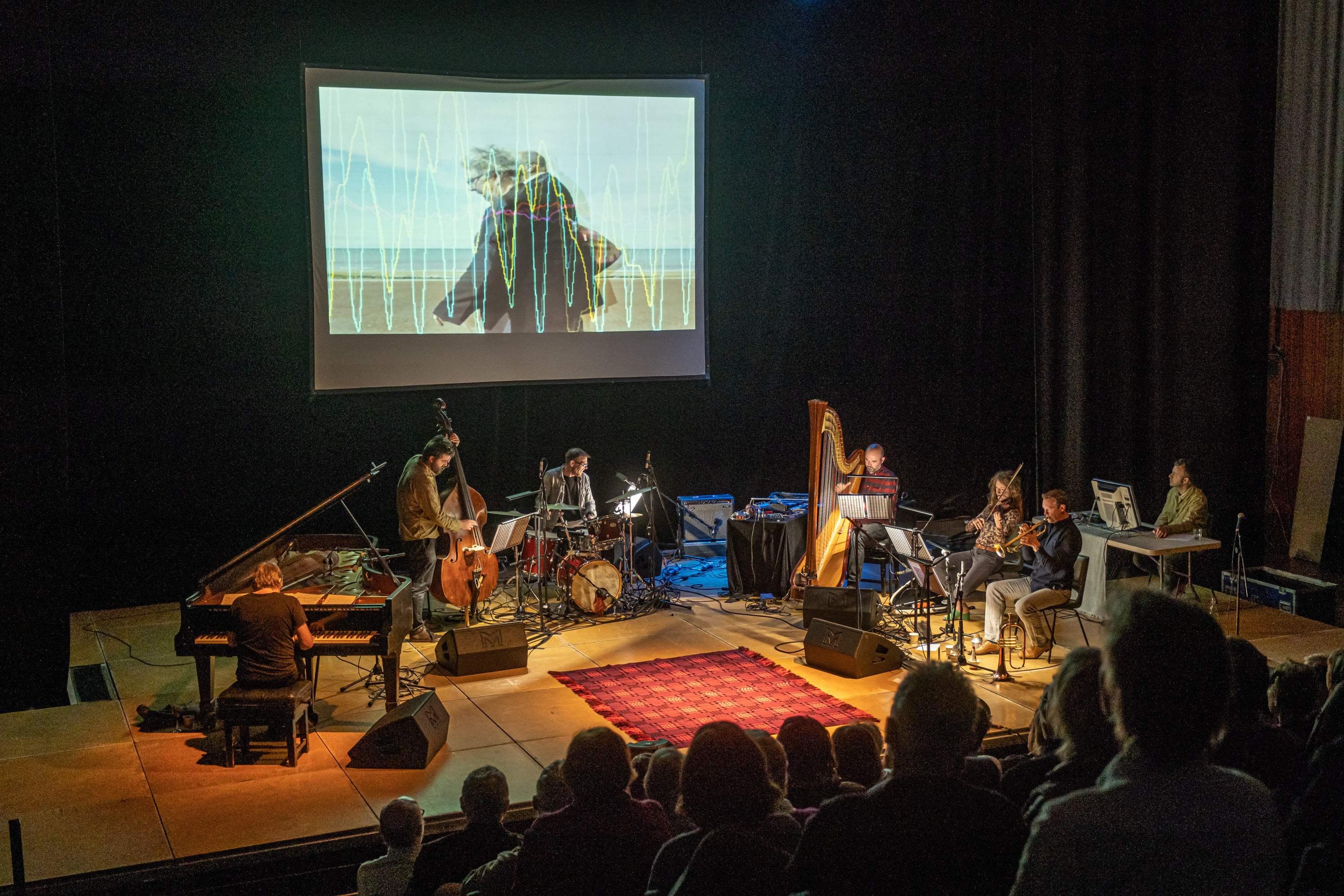
Six of the seven pieces on the album were written by the trumpeter Tomos Williams (the exception is the traditional “Glyn Tawe”) and performed by him with Francesca Simmons (violin and saw), Rhodri Davies (harp and electronics), Huw Warren (piano), Huw V. Williams (bass), and Mark O’Connor (drums). The titles make reference to Paul Robeson’s historic performance at the miners’ eisteddfod in Porthcawl in 1957; to the Blue Books of 1847, in which the teaching of the Welsh language was officially discouraged; and to the infamous obliteration of an entire North Wales village in 1965 in order to create a reservoir to provide water for the people of Liverpool.

This would be all very well and good, but perhaps pleasing primarily to Welsh hearts, were it not that the music produced by Tomos Williams and his colleagues is of the very highest class. Supported by Ty Cerdd (Music Centre Wales), on whose label the CD was released this month, The Cwmwl Tystion Suite was given five concert performances — with live visuals by Simon Proffitt — in 2019, from which these recordings were taken.

What Tomos Williams has done is subtly infiltrate contemporary jazz practices with textures drawn from the music of his native land, but in a very non-literal way. So while the sound of Rhodri Davies’ harp is a reminder of traditional Welsh music, it also carries an echo of Alice Coltrane: the spirituality shared by both infuses the music without dominating it. Davies’s use of electronics adds different colours and dimensions to the music, as an equal voice with the acoustic instruments or as a soundwash. The unusual instrumentation is thoughtfully deployed — as in the trumpet/violin statement of the opening “Mynyddoedd Cymru (Mountains of Wales)” — and shrewdly rotated to maximise its possibilities and its freshness.

All the soloists bring character to their improvisations. Tomos Williams plays as Wadada Leo Smith might do, had he been born in Aberystwyth: a different kind of blues. Francesca Simmons finds interesting ways of applying lyricism to these often astringent textures, and her rich tone is spotlit on “Glyn Tawe”. Huw V. Williams is a powerful force on bass, taking the spotlight on the tribute to Robeson, and Huw Warren’s glistening solo on the closing track, “What is Man?”, mines the creative space between Bill Evans and Herbie Hancock. Mark O’Connor’s drumming is beautifully sensitive and exquisitely detailed, radiating light and swing.

Jazz is an African American music generous enough to allow others to inhabit its spirit and to shape it to their own ends. Django Reinhardt proved that, as have Tomasz Stanko, Dudu Pukwana, Han Bennink, Don Drummond, Giorgio Gaslini, John Surman, Masabumi Kikuchi, Gato Barbieri, and many others. If the music can “belong” to Sinti, Poles, South Africans, Dutch, Jamaicans, Italians, English, Japanese and Argentinians, then it can belong to the Welsh, too.

Small country, big heart — a heart that beats firmly throughout this excellent album, a showcase for skill, imagination, soul and originality. Even without a spasm of hiraeth — the Welsh yearning for the homeland — I’d be disposed to recommend it very highly indeed.

* The photograph was taken at Aberystwyth Arts Centre by Keith Morris. Further information: http://www.tycerdd.org or http://www.tycerddshop.com

(Not) leaving on a jet plane

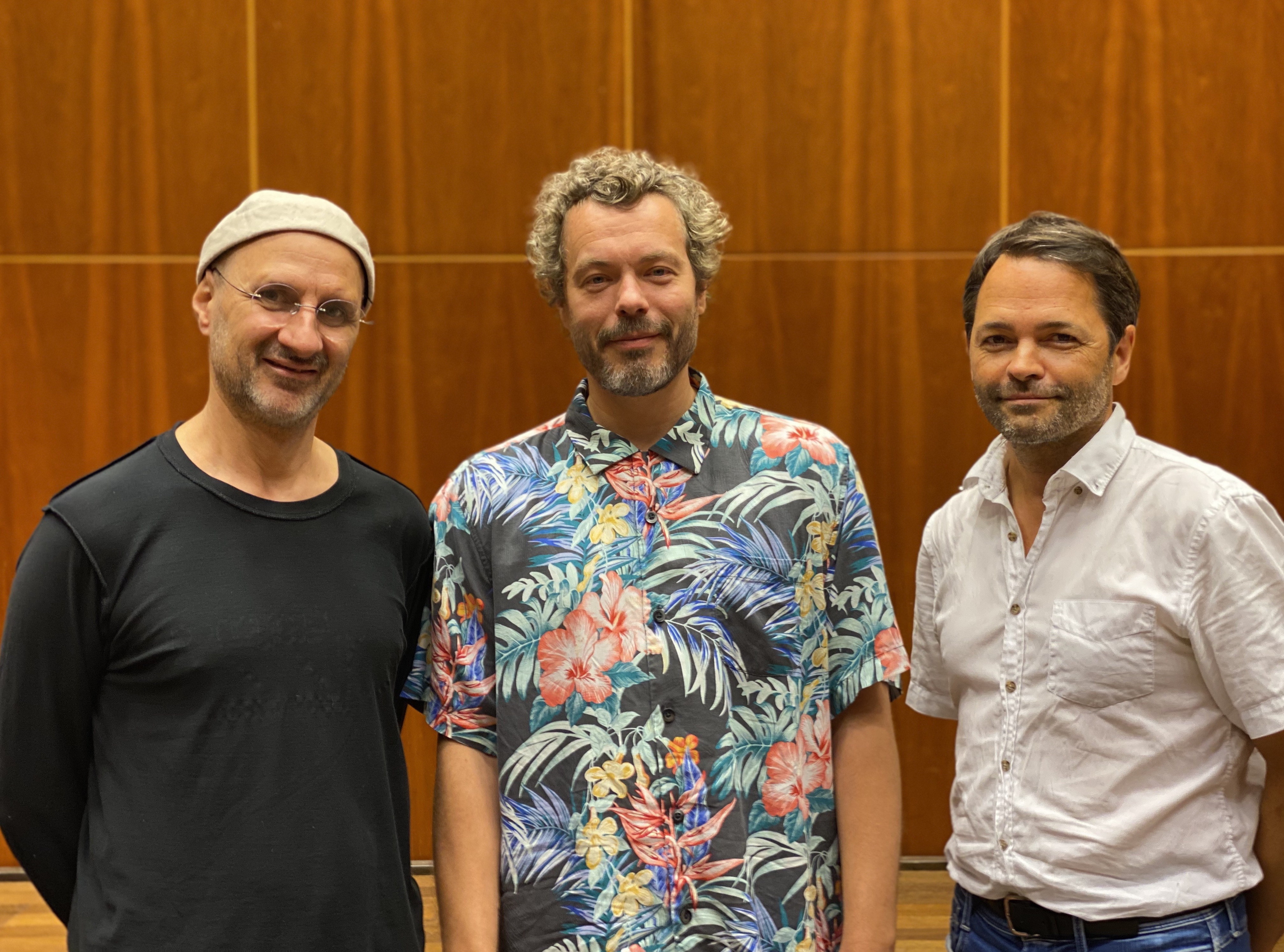
Lynda Laurence, Jimmy Webb, Mary Wilson, Jean Terrell (photo:Jim Britt)

Until a few weeks ago, I’d never heard the album the Supremes made with the songwriter and producer Jimmy Webb for Motown in 1972. The 26th of their 29 studio albums, the collaboration represented a pretty lateral move for the group. Commercially, it wasn’t a success. Its leaden title — The Supremes Produced and Arranged by Jimmy Webb — was a bit of a charisma-killer. Only one single was issued: its A-side was the one track on the album in which Webb had no hand. “I Guess I’ll Miss the Man”, a nondescript cover of a song from the Stephen Schwartz musical Pippin, produced by Motown regulars Sherlie Matthews and Deke Richards, made it to No. 85 on the Billboard Hot 100: a long way from their long run of chart-toppers in the mid-’60s.

It was in 1965 that the Supremes first sang a Jimmy Webb song. That was “My Christmas Tree”, produced by Harvey Fuqua for the group’s Christmas album. Webb was 18 years old and had signed his first publishing deal with the Motown-affiliated Jobete Music, and this was the first of his songs to be recorded by a major artist. By the time he joined the group in the studio seven years later, his track record included “By the Time I Get to Phoenix”, “Up, Up and Away”, “Wichita Lineman” and “MacArthur Park”. With the Fifth Dimension’s Magic Garden, he’d shown that his songs and arrangements could shape the sound of a sophisticated vocal group.

At no point does the Supremes’ Jimmy Webb album sound like a Motown production. No Funk Brothers, that’s for sure. It’s a typical product of early-’70s Hollywood, applying standard-issue studio polish to modish concerns represented by the presence of a Joni Mitchell song (“All I Want” from Blue) and Webb’s own “When Can Brown Begin?”, which he wrote after hearing Sammy Davis Jr use that phrase. There’s not much inspiration to be found in “Silent Voices”, a pleasant cover of Mina’s “La Voce del Silenzio”, and any comparison between this version of Harry Nilsson’s “Paradise” and the Ronettes’ original provides only irrefutable evidence of Phil Spector’s genius.

But there are two memorable moments. One is Webb’s “I Keep It Hid”, the only track on which the excellent Jean Terrell doesn’t take the lead. This one is sung by Mary Wilson, and it was her recent death that made me go back and listen to it again. The Supremes’ greatest team player — the only one who was there from start to finish — had a lovely voice, if not a wildly distinctive one. Here she handles a very nice pop ballad with poise and confidence.

The other moment is one I’d put up alongside any of Webb’s early classics. It’s called “5:30 Plane” and it’s one of those marvellous songs in which he captured all the subtleties and nuances of an entire relationship through snatches of thought and circumstantial detail. The singer is in the throes of a break-up. Both parties have been unfaithful and things have become desperate. “I don’t want to know about the whole affair,” she sings, “and you don’t want to know about his pretty hair.” So she’s decided to go. She doesn’t want any more talking. She’s bought a ticket to another town. But here she still is.

What makes you want to play this mid-tempo song over and over again is the glorious melody over beautiful changes, with a hook in the chorus that represents Webb at his best as a pop-music craftsman. But what makes it a great song is the detail of the flight time. “I didn’t want to be here, baby, when you got home, sitting alone,” Terrell sings, her voice soaring and swelling with sadness over the supporting choir, “but the 5:30 plane has already gone.” You’re in the room with her as she sits there, thinking of that plane heading through the evening sky towards Houston or Phoenix or Albuquerque, waiting for what comes next.

Bunny Wailer 1947-2021

In 1966 I bought two Wailers singles, issued in the UK on the Island label. The first, WI-268, was the beautiful original up-tempo take of “Put It On”, b/w “Love Won’t Be Mine”. It would be five or six years before I knew that the song and the preaching vocal on the A-side were by a man called Bob Marley. The second, WI-3001, was even better. “Sunday Morning” was the B-side to “He Who Feels It Knows It” but it is one of the loveliest ballads of that whole decade. It was written and sung by Neville Livingston, who became better known as Bunny Wailer.

Marley wasn’t even on this record. It was cut during his time away in the United States, working at factory jobs in Wilmington, Delaware, where his mother had gone to live. His replacement at the session, joining Peter Tosh as one of the harmony voices supporting Bunny’s gentle lead, was Constantine “Vision” Walker, a cousin of Rita Marley, Bob’s wife.

For me, the Wailers were always Bob, Bunny and Tosh. It was obvious why Bob turned into the focal point and became one of the most famous and charismatic singers on the planet. But that leaderless era, from 1962-1973, produced some wonderful music, none of it better than “Sunday Morning”, made by a bunch of Jamaican teenagers and standing alongside the Impressions’ “I Made a Mistake”, “I’ve Been Trying” and “I’m So Proud” as a classic of mid-’60s soul balladry.

History says that Bunny harboured a bitterness about what happened to the group he had helped to form. There are rights and wrongs about that, things to be said on both sides, and no doubt they’ll be analysed in the obituaries that will follow today’s announcement of his death at the age of 73, following a stroke last year. But at the moment I’d rather listen to these three minutes of concentrated, unspoilt, imperishable beauty.

* If you want another dose of Bunny’s exquisite singing from that era, try the Wailers’ version of the Moonglows’ “Ten Commandments of Love”.

Music for Black Pigeons

Jorge Rossy, Jakob Bro, Arve Henriksen (photo: Andreas Koefoed/ECM Records

To be perfectly honest, I couldn’t think of a headline for this piece. So I used the title of a composition from Jakob Bro’s new album, which features the Danish guitarist with the Norwegian trumpeter Arve Henriksen and the Spanish drummer Jorge Rossy. I just liked the sound of it. Or maybe I liked the idea of what sort of music might appeal to black pigeons. And if you’re asking yourself, as I did, whether there actually are black pigeons, the answer is that the black imperial pigeon, Ducula melanochroa, also known as the Bismarck imperial pigeon, is native to the Bismarck Archipelago, a group of islands off the north-east coast of New Guinea.

The album is titled Uma Elmo and is a good example of the procedure developed by the producer Manfred Eicher early in the life of his label, ECM Records. He assembles a group of musicians from among his repertory company, puts them in a sympathetic recording environment and sees what happens. In this case the three musicians receive equal billing, displayed on the sleeve in alphabetical order, although the fact that all eight compositions are by Bro suggests that he is in some sense the leader of the session, or at least the agenda-setter.

I love Bro’s playing and the records he makes. He has an understated take on modern guitar-playing, more painterly than most. Thought goes into every note, which is why in the past he’s worked so well with the bassist Thomas Morgan, who appeared on Bro’s first four ECM albums. Morgan isn’t here this time, but Henriksen and Rossy (who is probably best known for his long tenure with the trio of Brad Mehldau) have a similar sense of economy and of the need to play only the right notes.

The pieces on this album are tone poems, more abstract than Bro’s usual creations. Each one floats in its own pool of texture, subtle in effect and gradual in momentum, but employing a surprisingly wide dynamic and emotional range. Exquisite but never effete, they invite the musicians to explore their individual instrumental vocabularies as part of a collective creation. Solos are not the point here. But all of them play at the top of their form: Bro making fascinating use of loops, Henriksen producing his most lyrical flights, and Rossy proving himself to be a master colourist in this largely tempo-free music.

Highly recommended, then, and not just to Bismarck imperial pigeons. Ducula melanochroa is not, I’m pleased to report, an endangered species. They flourish, just like these three exceptional modern musicians.

* Here’s a link to the promo clip for Uma Elmo: https://youtu.be/UZQZNF4qwwo

Just like Elvin, Art, Max…

All the way through the ’60s, starting at the age of 13, I’d buy a copy of Down Beat every fortnight from a newsagent that stocked foreign publications. Thirty five cents in the US, it cost half a crown in the UK — a lot of money when I was still at school. Of course I wanted to read interviews with people like John Coltrane and Ornette Coleman, and to absorb the wisdom of critics and columnists such as Pete Welding, Don DeMichael, John A. Tynan and LeRoi Jones. But I also wanted to gaze at the full-page ads for Gretsch drums.

Other manufacturers also used famous players as their pitchmen: Shelly Manne used Leedy drums, we were told, while Buddy Rich played Rogers, Rufus Jones played Slingerland, and Joe Morello had a Ludwig kit. But the Fred Gretsch Manufacturing Co. of Brooklyn, NY… well, as you can see above, they had Elvin Jones, Art Blakey, Max Roach, Philly Joe Jones and the teenaged prodigy Tony Williams, all of them drummers I worshipped, and most issues of Down Beat included an ad showing one of them with the kit he favoured. That was enough to give me a lifelong yearning to own a set of Gretsch drums: a jazz kit with an 18-inch bass drum and 12- and 14-inch toms, all in that nice black finish that Tony used with Miles, and a five-inch chrome-shelled snare drum. Since you’re asking.

I know it’s stupid to fetishise makers of percussion instruments; after all, one of the most effective drum kits in music history — the one in Motown’s main studio throughout the ’60s, played by Benny Benjamin, Richard “Pistol” Allen and Uriel Jones on countless classic hits — was a hotch-potch bearing the logos of Ludwig, Slingerland, Rogers and Gretsch. And how great did that sound?

Still, we can dream, and my particular yearning was partially satisfied a few years ago when I was asked what I wanted for Christmas and the only thing I could think of, within sensible limits, was a Gretsch snare drum. So now I have one, just to keep my wrists in shape, although a fear of annoying the neighbours leads me to muffle it with a thick duster, which removes a fair amount of the fun. (The kid across the street who started playing a full kit from scratch a year ago has no such compunction, but at least he’s got a future and I can hear him improving by the month.)

And the point of this, you’re asking? It’s that next month there’s an online auction of equipment from the Gretsch factory, with the proceeds apparently going to the company’s charitable foundation, whose activities include organising drum circles for child refugees from Africa and the Middle East. Here’s a link. You’ll see that among the offerings are not just drums and some of the guitars for which the company also became famous — including the Chet Atkins and Duane Eddy models — but an intriguing miscellany of items including “vintage guitar neck patterns, a rolling rack with ten drawers of saw blades, metal clamps with a large wooden hand drill, an antique cabinet, body forms, wrenches, a sanding table, vintage four-wheel open carts and more…”

I won’t be bidding. I’ve got my drum with a Gretsch badge on it. Just like Elvin, Art, Max, Philly Joe and Tony, right?

Cats, herded

Alexander Hawkins and Evan Parker (photo: Dawid Laskowski)

Organising free improvisers might seem like a fool’s task. Why would the special breed of players who spend their lives resolutely creating music from scratch suddenly want to submit to the will of a composer? Nevertheless, history proves that sometimes it works: notable successes were recorded by Michael Mantler with the original Jazz Composer’s Orchestra, Alexander von Schlippenbach with his Globe Unity Orchestra and Barry Guy with the London Jazz Composers’ Orchestra. Each project depended to some extent on the leader/composer’s familiarity with the techniques of contemporary European straight music, but the idea was given new impetus with the introduction of the looser and perhaps more organic-to-the-idiom technique of “conduction”, pioneered by the late Butch Morris and pursued by George Lewis and Tyshawn Sorey, among others. Slightly to one side were the adventures of the British duo Ashley Wales and John Coxon, known as Spring Heel Jack, who created stimulating modern environments for many individual improvisers, including Wadada Leo Smith and John Tchicai.

The first sound heard on Togetherness Music: For Sixteen Musicians, Alexander Hawkins’ new album, is that of Evan Parker’s soprano saxophone, unwinding its always surprising coils of sound, the seemingly unbroken skeins of notes punctuated by split-second darts and lurches into other registers. As usual, it’s exhilarating and mesmerising, particularly when the sound of the isolated soprano blooms with reverberation, which may or may not be the natural property of Challow Park Studios in Oxfordshire, where the set was recorded. But then Hawkins introduces his other resources: the five string players of the Riot Ensemble and nine other musicians, including the trumpeter Percy Pursglove, the saxophonist and flautist Rachel Musson, the cellist Hannah Marshall, the bassist Neil Charles, the drummer Mark Sanders, and Matthew Wright on electronics, all conducted by Aaron Hollway-Nahum. Gradually they add sombre pedal-points, heightening the atmosphere before Parker drops out and the strings begin to slip and slide until the piece ends, after almost 10 minutes, with several of them holding a tentative D natural.

Sanders and Pursglove are the next to get the concerto grosso for improvisers treatment, a layer of restless percussion under the silvery trumpet continuing into a dialogue with written lines for flute/bass clarinet and viola/cello. On the third piece Parker returns for a pointilliste conversation with Hawkins’ scrambling piano in which the Riot Ensemble make their full presence known, soaring and churning as the music holds itself together through some mysterious centripetal force.

Hawkins, the 16th musician, is featured on the fourth piece, against a walking line played by two basses (Charles and Marianne Schofield) and possibly one of the two cellos, too. Showing the pianist at his most inventive and hyper-alert, it has the loping gait and harmonically ambiguous flavour of the music created by young Cecil Taylor and the bassist with his early groups, Buell Neidlinger, before Parker pipes up with a reminder of another early Taylor collaborator, Steve Lacy, in a passage of ensemble agitation that resolves into an elegant, ruminative diminuendo.

The strings dominate the fifth piece, a collective statement in which the individual instruments glide around each other as if in mismatched orbits, the fine details of tone and timbre revealed within an aural space that feels busy yet uncluttered. The sixth and final composition opens with a trio of Charles, Sanders and Wright, bass and drums working around light electronic taps, thuds and crackles. Pursglove and Hawkins emerge with staccato trumpet figures and a purposefully wandering single-note piano line, continuing as Sanders briefly dominates with thrashing brushwork before the other musicians reappear in a crescendo of exultant sound. A graceful withdrawal gives the last word to Parker and Hawkins, two improvisers who share a near-infallible instinct for an ending.

The six pieces are titled, in order, “Indistinguishable from Magic”, “Sea No Shore”, “Ensemble Equals Together”, “Leaving the Classroom of a Beloved Teacher”, “Ecstatic Baobabs” and “Optimism of the Will”. I’ve described them in such details because the more you listen, the more distinctive they become: each one a living organism with its own cellular structure, texture and micro-climate. I’ve said before that Hawkins has a rare understanding of how to combine composition and improvisation, and here, in this very special recording, we have a perfect example of his gift.

Perhaps I’ve found Togetherness Music particularly valuable because I’ve missed attending live performances of free improvisation very much over the past year. Recordings of small groups, however excellent, aren’t the same thing as hearing and seeing this music conjured in front of you. But by framing improvisation so creatively, Hawkins brings it to life in a different way.

* Alexander Hawkins’ Togetherness Music is out now on the Intakt label (www.intaktrec.ch)

Bob Dylan in Surbiton

Here’s a building that deserves one of English Heritage’s blue plaques — if, that is, the story about Bob Dylan putting in an appearance at Surbiton Assembly Rooms in the first week of January 1963 can ever be verified.

Mentioned 25 years ago in Clinton Heylin’s Bob Dylan: A Life in Stolen Moments (Day by Day 1941-1995), the alleged performance also gets a brief reference in a new book, Bob Dylan in London: Troubadour Tales, by Jackie Lees and K. G. Miles, an account of the singer’s various engagements with the British capital, from that first visit in the winter of 1962-63, when he appeared in the long-lost BBC TV play Madhouse on Castle Street, learned songs from Martin Carthy, displeased the hard-line traditionalist folkies and fell out with Nigel Denver, through the Albert Hall concerts of 1965 and ’66 and the Earl’s Court comeback of 1978 to his most recent performance in Hyde Park, sharing the bill with Neil Young in 2019.

It’s a slender paperback — you can read it in a couple of hours — with some useful background information and enjoyable descriptions of events such as the filming of the “Subterranean Homesick Blues” clip by D. A. Pennebaker in the snicket called Savoy Steps in 1965 and the session in a Camden Town café with the photographer Ana María Vélez-Wood that produced the cover shot for World Gone Wrong in 1993.

Much of it will be familiar even to amateur Dylanologists like me. But there’s the occasional nugget of wisdom, too. I particularly liked the observation that Dont Look Back, the Pennebaker documentary of the 1965 tour, was not an example of cinéma-vérité — as it is usually taken to be — but a performance.

As for Surbiton, the glancing mention made me curious, possibly because I live in that direction. A bit of research turned up the information that the Wednesday-night sessions of the Surbiton & Kingston Folk Club were started in 1962 by the singer Derek Sarjeant, who had just moved to the area to take a job with the South Eastern Electricity Board. The opening night was on January 14 that year; three weeks later the first guest night featured two visiting Americans, Carolyn Hester and Richard Fariña, who were married to each other at the time. Both had Dylan connections, having met him in Cambridge, Massachusetts the previous summer. Hester’s first album, produced by John Hammond for Columbia Records in the autumn of 1961, featured Dylan’s first recorded appearance, contributing his harmonica to three tracks.

Dylan’s visit to Surbiton seems to have taken place on either January 2 or the following Wednesday, the 9th. Sarjeant died in 2018, aged 87, and no written record of a Dylan performance at his club appears to exist. But we know that Fariña was in London at the same time; he, Dylan and their friend Eric von Schmidt (from whom Dylan had learned “Baby Let Me Follow You Down”) performed at the Troubadour in Earl’s Court on January 12; on January 14 and 15 they recorded tracks for a Fariña/von Schmidt album for Doug Dobell’s 77 Records in the basement of Dobell’s Jazz Record Shop on Charing Cross Road, with Dylan — contracted to Columbia — guesting under the alias Blind Boy Grunt. It seems highly likely that the three of them would have made it to the Assembly Rooms.

The book’s subtitle is a reference to the venerable Troubadour club, where Dylan played on several occasions during that first British visit and where the authors now co-curate a permanent Dylan Room, opened in 2013.

* Bob Dylan in London by Jackie Lees and K. G. Miles is published by McNidder & Grace (£12).

Live at the Village Vanguard

Something Sonny Rollins said in an excellent interview in the March issue of Uncut magazine reminded me of how much I miss being in clubs. The thing with live music, Rollins told John Lewis, is that “everybody has a role — even the audience. The guy nodding his head, the girl who’s smiling, the sceptic who’s not impressed — they all make you play better.” He was answering a question about his youthful experiences in clubs on 52nd Street, but the thought is eternal.

The Village Vanguard, the legendary club on Seventh Avenue South where John Coltrane, Bill Evans and many others made historic recordings, is currently programming a series of livestreamed gigs. You pay $10 and you can either watch the performance live or at any time in the following 24 hours. It’s a way of staying close to the practitioners of an idiom that places such a premium on communication, as well as supporting an institution.

I caught the second of the weekend’s two gigs by the drummer Tyshawn Sorey, the saxophonist Joe Lovano and the guitarist Bill Frisell. Sorey was billed as the leader, and I guess the tunes must have been his, but this was a meeting of three creative minds in a relaxed chamber-jazz environment. I particularly enjoyed seeing Tyshawn — who can do anything — at work on a small jazz kit, swinging with a loose, easy but totally alert feeling that makes me think of Billy Higgins and Tony Williams at the same time.

Lovano and Frisell played together for many years in a trio with the late drummer Paul Motian. There’s no replacing the kind of rapport those three developed over time, but it was fascinating to hear the music the two of them made with Sorey deepen and intensify over the course of an hour. One day maybe we’ll be in the same room as these musicians again, playing our little parts in the ceremony.

* The Vanguard’s coming attractions include the trio of the great pianist Kris Davis and solo performances by the guitarist Ben Monder and the drummer Bill Stewart. Go to http://www.villagevanguard.com and hit the livestream button. You’ll need to register.

The Band at the Albert Hall

The story of the Band is one of the most beautiful and tragic in the history of popular music. But at the Albert Hall on June 2, 1971, we only knew the half of it: the beautiful half. Rick Danko, Levon Helm, Garth Hudson, Richard Manuel and Robbie Robertson gave us one of the finest concerts imaginable, something that would stay in the memory of everyone lucky enough to have been there.

It was one of those nights when you felt you knew every single person in the audience: a kind of clan gathering, drawn together by a tremendous sense of anticipation. It’s hard to imagine that there was a single person among the 5,000 who didn’t have every note of Music from Big Pink and The Band engraved on their hearts. Even so, we got more than we expected.

On a Monday afternoon two weeks earlier the five members of the Band could be found in the Hamilton Suite on the second floor of the Inn on the Park, close to Hyde Park Corner. After assembling on the balcony for group photographs, they gave interviews. I talked to Robertson and Danko, my Melody Maker colleague Chris Welch spoke to Helm, Hudson and Manuel, while Barrie Wentzell took photographs for the spread we produced. The NME‘s Nick Logan discussed the history of jazz piano with Garth (I’m still jealous), and Caroline Boucher was there to introduce these mysterious musicians to the readers of Disc. It was a pleasant and polite affair, with drinks and canapés, arranged by their record company. They left us all looking forward to the gig, which would come towards the end of their European tour.

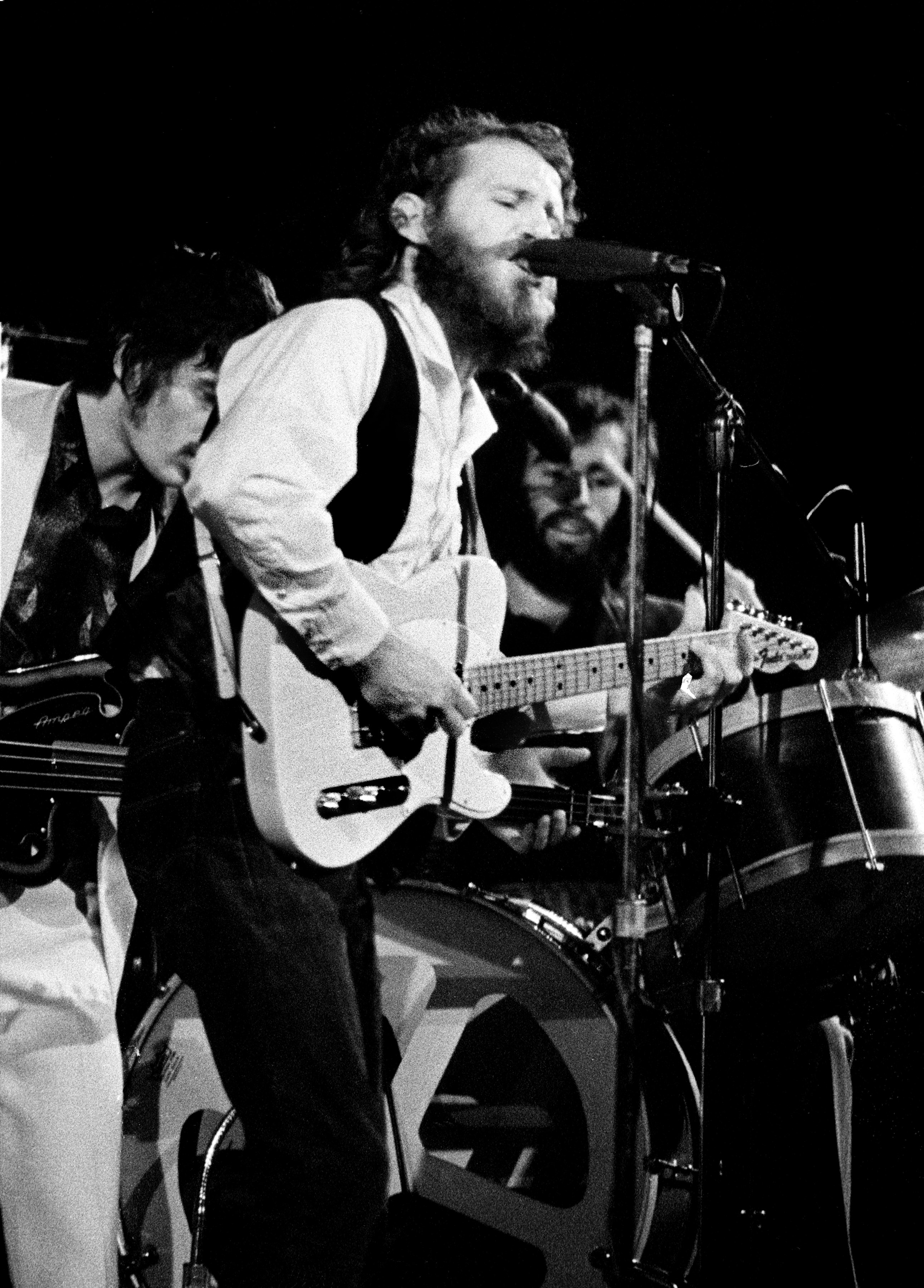
The Albert Hall concerts — there were two, on June 2 and 3 — had several salient features. The first was the layout of the instruments, arranged as if in a studio or a front room rather than on a proscenium stage, making it easy and natural for the musicians to swap instruments — Helm picking up a mandolin or a second Telecaster while Manuel took over at the drums, Danko setting aside the bass guitar for a fiddle, Hudson getting up from the organ to play tenor saxophone or accordion.

The second was the quality of the sound. The Albert Hall had been notoriously unfriendly to rock bands, whose amplified instruments floundered in a haze of unwanted natural echo created by the high ceiling. But, as Danko told me, the British audio engineer and PA builder Charlie Watkins had visited the Band in the US and noted the specifications of their regular equipment before creating something similar for their European concerts. Just as important, they played at a volume level which allowed them to hear and respond to each other while permitting the audience to appreciate the nuances of their music.

They played with an astonishing blend of finesse and emotion, of musicianship and modesty. There were four songs from Big Pink, eight from The Band, five from Stage Fright — released the previous summer — and two Motown covers, the Four Tops’ “Loving You Is Sweeter than Ever” and Marvin Gaye’s “Baby Don’t Do It”, plus Little Richard’s “Slippin’ and Slidin'” as a final encore. They made even the most familiar of the songs sound new — and what a thrill it was to hear, in person, the voices of Danko, Manuel and Helm alternating leads and creating those overlapping coarse-grained harmonies.

Everything sounded even better than the records: more present, of course, but also more pristine, which was a surprise given the number of times they must have played these songs. The subtle complexity of “King Harvest” was laid out in all its rustic splendour. Hearts were broken as Danko sang “The Unfaithful Servant” with such tender ardour and mended by the centuries-old ache in Manuel’s voice on “I Shall Be Released”. Danko’s fretless bass imitated the weight of a tuba on “Time to Kill”. Robertson didn’t need to show off — the intro to “The Weight” was enough to tell us that the house’s electricity supply was running through the strings of his Tele — but the eight-bar solo bridging into Hudson’s tenor coda on “Unfaithful Servant” was worth the entire careers of some of the more famous guitarists in the audience.

Levon sang “The Night They Drove Old Dixie Down” with fervour and drew both resonance and whipcrack from a lovely old kit — placed stage left, side on — that looked as though it might have been around since Robert E. Lee surrendered at Appomattox. Garth gave us a hint of the pitch-warping capabilities of his keyboards on the opening “The Shape I’m In” and then, deep into the second half, let it all out on the unaccompanied four-minute introduction to “Chest Fever”, given its own title — “The Genetic Method” — and sounding as though the pipes of the mighty Albert Hall organ had been attached to his Lowrey console in order to facilitate some magical union of J. S. Bach and Sun Ra.

But it really wasn’t about the individuals. As Bruce Springsteen observes in the 2019 documentary Once Were Brothers, when those five musicians got together, “something miraculous occurred.” You could hear it when they kicked into “Baby Don’t Do It”, overlaying a Second Line accent on Holland-Dozier-Holland’s version of the Bo Diddley rhythm, generating a steady collective surge that had nothing to do with volume.

Most of that has been stored in my head for half a century, always ready to be unpacked in any discussion of the greatest gigs of all time. It was a thrill when three tracks — “Strawberry Wine”, “Rockin’ Chair” and “Look Out Cleveland” — turned up in 2005 on The Band: A Musical History, a six-CD box supervised by Robertson. Here was proof that the concert had been recorded — by EMI on a humble four-track machine, as it turns out. And now the whole thing, less only “Slippin’ and Slidin'”, is available as the second disc on a 50th anniversary edition of Stage Fright, with sound every bit as good as it was on the night.

In Testimony, his autobiography (which provided the basis of Once Were Brothers), Robertson describes the Albert Hall audience as “rippling with enthusiasm.” In the notes for the Stage Fright reissue, he calls it “one of the greatest live concerts the Band ever played.” What is clear now is that shadows were already looming. Newly acquired wealth and the ability to indulge in damaging habits had begun to warp the relationships between the musicians, eroding the work ethic and the sense of purpose that had driven them through the first two albums. In particular, a rift between Helm and Robertson would be opened and never closed. With The Last Waltz, in 1978, the story of the five-man band was over. Although Robertson’s take on the background events often invites a charge of self-justification, it seems understandable that his patience was eventually exhausted.

Now Richard, Rick and Levon are dead. But at the Albert Hall in June 1971, a last-minute decision ensured that the sound of the Band at their zenith would be preserved. You had to be there, and now you are. In a dark time, it’s a shaft of light.

* The new edition of Stage Fright is released on February 12 by Capitol Records in CD and vinyl formats. The original studio album is rearranged into the running order originally intended, and the set includes alternate mixes and an informal hotel-room session. The DVD of Once Were Brothers is on Dazzler Media. Robbie Robertson’s Testimony was published by William Heinemann in 2016. A revised edition of This Wheel’s on Fire, by Levon Helm with Stephen Davis, was published by Chicago Review Press in 2000. Barney Hoskyns’ Across the Great Divide: The Band and America (Viking, 1993) is highly recommended. The photographs of the Band at the Albert Hall on June 2, 1971 are by Barrie Wentzell (barriewentzell.com), and are used by kind permission.

‘One Night in Miami’

Sam Cooke would have turned 90 today, had he not been shot to death by Bertha Franklin, a motel manageress, during a dispute in South Central Los Angeles on December 11, 1964, when the singer seemed on the brink of the kind of transition from popular hitmaker to cultural spokesman that the equally ill-fated Marvin Gaye would make with What’s Going On seven years later.

According to Franklin, his last words were: “Lady, you shot me.” She is one of the witnesses summoned to speak in The Two Killings of Sam Cooke, a documentary available on Netflix. Its director, Kelly Duane de la Vega, does an excellent job of piecing together Cooke’s story, although perhaps too much emphasis is placed on the conspiracy theories that accumulated after his murder.

His real last words, however, were the lyrics to “A Change Is Gonna Come”, the song that he was inspired to write by hearing Bob Dylan’s “Blowing in the Wind” and which duly became an anthem for the civil rights movement when released as an A-side a fortnight after his death. A probably romanticised version of how he came to compose it is contained in One Night in Miami, a new filmed version of a stage play by Kemp Powers in which Cooke, the NFL star Jim Brown and Malcolm X join Cassius Clay in a motel room on the hours after Clay’s first defeat of Sonny Liston on February 25, 1964.

The meeting did take place, and the invented conversations between the four men are intense and compelling. Malcolm is on the brink of completing Clay’s conversion, but has yet to reveal that he himself is about to break with Elijah Muhammad and the Nation of Islam. In individual confrontations, the men challenge each other about how to proceed in their dealings with the white world. Brown wants to give up the NFL — in which he represents a role model for black kids — to become a Hollywood star. Cooke is told that it’s time to stop pandering to white audiences. Clay is hours away from becoming Muhammad Ali. But Malcolm, too, is confronted with his own issues.

I lost a bit of faith in the film when Malcolm pulls out a copy of The Freewheelin’ Bob Dylan and plays “Blowing in the Wind” on a handy record player, telling Cooke he should be ashamed that it takes a white boy to write a song addressing their concerns. As far as I can see “A Change Is Gonna Come” was recorded on January 30, 1964, a month before the first Clay-Liston fight. Here the dramatist’s imperative seems to have taken precedence over the actual truth, whatever that may have been.

Otherwise the film — available on Amazon Prime — is beautifully fashioned by its director, Regina King, deeply atmospheric in its mood and its detail, although traces of its stage origins remain. There are excellent performances from the four leads: Kingsley Ben-Adir as Malcolm, Eli Goree as Clay, Aldis Hodge as Jim Brown, and Leslie Odom Jr as Cooke. Michael Imperioli — The Sopranos‘ Christopher Moltisanti — turns up as Angelo Dundee, Clay’s trainer.

I recommend it highly, to be followed immediately by The Two Killings, in which — among other things — we see Cooke’s attempts to retain ownership of his work. Dr Mark Anthony Neal, a professor of African studies at Duke University, says of him: “What we know is that we never got to see him as a fully mature artist, thinker and activist who, had he lived, would have had a dramatic impact on the next generation of artists, thinkers and activists.” That seems plausible.

Another of the documentary’s talking heads, Renée Graham of the Boston Globe, considers “A Change Is Gonna Come” and remarks: “It’s the shame of this nation that this song should still be so relevant.” But you have the feeling that another generation, perhaps more than one, will come and go before the change of which Cooke sang becomes definitive.

* Some of Cooke’s recordings — including Sam Cooke at the Copa and Ain’t That Good News — are newly available on vinyl, released on the ABKCO label. His finest albums, Night Beat and One Night Stand! Live at the Harlem Square Club, were reissued on CD by RCA Legacy in 2005.