Skip to content

Many accents, one voice
Just about the first thing I discovered when I began a three-year term as artistic director of Berlin’s historic jazz festival in 2015 was that I would be required to explain myself. More specifically, I would be asked to describe my “concept”. This was a little disconcerting since I didn’t really have one, at least not in any worked-out form.

What I came up with, thinking on my feet, was a definition applicable to the kind of festival I wanted to make. “Jazz,” I told my inquisitors, “is any music that couldn’t exist if jazz hadn’t existed.”

I’ve never been quite sure whether I invented that aphorism simply out of expediency, in order to cover myself and to explain some of the music I wanted to present, in which the elements of traditional forms of jazz were sometimes attentuated or modified almost to invisibility. Eventually I decided that I believed it enough to feel comfortable about using it whenever it was necessary to justify something.

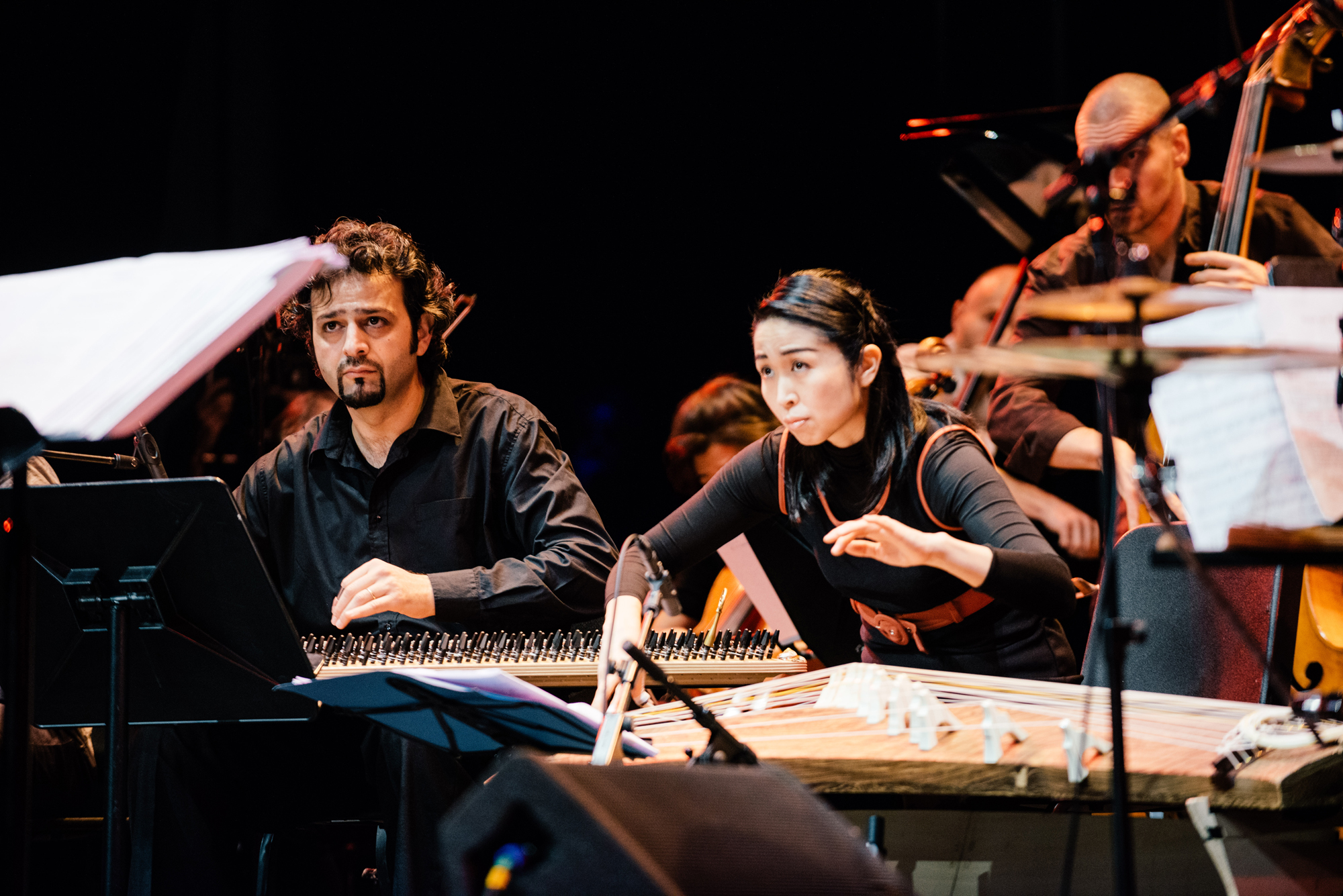
In my first year, the best example was provided by Divan of the Continents, a 22-piece band jointly led by Cymin Samawatie, a singer born in Berlin to Iranian parents, and Ketan Bhatti, a drummer born in India. Both graduates of jazz courses at Berlin’s University of the Arts (the UdK), together they had devised an ambitious project to bring together a large ensemble of locally based musicians from various ethnic backgrounds, from the principal viola-player of the Berlin Philharmonic and an English free-jazz trombonist to virtuosos of the sheng, the oud, the ney, the kanun and the koto. The aim was to work at creating music which honoured the essence of each player’s respective genre while (and this is the important bit) aiming for something genuinely new. What it would not be was an example of musical tourism. It wouldn’t be obviously “jazz”, either. But you could even see this as being a modern version of jazz’s origin story, in which elements of African and European musics came together to form a hybrid that took on a life of its own.

Since the music was complex, it seemed right to arrange for them to have three days of rehearsals in the small concert hall at the UdK’s Jazz Institute, open to students and the public. Then, on the festival’s closing night, they gave a performance in the 1,000-seater hall of the Berliner Festspiele, leading off a bill completed by Louis Moholo-Moholo’s Four Blokes and Ambrose Akinmusire’s quartet with the singer Theo Bleckmann. It was, I think, a success: the audience gave every appearance of being intrigued, particularly by the settings of poetry sung by Samawatie and two other female singers.

Now Samawatie and Bhatti have made an album of that music, and other pieces, with an ensemble of similar size and instrumentation, containing about half the original personnel. In the meantime, the project been retitled: the album is called Trickster Orchestra. But the concept is the same, and the time spent in preparation has resulted in something rather extraordinary: a music in which the sheng of Wu Wei and the viola of Martin Stegner have equal weight, in which the double bass of Ralf Schwarz can emerge with a walking 4/4 line and the various items of tuned percussion can set up rhythm patterns reminiscent of Steve Reich. The words of the songs range from Psalm 130 to the Sufi poet Rumi and the contemporary poet Efe Duvan, and are sung in Farsi, Hebrew, Arabic and Turkish. The lyricism is always poised and sometimes swooning, but the serenity can be punctured by a fusillade of drums, subtly coloured by electronics.

It’s not a mosaic, but it is a kaleidoscope. Each musician retains her or his own tuning and vocabulary. The various tones, textures and idiomatic accents are overlapped, juxtaposed and filtered through each other, creating something much more interesting than a flavourless fusion. I think it would have interested the founder of Berlin’s jazz festival, the late Joachim-Ernst Berendt, a man with a strong belief in the potential value of opening jazz up to new relationships with the music of other cultures. Trickster Orchestra is an impressive example of where that kind of thinking has led, giving musicians of high skill and inquiring minds the chance to find new paths.

* Trickster Orchestra by Cymin Samawatie and Ketan Bhatti is out now on the ECM label. The photograph of Bassem Alhouri (kanun), Naoko Kikuchi (koto) and Ralf Schwarz (bass) is from their 2015 concert in Berlin and was taken by Camille Blake.

Wes Montgomery and friends

By the time Wes Montgomery died of a heart attack in 1968, aged 45, he was most famous for a series of albums, supervised by the producer Creed Taylor, in which he used his jazz chops to turn pop hits — “Goin’ Out of My Head”, “Eleanor Rigby”, “California Dreaming”, “A Day in the Life” — into a form of high-quality, lightly funky easy-listening music. In his earlier years, however, he had raised the bar for jazz guitar — and that Wes Montgomery was the one who visited Europe three years before his death. His touring itinerary included a season at Ronnie Scott’s, where he met some of the musicians who would accompany him to Germany for a TV broadcast commissioned by Norddeutsche Rundfunk, the Hamburg-based station that was, and is, part of the ARD national public broadcasting network.

Playing in NDR’s studios in front of an audience, Montgomery led an eight -piece line-up including one fellow American, the tenor saxophonist Johnny Griffin. The six European musicians were the Austrian altoist Hans Koller, the French-Algerian pianist Martial Solal, the French bassist Michel Gaudry, and three Brits: Ronnie Scott on tenor, Ronnie Ross on baritone and Ronnie Stephenson on drums.

The music they played on April 30, 1965 in NDR’s Jazz Workshop series has just been released for the first time, and it’s a fine example of multinational mainstream-modern jazz. The four-piece reed section breezes through the solid, tightly-voiced arrangements of Montgomery’s “West Coast Blues”, “Four on Six” and “Twisted Blues”, Ross’s “Last of the Wine” and “Blue Grass”, Griffin’s “The Leopard Walks” and Solal’s fascinating “Opening 2”. There are special features for Wes on a quartet bossa nova version of “Here’s that Rainy Day”, and an electrifying Griffin on “Blue Monk”. It’s a very satisfying hour, and a welcome discovery.

But there’s also a second disc, a Blu-Ray video recording of the rehearsal in the studio two days earlier, in which the musicians are getting comfortable with the charts while the TV director works out his camera shots. And it contains five minutes that are absolutely remarkable.

Between the rehearsals of “Blue Grass” and “Blue Monk”, Solal runs through an intricate trio arrangement of “On Green Dolphin Street” with Gaudry and Stephenson. As they begin, the other musicians slowly gather round, listening intently. Scott peers over Stephenson’s shoulder, following the chart on the drummer’s music stand. Montgomery stays his chair, cradling his fat-bodied Gibson guitar, but is paying serious attention. So is Griffin, who prowls round to stand behind the pianist.

It’s a breathtaking performance. Typically of Solal, it mixes angular modernity with perfectly integrated hints of the history of jazz piano, from stride to bebop. It’s audacious and witty and wonderful, and the bassist and drummer do brilliantly to keep pace. By the time it’s over, you’re thinking that Solal is the inheritor to Art Tatum’s breathtaking virtuosity. And the other musicians are thinking something similar. You can see it in their body language. And you can hear it when, as the last note dies, Griffin walks round beside Solal, leans into him and says: “Ridiculous!” And as he walks away and he and Scott cross paths, you can see them shaking their heads in admiration. It’s a beautiful thing to see musicians reacting spontaneously in an informal setting. More than half a century later, we can share their sense of delight and discovery.

All these men — in their stylish polo shirts and cardigans and narrow slacks and neat haircuts, with their mastery of a complex musical language — are now gone, except one. That one is Martial Solal, who played with Sidney Bechet and Django Reinhardt and wrote the music for Godard’s À bout de souffle, now 93 years old and, as he has continued to prove through the years, an authentic genius of jazz.

* Wes Montgomery’s The NDR Hamburg Studio Recordings, produced by Stefan Gerdes, Axel Dürr and Joachim Becker, is on the Jazzline Classics/NDR Kultur label.

Peter Hammill in lockdown

Some time in the future, academics will pore over the ways people found to make music despite the restrictions imposed during the various lockdowns. But there are things that don’t need the benefit of time to provide perspective. The knowledge that Peter Hammill’s In Translation was created in cruel and unusual circumstances may increase his listeners’ admiration, but its quality transcends such considerations.

Coming 50 years after the release of his first solo release, Fool’s Mate, in the summer of 1971, this is Hammill’s covers album, with a difference. Only three of the songs — “The Folks Who Live on the Hill”, “This Nearly Was Mine” and “I (Who Have Nothing)” — are likely to be well known to the Anglophone audience. The remainder are either Italian pop songs or melodies by classical composers with lyrics translated by Hammill. It’s the measure of the strength of his artistic character that the whole thing has the unity of a song cycle.

Working in his Wiltshire studio, he weaves his own guitars and keyboards together with samples to create orchestrations that are full of interesting textures — complementary and contrasting — while retaining a sense of economy and intimacy, finding common ground between material plucked from seemingly divergent sources. Perhaps the best way of putting it is that he creates a emotional microclimate within which songs as different as “The Folks Who Live on the Hill” and Gustav Mahler’s “Lost to the World” can thrive together.

Hammill’s vocal style, with its clear diction, complete absence of blues inflections and occasional use of a pronounced vibrato, has always emphasised the closeness of his music’s spirit to that of European art song, from the Weimar cabaret music of Kurt Weill to the chanson of Jacques Brel, filtered through the sensibility of British musicians who served their apprenticeships in the second half of the 1960s. You can hear this tendency at its most declamatory on “Ballad for My Death”, whose melody is by the tango master Astor Piazzolla but could easily be by Brel. Hammill dials back the drama on other songs, such as Fabrizio de Andre’s “Hotel Supramonte” and Gabriel Fauré’s “After a Dream”, that might have been submerged by similar treatment.

“The Folks” and “This Nearly” are songs he grew up with, so he’s not going to poke fun at their 1950s sentiments. He takes them seriously, delivering them in his ardent English semi-croon, relishing their shapely contours and allowing listeners to make up their own minds about what the lyrics represent. “I (Who Have Nothing)” comes with drama built in: you either sing it that way or you don’t sing it at all, and Hammill’s version adds a shadow second vocal to emphasise what he calls the song’s “somewhat creepy nature”, as well as the hallucinatory sound of a mellotron (I think) and a paranoid electric guitar.

Perhaps the most striking arrangement of all is provided for Piero Ciampi’s “Il Vino”, a late-night drinking song that sways to synthesised strings, a cheap organ and glockenspiel. Its finale reminded Hammill of Nino Rota and thus of a “Fellini-esque aesthetic” which, he thinks, suffuses the whole project.

In Translation is an exceptional album: warm, approachable, and betraying no sense of the isolation in which it was created. Rather the reverse, as Hammill suggests when, in his notes, he remarks that, as well as the coronovirus, he had Brexit on his mind while he was making it. “Now the free travel around Europe which has been such a feature, pleasure and education in my adult life has ended,” he writes, “and all the benefits of cultural exchange are gone with it. I wouldn’t have been able to approach or understand many of these songs without that experience and to lose it is piteous.” It’s hard to believe that one day, when our corner of the world has come to its senses, those borders will not be open again.

* Peter Hammill’s In Translation is released today on the Fie! label: http://www.sofasound.com. The photograph is from the album cover and was taken by James Sharrock.

Marianne & Joan

In 1965, when she was 18 years old, Marianne Faithfull was cast as Ophelia in Tony Richardson’s Hamlet, a Roundhouse production swiftly transferred to film. Two years later Bill Gaskill directed her in Chekhov’s Three Sisters at the Royal Court, alongside Glenda Jackson: “Marriane (sic) Faithfull looked Irina most plausibly,” Philip Hope-Wallace wrote in the Guardian, “even if she could still get more out of the words.” Today, in her maturity, Faithfull knows that the best lines can be allowed to speak for themselves.

Lines like Keats’ “The sedge has withered from the lake/And no birds sing”, for example, and Tennyson’s “The mirror crack’d from side to side.” They’re heard on her new album, She Walks in Beauty, in which she recites verses from the Romantic poets over backdrops created by the Australian musician Warren Ellis.

I’ve no idea whether, following her recovery from a bout of Covid-19 which put her in intensive care for three weeks, she has plans to make any more albums. If not, She Walks in Beauty would make a fitting capstone to a career that began in 1964 when, at a party for the singer Adrienne Posta, Andrew Loog Oldham spotted a convent schoolgirl who was already in thrall to the poetry she reads here.

The album adheres to a single mood, tending towards the ethereal: drifting ambient soundscapes sparingly garnished by Ellis’s violin, Vincent Ségal’s cello, Nick Cave’s piano and, on two pieces, Brian Eno’s treatments. Faithfull’s delivery of the verses is respectful and measured: her deep contralto has the grain of experience, grounding the poetics. About half the tracks received their voice tracks after her recovery, which might explain why one or two of them are more deliberate than the rest, although not obviously or disturbingly so.

Among the pieces I particularly enjoyed are Byron’s title piece, Keats’ “La Belle Dame Sans Merci”, Percy Bysshe Shelley’s “Ozymandias” and Wordsworth’s “Surprised by Joy”. I was amused, too, that she borrows a tactic perfected by her old admirer Bob Dylan with “Desolation Row” and “Sad Eyed Lady of the Lowlands”: the trick of leaving the collection’s epic performance until last. In this case it’s the 12 minutes of Tennyson’s “The Lady of Shalott”, which she gives in the 20-stanza version published in 1832, 10 years before the author revised the ending to suit Victorian sensibilities. (It’s a shame her script — repeated in the accompanying booklet — gave her “Through the squally east wind keenly/Blew…” rather than “Though…”, but the blemish is fleeting.)

It’s worth adding that ownership of the special edition of She Walks in Beauty is much enhanced by the inclusion of reproductions of a dozen watercolours — including the cover illustration — by the English artist Colin Self, any one of which I’d be happy to have hanging on the wall.

As a collateral benefit, Faithfull’s album sent me back to Baptism: A Journey Through Our Time, a 1968 release in which Joan Baez read and sang poetry over music by the composer Peter Schickele. Conceived by Maynard Solomon, the co-founder of Vanguard Records, it was an ambitious project in which Schickele created bespoke settings for verses from poets ranging from anonymous medieval Chinese and Japanese writers through John Donne, William Blake and Walt Whitman to Arthus Rimbaud, Wilfred Owen, Henry Treece, James Joyce, Federico García Lorca, Jacques Prévert, Countee Cullen and Yevgeny Yevtushenko.

The album is bookended by Treece’s “Old Welsh Song”, a fragment sung by Baez, backed by a harmonium. Much more of a mosaic of miniatures than Faithfull’s album, the mood of the programme is defined by a hatred of war and bloodshed, beginning with Whitman’s “I Saw the Vision of Armies”, read to softly rolling tom-toms and cymbals, and the Chinese verse “Minister of War”, punctuated by a distorted guitar and a clashing gong-like effects. A hovering unison cello and bass line wanders disconsolately behind Lawrence Ferlinghetti’s translation of Prévert’s “Song in the Blood”, glockenspiel and celeste accompany the sung version of Joyce’s early “Of the Dark Past”, a jaunty string quartet matches the vivacity of a fragment from the same writer’s Portrait of the Artist as a Young Man.

If the flute and harp embroidering Rimbaud’s “Childhood” are a bit twee, his “Evil” gets a cinematic soundtrack whose opening sounds of strife thin out as they give way to pathos. The flute, viola and celeste colouring Kenneth Rexroth’s translations of Japanese haiku are appropriately exquisite, and Schickele gives Baez a lovely melody for e.e. cummings’ “All in green went my love riding”. Wilfred Owen’s “The Parable of the Old Man and the Young”, with its devastating payoff, is wisely left unaccompanied.

Baez was 27 at the time of this recording. Sometimes her delivery could be a little over-reverent, but mostly she found the right tone, nowhere more powerfully than on the two short poems at the heart of the album: Blake’s “London”, with its appalled visions of the corruption of the flesh and the spirit, and Norman Rosten’s “In Guernica”, where a simple, almost photographic description deepens into tragedy through a single word: “In Guernica the dead children / Were laid out in order on the sidewalk / In their white starched dresses / In their pitiful white dresses.” Both pieces employ the tolling of tuned percussion over strange drones.

By 1968, Baez had sold a lot of albums. Her two In Concert albums had made the Billboard top 10 in 1962-63, and in a year later Joan Baez 5 reached the UK top three. Baptism made it no higher than No 84 in the US and failed to register at all in Britain Somehow, though, partly for its sense of adventure and partly for “London” and “In Guernica”, it’s the one that’s stayed with me.

‘Colour me gone, baby…’

The death of the film director Monte Hellman this month, at the age of 91, occurred exactly 50 years after the full screenplay to Two-Lane Blacktop, his best known picture, was published in the April 1971 issue of Esquire magazine. Its appearance preceded by three months the release of a film that starred James Taylor and Dennis Wilson as two hot-rod racers engaged in a cross-country contest between their ’55 Chevy and a Pontiac GTO with a fantasist played by Warren Oates at the wheel, their three lives complicated by the presence of a footloose hippie chick played by the 18-year-old Laurie Bird, in the first of her three films.

By the time the film was premiered, the published screenplay — by the novelist Rudy Wurlitzer and the actor Will Corry — had been stripped as effectively as the primer-grey Chevy. Quite a lot of it disappeared in the shooting. Some of it was replaced by improvised dialogue: “The wheels didn’t grab off the start” became “The tires didn’t bite out of the hole.” Even more was removed in the eventual studio-enforced final cut from three and a quarter hours to 100 minutes. No bad thing, perhaps, since it removed a lot of car talk; what remains is quite enough.

Far from being, as Esquire claimed, “the movie of the year”, Two-Lane Blacktop was a flop. Most film critics hated it. In particular, they hated Taylor and Wilson. I thought, and still think, that they were perfect for Hellman’s vision of an existentialist road movie peopled by damaged characters — none of them given a name — set in an America undergoing a cultural upheaval so profound that people could hardly communicate with each other. Look at it now and you see a couple of performances of considerable sensitivity by two musicians who had never acted before. The ill-fated Bird provides the perfect complement, while Oates is magnificent as a character caught in nervy bemusement between two eras, his use of already dated argot — including the phrase I’ve used for the headline of this piece — perfectly judged.

Other highlights include one “H. D. Stanton” as a gay hitchhiker who weeps when the GTO driver rejects his advances (apparently Harry Dean initially objected to his character’s sexual orientation). Wurlitzer himself plays a fellow with a ’32 Ford in an early drag-strip sequence shot in Santa Fe, while James Mitchum, lookalike son of Robert, can also be glimpsed in one of the racing scenes. The unresolved ending was something else the critics detested, but it’s exactly the one the film demands.

I bought the April 1971 Esquire when it came out and have hung on to it ever since. It’s amusing to leaf through it now and find a counter-cultural screenplay sharing the issue with a lavish colour feature on golf-course architects, Malcolm Muggeridge’s review of The Female Eunuch, a survey of men’s two-tone shoes for the spring season, and ads for Johnny Carson’s “Carson-eze” polyester/wool blend slacks and Flying Dutchman pipe tobacco (“Lead women around by the nose!”).

A few years ago I also bought a Universal Pictures DVD of the film; its extras include Hellman and Gary Kurtz, one of the film’s co-producers, giving a fascinating off-screen commentary as the film rolls. Among the things they tell us is that although Jack Deerson was credited as the director of photography, he was hired merely to satisfy the union, which had refused a card to Gregory Sandor, who was actually responsible for the brilliant cinematography. Only when two cameras were required was Deerson summoned from the hotel rooms in which he spent the vast majority of the shoot, which ranged from California through Arizona, New Mexico, Oklahoma, Arkansas, Tennessee and North Carolina. A much-requested DVD release of Hellman’s three-hour version was scuppered, they say, by the studio’s refusal to negotiate the rights to the extra music originally included.

Oh, yes. A last thing. Three ’55 Chevys were built: the first for interior shots, with camera platforms built in; the second with roll bars for stunt work, such as the sequence in which the car ends up in a field; and the third as a full-blown race car. I wonder where that last one is now?**

* Here’s the Two-Lane Blacktop trailer: https://youtu.be/Q4onX6ZDsZ0 And here’s an obituary of Monte Hellman by Ronald Bergan: https://www.theguardian.com/film/2021/apr/27/monte-hellman-obituary

** The answer: https://www.hemmings.com/stories/2014/11/26/two-lane-blacktop-1955-chevy-two-door-sedan-heads-to-auction

Blues for Bob Porter

The name of Bob Porter started appearing on jazz albums at the end of the 1960s and then, with gathering frequency, through the succeeding decades. It soon became obvious that, whether as a record producer, a compiler of historical anthologies or a writer of liner notes, Porter — who died last week at the age of 80 — was most interested in the kinds of jazz that stayed close to old verities: a powerful swing, the feeling of the blues, a warmth of expression, a direct engagement with the audience’s emotions.

Porter did a lot of his work for Bob Weinstock’s Prestige label, but when the Savoy label was bought by Arista he supervised a reissue programme that included a series of double albums called The Roots of Rock ‘n’ Roll, two of which you can see two of them above. What Porter located was a sweet spot where jazz and R&B fed each other in hits like Paul Willliams’ “The Hucklebuck” and Big Maybelle’s “Candy”. He supervised anthologies of Miles Davis for Prestige and John Coltrane for Atlantic (for whom he also put together the seven volumes of Atlantic Rhythm and Blues 1947-1974), won a Grammy for a 1979 anthology of Charlie Parker’s Savoy sessions, and produced new albums by Jimmy McGriff, Gene Ammons, Red Rodney, Hank Crawford, Charles Earland and many others. For the last 20 years he was a regular on WBGO, the public-service radio station broadcasting from Newark, New Jersey

His particular take on jazz was summed up in his only book: Soul Jazz: Jazz in the Black Community 1945-75, the story of musicians who earned their living mostly in dance halls and clubs of black America and whose recordings were primarily aimed at the listeners they found there. The book starts with the last of the commercially viable popular-oriented black big bands, such as those led by Buddy Johnson and Erskine Hawkins, and advances chronologically via Louis Jordan, Lionel Hampton, Arnett Cobb, Jack McDuff and Lou Donaldson all the way through to Grant Green and Grover Washington Jr. Producers like Teddy Reig and Bob Shad take their place in the narrative, along with record-company bosses as different as Roulette’s Morris Levy, Savoy’s Herman Lubinsky and Verve’s Norman Granz, and radio disc jockeys from Alan Freed (a jazz fan before he helped invent rock and roll) to Frankie Crocker, a hero of disco whose closing theme — at the end of shows full of Kool & the Gang, the Commodores and Earth, Wind & Fire — was King Pleasure’s “Moody’s Mood for Love”.

Porter only wrote his book, he said, because no one else had, and it was a story that needed to be told. If Soul Jazz were a night out, it would be an organ-tenor-guitar-drums quartet playing to an audience of working people in a lounge on the South Side of Chicago: the kind of meat-and-potatoes jazz you could find on the albums Porter supervised. Swing, blues, warmth, engagement, informality, a complete lack of pretension: the recipe for a kind of basic nourishment that might be harder to find today.

* Bob Porter’s Soul Jazz was published in 2016 by Xlibris.

Woman at her typewriter

Mom was my greatest champion right from the very beginning. Except for drugs, I shared every event with her. Boyfriends, famous friends, triumph, and regret. My mother subscribed to Rolling Stone for an entire decade, complaining that I was not on the cover again. Watching me fade from the limelight seemed harder on her than it was for me. She didn’t understand that careers must be pliable. If an act insists on not changing and making the music audience come to them, they can end up an oldies act. I always wanted my music to be a place un-aging. The real danger of early success is that our parents, our children, our friends also reap what we sow. I had watched the trajectory of every member of my family change as they chased the fairy light of my success.

I weathered the storms of humility, the people who did not offer backstage passes anymore, or the people who did not even know my name anymore, and I kept on working. Mom told me I should just quit. Finally, I asked:

“And do what, Mom? This… this is what I am.”

Here is the tone and texture of Last Chance Texaco, Rickie Lee Jones’s new memoir. Subtitled “Chronicles of a Troubadour”, it’s one of the most remarkable I’ve read from a musician, a first-person commentary on the life and early career of this extraordinary artist, full of romance and adventure, misadventure and indiscipline, anecdote and reflection — just the stuff we want from those free spirits who live the life so that we don’t have to, inviting us to stand and watch in fascination, half admiring and half appalled.

If you want to know what prompted Steve Gadd to devise that drop-dead-laconic snare-drum lick on “Chuck E’s in Love”, or precisely how her first producers, Lenny Waronker and Russ Titelman, teased and moulded the songs that made up Pirates into a classic album, this is not the book that you might have hoped for. Most of the albums after those first two don’t even get a mention. She does tell you how some of the songs came into being (“Last Chance Texaco” itself resulted from a first meeting with Tom Waits, dancing together under a streetlight on Doheny Drive, before she drove away in her yellow Chevy Vega). But there’s rather more to her autobiography than a recital of facts.

The fact that we’re 260 pages into a 360-page book before we even get to signing with Warner Bros for the debut album that made her an overnight sensation at the age of 24 indicates that the emphasis of the narrative is firmly on her childhood and adolescence. This works because her early life was so peripatetic and picaresque, travelling with her perennially malfunctioning family through Oklahoma, Arizona, California and Washington State, sometimes enrolling at three new schools a year, running away and coming back and running away again and eventually staying away but without being able to sever the bonds to her father, the child of a vaudeville performer, and his wife, who had been brought up in an orphanage. They were a couple who “had learnt as kids to avoid government, big institutions and authority” and who “used cash to avoid declaring income and… avoided obligations beyond next month’s rent.” We know where that less than stable background got her, but the journey to her destination makes for compelling and sometimes distressing reading.

She’s good on how music took a hold of her, most significantly through the Beatles (“I fantasised all the ways I could meet Beatle Paul… In melodramatic scenarios I abandoned my hopes and dreams for the sake of Paul who would eventually come find me as I lay dying and realise how much he loved me”) and, later, through seeing Laura Nyro on TV: “(She) seemed to send a message to me that day that said, ‘Come you young girls who are not like the others because you love Broadway as much as rock ‘n’ roll.'” Other influences: an English teacher who got her writing poetry in one of her several high schools, and picking up a book at her sister’s house — Dick Fariña’s Been Down So Long It Looks Like Up To Me — that “told me I was not the first to go for this bohemian life of hitchhiking, pranksters, pot smokers, rebellion and free love.”

There are vivid descriptions of her early experiences as a performer, including her first gig with her first band, playing to an audience of deaf people, her first professional engagement as, briefly, the only white member of Little Caesar and the Romans, famous for their doo-wop hit, “Those Oldies But Goodies (Remind Me of You)”, and the fraught appearance on Saturday Night Live that made a hit of “Chuck E” and a star of Rickie Lee in 1979.

Her lovers — from the famous, including Waits, Lowell George and her heroin buddy Dr John, who shot up with her after being assured that she’d tried it once before, to the lesser known — are given due and intimate consideration. As with her treatment of family members, she’s both generous and unsparing. “We stayed in character throughout our entire romance,” she writes of Waits, “and our characters were sometimes cruel and selfish.” She is wry and realistic about his disciples: “Was I going to be another ghost, sitting around in Tom Waits’s peripheral vision, hoping he looked directly at me?” It led her to a conclusion about the problematic relationship between performer and listener: “I don’t want to have sex with someone who has mistaken me for my song.”

The book sent me back to the albums — the first two, of course, then the great covers collections of Pop Pop, Girl at Her Volcano and It’s Like This, and Traffic from Paradise and a later favourite, The Sermon on Exposition Boulevard — and to the memories of one of the finest concerts I’ve ever attended, at the Dominion Theatre in London in 1992, and one of the most hair-raising, at the Jazz Café in 2007. Most of all, without being unnecessarily literal-minded, it gave me a much clearer idea of the life went into the making of songs like “Coolsville”, “Traces of the Western Slopes”, “The Horses”, “Stewart’s Coat” and “The Evening of My Best Day”: one in which, as she says, “most of the dangerous choices I made were in fact lesser evils.”

By the time she came to read On the Road, it was a disappointment. She’d already lived the story herself. On the journey from the three-year-old lapping up applause for her performance as a snowflake in a children’s ballet to a recovered addict with a Grammy on her mantelpiece, via deportation from Canada as a teenaged hippie officially described as being “in danger of leading a lewd and lascivious life”, she’d learnt that “fame brings no solace, no love, and no warmth” and that money can cut you off. “You may say, ‘So what?’ and ‘I’ll take it if you don’t want it,'” she writes. “I do want it, fame and money and all that goes with it. It’s just that they weren’t what I thought they would be.”

* Rickie Lee Jones’s Last Chance Texaco is published by Grove Press. The photograph is from the album It’s Like This, released in 2000, and was taken by Lee Cantelon.

A cappella in Barcelona

Just off the Ramblas in Barcelona is a square containing the city’s Museu d’Art Contemporani, housed in a plain white modern building by the American architect Richard Meier. Facing it, on the other side of the Plaça dels Ángels, is a convent established by an order of Dominican nuns in the 16th century. Attached to the main building is a small chapel in which, back in 2007, I had an experience I’ll never forget.

The convent now belongs to the museum and for four months that year they used the chapel to house a work by the Canadian artist Janet Cardiff, who specialises in sound installations. For this one, A Forty-Part Motet (2001), she took a recording by the Salisbury Cathedral Choir of “Spem in Alium”, the 12-minute piece composed in around 1570 by Thomas Tallis for 40 voices, and channeled each individual voice through its own speaker, all mounted at head height on plain stands in a U shape, as Tallis apparently intended his singers to be arranged (the photograph explains how it looked).

There were two plain wooden benches within the U of the speakers, on which one could sit while listening. It was deserted while I was there. The recording opened with the ambient sounds of performers settling themselves. And then it began. “Spem in Alium” is one of the great masterpieces of English music. Within that ancient austere space, the effect of the voices blooming and soaring in overlapping waves, building and receding and building again, was extraordinary.

For the first time through I listened while standing, with eyes open. For the second time, I sat down and closed my eyes. The experience was even more intense. I was inside the music in a way that seldom happens to non-performers.

Today I read of plans to remodel the museum and to turn the chapel into an entrance — the equivalent, they say, of Tate Modern’s Turbine Hall. They’re good at architecture in Barcelona, so I imagine they know what they’re doing and it’ll turn out just fine. But I’m glad I had that half-hour alone in the chapel, immersed in another world.

* A Forty Part Motet (2001) has been installed in many venues around the world. Janet Cardiff talks about it here: https://youtu.be/rZXBia5kuqY

A Mike Taylor discovery

When the English jazz pianist and composer Mike Taylor walked into the sea and died in 1969, aged 30, he left behind two albums — Pendulum, by his quartet, and the self-explanatory Trio, recorded in 1966 and ’67 respectively — as a memorial to a talent silenced by the kind of problems experienced by too many creative souls in that era.

Taylor’s gifts and instincts put him somewhere in the line of pianists running from Thelonious Monk through Herbie Nichols and Elmo Hope to the young Cecil Taylor. His playing had a similar sense of a private language being put on public display. There could be a hint of obsession in the way he jabbed at his phrases, testing their resistance before turning them to catch the light from a different angle, but there was nothing forbidding about his music.

His story, from bright promise to unexplained death, was told in a feature in Jazzwise magazine by Duncan Heining in 2007 and at greater length in a useful biography by the Italian writer Luca Ferrari, published six years ago. Taylor remains much mourned both by first-hand witnesses to his short career and by those who know him only from those two albums, produced by Denis Preston for EMI’s Columbia label and now collectors’ items.

A third Mike Taylor album, then, is quite a significant discovery. Mandala consists of a live session by Taylor’s regular quartet — with Dave Tomlin on soprano saxophone, Tony Reeves on double bass and Jon Hiseman on drums — at the Studio Club, Westcliff-on-Sea in January 1965. It was Hiseman who recorded the gig on a reel-to-reel machine and filed the tape away in his archive. On August 29 that year the same group would support the Ornette Coleman Trio in an historic concert at the Fairfield Halls, Croydon; the following May they would assemble at the Lansdowne Studios in Holland Park to record Pendulum.

Mandala contains one jazz standard and four of Taylor’s compositions, making 38 minutes of high-octane music in which the musicians display an obvious reverence for the John Coltrane Quartet of the early ’60s while conveying the impression that, given time and scope, they will find a way to move beyond the template towards the expression of their own character. It can be heard emerging in the hectic exuberance of “Night in Tunisia” — more linear and less dense than the version of the Gillespie favourite captured on Pendulum — and Taylor’s “Folk Dance #1” (a 6/8 tune with unexpected modulations), and in the interesting rhythm section figurations behind Tomlin on “Half Blue”.

Tomlin is the main soloist, confidently feeling his way towards a Trane-like level of incantation while keeping a few more emotional buttons done up. Reeves is slightly under-recorded, as was often the case on amateur recordings from the period, but he can be heard to work well with Hiseman, who is a rewardingly active presence throughout, providing an incessant but constantly stimulating commentary reminiscent to me of Charli Persip. Together they create a powerful momentum.

If there is a regret, it is that Taylor chose to take only two relatively short solos on this occasion, on “Son of Red Blues”, the agile opener, and “Night in Tunisia”. Both are typically intriguing, if somewhat subdued. There might have been a third solo: the title track, which closes the album (and was left untitled until the album’s compilers borrowed one from a painting by the pianist), fades to silence just as Tomlin closes his long, intense solo and Reeves appears to be bridging into what might have been a piano improvisation. Maybe the tape ran out. But Taylor’s accompaniments are so consistently interesting that this is a minor reservation: the point here is the music of a fine group, captured in full and free flight.

* Mandala is available as a download and a limited edition CD from the Jazz in Britain label: http://www.jazzinbritain.org. A vinyl release is forthcoming. Luca Ferrari’s Out of Nowhere: The Uniquely Elusive Jazz of Mike Taylor is published by Gonzo Multimedia.

The uneasy trio

It’s possible that, like me, you think there are already quite enough jazz piano trio albums in your collection. Think again. Uneasy, the new recording by Vijay Iyer, Linda May Han Oh and Tyshawn Sorey, demands attention.

The realignment of the piano-bass-drums hierarchy from “piano with rhythm accompaniment” to a full three-way conversation of equals has been going on for decades, and Uneasy is about as elevated as the format currently gets. Listen to the opener, “Children of Flint”, to appreciate the level of interaction between three musicians with virtuoso-level skills and giant imaginations. It sounds lyrical, even simple. But just concentrate on the astonishing touch displayed by each of the trio, whether on piano keys, bass strings, drums or cymbals, and the sense of three seamlessly interlocking and interdependent components.

As you work your way through the 10 tracks — eight compositions by Iyer, plus Geri Allen’s “Drummer’s Song” and Cole Porter’s “Night and Day” — you’ll also notice a complete absence of ego-projection. No one is showing off. On the sole standard, it’s easiest to hear how far Iyer can take the line of piano-playing founded by Bud Powell. Oh displays the deep sense of swing, nimble melodic imagination and beautiful sound of a 21st-century Paul Chambers. Sorey creates a momentum at once light but deep, exploiting a combination of technique and intellect that redefines the investigation of rhythm.

Recorded in a studio in Mount Vernon, NY three months before pandemic arrived, the album comes with a cover photograph of the Statue of Liberty seen through mist and against clouds. In his sleeve note, Iyer writes that Uneasy was originally the title of a collaborative piece with the choreographer Karole Armitage in 2011, exploring “the instabilities that we then sensed beneath the surface of things… the emerging anxiety within American life. A decade later, as systems teeter and crumble, the word feels like a brutal understatement.”

That heightened disquiet, however, remains implied. You’re not thinking about the end of the world. You’re remembering how even the darkest of times can’t extinguish such astonishing creativity. One of the records of the year, no doubt.

* Uneasy is on ECM Records. The photographs of (from top) Iyer, Oh and Sorey are from the CD’s booklet and were taken by Craig Marsden.