From left: Kenny Gamble, Joe Tarsia and Leon Huff at Sigma Sound in 1978
The Sound of Philadelphia was made by many hands. The singers, songwriters, producers and arrangers: Kenny Gamble, Leon Huff, Thom Bell. On guitars, Norman Harris, Roland Chambers and Bobby Eli. On keyboards, Huff, Bell, Harold Ivory Williams and Lennie Pakula. On bass guitar, Ronnie Baker. On drums, Earl Young. On vibes, Vince Montana. On percussion, Larry Washington. String and horn sections supervised by Don Renaldo. But it was also made by Joe Tarsia, the founder of Sigma Sound Studios, who died this week, aged 88.
Tarsia engineered such imperishable records as the the O’Jays’ “Love Train”, Harold Melvin and the Blue Notes’ “Bad Luck”, the Stylistics’ “You Make Me Feel Brand New”, the Spinners’ “One of a Kind (Love Affair)”, Billy Paul’s “Your Song”, Wilson Pickett’s “Engine Number 9”. He collaborated with Gamble, Huff and Bell to make a sound that updated soul music for the 1970s: richer in timbre than Motown, suaver in tone than Stax, more citified than Hi. Tarsia called it “black music in a tuxedo”.
He began his career as a radio engineer and serviced recording studios in Philadelphia before taking a job in 1961 at Cameo-Parkway Records, where he became chief engineer and worked on hits by the likes of Chubby Checker, Dee Dee Sharp, Fabian and the Orlons. In 1968 he took over and renamed an existing studio at 212 North 12th Street, updating the technology from two-track to eight-track. In 1971 his establishment entered the wider consciousness when Gamble and Huff started their own label, Philadelphia International, and began the decade-long run of hits captured on tape at Sigma Sound.
I met Tarsia, very briefly, in 1975, when I spent a day at Sigma Sound working with one of his assistant engineers on remixing the B-side of the Fantastic Johnny C’s “Don’t Depend on Me”, a song called “Waitin’ for the Rain”, down to its backing track for release on Island USA as an instrumental aimed at the Northern Soul market. David Bowie had just been in, working on Young Americans. I talked to the engineers a bit about the records they’d been making that I admired so much, and I asked them in particular about the great Thom Bell. One of them — and it might have been Tarsia — told me that Bell was in tears as he played piano while Philippé Wynne sang on the Spinners’ recording of “Love Don’t Love Nobody”. Not surprising, when you listen to it. That’s the power of the records they were making, with Joseph Tarsia at the board. Mighty, mighty music.
Last night I was on my way to see Bob Dylan in concert in my home town for the first time, at a venue a few hundred yards from where, almost 60 years earlier, my girlfriend and I had listened to Freewheelin’ all the way through, squeezed together in a record-shop listening booth, before buying it, taking it to her parents’ house, and listening to it all the way through again. And then again.
Walking through Nottingham to reach the Motorpoint Arena, as the refurbished ice stadium is now known, I saw a chip shop in the Lace Market, formerly a coffee bar called the Jules et Jim, where three schoolfriends — Ian Taylor, Jeff Minson and I, a sort of Peter, Paul and Peter — had sung “Blowin’ in the Wind” in 1963. On Stanford Street I passed the site of Dungeon Club, the basement where — at the height of Bobmania in early 1965 — the harmonica player of the R&B group I was then in performed a solo mini-set of Dylan songs that attracted a lot more enthusiasm than our normal Jimmy Reed and Howlin’ Wolf repertoire.
It was also in the spring of 1965 that I first saw Dylan in person, at Sheffield’s City Hall on the first date of what would turn out to be his last solo acoustic tour. Since then I’ve seen him as often as I can — many times in London but also in Birmingham, Paris, Rome, New York and Philadelphia. Precious memories include a heart-stopping “It’s Alright, Ma” in Sheffield, a staggering “Like a Rolling Stone” at Earls Court, a blistering thrash-metal “Barbara Allen” at the NEC, a sweet duet on “Dark Eyes” with Patti Smith in Philly, and a gorgeous “Forgetful Heart” at the Albert Hall. In the week leading up the Nottingham concert I saw him twice at the Palladium, giving the first show a five-star review in the Guardian and then enjoying the second one even more.
But when I say that last night in Nottingham felt like the best concert I’ve ever seen from him, I’d ask you to accept that hometown nostalgia had nothing to do with it. Until a surprise right at the end, he played the set I’d heard twice at the Palladium. But in a place at least three times larger, with none of the inherent warmth and intimacy of the historic London theatre, he sang the same songs — nine from Rough and Rowdy Ways, seven older compositions of his own and “That Old Black Magic” — with an intensity and verve that gave them a different kind of life.
His singing was good in London, but in Nottingham it was astounding. Every line was nailed with phrasing that was always adventurous but never eccentric. I don’t think it was a change of emphasis in the sound mix: it was all in the vigour and projection of his delivery. As a result, songs like “Black Rider”, “My Own Version of You”, “Key West” and “I’ve Made Up My Mind to Give Myself to You” had a new confidence and richness, with a heightened sense of tension and release. The arrangements took on a different life, too. The Arlen/Mercer standard was brought off with a crisp panache. The twin surf guitar interludes on “Gotta Serve Somebody” were hair-raising. The three-movement version of “I’ll Be Your Baby Tonight” — first out of tempo, then Latin, then barrelhouse — was a delight. The rearrangements of “To Be Alone With You” and “Every Grain of Sand” glistened.
His piano-playing also seemed better integrated. The upright he’s using on this tour is adjusted to sound high and bright, almost like a tack piano, with a tone so close to that of the two guitars of Doug Lancio and Bob Britt that they’re sometimes indistinguishable. But during both Palladium shows there were moments when he crossed the line from playful to wilful, as if he were trying to lead the songs astray, occasionally sticking a major-key note into a minor-key song, or doing that thing he sometimes used to do on electric guitar of working out a short symmetrical phrase and then stubbornly repeating it over and over again with the chords changing under him. It crossed my mind that he might be trying to turn himself into the Thelonious Monk of folk-rock piano, looking for the notes in the cracks, the notes between the notes. But in Nottingham, with the exception of “Most Likely You’ll Go Your Way”, there was little of that; instead everything he played was directly relevant to what the band was doing and where the song was heading.
Where the concert was heading was towards the unforgettable moment, after the band had taken their bow, when they returned for the only encore of the tour so far. “I don’t know if many of you know, but Jerry Lee has gone,” Dylan said, “and we’re gonna play this song, one of his. Jerry Lee will live for ever, we all know that.” The song, an exquisite choice, was “I Can’t Seem to Say Goodbye”, a country ballad by Don Robertson, recorded by Lewis in 1963. After one chorus, delivered with quiet elegance, they were gone. But what a memory they left. Maybe even the best of all.
Bryan Ferry was kind enough to invite me to contribute the introductory essay to the programme for Roxy Music’s 50th anniversary concerts in North America and the UK, so I went along to the O2 last night to see the closing date of the tour and to witness what might, I suppose, have been their final performance together. I don’t like arena shows, but once the sound had settled down it was possible to enjoy what the four members who played on the debut album in 1972 — Ferry, Andy Mackay, Paul Thompson and Phil Manzanera — and their six auxiliary musicians and three backing singers were up to. And of course there was that funny bitter-sweet feeling you get while watching something you first saw in a basement with a few dozen other people half a century ago scaled up to world-conquering proportions in its ultimate iteration. In the essay I wrote about the inevitability of the process by which what had begun as an experiment would become a performance, but hints of the original art-school excitement and uncertainty managed to survive even today’s production values and resources, and the lighting and the back-projections — endless highways for “Oh Yeah”, Warhol images for “Editions of You” — made it beautiful to watch. The show began with reminders of the slightly gawky early stuff (“Re-make/Re-model”, “Ladytron”) and finished with full-throttle favourites (“Love Is the Drug”, “Virginia Plain”) but in between came a long passage in which the pace slowed to a resting heartbeat as luxuriant textures and romantic descending patterns took over. Introduced by the wordless “Tara”, the sequence of “The Main Thing”, “My Only Love”, “To Turn You On”, “Dance Away”, “More Than This” and “Avalon” swept elegantly by in one long candlelit swoon. Not a bad envoi, if that’s what it was.
I’m sure we all have a list of times and places to which we yearn to be transported in order to bear witness to particular musical events. My own would include the Miles Davis Nonet at the Royal Roost in 1948, Charlie Parker, Fats Navarro and Bud Powell at Birdland in 1950, Thelonious Monk with John Coltrane at the Five Spot in 1957, James Brown at the Apollo in 1963 and Andy Warhol’s Exploding Plastic Inevitable at the Dom in 1966. That’s a lot of time-machine trips to New York. But also very high on the list would have been one of the weekly dances hosted by the disc jockey Art Laboe at El Monte Legion Stadium, east of Los Angeles, where between 1955 and 1961 he presented star singers and vocal groups, mostly doo-wop and R&B, to a young and mixed audience of Hispanics, blacks and whites. Mr Laboe died in Palm Springs last Friday, aged 97, the day after taping his final radio show, and I’ve just finished writing his obituary for the Guardian. In 1963, two years after the last of the dances, Frank Zappa and Ray Collins wrote a song in tribute, which they recorded with Cleve Duncan of the Penguins. “Memories of El Monte” always makes me feel as though I know exactly how it must have felt to be there.
On an earlier re-release of the first and only album by Centipede, the 50-strong (and therefore 100-footed) band assembled by Keith Tippett, RCA’s marketing department used a quote from the Melody Maker‘s original review: “No one who wants a permanent record of where our music was at in 1971 will want to be without Septober Energy.” It was true at the time and today, listening to a remastered and reissued version of the double album made by an ensemble containing actual and former members of Soft Machine, King Crimson, the Blue Notes, the Spontaneous Music Ensemble, the Blossom Toes, Nucleus, Patto, the Steam Packet and Dantalian’s Chariot, it still feels right.
In his notes to the new Septober Energy reissue, Sid Smith quotes my description of it at the time as “a miracle”, but as miracles go it was an eminently achievable one, given the spirit of creativity, goodwill and mutual encouragement in which it was conceived and implemented under Tippett’s inspired guidance. This was the first of his large-ensemble projects; if it lacked some of the finesse of later endeavours, it wanted for nothing in terms of spirit.
The clue was in the title. “Energy” was a word much applied back then to the kind of improvising habitually done by the freer players here — the tenorists Gary Windo and Alan Skidmore and the trombonist Paul Rutherford, for example, the singers Julie Tippetts and Maggie Nichols, and the three marvellous South Africans: the trumpeter Mongezi Feza, the altoist Dudu Pukwana and the bassist Harry Miller. But others from related fields were cheerfully infected by the same vibe: the trumpeter Ian Carr, the guitarist Brian Godding, the oboeist Karl Jenkins and the 19 string players led by the violinist Wilf Gibson. And then there were the horns from Tippett’s own sextet, already borrowed by Soft Machine and King Crimson: the cornetist Mark Charig, the trombonist Nick Evans and the altoist Elton Dean. There were five bass players in all, including Jeff Clyne and Roy Babbington, and three drummers, two of them being Robert Wyatt and John Marshall. Robert Fripp played guitar on stage and produced the album.
I seem to remember that the announcement of their debut concert, at the Lyceum in November 1970, made the front page of the MM. After that first gig, boisterously exhilarating but inevitably chaotic, they went on the road in Europe and had a great time. The following June they went into Wessex Studios in north London, located in an old church hall, with just four days for recording the 80-minute piece under Fripp’s supervision and a couple more days for him to mix and edit the results into four movements, each one fitting a side of the double album. Their last appearance was at the Albert Hall in December 1971.
All the enthusiasm of the time, as yet unspoiled by time and the depredations of the music industry, is there on the album. And so, thanks to the skills of the composer and the producer, is a clear view of the individual strengths of the featured soloists (meaning practically everybody), as well as their readiness to attempt a coalescence into something greater than the sum of the parts.
Part 1 begins with the sound of small percussion, like something from a Shinto temple, before long tones — strings, voices — emerge and hover, soon disrupted by the first hints of the storms to come. Gradually the brilliant disposition of the orchestral resources comes into focus as Tippett balances the roistering horns and thunderous drums with subtler deployments and great control of crescendo and diminuendo. The wrapover to Part 2 is a lovely bass conversation — one bowed, one plucked, one playing harmonics con legno — leading to a very period-correct jazz-rock sequence with Tony Fennell’s drums and Babbington’s bass guitar accompanying quarrelsome saxes over a brass choir, suddenly interrupted by giant overlapping unison riffs in which, metaphorically, the entire band seems to have been fed through a fuzz-box. A space is cleared for Carr’s serene trumpet and Skidmore’s urgent tenor to take solos against the rhythm section, both exploiting the lift of lyrical chord sequence, before Godding’s distortions announce the return of the heavy artillery. An improvised trombone quartet adds another contrasting texture.
Part 3 opens with the four singers — Tippetts, Nichols, Zoot Money, Mike Patto — delivering Julie’s lyric without accompaniment: “Unite for every nation / Unite for all the land / Unite for liberation / Unite for the freedom of man.” Then the trio of drummers take over for a powerful conversation, each individual carefully separated in the stereo picture, leading into a long ensemble passage that builds to a shuddering climax before a slow electronic fade leads to the two female singers improvising over the strings, like a giant version of the SME, the same forces combining in a disquieting written section that ends the side. Tippett’s solo piano announces Part 4, sliding into a broad, swelling theme for brass, mutating through a long Elton Dean soprano solo into a trenchant restatement of the “Unite for…” song, and ending with a pensive coda for piano and cornet.
Of course it sprawls, and not every note played over the course of almost an hour and a half could be described as deathless or essential. But it was and remains a triumph of conception and execution, a vision of musical scale with, as it were, the Little Theatre Club at one end and Woodstock at the other. It also set me thinking about the form an equivalent project might take today, with similarly open-minded and collaboratively inclined musicians drawn from newer generations. Jonny Greenwood and Thom Yorke from Radiohead would have to be there. Shirley Tetteh, Shabaka Hutchings, Olie Brice, Sheila Maurice Grey, Moses Boyd, Nubaya Garcia, Rachel Musson, Tom Skinner, Rosie Turton, Cassie Kinoshi and Theon Cross from the new London jazz scene. Beth Gibbons and Adrian Utley from Portishead. Keiran Hebden (Four Tet) and Sam Shepherd (Floating Points). Well, you can make your own list.
* The CD reissue of Centipede’s Septober Energy is on the Esoteric label.I don’t know who took the photograph at the Lyceum show.
There must be a lot of people out there who had their first encounter with a favourite artist through seeing them on Later…with Jools Holland. On Saturday night the programme celebrated its 30th anniversary by beginning its latest series on BBC2 with a typical bill: a guitar-based popular rhythm combo from Sheffield (the 1975, pictured above), a cutting-edge female performer from Rotherham (Self-Esteem), a rediscovered 82-year-old soul singer and his fine band from Portland, Oregon (Ural Thomas and the Pain), a Spanish-American solo singer-songwriter (Victoria Canal) and a deeply unclassifiable London-based trio playing challenging and highly contemporary instrumental music (The Comet Is Coming). Each of them will have attracted new admirers as a result of this brisk 50-minute programme filmed in the round on the floor of the Alexandra Palace Theatre.
When Later… first appeared, I felt straight away that it was almost exactly the show I’d always wanted The Old Grey Whistle Test to be during my year as its first presenter, and which it only occasionally became (examples: the performance of Curtis Mayfield and his band, John Martyn’s first solo appearance, and the 10 minutes when Dr John sat at an upright piano and ran through the history of New Orleans piano). It was about musicians of varying backgrounds and styles playing live — and even better, in the Later… format, listening to each other’s performances while waiting for their own turn. It was also my strong feeling that such a show needed a more extrovert presenter, and in Jools Holland it found one — and one who, moreover, could sit down at the piano and occasionally accompany a guest, as he did last night when Ural Thomas sang “Stand By Me”.
He isn’t to everyone’s taste — the “Hootenanny!” thing on his New Year’s Eve specials has been known to drive me from the room — but the show wouldn’t have survived through three decades without his ebullient personality to sell it. He was chosen back in 1992 by Mark Cooper, the programme’s founding producer and presiding spirit, whose broad but discriminating taste in music has probably been the single most important factor in the maintenance of the show’s quality. Over the years the production has become more polished, at the expense of a certain spontaneity, but last night’s line-up showed a continuing desire to present the experimental and adventurous alongside the familiar and safe.
Now Cooper — who began his career as a music journalist in the pages of Record Mirror, Q and Mojo and was BBC Studios’ Head of Music from 1999 to 2019 — has written a book about the show chronicling, as its subtitle promises, “30 years of music, magic and mayhem”. It’s a 400-page narrative rich in anecdotes and interspersed with reflections contributed by some of those who made memorable appearances, including Alicia Keyes, Richard Thompson, Ed Sheeran, St Vincent, Nick Cave and Baaba Maal. Thompson is particularly good value on being able to listen to Al Green from a distance of about 10 feet, on being able to tell Little Jimmy Scott how much he loved his music, and on backing Norma Waterson on a band including Martin Carthy, Eliza Carthy, Danny Thompson and Dave Mattacks. Keyes describes her first appearance in 2001, soon after the release of her debut album, as one of the great musical moments of her life: “The circle raises your game. You walk into the studio different, knowing you’re going to be among musicians who are being themselves and not trying to do what somebody else is doing.”
Open the book almost anywhere and you’ll get a good story, or even just a line reminding you that a single episode in 2008 could incorporate Solange, Stereophonics, Eli Paperboy Reed and a chat with Ray Davies. The section on Lou Reed’s appearances in 2000, 2003 and 2011 is beautifully remembered and observed; the author had first attended one of Reed’s concerts in 1972 and interviewed him for a magazine in 1992, which can’t have harmed his ability to provide the artist with a comfortable setting and a sympathetic atmosphere. He was less prepared for the arrival of Solomon Burke in the Later… studio in 2002, never having seen him live. Burke turned up in a wheelchair before settling his enormous bulk into a golden throne and proceeding, with the help of Holland’s Rhythm & Blues Orchestra, to wreck the house.
Later… is about respecting the elders, giving a platform to the new, and having fun with music. “There’s nothing like it in the world,” Baaba Maal says, and he may be right. Mark Cooper’s book — in which he properly shares credit with the many other people, such as his co-producer Alison Howe and the director Janet Fraser-Crook — is an entertaining and instructive guide to how it happened and to the small miracle of its survival.
* Mark Cooper’s Later… with Jools Holland is published by William Collins.
I’d been working at the Melody Maker only a few weeks in the autumn of 1969 when the drummer John Stevens and the saxophonist Trevor Watts arrived to see me, unannounced, at the paper’s offices in Fleet Street. They’d sensed the presence of a writer sympathetic to their music and they’d brought me a copy of the Spontaneous Music Ensemble’s new album, recorded for Giorgio Gomelsky’s Marmalade label. I already knew about them, of course, and over the years I saw John play on many occasions and in many different musical environments. His death from a heart attack in 1994, at the age of 54, deprived the London scene of a musician who, his own great gifts aside, had devoted much of his life to encouraging others to express their creativity.
“John didn’t just change my life — he saved it,” the singer Maggie Nichols said at the Café Oto last night, while introducing an evening of hitherto unseen films featuring Stevens in a variety of contexts. They had been put together by the music and label owner Mark Wastell from a cache of videos owned by John’s widow, Anne, and his children, Ritchie and Louise. There is, as Wastell remarked, so little filmed evidence of John’s life and work available to be seen that anything is to be treasured — and these films brought him back to life in full strength.
Four films were shown. I was able to see the first three, each half an hour long. The first, filmed at the Third Eye Centre in Glasgow in 1976 on a single hand-held camera in black and white, captured a date on a tour by the trio of Stevens, Danny Thompson on bass and John Tchicai on soprano and alto saxophones. This was the bearded, roaring John Stevens with the bearded, roaring Danny Thompson — together in another incarnation as John Martyn’s accompanists — giving Tchicai the most enthusiastic and empathetic encouragement.
The second film, shot at a club in Stavanger by Norwegian TV in 1991, was a far more polished affair in every way. The music produced by this trio, completed by the American bassist Kent Carter and the Norwegian altoist Frøde Gjersted, was just as impassioned, running through different modes of collective improvisation: time, no time, and the sort of pointillism that recalled John’s famous “click pieces”, when the SME or workshop groups were instructed to use the shortest possible sounds to create their improvisations. This film included a joint interview with the three musicians, during which Carter memorably summarised his philosophy of constant renewal: “If the audience can recognise what we’re doing, it’s already been done.”
A year later, in 1991, Channel 4 filmed John’s new quartet, with the saxophonist Ed Jones, the trumpeter Byron Wallen and the bassist Gary Crosby, performing a Stevens composition dedicated to the then recently deceased Dudu Pukwana, called “Dudu’s Gone”. Not a lament but a celebration, recalling Ornette Coleman’s bounciest medium-tempo tunes, it showcased John’s beautiful time playing, with its strong echoes of Max Roach’s drive and Billy Higgins’s float. The unedited takes we were shown included an interview in which John was asked what it took to play free music. “It’s a freedom that demands high discipline and high articulation,” he replied.
Regrettably, I wasn’t able to stay to see the final episode of the evening, a 70-minute film of John playing and talking with Derek Bailey at Jazz Rumours in London in 1992, released in an edited form on video cassette by the Incus label in 1996. But I left with some more of Maggie Nichols’s words in my head, about the experience of being introduced by John to the practice of free improvisation back in the late ’60s: “It was like walking off a cliff — terrifying and ecstatic at the same time.”
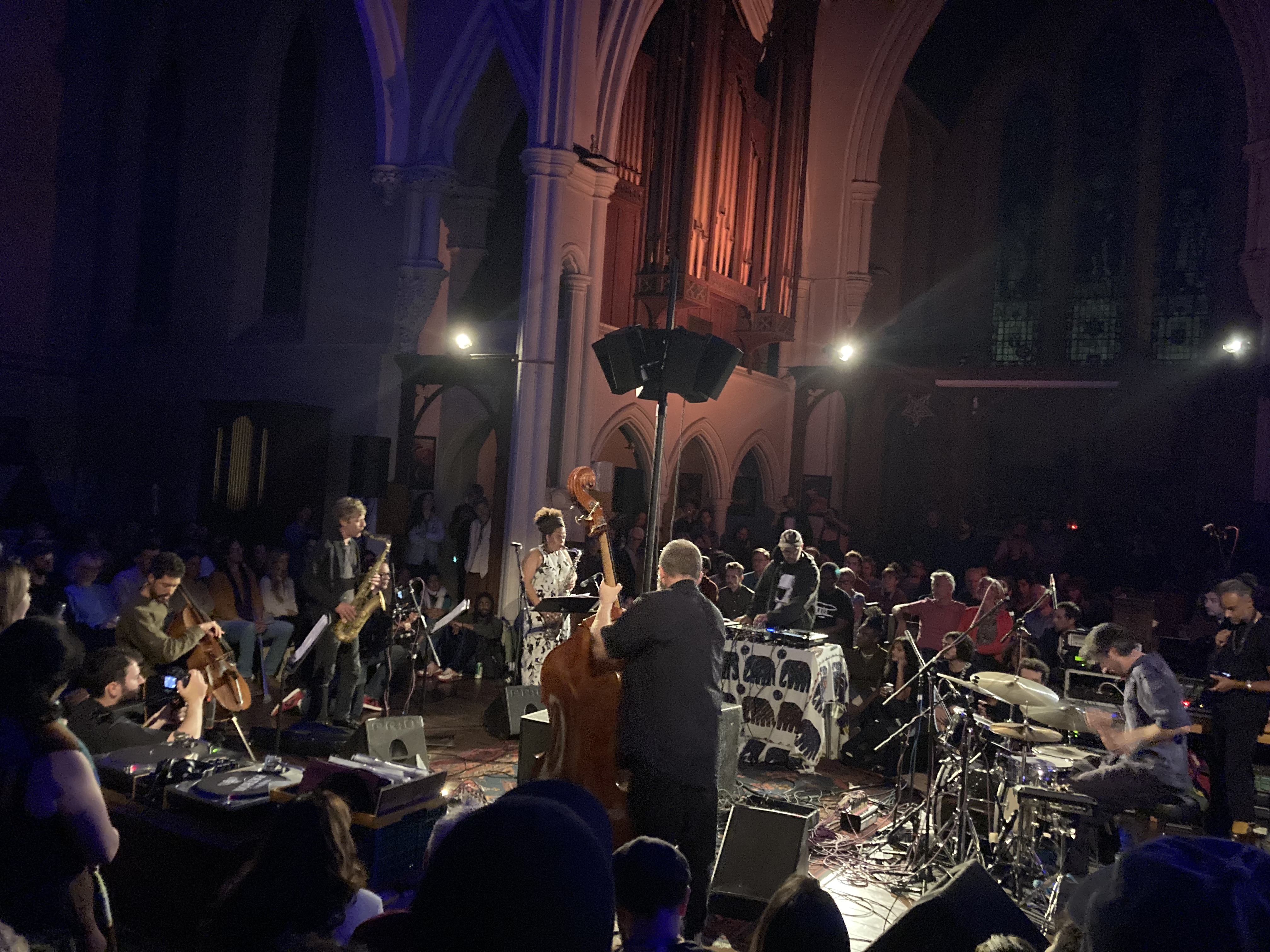
Long before hearing of Abdul Wadud’s death in August at the age of 75, Tom Skinner had been preparing his homage to the great cellist. Last night’s Church of Sound concert at St James the Great in Lower Clapton was a wonderful tribute from one musician to another, transmuting elements of Wadud’s solo album, By Myself, into a framework for a six-piece band called Voices of Bishara.
Taking their name from that chosen by Wadud for the label on which his album was released in 1977, the musicians were Chelsea Carmichael (tenor saxophone and flute), Robert Stillman (tenor saxophone and bass clarinet), Kareem Dayes (cello), Tom Herbert (bass), Paul Camo (samples) and Skinner himself (drums). Church of Sound is a terrific gig: the place was packed for the debut of a project led by a man known from his work with Sons of Kemet and more recently with Thom Yorke and Jonny Greenwood. Not many among the audience would have known of Wadud before last night, although there were a few whoops when Skinner mentioned the name of Julius Hemphill, with whom the cellist worked so memorably in the 1970s and ’80s, but they certainly responded to the music created in his honour.
Even at its most sophisticated there was something elemental about Wadud’s playing, something steeped in African ancestry, to which the name Bishara — ”gospel” or “good news” in a variety of languages, including Arabic and Swahili — made reference. Skinner’s arrangements enhanced this core sensibility, using the two stringed instruments and Camo’s samples to create a kind of desert blues atmosphere, floating on the drummer’s own loose-jointed propulsion and providing the setting for the two horn soloists. (At times it recalled the use of Ahmed Abdul-Malik’s oud and the basses of Jimmy Garrison and Reggie Workman on Coltrane’s 1961 Village Vanguard recordings). Dayes made fine contributions with his scrabbled pizzicato figures and keening arco, while Herbert raised the temperature in the second half with a majestic solo, setting up a two-tenor juxtaposition of Stillman’s asymmetrical agility and Carmichael’s confident power.
At St James the Great the musicians play in the round, and the church’s architecture means that the quality of the sound depends on where you’re sitting or standing. I moved after the interval and found that what had previously been swimming in echo now came into proper focus. The activities of two camera operators, filming the musicians at close quarters, was unhelpful and at times a distraction, but there’s an album of this music out soon, and on the evidence of the concert I’m looking forward to it very much. Rather than just settle for saluting the source of his inspiration, Skinner has found a way of going beyond it to discover something of his own.
On a fine but chilly day in January 2016, I took the train from Christopher Street in the West Village to Hoboken for a cup of coffee with Steve Lehman, the alto saxophonist and composer whose octet I was hoping to present at JazzFest Berlin later in the year. I’d seen them in Amsterdam and they’d confirmed the impression created by their albums that here was a band with a rare ability to use highly sophisticated compositional techniques as a vehicle for a group of superlative improvisers.
Lehman did indeed appear with the octet in the formal surroundings of the Haus der Berliner Festspiele that November, but something he said during our conversation on the western shore of the Hudson River led to a second gig the following year. When I asked what else he was up to, this tall, thin, bespectacled, generally studious-looking man, who studied the “spectral music” of Olivier Messaien in France, has lectured at the Royal Academy of Music in London and was about to head west to take up a post as a professor of music at the California Institute of the Arts, mentioned that he was working with a couple of MCs, one of whom rapped in English, the other in Wolof, the language of Senegal and the Gambia.
That project turned into a band called Sélébéyone, whose first album came out in 2017, shortly before Lehman brought them to Berlin to appear at the old Lido cinema in Kreuzberg as part of a two-night prelude to the main festival which also featured Amirtha Kidambi’s Elder Ones, Shabaka and the Ancestors, and Heroes Are Gang Leaders. They were brilliant. And now their second album — Xaybu: The Unseen — continues their remarkable exploration of ancient and modern.
Sélébéyone are the MCs Gaston Bandimic and HPrizm, who write and rap in Wolof and English respectively, the drummer Damion Reid and the soprano saxophonist Maciek Lasserre, who shares the compositional duties and the instrumental solos with Lehman. The 15 tracks of Xaybu are as carefully constructed, intricately detailed and richly textured as the music of the octet, making extensive use of electronics to modify and layer the source sounds. Lehman’s alto improvisations, always bearing the thoughtfully metabolised influence of his teacher and mentor Jackie McLean, fit beautifully between the spoken words and Reid’s endlessly creative beat-making, as do Lasserre’s citrus-flavoured soprano solos.
The words you catch strike home, and it’s worth reading the translation on the record label’s website to find something like this: “Kou dakoroul sin Ou yalla ndogale clamel god / Kou goki gokk tere nelaw goudi blamel mboot (If you don’t agree with God’s decisions, complain to God / If the frog’s sound keeps you up at night, complain to the frog).” Not your usual hip-hop message. Not your usual hip-hop music, either, or even your usual jazz/hip-hop fusion, but something deep, distinctive, urgent and often exhilarating.
* The photograph of Steve Lehman performing with Sélébéyone in Berlin in 2017 is by Camille Blake. Xaybu: The Unseen is on the Pi Recordings label. Lyrics: https://pirecordings.com/selebeyonelyrics/
Jean-Luc Godard once compared watching the great Hungarian football team of the 1950s to listening to free jazz. A few hours after the announcement of the great director’s death, it was possible to reflect on the meaning of his comparison during a performance at the Café Oto by the trio and octet of Olie Brice, launching the bassist’s new double album, Fire Hills.
Nowadays when we use the term free jazz we tend to mean music created from scratch, on the spot, with no prepared material. Back in the early ’60s, it tended to mean the use of composition to inspire improvisers to stretch the traditional boundaries, using the material as a launch-pad rather than a template while freeing soloists and accompanists to exchange roles. All that could be heard in the music made by Brice’s groups, both of them benefitting from his ability to use his role as a composer to guide rather than prescribe.
The first half featured the trio, completed by the tenor saxophonist Tom Challenger and the drummer Will Glaser, moving with great empathy through compositions dedicated to Johnny Dyani, Eric Dolphy and Andrew Hill. Linking two of the pieces, Glaser delivered a extraordinary solo that began with mallets rolling fast around his snare drum and two tom-toms, using the three pitches to produce something that had the quality of a song, before reversing one of the mallets to introduce a kind of counter-line. Drum solos are seldom poetic, but this was.
Between the two sets, the Oto sound system quietly played selections from the soundtracks of Godard’s movies, including Georges Delerue’s gorgeous orchestral compositions for Le Mépris: a nice touch on a day when a key figure of contemporary culture left the scene.
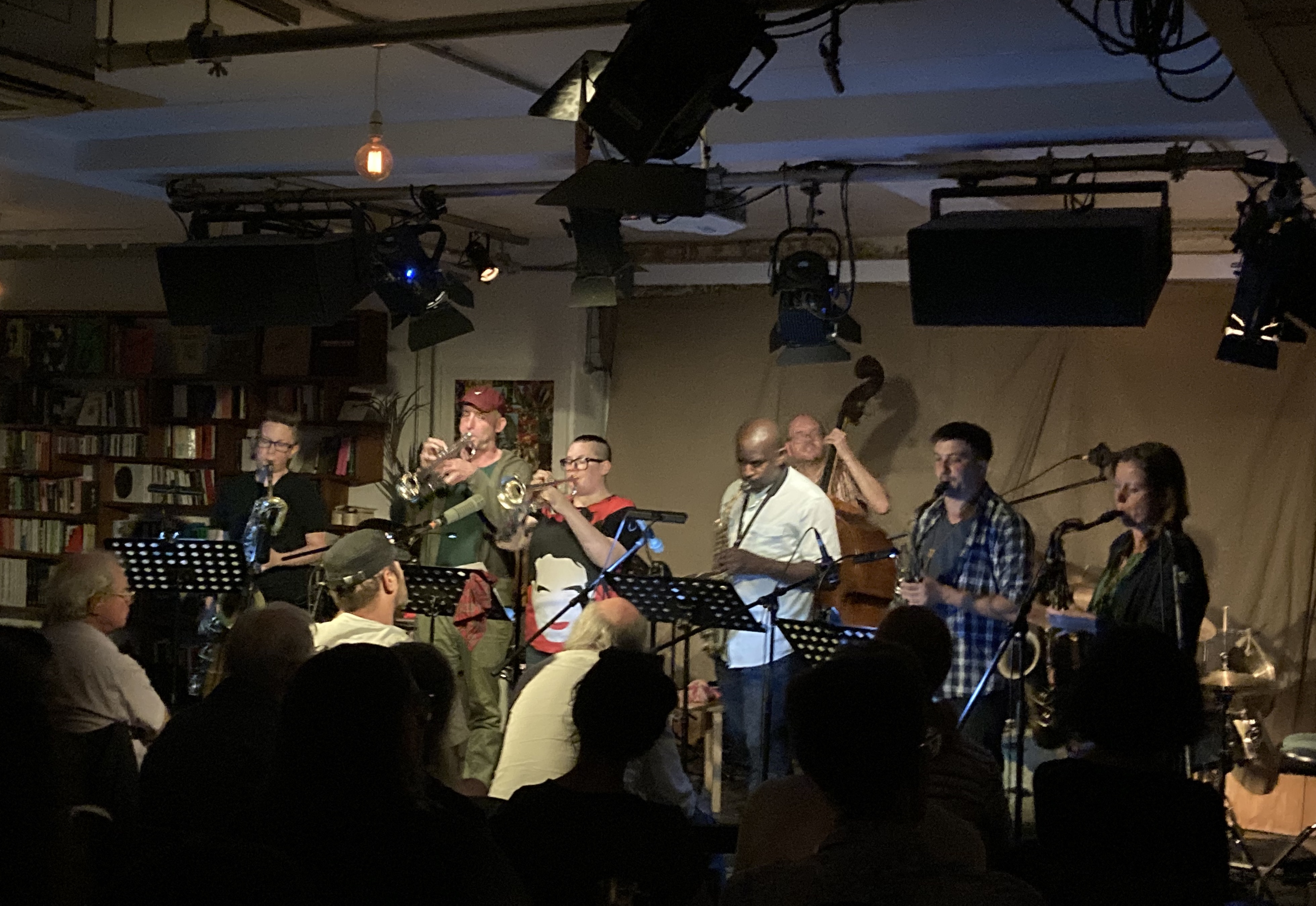
The six horns of Brice’s octet were assembled in a single line, but it soon became apparent that he would be using them as two units: a pair of trumpets (Kim Macari and Alex Bonney) and a baritone saxophone (Cath Roberts) to the left, an alto saxophone (Jason Yarde) and two tenors (George Crowley and Rachel Musson) to the right, with the drummer Johnny Hunter joining Brice in the rhythm section.
The short ensemble passages — sometimes just punctuations between the improvisations — had the kind of loose-woven, slightly ragged ebullience that could remind you of Mingus’s bands or Charlie Haden’s Liberation Music Orchestra, without borrowing moves from either. That made sense, since Mingus and Haden also figure strongly as inspirations for Brice’s own playing, in which virtuosity and passion are equally mixed.
The first two solos, by Macari and Musson, were the kind you want to wrap up and take home: on-the-nose power from the trumpet, beautifully controlled tonal distortion from the tenor. There were many duets, notably one between the soaring Yarde and the agile Bonney. One or two of the solos outstayed their momentum, but with this music that’s a risk worth taking. And what the evening showed was that Brice has his own way of applying organisation to music, shaping it in interesting ways without compromising the crucial spontaneity of expression and interaction.




 thebluemoment.com