Skip to content

‘The Philosophy of Modern Song’
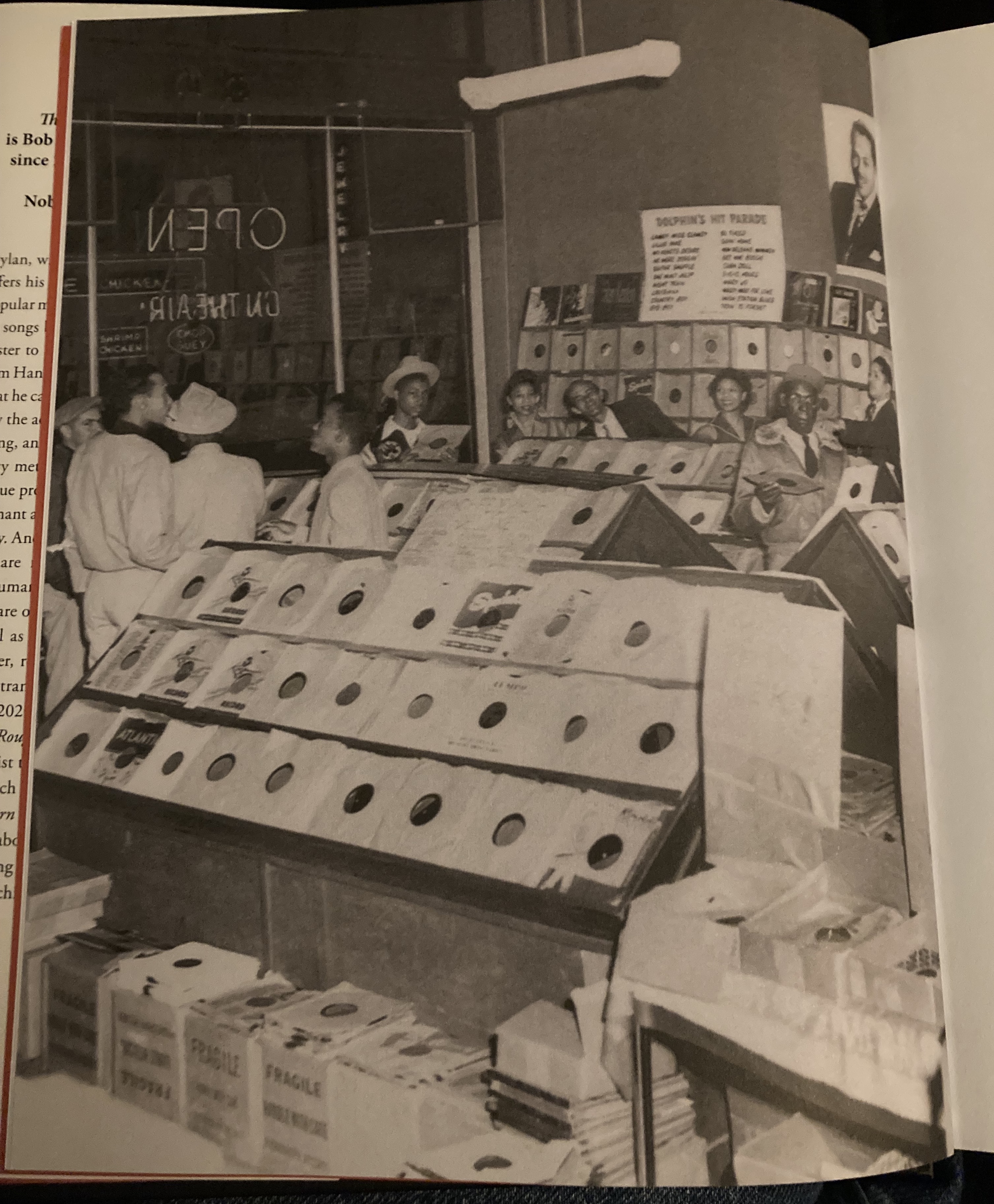
The second photograph you see when you open Bob Dylan’s The Philosophy of Modern Song is one of the reasons I don’t entirely resent having paid the £35 the book costs. It shows a group of customers in a record shop, surrounded by boxes and displays of 78rpm discs. There’s no caption, but there’s a clue in a poster on the wall saying “Dolphin’s Hit Parade”, followed by a list of songs. So this is Dolphin’s of Hollywood, the record shop opened by the black entrepreneur John Dolphin in South Central Los Angeles in 1948. Its frontage was on Vernon Avenue, near the corner with Central Avenue – the main stem of black LA in that era, thanks to nearby night spots like the Club Alabam, the Turban Room, the Downbeat, Elks Hall and Jack’s Basket Room. Dolphin’s opening hours — 24 hours a day, including Sundays — were pioneering, as was a buy-one-get-one-free deal. The titles on the poster — deciphered with the aid of a magnifying glass — tell you that this is the spring of 1952, which is when “Lawdy Miss Clawdy” by the Lloyd Price Orchestra was released on the Specialty label, along with “One Mint Julep” by the Clovers (Atlantic), “Night Train” by the saxophonist Jimmy Forrest (United) and “My Heart’s Desire” by the vocal duo Jimmie Lee and Artis with Jay Franks and his Rockets of Rhythm (Modern)*.

John Dolphin had originally tried to open a business in Hollywood, but was denied the opportunity on the grounds of his colour. So, locating instead in the heart of the black community, he gave the shop a semi-ironic title, soon adding a record label of his own, called Recorded in Hollywood, whose output included early recordings by the Hollywood Flames and Jesse Belvin. His business, and others in the neighborhood, were so successful that they began to attract white customers, which in turn brought threats from white competitors to such a degree that in 1954 he organised a protest against their campaign of intimidation. In 1958 he was shot dead in his office by a disappointed singer named Percy Ivy, in the presence of two soon-to-be-famous white teenagers, Sandy Nelson and Bruce Johnston, who had been trying to get him interested in their music. In the photograph, John Dolphin is the man in the dark suit under the picture of Billy Eckstine.

None of this information is to be found in the book, in which Dylan discusses 66 other songs. You’ve probably already read about it (I recommend Dwight Garner in the New York Times or Craig Brown in Private Eye), so I’m not going to try and review it properly. It’s easy to describe. Most of his choices get two chunks of prose: first, an outpouring of feelings and images provoked by the recording in question, followed by a historical note, all illustrated by a selection of images that range from the relevant to the tangential or allusive. Jimmy Reed’s “Big Boss Man”, for instance, gets a description of the boss class (“You’re the famous Chieftain, the enormous tight fisted penny pincher who treats all the workers like errand boys”) followed by a short description of Reed’s music (“You put him with Jimmie Rodgers and Thelonious Monk, two other musicians whose work never sounds crowded no matter how many players are there” and “He plays the harmonica through a neck rack. And you can’t do much with a harmonica in a neck rack” — really? Bob should go back and listen to his own live recordings from 1965 and ’66. Or maybe he’s putting us on). There are pictures of Reed, of Brando in The Godfather, and Elvis Presley — unmentioned in the text — with Colonel Tom Parker, who is pretending to play an acoustic 12-string guitar and is presumably there to represent boss men in general.

The criteria by which Dylan chose the songs are never made clear. Many are from his childhood in the pre-rock era. Others seem to have been plucked at random. As many have already pointed out, in some bafflement, only a tiny handful are by women. But the specifics don’t seem to be important: they are there to give Dylan the chance to vent. Where people with synaesthesia experience music as colour, Dylan seems to experience a song as a set of feelings that may or may not be triggered by anything explicit in the song itself, arising instead from his own imagination, his memories, fears, fantasies. Or perhaps that’s quite wrong. Perhaps he’s just making it up, and why not? At any rate, while working your way through one laboured exegesis after another, you may find yourself thinking that he’d be better employed fashioning them into songs of his own.

Soon after I started reading The Philosophy of Modern Song, I found I wasn’t enjoying it very much. It isn’t anywhere near the standard of his brilliant sleeve note for World Gone Wrong in 1993 or the considered thoughts on music expressed in several interviews in recent years. It didn’t seem to be telling me anything original or important. As for a “philosophy of modern song”, the closest he gets to that is his claim that a song’s true value resides in the listener’s response to it, which I guess is the book’s raison d’être, or at least its excuse. So I thought I’d try it from another angle. On the basis of having loved his Theme Time Radio Hour programmes largely because of the sound of his voice, I spent another few quid on the audiobook, only to discover that most of the reading is done by famous actors, from Jeff Bridges to Sissy Spacek. Why would I want to hear that? When Dylan does appear, his voice sounds weirdly remote, losing all the warmth and intimacy of the radio series. And there are times, to be blunt, when he sounds like he’s reading someone else’s research. So I’ve given up on that, too, at least for now.

Whatever the contentious origins of its component parts, Chronicles Vol 1 was a proper book, the product of craft and concentration. Which The Philosophy of Modern Song definitely isn’t. It’s inessential, a coffee-table book to be given as a Christmas present. Clearly he didn’t fancy writing Chronicles Vol 2 — perhaps, who can tell, because he knows that’s what we want.

* Correction: In the original post, “My Heart’s Desire” was credited to the Wheels, whose recording was not released until 1956. The recording by Jimmie Lee and Artis was released on the LA-based Modern label in early 1952.

* Bob Dylan’s The Philosophy of Modern Song is published by Simon & Schuster. The audio version is available from audible.co.uk. The copyright in the photograph above is owned by the Michael Ochs Archive via Getty Images.
Michael Gibbs / Vortex

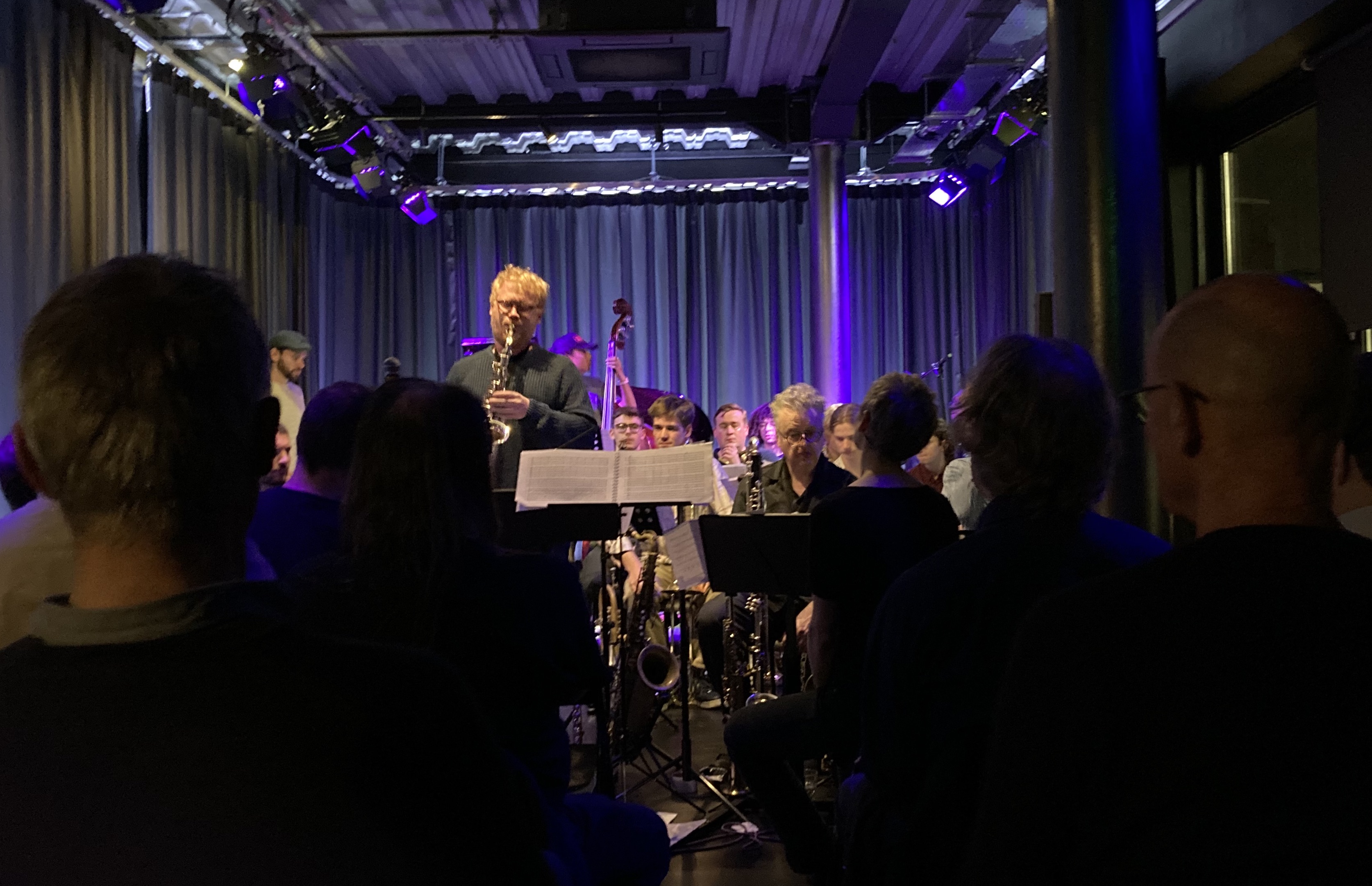
Tom Challenger soloing with the Trinity Laban Jazz Orchestra at the Vortex

Small space, big band. Can’t beat it. Five trumpets, four trombones, four reeds, five rhythm, making the air move within the confines of a proper jazz club. Even the smallest concert hall wouldn’t be the same. And sitting just behind me at the Vortex last night was Mike Gibbs, smiling and cheering as the Trinity Laban Jazz Orchestra, conducted by Josephine Davies, performed a selection of his compositions and arrangements in one of four sets arranged over two nights as part of the EFG London Jazz Festival, in celebration of his recent 85th birthday.

The finest tribute to the great man was the spirit shown by the young musicians of the orchestra, buttressed by a few distinguished elders, including Julian Siegel and Tom Challenger on saxophones, Lewis Wright on vibes, Hans Koller on piano and Gene Calderazzo on drums. Challenger’s alto soared unstoppably on a heart-lifting “Almost Ev’ry Day”, Wright proved yet again on “Ramblin'” that he doesn’t know how to play an uninteresting phrase, Siegel took firm control of “Round Midnight”, and Calderazzo kept the music on its toes. But the newer faces also had points to make: Kobe Heath Ngugi’s bass matched the drummer’s power and agility, Talfan Jenkins delivered a poised alto solo on Gibbs’ fascinating arrangement of Eberhard Weber’s “Mauritius”, Alex Polack’s trumpet cut through on the closing sequence of “Round Midnight”, and the guitar comping of Joseph Leighton behind Koller and Wright on “Ramblin'” was stimulating enough to remind me of Ray Crawford’s contribution to Gil Evans’s “La Nevada”, than which there can be no higher praise. These are all student at the Trinity Laban Conservatoire, and all names to watch.

Gibbs has worked with many musicians and orchestras in his long career — Kenny Wheeler, Gary Burton, Joni Mitchell, John McLaughlin, John Scofield and so on — but not much can have been more fun than this. At the end of the set, he was presented with a birthday cake while the band stood to play “Happy Birthday”. The fizzing candle was only one of the night’s fireworks.

* If you hurry, there are two more sets tonight: https://www.vortexjazz.co.uk/events/?s=Mike+Gibbs

Binker Golding / Purcell Room

There were times tonight when it felt as though Binker Golding was inventing a new kind of music. He wasn’t, of course, not really. But by combining and recombining familiar elements, and putting them through the filter of his own personality, the saxophonist and composer was doing something that jazz has always done, often to its great and lasting benefit.

On the opening night of the 2022 EFG London Jazz Festival, Golding arrived at the Purcell Room with the music from his recent album, Dream Like a Dogwood Wild Boy, and the brilliant musicians with whom he made it: Billy Adamson (electric and acoustic guitars), Sarah Tandy (piano), Daniel Casimir (bass) and Sam Jones (drums). But he added a whole extra dimension through the presence of the singer and violinist Alice Zawadzki and the harmonica player Philip Achille, who fleshed out the themes and tags that distinguish a set of tunes taking their inspiration as much from the influences behind 1970s singer-songwriter music — folk, gospel, pop — as from the free and post-bop jazz with which Golding has been associated.

He started the concert from a different angle, with the band minus piano and drums playing chamber versions of songs he loves, including Carole King’s “Way Over Yonder”, the Smashing Pumpkins’ “To Sheila”, the traditional “I’ll Fly Away” and Richard Thompson’s “Dimming of the Day”, all featuring Zawadzki’s pure voice. When Tandy and Jones arrived, the enlarged band slammed straight into “(Take Me to the) Wide Open Lows”, the new album’s irresistible opening track, on which Golding and Tandy soared in solos that built to ecstatic heights, with the saxophonist finding an unexpected sweet spot somewhere between Pharoah Sanders and Junior Walker.

Most of all though, it’s the pervasive sense of melody that makes Golding’s new music so appealing. The edge of hard bop is still there in something like “Howling and Drinking in God’s Own Country”. But it’s applied to the cadences of gospel and country, and to chord changes that come from pop music, including Motown, but all metabolised into something with its own organic integrity. Tonight Zawadzki’s fiddle and Achille’s agile chromatic mouth harp immeasurably enhanced these flavours. There was a hoedown mood to the music, a sense of joy, a freshness, a feeling that this was something you really ought to be dancing to.

* Binker Golding’s Dream Like a Dogwood Wild Boy is on Gearbox Records.

Just before the world changed

Sixty years ago this month, “Love Me Do” made the charts and the world changed. But what was it changing from? Not just the drab, complacent cardigans-and-Billy Cotton caricature of post-war British culture. Before the Beatles and Stones came along to provide a focus, there were plenty of signs, if you were looking, that something was about to happen. And two dozen of them are collected in A Snapshot in Time, a new compilation of sounds from 1960-63 that can be seen today as a series of premonitions.

I was 15 at the time, primed for change and and looking for those signs, in particular anything that resembled the incursion of the blues or modern jazz into mainstream pop music. “Sugar Baby Pts 1 and 2” by Jimmy Powell, a raw-voiced R&B singer from Birmingham was one. The more decorous Lyn Cornell — formerly of Liverpool’s Vernons Girls — singing Jon Hendricks’s lyric to Bobby Timmons’ “Moanin'” was another. Anthony Newley’s skewed Cockney-hipster version of “Strawberry Fair”, too. They’re included in this collection, which is subtitled “Society, scandal and the first stirrings of modernism 1960-63”.

One of the defining events of this fast-changing culture was the broadcast of the first episode of the satire show That Was the Week That Was by the BBC in November 1962. One track is a reminder of the national mood caught and amplified by TW3: “Christine” by Miss X exploits the Profumo affair in a cocktail-piano rhumba punctuated by lubricious faux-ingénue vocal interjections from Joyce Blair (sister of Lionel). Produced by John Barry, with the piano played by the Spanish aristocrat and film actor Jaime Mora y Aragón, and released on Jeff Kruger’s Ember label, it was propelled into the lower end of the charts by scandalised newspaper stories.

More seriously indicative of the future was the music evolving among those who had come out of the skiffle, folk and trad scenes, like Long John Baldry singing Willie Dixon’s “Built for Comfort” with Blues Incorporated, the guitarist Davy Graham’s solo set-piece “Anji” and two tracks, “Country Line Special” and “Chicago Calling”, released as the first single by the singer and harmonica player Cyril Davies, the Ken Colyer of British R&B. Others also came by way of the jazz scene, like the tenorist Red Prince with the Danger Man theme and the trombonist Don Lang with “Wicked Woman” (composed by the person who was to become P. J. Proby). Oh, and Sounds Incorporated’s Markeys-like “Sounds Like Locomotion” and “Why Should We Not”, Manfred Mann’s first single, a jazz-waltz instrumental heavy on alto saxophone, organ, harmonica and tom-toms.

A number of the tracks — including those by Powell, Lang and Cordell — came into being because Jack Good, the great producer of the TV show Oh Boy, had an A&R deal with Decca Records. Good was a visionary who wrote columns in the music press extolling the virtues of US records such as Gene Chandler’s “Duke of Earl” and Bruce Channel’s “Hey Baby” (which, of course, provided the inspiration for John Lennon’s harmonica on “Love Me Do”). Among the three Powell tracks is a version of “Tom Hark”, a South African kwela song that had been a hit for Elias and his Zig-Zag Jive Flutes, a pennywhistle band from Johannesburg, in 1958.

The track that sums it up best for me is “Orange Street”, a finger-snapping instrumental by the Blue Flames, with Georgie Fame on Hammond organ. I bought it on a school trip to London and yearned to be a part of the groovy scene to which it provided a soundtrack. Pretty soon, we all were.

* A Snapshot in Time, compiled by Rob Finnis and Roger Armstrong, is released on the Ace label.

Joe Tarsia 1934-2022

From left: Kenny Gamble, Joe Tarsia and Leon Huff at Sigma Sound in 1978

The Sound of Philadelphia was made by many hands. The singers, songwriters, producers and arrangers: Kenny Gamble, Leon Huff, Thom Bell. On guitars, Norman Harris, Roland Chambers and Bobby Eli. On keyboards, Huff, Bell, Harold Ivory Williams and Lennie Pakula. On bass guitar, Ronnie Baker. On drums, Earl Young. On vibes, Vince Montana. On percussion, Larry Washington. String and horn sections supervised by Don Renaldo. But it was also made by Joe Tarsia, the founder of Sigma Sound Studios, who died this week, aged 88.

Tarsia engineered such imperishable records as the the O’Jays’ “Love Train”, Harold Melvin and the Blue Notes’ “Bad Luck”, the Stylistics’ “You Make Me Feel Brand New”, the Spinners’ “One of a Kind (Love Affair)”, Billy Paul’s “Your Song”, Wilson Pickett’s “Engine Number 9”. He collaborated with Gamble, Huff and Bell to make a sound that updated soul music for the 1970s: richer in timbre than Motown, suaver in tone than Stax, more citified than Hi. Tarsia called it “black music in a tuxedo”.

He began his career as a radio engineer and serviced recording studios in Philadelphia before taking a job in 1961 at Cameo-Parkway Records, where he became chief engineer and worked on hits by the likes of Chubby Checker, Dee Dee Sharp, Fabian and the Orlons. In 1968 he took over and renamed an existing studio at 212 North 12th Street, updating the technology from two-track to eight-track. In 1971 his establishment entered the wider consciousness when Gamble and Huff started their own label, Philadelphia International, and began the decade-long run of hits captured on tape at Sigma Sound.

I met Tarsia, very briefly, in 1975, when I spent a day at Sigma Sound working with one of his assistant engineers on remixing the B-side of the Fantastic Johnny C’s “Don’t Depend on Me”, a song called “Waitin’ for the Rain”, down to its backing track for release on Island USA as an instrumental aimed at the Northern Soul market. David Bowie had just been in, working on Young Americans. I talked to the engineers a bit about the records they’d been making that I admired so much, and I asked them in particular about the great Thom Bell. One of them — and it might have been Tarsia — told me that Bell was in tears as he played piano while Philippé Wynne sang on the Spinners’ recording of “Love Don’t Love Nobody”. Not surprising, when you listen to it. That’s the power of the records they were making, with Joseph Tarsia at the board. Mighty, mighty music.

Bringing it all back home

Last night I was on my way to see Bob Dylan in concert in my home town for the first time, at a venue a few hundred yards from where, almost 60 years earlier, my girlfriend and I had listened to Freewheelin’ all the way through, squeezed together in a record-shop listening booth, before buying it, taking it to her parents’ house, and listening to it all the way through again. And then again.

Walking through Nottingham to reach the Motorpoint Arena, as the refurbished ice stadium is now known, I saw a chip shop in the Lace Market, formerly a coffee bar called the Jules et Jim, where three schoolfriends — Ian Taylor, Jeff Minson and I, a sort of Peter, Paul and Peter — had sung “Blowin’ in the Wind” in 1963. On Stanford Street I passed the site of Dungeon Club, the basement where — at the height of Bobmania in early 1965 — the harmonica player of the R&B group I was then in performed a solo mini-set of Dylan songs that attracted a lot more enthusiasm than our normal Jimmy Reed and Howlin’ Wolf repertoire.

It was also in the spring of 1965 that I first saw Dylan in person, at Sheffield’s City Hall on the first date of what would turn out to be his last solo acoustic tour. Since then I’ve seen him as often as I can — many times in London but also in Birmingham, Paris, Rome, New York and Philadelphia. Precious memories include a heart-stopping “It’s Alright, Ma” in Sheffield, a staggering “Like a Rolling Stone” at Earls Court, a blistering thrash-metal “Barbara Allen” at the NEC, a sweet duet on “Dark Eyes” with Patti Smith in Philly, and a gorgeous “Forgetful Heart” at the Albert Hall. In the week leading up the Nottingham concert I saw him twice at the Palladium, giving the first show a five-star review in the Guardian and then enjoying the second one even more.

But when I say that last night in Nottingham felt like the best concert I’ve ever seen from him, I’d ask you to accept that hometown nostalgia had nothing to do with it. Until a surprise right at the end, he played the set I’d heard twice at the Palladium. But in a place at least three times larger, with none of the inherent warmth and intimacy of the historic London theatre, he sang the same songs — nine from Rough and Rowdy Ways, seven older compositions of his own and “That Old Black Magic” — with an intensity and verve that gave them a different kind of life.

His singing was good in London, but in Nottingham it was astounding. Every line was nailed with phrasing that was always adventurous but never eccentric. I don’t think it was a change of emphasis in the sound mix: it was all in the vigour and projection of his delivery. As a result, songs like “Black Rider”, “My Own Version of You”, “Key West” and “I’ve Made Up My Mind to Give Myself to You” had a new confidence and richness, with a heightened sense of tension and release. The arrangements took on a different life, too. The Arlen/Mercer standard was brought off with a crisp panache. The twin surf guitar interludes on “Gotta Serve Somebody” were hair-raising. The three-movement version of “I’ll Be Your Baby Tonight” — first out of tempo, then Latin, then barrelhouse — was a delight. The rearrangements of “To Be Alone With You” and “Every Grain of Sand” glistened.

His piano-playing also seemed better integrated. The upright he’s using on this tour is adjusted to sound high and bright, almost like a tack piano, with a tone so close to that of the two guitars of Doug Lancio and Bob Britt that they’re sometimes indistinguishable. But during both Palladium shows there were moments when he crossed the line from playful to wilful, as if he were trying to lead the songs astray, occasionally sticking a major-key note into a minor-key song, or doing that thing he sometimes used to do on electric guitar of working out a short symmetrical phrase and then stubbornly repeating it over and over again with the chords changing under him. It crossed my mind that he might be trying to turn himself into the Thelonious Monk of folk-rock piano, looking for the notes in the cracks, the notes between the notes. But in Nottingham, with the exception of “Most Likely You’ll Go Your Way”, there was little of that; instead everything he played was directly relevant to what the band was doing and where the song was heading.

Where the concert was heading was towards the unforgettable moment, after the band had taken their bow, when they returned for the only encore of the tour so far. “I don’t know if many of you know, but Jerry Lee has gone,” Dylan said, “and we’re gonna play this song, one of his. Jerry Lee will live for ever, we all know that.” The song, an exquisite choice, was “I Can’t Seem to Say Goodbye”, a country ballad by Don Robertson, recorded by Lewis in 1963. After one chorus, delivered with quiet elegance, they were gone. But what a memory they left. Maybe even the best of all.

Fifty years later

Bryan Ferry was kind enough to invite me to contribute the introductory essay to the programme for Roxy Music’s 50th anniversary concerts in North America and the UK, so I went along to the O2 last night to see the closing date of the tour and to witness what might, I suppose, have been their final performance together. I don’t like arena shows, but once the sound had settled down it was possible to enjoy what the four members who played on the debut album in 1972 — Ferry, Andy Mackay, Paul Thompson and Phil Manzanera — and their six auxiliary musicians and three backing singers were up to. And of course there was that funny bitter-sweet feeling you get while watching something you first saw in a basement with a few dozen other people half a century ago scaled up to world-conquering proportions in its ultimate iteration. In the essay I wrote about the inevitability of the process by which what had begun as an experiment would become a performance, but hints of the original art-school excitement and uncertainty managed to survive even today’s production values and resources, and the lighting and the back-projections — endless highways for “Oh Yeah”, Warhol images for “Editions of You” — made it beautiful to watch. The show began with reminders of the slightly gawky early stuff (“Re-make/Re-model”, “Ladytron”) and finished with full-throttle favourites (“Love Is the Drug”, “Virginia Plain”) but in between came a long passage in which the pace slowed to a resting heartbeat as luxuriant textures and romantic descending patterns took over. Introduced by the wordless “Tara”, the sequence of “The Main Thing”, “My Only Love”, “To Turn You On”, “Dance Away”, “More Than This” and “Avalon” swept elegantly by in one long candlelit swoon. Not a bad envoi, if that’s what it was.

Art Laboe 1925-2022

I’m sure we all have a list of times and places to which we yearn to be transported in order to bear witness to particular musical events. My own would include the Miles Davis Nonet at the Royal Roost in 1948, Charlie Parker, Fats Navarro and Bud Powell at Birdland in 1950, Thelonious Monk with John Coltrane at the Five Spot in 1957, James Brown at the Apollo in 1963 and Andy Warhol’s Exploding Plastic Inevitable at the Dom in 1966. That’s a lot of time-machine trips to New York. But also very high on the list would have been one of the weekly dances hosted by the disc jockey Art Laboe at El Monte Legion Stadium, east of Los Angeles, where between 1955 and 1961 he presented star singers and vocal groups, mostly doo-wop and R&B, to a young and mixed audience of Hispanics, blacks and whites. Mr Laboe died in Palm Springs last Friday, aged 97, the day after taping his final radio show, and I’ve just finished writing his obituary for the Guardian. In 1963, two years after the last of the dances, Frank Zappa and Ray Collins wrote a song in tribute, which they recorded with Cleve Duncan of the Penguins. “Memories of El Monte” always makes me feel as though I know exactly how it must have felt to be there.

The spirit of 1971

On an earlier re-release of the first and only album by Centipede, the 50-strong (and therefore 100-footed) band assembled by Keith Tippett, RCA’s marketing department used a quote from the Melody Maker‘s original review: “No one who wants a permanent record of where our music was at in 1971 will want to be without Septober Energy.” It was true at the time and today, listening to a remastered and reissued version of the double album made by an ensemble containing actual and former members of Soft Machine, King Crimson, the Blue Notes, the Spontaneous Music Ensemble, the Blossom Toes, Nucleus, Patto, the Steam Packet and Dantalian’s Chariot, it still feels right.

In his notes to the new Septober Energy reissue, Sid Smith quotes my description of it at the time as “a miracle”, but as miracles go it was an eminently achievable one, given the spirit of creativity, goodwill and mutual encouragement in which it was conceived and implemented under Tippett’s inspired guidance. This was the first of his large-ensemble projects; if it lacked some of the finesse of later endeavours, it wanted for nothing in terms of spirit.

The clue was in the title. “Energy” was a word much applied back then to the kind of improvising habitually done by the freer players here — the tenorists Gary Windo and Alan Skidmore and the trombonist Paul Rutherford, for example, the singers Julie Tippetts and Maggie Nichols, and the three marvellous South Africans: the trumpeter Mongezi Feza, the altoist Dudu Pukwana and the bassist Harry Miller. But others from related fields were cheerfully infected by the same vibe: the trumpeter Ian Carr, the guitarist Brian Godding, the oboeist Karl Jenkins and the 19 string players led by the violinist Wilf Gibson. And then there were the horns from Tippett’s own sextet, already borrowed by Soft Machine and King Crimson: the cornetist Mark Charig, the trombonist Nick Evans and the altoist Elton Dean. There were five bass players in all, including Jeff Clyne and Roy Babbington, and three drummers, two of them being Robert Wyatt and John Marshall. Robert Fripp played guitar on stage and produced the album.

I seem to remember that the announcement of their debut concert, at the Lyceum in November 1970, made the front page of the MM. After that first gig, boisterously exhilarating but inevitably chaotic, they went on the road in Europe and had a great time. The following June they went into Wessex Studios in north London, located in an old church hall, with just four days for recording the 80-minute piece under Fripp’s supervision and a couple more days for him to mix and edit the results into four movements, each one fitting a side of the double album. Their last appearance was at the Albert Hall in December 1971.

All the enthusiasm of the time, as yet unspoiled by time and the depredations of the music industry, is there on the album. And so, thanks to the skills of the composer and the producer, is a clear view of the individual strengths of the featured soloists (meaning practically everybody), as well as their readiness to attempt a coalescence into something greater than the sum of the parts.

Part 1 begins with the sound of small percussion, like something from a Shinto temple, before long tones — strings, voices — emerge and hover, soon disrupted by the first hints of the storms to come. Gradually the brilliant disposition of the orchestral resources comes into focus as Tippett balances the roistering horns and thunderous drums with subtler deployments and great control of crescendo and diminuendo. The wrapover to Part 2 is a lovely bass conversation — one bowed, one plucked, one playing harmonics con legno — leading to a very period-correct jazz-rock sequence with Tony Fennell’s drums and Babbington’s bass guitar accompanying quarrelsome saxes over a brass choir, suddenly interrupted by giant overlapping unison riffs in which, metaphorically, the entire band seems to have been fed through a fuzz-box. A space is cleared for Carr’s serene trumpet and Skidmore’s urgent tenor to take solos against the rhythm section, both exploiting the lift of lyrical chord sequence, before Godding’s distortions announce the return of the heavy artillery. An improvised trombone quartet adds another contrasting texture.

Part 3 opens with the four singers — Tippetts, Nichols, Zoot Money, Mike Patto — delivering Julie’s lyric without accompaniment: “Unite for every nation / Unite for all the land / Unite for liberation / Unite for the freedom of man.” Then the trio of drummers take over for a powerful conversation, each individual carefully separated in the stereo picture, leading into a long ensemble passage that builds to a shuddering climax before a slow electronic fade leads to the two female singers improvising over the strings, like a giant version of the SME, the same forces combining in a disquieting written section that ends the side. Tippett’s solo piano announces Part 4, sliding into a broad, swelling theme for brass, mutating through a long Elton Dean soprano solo into a trenchant restatement of the “Unite for…” song, and ending with a pensive coda for piano and cornet.

Of course it sprawls, and not every note played over the course of almost an hour and a half could be described as deathless or essential. But it was and remains a triumph of conception and execution, a vision of musical scale with, as it were, the Little Theatre Club at one end and Woodstock at the other. It also set me thinking about the form an equivalent project might take today, with similarly open-minded and collaboratively inclined musicians drawn from newer generations. Jonny Greenwood and Thom Yorke from Radiohead would have to be there. Shirley Tetteh, Shabaka Hutchings, Olie Brice, Sheila Maurice Grey, Moses Boyd, Nubaya Garcia, Rachel Musson, Tom Skinner, Rosie Turton, Cassie Kinoshi and Theon Cross from the new London jazz scene. Beth Gibbons and Adrian Utley from Portishead. Keiran Hebden (Four Tet) and Sam Shepherd (Floating Points). Well, you can make your own list.

* The CD reissue of Centipede’s Septober Energy is on the Esoteric label. I don’t know who took the photograph at the Lyceum show.

Thirty years of Later…

There must be a lot of people out there who had their first encounter with a favourite artist through seeing them on Later…with Jools Holland. On Saturday night the programme celebrated its 30th anniversary by beginning its latest series on BBC2 with a typical bill: a guitar-based popular rhythm combo from Sheffield (the 1975, pictured above), a cutting-edge female performer from Rotherham (Self-Esteem), a rediscovered 82-year-old soul singer and his fine band from Portland, Oregon (Ural Thomas and the Pain), a Spanish-American solo singer-songwriter (Victoria Canal) and a deeply unclassifiable London-based trio playing challenging and highly contemporary instrumental music (The Comet Is Coming). Each of them will have attracted new admirers as a result of this brisk 50-minute programme filmed in the round on the floor of the Alexandra Palace Theatre.

When Later… first appeared, I felt straight away that it was almost exactly the show I’d always wanted The Old Grey Whistle Test to be during my year as its first presenter, and which it only occasionally became (examples: the performance of Curtis Mayfield and his band, John Martyn’s first solo appearance, and the 10 minutes when Dr John sat at an upright piano and ran through the history of New Orleans piano). It was about musicians of varying backgrounds and styles playing live — and even better, in the Later… format, listening to each other’s performances while waiting for their own turn. It was also my strong feeling that such a show needed a more extrovert presenter, and in Jools Holland it found one — and one who, moreover, could sit down at the piano and occasionally accompany a guest, as he did last night when Ural Thomas sang “Stand By Me”.

He isn’t to everyone’s taste — the “Hootenanny!” thing on his New Year’s Eve specials has been known to drive me from the room — but the show wouldn’t have survived through three decades without his ebullient personality to sell it. He was chosen back in 1992 by Mark Cooper, the programme’s founding producer and presiding spirit, whose broad but discriminating taste in music has probably been the single most important factor in the maintenance of the show’s quality. Over the years the production has become more polished, at the expense of a certain spontaneity, but last night’s line-up showed a continuing desire to present the experimental and adventurous alongside the familiar and safe.

Now Cooper — who began his career as a music journalist in the pages of Record Mirror, Q and Mojo and was BBC Studios’ Head of Music from 1999 to 2019 — has written a book about the show chronicling, as its subtitle promises, “30 years of music, magic and mayhem”. It’s a 400-page narrative rich in anecdotes and interspersed with reflections contributed by some of those who made memorable appearances, including Alicia Keyes, Richard Thompson, Ed Sheeran, St Vincent, Nick Cave and Baaba Maal. Thompson is particularly good value on being able to listen to Al Green from a distance of about 10 feet, on being able to tell Little Jimmy Scott how much he loved his music, and on backing Norma Waterson on a band including Martin Carthy, Eliza Carthy, Danny Thompson and Dave Mattacks. Keyes describes her first appearance in 2001, soon after the release of her debut album, as one of the great musical moments of her life: “The circle raises your game. You walk into the studio different, knowing you’re going to be among musicians who are being themselves and not trying to do what somebody else is doing.”

Open the book almost anywhere and you’ll get a good story, or even just a line reminding you that a single episode in 2008 could incorporate Solange, Stereophonics, Eli Paperboy Reed and a chat with Ray Davies. The section on Lou Reed’s appearances in 2000, 2003 and 2011 is beautifully remembered and observed; the author had first attended one of Reed’s concerts in 1972 and interviewed him for a magazine in 1992, which can’t have harmed his ability to provide the artist with a comfortable setting and a sympathetic atmosphere. He was less prepared for the arrival of Solomon Burke in the Later… studio in 2002, never having seen him live. Burke turned up in a wheelchair before settling his enormous bulk into a golden throne and proceeding, with the help of Holland’s Rhythm & Blues Orchestra, to wreck the house.

Later… is about respecting the elders, giving a platform to the new, and having fun with music. “There’s nothing like it in the world,” Baaba Maal says, and he may be right. Mark Cooper’s book — in which he properly shares credit with the many other people, such as his co-producer Alison Howe and the director Janet Fraser-Crook — is an entertaining and instructive guide to how it happened and to the small miracle of its survival.

* Mark Cooper’s Later… with Jools Holland is published by William Collins.