Skip to content

Adieu, Jane B.

The obituaries of Jane Birkin in this morning’s British newspapers mentioned all the obvious stuff — the BBC ban, the handbags — while neglecting to record two salient features of her career in the public eye. One was her extensive campaigning on behalf of many important causes (including the rights of immigrants and refugees, AIDS, abortion rights and climate change). The other was her music.

She became a singer through her association with Serge Gainsbourg, who gave her many good songs to sing, filled with his love of daft, clever puns and adroit double entendre. She remained faithful to them long after she and Gainsbourg had ceased to be a couple, and five years after his death in 1991 she made an album called Versions Jane, the title indicating its theme: a desire to find her own approaches to his songs.

Since her light, funny, deceptively fragile English-girl-in-Paris voice never changes, the settings are always the key, and for the album’s 15 songs she chose 15 different approaches. It opens with “Ces petits riens”, beautifully sung against animated pizzicato strings arranged by Jean-Claude Vannier. The joviality of “La gadoue” is animated by the sparky ska of Les Negresses Vertes, an accordion playing the role of rhythm guitar, with a cheeky interpolation of the melody from “Je t’aime — moi non plus”. The concert harp of Catherine Michel is the only accompaniment to the haunting “Dépression au-dessus du jardin”. The trio of the veterans Joachim Kühn (piano), Jean-François Jenny Clark (bass) and Daniel Humair (drums) give “Ce mortel ennui” a suave swing reminiscent of a Left Bank jazz club — Le Chat qui pêche, say — in the 1950s.

And on it goes. A full orchestra, arranged by Philippe Delettrez, billows beneath the mad verbal gymnastics of “Exercice en forme de Z”, with its buzzing bestiary of “chimpanzés, gazelles, lézards, zébus buses et grizzli d’Asie.” A slinky electro backing by Bruno Maman and the drummer Patrick Goraguer (son of Gainsbourg’s old musical director) adds a glide to “L’anamour”. The heavy rock of Daren et les Chaises detonates the demureness of “Elisa”. The Hammond organ of Eddy Louiss, once a member of Stan Getz’s European band, chugs beneath “Elaeudanla Téïtéïa”. Swelling strings and a rock rhythm section make a disquieting Euro-pop aria of “Aux enfants de la chance”, Gainsbourg’s warning against angel dust, magic mushrooms, freebasing and dragon-chasing. “Ford Mustang”, the story of a fashionable couple who die (or that’s how I interpret it) while kissing at the wheel of their big American car and crashing into those sturdy plane trees that used to line French routes departmentales, is recited against Boom Bass’s mosaic of samples: free jazz saxophones, random voices, piano, stabs of strings.

Birkin’s travels in pursuit of her various campaigns are recalled by “Couleur Café”, recorded in Dakar, featuring the drumming of the Senegalese griot Doudou N’Diaye Rose, and “Comment te dire adieu”, in which the contribution of the Orkestar Salijević, recorded in a Serbian village, results in a wonky brass band version that Tom Waits would enjoy.

Of the whole collection, the one that has always stuck with me most vividly is “Sorry Angel”. A lover’s ambiguous farewell, its words are half sung, half whispered against the layered guitars of Sonny Landreth, the noted bottleneck exponent in whose Louisiana studio the track was recorded. Floating in a gentle haze between boulevard and bayou, it’s a four-minute movie — and a highlight of the album that perhaps conveys best of any she made the range of her own creative thought.

I knew her a bit around this time and came to understand something of the extent to which she was admired and loved in her adopted country. One evening in Paris I got back to my modest hotel to find the woman at the desk beaming with unusual warmth as she gave me a piece of paper along with my room key. Mme Birkin had dropped by from her house around the corner a little while earlier and left a note about meeting the following day. As the receptionist handed it over, she practically curtsied.

Northern Soul at the Albert Hall

The spirits of Tobi Legend, Tony Clarke, Sandi Sheldon, Eddie Holman, Bobby Paris, Judy Street, Shane Martin, Dana Valery and other heroes of Northern Soul inhabited the Royal Albert Hall last night. Goodness knows what they would have made of the sight and sound of 5,000 people acclaiming performances of their songs in the second concert of the 2023 BBC Proms season.

To recreate 30 Northern Soul favourites with the BBC Concert Orchestra in such formal surroundings seemed like an endeavour fraught with risk. In fact it was an unmitigated triumph, for which enormous credit goes to the co-curators, the writer and broadcaster Stuart Maconie and the arranger Joe Duddell, as well as the half-dozen singers recruited to attempt the task.

The evening started with the ebullient Brendan Reilly delivering the MVPs’ “Turning My Heartbeat Up” and Dobie Gray’s “Out on the Floor”, setting the mood while reassuring the audience that the performances would both idiomatically accurate and true to the music’s spirit. It ended two hours later with all six singers taking turns to lead the audience in a wonderful version of Frank Wilson’s “Do I Love You (Deed I Do)”, the song that most perfectly captures the pure exhilaration of Northern Soul.

But there are many more shades to this music, as we heard as Frida Touray elegantly interpreted Rita and the Tiaras’ sublime “Gone With the Wind Is My Love” and Little Anthony and the Imperials’ sophisticated “Better Use Your Head”, in Nick Shirm’s elastic delivery of Shane Martin’s “I Need You”, Bobby Paris’s “Night Owl” and Jimmy Beaumont’s “I Never Loved Her Anyway”, in Natalie Palmer’s lively reading of Dana Valery’s “You Don’t Know Where Your Interest Lies” and Judy Street’s “What Can I Do”, in Darrell Smith’s stylish version of Ray Pollard’s “The Drifter”, and in Vula Malinga’s superb account of Gladys Knight’s gospel-driven “No One Can Love You More”. Reilly had just the voice for both the Trammps’ “Hold Back the Night” and the Carstairs’ “It Really Hurts Me Girl”.

As each singer took their solo turn, the others provided beautifully judged backing vocals. Gradually the orchestra, conducted by Edwin Outwater, came into its own, with Duddell and Fiona Brice providing the meticulously detailed arrangements: the strings soared, the brass and reeds thickened the sound. The rhythm section — Andy Vinter (piano), Alasdair Malloy (vibes), Pete Callard (guitar), Steve Pearce (bass guitar), Mike Smith (drums), Steve Whibley and Julian Poole (percussion) — provided the unstoppable momentum. Vibraphone and baritone saxophone, the keys to so many Motown-influenced Northern Soul favourites, were present and correct, while the guitarist chopped chords on the backbeat as the idiom demanded. The whole sound was mixed and balanced perfectly. A couple of times the singers stepped aside, allowing the orchestra to perform two of the backing tracks — “Sliced Tomatoes” and a magnificent “Exus Trek” — that were such an important part of the scene.

Darrell Smith, perfectly turned out in a brown Tonik suit, supplied soaring drama that stole the show late on with the Four Seasons’ “The Night”, the Albert Hall’s lighting technicians bathing the ecstatic throng in something approaching a mirror-ball effect. Then came the famous trio of songs with which the DJs at Wigan Casino closed their all-nighters: Dean Parrish’s “I’m on My Way”, Jimmy Radcliffe’s “Long After Tonight Is All Over” and Tobi Legend’s “Time Will Pass You By”, which between them summon all the emotions its audience continues to draw from this music: optimism and determination, but also the layer of aching sadness beneath the euphoria. All the complicated feelings of youth, captured in these seemingly disposable but resolutely enduring songs.

Maconie’s introduction had drawn cheers for his mentions of Manchester’s Twisted Wheel, Blackpool Mecca, Wigan Casino, Stoke’s Golden Torch and Bolton’s Va Va Club. This was a communal rite, a meeting of the clans, the reunion of a family in an alien setting that turned out to be a home from home. It was something very precious. I can’t begin to tell you how much I enjoyed it.

* You can hear BBC Prom 2: Northern Soul on BBC Sounds for the next 29 days. You can see it on BBC2 on 26 August and hear it again on BBC Radio 6 Music on 9 September.

Coltrane & Dolphy on the record

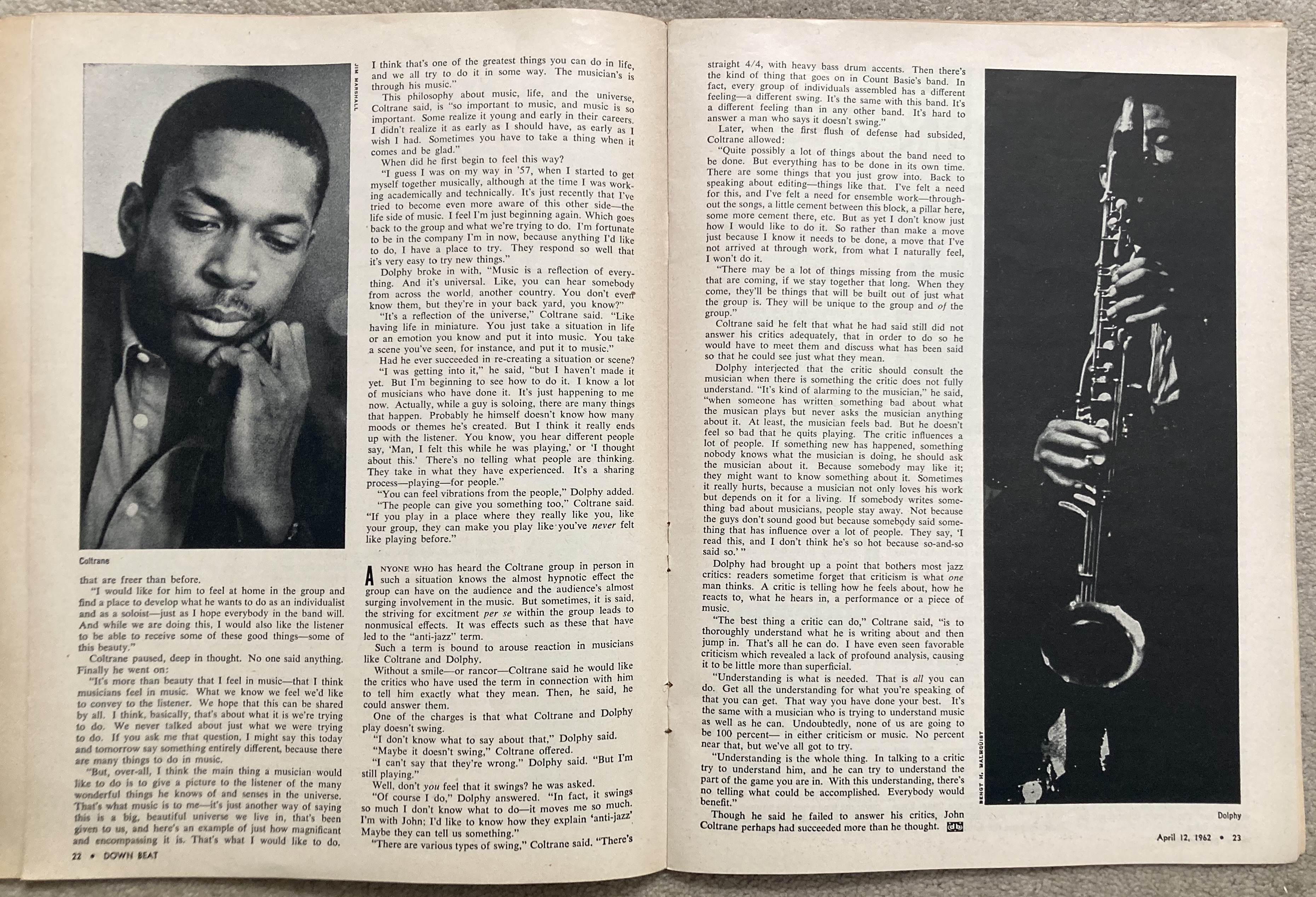
When Uncut magazine invited me to review the newly discovered tapes of John Coltrane and Eric Dolphy at the Village Gate in the summer of 1961, which are released today on vinyl and CD, I went and dug out the 12 April, 1962 of issue of Down Beat. Its striking cover announced that the two musicians had given a joint interview defending themselves against the charge that what they were playing was “anti-jazz”. I was 15 years old when I bought this copy of the magazine and exhilarated by what I saw and read.

Down Beat, essentially a magazine of the jazz establishment, had given a platform to two revolutionaries. Interviewed by Don DeMichael, the publication’s editor, they provided long and fascinating responses to his questions, as you can see below. Their patience is exemplary. Much of what they had to say is as valuable today as it seemed 60 years ago.

The way the cover and the two inside spreads were designed somehow echoed the tone of the piece. Whoever “Roth” was, his charcoal portraits seemed to catch a quality of heroic iconoclasm, as did the extreme cropping of the photographic images (taken by Bill Abernathy of Chicago and the Stockholm-based Bengt H. Malmqvist, who later became Abba’s photographer) on the first inside page. The whole thing made an impression that has never faded.

* Evenings at the Village Gate by John Coltrane with Eric Dolphy is on the Impulse label. The September issue of Uncut is out now.

Under the same sky

It’s 10 years since the veteran countercultural insurrectionist Mick Farren died. In 1976, in a celebrated polemic for the NME headlined “The Titanic sails at dawn”, he asked: “Has rock and roll become another mindless consumer product that plays footsie with jet set and royalty, while the kids who make up its roots and energy queue up in the rain to watch it from 200 yards away?” I thought of his words while watching — from a range of almost exactly 200 yards, as it happened, albeit on a warm, dry afternoon — Bruce Springsteen and the E Street Band giving the first of their two concerts in Hyde Park.

Farren wrote his piece only seven years after the Rolling Stones had played a free concert in Hyde Park to an audience of perhaps a quarter of a million (although I’ve always questioned that figure): a significant event in the history of both the band and the Sixties youth culture of which it was a part. All you had to do was turn up and find yourself a space on the grass. There were no merchandise stalls, because there was no merchandise. If you wanted anything to eat, drink or smoke, you had to bring it with you.

By contrast, Springsteen’s gigs (and others in the British Summer Time series) were sponsored by American Express. To secure a couple of tickets, even those very far away from the privileged enclosures housing the jet set (and perhaps even royalty), you needed to spend a few hundred quid. In the days leading up to the event, there were messages via a special app telling you what to expect and what you could and couldn’t do, with a map of the site, a list of prohibited items (including food and drink), and so on. And it all worked fine. Pleasant attendants, a variety of refreshment outlets and the provision of adequate toilet facilities made it a civilised experience. The weather was warm but not too hot, and the setting sun provided the golden light that enhances any performance.

Once upon a time Springsteen made concert halls feel like clubs. Then he made stadiums feel like concert halls. At 73 he still performs for three hours with impressive vigour and generosity of spirit (he gives the band a mid-set break rather than taking one himself), but nowadays his big gigs feel like big gigs. That’s the price, I guess, of having such a massive following. But although I liked hearing “Darlington County” and “Mary’s Place” and “Badlands” and “Wrecking Ball”, and enjoyed his decent stab at the Commodores’ “Nightshift”, a lot of the set sounded coarsened, which was not how it used to be. Maybe the band is now so big — all those horns and voices — that the music has lost the agility which was such a vital part of its early charm.

And, of course, from 200 yards, each figure on stage was about a quarter the size of a matchstick. So you watched it all on the big screens. Which, inevitably, were not quite synched with sound travelling such a distance to where I was standing. That was about halfway back in a crowd of 62,000, some of whom said afterwards that it was the best Springsteen show they’d ever seen. In the Guardian, Jonathan Freedland wrote an affecting piece about his reaction to the concert’s valedictory tone and its message for a generation now growing old.

I don’t begrudge anyone their enjoyment in Hyde Park. I’ve seen Springsteen at other times and in other places when the shows he delivered were as good as anything of their kind could possible be. But when I think about the corporate infrastructure of the Hyde Park concerts, and about the row over “dynamic pricing” in the US, and about the stories of what people are having to go through (and spend, of course) to see Taylor Swift on her forthcoming tour, I think Mick Farren’s point was so well made that its meaning has only grown louder over the years.

When he wrote that piece, punk rock was coming down the track. For a while that movement seemed to destabilise the commercial edifice built up around the music. Then the music industry found ways to reassert its authority, to globalise its product while building an impenetrable wall around it. Whatever the instincts and virtues of Springsteen, Swift and others, however immaculate and sincere, their gigantic tours are now an expression of that authority.

I’m probably sounding naive, because in a sense it’s nothing new. At the time of their free concert in Hyde Park, the Stones were managed by Allen Klein, the American hustler whose involvement was emphatically not motivated by countercultural concerns. Mick Farren also wrote books about Elvis Presley, and he knew perfectly well that Colonel Tom Parker didn’t care about Elvis’s audience or the culture they represented. He cared about making a buck.

Chapel of love

This September it will be 70 years since Roebuck Staples took his daughters Cleotha and Mavis and his son Pervis into a studio in Chicago where, accompanied by his guitar and the piano of Evelyn Gay, they made their first recordings. Mavis had just turned 14, but the unearthly power of her voice was already transfixing congregations in the local churches where they sang. Now the only survivor of the Staple Singers, she’ll turn 84 in a few days’ time, and this week she returned to London to fill the Union Chapel to capacity two nights in a row, still growling and roaring out her message of love, still a tireless soldier in the army of her Lord.

She’s a monument, and that’s all there is to it. To attempt to “review” her would be an insult. It’s enough to say that she and her two female singers and three-piece rhythm section delivered a well chosen repertoire with vigour and warmth to a clamorously admiring and affectionate response. She spoke of the Union Chapel, a Grade 1-listed nonconformist church built in 1870s and still doing work for the homeless, isolated and dispossessed, being “home”, and that’s how it felt.

The songs she performed included beautifully minimalist versions of Norah Jones’s “Friendship” and Ike Cargill’s “Are You Sure”, and trenchant readings of Stephen Stills’s “For What It’s Worth”, Talking Heads’ “Slippery People”, Funkadelic’s “Can You Get to That” and Dottie Peoples’ “Handwriting on the Wall”. And, most of all, “Respect Yourself”, a song by Luther Ingram and Mack Rice that the Staple Singers recorded in Muscle Shoals, Alabama in 1971, and whose sentiments carry even greater force half a century later. If the song’s brand new day has yet to come, it’s not Mavis’s fault. As she once sang, she’ll never turn back.

A Ducal setting

Groups of figures — men in dinner jackets, women in floaty dresses — moving across terraced lawns on a warm midsummer afternoon, carrying picnic baskets and champagne in coolers. An auditorium built into an 18th century Greek Revival mansion sitting above a river in the lovely Hampshire countryside. It’s not hard to imagine that Duke Ellington — who, after all, once dedicated a (rather insipid) suite to Queen Elizabeth II — would have appreciated the idea of his music being played in such a setting, performed by a full orchestra as part of a summer-long festival that also features evenings dedicated to operas by Mozart, Purcell, Glück and Tchaikovsky.

Ellington: From Stride to Strings was the idea of Piers Playfair, an Englishman who is the creative director of 23Arts, based in New York. It was taken up by Michael Chance, the artistic director of the Grange Festival, which was established in 2017 along the lines of Glyndebourne but with, it seems, a more eclectic outlook. Playfair invited the pianist, composer and writer Ethan Iverson to create symphonic versions of pieces written by Ellington in his final decade, and secured the Bournemouth Symphony Orchestra to perform them, under the baton of Gavin Sutherland.

To open the evening, Playfair assembled a sextet of experienced New York musicians, half of them Juilliard graduates, to perform a dozen Ellington favourites in arrangements by their leader, the trumpeter Dominick Farinacci. They kicked off with a solo medley of stride piano pieces by Mathis Picard, French-born with family roots in Madagascar, whose vivacity immediately won the audience’s hearts — and held them at the start of the second half, too, when he performed “New World a-Comin'”, Duke’s playful, rhapsodic piano concerto, with the orchestra.

The sextet began with “Drop Me Off in Harlem”, featuring the clarinet of Patrick Bartley Jr, followed by a cunning combination of “The Mooche” and “East St Louis Toodle-oo”, on which Bartley’s alto saxophone was more Toby Hardwicke than Johnny Hodges, and by Billy Strayhorn’s “Take the ‘A’ Train”, with Farinacci using a cup mute to proper effect. The opening chorus of “In a Sentimental Mood”, played unaccompanied by the vibraphonist Christian Tamburr using only his fingertips on the metal keys, was alone worth the round trip from London. Iverson appeared at the piano for “Creole Love Call” and “Come Sunday”, beautifully sung by the Armenian soprano Anush Hovhannisyan. Bartley’s ebullient vocal on the closing “It Don’t Mean a Thing (If It Ain’t Got That Swing)” sent the audience off for the long dinner interval in marquees around the grounds in very high spirits, having heard the group’s drummer, Jerome Jennings, as light-fingered as Oliver Jackson or Billy Higgins, demonstrate exactly what swing is.

Ellington’s reputation will never be required to stand or fall by his late large-scale compositions, but Iverson’s eight-part suite, titled Valediction, did them honour. Although there were no improvised solos, there was enormous pleasure to be had from hearing the chirping woodwind against walking pizzicato low strings (four cellos, two basses) on “Daily Double”, from The Degas Suite, the brassy groove of “Acht O’Clock Rock”, from The Afro-Eurasian Eclipse, the wistfulness of “King Solomon” (from Three Black Kings) and the moody, blues-inflected “Bourbon Street Jingling Jollies”, from New Orleans Suite. The decision to reset “The Lord’s Prayer”, a piano solo from one of his sacred concerts at Westminster Abbey, for two trombones against bells and strings was wonderfully imaginative. One of Ellington’s train pieces, “Loco Madi”, from The Uwis Suite, began with puffs and whistles and then chuffed along merrily with interlocking phrases for cellos, bassoons, French horns and flutes, before coming to a halt just short of the buffers.

The sextet joined the orchestra for a relatively rowdy “C Jam Blues”, closing an evening that clearly intrigued and delighted a mostly non-jazz audience. It deserves to be repeated in other settings.

The bending of headlights

“We have a new very quiet album out,” Rickie Lee Jones said as she greeted a packed Jazz Café in London last night. I bought Pieces of Treasure, the album in question, a few weeks ago, played it three times, and filed it next to the rest of the evidence of her long and remarkable life in music. It was certainly nice to see her reunited with Russ Titelman, the co-producer of her unforgettable debut album back in 1979 and a careful curator of this new collection of standard songs, but it didn’t make a huge initial impression. Last night she brought it to life.

She’s travelling with a three-piece band: Ben Rosenblum on electric piano doubling accordion, Paul Nowinski on string bass and Vilray Bolles on electric guitar. For the first half of the 75-minute set she just sang a selection of standards, starting with a pin-drop “The Second Time Around”, which she recorded on Pop Pop in 1991, and continuing with “Just in Time”, “One for My Baby” and “September Song”, which are on the new one, then “Up a Lazy River” from 2000’s It’s Like This, “Hi-lili, Hi-lo” from Pop Pop (with the accordionist not just exquisitely replicating but actually improving on Dino Saluzzi’s bandoneon part on the original recording), and “Nature Boy” from the new one.

It didn’t take long to appreciate not just how well she was singing but how beautifully her musicians were creating a matrix for the way she was so thoroughly inhabiting the songs. You might have heard “September Song” a million times, interpreted by some of the greatest singers in the history of popular music, but by bringing herself so close to the song, by eliminating the distance between song and singer, she made you think, as if for the first time, about what it meant.

Later on she did the same with another song worn threadbare by repetition. “There will be other lips that I may kiss / How could they thrill me like yours used to do? / Oh, I may dream a million dreams / But how will they come true? / For there will never be another you.” It was as though she’d just written it.

The groove changed with Steely Dan’s “Show Biz Kids”, which she recorded on It’s Like This. The slinky funk-lite keyboard riff summoned a whole universe of laid-back rock and roll hipness, and the audience enjoyed singing along: “Show business kids makin’ movies of themselves / You know they don’t give a fuck about anybody else.” (And how prophetic was that, written by Walter Becker and Donald Fagen 50 years ago?) She did her father’s song, the lullaby-ballad “The Moon is Made of Gold”, and her own much loved “Weasel and the White Boys Cool”, and finished by returning to the new album for “On the Sunny Side of the Street”, a song her dad taught her in the summer of 1963 (“a big year for me” — she would have been eight years old, and he also taught her “My Funny Valentine” and “Bye Bye Blackbird”). She left to an ovation, on a wave of profound affection.

But earlier, after about an hour, when she had strapped on a guitar, there had been “The Last Chance Texaco”. Those two gentle chords, instantly recognisable, then: “A long stretch of headlights / Bends into I-9…” It’s a movie. It’s a poem. It’s a confessional. It’s a communion. It’s the song that defines her. The one that most fully draws us into her world. “(It) wasn’t like anything I’d ever written,” she remembered in her wonderful 2021 autobiography. “It wasn’t like anything I’d ever heard.” As she sang it, once again the space between then and now collapsed. And when the sound of the car on the highway faded to silence, I might not have been alone in discovering that my cheeks were suddenly damp.

* The photo of Rickie Lee Jones at the Jazz Café is by me. Pieces of Treasure is on BMG/Modern. Her autobiography, Last Chance Texaco, is published in paperback by Grove Press. Thanks to Allan Chase (see Comments) for identifying the musicians.

Peter Brötzmann 1941-2023

I’m listening to Catching Ghosts, a beautiful recording of Peter Brötzmann’s set at the 2022 Berlin jazz festival, in whch he was joined by the Moroccan guembri player Majid Bekkas and the American drummer Hamid Drake. Brötzmann died last week in Wuppertal, his hometown, aged 82; the cause was chronic obstructive pulmonary disease, from which he’d suffered for some time, exacerbated by the arrival of Covid-19. His final public appearances were earlier this year at Café Oto in London.

A formidable figure. Brötzmann was famous for the volume (in every sense) of his saxophone playing: not just the prodigious decibel level but the volume of notes and the volume of energy, urgency and passion that poured out of his alto and tenor saxophones, his clarinet and bass clarinet, and his Hungarian tarogato in countless live appearances and scores of recordings. He lived as hard as he blew, and there’s pathos in the thought that the ferocity of his playing over the course of 60-odd years may have contributed to his fatal illness.

I first set eyes on him in November 1969, when I took time off from covering the Berlin Jazztage to visit what most people referred to as the anti-festival: the second annual Total Music Meeting, held in the Litfass, a café in Charlottenburg. It was the brainchild of the New Artists Guild, a group of young German musicians who objected to the way the line-up of official festival (whose stars that year were Duke Ellington, Miles Davis, Stan Kenton, Sarah Vaughan and Lionel Hampton) was failing to include exponents of the new European free jazz.

I remember hearing the pianist Alex von Schlippenbach there for the first time, and the tenorist Rüdiger Carl. Brötzman was leading a band including three British musicians — Evan Parker, Paul Rutherford and Derek Bailey — along with the German bassist Buschi Niebergall, the Dutch drummer Han Bennink and the Belgian keyboards player Fred van Hove. Without disavowing its influences, this was becoming a truly European idiom.

Several of these musicians had been involved in the recording of Machine Gun, the octet album released the previous year on Brötzmann’s own label. Taking its cue from John Coltrane’s Ascension and Albert Ayler’s Bells, but raising the collective intensity to unprecedented levels, Machine Gun acted as a manifesto. Today it retains, like Jimi Hendrix’s Woodstock version of “The Star Spangled Banner”, its ability to shock and amaze in real time while also carrying the mind back to the conflicts and social turbulence of the time and place in which it was made.

“We saw our task as building a different foundation for music,” Brötzmann told Reinhard Köchl of Zeit Online early this month, in his last interview. Out of that second Total Music Meeting in 1969 came a label called FMP (Free Music Production), the brainchild of Brötzmann and the producer Jost Gebers. Starting a few months later with Manfred Schoof’s European Echoes, FMP went on to release more than 200 albums on vinyl and/or CD — including, in 1971, the first of several reissues of Machine Gun.

It was also the home of several albums by one of my favourite Brötzmann groups, a quartet with the trumpeter Toshinori Kondo, the bassist William Parker and Hamid Drake on drums. Die Like a Dog was the name of their first album, subtitled “Fragments of Music, Life and Death of Albert Ayler”, and it became the name of the band. My favourite of the quartet’s albums is a 1999 session recorded in Berlin and released under the title Aoyama Crows. In an interview included with that album, Brötzmann reflected on mortality. “We’ll just play until we drop,” he said. “It’s not because we’re heroes. We have to. There isn’t much else for us to do but to carry on playing.”

He was not necessarily the easiest person to deal with, even for someone who admired him greatly. When Tyshawn Sorey agreed to be my artist in residence at Jazzfest Berlin in 2017, we discussed possible projects. I suggested that a duo with Brötzmann might be a good idea. Tyshawn was immediately enthusiastic. I made the approach, only to receive a message from Brötzmann saying that he had no intention of being part of “a circus”. That was a pity; it could have been a colossal meeting. Perhaps it was me. Anyway, I’m glad my successor, Nadin Deventer, had better luck in 2022.

By that time the onset of physical limitations may have shorn Brötzmann’s playing of some of the Sturm und Drang elements that characterised his prime years. But exposed to a clearer view in Catching Ghosts is a kind of lyricism which entwines beautifully around Majid Bekkas’s traditional Gnawa chants and the sprung rhythms set up by the guembri (a three-stringed bass lute) and the drums. Brötzmann gave us late work worthy of his long and extraordinary career.

* The photograph of Peter Brötzmann is by Anna Niedermeier. Catching Ghosts is out now on the ACT label.

Nick Drake: The Life

You had to wonder, looking around the October Gallery in London last night, what Nick Drake would have made of the gathering arranged to mark the publication of Richard Morton Jack’s account of his short life. As his sister, the actress Gabrielle Drake, remarked in her elegantly moving speech, he might have taken it as a vindication of his own belief in his talent.

Among those present last night were many who had spoken to the author about their encounters with Drake. Among those I knew were Simon Crocker, Chris Blackwell and Jerry Gilbert. Crocker played drums at Marlborough in a band in which Drake played saxophone and later travelled with him on expeditions to Aix and Saint-Tropez; their final encounter, a few months before Drake’s death, is recounted in the book. Blackwell, the founder of Island Records, had liked Drake’s demos — and Drake himself — when he heard them at the end of Nick’s first term at Cambridge in 1967; a year later he signed him to the label at the behest of Joe Boyd, who became his producer. Gilbert, my colleague at the Melody Maker for a few months in 1970, secured the only real interview Drake ever gave, published in Sounds later that year**.

And, of course, there was Gabrielle, to whom the extraordinary way her younger brother’s posthumous reputation and record sales eventually took off must have been the source of such complex emotions: joy that he had finally been recognised, regret that he could not see and be part of it, all filtered through the memory of the mixed happiness and pain that marked his 26 years.

As she writes in the book’s foreword, this is not an authorised biography in the sense that the author’s approach or his final manuscript were formally approved by Nick’s estate or his surviving family. But Richard Morton Jack was given such generous access to all relevant sources and material, and has treated this opaque, enigmatic life with such care and skill, and with such a calm, understated ability to evoke time and place, that his 550-page volume can be considered definitive — a dangerous word when it comes to biography, or indeed any non-fiction work, but in this case almost certainly justified.

* Richard Morton Jack’s Nick Drake: The Life is published by John Murray.

** Not quite the only one, as it turns out: during his research for the book, Richard Morton Jack unearthed a 1970 interview given to a writer from, amazingly, Jackie, a magazine for teenage girls.

Old and New Dreams

I may have said this before, but jazz tributes and reunions don’t do much for me. I’d rather hear the music moving on, using its past as the basis for further development. There are exceptions, including the welcome rediscoveries and reinterpretations of Herbie Nichols’ compositions by various musicians, Ryan Truesdell’s meticulous reconstruction of Gil Evans’s lesser known pieces, Alan Skidmore’s lifelong homage to John Coltrane and — of course — Old and New Dreams, four players who convened in 1976 to continue the work they’d done as members of Ornette Coleman’s acoustic quartets.

The trumpeter Don Cherry, the tenor saxophonist Dewey Redman, the bassist Charlie Haden and the drummer Ed Blackwell made three albums together, all for European companies. The first was for Italy’s Black Saint label. The second and third were for ECM, and the first of those will shortly reappear as part of the German company’s vinyl series under the general rubric ‘Luminessence’, along with Gary Burton’s New Quartet. (The first two albums in the series were Kenny Wheeler’s Gnu High and Nana Vasconcelos’s Saudades.)

In the case of Old and New Dreams, it’s good to have the album’s cover, designed by Barbara Wojirsch around the photograph by Herbert Wenn, back in 12-inch form: the calm austerity of the image and the controlled informality of the hand lettering are echt ECM. So is the sound, engineered by Jan Erik Kongshaug at Oslo’s Talent Studio under the supervision of Manfred Eicher, a combination that produced some of the label’s finest recordings throughout the 1970s.

The album begins with a 12-minute version of “Lonely Woman”, the classic ballad Coleman first recorded in Los Angeles in 1959 for The Shape of Jazz to Come, to which it also provided the lead-off track. Cherry and Haden were present for that momentous session (Billy Higgins was the drummer), and their historic connection to the song contributes to the extraordinary richness of this interpretation. If the original was a five-minute miniature in which every note could be committed to memory, here the framework is stretched to incorporate new perspectives. If I could only keep half a dozen tracks from the five decades of ECM, this would be one of them.

The remainder of the album maintains the standard: another Coleman tune (the previously unknown bounce-tempo “Open or Close”) plus Blackwell’s African-flavoured “Togo”, Cherry’s lyrical desert-blues “Guinea”, Redman’s musette feature “Orbit of La-Ba”, and Haden’s eco-anthem “Song of the Whales”, the bassist using his bow to create the sound of the endangered marine leviathans as an introduction to his gorgeous descending theme, which manages to be simultaneously mournful and uplifting.

All four of these musicians are gone now, as are Ornette and Higgins. But the unique music they made lives on, not least in this priceless reincarnation and the epic “Lonely Woman” it contains.

* Old and New Dreams is out in a vinyl edition on the ECM label on June 23. I don’t know who took the photo of the quartet — Charlie Haden, Don Cherry, Ed Blackwell and Dewey Redman — playing together; if anyone has that information, please tell me and I’ll provide a credit.