Skip to content

Ishiguro, long ago

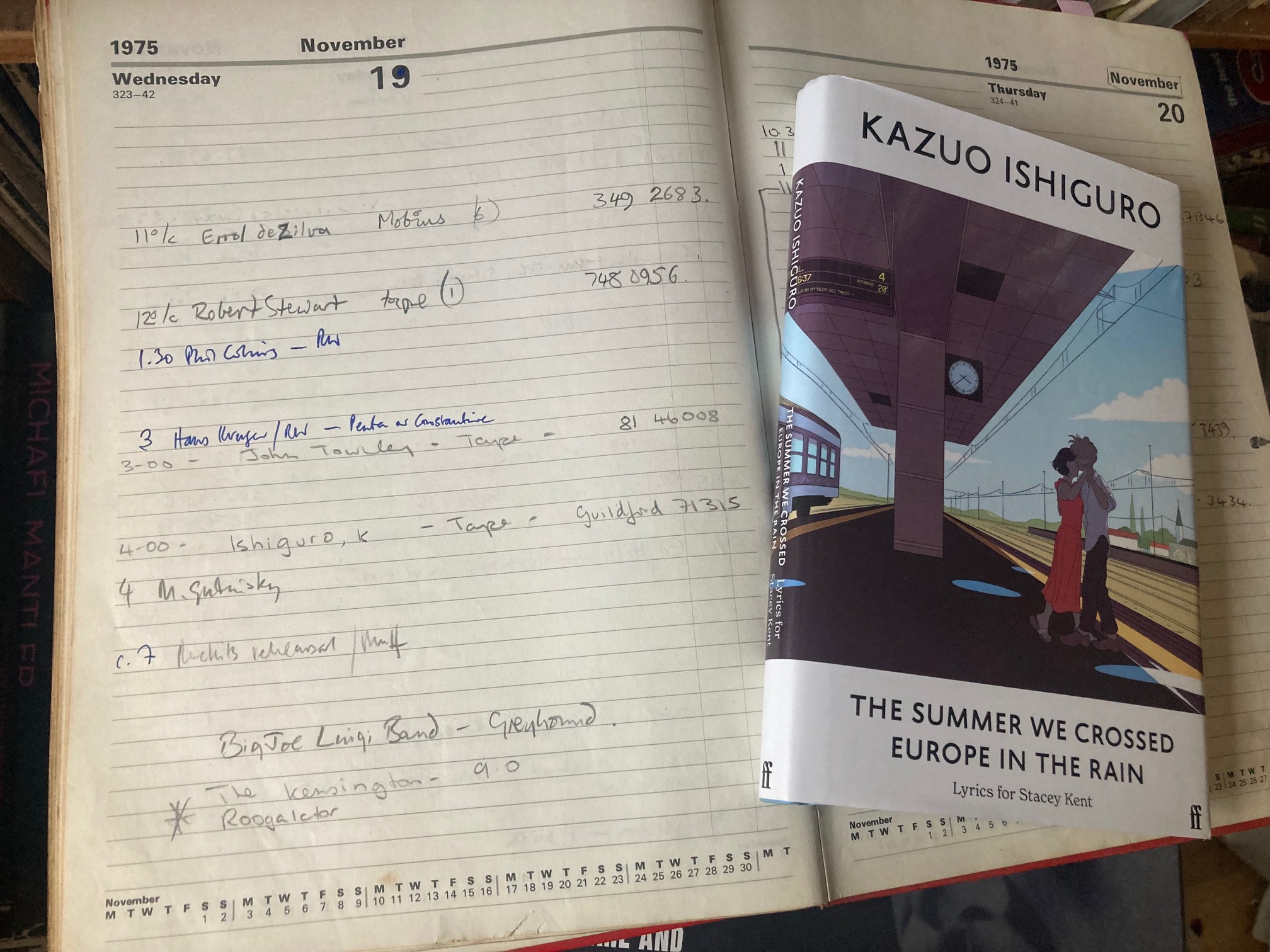
A typical day in the A&R department at Island Records’ London headquarters in November 1975. Four or five people coming in to play their demo tapes to me or my assistant, Howard Thompson, in the semi-basement office in a beautiful stucco house in St Peter’s Square, W6. A lunchtime meeting with Phil Collins, a familiar face from the early days of Brand X, before they went off to sign with Charisma. The early evening rehearsal of a band called the Rockits, evidently a Muff Winwood project. And a note to go and see the still-unsigned Roogalator, with their great American guitarist Danny Adler, at the Kensington pub near the Olympia exhibition halls.

At four o’clock that day there was an appointment with “Ishiguro, K”, bringing a tape for us to hear, evidently from Guildford. Sadly, I have no clear memory of the man or his songs. What I do know is that he would go on publish the first of his eight novels, A Pale View of Hills, in 1982, win the Whitbread Prize for An Artist of the Floating World in 1986, the Booker Prize for The Remains of the Day in 1989, and the Nobel Prize in literature in 2017, all of this topped by a knighthood in 2018. So I think one could say that, just a couple of weeks past his 21st birthday and a couple of months into the first year of his undergraduate studies at the University of Kent, Kazuo Ishiguro negotiated what is nowadays known as a sliding-doors moment with some success.

I found that diary entry a couple of years ago, while looking for something else. It came back into my mind while reading the introduction to The Summer We Crossed Europe in the Rain, a book of Ishiguro’s lyrics, written over the last couple of decades for the London-based American jazz singer Stacey Kent.

“I’ve built a reputation as a writer of stories, but I started out writing songs,” he writes, before going on to describe an apprenticeship influenced by Leonard Cohen, Joni Mitchell, Bob Dylan, Robert Johnson, Jimmy Webb, Tom Jobim, Hank Williams, Hoagy Carmichael, Cole Porter and many others. He failed in his original ambition to become a successful singer-songwriter, but what’s interesting is the degree to which he believes his eventual mastery of writing fiction was shaped by his early efforts with music, which led him to think that the trick was not to prioritise getting a grip on his readers but rather to find a way of engaging their interest at a different and perhaps more lasting level.

“A song lasts only a few minutes,” he writes. “Its impact can’t afford to reside just in what happens during the moment of direct contact. A song lives or dies by its ability to infiltrate the listener’s emotions and memory, and, like a parasite, take up long-term residence, ready to come to the fore in moments of joy, grief, exhilaration, heartbrteak, whatever. No one aspires to write a song that catches the attention only while it’s being heard, then gets forgotten. That’s not how songs work.”

What he identifies is “something in the unresolved, incomplete quality of so many well-loved songs that’s significant here. In the world of prose fiction, there’s a strong impulse to achieve completeness; to tie every knot, answer every question, to leave no loose ends hanging. By contrast, in the world of songs, there’s a much lower bar when it comes to literal sense-making. The tiny amount of words available, the internal logic of the melody, the emotional content imposed by chords and chord sequences mean that the ability of a song to connect had little to do with, say, convincing psychological back stories or even the clear readability of the songs unfolding before us. It occurs to me that good songs may haunt the mind not despite their incompleteness, but because of it…”

The whole thing is worth reading, as are the 16 lyrics reproduced in the book, beautifully illustrated by the Italian artist Bianca Bagnarelli in a bande dessinée style. If the occasional specificity of places and film references recalls Clive James’s efforts in a similar direction (mentions of Casablanca and Indochine, Les Invalides, “some tango in Macao”, “Gabin / Hooded eyes / A slow Gitanes / Weary deserter on the run”), the subtlety of the emotional engagement is closer to that of Fran Landesman, the writer of “The Ballad of the Sad Young Men” and “Spring Can Really Hang You Up the Most”. Ishiguro’s lyrics are sophisticated without being smart, precise but leaving intriguing gaps; they bear reading on the page, and their effect — like that of his mature prose — can linger in the mind.

As I said, I have no real memory of what happened on that Wednesday in 1975 when “Ishiguro, K” came by. It can’t have had any effect on his destiny. But I hope we were nice to him.

* Kazuo Ishiguro’s The Summer We Crossed Europe in the Rain is published by Faber & Faber. Stacey Kent’s albums Breakfast on the Morning Tram and The Changing Lights, which contained some of the early fruits of their collaboration, set to music by Kent’s husband, the saxophonist and flautist Jim Tomlinson, were released in 2007 and 2013 respectively on the Blue Note label.

New sounds in the Round

Mejedi Owusu (left) with his quintet at Jazz in the Round

There’s been a bit of a kerfuffle at London’s music conservatoires in recent days over an email from a teacher claiming that white students in the jazz departments are disadvantaged by the preferences given to fellow students who are black. The teacher in question — and I won’t name him — is an eminent white musician in his sixties. He claims, in passing, that his own career has been hindered by discrimination in favour of black musicians, and it would not be hard to imagine that this sense of grievance may lie at the heart of his more general complaints.

These include the suggestions that because so few black students study classical music, a disproportionate number are allowed into the jazz courses in order to meet overall equality and diversity quotas within the institutions, and that white bandleaders employ black musicians at the expense of superior white candidates simply because their presence helps them get gigs and grants.

Anyway, his classes at Trinity Laban, the Guildhall and the Royal Academy of Music have been boycotted and he is currently at home on sick leave. While his supporters have been disparaging the students as woke snowflakes and getting up a petition to demand his reinstatement, his critics have set up a counter-petition calling for his permanent removal.

My view is that what he had to say in the email is nonsense, and dangerous nonsense at that. Towards him personally, I’m old enough to feel a kind of sorrow tinging the hot anger with which his students have understandably responded. No doubt he thinks that he was smply being honest. But there had to be a better, wiser alternative to creating divisions where none should exist.

The success and visibility of young musicians of colour coming through the conservatoires and Tomorrow’s Warriors and similar schemes around the country in the last few years, working alongside their white contemporaries while bringing a new audience to the music, has been the healthiest collective phenomenon I can remember in six decades of listening to British jazz. Black musicians over-represented in jazz? About time, is all I can say.

As if to prove the point, last night’s edition of Jazz in the Round at the Cockpit Theatre in North London was opened, as is the custom at the monthly series, by a group of young musicians. This was a quintet let by the trumpeter Mejedi Owusu, who is 18 years old and a student at Trinity Laban. The line-up was completed by others from his cohort: Will Coode on alto and tenor saxophones, Chris Outhwaite on piano, Kielan Sheard on bass and Sacha Harlan on drums. They played three Owusu originals, and as they tore into the first of them, a jet-propelled piece titled “Paranoia”, every ear in the place was pinned back. For a minute the scalding trumpet-and-alto unisons allowed us to feel what it must have been like to be ringside at Birdland in the early 50s.

The second piece was a likeable composition called “Dark Eyes”, in the style of those Blue Note boogaloo pieces that Alfred Lion used to get Lee Morgan or Hank Mobley to write and record in the hope of getting jukebox exposure. The final piece was a ballad called “Affliction of the Innocent”, written a couple of years ago in the double shadow of the Covid-19 death toll and the murder of George Floyd, following the tradition of such elegant hard-bop threnodies as Benny Golson’s “I Remember Clifford” and Freddie Hubbard’s “Lament for Booker”.

One thing the set confirmed is that it is usually harder, at least for relatively inexperienced musicians, to play a slow tune than a fast one. That comes with maturity. Owusu and his colleagues are at the beginning of their careers, with plenty of time for growth. You just hope that, when they emerge into the professional world, there’ll be work for them all — as well as for sixty-something teachers who may yet prove capable of learning from the voices of their students.

Diamante visions

Phil Manzanera has been a friend since I first interviewed him during the days of Quiet Sun, the band of school friends he was in before being recruited by Roxy Music in time to play on their debut album in 1972. So I can’t pretend to be completely objective about Revolución to Roxy, his newly published autobiography. But I can be completely honest in saying that it will prove informative and entertaining to anyone who’s followed his career over the past half-century, even from a distance.

Here’s a sample that had me almost collapsing with laughter, when he spins a metaphor out of one of the trappings of early success: a maroon Rolls-Royce coupé whose combination of heavy weight and light steering was guaranteed to induce car sickness in children, making it “completely useless as an everyday family vehicle” and forcing him to keep in storage, bringing it out only on special occasions.

“The car carried a famous brand name,” he writes, “it was sleek, stylish and smooth, and undoubtedly in its own way it was iconic. It was a treat to take out, and whenever I did, it was admired and enjoyed by everyone who experienced it. Eventually, though, the time would come when it needed to go back into the garage and once again be covered by the tarpaulin to keep it well preserved and in good order, ready for the next outing.

“I guess you can see where this is going. There was something about that Roller which felt to me to be a bit like Roxy Music. Eye-catching, stylish and high quality, extremely enjoyable and I was proud to be associated with it. From time to time, it would be an absolute joy to take out for a ride so that it could be admired and appreciated; but the ‘steering’ difficulties and the resultant discomfort meant that its outings were strictly limited. After a while it had to go back under the tarpaulin so I could live my everyday life in my runabout.”

The history of Roxy Music as a kind of artistic Petri dish is, of course, explored in some depth throughout these 300 pages, from Manzanera’s first failed audition through the years of great success to the period in which, he began to feel like “not much more than a session player in my own band” — a band in which “I had to find out what was going on more or less by accident.”

Not least, the book is an interesting exploration of rock-band dynamics, with all the associated uncertainties, insecurities, frustrations and exasperations, and Manzanera has a perceptive take on Bryan Ferry’s legendary penchant for procrastination and prevarication: “His Fine Arts background obliged him to tinker and fiddle way beyond the point where the vast majority of people would long since have settled. I now understand this is about his need to make everything he does artistically beautiful and perfect. I tend to want to do things quickly and I’m not worried if they have a primitive edge, and what I’ve learned is that in Roxy opposites can attract. That’s integral to what makes Roxy music special. Makes it us. Makes us it.”

As musical director of the Guitar Legends festival in Spain is 1991, he had the job of telling Bob Dylan that the organisers expected him to perform “All Along the Watchtower”. How he coped and got there in the end, with the aid of Richard Thompson, is worthy of a place in Ray Padgett’s recent book of interviews with people who’ve worked with Dylan. Recollecting in tranquillity, Manzanera writes: “The way I think about the whole thing is much the same as I used to think about my first visit to various foreign countries. I’m really keen to go, really keen to get to know their individual customs and idiosyncrasies, but having been there and done that, I don’t necessarily ever feel the urge to revisit.”

There are stories about his long collaboration with David Gilmour, a shorter and almost Dylanesque one with the Argentinian hero Fito Paez, a WOMAD tour of South Africa and the Antipodes, his discoveries of the pizzica music of Puglia while directing another festival, his adventures with Jack Bruce in Cuba, his songwriting partnership with Tim Finn and his long relationship with Robert Wyatt. And about 801, that short-lived but incandescent all-star band he created in 1976 with Brian Eno, Bill MacCormick, Francis Monkman, Simon Phillips and Lloyd Watson. And, of course, about those diamante-studded bug-eyed sunglasses created for him in Roxy’s early days by Antony Price.

But, as the man who interviewed Phil for today’s Times observed, this isn’t one of those rock-star biogs where you skip the early chapters dealing with childhood, family and schooldays. In this case, that aspect of the narrative is quite as compelling as the rock-star stuff. Phil was born in London but grew up in Cuba during the run-up to the Castro revolution, the son of an Englishman, Duncan Targett-Adams, who had worked for the British Council in Colombia but now represented BOAC in South America, and a Colombian mother, Magdalena Manzanera. There were mysterious elements on his father’s side of the family — was he a spy? where did an Italian opera singer fit into the picture? — and the Latino influence from his mother’s side on his life and work is interestingly explored.

In a way, though, the most striking passage in the book come when he discusses the phone call from America one day in 2012 in which he was told that Kanye West and Jay Z had sampled a riff from K-Scope, his slightly obscure second solo album, then more than 30 years old. They used it on “No Church in the Wild”, a bleak modern masterpiece and the lead track from their album Watch the Throne, which went platinum in the US and gold in the UK before the track appeared in ads for Audi and Dodge cars. Most significantly of all, as it turned out, it was used by Baz Luhrmann on the soundtrack and the trailer for The Great Gatsby.

“Who knew,” Phil writes, in a sentence that tells you a great deal about the evolution of the music industry in our lifetime, “that I would earn more money from a short guitar riff I wrote one evening on a sofa in front of the telly in 1978 than I ever earned in the entire 50 years as a member of Roxy Music?”

* Phil Manzanera’s Revolución to Roxy is published by A Way With Media (£35)

The artwork of British jazz

Who could have imagined, as the music and those who made it were fighting for their existence, the three-figure sums that British jazz albums from the ’60s and ’70s would be fetching in a new century? To some, Richard Morton Jack’s Labyrinth: British Jazz on Record 1960-75, a large-format book containing threequarter-size reproductions of the front and back sleeves of 161 albums, plus another 140 at a smaller scale, will be a catalogue of longing and desire.

Look! Original copies (cond: VG) of Joe Harriott’s Abstract and David Mack’s 12-tone New Directions on Columbia, of Poetry and Jazz in Concert on Argo, of Mike Westbrook’s Celebration on Deram, of The People Band on Transatlantic, Bob Downes’s Open Music on Philips and Ric Colbeck’s The Sun Is Coming Up on Fontana! The first LPs by Howard Riley on the Opportunity label and Back Door on the Blakey imprint! The SME’s debut on Eyemark! Mike Taylor’s Pendulum! The only recording of the Chitinous Ensemble, directed by Paul Buckmaster! Guy Warren of Ghana! Lots of Michael Garrick, Graham Collier, Gordon Beck, Tony Oxley, Tubby Hayes, Stan Tracey, Keith Tippett, Alan Skidmore, Rendell & Carr, Ray Russell… all the way to the Nottingham Jazz Orchestra’s Festival Suite, released on Doug Dobell’s Swift label.

Richard Morton Jack gives a brief commentary on each album, with quotes from reviews, and there’s an introduction by Tony Reeves, probably most famous as the bass player with Jon Hiseman’s Colosseum, who describes how he, a Lewisham schoolboy, found his way into the scene as a player and a producer, with Neil Ardley’s New Jazz Orchestra, whose Western Reunion and Le Déjeuner sur l’herbe are featured, and others.

What a time it was — although, as I said, it was always a struggle for those trying to make a living in jazz clubs up and down the country, despite the efforts of intrepid A&R men/producers like Denis Preston, Terry Brown, Peter Eden and Giorgio Gomelsky to persuade Decca, EMI, Philips, Pye, Polydor and CBS to record this adventurous music.

Labyrinth finds a different and very enjoyable way of telling the story, exploiting the artwork and the information contained within 12 x 12 album jackets, back in the days of helpful sleeve notes. And if I had the choice of all these albums, but could keep only one? It would probably be the Blue Notes’ Very Urgent, their first recording after landing in the UK from South Africa. Produced by Joe Boyd at Sound Techniques and issued on Polydor under Chris McGregor’s name, it’s as exhilarating today as it was back in 1968, and its long-term influence is still to be felt, even in the work of young musicians then unborn.

* Richard Morton Jack’s Labyrinth: British Jazz on Record 1960-75 is published by Lansdowne Books (£60)

The Ballad of Bob and Rita

On the way to the cinema to see One Love last night, my thoughts went back to 1967, and buying the Wailers’ “Put It On” on an Island 45 at the West Indian record shop on Union Street in Nottingham, near the bus station. And to 1972, and spending hours at Harry J’s studio in Kingston, listening to them recording tracks for Catch A Fire, sharing Chris Blackwell’s pleasure as he realised what a good decision he’d made when he advanced them — in a move so unusual in the Jamaican record industry as to be unique — enough money to make an album. Who could have imagined then that Bob Marley, having first become a global symbol, would eventually turn into an industry, the generator of posthumous books, exhibitions, a musical and now a feature film?

So I was going to the film slightly reluctantly, in a mood of mild pessimism, even cynicism. How sensible, after all, is it to expect Hollywood to treat something you know a bit and care quite a lot about with sensitivity and respect? An hour and a half later I emerged in a very different frame of mind.

Reinaldo Marcus Green’s film concentrates on one short period of Marley’s life, from his shooting by political gunmen two days before a planned Peace Concert in December 1976 through the 18 months in London during which he recorded Exodus before returning home for the One Love concert, in which he stood between the prime minister, Michael Manley, and the leader of the opposition, Edward Seaga, and made them join hands.

It isn’t a biopic, although there are flashbacks to Marley’s early years: to the departure of his father, to his introduction to the cult of Rastafari, to the day the producer Clement Dodd invited the nascent Wailers into the studio. The earliest of these are framed, very effectively, as dreamlike childhood memories. But the bulk of the film concentrates on the narrow span of time in which he rose to his fullest artistic height (Exodus is his What’s Going On or Innervisions) while first surviving the would-be assassins’ bullets and then receiving the diagnosis of the cancer that would kill him in 1981, aged 36.

No praise is too high for Kingsley Ben-Adir, the British actor playing Marley. Ben-Adir, who portrayed Malcolm X in the brilliant One Night in Miami a few years ago, doesn’t look much like Marley, and his speaking voice is deeper, but he finds the physical litheness, the fleeting expressions and the inflections of speech, and the distinctive air of watchfulness, that evoke the man very clearly and accurately.

He’s well matched by Lashana Lynch as Rita Marley, Bob’s wife, the mother of three of his 11 children, and a member (with Judy Mowatt and Marcia Griffiths) of the I-Threes, his backing singers. Lynch does the long-suffering thing with a light touch and a range of nuance to match that of Ben-Adir. The family’s involvement in the production might call the accuracy of the depiction of their relationship into question, but the two actors make you believe in it for an hour and a half, at least, giving the film its emotional core.

The dramatis personae includes many of the characters who made contributions to Bob’s life, from Mortimer Planno, the Rasta philosopher, through Joe Higgs, his musical mentor, and Gilly the cook to Neville Garrick, the brilliant graphic designer, who died last year. And, of course, the musicians, who populate the scenes in rehearsals and recording studios that bring the songs from Exodus fully to life. It helps to have Aston Barrett Jr, one of Family Man’s sons, playing bass, but the actor-musicians playing Tyrone Downie, Carlton Barrett, Seeco Patterson, Junior Marvin and the rest are completely convincing, as is the depiction of the atmosphere within Island’s London studios.

The film is unfair, I think, on Chris Blackwell, who is played by James Norton — a reasonable match in visual terms, but coming across as far smoother and more superficial and ingratiating than the real thing. Blackwell’s concentration on Marley’s career eventually brought him the enmity of Bunny Livingston and Peter Tosh, but his vision and commitment created the opportunity for Jamaican music, spearheaded by the Wailers, to establish itself as a creative contributor to the music of the world.

But, you know, this is a story about black creativity and culture, told for once by black people, and if it’s the white people — record executives, promotion people and journalists — who look like the outsiders, then that’s more than fine. The use throughout of unsubtitled Jamaican patois is a way of making people like me aware that we’re being invited to enter another world.

And, of course, you come out of the cinema with the music in your ears, brilliantly rendered: the war cries and lamentations and songs of seduction and redemption, all still gloriously full of that defiant sweetness.

Oh, Yoko

The first time I met Yoko Ono, at the Apple HQ in Savile Row in September 1969, I was impressed by her obvious engagement. She and John Lennon were doing a day of interviews, and I got my couple of hours on behalf of the Melody Maker. At that stage she was being treated by the media as a bit of a sour joke. The film she’d made of people’s bottoms got her in the papers, and her relationship with Lennon rendered her, in the eyes of many, what we would nowadays call toxic. Not only did she look weird, she thought weird. But at that first meeting, it was impossible to ignore the way the two of them shared the burden of the interview as equal voices.

The second time, two years later, was just after they’d moved to New York and temporarily sequestered themselves in a suite in the St Regis Hotel on East 55th Street. I spent a few days with them in the hotel, at the Record Plant studio a dozen blocks south, and on a trip to the West Village during their hunt for a permanent address. And that time I could see, much closer up, what it was that he liked so much about her: she was funny, and physical, and assertive, and full of life and ideas — all the characteristics that are currently on very clear display at Tate Modern in Yoko Ono: Music of the Mind, an exhibition of her life’s work.

The wittiest T-shirt around just now carries the message JOHN LENNON BROKE UP FLUXUS — a play on the belief that Yoko destroyed the Beatles. Her work while a member of Fluxus, the informal avant-garde art movement founded in New York by her friend George Maciunas in 1961, also involving La Monte Young, John Cage, Joseph Beuys, Nam June Paik, Jonas Mekas and many others in events often held in her downtown loft, is to me the most interesting part of the show, occupying several rooms.

It features documentation of the notorious Cut Piece of 1964, in which she sat on a chair in the Carnegie Recital Hall while members of the audience cut off her clothes, and Bag Piece of the same year, which I saw her re-enact with Lennon at the ICA in London in 1969, and Ono’s Sales List of 1965, in which she offered such items as a blank tape labelled “Sound tape of snow falling at dawn”, a Light House constructed from light, and custom-made underwear, including “special defects underwear for men — designed to accentuate your special defects: in cotton $10, in vicuna $175.”

Like a lot of people wandering through the rooms, I found myself smiling a lot, and occasionally laughing out loud at something like a 1962 work called Audience Piece to La Monte Young, in which the 20 performers simply lined up across the stage and stared at the audience until the audience left, and Smoke Piece of 1964: “Smoke everything you can / Including your pubic hair.”

The exhibition shows off her imagination and her indefatigability, as well as the way she was influenced by pre-existing Japanese culture (Zen koans, haiku, kabuki theatre) and the experience of living, as a child evacuated from her family home in Tokyo, through the final stages of World War Two.

On the morning I spent there, the show was full of women and small children who were having a good time with the all-white chess set, the wall-hung board into which visitors are invited to hammer a nail, and the room called Add Colour (Refugee Boat), whose walls, floor and eponymous centrepiece are covered in blue graffiti. In the final room, many people had accepted another of her invitations: to write something about their mothers on a small piece of paper and tape it to the wall.

I thought of Yoko’s own mother, a descendant of an aristocratic family forced — in the absence of her captured husband — to scuffle for her family’s existence amid the postwar ruins before, reunited, they left to resume a comfortable existence in the US. And, too, of the scar tissue of Lennon’s “Mother” (“You left me, but I never left you…”), written after he and Yoko had undergone a course of Arthur Janov’s Primal Therapy. That’s something else they were mocked for, along with the bottoms movie and the riddles and the naked cover of Two Virgins and the Bed Peace event in Amsterdam.

Ah, peace. Remember that? WAR IS OVER!, they announced in 1969 via the medium of billboards plus a concert at at the Lyceum. All we are saying is GIVE PEACE A CHANCE. Send a bag of ACORNS FOR PEACE to world leaders. You can mock all that, too, if you want, but it wouldn’t really seem right in 2024.

I don’t mean to sound patronising when I say that I was surprised by how much the exhibition made me think, even when those thoughts were not necessarily the sort that can be followed to a conclusion. The first thing to do with a mind is open it.

* Yoko Ono: Music of the Mind, curated by Julia Bingham and Patrizia Dander, is at Tate Modern until 1 September. There’s an illustrated book of the same name to accompany the exhibition, its selection of short essays including a good one on Yoko’s relationship to sound and silence by David Toop (Tate, £32).

Songs for a mother

When the painter Penny Marrows was given a diagnosis of terminal cancer in March 2023, her son, the London-based composer and guitarist Billy Marrows, began writing pieces for her. Some of them were recorded and played to her before her death five months later, aged 72. In the aftermath Billy carried on writing and recording, and compiled the pieces in an album, Penelope, for which one of his mother’s paintings provides the cover (you can see it above).

One good reason for buying the album is that the proceeds will go to World Child Cancer, a charity providing help in countries that don’t have the benefit of the sort of organisations that cared for Billy’s mother, such as the NHS and Macmillan Cancer Support. But the music is reason enough.

The aggregation of musicians heard on the album is known as Grande Família. Five of the pieces, interspersed throughout the running order, are for solo guitar or baritone guitar. One is a duo for guitar and viola (Teresa Macedo Ferreira). Another is a trio for guitar, piano (Angus Bayley) and clarinet (Gustavo Clayton Marucci). The remaining three are by a 12-piece chamber-jazz ensemble including trumpet, trombone, French horn, flute, clarinets, saxophones and viola.

I’ve been playing the album a lot over the last few days, and it’s made a friend of me. The solo guitar pieces are pitched somewhere between Bill Frisell (a refined backporch sensibility) and Mary Halvorson (the sparing and subtle use of effects, and a sense that a surprise isn’t far away). The solo version of “Shenandoah” (the only non-original) which provides the album’s coda is lovely; when I do my “Shenandoah” mixtape, it’ll go nicely between Frisell’s interpretation (with Ry Cooder on Good Dog, Happy Man) and Bob Dylan’s (one of the saving graces of Down in the Groove).

The most striking of the ensemble pieces is “L’Heroïsme”, which features the tenor saxophone of Tom Ridout and the trumpet of Mike Soper. You can see them playing it here. But what I really like about the album is how its 10 separate pieces, for all their variety of means and approach, behave as though they belong together, like a family.

* Penelope by Billy Marrows + Grande Família is available as a CD and download. Details here:http://www.billymarrows.com. They’ll be playing at the Pizza Express in Soho on 13 May. Penny Marrows’ painting is used by kind permission.

‘Rhapsody in Blue’ at 100

The first public performance of George Gershwin’s “Rhapsody in Blue” was given 100 years ago this week, on 12 February 1924, at the Aeolian Hall on West 43rd Street in New York City, by Paul Whiteman and his Concert Orchestra, with Gershwin himself at the piano. Whiteman had commissioned the piece from its composer specially for the evening, which was billed as ‘An Experiment in Modern Music’.

I first heard “Rhapsody in Blue” in childhood, played by the same Whiteman/Gershwin combination, on the 12-inch 78rpm record you see above, which my mother would have bought from a record shop in Barnsley, South Yorkshire, in the 1930s. Nine minutes long, it’s split over both sides of the disc. The gramophone — a Columbia Viva-Tonal Grafonola — is the one on which she played it, along with her other 78s.

To mark the centenary, the pianist Ethan Iverson started a lively debate the other day with a piece for the New York Times in which he examined the artistic impact, then and now, of what he called “a naive and corny” attempt to blend the superficial characteristics of jazz with European classical music. If “Rhapsody in Blue” is a masterpiece, he wrote, it’s surely “the worst masterpiece”: an uncomfortable compromise that blocked off the progress of what would later be called the Third Stream, and with which we are both “blessed and stuck”.

Thanks to my mother’s influence, I view it from a slightly different angle. For me, in childhood, it became a gateway drug. I loved the spectacular clarinet introduction, and the shifting melodies and the hints of syncopation, but more than anything I responded to the tonality that reflected its title, expressed in the exotic flattened thirds and sevenths of the blues scale.

It didn’t take very long before I was following a path that led to Louis Armstrong, Duke Ellington, Charlie Parker, Thelonious Monk, Miles Davis, Charles Mingus, John Coltrane, Ornette Coleman and Cecil Taylor, right up to the Vijay Iyers, Matana Robertses and Tyshawn Soreys of today’s jazz. Pretty soon I’d worked out that an ounce of Ellington was worth a ton of Gershwin’s instrumental music*, but I retain a respectful gratitude to “Rhapsody in Blue” and its role as a gateway, just as I do to The Glenn Miller Story and “Take Five”.

A few weeks after the world première Gershwin’s piece, F. Scott Fitzgerald and his young family would set off for France, where he spent the summer knocking the early draft of his third novel into shape. When The Great Gatsby was published the following April, it contained a vivid scene in which the society guests at one of Jay Gatsby’s Long Island parties were entertained by a band described by the author as “no thin five-piece affair, but a whole pitful of oboes and trombones and saxophones and viols and cornets and piccolos, and high and low drums.”

The bandleader — who is unnamed, but it’s easy to imagine him as Paul Whiteman, with his tuxedo, bow-tie and little moustache — makes an announcement. “At the request of Mr Gatsby,” he says, “we are going to play for you Mr Vladimir Tostoff’s latest work, which attracted so much attention at Carnegie Hall last May.” The piece is known, he adds, as “Vladimir Tostoff’s Jazz History of the World”. I’ve always idly wondered what it would sound like, but I imagine Mr George Gershwin’s “Rhapsody in Blue”, with its bustling bass saxophone eruptions and flamboyantly choked cymbal splashes, is as close as we’ll get.

* A few people have picked me up on this statement, and I tend to agree with them. I was trying to make a specific point, rather clumsily. George Gershwin was a genius songwriter, as any fule kno.

At Peggy’s Skylight

Some jazz clubs are intimidating to the first-time visitor, and maybe that’s how they’re supposed to be. Not all of them, though. I’d been meaning to visit Peggy’s Skylight in Nottingham for ages, and on Saturday afternoon I walked in there for the first time and felt right at home.

A Saturday afternoon might seem an odd time to visit a jazz club. But I’d just got off the train from London, with a couple of hours to spare in my old home town before the start of the football match I’d come up to see, so I walked from the station to George Street, just off Hockley, a narrow but always busy street on the edge of the historic Lace Market.

Peggy’s Skylight occupies the double-frontage of a nice old building. The club was opened in 2018 by Rachel Foster and Paul Deats, and it’s named after Charles Mingus’s “Peggy’s Blue Skylight”; you can see a visual reference above the bandstand in the photo. The Mingus track was recorded in 1961 and featured Roland Kirk, who in 1964 played a concert one street away from where Peggy’s now stands, at the Co-operative Arts Centre on Broad Street (I wrote about it here and here).

On Saturday afternoons Peggy’s has an Unplugged session, with free admission. Deats was playing piano when I walked in. He was sharing the stage with a seriously good local tenor saxophonist, Ben Martin, and they were playing “My One and Only Love”, one of my favourite ballads. The room was full, and I was lucky that they could find me a seat. People of several generations were eating, drinking, chatting and occasionally checking their phones while Martin and Deats produced accomplished, unflashy, nicely proportioned duets that were soon putting me in mind of how Hank Mobley and Tommy Flanagan might have sounded together.

At this session, the music had a different vibe. It was part of a social setting, absorbed in a way that didn’t devalue it at all. If you wanted to listen to as good version of “Alone Together” as you’re likely to find this side of Jo Stafford, or a lively “On the Sunny Side of the Street”, you could do happily do so, joining the warm applause at the end of each tune. But the voices from the tables around you were part of the environment. It wasn’t like that oaf guffawing for posterity over Scott LaFaro’s final notes on the Bill Evans Trio’s sublime version of “Milestones” at the Village Vanguard in 1961. Here, the ambient sounds were perfectly natural and unobtrusive.

Normally I don’t like eating while I listen to music, and I’m not much interested in food anyway. But I was hungry and it seemed fine to enjoy an excellent pan of eggs with harissa while keeping my ears open. (Deats is also a chef, and Peggy’s menu has a North African and Middle Eastern tilt.)

Last year the club’s partners were required to resist plans to sell the building by the local council, which owns the freehold and has recently become one of several around England to announce its own bankruptcy. The day before I walked in had brought news the reduction of the city’s entire culture budget to zero. Nottingham Playhouse, opened with great pride 60 years ago almost to the month and whose artistic directors included John Neville and Richard Eyre, will see its council subsidy, which stood at an annual £430,000 a decade ago, reduced from last year’s £60,000 to £0.

This is mostly due, of course, to the severe reduction, during 14 years of Tory misrule, in the government funding on which local authorities depend. The present generation of Conservative Party politicians seems to regard the arts as something that might open minds and encourage independent thought, and therefore to be stamped on.

On the train from London I’d been reading a depressing piece in the FT about the boom in giant high-tech music arenas — the sort of place where you might go to see Taylor Swift or U2 — being built around the country, paralleled by a crisis affecting small-scale venues, almost one in six of which closed or stopped scheduling music during 2023. That made a first visit to Peggy’s Skylight seem even more precious.

* The very nice new album by the guitarist John Etheridge and his organ trio was recorded live at Peggy’s Skylight. It’s called Blue Spirits, it’s on the DYAD label and appropriately enough it concludes with Etheridge’s solo treatment of a favourite Mingus tune, “Goodbye Pork Pie Hat”. Forthcoming attractions at the club include the saxophonist Tony Kofi and the trombonist Dennis Rollins. Full programme: peggysskylight.co.uk

For Martin Davidson

Martin Davidson, who died just before Christmas at the age of 81, was a valued friend of improvised music in Britain and elsewhere. Most significantly, he ran the Emanem label, which made its debut in 1974 with Steve Lacy’s first album of unaccompanied soprano saxophone pieces. Emanem went on to amass a catalogue of new and archive vinyl releases featuring the first generation of London-based improvisers — John Stevens, Trevor Watts, Evan Parker, Derek Bailey, Paul Rutherford and so on — and then, following its re-emergence as a CD label in the mid-’90s, of their successors and many others.

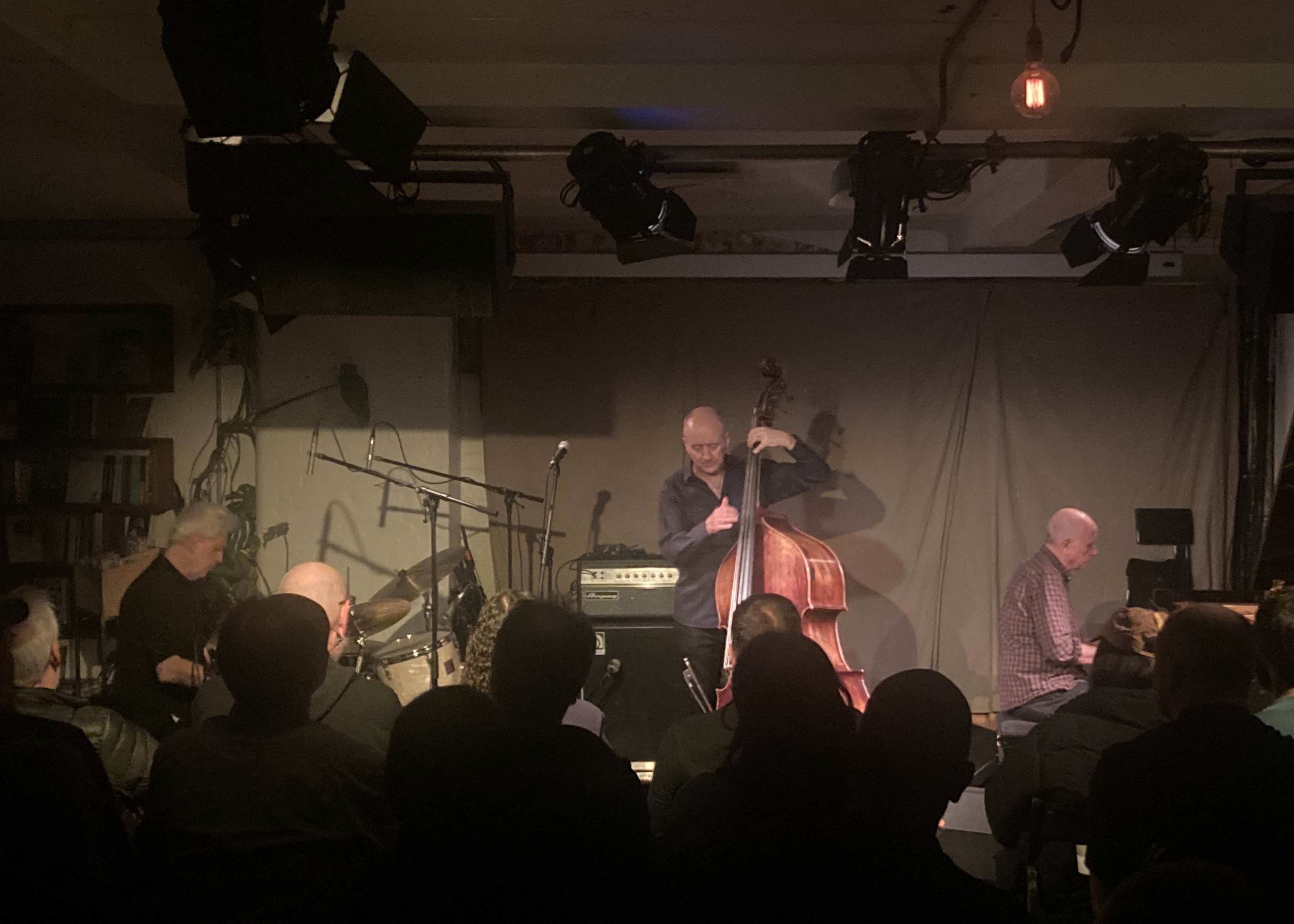
Today at Café Oto and the Vortex many of those artists performed in celebration and commemoration of Martin’s life. It was my privilege to introduce the Café Oto gig, which began with a set from the quartet pictured above during their soundcheck — Parker, Mark Sanders, Hannah Marshall and Matt Wright — and continued with the duo of the altoist Caroline Kraabel and the pianist Veryan Weston before concluding with the 27-strong London Improvisers Orchestra.

I met him 11 August 1969. I remember it because it was my first day in London, my first day at the Melody Maker, and I was sent to review Mike Westbrook’s band at the 100 Club that night. Martin was the man with a box of very desirable albums for sale, set up on a table in the space between the end of the bar and the stage. I soon learned that he was a man of views that were carefully considered and firmly held, some of them expressed in reviews for the MM over the next couple of years.

I was able to share with the audience a handful of the characteristic aphorisms from his New Musical Dictionary, which he posted online. Easy Listening: Music that is extremely difficult to listen to for anyone who really listens to music. Post-modernism: New things for people who don’t like new things. An Improviser: A musician who combines the roles of both composer and interpreter, yet usually receives less respect and remuneration than either.

At the request of Mandy Davidson, Martin’s widow (and the other Em in Emanem), all the proceeds from the gigs, for which the musicians waived their fees, will go to B’Teselem, a Jerusalem-based non-profit organisation documenting human rights violations in Israeli-occupied Palestine. At the end of the LIO set, which consisted of ensemble improvisations conducted by Terry Day, Ashley Wales and others, Maggie Nichols — who met Martin when she was a member of the SME — read a verse by a Palestinian poet killed in the Gaza fighting. That’s what you can see in the picture below, as she holds up a placard saying CEASEFIRE NOW!!