Skip to content

Posts from the ‘World music’ Category

The world and Don Cherry

Wherever, whenever and by whomsoever the idea of “world music” was invented, it had no finer exponent, explorer and exemplar than Don Cherry. In a few months’ time it will be 30 years since Cherry died in Malaga of liver cancer, aged 58, leaving a world in which he was, to quote Steve Lake’s happy phrase, “a trumpet-playing lyric poet of the open road, whose very life was a free-flowing improvisation.” I suppose it was fitting that he should have died in Andalucia, a region where many cultural influences met in the Middle Ages to create a foundation of song.

Cherry’s life and work demand a full-scale biography, along the lines of Robin D. G. Kelley’s standard-setting study of Thelonious Monk. In the meantime, it’s worth welcoming Eternal Rhythm: The Don Cherry Tapes and Travelations, a new book consisting mostly of interviews conducted in various locations around the world by the author Graeme Ewens, who met the trumpeter in the 1970s and became his “confidant, travel companion, witness and friend” over the subsequent two decades. They are augmented by Ewens’ memories of their times spent together from Bristol to Bombay, by biographical notes, and by an interesting selection of photos and other visual material.

A useful addition to Blank Forms’ The Organic Music Societies, a Cherry compendium published in 2021, it’s full of worthwhile stuff. Here’s Cherry on playing with Ornette Coleman in the great quartet that changed the direction of jazz: “Ornette would never count a song off: ‘One, two, three, four, go.’ We would feel each other in the silence before playing and then we would play. And the first accent, or the first attack, would determine the tempo and temper of the composition.” And this, which goes to the heart of Cherry’s conception: “One day when Ornette was working on notation, we talked about how you couldn’t notate human feelings. For me, there was always this problem of notated music sounding like notated music. In the older days you never saw black musicians playing with music stands. They learnt it by heart, which is important. For me, when I learn a song with notes it will take time for me to really memorise it, but it’s important to learn it by heart because then you will know it.”

Cherry tells a story about Miles Davis coming to sit in with him and Billy Higgins at the Renaissance in Hollywood and borrowing his pocket trumpet. And then, later in the ’60s, Miles invites Cherry to sit in with his quintet at the Village Vanguard: “So I played something, the changes from ‘I Got Rhythm’ — AABA — and I stopped my solo right before the bridge, which is the B part, and Miles said, ‘You’re the only man I know who stops his solo at the bridge.’ Then later on I heard him doing the same thing. And the next time I saw him he said to me, ‘Hey, Cherry, I play a little like you now,’ which was a big compliment.” Particularly, one might point out, coming from a man who had initially scorned Cherry’s playing.

In an offical note telexed after a concert in Yaoundé in 1981, during a tour of Cameroon sponsored by the US State Department, a consular official writes: “Cherry and companions were real good-will ambassadors: courteous, patient, curious about country, irrepressibly friendly… (the) only problems arose in trying to move them from place to place as they kept striking up conversations in the street.” On page 132 we learn that the pocket trumpet Cherry was playing at the time of his conversation had once belonged to Boris Vian, the writer and critic, and possibly before that to Josephine Baker. On the very next page Cherry mentions an occasion in the 1950s when he and Ornette went to hear a Stockhausen performance at UCLA.

The book doesn’t duck the question of the social conditions under which the music came into being, or the heroin addiction that began for Cherry in the 1950s and continued on and off for the rest of his life. Here, as part of a lengthy disquisition on changes in the heroin trade, is an insight, from the perspective of 1981: “…you always try and keep some morals. There were certain influential white people who were messing with drugs and so I’d be copping for them, and that’s the way I’d survive. But now on the Lower East Side anybody can go and cop. Anybody. Sometimes they’ll ask you to show them your marks before they let you in the building. That world is another kind of world. You cannot compare that world with the people who just smoke grass, because you’re fighting for your life to survive.”

World music hadn’t been invented — or codified as a marketing category — when Cherry moved on from his jazz background. He’d become famous through his association with Coleman, followed by three wonderful albums of his own for Blue Note (Complete Communion, Symphony for the Improvisers and Where Is Brooklyn?), and his work with Albert Ayler, the New York Contemporary Five, the Jazz Composers Orchestra and Charlie Haden’s Liberation Music Orchestra. His new direction denied nothing of his past but incorporated elements drawn from other cultures, exemplified by his use of bamboo flutes, gamelan and the doussn’ gouni, the six-stringed hunter’s harp from West Africa.

His concert at the Berlin Jazz Festival in 1968, released by MPS under the title Eternal Rhythm, gave a clear indication of where his music was heading. Further evidence came with collaborations with the Turkish drummer Okay Temiz (Orient on BYG and Organic Music Society on Caprice), his duo albums with Ed Blackwell (Mu Pts 1 & 2 on BYG, El Corazón on ECM), his guest appearance on the Swedish drummer-composer composer Bengt Berger’s essay in African ritual modes and rhythms, Bitter Funeral Beer (also ECM), and the three ECM albums by Codona, a trio with the multi-instrumentalists Collin Walcott and Nana Vasconcelos, recorded in 1978-82 (and reissued in 2008 as The Codona Trilogy).

Elsewhere, refusing to be limited by notions of idiom and genre, he turned up on Lou Reed’s The Bells, Rip Rig & Panic’s I Am Cold and a lovely half-hour improvised duet with Terry Riley, bootlegged from a 1975 Riley concert in Cologne. In the early ’80s he toured with Sun Ra’s Arkestra and Ian Dury’s Blockheads.

I want to pass on a pithy little description of Cherry’s playing that I’ve just read in a Substack post celebrating Ornette’s 1972 album Science Fiction by the pianist Ethan Iverson: “Folk music, surrealism, the blues, the avant-garde, deep intelligence, primitive emotion.” That’s good. And, as much as I love his work with Coleman, Albert Ayler and Gato Barbieri, my favourite Cherry albums are probably those that best encapsulate the full range of those qualities, and of his imagination.

They would be Eternal Rhythm, Relativity Suite from 1973 (with the JCOA, never reissued in any form since its its first appearance on vinyl), and the wonderful Modern Art: Stockholm 1977, a concert at the city’s Museum of Modern Art, which appeared on the Mellotronen label in 2014, featuring Cherry and a nine-piece band played marvellously rich acoustic versions of the material from his then-recent album Hear & Now, produced by Narada Michael Walden. It includes a spellbound duet with the Swedish guitarist Georg Wadenius on a graceful Coleman ballad called “Ornettunes” and an ecstatic transition from the gentle groove of “California” (a take on Donald Byrd’s “Cristo Redentor”, with Cherry on piano) to the miniature prayer for transcendence of “Desireless” (first composed as “Isla (The Sapphic Sleep)” for Alexander Jodorowsky’s 1973 film The Holy Mountain and then re-recorded under its new title for Relativity Suite).

It’s easy to imagine that there probably isn’t any music ever played by anyone, anywhere, at any time, from prehistoric hunters on the Eastern Steppe to whatever Kendrick Lamar, Billie Eilish or Nils Frahm are doing next, to which Don Cherry could not have made a worthwhile contribution. And the secret to that must have been his openness.

“I’m self-taught in a way,” he says in the book, “but I’ve always been open to learn, because one lifetime I don’t feel is long enough to really learn music.”

* Graeme Ewens’ Eternal Rhythm: The Don Cherry Tapes and Travelations is published by Buku Press: bukupress@gmail.com. The photograph of Cherry on the Lower East Side of Manhattan in 1988 was taken by Val Wilmer and is used by her kind permission.

Other sounds 2: Vazesh

The Persian tar is a cousin of the lute, the saz and the oud, a long-necked instrument with three double courses of strings — sort of like half a 12-string guitar, another relative — and an unusual double bowl made of mulberry wood with a membrane of stretched lambskin. Perhaps you already knew that, but I didn’t until I encountered the playing of the Iranian-born tar virtuoso Hamed Sadeghi in Vazesh, a trio in which he’s joined by two Aussies, the saxophonist and clarinetist Jeremy Rose and the bassist Lloyd Swanton.

Their first album, released in 2021, was a live recording at Sydney Opera House and won awards. Its successor, Tapestry, was recorded during a single night of improvisation at an arts centre in Annandale, a suburb of Sydney. Just under an hour long, Tapestry seems to be an unbroken performance, although on the sleeve it’s divided into 14 tracks, each jointly credited and given a single-word title that might be the result of a game in which the three members contributed their favourite words: “Lilac”, “Pagoda”, “Calabash”, “Demitasse”, “Musk” and so on.

It’s a beautiful and unclassifiable record. The individual sounds are exquisite — the tar strummed and plucked with a tiny hint of twang, the reeds (bass clarinet, soprano and tenor saxophones) elegant, the double bass resonant (Swanton, of course, is also one-third of the Necks). But the point is the sense of conversation, ebbing and flowing without rhetoric or exhibition meditative but never passive. When musicians from different cultures can do this together, with so much ease and naturalness, maybe we’re not in such a terrible state after all.

* Vazesh’s Tapestry is released on October 25 on the Earshift Music label: https://vazesh.bandcamp.com/album/tapestry

Manu Chao in London

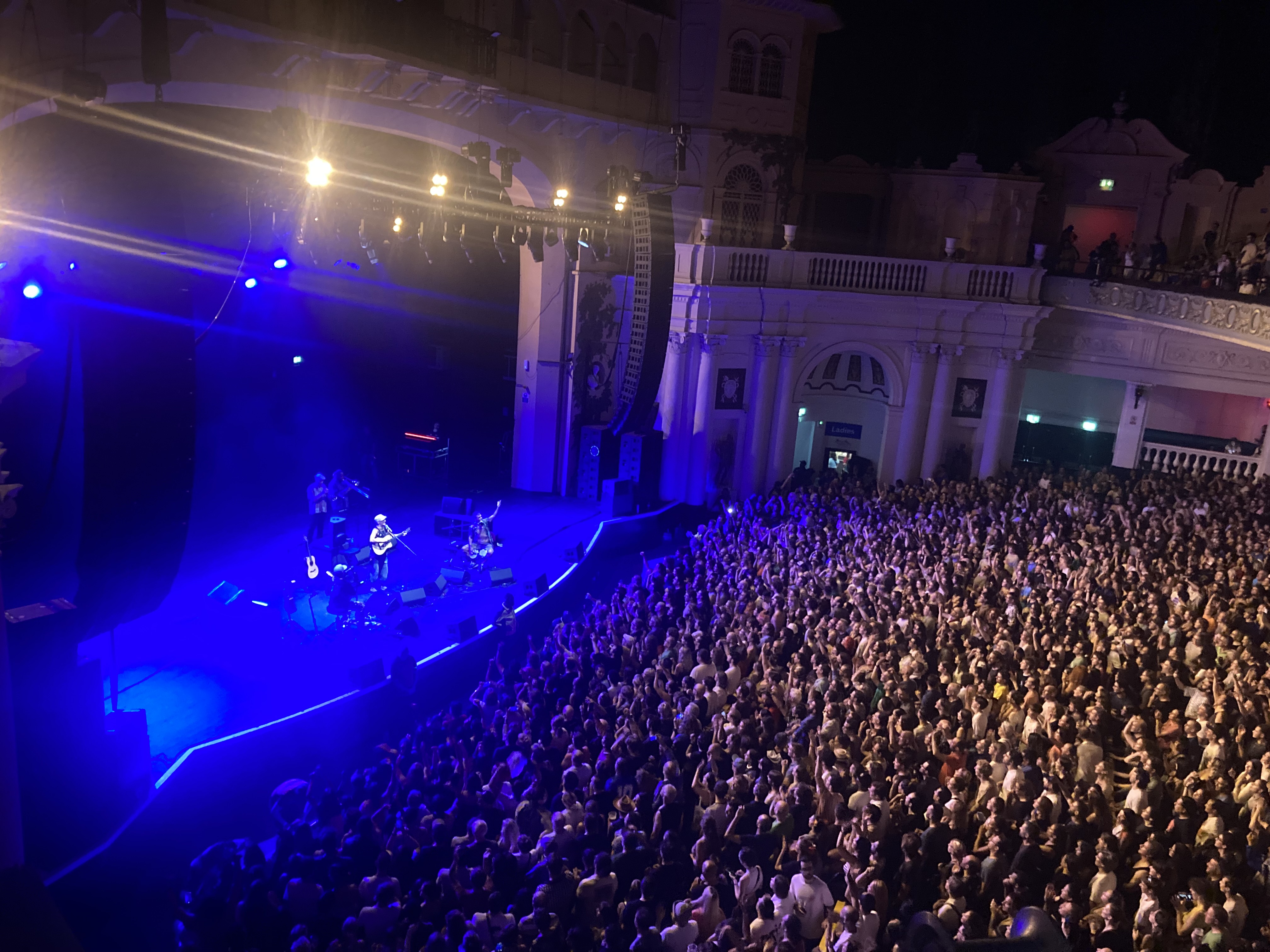
The advance publicity described Manu Chao’s show at Brixton Academy last night as an acoustic set, but if that suggests some kind of gentle fireside recital, forget it. The energy was peaking from the moment the 63-year-old Franco-Spanish singer-guitarist appeared — with Lucky Salvadori from Argentina playing what I think was a Colombian tiple and Miguel Rumbao from Havana playing bongos and activating a little black box that triggered the whistles, sirens and other effects that are the essential ambient noise of Chao’s music.

Actually, the energy was high well before the band showed up, thanks to a capacity audience whose anticipatory chatter set the vibe. It was a polyglot crowd, predominantly made up of expatriates and exiles and perhaps even refugees, speaking at least as many languages as those in which Chao sings — Spanish, French, Italian, Portuguese, English — and the richness of the sound they made while waiting for the music to start was an audible manifestation of that multicultural make-up.

Chao’s second or third song in a two-hour set was “La Vida Tombola”, his wonderful ode to Diego Maradona. He sang it, then paused, and sang it again, and paused, and sang it again. And so on. It may have continued in that fashion for 20 minutes. Long enough for me to suggest to my companion that perhaps he was going to carry on singing it all night. We agreed that this would be fine with us.

He didn’t, but many of the other songs got a similar treatment. “Clandestino”, “Me Gusta Tu”, “El Viento”, “Bongo Bong” — each seemed full of false endings and fresh starts. It was as though every song, some of them featuring a two-man horn section of trumpet and trombone, came with its own built-in encores. And each time the strumming began again, your own heartbeat seemed to restart itself.

There was a lot of audience participation, of the sort that happens at a Bruce Springsteen concert, when everyone sings the first verse of “Hungry Heart”. Unlike me, most of last night’s audience seemed to be word-perfect on every song. In the immediate aftermath, as we made our way slowly down the stairway to the exit, all bathed in Chao’s special warmth, a happy throng burst into the last nonsense chant we’d been singing with him.

This was his first show in London in 14 years, which perhaps explains some of the fervour with which he was greeted. For once, I got home not wanting to play the recorded versions of the songs I’d just been enjoying live but instead to listen again to his new album, Viva Tu, his first since La Radiolina in 2014.

It’s a gentler and more intimate version of his usual approach, reflecting his words in the accompanying press release, in which he mentions the influence skiffle had on him. Whatever, it’s full of beautiful songs, including two duets — the lilting “Tu Te Vas” with Laeti and “Heaven’s Bad Day” with Willie Nelson, an inveterate duetter even in his 10th decade — and the gorgeous “Cuatro Calles”. Like last night’s concert, it draws you in, making you — and the whole world — feel included.

* Manu Chao’s Viva Tu is out now, released through Because Music.

Autumn books 1: Joe Boyd

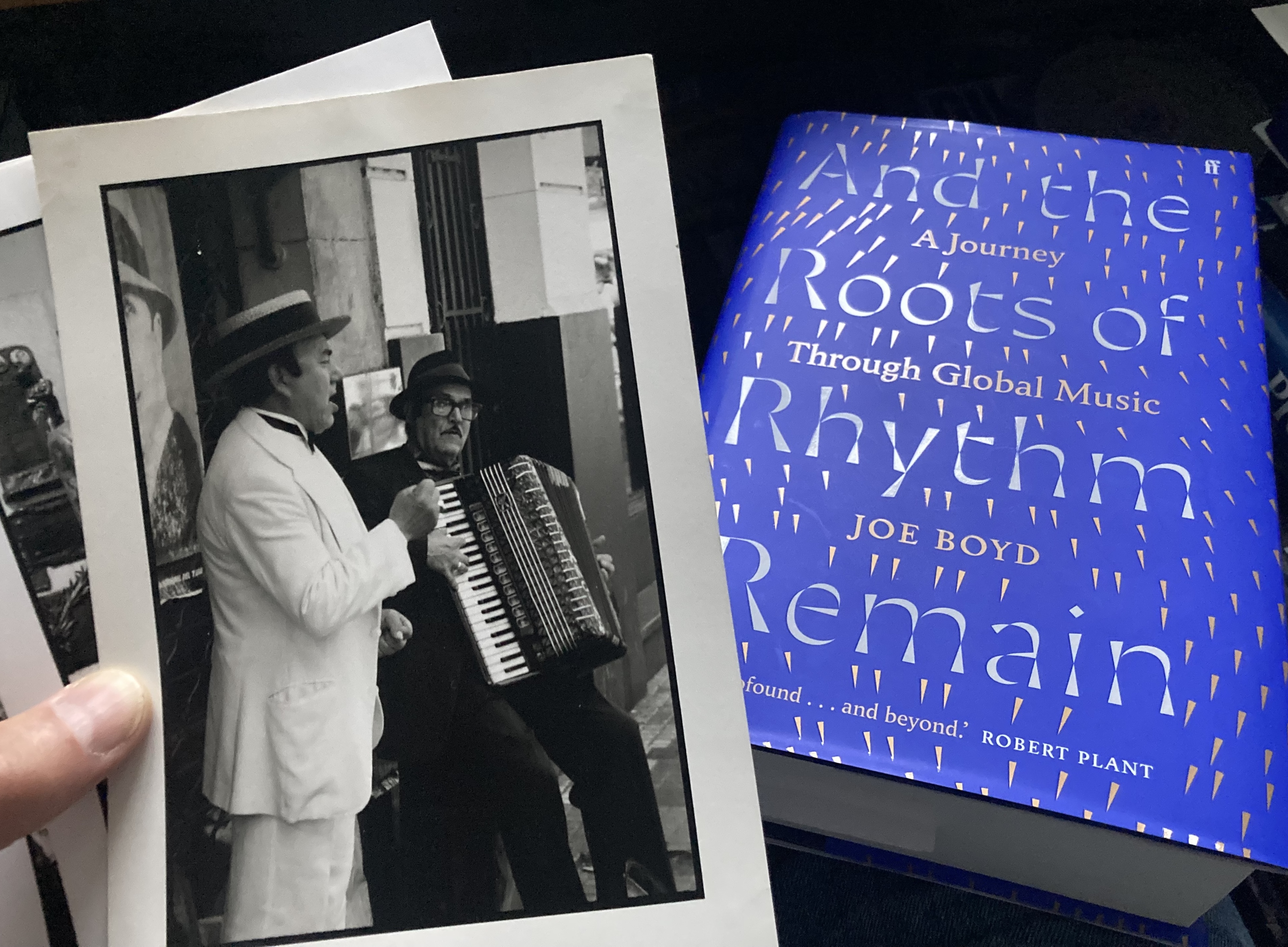
“Tango comes from the mud,” Brian Eno told an audience at Foyle’s bookshop the other night. He was conducting a public conversation with the author of And the Roots of Rhythm Remain, an 850-page examination of the forms of popular music with which Joe Boyd has engaged in Cuba, Jamaica, Brazil, Argentina, Bulgaria, Senegal, Albania and elsewhere during his six decades as a successful record producer and enlightened facilitator of musical projects.

For many years now it’s been rumoured that Boyd was writing a history of “world music”, a tale perhaps beginning with his presence at the famous meeting at a London pub in 1987 during which that rubric was invented, with the best of intentions and outcomes, as a way of persuading open-minded listeners to pay as much attention to music from other cultures as they did to their own western idioms. The result is much more interesting than a simple history; its eventual subtitle, “A Journey through Global Music”, conveys a much more accurate impression of what Boyd has taken on.

The quote about tango coming from the mud is to be found on page 483, where it’s identified as an Argentine saying. It was clever of Eno to spot it, because it says something larger about pretty much all the music Boyd considers here. How and when it happened, who made it happen, and to whom it happened are all part of his investigations, whether the music under consideration is Tropicália or townships jazz, Django Reinhardt or Béla Bartók.

I’m still working my way through the book, which will take a while even though Boyd writes in the easy, fluent, open-minded, anecdotal style familiar from White Bicycles, the relatively slender book about his adventures in the ’60s underground, published in 2005 to justified acclaim. Vast as his new one might seem, it’s worth reading with full attention, lest you miss some vital socio-cultural connection or valuable information on the roles played by, for example, the Ghanaian drummer Tony Allen, the Sudanese oud-player Abdel Aziz El Mubarak, Rodney Neyra of Havana’s Tropicana nightclub or the ballet impresario Sergei Diaghilev. (I didn’t know, for instance, that, according to Boyd, the names samba, rumba, mambo, tango and cha-cha all have their roots in Ki-Kongo, one of the languages of the Kongo people living in what are now the Republic of Congo, the Democratic Republic of Congo, Angola and Gabon.) Boyd’s enviable skill is to bring the reader an astonishing level of historical detail while wearing his research lightly and enlivening the narrative with exactly the right seasoning of his own views.

After buying the book at the Foyle’s event and getting it signed, I took it home and went straight to the chapter about tango. I like tango very much, although I once spent an evening in a bar in San Telmo, a Buenos Aires quarter then about to make the jump from funky to gentrified, proving to everyone’s satisfaction that I’ll never be able to dance it. I share Boyd’s enthusiasm for the singer Carlos Gardel to such an extent that I once visited the great man’s tomb in the cemetery of Chacarita in Buenos Aires, observing the ritual of leaving flowers at the base of his statue and placing a lit cigarette in the space left by the sculptor between the index and middle fingers of his raised right hand, because that’s how Gardel always sang until his untimely death in an air crash in 1935.

The photo above is one I took in 1994 on a sidewalk in Rosario, Argentina’s third largest city, the birthplace of Che Guevara and Lionel Messi. I was struck by the elegance and dignity of the street singer and his accordionist, who were serenading appreciative shoppers and other passers-by with a selection of songs made famous by Gardel.

Boyd traces the idiom’s origins in the bars and bordellos of Buenos Aires, examining its sources and tracking its destiny. He doesn’t share my fondness for the late composer and bandoneon virtuoso Astor Piazzolla, who became, he believes, “for tango what John Lewis and the MJQ were to jazz, ‘elevating’ it from the dancefloor and giving it concert-hall respectability.” He’s both right (in the comparison) and wrong (in the implicit criticism). Nobody who went, as I did, to see Piazzolla and his astonishing quintet for three out of their five nights in the intimate environment of the Almeida Theatre in London during the summer of 1985 could accuse them of forfeiting the sensual charms of tango in a pursuit of respectability. For a lot of worthwhile music with roots “in the mud”, the need to get people dancing is no longer a priority. But it’s a good and worthwhile argument to have, and I expect there’ll be many more as I work my way through what is shaping up to be not just an exceptionally enjoyable book but perhaps also an important one.

* Joe Boyd’s And the Roots of Rhythm Remain: A Journey Through Global Music is published by Faber & Faber (£30)

Sounds for summer

Tall enough to be unmissable in any environment, and with a truly remarkable fashion sense, Shabaka Hutchings had presence from day one of his career. To me, as an observer, that was the concert at the Royal Festival Hall in June 2009 at which he was one of several UK guests with Charlie Haden’s Liberation Music Orchestra (others included Robert Wyatt, Jason Yarde, John Parricelli and Andy Grappy). He had just one solo but when he stepped forward, the sounds coming from his tenor saxophone commanded everyone’s attention.

Since then, we’ve heard him with Sons of Kemet, The Comet Is Coming, the Ancestors and Louis Moholo-Moholo’s Five Blokes, and in a reinterpretation of Coltrane’s A Love Supreme at the Church of Sound a few weeks ago which I was very sorry to miss. And now he has enough presence to allow him to drop his surname and become just Shabaka.

He’s also dropped the saxophone, which is more of a surprise, in order to study the flute — specifically the Japanese shakuhachi and other iterations, including the Andean quena and the Slavic svirel. His new album — titled Perceive Its Beauty, Acknowledge Its Grace — is evidence of this turn of interest.

It’s a radical departure from anything he’s given us before. A series of sketches deploys varying personnel, including the pianists Nduduzo Makhathini and Jason Moran, the guitarist Dave Okumu, the singer Lianne La Havas, Moses Sumney, Laraaji and ESKA, the harpists Brandee Younger and Charles Overton, the drummers Marcus Gilmore and Nasheet Waits, the speakers Saul Williams, Miguel Atwood-Ferguson and Anum Iyupo, the rapper Elucid, the percussionist Carlos Niño and the bassists Esperanza Spalding and Tom Herbert.

That’s an impressive line-up, but as you listen to the album you’re never really thinking of individuals or their virtuosity. In that sense it’s a quite different experience from that of listening to a “jazz album”. But neither is it a kind of New Age tapestry of sound, slipping by without disturbance, merely a bit of aural decoration.

It has an overall charm and moments of great and singular beauty, too, such as the shakuhachi improvisation against Overton’s harp and the celestial layered voices of Sumney on “Insecurities”, La Havas’s vocal reverie on “Kiss Me Before I Forget”, or Spalding’s springy bass behind Elucid’s rap on “Body to Inhabit”, but it also has depth, and not just in the occasional verbal passages, which are carefully integrated into the quilt of sound. The overall impression is what counts, and somehow that goes beyond words.

The album contains one snatch of tenor saxophone, on a track called “Breathing”, in which Rajni Swaminathan’s mridangam — a Carnatic double-ended hand drum — backs first Shabaka’s treated and looped flutes, then his clarinet, and finally his saxophone, which briefly erupts in a gentle squall with an intonation recalling the great Ethiopian tenorist Getatchew Mekuria.

That little hint of Ethiopian music sent me to a new release in the name of Emahoy Tsege Mariam Gebru, who died this time last year at the age of 99. Born in Addis Ababa, she studied violin in Switzerland as a child, worked as a civil servant and sang for Haile Selassie, was imprisoned by the Italian occupiers during the Second World War, and spent a post-war decade as a nun in a hilltop monastery. The arrival of a new regime forced her to flee to Jerusalem, where she spent the rest of her life in an Ethiopian Orthodox convent and composed music for piano, organ, and various ensembles while running a foundation to encourage music education among children in her native land and elsewhere.

Like Mekuria, she had a volume of the producer Francis Falceto’s Ethiopiques series devoted to her music in 2006, and in the last couple of years there have been more albums on the Mississippi label. The latest is called Souvenirs, a collection of her songs apparently recorded between 1977 and 1985. It’s a primitive recording: the piano sounds like a poorly maintained upright and her voice was probably recorded on the same microphone, in a room that was almost certainly not a recording studio. But that does nothing to diminish the appeal of these songs, with titles such as “Where Is the Highway of Thought?” and “Like the Sun Shines on Meadows”, whose vocal melodies are doubled by the pianist’s right hand against left-hand figurations assembled from scraps of blues and rhumba and gospel tunes.

What’s so appealing, almost mesmerising, about this music? I think it’s the combination of transparent simplicity (and sincerity) with the unexpected guile of the rhythmic undertow, which is always playing appealing tricks on the western ear. There’s something about the distinctive melodic shapes and phrase lengths that is special to this kind of Ethiopian music, springing from some deeper root.

Something else to add pleasure to this summer is After a Pause, the new album of acoustic duo music by two brilliant Welsh musicians, the guitarist Toby Hay and the bassist and cellist Aidan Thorne. I got interested in Hay when he was filming himself outdoors playing ragas during the first Covid-19 lockdown in 2020 and putting the results on YouTube, and wrote a bit more about him when he released some duets recorded in an old chapel with his fellow guitarist David Ian Roberts later that same spring.

I try to avoid talking about what musicians are doing in terms of the work of other musicians, but I suppose a simple — and, I hope, enticing — way of describing the scope of these duets is to imagine what Davy Graham and Danny Thompson might have got up to if they were both in their prime in the 2020s and were able to spend three days together in a studio with no distractions, enhancing their compositions and improvisations with a sparing but highly effective use of overdubbing and electronics.

After living with this album for a few weeks, I’ve come to appreciate not just its surface beauty but the way it reveals more of itself and its spiritual essence the closer you listen. The 12-string arpeggios and bowed bass of the opener are a call to the attention that is never wasted as the music blooms and glows through 10 shortish but unhurried pieces, trajectories shifting and densities varying considerably from bare-bones to near-orchestral (on “Burden” or “Eclipse”) but mood sustained. The brief solo piano coda is a lovely way to finish.

A light shines through these three albums. I’ve a feeling they’re going to be among the summer’s best companions.

* Shabaka’s Perceive Its Beauty, Acknowledge Its Grace is on the Impulse! label. Emahoy Tsege Mariam Gebru’s Souvenirs is on Mississippi Records. Toby Hay and Aidan Thorne’s After a Pause is on Cambrian Records. Links here:

https://spibaig.bandcamp.com/album/perceive-its-beauty-acknowledge-its-grace

https://emahoytsegemariamgebru.bandcamp.com/album/souvenirs

https://cambrianrecords.bandcamp.com/

London Jazz Festival 5: Yazz Ahmed

Given the times we’re in, it was pretty wonderful to witness the scale of this year’s EFG London Jazz Festival, which shows no sign of losing its ambition under its new artistic director, Pelin Opcin. Typical of its scope was last night’s meeting of the trumpeter and composer Yazz Ahmed with the BBC Concert Orchestra at the Queen Elizabeth Hall, under the title Fusing Forces.

In recent years Ahmed has been pursuing a strand of thought which blends her jazz training at the Guildhall with an exploration of the music of Bahrain, where she lived until she was nine. Two striking albums, La Saboteuse and Polyhymnia, gave evidence of her success, and last night’s project took the process a stage further. With the help of arrangers including Noel Langley and Tim Garland, her compositions were enhanced by the use of the orchestra’s resources, under the empathetic baton of Bramwell Tovey.

Ahmed’s exceptionally gifted quintet — completed by Ralph Wyld on vibes, Dave Manington on bass guitar, Martin France on drums and the percussionist Corrina Silvester — was positioned across the front of the stage, separated from the orchestra by a perspex barrier, presumably for reasons of acoustic separation (the concert was being recorded for radio). But, thanks to Tovey and the sound engineers, there was no separation of thought or action. The calibre of the writing ensured that both elements were often perfectly integrated into a single organism, with no sense of excess baggage or impediment on the occasions when the orchestra simply added its weight to the smaller group.

The most striking of the compositions were those that brought Middle Eastern patterns and modes into the music, such as “A Paradise in the Hold” (inspired by the songs of Bahraini pearl divers) and “Al Emadi”, with their distant echoes of the Miles Davis/Gil Evans collaboration on “Solea” from Sketches of Spain. The blend sounded completely organic, the rhythmic drive providing a fine setting for inventive solos by Wyld, who was heavily featured, and Ahmed herself, who made use of reverb and other electronic effects to emphasise the legato quality of her playing but sounded even more impressive when she allowed the natural qualities of the flugelhorn to be the vehicle for her tone and ideas.

Other interesting Ahmed compositions included “A Shoal of Souls”, dedicated to refugees who lost their lives trying to cross the Mediterranean in small craft, in which Garland’s chart made dramatic use of tubular bells and timpani against the strings, and “2857”, inspired by Rosa Parks, its title using the number of the bus on which she refused to give up her seat to a white customer in Montgomery, Alabama in 1955, the two-part piece moving from sombre reflection to urgent hustle.

The programme also included short pieces by Jessie Montgomery (a fantasy on “The Star-Spangled Banner”) and Judith Weir (gentle nightmusic). At Ahmed’s behest, the orchestra’s strings played Arvo Pärt’s “Silouans Song”, a compositions of great loveliness that might have resulted from Vaughan Williams visiting a Baltic monastery in winter. All in all, an absorbing evening which fully justified the audience’s prolonged ovation.

* Fusing Forces is broadcast on BBC Radio 3 tomorrow night (Tuesday 23 November) from 7.30-10pm.

RIP Jon Hassell 1937-2021

From The Times, 25 November 1981

Bookshelf 1: Don Cherry

The world needs a really great Don Cherry biography, one that would do full justice to the story of the man whose collaboration with Ornette Coleman brought a completely new set of attitudes to the business of playing jazz at the end of the 1950s and who then, rather than polishing his laurels, set out on a long and eventful mission to explore the music of the world. Until someone approaches the task with the sort the depth and sensitivity that characterised Robin D. G. Kelley’s study of Thelonious Monk or John Szwed’s Miles Davis biog, a new anthology titled Organic Music Societies will do to be going on with.

A 496-page compendium of pieces, poems, photographs and artwork, it was compiled and edited by Lawrence Kumpf — the curator of the Cecil Taylor exhibition at the Whitney Museum in New York five years ago — with Naima Karlsson (Cherry’s granddaughter) and the writer Magnus Nygren, and published by Kumpf’s Brooklyn-based Blank Forms imprint. Writings by early champions Keith Knox and Rita Knox, the Swedish artist and musician Christer Bothén, the curator Ruba Katrib, the music historian Ben Young and the academic Fumi Okiji sit alongside contributions from Moki Cherry, Don’s wife, and Neneh Cherry, his stepdaughter.

It’s full of fascinating stuff, much of it coming from several interviews with Cherry conducted by Knox. In one lengthy reminiscence, he talks about Miles Davis borrowing his pocket trumpet to play on a gig in California, and about Monk coming to see the Coleman quartet at the Five Spot in 1959. Discussing the Argentinian tenorist Gato Barbieri, a member of his band in the ’60s, he says: “Gato is a fantastic man. He’s got so much love in him, automatically in his sound, and he’s paid a lot of dues, he’s come a long way from where he’s from, down in Buenos Aires. You can hear that in his sound — it’s one of those sounds that puts the wind in your face.”

One of those sounds that puts the wind in your face. What a great thing to say, and somehow it seems very typical of the way Cherry heard and felt music, as a part of the elements of the natural world — the response of a man who took as much pleasure from playing the doussn’gouni, the African hunter’s harp, as from his trumpet. Thanks to what he discovered during his travels to Turkey, Morocco, Sweden and elsewhere, he collapsed the distance between the supposedly primitive and the supposedly sophisticated more effectively than any musician I can think of.

There are diaries, a piece on Pandit Pran Nath and an interview with Terry Riley, a conversation with Cherry about his term as artist in residence at Dartmouth College in New Hampshire, and a description by Moki of her background in Sweden and how she and Don met in Stockholm in 1963 and what happened next. I suppose you could say it’s a bit of a random selection, but the parts are tied together by the visual element, which includes a large number of interesting photos and a lot of the paintings, fabrics and tapestries with which Moki gave such a strong flavour to her husband’s work when they were used as stage backdrops, costumes, posters and flyers and on the covers of albums like Mu First and Second Parts, Relativity Suite and Organic Music Society.

If the book has a strong flavour of the children-at-play utopianism of the ’60s, when many of the pieces were first published, so be it. You might feel, after leafing through it, that even now, against all the odds, utopianism deserves its chance.

* Organic Music Societies can be ordered from the publisher at http://www.blankforms.org ($20 paperback, $60 hardback). The photograph of Don Cherry is from the book and was taken by Moki Cherry.

The Japanese for ‘pathos’

Sonny Clark F Wolff

The hip Sonny Clark album, as everyone knows, is Cool Struttin’, a quintet date from 1958 which has come to epitomise what we think of as the Blue Note style: relaxed but compact hard bop, rooted in a deep swing and with the blues never far away. Clark died of a heroin overdose in 1963, aged 31, with nothing to his name beyond his appearances on some exceptional recordings. He would no doubt be astonished to learn that his most celebrated album would sell over 200,000 copies between 1991 and 2009 — almost 180,000 of those copies in Japan, where Cool Struttin’ mysteriously became one of the biggest jazz albums of all time.

My favourite Clark album is something different: a trio session that didn’t see the light of day until its release in Japan more than three decades after the pianist’s death. Blues in the Night is a comparatively modest effort: only 26 minutes long, or 33 minutes if you count the alternate take of the title track. Presumably that’s why it wasn’t released at the time: simply not enough music to make a full 12-inch LP.

Clark was a fine composer, but Blues in the Night is all standards: “Can’t We Be Friends”, “I Cover the Waterfront”, “Somebody Loves Me”, “Dancing in the Dark”, “All of You”. It’s a supper-club set, with nothing to upset the horses. But it’s also, in its quiet and unassuming way, pure treasure. With the great Paul Chambers on bass and Wes Landers — otherwise unknown to me — on drums, Clark makes his way through these tunes at a variety of comfortable tempos with a wonderful touch perfectly highlighted by the simplicity of the setting. I can listen to it all the way through just concentrating on how he articulates a triad: putting down his fingers in a way that makes the chord far more than three notes being played at the same time, the minute unsynchronisations that make it human. And what he finds, I suppose, is a sweet spot between Bud Powell’s probing, restless single-note lines and the swinging, transparently joyful lyricism of Wynton Kelly. Which is a place I’m very happy to be.

I’m indebted for the Cool Struttin’ sales figure to an extraordinary chapter devoted to Clark in a book by Sam Stephenson called Gene Smith’s Sink, a kind of discursive biographical appendix to The Jazz Loft, an earlier book in which Stephenson gave a detailed history of the rackety loft apartment on New York City’s Sixth Avenue, in what used to be called the Flower District, where the great photographer W. Eugene Smith kept a kind of open house for beatniks and other outsiders, recording all their comings and goings on camera film and reel-to-reel tape. From 1957 to 1965 Smith’s loft was the location of an endless jam session featuring the likes of Thelonious Monk and Zoot Sims. Sara Fishko’s 2015 documentary film, The Jazz Loft According to W. Eugene Smith, is based on the book and is highly recommended.

Clark was a regular at the loft, and in Gene’s Sink the author recounts how Smith’s obsession with recording everything around him — even TV and radio news bulletins — extended to the sound of the pianist barely surviving another overdose. Stephenson himself fell in love with Clark’s playing when hearing another posthumous Blue Note release, Grant Green’s The Complete Quartets with Sonny Clark. He writes about him with enormous sensitivity, piecing together the story of a life that began as the youngest of a family of children in a Pennsylvania town called Herminie No 2, named after the mineshaft that gave the place its reason for existence.

If you’re interested in Sonny Clark’s progress from Pennsylvania coal country via Southern California to the New York jazz scene of the late 1950s, Stephenson’s beautiful piece of writing is the thing to read. And it was while following in Gene Smith’s footsteps to Japan (where the photographer documented the horrendous effects of mercury poisoning on the people of the fishing village of Minamata in the 1970s) that the author came across the ideograms most commonly used by Japanese jazz critics in discussions of Clark’s playing: they can be translated as “sad and melancholy”, “sympathetic and touching”, “suppressed feelings”, and one which combines the symbols for “grieving”, “autumn” and “the heart” to suggest “a mysterious atmosphere of pathos and sorrow”.

That mood isn’t really reflected in my favourite Sonny Clark record. What I hear, funnily enough, is an expression of pleasure in being alive to play the music he loved and for which he had such a precocious talent. I’m guessing he sometimes felt like that, too.

* Sam Stephenson’s Gene’s Sink: A Wide-Angle View was published by Farrar, Straus and Giroux in 2017. The Jazz Loft Project was published by Knopf Doubleday in 2012. The portrait of Sonny Clark is from Blue Note Jazz Photography of Francis Wolff, by Michael Cuscuna, Charlie Lourie and Oscar Schnider, published by Universe in 2000 (photo © Mosaic Images). Clark’s Blues in the Night was first released in Japan in 1979 and issued on CD in 1996. The tracks are also available on Clark’s Standards CD, released in 1998.

Trio Da Kali / Kronos Quartet

Kronos Quartet photographed in Berkeley, CA December 12, 2013©Jay BlakesbergIt’s been my experience that no time spent checking out the Kronos Quartet’s latest activity is ever wasted, and the group’s new album, Ladilikan, in which they accompany Mali’s Trio Da Kali, is a beauty. The meeting between the voice of Hawa Diabaté, the balafon of Lassana Diabaté and the bass ngoni of Mamadou Kouyaté and the violins of David Harrington and John Sherba, the viola of Hank Dutt and the cello of Sunny Yang turns out to sound like something that has always existed, somewhere in the universe.

The primary impression is one of rhythmic vitality, with the quartet locking naturally into the trio’s two instruments to create a thoroughly integrated sextet, providing a lovely setting for Hawa Diabaté’s graceful contralto. In between the vocal passages, the band vamps with delicate power and a groove that is at times almost delirious. Approaching the conclusion of the stunning “Lila Bambo”, they come together in a unison coda that sweeps you off your feet.

Halfway through the album they give us something that might well become a classic. At Harrington’s suggestion, Hawa Diabaté sings Mahalia Jackson’s “God Shall Wipe All Tears Away”, with the original organ accompaniment transcribed for the string quartet; the words are translated into Bambara, the first among more than 40 languages spoken by Mali’s various ethnic groups. The controlled ardour of the voice and the grain of the strings — which together recreate the slightly wheezy sound of a portable harmonium — are irresistible (you can hear a snatch of it in this short trailer).

Meticulously produced by Nick Gold and Lucy Duran for the former’s World Circuit label, Ladilikan could well end up being the album I give to friends and family this Christmas. It’s hard to imagine anyone not loving it.

* Trio Da Kali play at the Musicport Festival in Whitby on October 21, then at Opera North, Leeds (22), St Barnabas Church, Oxford (25) and the Old Church, Stoke Newington,  London N16 (26).