Skip to content

Posts from the ‘Uncategorized’ Category

The Henrys at 21

the_henrys_2015For some years now the Henrys have been one of my stock answers to the question, “What’s your favourite band?” Since they’re celebrating their 21st anniversary with this week’s release of their first album since 2009, it’s probably time I wrote something about them.

I say “them”, but the Henrys are really Don Rooke, a resourceful guitarist and songwriter, with a floating group of like-minded musicians gathered at his base in Toronto. Rooke will be known to some people for his contributions to the regrettably slender discography of the elusive singer-songwriter Mary Margaret O’Hara, an authentic genius whose sole full-length album, Miss America, and two London concerts around 25 years ago are still vivid in the memory.

MMO’H appears as a guest on earlier Henrys records — Puerto Angel (1994), Chasing Grace (1996), Desert Cure (1997), Joyous Porous (2002), and Is This Tomorrow (2009) — and if you click on http://www.thehenrys.ca/listen.html and scroll down down to “God Moves on the Water”, you’ll hear one of their finest moments together. But she’s not on the new one. The lead singing on Quiet Industry is done by Gregory Hoskins, with John Sheard on pump and electric organ, Hugh Marsh on violin, Jonathan Goldsmith on “muted piano”, Andrew Downing on bass, Davide DiRenzo on drums, and Tara Dunphy on backing vocals.

The music of the Henrys has what always seems to me to be a typically Canadian quality: like that of the Band and the Cowboy Junkies, or the musicians who used to travel with the McGarrigle sisters, it sounds as though it’s being played in your front room by musicians who wouldn’t be put out if you asked them to swap instruments. I don’t know a better way of describing the sense of ease that lubricates their creativity.

The tone may be set by the timbres of a slide guitar, a pump organ and drums that sound like they were made from a set of well-travelled cardboard suitcases from the 1930s, but the music isn’t revivalist or retrospective in any way. It’s devised and directed by a person who seems to have spent a lifetime cultivating good listening habits and distilling them into a personal vision of the way things might sound.

So while the noise the Henrys make is full of creaks and sighs, these are an indication of carefully chosen textures rather than of an attempt to counterfeit the patina of age. Rooke himself, an unassuming virtuoso on various kinds of guitars, including a Weissenborn koa-wood model, has a better command of acoustic sonorities than just about any guitarist I can think of, along with an absolute disinclination to show off. About a dozen years ago he made an album of instrumental pieces under his own name called Atlas Travel, also highly recommended.

Rooke has excellent taste in singers (Becca Stevens was also featured on Is This Tomorrow), and Hoskins, a veteran of the Canadian folk-rock scene, has a sidelong, semi-private delivery that suits the songs almost as well as O’Hara’s more gestural approach once did. And these are really beautiful songs. Once you get past the exquisitely detailed settings, like the dancing organ on “Was Is” and the shadowy doubled vocal on “Burn the Boat”, there are many things to admire in the finely turned melodies and the thoughtful lyrics, such as this payoff verse from “Dangers of Travel”, a great edge-of-breakup song: “The light is pretty now / But soon it will fade / So put the bags down / Please put the bags down / Your dinner’s been made.”

Here’s a film they made to go with the album’s opening track, “The Weaker One”. Here’s a clip of “When That Far Shore Disappears”, a song that illustrates some of their subtler virtues. And as a bonus, here they are in an earlier incarnation, playing a piece called “VF61” from Joyous Porous on an Ontario TV station in 2002, with David Pilch on bass and Michael White on trumpet.

There’s a special strength, intimacy and sense of proportion to this music, along with great inventiveness. Quiet Industry may be the product of the Henrys’ 21st year, but it’s a great place to start. And they’re still one of the answers to that question.

* Pictured above, the Henrys as heard on their new album: (left to right) John Sheard, Don Rooke, Gregory Hoskins and Andrew Downing.

The Weather Station

The Weather StationIt was the liquid sound of a song called “Way It Is, Way It Could Be” that snagged my attention. The track was featured on one of those monthly-magazine sampler CDs (Uncut, in this case) that force you to take great care not to rip the cover as you remove it, and then leave you with a blob of sticky stuff to dispose of.

This time the stuff that really stuck was the track in question, by something calling itself the Weather Station. This turned out to be a 30-year-old Canadian woman called Tamara Lindeman, a singer and songwriter (and actress) based in Toronto: a new name to me. It seems that the Weather Station was a band once but is now just her, helped by friends such as Afie Jurvanen and Robbie Lackritz, who joined her to co-produce the new album, Loyalty, from which “Way It Is…” is taken.

The sound is nothing unusual, in a sense: light, folk-based, with fluid finger-picked guitars, gently supportive bass and pattering drum. It would be hard to carbon-date with any accuracy. As would Lindeman’s grave, thoughtful voice, which comes from the school of somewhere between Judy Collins and Sandy Denny.

But it had some strange quality about it that didn’t evaporate when the music stopped. I played it again a few more times, and then bought the album. I’m very glad I did. There’s more of the same, but from different trajectories, almost every song exuding a strong and individual musical personality, each one wrapped in a carefully shaped arrangement. A couple of tracks use small groups of woodwind and strings, very discreetly: just a wash of colour.

Those groups are actually just one player each (Jeremy Strachan and Anthony Wallace respectively), overdubbed. Lindeman plays guitars, keyboards, banjo and — for the final note of the album, in a lovely touch — vibraphone. Jurvanen adds drums, bass and more keyboards. And that’s all. The music never sounds cluttered, or even full. Economy of means is a significant factor here.

Then I started catching some of the words and decided that I wanted to know what she was singing about. Her voice, although pure and uninflected, sometimes obscures the lyrics. That may be intentional: like someone who talks softly to get you to lean in. What I could hear sounded interesting. When I started reading the words, my interest in the album redoubled — just like that.

She prints them on the sleeve as if they were prose, and they read like short stories. “You looked small in your coat, one hand up on the window, so long now you’d been lost in thought. No snow on the road — we’d been lucky and it looked like we would be well past Orleans”: that’s how “Way It is…” starts out. Here’s the opening of “Floodplain”: “All spring I was driving. Every river was flooded with rain, every stream a torrent. Over the highway bridges that run high across the plains, flooded. ‘Half the Maritimes,’ they say, ‘is running this way.'”

A little bit of Cormac McCarthy scene-setting, and then you come across something reminiscent of the plain-spoken intimacy of Raymond Carver’s poetry. From “I Mined”: “It started small — a simple thought. That there was something wrong. And if it’s caught I could set it right, or at least I could try.” From “At Full Height”, the song that ends with the single vibraphone chime: “If he don’t mean it, he won’t say it, and I can tell. If I don’t mean it, I can’t say it, and his face fell. But it’s so seldom I believe it — it takes a clear kind of day. Like air so cold it hurts to breathe it. (And the colour comes to my face.)”

That’s how she punctuates them. Punctuation in a song! Doesn’t happen often, even implicitly (I think of the first verses of “Thunder Road” and “The Boys of Summer”). And it works perfectly. These turn out to be short stories in prose-poem form, arranged with great scrupulousness and performed with imaginative sensitivity. At the moment I’m finding it hard to listen to anything else.

Marcus Belgrave 1936-2015

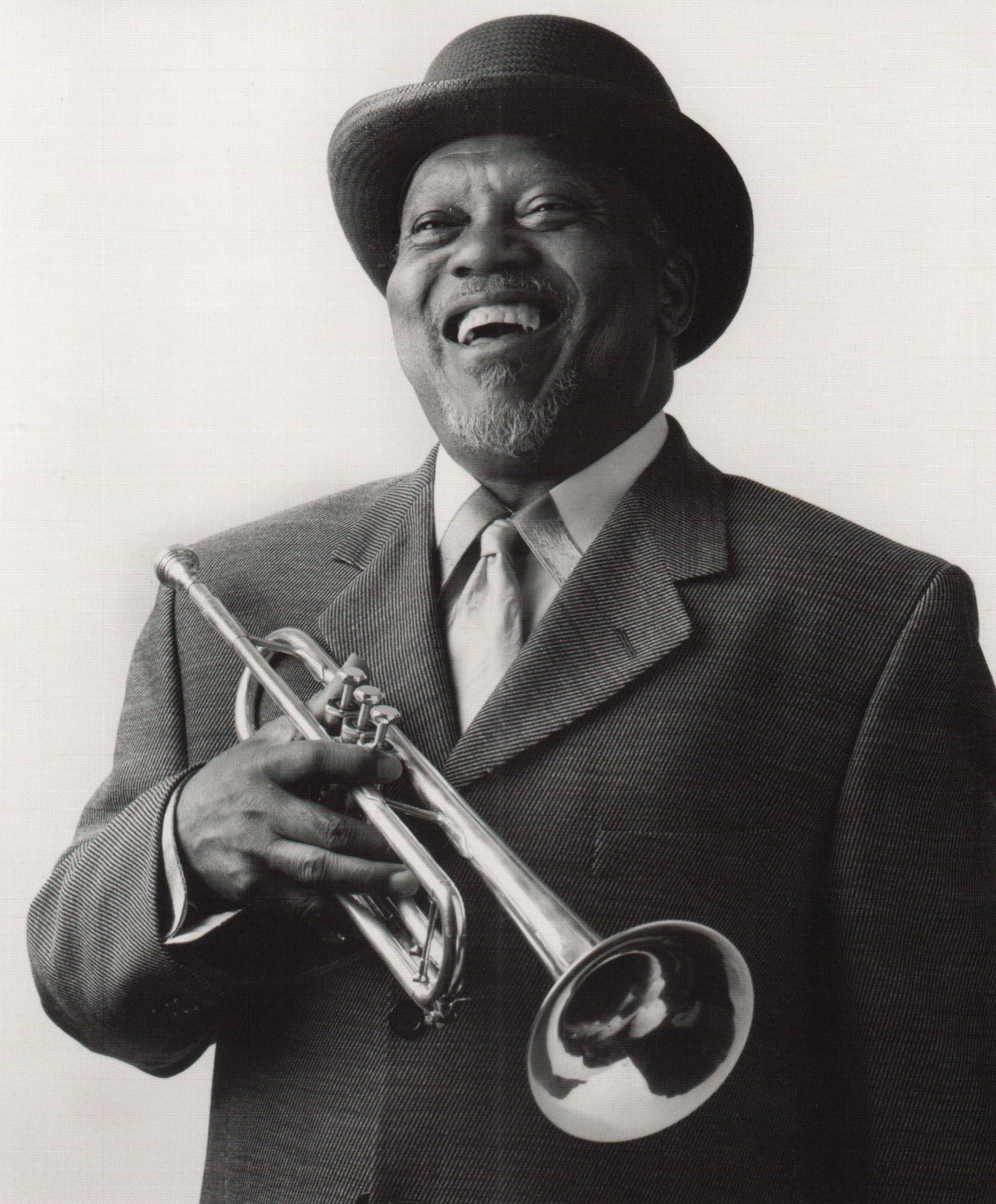
Marcus BelgraveIt would be hard to exaggerate the influence, or indeed the excellence, of the small bands Ray Charles led in the late 1950s and early 1960s. One by one, their members have disappeared. (Rather movingly, three of Charles’s great saxophone players, Hank Crawford, David “Fathead” Newman and Leroy “Hog” Cooper, died within days of each other in January 2009.) Now another one has gone: the trumpeter Marcus Belgrave, who joined Charles in 1958 and stayed five years, playing on the sessions that produced “What’d I Say” and the immortal Genius Sings the Blues album.

I particularly love Belgrave’s playing on Fathead, Newman’s first solo album and the initial release in Atlantic’s “Ray Charles Presents…” series, produced in 1959 by Ahmet Ertegun and Jerry Wexler, with Charles on piano and Crawford, playing baritone, rounding out the three-man front line. It’s a typical and wonderful fusion of R&B feeling with mainstream jazz and bebop structures: completely natural and unaffected music, totally satisfying on every level. The warm-toned trumpet solos are deftly formed and joyously lyrical: it’s no accident that Clifford Brown was one of Belgrave’s early idols.

An excellent obituary by Mark Stryker of the Detroit Free Press (read it here) tells us that Belgrave was born in Chester, Pennsylvania in 1936. His cousin Cecil Payne, one of the handful of the outstanding baritone saxophonists of the bop era, taught him how to play the new music, and he played with Brownie — who was six years older — in a student band in Delaware. It was with Ray Charles that he learned to play fewer notes.

Tired of life on the road, he turned down offers from Duke Ellington, Horace Silver and Charles Mingus and settled in Detroit in 1963. It is said that he played on a few Motown hits of the period, including “Dancing in the Street”, and he certainly became an important figure on the local jazz scene, both as a player and as a teacher. Those he mentored included the pianist Geri Allen (with whom he appeared on several albums) and the saxophonist Kenny Garrett. He was also a guest soloist with Was (Not Was), the great boho-disco band led by Don and David Was in Detroit in the 1980s (that’s him on their classic dancefloor 12-inch “Wheel Me Out”).

Marcus Belgrave was one of those figures who ensured the continuity of the jazz tradition, taking what he had learnt from his elders and passing it on to later generations. He was, by all accounts, much loved in his community: when a thief took his custom-made copper-belled horn from his car earlier this year, the pawn shop in which it was spotted waived the $350 that it would normally have cost him to reclaim it, given that they had not been aware they were acquiring stolen property.

One way to remember him would be to enjoy his contributions to the solo sequences on “Hard Times” and “Weird Beard”, a couple of tracks from Fathead. Just beautiful, I hope you’ll agree.

Taking on the British Invasion

Bobby Comstock

Fifty years ago this month, Bobby Comstock’s version of Bo Diddley’s “I’m a Man” was trying and failing to make it into the US and UK charts. It’s interesting to me not just as a favourite record from an almost freakishly fruitful year but as an example of one response to the British Invasion: an American artist copying a British approach to an American idiom.

Born in 1941 in Ithaca, New York, Bobby Comstock is a singer and guitarist who nibbled at the fringe of the Top 50 in 1958 with a lightly rocked-up treatment of “Tennessee Waltz”. It was released on the Triumph label, started by Herb Abramson after his departure from Atlantic Records, and since the 17-year-old Comstock’s early patrons also included Alan Freed and Dick Clark, it’s a little surprising that he didn’t do better. Five years later, having fallen in with the successful publisher Wes Farrell and the songwriting/production team of Bob Feldman, Jerry Goldstein and Richie Gottehrer, he released “Let’s Stomp” on the Lawn label. Despite climbing no higher than No 57, it became a party favourite and was widely covered over the years. Thanks to his association with Feldman, Goldstein and Gottehrer, he also played guitar on the Angels’ wonderful “My Boyfriend’s Back”, a girl-group classic.

“I’m a Man” is something very different and vastly superior: a raw blue-eyed R&B record with a crunching guitar/bass/drum riff, sinister organ, and lashings of echo on Comstock’s very impressive vocal. I don’t know who plays the eight bars of jagged guitar solo — probably Bobby himself — but it’s as impressive as anything Jimmy Page produced in his days as a teenaged session man over on the other side of the Atlantic.

Comstock grew up in the middle of the doo-wop era, and his earliest heroes included Chuck Berry, but I’d guess that “I’m a Man” sounds the way it does because in the summer of 1964 he and his band, the Counts, had supported the Rolling Stones on a handful of East Coast dates, finishing at Carnegie Hall. As he watched the chart-storming English longhairs delivering their interpretations of hard-core R&B songs to audiences in Pittsburgh, Pennsylania and Harrisburg, West Virginia as well as on Seventh Avenue in New York City, he must have felt he’d been given a licence to try it himself.

The single came out on Ascot Records in the US and United Artists in the UK; the copy I bought back then is pictured above. I had a Saturday job in a record shop at the time, and I guess that’s how I first heard it, while checking out the new releases. It certainly didn’t get much, if any, radio play.

Comstock had no more hits but made a good living for the rest of his career as a performer and backing musician — to artists including Chuck Berry and Bo Diddley — on the rock and roll revival shows promoted by Dick Clark and Richard Nader. He’s now living in retirement in Southern California, leaving the rest of us to carry on listening to “I’m a Man”, a highlight of his 24th year.

Gary Peacock: The place of the bass

Gary PeacockRight from the earliest days of jazz, its musicians have humanised the instruments on which they play, particularly those instruments whose identities were formed in the European classical tradition. If the phenomenon is most obvious with members of the brass and reed families, it is no less true of instruments that do not depend on breath to generate their sound. And next to Charles Mingus and Charlie Haden, the musician who most clearly imbues the double bass with the inflections of the human voice is Gary Peacock, who celebrates his 80th birthday tomorrow.

What is impossible to miss in Peacock’s playing is a profound emotional weight, expressed with a lightness of touch, a lithe, sinewy phrasing and a lyricism reaching far beyond that term’s usual connotations. He has always seemed to be as comfortable playing free jazz with Albert Ayler and Sunny Murray (on the world-changing Spiritual Unity in 1964) as finding new angles on the show tunes and jazz classics he plays with Keith Jarrett and Jack DeJohnette, his fellow members of the long-lived Standards Trio.

He was born in Burley, Idaho on May 12, 1935, and came late to the bass, after studying piano and percussion at music college in Los Angeles. It was with a US Army band in Germany that he first picked it up, aged 21, and — according to a recent interview — “just sort of figured it out” for himself, a remark that gives no hint of the great sophistication of his playing but might explain its prevailing air of naturalness.

In 1962, while still based in Los Angeles, he made his recording debut with the quartet of the trumpeter Don Ellis and the trio of the pianist Clare Fischer. The first time I heard his work was on Tony Williams’s great Life Time album in 1964, where he, Richard Davis and Ron Carter were the three bassists, and he suffered not at all from the comparison. He was on Williams’s equally brilliant follow-up, Spring, alongside Wayne Shorter and Sam Rivers. Then came Spiritual Unity and the quartet Ayler co-led with Don Cherry. With Bill Evans on Trio 64, Peacock confirmed his standing as the natural heir to the late Scott LaFaro, whose dexterity and imagination he shared, and worked for the first time with Paul Motian.

The piano trio has always been the context in which he is most likely to be found, whether with Paul Bley, Masabumi Kikuchi or Marilyn Crispell, the line-up most often completed by Motian until the drummer’s death in 2011. Now This, the new album released to coincide with Peacock’s birthday, is also by a trio, featuring the pianist Marc Copland, a long-time associate, and the drummer Joey Baron.

Recorded in Oslo in the summer of 2014, it includes seven of Peacock’s compositions, some of them familiar from earlier versions. The striking “Moor”, for example, was first recorded with Bley and Motian in 1968, followed two years later by a reading with Kikuchi and the drummer Hiroshi Murakami on an album called Eastward, recorded for CBS/Sony in Tokyo. The restless “Requiem” made its debut in 1971 at a further session in Tokyo with Kikuchi and Murakami, released on an album titled Voices; later it was featured on other albums, including Crispell’s Amaryllis, and with other instrumentations.

I mention those two Japanese albums because they are relatively obscure but outstanding, particularly Eastward. So is a third album recorded during the several years that Peacock spent in Japan: Silver World, in which the trio were joined by the shakuhachi virtuoso Hozan Yamamoto; here’s part of the lovely title track, and here’s a piece called “Stone Garden of Ryoan Temple”.

Perhaps it’s too obvious to suggest that Peacock’s study of Zen philosophy exerted a significant influence on his music, which exudes a wonderful sense of calmness and balance even at its most complex and impassioned. Going back and listening to his pre-Japan records, however, you’d have to say that it was there from the beginning: a defining characteristic of a remarkable musician who still, on the evidence of Now This, has much to say.

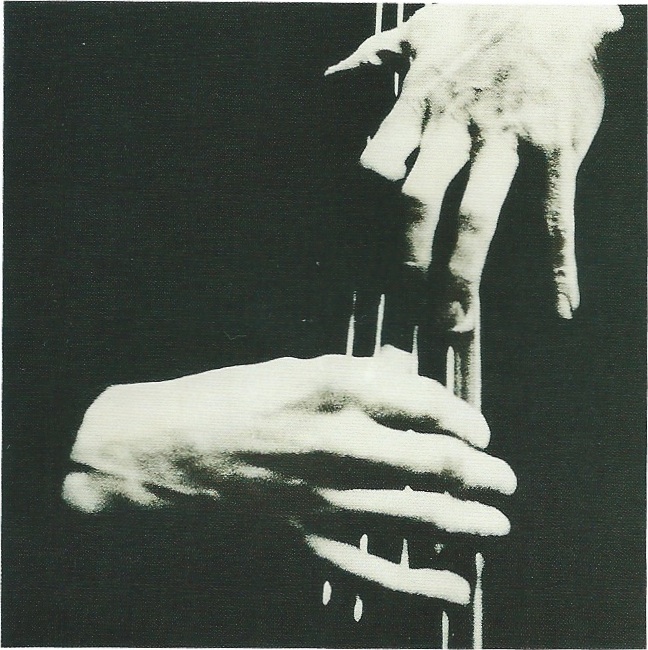
* The photograph of Gary Peacock’s hands is from the sleeve of Eastward, recorded and and first released in 1970. Now This is released tomorrow by ECM Records.

Bernard Stollman and ESP-Disk’

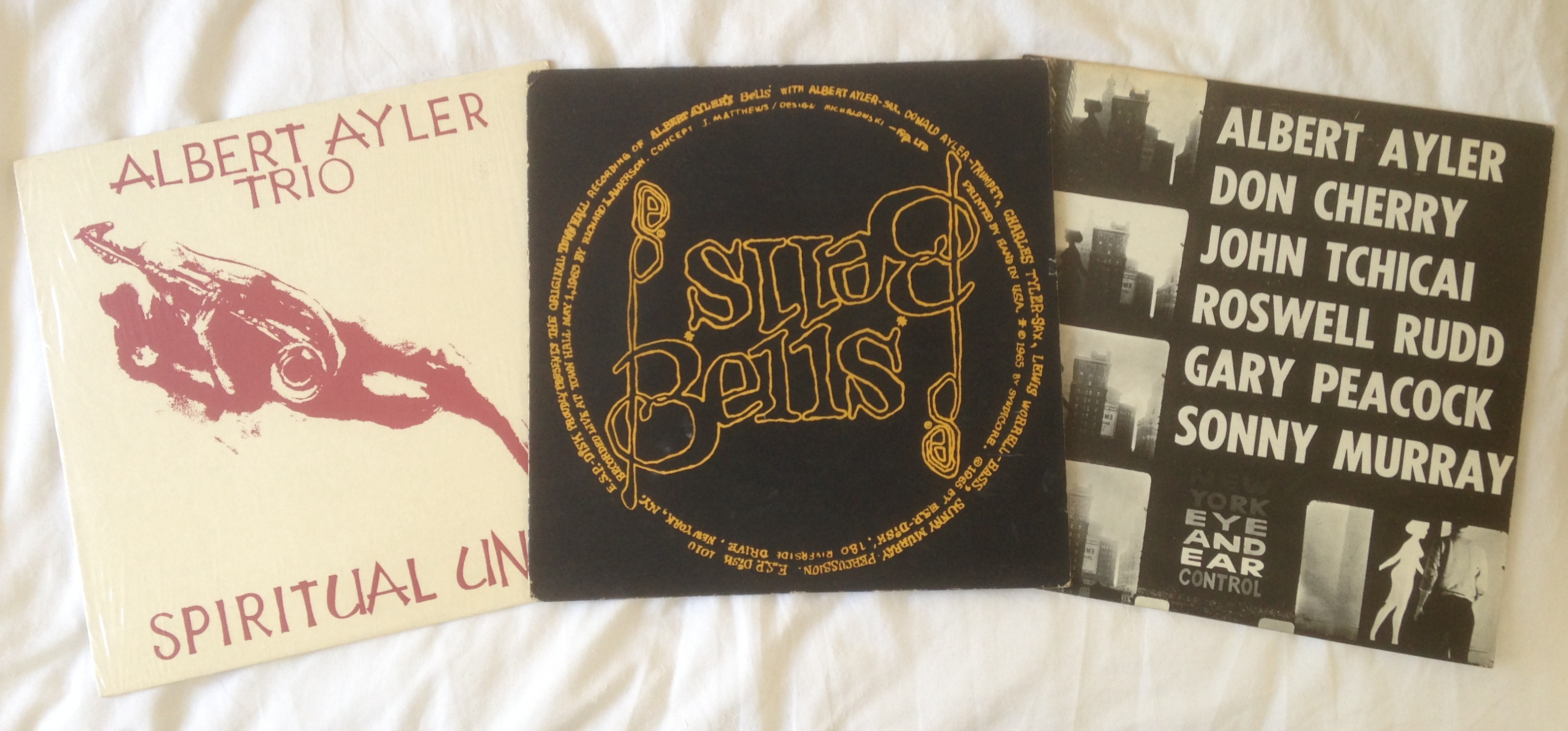
Albert Ayler BellsOn Friday it will be exactly 50 years since Albert Ayler and his musicians appeared at Town Hall in New York City. On May 1, 1965 Ayler’s quintet gave a performance that was released in part on an album titled Bells: a single-sided 12-inch 33rpm disc pressed on transparent plastic, with the title and the artist’s name overprinted in white. The album comprised two untitled pieces together amounting to a few seconds short of 20 minutes. If you wanted to buy it in Britain, not only did you have to pay the considerable premium demanded for records imported from the United States, in this instance you were paying for something that contained half of the standard amount of music. But what music it was.

I bought it by mail order, and I remember the thrill of opening the package. That was the effect of just about any record on ESP-Disk’, the small independent label that issued albums by Ayler, Sun Ra, the New York Art Quartet, Giuseppi Logan, Gato Barbieri, the Fugs, Pearls Before Swine and other names from the New York avant-garde scene. If the visual style of a Blue Note or a Riverside album perfectly reflected the crisp, clean sound of hard bop, the look of an ESP record reflected a wilder sensibility.

Bernard Stollman, the lawyer who founded ESP-Disk’ in 1964, died last week, aged 85. He had run it throughout the 10 years of its original lifetime and then in its subsequent, rather half-hearted, reincarnations. Stollman was a kind of cultural and political idealist — the label’s name came from his belief in the universal language of Esperanto, and he later claimed that ESP was brought down by the US government “because of our opposition to the (Vietnam) war” — but he came in for criticism from musicians who felt he had not properly rewarded them, particularly in terms of royalties.

During the course of an interview with Jason Weiss, the author of Always in Trouble: An Oral History of ESP-Disk’, The Most Outrageous Record Label in America (Wesleyan University Press, 2012), Stollman explained that for each recording he paid $300 to the leader and $50-100 to the other musicians. “They all shared ownership of the album,” he added, and therein, or so one imagines, lay a world of trouble once licensing agreements started to be made with record companies outside the US. He also claimed: “There is no ESP musician today with whom I can’t communicate amicably.”

Some unquestionably resented him for seeming to profit from their art. But Milford Graves, the great drummer who was a member of the New York Art Quartet on their classic ESP album, and who would start his own label (SRP, with the pianist Don Pullen) later in the decade, put an interesting viewpoint to Weiss:

I look at the positives, he said, because I can’t deal with the negatives of Bernard Stollman. I just know one thing: nobody was recording us in the ’60s other than ESP! And the pay that maybe you didn’t get from Bernard, it neutralises itself because if you had to hire a public-relations person, you were going to have to pay him. So you’re still going to come out to zero. It balances out, a plus and a minus. Now, ESP puts you out. What are you going to do after that? Albert Ayler became what, he started putting out — that’s all through ESP. Myself, through ESP, I came out… Look, ESP publicised us all over the planet, so anybody complaining about Bernard, I have to ask people, You’ve got to check yourself out. That’s over, man. Bernard was a businessman — he wasn’t a charitable organisation… With Bernard, you’ve got to say, “Hey, man, you started something, Look, you did what you did.”

ESP albums had a real counter-cultural charisma, and Bells — poorly recorded and bizarrely packaged (the sleeve of my copy has the word “stereo” redacted by someone with a marker pen in the company’s offices) — had more than most. Its sequence of blaring unison themes, wild collective improvisation and emotionally audacious solos by Ayler, his brother Don on trumpet and Charles Tyler on alto saxophone, with Lewis Worrell almost inaudible on bass through the firestorm set up by the astonishing Sunny Murray on drums, retains every ounce of the impact it must have made on the Town Hall audience half a century ago, and certainly on a teenager opening a package a few months later and three thousand miles away.

To Pimp a Butterfly: the shape of jazz to come?

Kendrick LamarKendrick Lamar’s To Pimp a Butterfly feels and sounds like one of the most important albums in years. I only wish I were able to explain properly why that might be so, but it would take somebody with a much deeper and more secure knowledge of the musical idiom and, more important, the social context from which it springs.

In his excellent Guardian review, Alexis Petridis invoked the names of Marvin Gaye, Curtis Mayfield and Sly Stone. I hear something different. What it reminds me of — and this is about as high a compliment as I can pay — is a group of albums that came out in the late ’60s and early ’70s, reflecting black America’s various states of mind in that turbulent era: the proud isolationism of Eddie Gale’s Ghetto Music, the deep lament of Art Ensemble of Chicago’s People in Sorrow, and the rage within the Last Poets’ debut album (the one containing “Niggers Are Scared of Revolution”). It doesn’t sound remotely like any of them, of course, but it springs from the same collective consciousness, albeit from a very individual and, as it seems to me, original viewpoint. It, too, speaks of a turbulent time.

If you want to take your involvement further than appreciating the surface of the album, by getting to grips with the complicated issues that Kendrick Lamar is exploring, it’s worth listening to it once all the way through while reading the lyrics, which can be found here, along with a certain amount of textual analysis. Introspection is not uncommon among rappers, and there’s a refrain which crops up on several of the tracks: “I remember you was conflicted / Misusing your influence / Sometimes I did the same / Abusing my power, full of resentment / Resentment that turned into a deep depression / Found myself screaming in a hotel room.” But what’s going on here is not solipsism or self-pity. Lamar seems able to find a connection between his own soul-searching and a broader social context.

The totality of this very big and complex picture is what counts, but among the individual highlights for me are the sudden explosion of hard bop in “For Free? (Interlude)”, the appearance of Ronald Isley to sing a single resonant verse at the end of “How Much a Dollar Cost”, and the extraordinary passage in the closing “Mortal Man” where Lamar edits in sections of an interview given by Tupac Shakur, interposing his own voice in the place of the original interviewer (we don’t know whether he has rephrased the questions, or is merely repeating them). Tupac talks about the imminence of conflict: “I think that niggas is tired of grabbin’ shit out of stores and next time it’s a riot there’s gonna be, like, bloodshed for real. I don’t think America know that.” He died in 1996, almost 20 years before Trayvon Martin, Michael Brown and, now, Walter Scott.

Easier for me to talk about is the contribution made by people such as the trumpeter Ambrose Akinmusire, the pianists Robert Glasper and Brandon Coleman, the saxophonists Terrace Martin and Kamasi Washington, and the bassist Stephen Bruner (known as Thundercat) and his brother, the drummer Ronald Bruner Jr. The inclusion of these musicians in a project such as this, and in Flying Lotus’s You’re Dead from last year, might be among the best things to have happened to jazz in recent decades.

Ever since the eruption of bebop, which moved jazz away from the dancefloor, there has been a problematic relationship between jazz and the popular music of the day. Sometimes, as with the Charles Lloyd Quartet of the late ’60s, Miles Davis’s post-1968 music, Herbie Hancock’s Headhunters and, in a lighter tone, the work of Ramsey Lewis, Ronnie Laws and Roy Ayers, jazz has edged closer to the relationship it enjoyed in the ’20s and ’30s, when it maintained a balance between mind and body. It may be — although I say this very tentatively — that we are seeing the beginnings of re-engagement at a more organic level.

From the jazz perspective, there are extremely interesting interviews about the making of To Pimp a Butterfly with the participants here (with Natalie Weiner of Billboard) and here (with Jay Deshpande of Slate). Martin, Steven Ellison (Flying Lotus), Washington, Coleman and the Bruner brothers are around 30 years old and, like Lamar, grew up in Los Angeles. Several of them received an informal education at the late Billy Higgins’ regular World Stage gig in Leimert Park. Akinmusire, who is a similar age, was born in Oakland. Glasper is in his mid-thirties and was born in Texas and studied in New York. They are equally familiar and comfortable with the music of John Coltrane, Public Enemy, Sun Ra, Tupac Shakur, Thelonious Monk and Snoop Dogg. They know these idioms from the inside. And they’re finding ways to make that familiarity work.

I’ve also been listening to an advance copy of Washington’s extraordinary debut album, a three-CD set called The Epic. It’s a big work in title, tone and textures, almost three hours long, divided into 17 tracks, and lining up a 32-piece string orchestra, a 20-voice choir and the occasional vocal contribution by Patrice Quinn alongside a 10-piece jazz combo. An extract from one of Malcolm X’s most celebrated speeches also makes an appearance.

In its layering of the combo and the choir, The Epic has some of the sweep of Max Roach’s It’s Time and Donald Byrd’s I’m Tryin’ to Get Home, both of which were arranged, in 1962 and 1964 respectively, by the African-American composer Coleridge-Taylor Perkinson. In jazz terms, it stays mostly “inside”: the moves are the familiar ones of modal jazz from the era of A Love Supreme, before Coltrane cut loose in 1965 with Ascension, which took him into the final phase of his career. Any disappointment at a failure to engage with those later developments is mitigated by the sheer energy with which the music is attacked, and the degree of inventiveness on display within the now-traditional forms.

Washington’s music comes at you in waves, surging and receding with the power that Carlos Santana and Mike Shrieve were looking for when they tried to harness Coltrane’s sound and spirituality to the drive of their own Latino rock on Caravanserai, Welcome and Borboletta in the early ’70s. Multiple drummers, multiple electronic keyboards and modal structures are among the common elements. This is music in search of transcendence and/or catharsis.

Forty years later, however, there’s a great deal more self-assurance about this project, and the solos — particularly those of Washington, who has a sound as big as his ideas, and the trumpeter Igmar Thomas — never lack conviction or substance. Here’s a sample, a comparatively straight-ahead 14-minute piece called “Re Run Home”. You might find that the trumpet-trombone-tenor sound puts you in mind of the front line on Coltrane’s classic Blue Train, but there’s nothing to object to in that: why not use it as an available colour, offset by a very differently orientated rhythm section? Stay with it through to the conclusion, where the textures grow sparser but the groove intensifies.

It’s too early to be definitive about all this, to claim that this new development represents the future, or to dismiss it because the kind of jazz they’re exploring/exploiting isn’t, of itself, new and challenging. What matters is that some interesting young minds are facing up to the problem of where jazz goes next, and they’re turning it into an adventure.

* The photograph is from the insert accompanying To Pimp a Butterfly. The credited photographers are Denis Rouvre and Roberto Reyes. The Epic will be released at the beginning of May on the Brainfeeder label.

Glass window

Lennie TristanoIn an early chapter of Words Without Music, his new autobiography, Philip Glass remembers how, soon after his arrival in New York in 1957, while waiting for a place at the Juilliard conservatory, he called the pianist and teacher Lennie Tristano from a phone booth on the Upper West Side to ask for lessons. Tristano himself answered the phone.

“Mr Tristano, my name is Philip Glass. I’m a young composer. I’ve come to New York to study, and I know your work. Is there any chance I can study with you?”

“Do you play jazz?”

“No, I don’t.”

“Do you play the piano?”

“A little. I came here, really, to study at Juilliard, but I love your music and I wanted to be in touch with you.”

“Well,” he said, “thank you for the call, but I don’t know that there’s anything I can do for you.”

He was kind, almost gentle. He wished me luck.

Fifty years later, while listening to the section called “Train” from his opera Einstein on the Beach, the work that eventually made him famous, Glass found himself wondering about the source of inspiration for the piece:

A part of the music was almost screaming to be recognised. I began looking around in my record library, and I came upon the music of Lennie Tristano… I found what I was looking for. Two tracks: the first, “Line Up”, and the second, “East 32nd Street”. I listened to them and there it was. No, the notes weren’t the same. Most listeners would probably not have heard what I did. But the energy, the feel, and, I would say, the intention of the music was completely and accurately captured in the “Train”. It doesn’t sound like him, but it shares the idea of propulsion, the self-confidence, and the drive. There’s an athleticism to it, a nonchalance, an “I don’t care if you listen to it or not — here it is.”

By coincidence, I was in the middle of reading Glass’s book when a package arrived containing a two-CD set featuring a newly discovered live recording of Tristano and his sextet — Willie Dennis (trombone), Lee Konitz (alto), Warne Marsh (tenor), Buddy Jones (bass) and Mickey Simonetta (drums) — from the Blue Note club in Chicago in the spring of 1951. Tristano’s discography is sufficiently thin to make this album, with its excellent sound and impeccable annotation, a major event.

The mood is relaxed, the playing intense. Tristano was a Jesuitical figure whose insistence on technical and conceptual rigour from his students was legendary. Only the best survived. Konitz and Marsh were the best known of his acolytes, and they are close to top form here. Tristano’s own playing is as densely figured as usual, whether soloing or comping behind the horns. Dennis is the surprise: somehow he makes the trombone achieve the cliché-free agility required of Tristano’s improvisers.

All the tunes, as was Tristano’s wont, are based on his favourite chord sequences, whether he wrote them or not: “Fine and Dandy” for Marsh and Konitz’s “Sax of a Kind”, “All of Me” for Marsh’s “Background Music”, “Idaho” for Konitz’s “Tautology”. The leader’s suave spoken introductions are almost worth the price of admission alone, as when he follows Konitz’s swift, knotty “Palo Alto” (based on “Strike Up the Band”) with this: “I hope this gentlemen down here right in front enjoyed that more than he might have enjoyed ‘The Tennessee Waltz’, which he requested.”

Glass’s book provides a charmingly unpretentious portrait of an artist’s life, from the studies with Nadia Boulanger and Ravi Shankar which shaped his conception to his productive acquaintanceships with Samuel Beckett, Merce Cunningham, Richard Serra, Chuck Close, William Burroughs, Jasper Johns, Allen Ginsberg, Joseph Papp and many others. There’s a valuable account of how he turned away from the post-war orthodoxy of 12-tone composition, including the following passage:

When I had returned to New York in 1967, I had discovered that the people around me at the time — painters and sculptors like Bob Rauschenberg , Sol LeWitt and Richard Serra — all listened to rock ‘n’ roll. They did not listen to modern music. It was not in their record collections.

When I asked them, “Do you listen to modern music?” I found that they weren’t interested at all. None of them listened to modern music: Stockhausen, Boulez, or Milton Babbitt — forget it. You’d never find that music there. There was more of a connection, for example, between artists and writers. What Ginsberg was doing in poetry and what Burroughs was doing in literature were not that different from what was going on in the art world.

“Why is there a disconnect here?” I asked myself.

Consciously, or to some degree unconsciously, I was looking for the music that should be in their record collection. If Rauschenberg and Johns were looking at paintings and saying, “What could go into a painting and what goes on in a painting?” I asked myself, “What is the music that goes with that art?”

I started going to the Fillmore East…

* The photograph is from the cover of Lennie Tristano: Chicago April 1951, released on the Uptown label. Philip Glass’s Words Without Music is published by Faber & Faber.

Buenas dias, Havana. Adios, Buena Vista…

Cuba passportIt was October 24, 1983, an ordinary enough day, when I arrived at Havana’s José Martí airport on a gentle assignment to write a travel piece about Cuba for The Times. To staff journalists of all newspapers, these trips — usually laid on by a government or local tourist board — represent free holidays: there’s nothing demanding about them, and of course they’re ethically questionable. For me this one was a particularly interesting trip in prospect, given that Cuba wasn’t yet a real tourist destination and that I had a long-standing interest in the Castro revolution and its consequences. Very quickly it became a great deal more interesting, in a wholly unexpected way.

After checking into the Habana Riviera, a modernist 21-storey hotel built in 1957 by the mobster Meyer Lansky on the sea-front boulevard called the Malecón, I was taken to the Tropicana night club, where it might as well have been the night before Castro and his freedom fighters arrived in the city 24 years earlier. There were dancers in exotic costumes and a big band that sounded like the one Machito might have left behind when he emigrated to New York to make his fortune in 1940. This was going to be fun.

The next morning, however, everything changed. The office called to say that paratroopers of the US 82nd Airborne had landed in Grenada, where they were fighting against Cubans. This turned out to be the vanguard of a full-scale invasion that eventually involved 7,000 American troops whose aim was to seize an airport under construction by Cuban workers and believed by Ronald Reagan to be intended for the use of Soviet transport planes. Or so the US story went.

The political background was complicated, involving the ousting and execution a few days earlier of Maurice Bishop, Grenada’s prime minister, who had staged a coup and established a People’s Revolutionary Government in 1979. Now another coup had installed a military government. The US justified their invasion, which lasted several days and claimed 89 lives (45 Grenadan, including 24 civilians killed in the accidental bombing of a mental hospital; 25 Cuban; and 19 American), by claiming that they had been requested to step in by the island’s governor-general and by the leaders of several other small Caribbean states.

If you couldn’t be in Grenada, Cuba was the best place for a reporter to be. The Cuban workers were fighting alongside those Grenadians who resisted the US forces. That morning, apart from the Guardian‘s stringer, Noll Scott, there were no other foreign journalists to be seen. This would change very quickly. Peter Arnett of the newly created CNN, a New Zealander who had won a Pulitzer Prize reporting on the Vietnam war for the Associated Press, was among the first to land. He was closely followed by a TV anchorman who kept a can of hairspray in his briefcase, for application just before the camera rolled.

Soon there were press conferences to attend — by Fidel, his brother Raúl, and their foreign minister, Ricardo Alarcón — and the British ambassador to be visited in an office that could have come straight from the pages of one of Graham Greene’s novels. A couple of days later, there were wounded workers to be seen arriving at the airport and interviewed in an impressively well appointed hospital a bit further down the Malecón. The scheduled visits to beaches and resort hotels in other parts of the island were quickly forgotten.

So I stayed on for a week, enjoying my temporary role as a foreign correspondent, filing news and op-ed pieces by telex. I went to gaze at the window in Che’s old office in the finance ministry, where the light is never switched off. I saw schoolchildren making a procession to the Malecón and throwing flowers into the sea in memory of the revolutionary Camilo Cienfuegos. I walked to the famous junction of 23rd Avenue and 12th Street — 23 y 12 — where anti-imperialist demonstrations traditionally took place. I noted the posters with their patriotic slogans and the mansions lining the Paseo del Prado, a handsome18th century boulevard.

There was time, in between the reporting, to attend an afternoon concert in a small theatre where a series of elderly singers performed ballads to guitar accompaniment in a sober, understated style that was unfamiliar to me but seemed like a cross between French chanson and Portuguese fado. Its dignified restraint had nothing to do with charanga or salsa, the Cuban idioms with which I was acquainted. My guess today would be that it was trova or canción, related forms of traditional ballad-singing.

An example of the music I heard that day is contained in Lost and Found, an excellent compilation of unreleased recordings by the musicians who contributed to the historic Buena Vista Social Club album in 1996, many of whom are no longer with us. Its appearance coincides with the arrival of a farewell tour by the surviving members and their colleagues.

In between the typically vigorous tracks by Omara Portuondo, Ibrahim Ferrer, Eliades Ochoa, Cachaíto López, Rubén González and the rest, the album features two solo pieces by Ochoa, recorded late at night in Havana’s Egrem studio at the end of a session for Ferrer’s solo album in 1998. Ochoa accompanies himself on guitar on a song called “Pedacito de Papel”, a ballad by Francisco Alberto Simó Damirón, a celebrated Dominican composer and pianist — known as Damirón — who died in 1992, aged 83. It’s preceded by a short piece called “Quiéreme Mucho”, an instrumental version of a song composed 100 years ago by the Cuban composer Gonzalo Roig.

The supreme elegance of this music enfolds me in the memory not just of an individual concert but of a rather unusual week.

* Lost and Found is released on the World Circuit label. The Buena Vista Social Club, including Omara Portuondo and Eliades Ochoa, begin a short British tour at Brighton Dome on April 4.

Phil Manzanera’s Sound of Blue

Phil ManzaneraThere’s a story behind the version of “No Church in the Wild” that appears on Phil Manzanera’s new album, and the guitarist tells it to here, in an interview with the Independent. In brief, Jay-Z and Kanye West sampled a guitar riff Manzanera had invented for the title track of his album K-Scope in 1978, and turned it into a track on their mega-hit album Watch the Throne. The result: Phil’s biggest payday in some time, although when they asked his permission, he’d just about forgotten the track existed.

He repaid the compliment by recording his version of their version, and including it on The Sound of Blue, which is out this week. He and his band premiered some of the tracks from the album last night at what he described as a friends-and-family gig in the basement of the Gibson guitars showroom in Eastcastle Street, near Piccadilly Circus. The set opened with some pleasant instrumentals, including one multi-sectioned piece featuring his old Roxy Music team-mate Andy Mackay on alto saxophone, appropriately titled “A Conversation with Andy Mackay”. But it really took off when Manzanera introduced a young London-based singer named Sonia Bernardo for two songs, the second of which was “No Church in the Wild”.

The first, “1960 Caracas”, referred to a scene from Manzanera’s peripatetic boyhood, which was spent in various parts of South America and the Caribbean. A dark, low-riding rhythm supported the title phrase, chanted by most of the band along with Bernardo as she tossed her long black hair and hoiked up her skirts in a manner that had the audience, men and women alike, reaching for their camera-phones. You could say she’d already made an impression.

But it was with “No Church in the Wild” that she really came into focus. Against that now fiendishly memorable guitar riff, supported by the bass guitar of the redoubtable Yaron Stavi, the drums of Javier Weyler and howlingly soulful Hammond effects from Paddy Milner’s synthesiser, she crooned and ululated with strength, control, conviction and a really enormous amount of presence. I love the track on the album (here is a Vimeo clip), but in person it revealed itself in three dimensions and full colour. When it was over, you just wanted them to play it again.

In an enjoyable show, those two songs made an impact out of all proportion to their brief duration. Sonia Bernardo is 24 years old and she comes from Portugal. It’s hard to imagine how she can be stopped.

* The Sound of Blue is released on Manzanera’s own label, Expression Records.