Skip to content

Posts from the ‘Uncategorized’ Category

2025: The best bits

The brutish reality of Donald Trump’s second term as president of the United States was beginning to emerge when Bruce Springsteen arrived for the first date of his 2025 European tour in Manchester on May 14. I wasn’t there, which meant I didn’t hear him perform, as his final encore, Bob Dylan’s “Chimes of Freedom”, a song that could be seen as the last, magnificent expression of its creator’s 1963-64 incarnation as a singer of protest ballads. The clip above shows that Springsteen, seeking to take a stand at another moment in history, gave it everything he had. In October, Al Stewart made a similarly fine choice when, during his farewell tour, he closed his London Palladium show with Dylan’s “Love Minus Zero/No Limit”, one of the compositions that had shaped his own career as a songwriter. With proper humility, but with their own creative spirit still demonstrably alive and alert, Springsteen and Stewart were reminding us of the enduring significance of the greatest artist of our time, whose own emergence was explored in the finest archival release of the year.

NEW ALBUMS

1 Ambrose Akinmusire: Honey From a Winter Stone (Nonesuch)

2 Mavis Staples: Sad and Beautiful World (Anti-)

3 Arve Henriksen / Trygve Seim / Anders Jormin / Markku Ouaskari: Arcanum (ECM)

4 Masabumi Kikuchi: Hanamichi / The Final Studio Recording Vol II (Red Hook)

5 The Necks: Disquiet (Northern Spy)

6 Patricia Brennan: Of the Near and Far (Pyroclastic)

7 Amina Claudine Myers: Solace of the Mind (Red Hook)

8 The Waterboys: Life, Death and Dennis Hopper (Sun)

9 Peter Brötzmann: The Quartet (Okoroku)

10 Chris Ingham Quintet: Walter / Donald (Downhome)

11 Vilhelm Bromander Unfolding Orchestra: Jorden Vi Ärvde (Thanatosis)

12 Nels Cline: Consentrik Quartet (Blue Note)

13 Bryan Ferry & Amelia Barratt: Loose Talk (Dene Jesmond)

14 Lucy Railton: Blue Veil (Ideologic Organ)

15 Charles Lloyd: Figures in Blue (Blue Note)

REISSUE / ARCHIVE

1 Bob Dylan: Through the Open Window: The Bootleg Series Vol 18 1956-1963 (Columbia Legacy)

2 Charlie Parker: Bird in Kansas City (Verve)

3 Dionne Warwick: Make It Easy on Yourself — The Scepter Recordings 1962-1971 (SoulMusic)

4 Mike Westbrook Orchestra: The Cortège / Live at the BBC 1980 (Cadillac)

5 Pharoah Sanders: Izipho Zam (Strata East)

6 Tomasz Stanko Quartet: September Night (ECM)

7 Larry Stabbins, Keith Tippett, Louis Moholo-Moholo: Live in Foggia (Ogun)

8 A New Awakening: Adventures in British Jazz 1966-1971 (Strawberry)

9 Emahoy Tsege Mariam Gebru: Church of Kidane Mehret (Mississippi)

10 Irma Thomas: Wish Someone Would Care (Kent)

LIVE PERFORMANCE

1 The Weather Station (Islington Town Hall, March)

2 Tyshawn Sorey Trio (Cafe Oto, February)

3 Paul Brady (Bush Hall, April)

4 The Necks (Cafe Oto, May)

5 Maria Schneider / Oslo Jazz Ensemble (Barbican, March)

6 Tom Skinner (Queen Elizabeth Hall, November)

7 Patti Smith Plays Horses (London Palladium, October)

8 Schlippenbach Trio (Cafe Oto, Jan)

9 Bang on a Can All Stars: Terry Riley 80th birthday tribute (Barbican, May)

10 Wadada Leo Smith / Vijay Iyer (Wigmore Hall, October)

11 Olie Brice Quartet (Vortex, July)

12 Adrian Dunbar / Guildhall Sessions Orchestra: The Waste Land (Queen Elizabeth Hall, November)

13 Al Stewart (London Palladium, October)

14 Sebastian Rochford’s Finding Ways (Jazz in the Round, Cockpit Theatre, November)

15 Louis Moholo-Moholo Memorial (100 Club, August)

MUSIC BOOKS

1 Billy Hart w/Ethan Iverson: Oceans of Time (Cymbal Press)

2 Tom Piazza: Living in the Present with John Prine (Omnibus)

3 Jonathan Gould: Burning Down the House (Mariner Books)

4. Neil Storey (ed.): The Island Book of Records Vol 2, 1969-70 (Manchester University Press)

5 Sonny Simmons w/Marc Chaloin: Before You Die Later (Blank Forms)

FICTION

1 Vincenzo Latronico: Perfection (Fitzcarraldo)

2 Sam Sussman: Boy from the North Country (Grove Press)

3 Andrew Miller: The Land in Winter (Sceptre)

NON-FICTION

Paul Gorman: Granny Takes a Trip (White Rabbit)

FILMS

1 Nickel Boys (dir. RaMell Ross)

2 From Hilde, With Love (dir. Andreas Dresen)

Sinners (dir. Ryan Coogler)

4 The Ballad of Wallis Island (dir. James Griffiths)

5 A Complete Unknown (dir. James Mangold) 

DANCE

Quadrophenia: A Mod Ballet (Sadler’s Wells, July)

EXHIBITIONS

1 Noah Davis (Barbican, May)

2 Jean-François Millet (National Gallery, October)

3 Lee Miller (Tate Britain, December)

Silence and slow time

“Silence and slow time…” John Keats’s beautiful phrase finds an echo in some of the music I love, the kind that emerges from a stillness to which it eventually returns, taking its time and not raising its voice to attract attention. Here are five brand-new examples of music with healing qualities, all highly recommended.

1 The Necks: Disquiet (Northern Spy)

Three hours of glorious studio-recorded collective interplay on three CDs. “Rapid Eye Movement” is a 57-minute exploration of densities, starting with Chris Abrahams’ Rhodes piano, punctuated by Lloyd Swanton’s abrupt double bass figures. It changes slowly, like the weather, eventually reaching a passage of single-note cascades from the acoustic piano over Tony Buck’s rumbling tom-toms, leading to an exquisitely tapered ending. “Ghost Net” is 74 minutes of lurching, clattering, gradually darkening polyrhythmic layering, with each musician apparently playing in 12/8, but in three different 12/8s. Using what sounds like a Farfisa organ, it’s as though they’ve suddenly found the sweet spot between Thelonious Monk and ? and the Mysterians. The other two tracks divide an hour between them. “Causeway” opens with echoing guitar and celestial organ and contains a completely intoxicating E minor/B minor/A minor vamp — the Necks’ own three-chord trick — with piano above guitar and organ before a sudden gearchange, involving the addition of thrashing drums, turns a reverie into something soaringly urgent. “Warm Running Sunlight” is an essay in textures and the contemplative space between them: string bass going from plucked to bowed and back, splashing cymbals, Rhodes heavy on the reverb. A lot to take in, but among their very best, I’d say.

2 Tom Skinner: Kaleidoscopic Visions (Brownswood)

The drummer and composer whose Voices of Bishara project I liked so much, in both its studio and live incarnations, takes a slightly different tack here. The music is built around his regular bandmates — the saxophonists Chelsea Carmichael and Robert Stillman, the bassist Tom Herbert and the cellist Kareen Dayes — but with a handful of guests: Meshell Ndegeocello layering her voices on one track, Portishead’s Adrian Utley adding his guitar to a couple more, the singer Contour (Khari Lucas) from South Carolina gently intoning the poetic lyric of “Logue”, and Yaffra (London-born, Berlin-residing Jonathan Geyevu) reciting the poem “See How They Run” over his own piano and Skinner’s overdubbed keyboards, vibes, bass, guitar and percussion. Music without boundaries, full of human feelings, ancient to the future.

3 Jan Bang / Arve Henriksen: After the Wildfire (Punkt Editions)

The two Norwegians devise eight pieces featuring Henriksen’s distinctive trumpet with Bang’s samples, Eivind Aarset’s guitar, Ingar Zach’s percussion, three singers, the Fames Institute Orchestra, a cellist, two Balkan instruments — the tapan (a double-headed drum) and the kaval (an end-blown flute) — and the zurla, a Turkish double-reed instrument. Ravishing from beginning to end, starting with “Seeing (Eyes Closed)”, which made me think that Miles Davis and Gil Evans had been reincarnated as graduates of the contemporary Norwegian jazz scene, to “Abandoned Cathedral II”, a continuation of Henriksen’s classic 2013 album, Places of Worship.

4 Rolf Lislevand: Libro Primo (ECM New Series)

Another Norwegian, this time an exponent of the archlute and the chitarrone, examining the works written for the lute and its variants by the 16th and 17th century composers Johann Hieronymus Kapsberger, Giovanni Paolo Foscarini, Bernardo Gianoncelli and Diego Ortiz. Lislevand’s sleeve essay explains the revolution in which these composers were involved, and he brings them into the present day with free, fluid interpretations that make this music ageless. His own riveting “Passacaglia al Modo Mio” is both a salute and a declaration of possibilities. Anyone with a fondness for Davy Graham or Sandy Bull will enjoy this enormously.

5 Charles Lloyd: Figures in Blue (Blue Note)

For the latest in his series of drummerless chamber trios, the great saxophonist is joined by an old colleague, the pianist Jason Moran, and a newer one, the guitarist Marvin Sewell. This two-CD set begins with what is surely the first version of “Abide with Me” to appear on a jazz album Monk’s Music in 1957 and ends with a exquisite rumination on the standard “My One and Only Love”. In between Lloyd invokes the spirits of Duke Ellington, Billie Holiday, Langston Hughes and Zakir Hussain. On two tracks he also makes fine use of Sewell’s command of bottleneck techniques, leading one to wish that more modern jazz musicians would explore the blues in the way Gil Evans did with “Spoonful” and Julius Hemphill with “The Hard Blues”.

Every beat of my heart

This is the bass-drum head from the kit I used as a member of an R&B band in 1964-65. Last week, two days after I’d taken it to the recycling centre as part of a general clearout of superfluous possessions, a mid-evening collapse on a platform at St Pancras station saw me in an ambulance, where a pair of paramedics gave me an ECG that showed I was suffering from cardiac arrhythmia.

What kind of a drummer, even an ex-drummer, suffers from arrhythmia? To injury was added insult.

I was admitted, via A&E, to St Thomas’s Hospital, directly across the river from the Houses of Parliament. For the first four days I was in a ward on the seventh floor, in a bed by a window giving me a view across the Thames that would cost you £5,000 a night were it a hotel room. At some time during those first four days under the care of the National Health Service the monitor showed that my heart stopped for four seconds — I thought only Aretha Franklin could do that to me — and then restarted itself.

Long story short, there was another episode that led to a rush into the Intensive Care Unit, and from there a day later to an operating theatre where a cardiac pacemaker was installed. My problem had been caused by bradychardia: the unnatural slowing of the heartbeat. The pacemaker will ensure that it won’t fall below 70 beats per minute. In a couple of months, a second procedure will lower the safe limit to 60bpm.

That sounds like a nice, steady, medium-pace lope, which probably suits me now. And thinking about it set me to imagining the possibility that one day, when you have a pacemaker fitted, it might come with a variety of settings, based on the characteristic approaches to tempo of great drummers. Naturally, I thought of jazz drummers.

Which button would I want to press? Elvin Jones would be too turbulent, Art Blakey too disruptive, Tony Williams too hyperactive, Tyshawn Sorey too unpredictable. Sunny Murray? Not sure I’d want my heart to run on free rhythm. If I were younger, I’d opt for Billy Higgins, not least because, along with that amazing sense of lift, I’d probably get, as an extra, the lovely smile he always wore. But I’m not young. So the graceful swing of either Kenny Clarke or Jimmy Cobb would do for me.

Anyway, the point of this profoundly self-indulgent story is that between one Sunday and the next I spent part of the time wondering what our elected representatives were up to in the big building on the other side of the river and the rest of it marvelling at the astonishing amount of kindness and consideration shown towards me by the skilled, wise and compassionate NHS staff whose job was to save the life of someone hitherto completely unknown to any of them.

I didn’t get the name of the young female maternity nurse who was getting off the same train and immediately came to my aid, or those of two more fellow passengers, a pair of young women doctors, who stayed with me until the ambulance arrived, or those of the two paramedics who took over, made the initial diagnosis, and decided that St Thomas’s would be the best place for me, or that of the doctor who triaged me in A&E and sent me up to the seventh floor.

But thereafter I did start writing down the first names of as many of those who helped me as I could catch: nurses, doctors, cleaners, cardiologists, electrocardiologists, radiographers and others. Those names, unsorted by function or rank but in more or less chronological order, give a sort of a portrait of the health service that is a riposte to those both working hard to destroy it and to divide us by undermining the stability of our post-colonial, multicultural society. Here they are:

Abdul, Melody, Beth, Eva, Cielo, Jonathan, Alma, Lily, Simran, Isaac, Angelo, Favour, Aba, Aboudin, Lina, Mehari, Precious, Nabila, Chris, Parth, Tracey, Izabela, Konstantinos, Serena, Gloria, Anoup, Shawza, Rawlston, Diego, two Clares, Richard, Sabeen, Emma, Terry, Elorine, Nikki.

I know the NHS is under strain and imperfect, and I’m aware that it was my good luck to find myself at St Thomas’s. But while I was waiting to be sent home on Sunday, the doctor in charge of intensive care at the hospital walked past on his rounds. I told him that while it had been in most respects the worst week of my life, it had also been among the richest. I’d been given an unexpected opportunity to experience and be grateful for human relationships in public service — comradeship among workers, empathy for strangers — at their best. Something I’ll never forget.

Under the same sky

In the 55 years since the discreet arrival of the first ECM album, Mal Waldron’s Free At Last, Manfred Eicher’s label has released somewhere north of a thousand albums. Contrary to a cynical early view, they don’t all sound the same. They are, however, distinguished by the presence of set of qualities — musical, aesthetic and philosophical — that appear, in varying proportions, in just about every one of them. You can detect those qualities in four of their recent releases, each of which exemplifies a certain characteristic taken to the very highest level.

1 Vijay Iyer / Wadada Leo Smith: Defiant Life

American jazz from the tradition continues to make its presence central to ECM’s output. Smith’s trumpet and Iyer’s keyboards and electronics weave their way through spellbinding duets subtextually infused with a sense of history. Smith’s “Floating River Requiem” is a dedication to Patrice Lumumba, the Congolese independence leader murdered by colonial forces in 1961, while Iyer’s “Kite” acknowledges Refaat Alareer, a leading Palestinian poet killed along with two siblings and four nephews during an Israel air strike on Gaza in late 2023. Sorrow and outrage are present in this music, but it also serves, in Iyer’s words, as a statement of “faith in human possibility.”

2 Anouar Brahem: After the Last Sky

Modes from all over the world find their way into the ECM matrix. The Tunisian oud player and composer Anouar Brahem first recorded for the label 35 years ago. On his latest album he is in the company of three of the company’s regulars: the cellist Anja Lechner, the pianist Django Bates and the bassist Dave Holland. Taking its title from a book by the late Edward Said, this album, too, is driven by reflections on the suffering, recent and historic, of the people of Gaza, as outlined in Adam Shatz’s fine sleeve essay. Unfolding with patience and elegance, metabolising elements from Arabic maqam, jazz and European classical music, these quartet pieces ache with grief.

3 Alexander Knaifel: Chapter Eight

By cultivating a widespread audience for the work of the Estonian composer Arvo Pärt via its New Series offshoot, ECM helped create the genre known as “holy minimalism”. Alexander Knaifel (1943-2024), born in Tashkent, studied cello with Rostropovich in Moscow in the 1960s before making a reputation writing operas and film music. A kind of an Uzbek version of Anthony Braxton, he also wrote an extended piece for 17 double basses and another for 35 Javanese gongs. But the pieces on this album, performed by an ensemble of three Latvian choirs and the Swiss cellist Patrick Demenga, are settings of verses from the Song of Solomon. Proceeding with great deliberation under the baton of Andres Mustonen, they achieve the required meditative glow to very satisfying effect, fully exploiting the acoustic resonance of the Jesuit church in Lucerne, where they were recorded in 2009.

4 Arve Henriksen / Trygve Seim / Anders Jormin / Markku Ounaskari: Arcanum

The crucial role played by ECM in the emergence of Nordic jazz needs no acknowledgement. Here are four leading players — the trumpeter Henriksen and the saxophonist Seim from Norway*, the bassist Anders Jormin from Sweden, and the Finnish drummer Ouaskari — at the height of their powers, taking memories of Ornette Coleman’s quartet as a starting point from which to develop conversations of great beauty and originality. All four of these albums are outstanding, but this is the one that sounds to me like a future classic.

* Due to a moment of brain-fade, this piece originally claimed that Henriksen and Seim are Finnish. My thanks to those who noticed and gently pointed out the error.

Rainbows for Terry Riley

Terry Riley has been living in Japan for the past few years, passing on the teachings of Pandit Pran Nath in Kamakura, the country’s medieval capital, and Kyoto, the city of temples. Ahead of his 90th birthday on June 24, he announced this week that he’ll be scaling back his activities, handing his classes over to an acolyte while restricting himself to private lessons with advanced pupils.

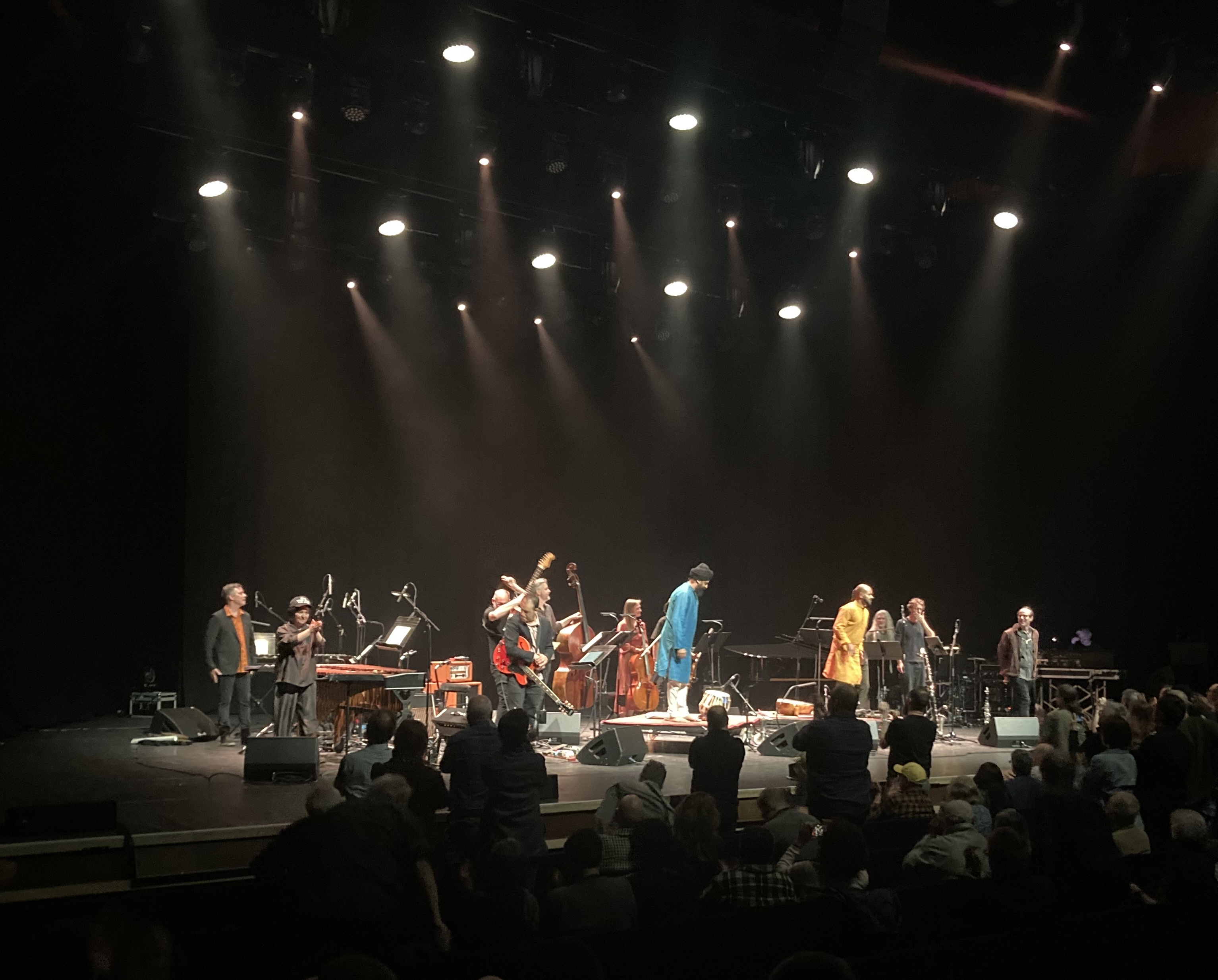
On Thursday night the New York ensemble Bang on a Can All Stars, longtime performers of Riley’s work, arrived at the Barbican to celebrate his birthday by presenting two of his most famous compositions, with the help of several guests. Riley, of course, was 6,000 miles away, but he welcomed the audience warmly with a recorded video message transmitted via large screens.

The evening began with the basic band — keyboard, clarinet/bass clarinet, electric guitar, cello, double bass and drum kit/vibes — performing A Rainbow in Curved Air, such a strong influence when it appeared in 1969 on the likes of Pete Townshend, Brian Eno and others experimenting with early synthesisers, although the original work itself was performed by Riley on organ, electric harpsichord, rocksichord, dumbec and tambourine, via overdubs.

Arranged for the sextet by Gyan Riley, Terry’s son, and slightly stretched from the original 19 minutes to 25, it preserved the sense of genially interlocking patterns, although Riley’s 14-beat measures seemed to have become a distinct 7/4, strongly articulated by the group’s drummer, David Cossin, before he switched to vibes for the later passages. The sudden halts and resumptions were as gently startling as they seemed on the album five and a half decades ago.

In C, first performed in 1964 and recorded in 1968, is the piece that made Riley’s reputation in the world of contemporary classical music. A remarkably versatile composition, open to any number of players and all musical instruments in any combination, its 53 modules — short musical phrases using all 12 tones of the tempered scale except C sharp and E flat — must be played in order but can be repeated according to each performer’s feeling for the piece’s overall collective development. For last night’s 65-minute performance, Bang on a Can were joined by Shabaka on flutes, Valentina Magaletti on marimba, Soumik Datta on sarod, Portishead’s Adrian Utley on guitar, Raven Bush on violin, Gurdain Rayatt on tablas and Jack Wyllie on soprano saxophone. (Pete Townshend was billed to appear but withdrew following a knee operation.)

I found the result entirely true to the original spirit of the composition, preserving the constant momentum and the sense of conversation without the presence of a conductor. The instrumentation produced wonderful fluctuations of density and shifting polyrhythmic layers; there were beautiful isolated moments, like a brief sarod/cello combination and the emergence of a clarinet melody, and the general lightness of tone brought the closing passage close to the texture of baroque music.

It was like lying on your back and watching clouds moving at a variety of altitudes across a busy but unthreatening sky, endlessly mutating and utterly absorbing until it was brought, with an act of intuitive collective decision, to the most graceful close. Happy birthday, Mr Riley.

Meet the house band

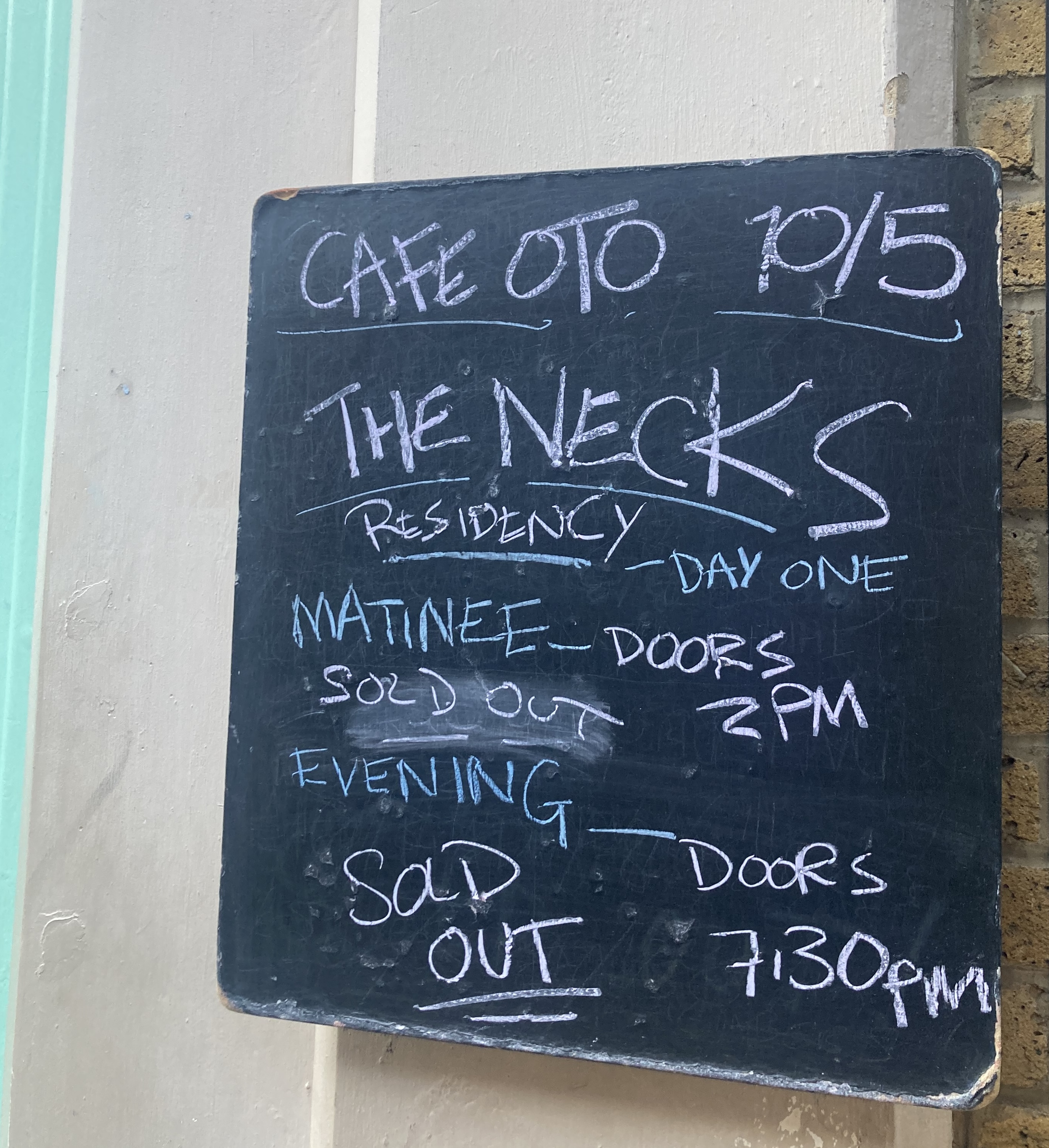
Before the evening show on the first of their two days at Cafe Oto on Saturday, the Necks were announced to the audience as “the house band”. We laughed, and so did they. But it seemed to fit. The Australian improvising trio have played in many London venues, but the little space on Ashwin Street in Dalston seems to suit them best.

Once the house was quiet, they began with Chris Abrahams picking out short melodic phrases in the piano, lightly hammering each note with the two fingers: the index finger of each hand. It was a lovely effect, almost like a santur or cimbalom. The phrases sounded vaguely Moorish, which might seem a bit vague and superficial as a description but is intended to suggest that they felt like fragments of ancient wisdom, conveyed without adornment.

Tony Buck was rubbing two old cymbals on the heads of his snare drum and floor tom-tom. They he began playing a medium fast 1-1-1-1 rhythm with his left hand on the top cymbal of his hi-hat, using a long slender stick. That cymbal stroke formed the basis of his contribution over the next 40 minutes, building in volume and density but retaining a silvery delicacy.

Meanwhile Lloyd Swanton plucked the open D string on his bass with emphasis, letting it ring. That became the tonal centre of the entire collective improvisation, the only fixed point as each of the three explored his own avenue of rhythmic and melodic creation, the symbiosis built up over 30 years enabling them to operate in seeming independence of each other and yet in complete communion. It takes the idea of listening to each other to a different place: listening without listening.

As is usual, but not inevitable, the music gathered power and volume until, by some unspoken intuition, the musicians broke it down, stripping back all the chosen materials until we were returned to the silence.

It’s always tempting to search for analogies and metaphors. Tempting, but unnecessary. Still, on Saturday I thought of the sea breaking on a shore, composed of countless waves and wavelets, all surging and cresting according to their own individual strengths and sub-trajectories, yet responding to a single tidal pulse. It’s an amazing thing to witness in person, when you see how these musicians never even look at each other in performance (Abrahams actually sits side-on, facing offstage) but are linked by something unique.

* The Necks are at Band on the Wall in Manchester tomorrow night (May 13), the Empire, Belfast (14), the Sugar Club, Dublin (15), and thereafter in Switzerland, Portugal, the Netherlands, Croatia, Greece, Poland, Spain, Italy and Belgium: https://shop.thenecks.com/tour-dates

Portrait of the artists

Bryan Ferry might have made a career for himself as a painter or ceramicist, and he had a go at both. Instead he chose music. But everything he’s done since has been about being an artist in a very particular sense. Roxy Music worked best when seen as an art project: “Re-make / Re-model”, “In Every Dream Home a Heartache”. The same could be said of his solo work: the readymades of These Foolish Things, the more-than-homage of Dylanesque, the ’30s glide and swoon of As Time Goes By, the brazen charm of The Jazz Age, the wintry covers of “Back to Black” and “Johnny and Mary”.

I’ve been thinking about that while listening to his latest release, Loose Talk, created in partnership with the poet and painter Amelia Barratt, which is immediately interesting because it’s a collaboration between artists at very different stages of their careers (she is in her thirties, he will be 80 in September). It’s also the first Ferry album on which someone else is responsible for the words and their delivery.

He’s a great assembler of words himself, of course, as his collected Lyrics underlined when it was published by Chatto & Windus three years ago, but it’s often been a painful business for him. I remember stories from the ’70s of his then-manager, the department store heir Mark Fenwick, sitting in an armchair sighing and tapping his fingers like an exam invigilator while Bryan struggled to carve out the words of the final verse to the last song for a new album, its release date already postponed by a record company impatient for product.

Loose Talk is an album in which Barratt reads eleven of her poems to Ferry’s musical settings, some using material set aside from his earlier projects. It would be flippant — and wrong — to suggest that he’s solved a problem by delegating the job of providing the words to a collaborator. It’s a legitimate artistic project, from both perspectives.

Barratt is a slender young woman with the sort of looks Cecil Beaton captured in his photographs of the pre-war Bright Young Things. Her voice is quiet, reserved, unemphatic. It’s a voice you might overhear amid the gush and babble at a party — a gallery opening or a book launch, perhaps — and look around to discover its source.

Her verses are not song lyrics: they’re poems, allusive and enigmatic and unresolved, filled with fleeting exchanges that hint at narrative but yield impressions rather than stories, occasionally threaded with contemporary images: “Wasting her time / she’s flipping channels with the remote control” or “My sneakers now washed / hang by their laces.” When combined with Ferry’s music, they take us to familiar territory: “She’s one to watch” is the first line of a track called “Stand Near Me”, a prime Ferry opening if I ever heard one, while “Pictures on a Wall” provides a neon-splashed groove that might have come from any Ferry session from Horoscope/Mamouna in the early ’90s to Avonmore in 2014.

There are decayed pianos being played in abandoned ballrooms, a mood that Ferry has explored with and without Roxy Music. Often the accompanying cadences descend with slow, muted elegance: the echoing piano on “Florist”, the bass on “Orchestra”. That’s another Ferry signature.

Barratt’s poems work for me, mostly, because her delivery sounds like a modern way of speaking and sometimes she produces a sketch whose images and emotions provide a satisfying coherence. “Florist” has an intriguing arc and a moment of piercing disquiet: “Imagine one day / he comes to me and says / There is nothing more I want than this / He gestures to the tulips / that look out from a bucket, bunched / in the passenger seat of the van / To his apron / To his diary with nothing in / and I say / That’s perfectly fine / Perfectly alright / Perfectly without the need to tell me all the time.”

There are some familiar names in the credits — the guitarists Neil Hubbard and Ollie Thompson, the bassists Neil Jason and Alan Spenner, the drummers Paul Thompson and Andy Newmark — but their individual presences are never noticeable: these tracks are stripped back to form a watchful background. The most assertive music comes in the final piece, the title track, where Barratt’s economical verses are accompanied by a subdued but baleful 12-bar blues, somewhat in the manner of “Let’s Stick Together”, Ferry’s 1976 solo hit.

Ferry’s own voice is allowed to peep through two or three times as a kind of palimpsest, probably leftover guide vocals from the demos, notably on “Orchestra”, where the atmospherics are at their most languid and dream-like. But in this collaboration he’s found another way to extend his expressive reach. It’s the latest episode in a long life full of interesting creative decisions. Another twist in an artist’s career.

* Loose Talk by Amelia Barratt and Bryan Ferry is out on Dene Jesmond Records on March 28. The photograph of Ferry and Barrett was taken in Los Angeles by Albert Sanchez.

A change in the weather

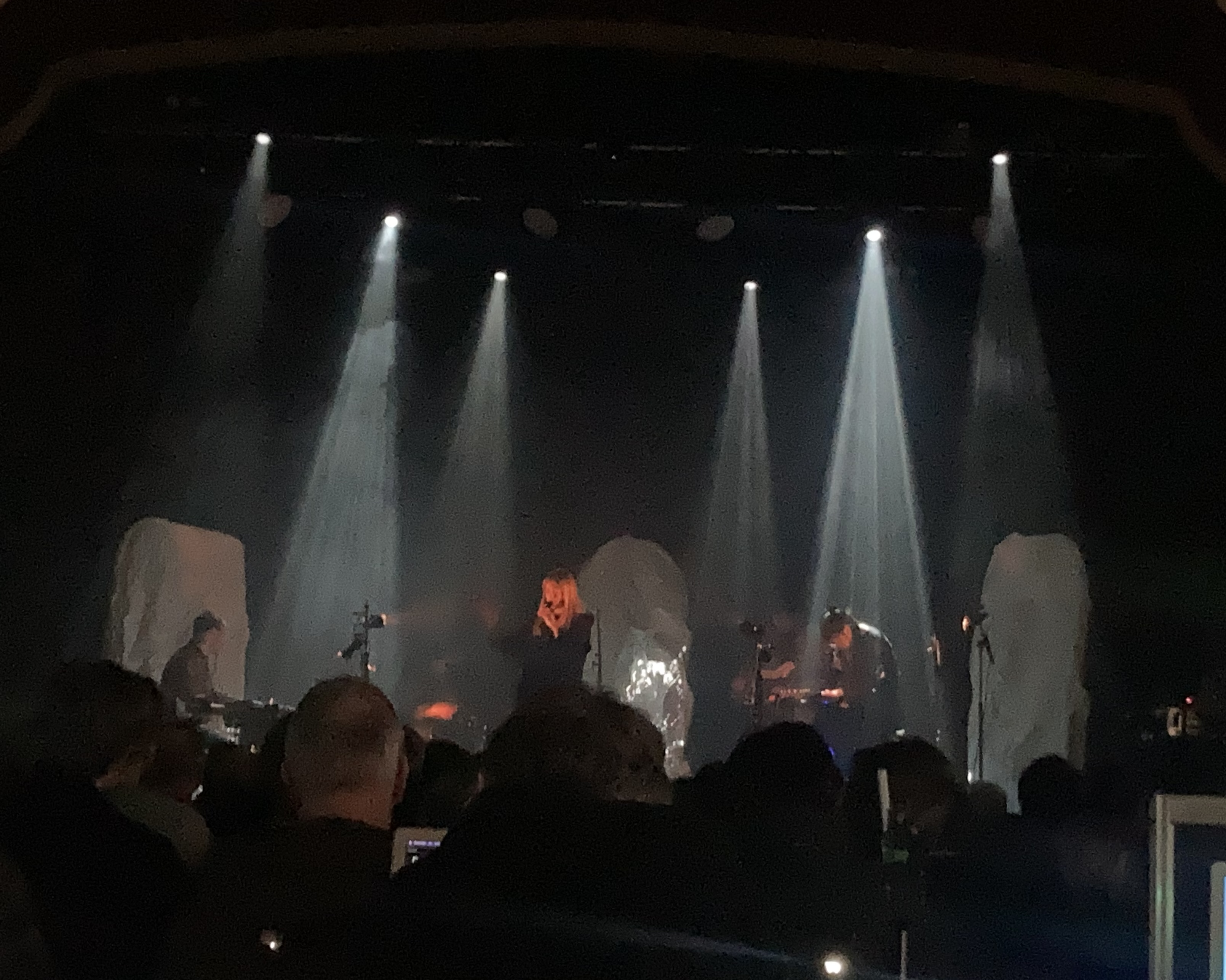
It took a while for me to get from admiration to love for the Weather Station’s new album, Humanhood. At Islington Assembly Hall last night, Tamara Lindeman and her four musicians — Ben Boye (keyboards), Karen Ng (alto saxophone, flute, keyboards), Ben Whiteley (bass guitar) and Dom Billett (drums) — brought its songs fully to focus, in combination with several from its great 2021 predecessor, Ignorance.

This was, as Lindeman had promised, a show designed for theatres, with subtle lighting and a set consisting of three tall, pale, rough-hewn standing stones on which were projected fragments of elemental images: flickers of light from stars and fires, avalanches, drowning forests, all counterpointing the cool but never disengaged clarity of the songs.

The musicianship was exemplary. Whiteley anchored the sometimes irresistible grooves, Billett graded his volume with great care, Ng added the occasional free-jazz flurries on alto that bring the music into a different atmosphere, Boye provided synth mood-setters and lovely spare unaccompanied piano passages, Lindeman contributed economical electric lead guitar.

Together they established moods that were sustained and allowed to evolve through clusters of half a dozen songs at a time, the dynamic ranging from reflecting near-silence on “Lonely” and “Sewing” to that gentle but irresistible gallop in which Lindeman specialises on songs such as Humanhood‘s title track and “Neon Signs” and Ignorance‘s “Loss” and the sublime “Parking Lot”.

Her lyrics are extraordinary: non-repeating snatches of thought and conversation that somehow came through more clearly in live performance, along with her concern for a threat to the environment renewed by the events of the last few months. After starting out as an acoustic singer-songwriter, she has now, with her musicians’ help, developed a carefully textured, agile and quietly resilient hybrid genre that is the ideal setting for her words.

On the last night of a European tour, this was pretty much a perfect concert, one likely to live long in the memory of a warmly appreciative audience.

* The Weather Station’s Humanhood is on the Fat Possum label.

The world and Don Cherry

Wherever, whenever and by whomsoever the idea of “world music” was invented, it had no finer exponent, explorer and exemplar than Don Cherry. In a few months’ time it will be 30 years since Cherry died in Malaga of liver cancer, aged 58, leaving a world in which he was, to quote Steve Lake’s happy phrase, “a trumpet-playing lyric poet of the open road, whose very life was a free-flowing improvisation.” I suppose it was fitting that he should have died in Andalucia, a region where many cultural influences met in the Middle Ages to create a foundation of song.

Cherry’s life and work demand a full-scale biography, along the lines of Robin D. G. Kelley’s standard-setting study of Thelonious Monk. In the meantime, it’s worth welcoming Eternal Rhythm: The Don Cherry Tapes and Travelations, a new book consisting mostly of interviews conducted in various locations around the world by the author Graeme Ewens, who met the trumpeter in the 1970s and became his “confidant, travel companion, witness and friend” over the subsequent two decades. They are augmented by Ewens’ memories of their times spent together from Bristol to Bombay, by biographical notes, and by an interesting selection of photos and other visual material.

A useful addition to Blank Forms’ The Organic Music Societies, a Cherry compendium published in 2021, it’s full of worthwhile stuff. Here’s Cherry on playing with Ornette Coleman in the great quartet that changed the direction of jazz: “Ornette would never count a song off: ‘One, two, three, four, go.’ We would feel each other in the silence before playing and then we would play. And the first accent, or the first attack, would determine the tempo and temper of the composition.” And this, which goes to the heart of Cherry’s conception: “One day when Ornette was working on notation, we talked about how you couldn’t notate human feelings. For me, there was always this problem of notated music sounding like notated music. In the older days you never saw black musicians playing with music stands. They learnt it by heart, which is important. For me, when I learn a song with notes it will take time for me to really memorise it, but it’s important to learn it by heart because then you will know it.”

Cherry tells a story about Miles Davis coming to sit in with him and Billy Higgins at the Renaissance in Hollywood and borrowing his pocket trumpet. And then, later in the ’60s, Miles invites Cherry to sit in with his quintet at the Village Vanguard: “So I played something, the changes from ‘I Got Rhythm’ — AABA — and I stopped my solo right before the bridge, which is the B part, and Miles said, ‘You’re the only man I know who stops his solo at the bridge.’ Then later on I heard him doing the same thing. And the next time I saw him he said to me, ‘Hey, Cherry, I play a little like you now,’ which was a big compliment.” Particularly, one might point out, coming from a man who had initially scorned Cherry’s playing.

In an offical note telexed after a concert in Yaoundé in 1981, during a tour of Cameroon sponsored by the US State Department, a consular official writes: “Cherry and companions were real good-will ambassadors: courteous, patient, curious about country, irrepressibly friendly… (the) only problems arose in trying to move them from place to place as they kept striking up conversations in the street.” On page 132 we learn that the pocket trumpet Cherry was playing at the time of his conversation had once belonged to Boris Vian, the writer and critic, and possibly before that to Josephine Baker. On the very next page Cherry mentions an occasion in the 1950s when he and Ornette went to hear a Stockhausen performance at UCLA.

The book doesn’t duck the question of the social conditions under which the music came into being, or the heroin addiction that began for Cherry in the 1950s and continued on and off for the rest of his life. Here, as part of a lengthy disquisition on changes in the heroin trade, is an insight, from the perspective of 1981: “…you always try and keep some morals. There were certain influential white people who were messing with drugs and so I’d be copping for them, and that’s the way I’d survive. But now on the Lower East Side anybody can go and cop. Anybody. Sometimes they’ll ask you to show them your marks before they let you in the building. That world is another kind of world. You cannot compare that world with the people who just smoke grass, because you’re fighting for your life to survive.”

World music hadn’t been invented — or codified as a marketing category — when Cherry moved on from his jazz background. He’d become famous through his association with Coleman, followed by three wonderful albums of his own for Blue Note (Complete Communion, Symphony for the Improvisers and Where Is Brooklyn?), and his work with Albert Ayler, the New York Contemporary Five, the Jazz Composers Orchestra and Charlie Haden’s Liberation Music Orchestra. His new direction denied nothing of his past but incorporated elements drawn from other cultures, exemplified by his use of bamboo flutes, gamelan and the doussn’ gouni, the six-stringed hunter’s harp from West Africa.

His concert at the Berlin Jazz Festival in 1968, released by MPS under the title Eternal Rhythm, gave a clear indication of where his music was heading. Further evidence came with collaborations with the Turkish drummer Okay Temiz (Orient on BYG and Organic Music Society on Caprice), his duo albums with Ed Blackwell (Mu Pts 1 & 2 on BYG, El Corazón on ECM), his guest appearance on the Swedish drummer-composer composer Bengt Berger’s essay in African ritual modes and rhythms, Bitter Funeral Beer (also ECM), and the three ECM albums by Codona, a trio with the multi-instrumentalists Collin Walcott and Nana Vasconcelos, recorded in 1978-82 (and reissued in 2008 as The Codona Trilogy).

Elsewhere, refusing to be limited by notions of idiom and genre, he turned up on Lou Reed’s The Bells, Rip Rig & Panic’s I Am Cold and a lovely half-hour improvised duet with Terry Riley, bootlegged from a 1975 Riley concert in Cologne. In the early ’80s he toured with Sun Ra’s Arkestra and Ian Dury’s Blockheads.

I want to pass on a pithy little description of Cherry’s playing that I’ve just read in a Substack post celebrating Ornette’s 1972 album Science Fiction by the pianist Ethan Iverson: “Folk music, surrealism, the blues, the avant-garde, deep intelligence, primitive emotion.” That’s good. And, as much as I love his work with Coleman, Albert Ayler and Gato Barbieri, my favourite Cherry albums are probably those that best encapsulate the full range of those qualities, and of his imagination.

They would be Eternal Rhythm, Relativity Suite from 1973 (with the JCOA, never reissued in any form since its its first appearance on vinyl), and the wonderful Modern Art: Stockholm 1977, a concert at the city’s Museum of Modern Art, which appeared on the Mellotronen label in 2014, featuring Cherry and a nine-piece band played marvellously rich acoustic versions of the material from his then-recent album Hear & Now, produced by Narada Michael Walden. It includes a spellbound duet with the Swedish guitarist Georg Wadenius on a graceful Coleman ballad called “Ornettunes” and an ecstatic transition from the gentle groove of “California” (a take on Donald Byrd’s “Cristo Redentor”, with Cherry on piano) to the miniature prayer for transcendence of “Desireless” (first composed as “Isla (The Sapphic Sleep)” for Alexander Jodorowsky’s 1973 film The Holy Mountain and then re-recorded under its new title for Relativity Suite).

It’s easy to imagine that there probably isn’t any music ever played by anyone, anywhere, at any time, from prehistoric hunters on the Eastern Steppe to whatever Kendrick Lamar, Billie Eilish or Nils Frahm are doing next, to which Don Cherry could not have made a worthwhile contribution. And the secret to that must have been his openness.

“I’m self-taught in a way,” he says in the book, “but I’ve always been open to learn, because one lifetime I don’t feel is long enough to really learn music.”

* Graeme Ewens’ Eternal Rhythm: The Don Cherry Tapes and Travelations is published by Buku Press: bukupress@gmail.com. The photograph of Cherry on the Lower East Side of Manhattan in 1988 was taken by Val Wilmer and is used by her kind permission.

Brutalised

Maybe you saw Daniel Blumberg’s acceptance speech for the best soundtrack award during the Academy Awards ceremony at the weekend. Honoured for his work on The Brutalist, he finishes off with a mention of Cafe Oto, which is less of a surprise when you’ve noticed, among the musical credits, the names of such Oto-adjacent improvisers as the saxophonists Seymour Wright and Evan Parker, the pianist John Tilbury and the trumpeter Axel Dörner.

After seeing Brady Corbet’s ambitious film at the IMAX in London today, I came away with mixed feelings. Sometimes it feels like three different and much shorter films, maybe four, trapped together in a very large sack and left to fight it out for three and a half hours.

But the real reason I went was to find out what use Blumberg had made of Evan Parker’s unique qualities. The saxophonist is featured in a sequence filmed amid the marble quarries at Carrara, in the hills above the Tuscan coast, the source of the material from which Michelangelo’s David was wrought, along with Rome’s Pantheon and London’s Marble Arch.

As a camera hovers over the spectacularly gorgeous hewn terraces of white stone, the air is filled with the sound of Parker’s soprano saxophone. Unbroken skeins of squiggling multiphonic sound are shaped with a sound-sculptor’s skill and imagination, soaring like birds above a sombre low-brass chorale.

Given the film’s narrative requirements, it’s a moment of audio-visual magic that can’t last long. But I could happily have taken three and a half hours of that alone, without all the plot-driven drama that surrounds it. Right there, perhaps, was yet another film struggling to escape: a potential classic of slow cinema.