Skip to content

Posts from the ‘Soul music’ Category

Steve Cropper 1941-2025

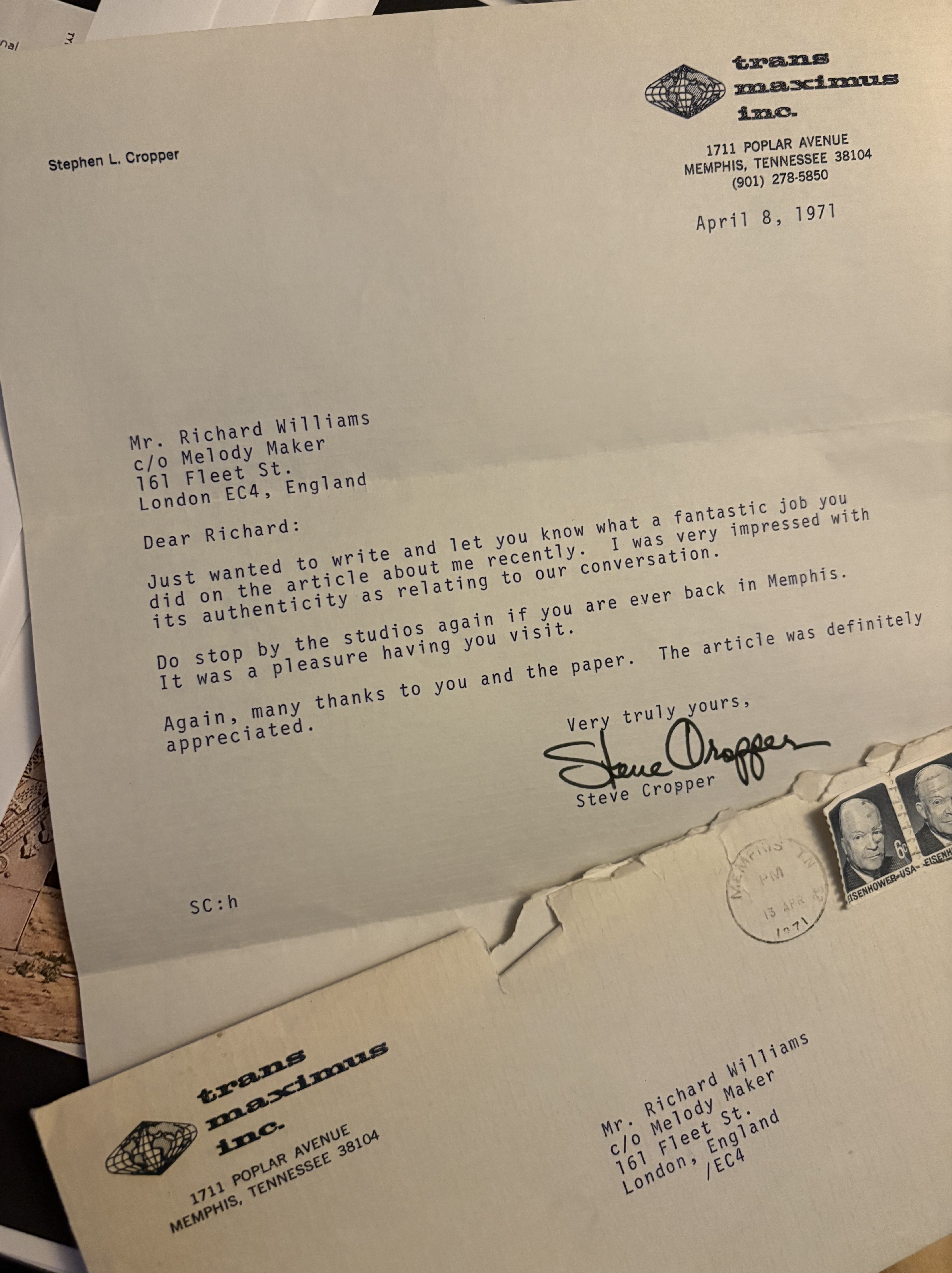
You don’t expect the people you interview to write thank-you letters, but it’s quite nice when they do. Particularly when it comes from someone like Steve Cropper, as happened to me in 1971 after I’d interviewed him for the Melody Maker at his new studio in Memphis on a break from a session he was producing for his old friend Eddie Floyd. I kept the letter, of course, as you would.

Cropper died this week, aged 84. Here’s the obituary I wrote yesterday for the Guardian. I hope I did him some kind of justice. He was a hero of mine, as were the other members of the MGs, ever since I first heard “Green Onions” in 1962. I have all their albums, all the way up to 1994’s That’s the Way It Should Be, and they’re among the last things I’d part with. My favourite is probably Soul Dressing, from 1965, even thought it was the one whose mediocre sales persuaded them that instrumental albums needed covers of familiar tunes in order to attract buyers.

Hence, on subsequent albums, things like their fine versions of the Temptations’ “Get Ready”, Gershwin’s “Summertime”, Cliff Nobles’ “The Horse”, the Delfonics’ “La-La Means I Love You” and Aretha’s “(Sweet Sweet Baby) Since You’ve Been Gone”. I listen to those alongside the MGs’ originals I love: “Big Train”, “Soul Sanction”, “Double or Nothing”, “Kinda Easy Like”, “Last Tango in Memphis”, “Cruisin'”, “Sarasota Sunset” and the rest. It was nice of Steve to take the trouble to express his thanks all those years ago. So now I’ll say thank you back to him, for all of it.

Voces humanae

Amazing, isn’t it, that even in this Tower of Babel an individual human voice can be unmistakeable. Mavis Staples sounds like Mavis Staples. Boz Scaggs sounds like Boz Scaggs. No one else. And over the decades those voices become trusted friends. Each of them has a new album out that suggests, as they head towards the inevitable end of long careers (Mavis is 86, Boz is 81), that they could never outstay their welcome.

After albums with Ry Cooder, Jeff Tweedy and Ben Harper in the producer’s chair, it’s the turn of Brad Cook, whose credits include Bon Iver and Nathaniel Rateliff and the Night Sweats, to supervise Mavis’s new album. He doesn’t let her down.

The song selection on Sad and Beautiful World is thoughtful and empathetic, starting with the conscious boogie-shuffle of Tom Waits and Kathleen Brennan’s “Chicago” and proceeding through Gillian Welch and David Rawlings’ “Hard Times”, Curtis Mayfield’s “We Got to Have Peace” and Leonard Cohen’s “Anthem” to Eddie Hinton’s “Everybody Needs Love” via material less familiar to me. The most striking of those is Frank Ocean and James Ho’s “Godspeed”, set in a dense instrumental weave that summons all the best elements of Americana into one perfect arrangement.

There’s no showing off by the many fine players involved on the 10 tracks, but I love Derek Trucks’ beautiful slide guitar decorating “Hard Times” and the glinting pedal steel of Colin Croom on “A Satisfied Mind”, the gorgeous country song by Red Hayes and Jack Rhodes, whose many cover versions go back to 1954 and Mahalia Jackson — perhaps the exemplar Mavis had in mind. And to take us out, there’s a backing choir on “Everybody Needs Love” consisting of Bonnie Raitt, Patterson Hood, Kate Crutchfield and Nathaniel Rateliff. Everybody loves Mavis, don’t they?

For Detour, Boz Scaggs returns to the sort of American standards he investigated on But Beautiful in 2003 and Speak Low in 2008, although it sells a dummy straight away by opening with a night-club version of Allen Toussaint’s “It”s Raining” before settling into the likes of “Angel Eyes”, “The Very Thought of You” and “We’ll Be Together Again”. After the very fine arrangements by Gil Goldstein that helped make Speak Low such a success, here Scaggs favours the more stripped-back setting of a piano trio with the lightest touches of string arrangements here and there.

OK, you could say that his “Angel Eyes” and “Once I Loved” don’t match those of, say, Sinatra and Shirley Horn respectively, but if you like Scaggs’ voice as much as I do, you won’t be worried by that — and you’ll be delighted to hear him excavate “I’ll Be Long Gone”, a waltz-time song from his very first solo album back in 1969, refurbishing it with a deeper, richer, more controlled approach.

Sometimes these American Songbook projects work (Bob Dylan) and sometimes they don’t (Rod Stewart), their success largely dependent on what their significance is to the singers and how much real appreciation they have of the art of the men wrote the melodies and lyrics. I don’t think there’s much doubt on which side of the divide Boz Scaggs falls.

Aces high in Camden Town

On the first floor at the Hawley Arms, a pub in Camden Town, Ted Carroll is spinning the discs. He’s started the session with the Bobbettes’ “Mr Lee”, a record that changed his life when he bought an original copy on the London label. He’ll go on to play Bo Diddley’s “Bo Diddley”, Inez and Charlie Foxx’s “Mockingbird” and other choice stuff before resuming his conversations with guests at last night’s 50th birthday celebration for Ace Records, which he and his co-founders, Roger Armstrong and Trevor Churchill, turned into the most prolific and consistently rewarding of reissue labels.

I used to visit Ted’s stall at the back of 93 Golborne Road, up at the then-untrendy north end of Portobello Road, soon after he opened it in 1971 with a stock built around 1,800 London 45s from the ’50s and ’60s. The equivalent of New York’s Village Oldies and House of Oldies, it attracted a clientele of people — some of them famous — looking for rare old R&B, rock and roll and doo-wop vinyl. He added a stall in Soho later in the decade before opening the Rock On shop on Kentish Town Road, next door to Camden Town tube station, from where he also ran the Chiswick label.

Ace began with the acquisition of Johnny Vincent’s label of the same name, out of Jackson, Mississippi. That was the first of many such deals made with some of the great American post-war record men, including Art Rupe of Specialty, Hy Weiss of Old Town and the Bihari brothers of Modern, a species now extinct. Carroll, Armstrong and Churchill had set off on their mission of creating high-class reissues of neglected music, assembled with love, care, and thousands of hours spent in tape vaults across the US. Among later additions would be the Fantasy group of labels, which included Stax/Volt, thus enabling Armstrong, as he told me last night, to stumble open-mouthed upon the session tapes of “Sitting on the Dock of the Bay”.

Personally, I’m profoundly grateful to such compilers as Mick Patrick, Ady Croasdell, Tony Rounce, John Broven, Dean Rudland and Alec Palao for the enthusiasm and scholarship behind dozens of wonderful CDs devoted to stuff I care about. There’s the imaginatively programmed songwriters’ and producers’ series, covering the works of Goffin & King, Leiber & Stoller, Greenwich & Barry, Mann & Weil, Jackie DeShannon, Randy Newman, Laura Nyro, P. F. Sloan & Steve Barri, Bob Gaudio, Dan Penn & Spooner Oldham, Bert Berns, Jerry Ragovoy, and others. There’s the four-volume Sue story, put together by Rob Finnis, and the epic five discs of the late Dave Godin’s Deep Soul Treasures. There’s Ady Croasdell’s beautiful Lou Johnson anthology, his two-volume This Is Lowrider Soul, and his compilation of Doré label tracks called L. A. Soul Sides, including Rita and the Tiaras’ magical “Gone With the Wind Is My Love”. There’s Mick Patrick’s collection of Teddy Randazzo’s great productions and, going back to 1984, Where the Girls Are, his first compilation and one of many devoted to the beloved girl-group genre.

That’s just scratching the surface. And whether pop, blues, R&B, Northern Soul, funk, gospel or jazz, the packaging of Ace’s releases has always been exemplary, thanks to the informative and enjoyable annotations and picture research by the compilers, and to intelligent artwork by designers including Neil Dell, who worked on many of the CDs I’ve mentioned.

The label was sold a couple of years ago. Its new owners, a Swedish company called Cosmos Music, seem committed to continuing on the same path, with the same managers and contributors. A lot of them were at last night’s very convivial party, which started well for me when I walked in to the sound of Dean Rudland playing Oscar Brown Jr’s “Work Song” off a French EP, followed by Ray Charles giving the Raelettes’ Margie Hendrix her finest hour — well, 16 bars — on “You Are My Sunshine”.

Ted, who followed Dean on the decks, now runs a new incarnation of Rock On in the lovely market town of Stamford in Lincolnshire, just off the A1; a bit different from Camden Town — where, as I walked back to the tube, a trio called Thistle were trying to convince their audience that the ground-floor room of the Elephants Head pub was CBGB, this was 1975, and the next band on the bill would be the Patti Smith Group.

Fifty years ago Ted, Roger, Trevor and their helpers did a great thing by starting Ace. When a label introduces you to such gems as Margaret Mandolph’s ” I Wanna Make You Happy” (on Croasdell’s Tears in My Eyes compilation from 1985) and the Vogues’ “Magic Town” (on Glitter and Gold, the first of Patrick’s two Mann & Weil CDs), you can only raise a glass to the work they’ve done and thank them for the happiness it continues to bring.

Everybody Loves a Train

About twenty years ago, my friend Charlie Gillett was compiling a series of themed CDs for a Polygram label called Debutante, under the aegis of the former Island A&R head Nick Stewart. Charlie asked me if I’d like to put one together, and if so, what the theme might be. “Trains,” I said, after about ten seconds’ thought, and then I went away to assemble a running order. It took a while, because I enjoyed the process so much.

Sadly, the series came to a sudden end before my contribution could see the light of day. But I’d edited together a disc of how I wanted it to go. I called it Everybody Loves a Train, after the song by Los Lobos. It has all sorts of songs, some of which speak to each other in ways that are obvious and not. I avoided the most obvious candidates, even when they perfectly expressed the feeling I was after (James Brown’s “Night Train” and Gladys Knight’s “Midnight Train to Georgia”) and instrumentals, too (see the footnote).

Every now and then I take it out and play it, as I did this week, with a sense of regret that it never reached fulfilment. Here it is, with a gentle warning: not all these trains are bound for glory. Remember, as Paul Simon observes, “Everybody loves the sound of a train in the distance / Everybody thinks it’s true.”

  1. Unknown: “Calling Trains” (From Railroad Songs and Ballads, Rounder 1997) Forty-odd seconds of an unidentified former New Orleans station announcer, recorded at Parchman Farm, the Mississippi state penitentiary, in 1936, calling from memory the itinerary of the Illinois Central’s “Panama Limited” from New Orleans to Chicago: “…Ponchatoula, Hammond, Amite, Independence… Sardis, Memphis, Dyersburg, Fulton, Cairo, Carbondale…” American poetry.
  2. Rufus Thomas: “The Memphis Train” (Stax single, 1968) Co-written by Rufus with Mack Rice and Willie Sparks. Produced by Steve Cropper. Firebox stoked by Al Jackson Jr.
  3. Los Lobos: “Everybody Loves a Train” (from Colossal Head, 1996) “Steel whistle blowin’ a crazy sound / Jump on a car when she comes around.” Steve Berlin on baritone saxophone.
  4. Bob Dylan: “It Takes a Lot to Laugh, It Takes a Train to Cry” (from Highway 61 Revisited, 1965) “Don’t the brakeman look good, mama, flaggin’ down the Double E?”
  5. Joe Ely: “Boxcars” (from Honky Tonk Masquerade, 1978) A Butch Hancock song. Ponty Bone on accordion, Lloyd Maines on steel guitar.
  6. Counting Crows: “Ghost Train” (from August and Everything After, 1993) “She buys a ticket ’cause it’s cold where she comes from / She climbs aboard because she’s scared of getting older in the snow…”
  7. Rickie Lee Jones: “Night Train” (from Rickie Lee Jones, 1979) It was a plane she took from Chicago to LA to begin her new life in 1969, and an old yellow Chevy Vega she was driving before she cashed the 50K advance from Warner Bros ten years later. But, you know, trains.
  8. The Count Bishops: “Train, Train” (Chiswick 45, 1976) London rockabilly/pub rock/proto-punk. Written by guitarist/singer Xenon De Fleur, who died a couple of years later in a car crash, aged 28, on his way home from a gig at the Nashville Rooms. Note that comma. I like a punctuated title.
  9. Julien Clerc: “Le prochain train” (from Julien, 1997) My favourite modern chansonnier. Lyric by Laurent Chalumeau.
  10. Blind Willie McTell: “Broke Down Engine Blues” (Vocalion 78, 1931) Born blind in one eye, lost the sight in the other in childhood. Maybe he saw trains in time to carry their image with him as he travelled around Georgia with his 12-string guitar.
  11. Laura Nyro: “Been on a Train” (from Christmas and the Beads of Sweat, 1970) One song she didn’t do live, as far as I can tell. Too raw, probably.
  12. Chuck Berry: “The Downbound Train” (Chess B-side, 1956) When George Thorogood covered this song, he renamed it “Hellbound Train”. He didn’t need to do that. Chuck had already got there.
  13. Bruce Springsteen: “Downbound Train” (from Born in the USA, 1984) “The room was dark, the bed was empty / Then I heard that long whistle whine…”
  14. Dillard & Clark: “Train Leaves Here This Morning” (from The Fantastic Expedition of Dillard & Clark, 1968) Written by Gene Clark and Bernie Leadon: “1320 North Columbus was the address that I’d written on my sleeve / I don’t know just what she wanted, might have been that it was getting time to leave…”
  15. Little Feat: “Two Trains” (from Dixie Chicken, 1973) In which Lowell George extends the metaphor of Muddy Waters’ “Still a Fool (Two Trains Running)”: “Two trains runnin’ on that line / One train’s for me and the other’s a friend of mine…”
  16. B. B. King: “Hold That Train” (45, 1961) “Oh don’t stop this train, conductor, ’til Mississippi is out of sight / Well, I’m going to California, where I know my baby will treat me right”
  17. Paul Simon: “Train in the Distance” (from Hearts and Bones, 1983) Richard Tee on Fender Rhodes. “What is the point of this story? / What information pertains? / The thought that life could be better / Is woven indelibly into our hearts and our brains.”
  18. Vince Gill: “Jenny Dreams of Trains” (from High Lonesome Sound, 1996) Written by Gill with Guy Clark. Fiddle solo by Jeff Guernsey. Find me something more beautiful than this, if you can.
  19. Muddy Waters: “All Aboard” (Chess B-side, 1956) Duelling harmonicas: James Cotton on train whistle effects, Little Walter on chromatic.
  20. Darden Smith: “Midnight Train” (from Trouble No More, 1990) “And the years go by like the smoke and cinders, disappear from where they came…”
  21. The Blue Nile: “From a Late Night Train” (from Hats, 1989) For Paul Buchanan, the compartment becomes a confessional.
  22. Tom Waits: “Downtown Train” (from Rain Dogs, 1985) “All my dreams, they fall like rain / Oh baby, on a downtown train.” A New York song.

Closing music: Pat Metheny’s “Last Train Home” (from Still Life (Talking), 1987) to accompany the photo of the Birmingham Special crossing Bridge No 201 near Radford, Virginia in 1957 — taken, of course, by the great O. Winston Link. Other appropriate instrumentals: Booker T & the MGs’ “Big Train” (from Soul Dressing, 1962, a barely rewritten “My Babe”) and Big John Patton’s “The Silver Meter Pts 1 & 2” (Blue Note 45, 1963, a tune by the drummer Ben Dixon whose title is a misspelling of the Silver Meteor, a sleeper service running from New York to Miami).

Roberta Flack in London

Roberta Flack, who has died aged 88, made her London debut on July 27, 1972, at an early-evening showcase presented by Atlantic Records before an invited audience of industry and media types at Ronnie Scott’s Club. She’d already released three albums but it was when Clint Eastwood chose to feature a track from the first of them, “The First Time Ever I Saw Your Face”, in his 1971 movie Play Misty For Me that she became a hot property.

I sat with my friend Charlie Gillett and we were both overjoyed to discover that her band included Richard Tee on keyboards, the guitarist Eric Gale and the drummer Bernard “Pretty” Purdie. A real New York studio ‘A’ team, the kind you couldn’t quite believe you were seeing in a London club. They provided the perfect platform for the poise and exquisitely chosen material of a singer who was already, at 35, a mature woman.

Of a beautiful little show, in which she also presented two talented young male singers who were her protégés (and whose names I’m afraid I don’t recall), the highlight for me was “Reverend Lee”, a slice of lubricious lowdown funk written by Eugene McDaniels, to whom she had been introduced by her original patron and mentor, Les McCann. She’d already recorded McDaniels’ “Compared to What” on her debut album, First Take, released the day before before McCann and Eddie Harris cut their hit live version at the Montreux Festival.

I prefer her reading, in which the incendiary lyric of a great protest song is rendered all the more powerful for her restrained delivery. Produced with exemplary sensitivity by Joel Dorn, it features the great Ron Carter on double bass, shortly after he had ended his six-year stint with Miles Davis’s quintet.

“I have chills remembering his virtuosity that first day in the studio in New York,” she told me when I asked her about working with Carter during an interview for Uncut magazine in 2020. “He understood that less is more and the importance of the silence between the notes. He was also humble and open to my musical thoughts and suggestions. Our synergy is what you hear on ‘Compared to What’ and ‘First Time’.”

Like Nina Simone, Flack had begun her musical career in the hope of becoming a classical pianist, but fate took them both in a different direction. Simone carried the sense of having been unjustly thwarted with her throughout her life. I asked Flack if she’d ever felt that way, too.

“Life can be so unpredictable,” she said. “One thing I know is that everything changes. I’ve tried to embrace the twists and turns that life’s changes have brought. I took my classical training and used it as the foundation on which I based my arrangements, my dynamics and ultimately my musical expression. I think if you’re rigid about how you see yourself and if you aren’t open to the changes that life brings you, the resentment will show in your music and can interfere with honest expression.”

I’m listening to First Take while writing this. Whether it’s in the quietly spine-tingling gospel of “I Told Jesus”, the laconic protest soul of “Tryin’ Times” or the sublime sophistication of “Ballad of the Sad Young Men”, honest expression from a great artist is what you get.

* The photograph of Roberta Flack at Ronnie Scott’s in 1972, with Eric Gale (right), was taken by Brian O’Connor. If you want to read more about Ms Flack, you won’t find anything better than this piece by Ann Powers: https://www.npr.org/2020/02/10/804370981/roberta-flack-the-virtuoso

Lady Blackbird’s ‘The City’

It begins with a piano tinkling against background chatter. Uptown jazz in a cocktail bar at the top of a skyscraper, its windows overlooking over the rainy nighttime streets. There’s a sighs of strings, and then a pause before a bass riff comes in against a rattle of congas. And then the voice of Lady Blackbird.

Born Marley Munroe in New Mexico 39 years ago, she now makes records with the guitarist/producer Chris Seefried. They wrote this song together. It’s on her new album and it’s called “The City”.

This is a story-song: “Lucille was a mother workin’ for the man / Hard-workin’ women always got a plan / She’ll get there (We’ll get there) / Gettin’ money for the kids and collect the pay / Save their money, gonna move away / To get there (We’ll get there)…” Her voice is strong — toughened by pain, although not unyielding, with a discreet use of fast vibrato, distinctive but subtle.

But then the chorus kicks in — “Show me the joy in the city / No time for pity…” — and the mood is instantly lifted by a groove that defines the way a driving four-four snare drum (here played by Tamir Barzilay) and a freer-floating bass guitar (Jon Flaugher) can together created an irresistible momentum based on the intuitive microsecond differences in their timing, the way Benny Benjamin and James Jamerson used to do at Motown. It sweeps you along, sweeps you away.

“The City” is on Lady Blackbird’s Slang Spirituals, the follow-up to 2021’s highly acclaimed Black Acid Soul. It’s 4:27 of the kind of soul music that blends a shout of triumph and defiance with an undertow of melancholy — so much more compelling than mere euphoria. Gladys Knight’s “Taste of Bitter Love” and Odyssey’s “Native New Yorker”: it’s one of those. And I suspect that it, too, will be with me for a long time.

* Lady Blackbird’s Slang Spirituals is on the BMG label.

‘The Black Chord’

David Corio is a fine British photographer whose book The Black Chord, with text by the writer Vivien Goldman, first appeared in the UK 25 years ago. A new edition, published by Hat & Beard, a Los Angeles-based imprint, presents his images of black musicians via a much more elegant design.

Corio was born in London in 1960 and had his first work published when he was 18. Where he differs from Roy DeCarava and Val Wilmer, two other great photographers of black music, is that most of his subjects are caught in performance, on or off stage. DeCarava and Wilmer both sought particular kinds of intimacy, spiritual or domestic. Corio’s images tend to look outward, making a direct address to the viewer, which means they work well in magazine features and on album covers, and the 200-odd photographs here, beautifully reproduced, combine to make an exhilarating book.

The subjects range from the drummers of Burundi and a Santeria ceremony in Cuba through John Lee Hooker, Fats Domino, Bobby Bland, Aretha Franklin, Art Blakey, Celia Cruz, Fela Kuti, Abbey Lincoln, Ray Charles, Barry White, Millie Jackson, Lee Perry, Ornette Coleman, Al Green, Toots Hibbert, Salif Keita, De La Soul, August Darnell, Sade, the Last Poets, Alton Ellis, PM Dawn, Miles Davis, Foday Musa Susa, Nile Rodgers, Don Cherry, Missy Elliott, and of course Bunny, Tosh and Bob. And many, many others. Goldman’s love of this music, from blues to jazz via R&B, soul, reggae, salsa, afrobeat and hip-hop, originally on view in her work in the 1970s for Sounds, the Melody Maker and the NME, infuses the lively essays that intersperse the groupings of photographs.

One of the pictures I like best contains no performers: over a double-page spread, half a dozen boys perch together around a sound system in London in 1978, shot from below, exuding life and possibilities despite the implicit challenge of the world around them. It has poetry in it. As, more obviously, does the portrait of Nina Simone seen above and also on the book’s cover, taken during a performance at Ronnie Scott’s in 1984, a photograph to make you think a lot about troubled genius. That, too, is Corio at his best.

* The Black Chord by David Corio with text by Vivien Goldman is published by Hat & Beard (hatandbeard.com), price $60.

The last of the Tops

There’s still something distinctly majestic, even monumental, about the run of more than a dozen hits that Eddie and Brian Holland and Lamont Dozier wrote and/or produced between 1964 and 1968 for the Four Tops, whose last surviving original member, Abdul “Duke” Fakir, died this week, aged 88.

It’s a Himalayan range of which the peak, of course, was “Reach Out, I’ll Be There”. I can still remember hearing it for the first time, played by Mike Raven on Radio 390 one evening in 1966, and being transfixed not just by its unprecedented arrangement — the galloping percussion, the piping woodwind, four to the bar on a tambourine, the celestial choir — but by the realisation that someone at Motown had been listening to Bob Dylan. For a fan of both kinds of music, that much was immediately obvious in the urgent repetitive incantation of the melody, so far away from the normal structures of Motown tunes.

The run of hits began in 1964 with “Baby I Need Your Loving”, its swinging rhythm carried by fingerpops on the backbeat — unusual for Motown, although also tried a couple of years later on Martha and the Vandellas’ “No More Tearstained Make Up” — and by James Jamerson’s inventive bass line. It reached the fringes of the Top 10, and remains much loved, but the follow-up, “Without the One You Love”, was too close to it to repeat that success. Listening to it now, I also realise that the bass player on this one must have been someone else; whoever it is, all he does is follow the root note, with none of the octave leaps, passing notes and general fluidity that made Jamerson’s work so distinctive.

Their third Motown single was a gorgeous anomaly: a heartbroken ballad written and produced not by H-D-H but by William Stevenson, the label’s A&R director at the time, and Ivy Jo Hunter. Jamerson returns here, working in conjunction with open strummed rhythm guitars. And as with its two predecessors, what’s particularly noticeable is the use of the Andantes, a female vocal trio, to add to the Tops’ own background harmonies. Jackie Hicks, Marlene Barrow and the soprano Louvain Demps never had a Motown hit in their own right, but they created a kind of penumbra of emotion that gave this record, and almost all the early Tops hits, a special quality that eludes analysis but goes straight to the inconsolable heart.

For their fourth single, and first No 1, they went back to Holland-Dozier-Holland in the spring of 1965 for “I Can’t Help Myself (Sugar Pie Honey Bunch)”, a record that established a template for bass-driven dance records, Jamerson bouncing off the 4/4 on the snare drum and Jack Ashford’s vibes. It was never a favourite of mine, unlike its slightly less successful successor, “It’s the Same Old Song”, which follows the formula but relies less on the bass line and has a lyric you could dance to.

“Something About You” emphasised the pounding beat, forfeiting some of the poetry rediscovered in “Shake Me, Wake Me (When It’s Over)”, and the move towards a funkier sound culminated in the return of Ivy Jo Hunter, co-writing “Loving You Is Sweeter Than Ever” with Stevie Wonder and producing a magnificent track based on chords whose voicings descend with a dark and thrilling inevitability, paced in a deliberate rhythm by the patented combination of tambourine, snare drum and chopped guitar on 2 and 4.

Then came the great run of “Reach Out, I’ll Be There”, “Standing in the Shadows of Love” and “Bernadette”, a trilogy united by the anguish of Levi Stubbs’ lead vocals and the exuberant imagination at work in the arrangements. Jamerson is at his towering best on “Standing in the Shadows”, where Eddie “Bongo” Brown’s congas grab the spotlight in four-bar breaks that foreshadow the tactics of disco remixers a decade later. The third part of the trilogy is remembered for a sudden silence broken by Stubbs’ cry of utter desperation — “BERNADETTE!” — but the female voices have already painted the backdrop, reaching up to touch the heavens.

After that came “7 Rooms of Gloom”, a track that almost turned the trilogy into a tetrad, its opening a masterpiece of suspense before drums and bass enter in a flurry, with a hint of harpsichord in the background. Then “You Keep Running Away”, notable for Jamerson’s hyperactivity and the two sets of syncopated convulsions that form a bridge between sections, and its B-side, the tearstained gospel-doowop fusion of “If You Don’t Want My Love”, with the harpsichord marking out the chord cycle.

We’re in 1968 now, and the two lush covers of the Left Banke’s “Walk Away Renée” and Tim Hardin’s “If I Were a Carpenter” were unexpected and beautifully soulful. But by the end of the year H-D-H were on their way out of Motown, leaving the Tops with one last masterpiece: “I’m in a Different World”, a gear-change in synch with (and perhaps a response to) Norman Whitfield’s increasingly adventurous productions for the Temptations. Dramatic changes of density with layers of guitars, a swoosh of strings, a bed of percussion: bass drum, congas, and that hi-hat, a single stroke hissing midway through every bar: “one-and-two-AND-three…”

Now Duke Fakir, whose tenor led the group’s background harmonies, has gone to joined his Detroit friends Lawrence Payton, who arranged those harmonies, Renaldo “Obie” Benson and Stubbs. What a run they had, and what a range of peaks they left, each one still catching the sun from a different angle.

Goodbye, Denny Laine

Denny Laine, who has died at his home in Florida, aged 79, was the best thing about the Moody Blues, even though he was only in the band for a couple of years, from its foundation in Birmingham to his departure two years later. It was his voice that made “Go Now”, their No 1 hit, more than just another British beat group’s cover of an American soul record.

The original of “Go Now”, by Bessie Banks, released in January 1964, was itself a classic. Produced by Jerry Leiber and Mike Stoller, arranged by Garry Sherman, written by Larry Banks (Bessie’s husband) and Milton Bennett, it was first released in the US on the Tiger label. “It shines,” wrote the great enthusiast Dave Godin, who released it in the UK on his Soul City label before including in the second volume of his Deep Soul Treasures series, “like an epic beacon in the history of soul music.”

Alex Murray, a young Decca A&R man, produced the Moody Blues’ version at the label’s West Hampstead studios. Denny Laine said the song had come to them via the journalist James Hamilton, a soul music fan who wrote for Record Mirror and received regular shipments of new records from the New York radio disc jockey B. Mitchel Reed. They speeded it up very slightly and took some of the gospel feel out of the 3/4 rhythm but, crucially, they kept Bessie’s unaccompanied opening vocal line, giving Laine the chance to seize listeners by the lapels: “We’ve already said goodbye…”

“Go Now” was still slipping down the charts when the band I was in supported the Moody Blues at the Dungeon Club in Nottingham in March 1965. No doubt the booking had been made before they hit No 1. In front of an audience of a couple of hundred kids in the basement premises, the Moodies were wearing their early uniform of dark blue Regency-collared double-breasted suits. As they went through their repertoire of covers, including James Brown’s “I’ll Go Crazy”, they were impressively powerful and professional. By the end of the year they were supporting the Beatles on their final UK tour. Two degrees of separation, eh?

Our Island Story

To those who found Chris Blackwell’s 2022 autobiography, The Islander, long on charm but, shall we say, short on detail, The Island Book of Records Vol 1 1959-68 will be the answer to their prayers. Here is the story of the UK’s most charismatic independent label during its formative years, in which the foundations were laid for the company that would later become the home of King Crimson and ELP, the Wailers and Bob Marley, Roxy Music, Bryan Ferry and Brian Eno, Sandy Denny, Sparks, John Martyn, U2 and Grace Jones before Blackwell sold it to Polygram in 1989.

Comprehensively compiled and meticulously edited by Neil Storey, who worked in the label’s press office (and was more recently responsible for the Hidden Masters archive box sets devoted to Chris Wood and Jess Roden), the book’s large square format — handsomely designed by Jayne Gould — enables LP covers to be reproduced at their original size. The scale also allows the enormous amount of information to breathe amid the mass of photographs, press cuttings, record labels and other paraphernalia and ephemera, plus masses of oral history from figures both famous and unknown to the general public but significant to the way the label was run, all deployed to inform and entertain.

After Storey’s discursive and amusing introduction, it begins by describing Blackwell’s origins in Jamaica and the UK, including a Daily Mirror clipping from 1933 showing a picture of his mother on her way to Buckingham Palace be presented as a debutante to King George V and Queen Mary, and his own Harrow School house photo from 1954. Island’s first release, the cocktail pianist Lance Haywood’s At the Half Moon Hotel, Montego Bay, from 1959, is accompanied by quotes from Blackwell, the guitarist Ernest Ranglin, the drummer Clarence “Tootsie” Bear, and the daughter of the hotel’s director, who invited Blackwell — then a water-ski instructor — to listen to the trio performing in the lounge, an encounter on which history hinged.

That’s the degree of depth the reader can expect, whether the subject is Jackie Edwards, Millie Small, Traffic, Jimmy Cliff, Spooky Tooth and the nascent Fairport Convention or the American artists — Ike & Tina Turner, James Brown, Inez & Charlie Foxx, J. B. Lenoir, Billy Preston, Jimmy McGriff, the pre-Spector Righteous Brothers and Huey “Piano” Smith — released on the Sue label by Guy Stevens, the DJ at the Scene club in Ham Yard whose vision was recognised and given free rein by Blackwell, to the lasting benefit of me and many other ’60s teenagers.

The more obscure bands — Wynder K. Frog, Art, Nirvana, the Spontaneous Music Ensemble — are covered in full, as are the projects undertaken to pay the bills while providing a laugh along the way: That Affair (about the Christine Keeler scandal), Music to Strip By (with a lace G-string stuck on to the cover), For Adults Only (comedy) and Big Theo (Johnson)’s Bawdy British Ballads. The company’s first gold disc was apparently secured by Why Was He Born So Beautiful by the Jock Strapp Ensemble, the first of several volumes of rugby songs, at least one of which was recorded at Sound Techniques by the engineer John Wood, who would later record Nick Drake and the other Witchseason artists at the same Chelsea studio.

The making of all these is illuminated by the people who were there, not just the artists but those who were playing important roles in the background, whether by working in the Basing Street office — where everyone sat at round tables, erasing a sense of explicit hierarchy — or by going around the country selling the records, or simply by being Blackwell’s friends. How they all made it up as they went along, and how the founder encouraged and allowed it to happen, is an object lesson in human and cultural dynamics.

“I’m not a collector,” Blackwell says. “I was always looking forward.” Island maintained no real-time archive during his era (which, of course, made Storey’s task of research more demanding and almost certainly more entertaining). When I worked in A&R there, in the mid-’70s, someone told me one morning that the Richmond branch of the Blackwell-owned One Stop Records was closing that evening and that the basement contained a cache of the company’s old 45s. They were going to be chucked out and did I want to do something about them? Collectors had better close their eyes at the next bit: I drove straight down there, found boxes and boxes of mint Sue and white-label Island singles from the ’60s, sorted out two of each — one for the company, one for my office — and sent the rest to be melted down. I have no idea what happened to the ones I saved after I left in 1976. Everyone was looking forward, which is the right way to run a record company.

* The Island Book of Records Vol 1 1959-68, edited by Neil Storey, is published by Manchester University Press (£85).