Skip to content

Posts from the ‘Ska’ Category

Autumn books 1: Joe Boyd
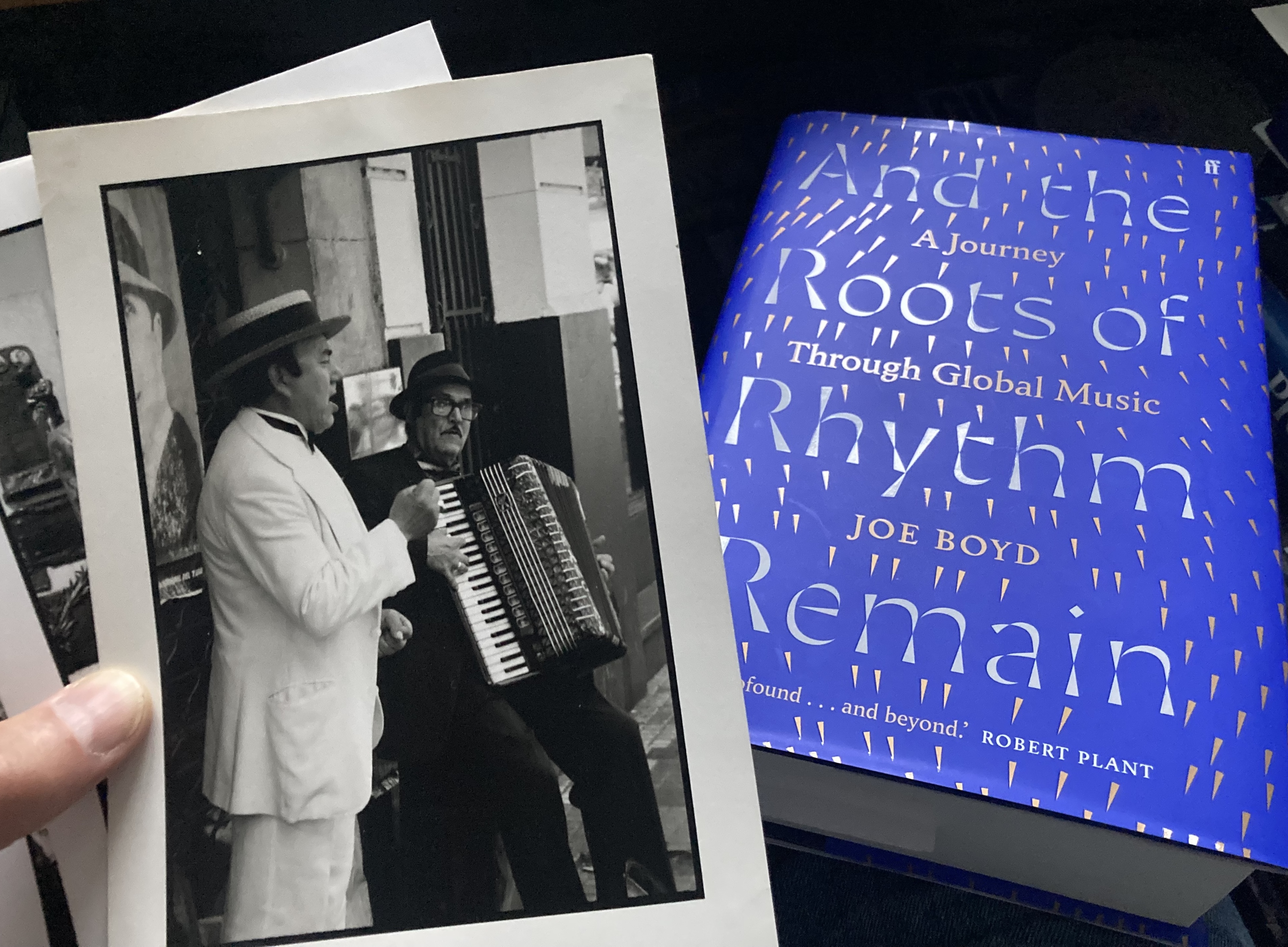
“Tango comes from the mud,” Brian Eno told an audience at Foyle’s bookshop the other night. He was conducting a public conversation with the author of And the Roots of Rhythm Remain, an 850-page examination of the forms of popular music with which Joe Boyd has engaged in Cuba, Jamaica, Brazil, Argentina, Bulgaria, Senegal, Albania and elsewhere during his six decades as a successful record producer and enlightened facilitator of musical projects.

For many years now it’s been rumoured that Boyd was writing a history of “world music”, a tale perhaps beginning with his presence at the famous meeting at a London pub in 1987 during which that rubric was invented, with the best of intentions and outcomes, as a way of persuading open-minded listeners to pay as much attention to music from other cultures as they did to their own western idioms. The result is much more interesting than a simple history; its eventual subtitle, “A Journey through Global Music”, conveys a much more accurate impression of what Boyd has taken on.

The quote about tango coming from the mud is to be found on page 483, where it’s identified as an Argentine saying. It was clever of Eno to spot it, because it says something larger about pretty much all the music Boyd considers here. How and when it happened, who made it happen, and to whom it happened are all part of his investigations, whether the music under consideration is Tropicália or townships jazz, Django Reinhardt or Béla Bartók.

I’m still working my way through the book, which will take a while even though Boyd writes in the easy, fluent, open-minded, anecdotal style familiar from White Bicycles, the relatively slender book about his adventures in the ’60s underground, published in 2005 to justified acclaim. Vast as his new one might seem, it’s worth reading with full attention, lest you miss some vital socio-cultural connection or valuable information on the roles played by, for example, the Ghanaian drummer Tony Allen, the Sudanese oud-player Abdel Aziz El Mubarak, Rodney Neyra of Havana’s Tropicana nightclub or the ballet impresario Sergei Diaghilev. (I didn’t know, for instance, that, according to Boyd, the names samba, rumba, mambo, tango and cha-cha all have their roots in Ki-Kongo, one of the languages of the Kongo people living in what are now the Republic of Congo, the Democratic Republic of Congo, Angola and Gabon.) Boyd’s enviable skill is to bring the reader an astonishing level of historical detail while wearing his research lightly and enlivening the narrative with exactly the right seasoning of his own views.

After buying the book at the Foyle’s event and getting it signed, I took it home and went straight to the chapter about tango. I like tango very much, although I once spent an evening in a bar in San Telmo, a Buenos Aires quarter then about to make the jump from funky to gentrified, proving to everyone’s satisfaction that I’ll never be able to dance it. I share Boyd’s enthusiasm for the singer Carlos Gardel to such an extent that I once visited the great man’s tomb in the cemetery of Chacarita in Buenos Aires, observing the ritual of leaving flowers at the base of his statue and placing a lit cigarette in the space left by the sculptor between the index and middle fingers of his raised right hand, because that’s how Gardel always sang until his untimely death in an air crash in 1935.

The photo above is one I took in 1994 on a sidewalk in Rosario, Argentina’s third largest city, the birthplace of Che Guevara and Lionel Messi. I was struck by the elegance and dignity of the street singer and his accordionist, who were serenading appreciative shoppers and other passers-by with a selection of songs made famous by Gardel.

Boyd traces the idiom’s origins in the bars and bordellos of Buenos Aires, examining its sources and tracking its destiny. He doesn’t share my fondness for the late composer and bandoneon virtuoso Astor Piazzolla, who became, he believes, “for tango what John Lewis and the MJQ were to jazz, ‘elevating’ it from the dancefloor and giving it concert-hall respectability.” He’s both right (in the comparison) and wrong (in the implicit criticism). Nobody who went, as I did, to see Piazzolla and his astonishing quintet for three out of their five nights in the intimate environment of the Almeida Theatre in London during the summer of 1985 could accuse them of forfeiting the sensual charms of tango in a pursuit of respectability. For a lot of worthwhile music with roots “in the mud”, the need to get people dancing is no longer a priority. But it’s a good and worthwhile argument to have, and I expect there’ll be many more as I work my way through what is shaping up to be not just an exceptionally enjoyable book but perhaps also an important one.

* Joe Boyd’s And the Roots of Rhythm Remain: A Journey Through Global Music is published by Faber & Faber (£30)

‘The Black Chord’

David Corio is a fine British photographer whose book The Black Chord, with text by the writer Vivien Goldman, first appeared in the UK 25 years ago. A new edition, published by Hat & Beard, a Los Angeles-based imprint, presents his images of black musicians via a much more elegant design.

Corio was born in London in 1960 and had his first work published when he was 18. Where he differs from Roy DeCarava and Val Wilmer, two other great photographers of black music, is that most of his subjects are caught in performance, on or off stage. DeCarava and Wilmer both sought particular kinds of intimacy, spiritual or domestic. Corio’s images tend to look outward, making a direct address to the viewer, which means they work well in magazine features and on album covers, and the 200-odd photographs here, beautifully reproduced, combine to make an exhilarating book.

The subjects range from the drummers of Burundi and a Santeria ceremony in Cuba through John Lee Hooker, Fats Domino, Bobby Bland, Aretha Franklin, Art Blakey, Celia Cruz, Fela Kuti, Abbey Lincoln, Ray Charles, Barry White, Millie Jackson, Lee Perry, Ornette Coleman, Al Green, Toots Hibbert, Salif Keita, De La Soul, August Darnell, Sade, the Last Poets, Alton Ellis, PM Dawn, Miles Davis, Foday Musa Susa, Nile Rodgers, Don Cherry, Missy Elliott, and of course Bunny, Tosh and Bob. And many, many others. Goldman’s love of this music, from blues to jazz via R&B, soul, reggae, salsa, afrobeat and hip-hop, originally on view in her work in the 1970s for Sounds, the Melody Maker and the NME, infuses the lively essays that intersperse the groupings of photographs.

One of the pictures I like best contains no performers: over a double-page spread, half a dozen boys perch together around a sound system in London in 1978, shot from below, exuding life and possibilities despite the implicit challenge of the world around them. It has poetry in it. As, more obviously, does the portrait of Nina Simone seen above and also on the book’s cover, taken during a performance at Ronnie Scott’s in 1984, a photograph to make you think a lot about troubled genius. That, too, is Corio at his best.

* The Black Chord by David Corio with text by Vivien Goldman is published by Hat & Beard (hatandbeard.com), price $60.

Our Island Story

To those who found Chris Blackwell’s 2022 autobiography, The Islander, long on charm but, shall we say, short on detail, The Island Book of Records Vol 1 1959-68 will be the answer to their prayers. Here is the story of the UK’s most charismatic independent label during its formative years, in which the foundations were laid for the company that would later become the home of King Crimson and ELP, the Wailers and Bob Marley, Roxy Music, Bryan Ferry and Brian Eno, Sandy Denny, Sparks, John Martyn, U2 and Grace Jones before Blackwell sold it to Polygram in 1989.

Comprehensively compiled and meticulously edited by Neil Storey, who worked in the label’s press office (and was more recently responsible for the Hidden Masters archive box sets devoted to Chris Wood and Jess Roden), the book’s large square format — handsomely designed by Jayne Gould — enables LP covers to be reproduced at their original size. The scale also allows the enormous amount of information to breathe amid the mass of photographs, press cuttings, record labels and other paraphernalia and ephemera, plus masses of oral history from figures both famous and unknown to the general public but significant to the way the label was run, all deployed to inform and entertain.

After Storey’s discursive and amusing introduction, it begins by describing Blackwell’s origins in Jamaica and the UK, including a Daily Mirror clipping from 1933 showing a picture of his mother on her way to Buckingham Palace be presented as a debutante to King George V and Queen Mary, and his own Harrow School house photo from 1954. Island’s first release, the cocktail pianist Lance Haywood’s At the Half Moon Hotel, Montego Bay, from 1959, is accompanied by quotes from Blackwell, the guitarist Ernest Ranglin, the drummer Clarence “Tootsie” Bear, and the daughter of the hotel’s director, who invited Blackwell — then a water-ski instructor — to listen to the trio performing in the lounge, an encounter on which history hinged.

That’s the degree of depth the reader can expect, whether the subject is Jackie Edwards, Millie Small, Traffic, Jimmy Cliff, Spooky Tooth and the nascent Fairport Convention or the American artists — Ike & Tina Turner, James Brown, Inez & Charlie Foxx, J. B. Lenoir, Billy Preston, Jimmy McGriff, the pre-Spector Righteous Brothers and Huey “Piano” Smith — released on the Sue label by Guy Stevens, the DJ at the Scene club in Ham Yard whose vision was recognised and given free rein by Blackwell, to the lasting benefit of me and many other ’60s teenagers.

The more obscure bands — Wynder K. Frog, Art, Nirvana, the Spontaneous Music Ensemble — are covered in full, as are the projects undertaken to pay the bills while providing a laugh along the way: That Affair (about the Christine Keeler scandal), Music to Strip By (with a lace G-string stuck on to the cover), For Adults Only (comedy) and Big Theo (Johnson)’s Bawdy British Ballads. The company’s first gold disc was apparently secured by Why Was He Born So Beautiful by the Jock Strapp Ensemble, the first of several volumes of rugby songs, at least one of which was recorded at Sound Techniques by the engineer John Wood, who would later record Nick Drake and the other Witchseason artists at the same Chelsea studio.

The making of all these is illuminated by the people who were there, not just the artists but those who were playing important roles in the background, whether by working in the Basing Street office — where everyone sat at round tables, erasing a sense of explicit hierarchy — or by going around the country selling the records, or simply by being Blackwell’s friends. How they all made it up as they went along, and how the founder encouraged and allowed it to happen, is an object lesson in human and cultural dynamics.

“I’m not a collector,” Blackwell says. “I was always looking forward.” Island maintained no real-time archive during his era (which, of course, made Storey’s task of research more demanding and almost certainly more entertaining). When I worked in A&R there, in the mid-’70s, someone told me one morning that the Richmond branch of the Blackwell-owned One Stop Records was closing that evening and that the basement contained a cache of the company’s old 45s. They were going to be chucked out and did I want to do something about them? Collectors had better close their eyes at the next bit: I drove straight down there, found boxes and boxes of mint Sue and white-label Island singles from the ’60s, sorted out two of each — one for the company, one for my office — and sent the rest to be melted down. I have no idea what happened to the ones I saved after I left in 1976. Everyone was looking forward, which is the right way to run a record company.

* The Island Book of Records Vol 1 1959-68, edited by Neil Storey, is published by Manchester University Press (£85).

Georgie Fame: the man in full

georgie-fame-box-2

Georgie Fame at the Cinnamon Club, Manchester, in 2007 (photo: William Ellis)

You wait decades for a proper anthology of Georgie Fame’s best stuff, and then two of them come along almost at once. Last year there was the beautifully produced five-CD box called The Whole World’s Shaking, including his first four albums for the Columbia label between 1963 and 1966 — Rhythm & Blues at the Flamingo, Fame at Last, Sweet Thing and Sound Venture, each with bonus tracks — plus a fifth disc of rarities and oddities from the period. Now there’s an equally handsome new six-CD set, also released on Universal/Polydor, called Survival: A Career Anthology 1963-2015, which ranges from the Blue Flames’ first two instrumental 45s for the R&B label to the lovely album, Swan Song, which came out last year, and which he billed as his last (although I gather he might be having second thoughts on that). This new box is so full of good stuff that I hardly know where to begin, although I suppose I should point out some of the less obvious highlights.

I was at Island Records in the mid-’70s when Chris Blackwell signed him, to the surprise of those at the company who thought his adventures in the middle of the road during his time with CBS (“The Ballad of Bonnie and Clyde”, and so on) had destroyed his credibility. From a commercial perspective, the Island liaison was a failure.  First, with J. J. Cale taking over from Mose Allison as the dominant influence on his music, Blackwell sent him to Tulsa with Denny Cordell to make an album that never saw the light of day, and then Glyn Johns took over for one that was released but made no impact. There’s a whole disc from those sessions, including the slinky blues “Ozone” and a high-stepping version of Bobby Womack’s “Daylight”.

But what we also have from the Island vaults are seven tracks from the previously unheard tapes recorded at a Lyceum gig in the autumn of 1974 with an expanded 12-piece all-star Blue Flames line-up, including Marc Charig alongside Eddie “Tan Tan” Thornton on trumpets and Elton Dean in a saxophone section also including Alan Skidmore, Stan Sulzmann, Steve Gregory and Bud Beadle. Brian Odgers (bass guitar) and Brian Bennett (drums) are the rhythm axis, with Colin Green and Bernie Holland on guitars and Lennox Langton on percussion. Thanks to careful remixing supervised by Tristan Powell, one of Georgie’s talented sons, it’s a treat to hear them roar through “Point of No Return”, “Parchman Farm” and so on in front of an enthusiastic audience at a venue that was once a great place for gigs, before The Lion King took up permanent residence.

The other big surprise to me was a track from his sole album for Pye, Right Now, produced in 1979 by the rather unlikely team of Karl Jenkins, then midway between Soft Machine and the knighthood earned for his classical compositions with Latin titles, and Jimmy Parsons, for many years the suave maitre d’ of Ronnie Scott’s. The song is called “Eros Hotel”, and Georgie wrote it with the UK-based American poet Fran Landesman, best known for her lyrics to “Spring Can Really Hang You Up the Most” and “Ballad of the Sad Young Men”. A gentle reverie, swathed in strings, it’s a most elegant evocation of seduction in London, and it makes me want to seek out the album from it comes.

We know what Fame can do with other people’s songs, but “Eros Hotel” is a reminder of what an accomplished composer he became. From “Getaway” through “Flamingo Allnighter”, “Vinyl” and “Mose Knows”, his stuff is hip. There’s another example of his lovely ballad-writing in “A Declaration of Love”, one of the 11 tracks here from the fine New York sessions supervised by Ben Sidran in the early ’90s. The eight-minute title track, the bluest of blues on altered changes, comes from those sessions: you can imagine how much he enjoyed sharing the studio with A-Teamers Richard Tee (piano), Robben Ford (guitar), Will Lee (bass) and Steve Gadd (drums).

An abundance of great material among the 111 tracks includes items from the two tremendous live albums, Name Droppin’ and Walking Wounded, recorded live at Ronnie’s in 1997. There’s also a glorious “Since I Fell For You” on which he’s accompanied only by his Hammond B3 and Guy Barker’s trumpet, and a fine “Funny How Time Slips Away” from the Pye session, and tons of other things that you might never have heard before but will be very pleased to meet in the course of a journey through a wonderful life in music, in which even the occasional misstep was simply the preface to a graceful recovery.

The team who put this exemplary package together — Tristan Powell, the disc jockey Dean Rudland and the Universal A&R man Chas Chandler — deserve the highest commendation. The blemishes are few: the Basie drummer Sonny Payne is mistranscribed as Sonny Cain, Bill Eyden is wrongly identified as Phil Seamen (the man he replaced as the Blue Flames’ drummer) in a caption to one of the many fine photographs in the accompanying 48-page hardback booklet, and I’d have liked the generally comprehensive musician credits to have extended to identifying those who played on the Island studio sessions. But those are quibbles. If I didn’t already have Survival, it would be the only thing I’d want or need for Christmas.