Skip to content

Posts from the ‘Rock music’ Category

Diamante visions

Phil Manzanera has been a friend since I first interviewed him during the days of Quiet Sun, the band of school friends he was in before being recruited by Roxy Music in time to play on their debut album in 1972. So I can’t pretend to be completely objective about Revolución to Roxy, his newly published autobiography. But I can be completely honest in saying that it will prove informative and entertaining to anyone who’s followed his career over the past half-century, even from a distance.

Here’s a sample that had me almost collapsing with laughter, when he spins a metaphor out of one of the trappings of early success: a maroon Rolls-Royce coupé whose combination of heavy weight and light steering was guaranteed to induce car sickness in children, making it “completely useless as an everyday family vehicle” and forcing him to keep in storage, bringing it out only on special occasions.

“The car carried a famous brand name,” he writes, “it was sleek, stylish and smooth, and undoubtedly in its own way it was iconic. It was a treat to take out, and whenever I did, it was admired and enjoyed by everyone who experienced it. Eventually, though, the time would come when it needed to go back into the garage and once again be covered by the tarpaulin to keep it well preserved and in good order, ready for the next outing.

“I guess you can see where this is going. There was something about that Roller which felt to me to be a bit like Roxy Music. Eye-catching, stylish and high quality, extremely enjoyable and I was proud to be associated with it. From time to time, it would be an absolute joy to take out for a ride so that it could be admired and appreciated; but the ‘steering’ difficulties and the resultant discomfort meant that its outings were strictly limited. After a while it had to go back under the tarpaulin so I could live my everyday life in my runabout.”

The history of Roxy Music as a kind of artistic Petri dish is, of course, explored in some depth throughout these 300 pages, from Manzanera’s first failed audition through the years of great success to the period in which, he began to feel like “not much more than a session player in my own band” — a band in which “I had to find out what was going on more or less by accident.”

Not least, the book is an interesting exploration of rock-band dynamics, with all the associated uncertainties, insecurities, frustrations and exasperations, and Manzanera has a perceptive take on Bryan Ferry’s legendary penchant for procrastination and prevarication: “His Fine Arts background obliged him to tinker and fiddle way beyond the point where the vast majority of people would long since have settled. I now understand this is about his need to make everything he does artistically beautiful and perfect. I tend to want to do things quickly and I’m not worried if they have a primitive edge, and what I’ve learned is that in Roxy opposites can attract. That’s integral to what makes Roxy music special. Makes it us. Makes us it.”

As musical director of the Guitar Legends festival in Spain is 1991, he had the job of telling Bob Dylan that the organisers expected him to perform “All Along the Watchtower”. How he coped and got there in the end, with the aid of Richard Thompson, is worthy of a place in Ray Padgett’s recent book of interviews with people who’ve worked with Dylan. Recollecting in tranquillity, Manzanera writes: “The way I think about the whole thing is much the same as I used to think about my first visit to various foreign countries. I’m really keen to go, really keen to get to know their individual customs and idiosyncrasies, but having been there and done that, I don’t necessarily ever feel the urge to revisit.”

There are stories about his long collaboration with David Gilmour, a shorter and almost Dylanesque one with the Argentinian hero Fito Paez, a WOMAD tour of South Africa and the Antipodes, his discoveries of the pizzica music of Puglia while directing another festival, his adventures with Jack Bruce in Cuba, his songwriting partnership with Tim Finn and his long relationship with Robert Wyatt. And about 801, that short-lived but incandescent all-star band he created in 1976 with Brian Eno, Bill MacCormick, Francis Monkman, Simon Phillips and Lloyd Watson. And, of course, about those diamante-studded bug-eyed sunglasses created for him in Roxy’s early days by Antony Price.

But, as the man who interviewed Phil for today’s Times observed, this isn’t one of those rock-star biogs where you skip the early chapters dealing with childhood, family and schooldays. In this case, that aspect of the narrative is quite as compelling as the rock-star stuff. Phil was born in London but grew up in Cuba during the run-up to the Castro revolution, the son of an Englishman, Duncan Targett-Adams, who had worked for the British Council in Colombia but now represented BOAC in South America, and a Colombian mother, Magdalena Manzanera. There were mysterious elements on his father’s side of the family — was he a spy? where did an Italian opera singer fit into the picture? — and the Latino influence from his mother’s side on his life and work is interestingly explored.

In a way, though, the most striking passage in the book come when he discusses the phone call from America one day in 2012 in which he was told that Kanye West and Jay Z had sampled a riff from K-Scope, his slightly obscure second solo album, then more than 30 years old. They used it on “No Church in the Wild”, a bleak modern masterpiece and the lead track from their album Watch the Throne, which went platinum in the US and gold in the UK before the track appeared in ads for Audi and Dodge cars. Most significantly of all, as it turned out, it was used by Baz Luhrmann on the soundtrack and the trailer for The Great Gatsby.

“Who knew,” Phil writes, in a sentence that tells you a great deal about the evolution of the music industry in our lifetime, “that I would earn more money from a short guitar riff I wrote one evening on a sofa in front of the telly in 1978 than I ever earned in the entire 50 years as a member of Roxy Music?”

* Phil Manzanera’s Revolución to Roxy is published by A Way With Media (£35)

Our Island Story

To those who found Chris Blackwell’s 2022 autobiography, The Islander, long on charm but, shall we say, short on detail, The Island Book of Records Vol 1 1959-68 will be the answer to their prayers. Here is the story of the UK’s most charismatic independent label during its formative years, in which the foundations were laid for the company that would later become the home of King Crimson and ELP, the Wailers and Bob Marley, Roxy Music, Bryan Ferry and Brian Eno, Sandy Denny, Sparks, John Martyn, U2 and Grace Jones before Blackwell sold it to Polygram in 1989.

Comprehensively compiled and meticulously edited by Neil Storey, who worked in the label’s press office (and was more recently responsible for the Hidden Masters archive box sets devoted to Chris Wood and Jess Roden), the book’s large square format — handsomely designed by Jayne Gould — enables LP covers to be reproduced at their original size. The scale also allows the enormous amount of information to breathe amid the mass of photographs, press cuttings, record labels and other paraphernalia and ephemera, plus masses of oral history from figures both famous and unknown to the general public but significant to the way the label was run, all deployed to inform and entertain.

After Storey’s discursive and amusing introduction, it begins by describing Blackwell’s origins in Jamaica and the UK, including a Daily Mirror clipping from 1933 showing a picture of his mother on her way to Buckingham Palace be presented as a debutante to King George V and Queen Mary, and his own Harrow School house photo from 1954. Island’s first release, the cocktail pianist Lance Haywood’s At the Half Moon Hotel, Montego Bay, from 1959, is accompanied by quotes from Blackwell, the guitarist Ernest Ranglin, the drummer Clarence “Tootsie” Bear, and the daughter of the hotel’s director, who invited Blackwell — then a water-ski instructor — to listen to the trio performing in the lounge, an encounter on which history hinged.

That’s the degree of depth the reader can expect, whether the subject is Jackie Edwards, Millie Small, Traffic, Jimmy Cliff, Spooky Tooth and the nascent Fairport Convention or the American artists — Ike & Tina Turner, James Brown, Inez & Charlie Foxx, J. B. Lenoir, Billy Preston, Jimmy McGriff, the pre-Spector Righteous Brothers and Huey “Piano” Smith — released on the Sue label by Guy Stevens, the DJ at the Scene club in Ham Yard whose vision was recognised and given free rein by Blackwell, to the lasting benefit of me and many other ’60s teenagers.

The more obscure bands — Wynder K. Frog, Art, Nirvana, the Spontaneous Music Ensemble — are covered in full, as are the projects undertaken to pay the bills while providing a laugh along the way: That Affair (about the Christine Keeler scandal), Music to Strip By (with a lace G-string stuck on to the cover), For Adults Only (comedy) and Big Theo (Johnson)’s Bawdy British Ballads. The company’s first gold disc was apparently secured by Why Was He Born So Beautiful by the Jock Strapp Ensemble, the first of several volumes of rugby songs, at least one of which was recorded at Sound Techniques by the engineer John Wood, who would later record Nick Drake and the other Witchseason artists at the same Chelsea studio.

The making of all these is illuminated by the people who were there, not just the artists but those who were playing important roles in the background, whether by working in the Basing Street office — where everyone sat at round tables, erasing a sense of explicit hierarchy — or by going around the country selling the records, or simply by being Blackwell’s friends. How they all made it up as they went along, and how the founder encouraged and allowed it to happen, is an object lesson in human and cultural dynamics.

“I’m not a collector,” Blackwell says. “I was always looking forward.” Island maintained no real-time archive during his era (which, of course, made Storey’s task of research more demanding and almost certainly more entertaining). When I worked in A&R there, in the mid-’70s, someone told me one morning that the Richmond branch of the Blackwell-owned One Stop Records was closing that evening and that the basement contained a cache of the company’s old 45s. They were going to be chucked out and did I want to do something about them? Collectors had better close their eyes at the next bit: I drove straight down there, found boxes and boxes of mint Sue and white-label Island singles from the ’60s, sorted out two of each — one for the company, one for my office — and sent the rest to be melted down. I have no idea what happened to the ones I saved after I left in 1976. Everyone was looking forward, which is the right way to run a record company.

* The Island Book of Records Vol 1 1959-68, edited by Neil Storey, is published by Manchester University Press (£85).

Exhuming Nico

It was out of sheer curiosity that I went along to Café Oto last night to hear a performance of Nico’s The Marble Index by the string quartet Apartment House (Mira Benjamin and Chihiro Ono on violins, Bridget Carey on viola and Anton Lukoszevieze on cello) augmented by Kerry Yong on piano and other keyboards. The part of Nico was taken by the singer Francesca Fargion.

The room was sold out and the audience expectant. The original album, in which John Cale added his viola, other instruments and post-production touches to Nico’s seven songs, has a special status within the history of rock: barely half an hour long, it arrived as a message from a different world, seemingly shaped by the sensibility of European art-song and the practices of the American classical avant-garde, completely uncompromising in the challenge it offered the listener in 1968.

I suppose the nearest it ever came to being played in concert in its original form during Nico’s lifetime was when she performed a couple of its songs with accompaniment by Cale and Brian Eno at the Neue Nationalgalerie in Berlin in 1974, where they were received with the mixture of applause and outright derision that had greeted the album’s release six years earlier. I certainly never expected to hear the music performed live again after her death in Ibiza 35 years ago.

It was brave of Yong to attempt a modified transcription of the full work, and of Fargion to deliver Nico’s words and melodies. Of course it wasn’t remotely like hearing Nico herself, whose strong, unabashed, wilfully inflexible and uninflected voice defined the music every bit as much as the sound of her harmonium and her strangely memorable melodies, with their echoes of folk tunes and lullabies.

Very wisely, Fargion did not attempt an imitation. But although she is a fine, classically trained singer with a pleasant tone, her interpretations seemed colourless, fading into the strings rather than dominating them. Only “Frozen Warnings”, where the string writing was at its most economical, and “Nibelungen”, a lovely acappella song unreleased until Elektra put out an expanded edition in 1991, allowed the emergence of an attractive poignancy at a worthwhile creative variance from that of the original.

If you wanted to do something really interesting with The Marble Index, to try and match its own inherent challenge, you’d probably have to take it apart and reconstruct it in a different form. This was a careful and respectful performance, observing some of the details of the original, such as the tiny vocal echo on “No One Is There” and a modest version of the pealing piano on “Evening of Light”, although the sound of the harmonium was not heard until “Julius Caesar (Memento Hodie)”, the fifth song in the sequence.

The audience listened intently, and the warmth of their response spoke of the veneration in which this extraordinary piece is now held. In the end, though, what was completely missing was the sense of outright shock and enigmatic purpose that the original artifact itself still conveys, 55 years later, and which is such a part of its eternally untranslatable meaning.

Requiem for a soft-rocker

Terry Kirkman (extreme left) with the Association at the Monterey Pop Festival

The members of the Association were still wearing suits and ties when they played the Monterey Pop Festival in 1967, the opening act on a bill including Jimi Hendrix, the Who, Jefferson Airplane, Big Brother and the Holding Company and other heroes of the new counter-culture. Their qualification for inclusion might have been their first Top 10 single, “Along Comes Mary”, a three-minute proto-psychedelic masterpiece written by Tandyn Almer.

The follow-up, “Cherish”, a No. 1, had swiftly recast them as purveyors of soft-rock before the great “Pandora’s Golden Heebie Jeebies”, with its koto intro and inner-light lyric, earned praise from no less a psychedelic authority than Dr Timothy Leary, despite going no higher than No. 35. But then “Windy” (another No. 1) and “Never My Love” (No. 2) put them firmly back in the middle of the road, where they have remained in the public mind ever since.

Anyone interested enough to turn over “Never My Love”, however, found a B-side that restated their claim to hippie credibility. It was called “Requiem for the Masses” and it begins with military snare drum rolls introducing a choir singing acappella: “Requiem aeternam, requiem aeternam…” Then a young man’s voice sings the opening lines against an acoustic guitar: “Mama, mama, forget your pies / Have faith they won’t get cold / And turn your eyes to the bloodshot sky / Your flag is flying full / At half-mast…” The snare drum tattoo continues behind the second verse: “Red was the colour of his blood flowing thin / Pallid white was the colour of his lifeless skin / Blue was the colour of the morning sky / He saw looking up from the ground where he died / It was the last thing every seen by him…” The backing falls away and the unaccompanied choir returns: “Kyrie eleison, kyrie eleison…”

And here’s the chorus: “Black and white were the figures that recorded him / Black and white was the newsprint he was mentioned in / Black and white was the question that so bothered him / He never asked, he was taught not to ask / But was on his lips as they buried him.” The song ends with a lonely bugle against snare drum and muffled tom-tom.

In 1967 this song could be about only one thing: the war in Vietnam. Of course there already had been “Masters of War” from Dylan, “Universal Soldier” from Buffy Sainte-Marie and “Eve of Destruction” from P. F. Sloan. And perhaps “Requiem for the Masses” is not a truly great record, but it stands alongside things like Country Joe and the Fish’s “I-Feel-Like-I’m-Fixin’-to-Die Rag” and Earth Opera’s “The Great American Eagle Tragedy” as an ambitious and powerful contemporary statement from the world of white rock music.

Its composer was Terry Kirkman, a founder member of the group, who sang, played percussion and brass and woodwind instruments (maybe including the bugle part). Before “Requiem for the Masses”, he had written “Cherish” and another soft-rock classic, “Everything That Touches You”. Born in rural Kansas, he was brought up in Los Angeles, where he studied music, but it was while working as a salesman in Hawaii that he met Jules Alexander, with whom he would go on to found several groups in LA, including the Inner Tubes (with Mama Cass and David Crosby), before the Association came together as a six-piece band in 1965. He left for the first time in 1972, returned in 1979, left again in 1984, and thereafter took part in various reunion concerts while working as an addiction counsellor.

Terry Kirkman died this week, aged 83. It would be absolutely wrong to underestimate the courage it must have taken for a band famous for their soft-rock hits to record such an unequivocal song of protest during a year in which the B52s were pounding Hanoi and Lyndon Johnson was sending ever more ground troops into the fight against the Vietcong, still with support from the majority of the American public. Respect to him, then.

Summer books 2: ‘Pledging My Time’

I don’t imagine I’m alone in sometimes glancing at a stack of books about (or by) Bob Dylan and thinking, OK, that’s enough now. The last two new volumes, bought hot off the press in the past couple of years, turned out to be expensive time-wasters, prompting the thought that maybe I’d be better off re-reading some of the old ones. Anthony Scaduto’s early biography, maybe, or Suze Rotolo’s memoir, or The Nightingale’s Code. Or even the one Patrick Humphries and the late John Bauldie published in 1990, called Oh No! Not Another Bob Dylan Book. But there’s always an exception, and one such is Pledging My Time by Ray Padgett, subtitled “Conversations with Bob Dylan band members”.

All I know about Padgett is that he has an erudite and entertaining email newsletter called Flagging Down the Double E’s, on which he discusses topics related to Dylan’s live performances. The book is an outgrowth of that newsletter, consisting of interviews with 40 people who have played with Dylan, either in his band or in briefer encounters, or, in a handful of cases, worked with him in slightly different capacities, such as Betsy Siggins, who ran a folk club in Cambridge, Massachusetts in the late ’50s and early ’60s, Chris O’Dell, the Rolling Thunder tour manager, and Keith Dirks, a sound engineer in the early stages of the Never Ending Tour.

You don’t want big names in a book such as this. Most of them have already told their stories many times. You want Ramblin’ Jack Elliott, Happy Traum, David Mansfield, Spooner Oldham, Fred Tackett, Stan Lynch, Christopher Parker, Dickey Betts, Larry Campbell and Benmont Tench, whose impressions are not worn thin by overexposure. You want someone like Jim Keltner, with a lifetime of service to music and a deep love of how it feels to explore it in Dylan’s company: “The thing I love about Bob is his fearlessness. There’s a fearlessness from some artists that transmits to the musicians playing. When that happens, you get the best from the musicians, because the musicians are not worried about tempo or about whether they’re rushing or they’re dragging or whether they’re not in the pocket. It’s not about finding a pocket. It’s more about searching for the vibe, searching for the thing that makes the song live.”

Keltner is not the only one here who likens the experience of playing with Dylan to jazz. It’s not jazz, of course, but it shares some important characteristics. Gary Burke, who played percussion on the 1976 Rolling Thunder dates, says: “Dylan lived more in the present than most musicians I know. The most common question I get is, ‘What’s it like to play with Dylan?’ I say, ‘Oh, it was the greatest jazz gig I ever played.’ People look at me like I’m crazy. I don’t mean stylistically it was like a jazz gig, but in terms of the mindset. It was very spontaneous. You never know where he’s going to go. You weren’t given directions ahead of time.”

The pianist Alan Pasqua had played with the New Tony Williams Lifetime when he joined Dylan for the Street Legal sessions and the 1978 tour. “Bob was a great bandleader,” he says. “I was lucky enough to play with Tony Williams early on in my life. He learned from Miles Davis. Miles never told him what to play, but by how Miles played, he showed Tony what he needed to do. I found Bob to be quite a bit similar to Miles.” He adds: “I didn’t know at the time that Bob was a jazz fan.”

In 2017 Pasqua was asked, out of the blue, to provide piano music against which Dylan could read his Nobel Prize acceptance speech. And then, a couple of years later, he was invited to play on “Murder Most Foul”. “They were playing a demo. I heard it and I just couldn’t believe it. In rock music, things usually have a specific beat and pulse. This was free. The time was free. It was elastic. It wasn’t specific to a certain time, feel, or tempo. It just moved and flowed. When I was done listening to the track, I turned to Bob and I said, ‘My God, Bob, this sounds to me like A Love Supreme.’ He just stopped and looked at me.”

Sometimes other aspects of being Bob Dylan are sharply illuminated. Burke remembers the business that went on at the end of every gig, when Dylan’s security men took charge: “When we would leave a place on the tour, security would go into the room where he was staying and take everything out. Every piece of garbage, everything. They would put it in bags and take it with them so that nobody went in and tried to find the lost verse to ‘Tangled Up in Blue’ or something like that.” That’s a tough way to live, Padgett observes. “It is. You got the feeling he was rubbed raw by it all.”

To Billy Cross, who played guitar in the 1978 band, he seemed “very friendly and very warm. He was lovely, absolutely lovely, considering what he’d been subjected to through his life at that point. Everywhere he goes, someone thinks he’s got the answer that’s blowin’ in the wind. I thought it was unbelievable that he could be as normal and personable and pleasant as he was.”

Padgett is a marvellous interviewer: not just enthusiastic and sympathetic but alert and perceptive, equally good at prompting and just letting people talk. Of course, the testimony is mostly admiring. There’s nothing resembling the interview with the veteran soul singer Betty LaVette in the Daily Telegraph earlier this month, where she described her “contempt” for Dylan, five years after enjoying a warm reception for an excellent album of his songs titled Things Have Changed.

She was annoyed that he never told her how good it is, and to underline her irritation she mentioned an incident from several years earlier, when they encountered each other in Spain and “he ran over to me. He put my face in his hands and kissed me square in the mouth. I don’t offer Bob Dylan a kiss and I’m not a f—ing fan. I was not looking to be kissed. If he thinks I’m good enough to put his mouth on, then he should have opened it to say just one good word about my record. When you’re as big as he is, that can make a huge difference to sales.” She didn’t mention whether she’d ever got in touch to thank him for the songs.

More than most people, Bob Dylan presents himself to the world as a jigsaw puzzle, full of complexities and seeming contradictions and bits that are hard to fit together. Maybe some missing bits, too, and others that once fitted but no longer do. Each of us assembles the puzzle as best we can. The keyboards player Benmont Tench, who once found himself playing “Desolation Row” — which he had listened to “a million times” but never played — with its composer to a festival audience of tens of thousands, is among the most thoughtful interviewees in Padgett’s book. He’s allowed to close it with some words that seem to express the feelings of many who’ve worked with Dylan.

“You can read about Bob’s life,” he says, “and you can pay attention to what he says, and you can learn from it, but when you play music with somebody of that calibre, you learn something entirely different. It can only be passed on by that person. And those of us who have the opportunity to play with that person can pass on what we took away, but we only each take away a certain part of our experience with someone like that. Long may he live, because he’s something else.”

* Ray Padgett’s Pledging My Time is published in hardback and paperback by EWP Press. Padgett’s email newsletter is at dylanlive.substack.com

Randy Meisner 1946-2023

The first time I noticed Randy Meisner’s name was when Rick Nelson released his first album with the Stone Canyon Band, recorded live at the Troubadour in LA in 1969 and released the following year. Meisner was the band’s bass guitarist and sang harmonies. Nelson was trying to update himself, shedding the “y” at the end of his first name and embracing the arrival of country rock in an attempt to put some distance between the teen idol of “Poor Little Fool” and his adult self. The Troubadour album included signposts for his desired new direction in the shape of his versions of three Bob Dylan songs, including a particularly creditable version of “I Shall Be Released”. It also had a lovely version of Eric Anderson’s “Violets of Dawn”, a song completely redolent of its era, with Meisner contributing fluid bass lines and high harmonies.

When Nelson was putting the band together, Meisner — who had just left Poco after a brief stay — brought in the lead guitarist, Allen Kemp, and the drummer, Pat Shanahan, from another of his earlier bands, the Poor. The veteran steel guitarist Tom Brumley, a former member of Buck Owens’ Buckaroos, completed the line-up. Meisner was no longer there by the time their second studio album, Rudy the Fifth, was released in late 1971, containing a song he’d co-written with Kemp. He’d become a founder member of the Eagles, with whom he stayed until 1978, not always happily. He died last week, aged 77, and the final years were not easy ones, as Adam Sweeting recounts in an obituary of him in the Guardian. If you’d asked Randy Meisner to identify his finest hour, I don’t imagine “Violets of Dawn” would have crossed his mind. But it still sounds sweet.

Under the same sky

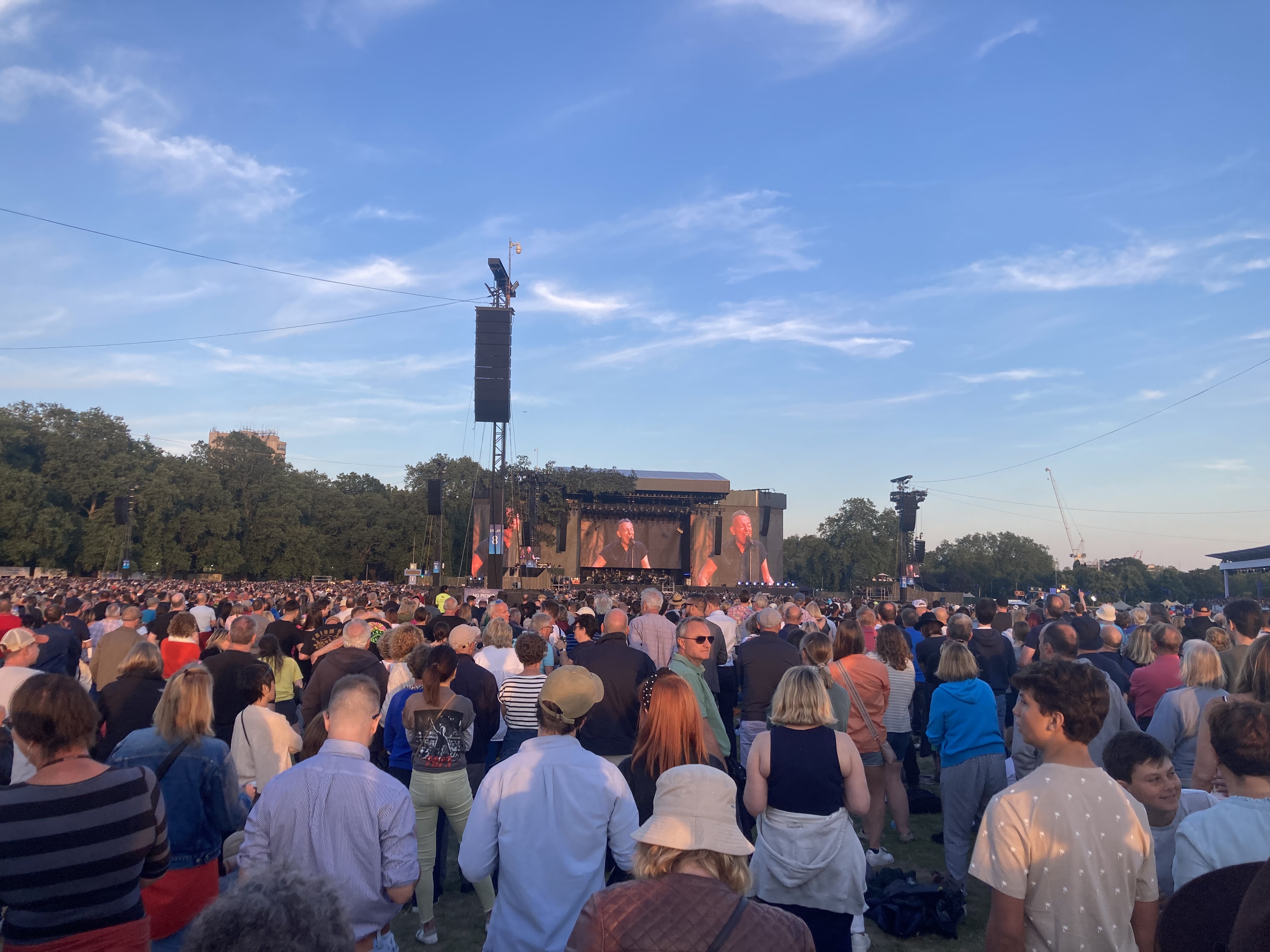
It’s 10 years since the veteran countercultural insurrectionist Mick Farren died. In 1976, in a celebrated polemic for the NME headlined “The Titanic sails at dawn”, he asked: “Has rock and roll become another mindless consumer product that plays footsie with jet set and royalty, while the kids who make up its roots and energy queue up in the rain to watch it from 200 yards away?” I thought of his words while watching — from a range of almost exactly 200 yards, as it happened, albeit on a warm, dry afternoon — Bruce Springsteen and the E Street Band giving the first of their two concerts in Hyde Park.

Farren wrote his piece only seven years after the Rolling Stones had played a free concert in Hyde Park to an audience of perhaps a quarter of a million (although I’ve always questioned that figure): a significant event in the history of both the band and the Sixties youth culture of which it was a part. All you had to do was turn up and find yourself a space on the grass. There were no merchandise stalls, because there was no merchandise. If you wanted anything to eat, drink or smoke, you had to bring it with you.

By contrast, Springsteen’s gigs (and others in the British Summer Time series) were sponsored by American Express. To secure a couple of tickets, even those very far away from the privileged enclosures housing the jet set (and perhaps even royalty), you needed to spend a few hundred quid. In the days leading up to the event, there were messages via a special app telling you what to expect and what you could and couldn’t do, with a map of the site, a list of prohibited items (including food and drink), and so on. And it all worked fine. Pleasant attendants, a variety of refreshment outlets and the provision of adequate toilet facilities made it a civilised experience. The weather was warm but not too hot, and the setting sun provided the golden light that enhances any performance.

Once upon a time Springsteen made concert halls feel like clubs. Then he made stadiums feel like concert halls. At 73 he still performs for three hours with impressive vigour and generosity of spirit (he gives the band a mid-set break rather than taking one himself), but nowadays his big gigs feel like big gigs. That’s the price, I guess, of having such a massive following. But although I liked hearing “Darlington County” and “Mary’s Place” and “Badlands” and “Wrecking Ball”, and enjoyed his decent stab at the Commodores’ “Nightshift”, a lot of the set sounded coarsened, which was not how it used to be. Maybe the band is now so big — all those horns and voices — that the music has lost the agility which was such a vital part of its early charm.

And, of course, from 200 yards, each figure on stage was about a quarter the size of a matchstick. So you watched it all on the big screens. Which, inevitably, were not quite synched with sound travelling such a distance to where I was standing. That was about halfway back in a crowd of 62,000, some of whom said afterwards that it was the best Springsteen show they’d ever seen. In the Guardian, Jonathan Freedland wrote an affecting piece about his reaction to the concert’s valedictory tone and its message for a generation now growing old.

I don’t begrudge anyone their enjoyment in Hyde Park. I’ve seen Springsteen at other times and in other places when the shows he delivered were as good as anything of their kind could possible be. But when I think about the corporate infrastructure of the Hyde Park concerts, and about the row over “dynamic pricing” in the US, and about the stories of what people are having to go through (and spend, of course) to see Taylor Swift on her forthcoming tour, I think Mick Farren’s point was so well made that its meaning has only grown louder over the years.

When he wrote that piece, punk rock was coming down the track. For a while that movement seemed to destabilise the commercial edifice built up around the music. Then the music industry found ways to reassert its authority, to globalise its product while building an impenetrable wall around it. Whatever the instincts and virtues of Springsteen, Swift and others, however immaculate and sincere, their gigantic tours are now an expression of that authority.

I’m probably sounding naive, because in a sense it’s nothing new. At the time of their free concert in Hyde Park, the Stones were managed by Allen Klein, the American hustler whose involvement was emphatically not motivated by countercultural concerns. Mick Farren also wrote books about Elvis Presley, and he knew perfectly well that Colonel Tom Parker didn’t care about Elvis’s audience or the culture they represented. He cared about making a buck.

At the Marquee

Was the Marquee Club really the world’s greatest music venue, as the subtitle to a new history of the club suggests? There might be arguments from Carnegie Hall, the Olympia music hall in Paris, Ronnie Scott’s, the Berlin Philharmonie, the Village Vanguard and a few others. But from its opening in 1958 to the closure in 2006 of the last club to bear that name, it had a fair claim to the title, given that its attractions over the years went from Dexter Gordon, Chris Barber and Dudley Moore through Alexis Korner and Long John Baldry, the Stones, the Yardbirds, Manfred Mann, Graham Bond, Little Stevie Wonder, the Who, David Jones/Bowie, Sonny Boy Williamson, Rod Stewart, Jimi Hendrix, King Crimson, Led Zeppelin, Fela Kuti, Genesis, Dr Feelgood and Dire Straits all the way through the Damned, the Sex Pistols (supporting Eddie and the Hot Rods), the Jam, the Police, Motorhead to REM and Guns N’ Roses and hundreds and hundreds of others, most of them still in their formative stages, including seemingly every British blues band and prog rock outfit assembled via the Musicians Wanted columns of the Melody Maker.

It began as a jazz club at 165 Oxford Street, in a basement ballroom beneath the Academy Cinema. In 1964, as R&B took over, it moved a couple of hundred yards south, to the ground floor of 90 Wardour Street, bang in the middle of Soho. That was its classic location, which it occupied until the summer of 1988, when it moved around the corner to 105-107 Charing Cross Road, which had been a cinema between 1911 and 1987. The Marquee was there for seven years, hosting Spiritualised, Aerosmith, Megadeath and others until it closed and the name was sold to people who briefly ran clubs exploiting its renown in Leicester Square and Upper St Martin’s Lane until the final closure in 2006.

Among many other things, the new history of the Marquee, by Robert Sellars with Nick Pendleton, told me that a contributory factor to the move out of Wardour Street was the crumbling detected in the façade of the building, an effect of the loud music being played within. One night that may have done more than most to shake the walls was 6 October 1970, the second night of a 36-date tour of Britain by Tony Williams’s Lifetime, recently expanded to a quartet with Jack Bruce joining Larry Young and John McLaughlin. If forced to nominate the greatest gig I’ve ever attended, that would probably be the one. For some of the many musicians who were present, it was a life-changing experience.

The club’s story is well told, with plenty of detail and a cast of characters that changes constantly as the decades whizz by. Not just the musicians but the people who ran the place, starting with Harold Pendleton (Nick’s father), a jazz-mad accountant who became president of the National Jazz Federation, and his wife Barbara, and including the lavishly toupéed manager John C. Gee and his assistant Jack Barrie, along with characters such as Tony Stratton-Smith, the founder of Charisma Records, whose acts often started their careers there. And not just the club itself but ancillary premises like The Ship, the pub a few yards up Wardour Street, where members of the audience could have a beer before going down to the non-licensed Marquee, or La Chasse, the first-floor drinking club where musicians and other music business types did likewise. If you were there during any of the club’s many eras, and even if you weren’t but wish you had been, the book will provide much enjoyment.

* Marquee: The Story of the World’s Greatest Music Venue is published by Paradise Road (320pp, £22). The photograph of the audience waiting outside 90 Wardour Street is from the book and is uncredited.

In the court of Robert Fripp

The basement of the Palace Café in the Fulham Palace Road was where the first version of King Crimson got it together, as we used to say, and where Robert Fripp auditioned and rehearsed the subsequent editions of the band. One Sunday in late August 1970 Fripp invited me to meet him there. He knew that I’d been a drummer, but also that I hadn’t held a pair of sticks for several years. “Come and have a play,” he said.

There was a kit set up in the basement, along with an array of amps and keyboards. And so for an hour or so we just played, improvising freely, Fripp on electric piano as well as guitar. We’d had a number of interesting conversations about music during the preceding months but I don’t remember any advance discussion about what we were going to do that day. We just played. At the end he took a reel of tape off the Revox, put it in a carton and handed it to me. I’ve still got it, although I’ve never listened to it. I really don’t want to know whether I’d get a pleasant surprise or, more probably, a dose of humiliating reality.

We never spoke about it, and I never got behind a kit again. But Fripp is not a man who often does things without forethought, and all I can imagine is that he wanted to see how it felt to play freely without having to measure himself against someone who really knew what they were doing.

I thought about that day for the first time in years when the percussionist Jamie Muir turned up as one of the interviewees in Toby Amies’s In the Court of the Crimson King, a film portrait of the band, seen through its present incarnation and the views of some of its former members. Muir joined King Crimson a couple of years after my little session with Fripp, becoming the fifth member of the line-up that included David Cross on violin and keyboards, John Wetton on bass guitar and vocals, and Bill Bruford on drums.

Muir was added as a kind of wild card. I’d seen him and interviewed him when he was in a band called Boris, in which he played a strange variety of percussion devices and did things like burst blood capsules in his mouth. Later he was with Derek Bailey and Evan Parker in the Music Improvisation Company. Highly skilled, and capable of playing perfectly conventionally, at this time he was a kind of performance artist whose presence in King Crimson was intended to shake his colleagues out of their strait-laced musicianly habits. He and Bruford got on surprisingly well; according to Muir, it was Fripp who, having invited him into the band, eventually tired of an approach that clearly failed to match his (Fripp’s) own love of order and preparation. He was invited to leave after less than a year, having played on Lark’s Tongues in Aspic. He went off to a Buddhist monastery and is now a painter.

Originally intended to celebrate the 50th anniversary of the founding of the band in 1969, Amies’s film — first screened in cinemas and now available as a DVD — is on the one hand a kind of real-life Spinal Tap and on the other an acute portrayal of Fripp’s effect on the musicians with whom he has worked. Quite early on, Fripp tells Amies that he was “heartbroken” when the drummer Mike Giles and the saxophonist Ian McDonald became the first musicians to defect from the band, only months after their appearance on the bill of the Rolling Stones’ free concert in Hyde Park, the release of their debut album and a US tour had made them the sensation of the year.

“He’s always been good at recruiting people — he knows he can’t do it on his own,” Giles says, the implicit suggestion being that doing it on his own would be the preferred option, were it possible. But here’s what Fripp now recalls of the rupture in December 1969: “I offered to leave King Crimson if Ian and Mike would continue. It was more important to me that the band continued than that I continued with the band.”

Of the original gang, we also hear from McDonald, interviewed before his death earlier this year, and Pete Sinfield, their lyricist. Adrian Belew, a vital foil for Fripp in the various editions of the band between 1981 and 2013, is clearly puzzled over why they’re not still working together, and says of their partnership: “I don’t know where you’d ever get this again. Robert has a way of creating a situation in which music is going to occur that you couldn’t otherwise do.”

Others are more ambivalent. Trey Gunn, a guitarist with King Crimson from 1994 to 2003, describes being in the band as “a little bit like having a low-grade infection — you’re not really sick, but you don’t feel well, either.” Jakko Jakszyk, the guitarist and singer who came into the line-up in 2010 after several years in a tribute band which featured almost all of the original line-up, sums up what many members must have felt: “You’re irreplaceable. Just like the next bloke.”

All this sounds very unsympathetic. But Bruford, with the perspective of a man who retired from playing in 2009 to study for a PhD, has a perceptive take: “Change is part of what the whole band is about. Change is essential. Otherwise you turn into the Moody Blues, for heaven’s sake.”

Fripp is given his say (and endorsed the final edit of the film), and the impression he leaves is of a complex, thoughtful and unyielding man who has found his own way through life, music, and the music business. Not mentioned here is his long struggle to obtain justice from those who formerly held the rights to the fruits of his labour, resulting in his freedom on recent years to release fastidiously compiled and remastered box sets of the band’s early output (a 26-disc summary of their complete recordings from 1969, for instance). But he does talk briefly about his discovery in the 1970s of the teachings of J. G. Bennett, a follower of Sufism and G. I. Gurdjieff, and his involvement in the Society for Continuous Education, which furthers Bennett’s work.

The gleanings can be found in a hefty new book, The Guitar Circle, a 560-page hardback full of aphorisms and Zen riddles in which Fripp draws from almost four decades of work with his own League of Crafty Guitarists to produce a kind of operating manual for art and life, a typical aspect of which is perhaps best summed up in something he says during the film: “If you have an unpleasant nature and dislike people, that is no barrier to work.” His sense of humour — to which the term wry does not do justice — can be glimpsed here.

Throughout the film, the present band — three drummers, two guitarists, keyboards, returnee Mel Collins on saxophones and flute and long-standing bassist Tony Levin — is heard in concert and rehearsal often enough to give a clear idea of what they do nowadays with the familiar Crimson repertoire, revelling in negotiating its knotty contours and in their own exploitation of the available hardware and technology, to the delight of their legion of loyal fans. The extras in the box set of the film include footage of a rehearsal take of “Sailor’s Tale”, a song from the 1971 album Islands, containing a particularly brilliant version of the guitar solo in which Fripp breaks free of his familiar approach and produces a piece of music of staggering audacity and eternal value, a visionary moment and a justification in itself for King Crimson’s long and often tortuous existence.

* The film In the Court of the Crimson King: King Crimson at 50 is available as a two-disc Blu-Ray/DVD set or as an eight-disc box set including six audio CDs: http://www.dgmlive.com. Robert Fripp’s The Guitar Circle is published by Panegyric/DGM: http://www.guitarcraft.com

Fifty years later

Bryan Ferry was kind enough to invite me to contribute the introductory essay to the programme for Roxy Music’s 50th anniversary concerts in North America and the UK, so I went along to the O2 last night to see the closing date of the tour and to witness what might, I suppose, have been their final performance together. I don’t like arena shows, but once the sound had settled down it was possible to enjoy what the four members who played on the debut album in 1972 — Ferry, Andy Mackay, Paul Thompson and Phil Manzanera — and their six auxiliary musicians and three backing singers were up to. And of course there was that funny bitter-sweet feeling you get while watching something you first saw in a basement with a few dozen other people half a century ago scaled up to world-conquering proportions in its ultimate iteration. In the essay I wrote about the inevitability of the process by which what had begun as an experiment would become a performance, but hints of the original art-school excitement and uncertainty managed to survive even today’s production values and resources, and the lighting and the back-projections — endless highways for “Oh Yeah”, Warhol images for “Editions of You” — made it beautiful to watch. The show began with reminders of the slightly gawky early stuff (“Re-make/Re-model”, “Ladytron”) and finished with full-throttle favourites (“Love Is the Drug”, “Virginia Plain”) but in between came a long passage in which the pace slowed to a resting heartbeat as luxuriant textures and romantic descending patterns took over. Introduced by the wordless “Tara”, the sequence of “The Main Thing”, “My Only Love”, “To Turn You On”, “Dance Away”, “More Than This” and “Avalon” swept elegantly by in one long candlelit swoon. Not a bad envoi, if that’s what it was.