Skip to content

Posts from the ‘Rock music’ Category

Twang. Thump. Crash. More twang.

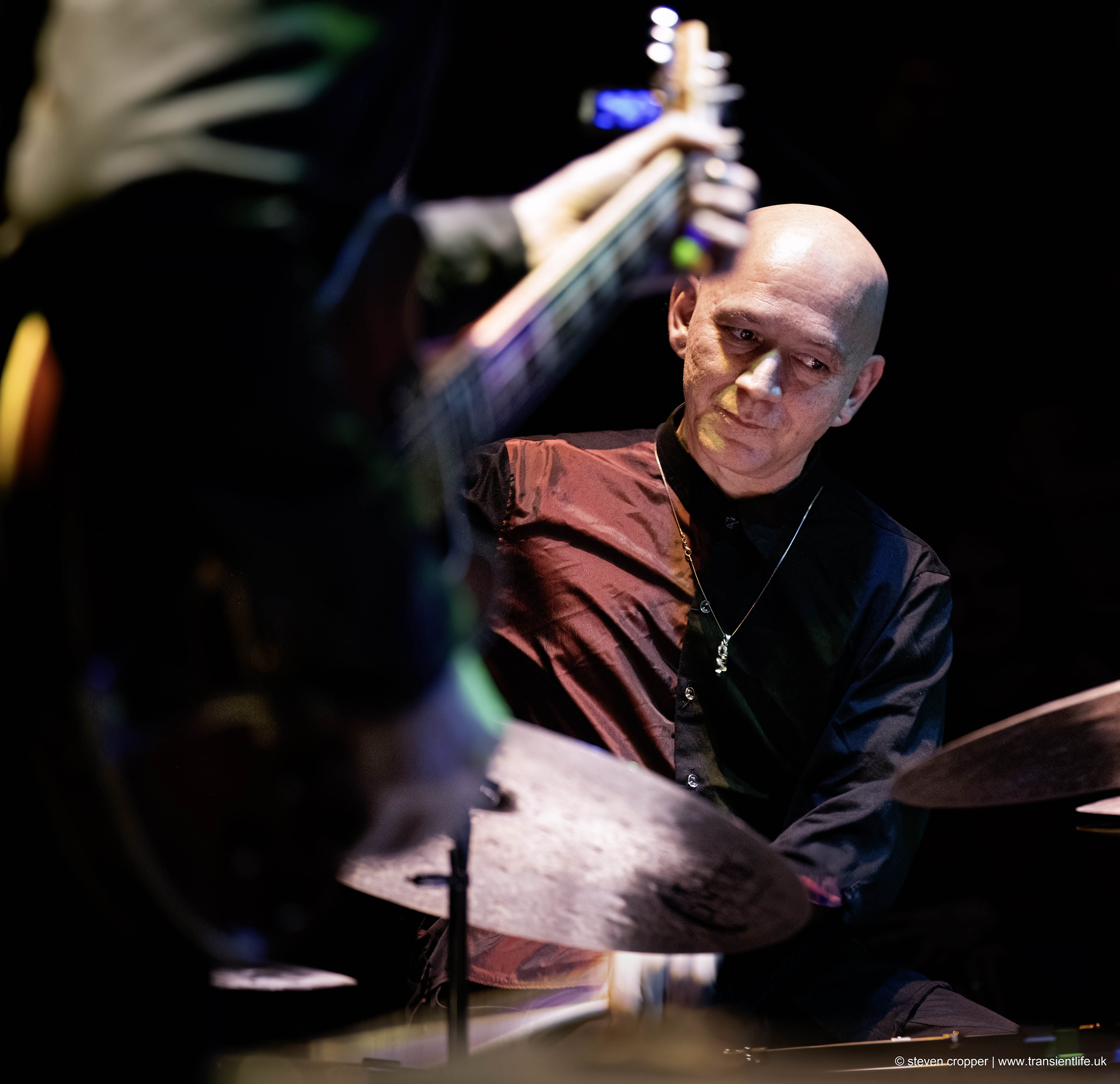
Finding Ways is the name of the drummer/composer Seb Rochford’s new band. It’s also the title of their debut album, which they played at the Cockpit Theatre in north-west London last night, as part of the Jazz in the Round series. It was one of the events featured on the closing night of the 2025 EFG London Jazz Festival, and I couldn’t imagine a happier way of ending the 10-day programme.

Rochford has made some intriguing choices in his career, but probably none more surprising than this. Finding Ways is a guitar-instrumental band: three guitarists, to be precise, plus bass guitar and drums. I don’t think I’ve seen such a line-up live since an early incarnation of Fleetwood Mac with Peter Green, Danny Kirwan and Jeremy Spencer back In 1968. Or at least not one so memorable.

Last night’s guitarists were David Preston, Tara Cunningham and Matt Hurley, joined by Anders Christensen on bass guitar. One thing that stuck out straight away was the absence of pedal boards or other effects. No wah-wahs, no phasing, no tremolo arms. This, apparently, was at Rochford’s insistence. So what we heard was three versions of the sort of sound you made when you got your first electric guitar, hit an E major chord and then looked for a way to make the strings twang. A sound with innocence intact. And an interesting approach to apply to three very sophisticated players.

So what was the result? Surf music in space, maybe. The Ventures or Dick Dale and the Del-Tones with Derek Bailey or Sonny Sharrock sitting in. Rochford’s tunes for this line-up are sometimes based on simple two-bar chord modules reminiscent of the twangtastic “Walk, Don’t Run” or “Misirlou” (and occasionally finding beguiling elaborations of the format, as on the soaring “People Say Stuff, Don’t Be Disheartened”). Also springing to mind: the free-form guitar conversations of Jerry Garcia and Bob Weir in the Grateful Dead and of Tom Verlaine and Richard Lloyd in Television: “Dark Star” or “Marquee Moon” but with different perspectives.

It was great to see the band in this environment, arranged in a circle, the musicians locked into each other, watching for cues, tidying up small errors but letting rough edges show as they exploited the spaces left for spontaneity within the structures. Furiously loud in some places (driven by Rochford’s brutal energy), it was surprisingly lyrical in others; I don’t think I’ve ever heard three electric guitars played as softly as in the filigreed three-way conversation between Cunningham, Hurley and Preston that formed the delightfully unexpected coda to “Community”, which had started out as a reggae piece.

In this intimate setting, the musicians’ very visible sharing of their pleasure extended to the audience and was washed back in return. They were having fun, and so were we.

* Finding Ways is out now on Edition Records. The photos of Sebastian Rochford and Tara Cunningham at the Cockpit were taken by Steven Cropper and are used by kind permission.

At the London Palladium

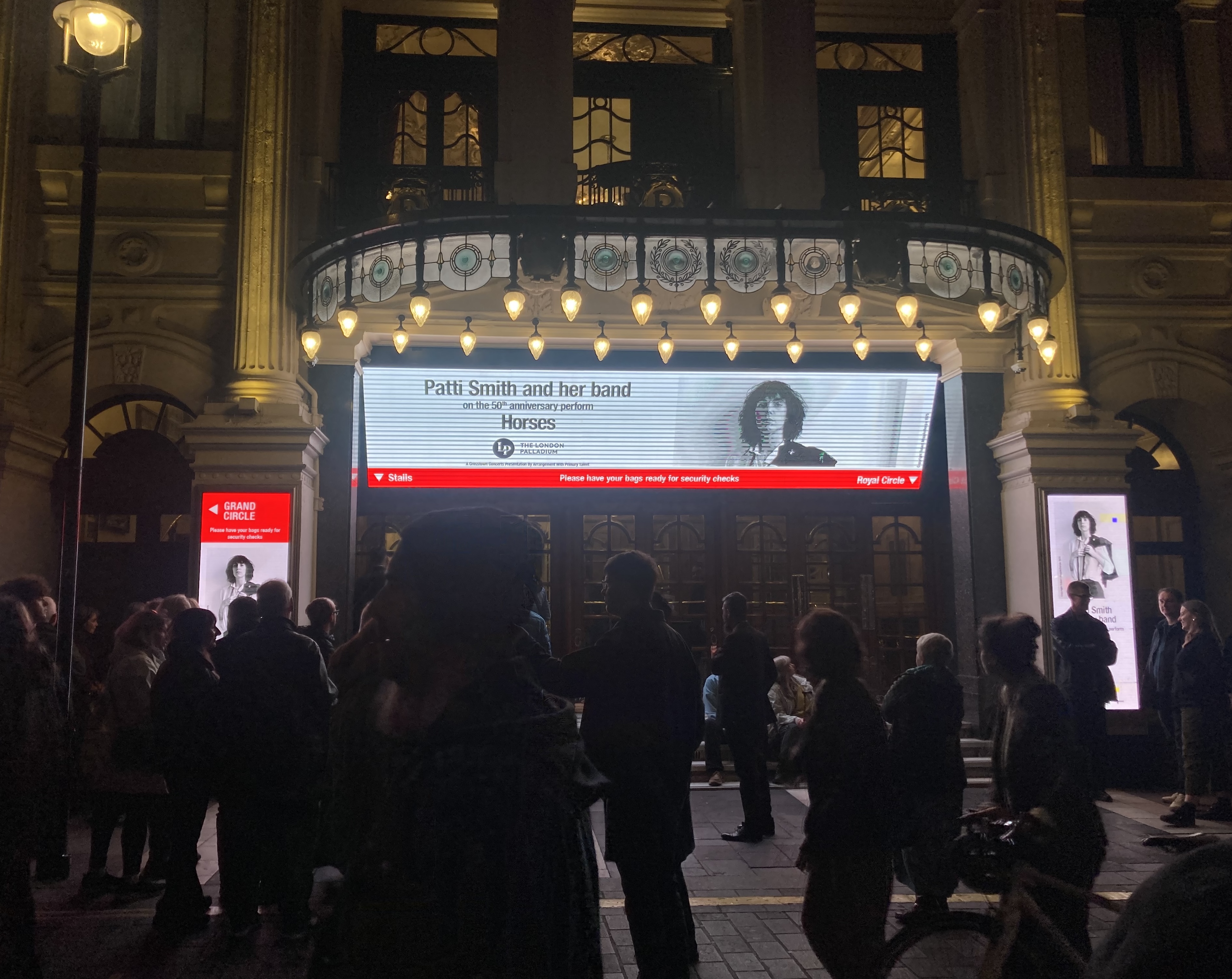
Two poets took the stage at the London Palladium this week. The first, Patti Smith, was celebrating the 50th anniversary of the release of the epochal album Horses by playing it all the way through with a band including two of her original confrères. The second, Al Stewart, had made it part of his farewell tour, and thus his final appearance in the city where he once shared a flat with the young Paul Simon and had a residency at Bunjie’s, a folk club a shortish walk across Soho from where he was saying his goodbyes.

Smith is 78. Stewart is 80. Horses came out in 1975, the year before Stewart enjoyed his biggest hit with the title track from Year of the Cat. Both drew full houses — Smith on two nights running — and performed with a vigour that reanimated the work of their youth.

We know Smith as a poet who rammed literary and musical forms together to great and lasting effect. Stewart’s success in turning big subjects — the Basque separatist movement, the French Revolution, Operation Barbarossa — into long narrative folk-rock songs reflected a creative use of the early impact of Bob Dylan on his songwriting. But where the enduring glamour of the New York era of CBGB and Max’s Kansas City ensures Smith’s continuing credibility, Stewart’s soft-rock associations have probably restricted his following to his original audience. There was no measurable difference in the enthusiasm that greeted both artists on a celebrated stage.

If the guitarist Lenny Kaye and the drummer Jay Dee Daugherty provided valued historical support for Horses, assisted by Jackson Smith and Tony Shanahan on keyboard and bass guitar, Stewart (and his four-piece band from Chicago, the Empty Pockets, plus the saxophonist/flautist Chase Huna) benefited from the guest presence of his old collaborator Peter White, who added beautiful guitar decoration to “Time Passages”, which he co-wrote, and “On the Border”, and remodelled the rhapsodic piano introduction — including “As Time Goes By” — to “Year of the Cat”.

To be honest, I hadn’t listened to Stewart for decades before last night. I bought the tickets as a treat for my wife, who knew him a little in Bristol folk scene of the late ’60s and remembers once giving him a lift to London. But as thrilled as I was to hear Smith declaiming “Redondo Beach” and “Birdland”, I was just as beguiled by Stewart’s “The Road to Moscow” and “The Dark and the Rolling Sea”.

Today Smith, of course, looks even more like a poet than she did in 1975. Stewart, who lives in Arizona, now resembles someone who might be the secretary of the local bridge club. Good on both of them.

Isle of Wight 1970: The getaway

The problem with the 1970 Isle of Wight festival was how to get out of it. On the morning of Monday, August 31, exactly 55 years ago, something like 600,000 fans were going to be trying to leave the island. In all probability, the queue for the ferry from Ryde to Portsmouth was likely to resemble a less frostbitten version of Napoleon’s army retreating from Moscow.

I’d attended the festival with my friend Geoffrey Cannon, then the Guardian‘s rock critic. I was one of three Melody Maker writers on the case; the others were Chris Welch and Michael Watts. Poor Watts, a recent recruit, had been sent to a camping supplies shop on Holborn, around the corner from the office, and given enough money to equip himself with a small tent and a bedroll. His job would be to tell the story from the perspective of the kids up on the hill.

Welch and I would be taking notes in the relatively salubrious area reserved for VIPs and the press in front of the stage, revelling in the experience of seeing Miles Davis play to a crowd of more than half a million with an average age of probably 20. And there was Joni Mitchell, and the Who, and Richie Havens, and John Sebastian, and the rest of an extraordinary bill.

Geoffrey and I both had to be at our respective offices by the Monday lunchtime, and it was he who came up with a brilliant solution. He called the flying school at Portsmouth airport and asked if they had a plane that could pick us up and take us across the Solent.

The flying school could indeed meet his request, and we were invited to report at something like six o’clock in the morning, maybe a bit earlier. After leaving the festival and making it to the nearby Bembridge airfield, we sat in a hut by the grass runway, waiting for our plane to arrive.

We’d been there for a few minutes when a limousine drew up. Out of it stepped Jimi Hendrix, still wearing the flowing multicoloured silks he’d worn on stage only three or four hours earlier, giving a performance that had begun badly but eventually coalesced into something those who heard it would never forget (luckily, the whole set was filmed).

For Jimi, a helicopter was waiting. He climbed in and disappeared into the misty dawn sky. Eighteen days later, after returning to London from gigs in Denmark and West Germany, he was dead.

Shortly after his departure from Bembridge, our single-engined Cessna turned up and off we went. I expect we shared a taxi from Portsmouth to London and put it on expenses, as we did with the cost of the plane ride, which came to nine pounds and six shillings, including landing fees. The bill was made out to Geoffrey. Somehow, I’ve managed to hang on to it for the past five and a half decades.

Major dudes, minor ninths

The implied flavour of much of the music made by Donald Fagen and the late Walter Becker might be read as that of hard bop as played on the West Coast: laconic, brainy, slyly coded, but also somehow sunlit. By contrast with the jazz musicians they admired, the Steely Dan duo were afforded the sort of time and effort needed to make their records as immaculate as possible, successfully substituting wit and taste for spontaneity. The result, almost airtight in its perfection, would seem to render any attempt at recreation by third parties not just superfluous but doomed from the outset.

There are, nevertheless, several Steely Dan tribute outfits of high repute, existing to satisfy the appetite in particular of those never fortunate enough to hear the original band in person. I haven’t seen any of them, although I was sorry to miss the 14-piece Royal Scammers when they played the 606 Club in Chelsea last year, having heard good reports from reliable sources.

But if tribute bands live are one thing, offering at least a partial guarantee of satisfaction, an album of reinterpretations is a great deal riskier. The British singer and pianist Chris Ingham brings it off with Walter / Donald, his rearrangements of 13 songs performed by a quintet in which he’s joined by the trumpeter Paul Higgs, the saxophonist Harry Greene, the double bassist Geoff Gascoyne and the drummer George Double.

Ingham is a former music journalist (for Mojo, mostly) and author of books on the Beatles, Billie Holiday and others. Now he writes TV soundtracks and leads a band that has also recorded and toured its surveys the music of Hoagy Carmichael, Dudley Moore and Stan Getz. A fine pianist, he has a light, pleasant singing voice, totally lacking in affectation but not in character, wisely avoiding attempts to imitate Fagen’s distinctive sardonic croon. It’s a little like listening to Georgie Fame singing Mose Allison’s songs: a intelligent take, full of the sort of implicit affection and respect which, along with the musicianship involved, make it stand up as a valid adjunct to the originals.

There are some fine moments, many of which bring the latent jazz to the surface. “Your Gold Teeth II” has a lovely two-horn unison intro, a little like a gentler Horace Silver arrangement, and “I Got the News” finds a hint of Monk in the melody’s staccato phrases. The choice of material also veers into less obvious areas, as with “The Last Mall”, a warped blues-with-a-bridge from Everything Must Go, the last Dan album, released in 2003, which has its chords straightened out and is enlivened by the smart addition of the irresistible horn riff from Fagen’s cover of “Ruby Baby”, from The Nightfly. And I think I might even prefer Ingham’s reading of the quietly heartbreaking “Paging Audrey” to that on Becker’s second solo album, Circus Money (2008).

There are fine horn solos throughout, Higgs displaying an almost cornet-like brightness and an adroit use of cup or plunger mute on the brief coda to “Your Gold Teeth II” and the intro and solos on “Haitian Divorce”, while Greene’s tenor has a fluent mobility reminiscent (to me, anyway) of Hank Mobley, excelling on “What a Shame About Me”, a really great song — a John Cheever short story in five verses.

Honestly, if you walked into a club and found yourself listening to this band playing this material, you’d be extremely happy. It might not be a revelation but you’d be hearing wonderful songs carefully turned so as to catch the light from a different angle, in the process drawing out their humanity.

* The Chris Ingham Quintet plays a launch gig for Walter / Donald at the Pizza Express in Soho on September 17. The album is out now on Downhome Records, available from https://www.chrisingham.co.uk/shop

Too much, too late

Once upon a time there was a phenomenon called the rip-off, a form of commercial exploitation that could be defined as being overcharged for something you really wanted and had to have. I guess that was back in the ’60s. You knew it when you saw it. Now we live in a rip-off culture, where the price of things is calculated not on the cost of the parts plus a bit of profit for the maker and distributor but on what a sufficient number of buyers can be induced to pay.

I’m writing this while wincing from the pain of having parted with £229 for Bruce Springsteen’s Tracks II: The Lost Albums. This, as you may be aware, is a set of seven CDs recorded between 1983 and 2014, six of them conceived and recorded at the same time and one assembled from bits and pieces. I’ve loved Springsteen since reviewing Greetings from Asbury Park, N. J. for the Melody Maker in early 1973, I bought bootlegs like You Can Trust Your Car to the Man With the Star and the Roxy tapes in the early days, and the last of the many times I’ve seen him, at Wembley in the summer of 2024, is a cherished memory. So I was looking forward to hearing these “lost albums” (which, of course, weren’t lost at all, merely filed away in Bruce’s personal tape store).

Their arrival was a bit disconcerting. They came in a container of very large dimensions, carefully packaged up, opening to reveal a box big enough to hold seven 12-inch vinyl albums, never mind seven little silver discs. The reason for the use of the outsized packaging seems to be the inclusion of a large-format 100-page hardback book containing a lot of impressionistic black and white photographs — Fender Esquire headstock, Twin Reverb amp, Bruce on horseback, Bruce on a motorbike, Bruce in the studio — and a series of short essays explaining the making of each of the CDs.

Despite this early evidence of art-director overkill, I was still looking forward to hearing the music. Gradually, though, as I worked my way through the CDs in sequence, it became obvious that their maker had made the right decision to put them on the shelf. There is virtually nothing here that reaches the level of his best officially released music. What it shows most clearly is that he’s written and recorded a lot of songs over the years in his various home studios, and some of them aren’t very good, which is why they were left on the shelf.

That’s most clearly apparent on the first disc, LA Garage Sessions ’83, where he sounds uncomfortably like the guy of limited horizons gently satirised by Prefab Sprout on “Cars and Girls” in 1988. Streets of Philadelphia Sessions is no better: one-paced and somehow enervated. Faithless, commissioned as the soundtrack for an “as-yet unmade” movie, is better: a well-turned essay in Americana with atmospheric instrumentals and lots of acoustic slide guitar and harmonica, a bit like one of Ry Cooder’s soundtracks, or Dylan’s Pat Garrett and Billy the Kid, with a strong song in “My Master’s Hand”, making it an album you can put on and quite enjoy from beginning to end.

Of Somewhere North of Nashville, a quite lavish but ultimately heavy handed production with lots of Soozie Tyrell’s fiddle and Marty Rifkin’s steel guitar, you can only say that if it were a bunch of demos it wouldn’t get him a publishing contract on Music Row, not when the best of the dozen songs is “Poor Side of Town”, written by Johnny Rivers and Lou Adler, here delivered in a version that lacks the charm of Rivers’ original, a No 1 hit on its release in 1966. Bruce’s stab at a Tex-Mex album, titled Inyo, is fresher, but still not really convincing, despite the occasional use of mariachi musicians, the pleasant textures and the attempt to create complex, poetic lyrics; you merely end up wishing he’d make an album with Los Lobos.

The worst, by a distance, is Twilight Hours, his stab at writing and recording a sumptuously upholstered album of saloon songs, laments for lost love glimpsed in the bottom of a whisky glass in a dimly lit cocktail bar while car tyres hiss by in the rain and neon signs glow in the puddles. That sort of thing. When Sinatra patented the genre, he had the benefit of repertoire composed by likes of Sammy Cahn and Jimmy Van Heusen, Harold Arlen and Johnny Mercer, Jerome Kern, Yip Harburg, Richard Rodgers, Lorenz Hart, Jule Styne and Gordon Jenkins — people who could fit together richly chromatic melodies and highly literate lyrics. And just as none of them could have written “Thunder Road” or “Badlands”, so Springsteen couldn’t write “Angel Eyes” or “Violets for Your Furs”. His decision not to release this album six years ago shows that he knew the results were not satisfactory.

The final album, Perfect Days, although cobbled together from various sessions, is paradoxically quite the most coherent of all the discs, with some songs that would have taken their places happily in second-rank Springsteen albums like Working on a Dream or High Hopes. Big and beefy in an E Street Band way, “Another Thin Line” is a fine take on the “Gloria” template, while “The Great Depression” is a particularly attractive strummed ballad.

If you told me that Dylan often leaves great stuff in the vault until it finds its way into a volume of his Bootleg Series, I’d answer that there’s no “Blind Willie McTell”, “Red River Shore” or “Cross the Green Mountain” here. If you were to say that Dylan often tries on costumes, whether for Nashville Skyline or Shadows in the Night, as Springsteen does here, I’d reply that the older artist made important strategic use of those genre-hopping adventures, allowing them to condition the music that came next. Dylan may have recorded “Autumn Leaves”, but he didn’t make the mistake of thinking he could write something like it; instead he used the experience of delivering it to redirect his approach to singing his own songs.

So I dunno. Previous dives into Springsteen’s vaults have delivered excellent official versions of much loved and often bootlegged songs such as “Santa Ana”, “Thundercrack” and “The Promise”. When it comes to this set, I admire him for exercising good judgment when it came to making an initial assessment of the material. I suppose it ought to be interesting to hear the stuff that didn’t work — but at more than 30 quid a disc? I really don’t think so.

‘Quadrophenia: A Mod Ballet’

For me, if for no one else, the Who completed the important phase of their work in the period that began at the start of 1965 and ended in the middle of 1966, encompassing their magnificent first four singles: “I Can’t Explain”, “Anyway Anyhow Anywhere”, “My Generation” and “Substitute”. I’d add “The Kids Are Alright”, recorded for their first LP but released as a 45 after they’d skipped labels from Brunswick to Reaction. And I can’t dismiss the later “I Can See For Miles” and “Won’t Get Fooled Again”. But I could never enjoy Pete Townshend’s rock operas in the same way, much as I admired his ambition.

So I was surprised by how much I liked the version of Quadrophenia presented at Sadler’s Wells this week: a full-blown ballet production, directed by Rob Ashford, with Townshend’s music rendered in pre-recorded orchestral arrangements by the composer Rachel Fuller, who has been his partner for more than a quarter of a century. No lyrics or dialogue, of course. I liked that. Show, don’t tell.

The dancing, choreographed by Paul Roberts, is wonderful, led by the nervily agile Paris Fitzpatrick as Jimmy and the lustrous Serena McCall as Mod Girl (the roles taken by Phil Daniels** and Lesley Ash in Franc Roddam’s famous 1979 movie version). There’s a warmly welcomed cameo for Matthew Ball as the Godfather, while the peroxide-rinsed Dan Baines takes Sting’s role as the Ace Face.

On stage, in this format, Townshend’s creation seems much closer to West Side Story than in its previous incarnations, particularly when the two gangs sweep back and forth in a recreation of the Mods versus Rockers battles on Brighton sea front, using a freeze-frame technique now familiar from war films. Equally stunning is a sequence evoking the PTSD nightmares suffered by Jimmy’s intolerant working-class dad as a result of his wartime experiences.

All of it is enabled by Christopher Oram’s brilliant set design, sliding back and forth in conjunction with video projections to recreate an office, a suburban home, a coffee bar, a Soho club (the Marquee), train compartments and the Brighton beach and promenade. On my rare outings to the theatre and the ballet these days I’m usually struck by the creativity with which modern resources are deployed, and this was a fine example. The climax, with Jimmy alone on a jetty against the sweeping tide, is something that won’t fade quickly.

Two instrumental bits of original Who recordings are used: “I Can’t Explain” and an extended mix of “My Generation”. Otherwise Fuller’s orchestrations are lush and brassy, and do the job satisfactorily, although they were actually a bit too loud, which might seem a strange thing to say about something based on the music of the Who, in their prime the loudest band I ever heard.

The other criticism would be that the individual identities of the characters playing the four elements of Jimmy’s character — the Tough Guy, the Lunatic, the Romantic and the Hypocrite — are never fully established, however well they’re expressed by the quartet of dancers. Of course they all have to be wearing the same kind of three-button Tonik suits as Jimmy (designed, at Townshend’s request, by Paul Smith), but even subtle colour variations can’t make it clear.

I never thought Quadrophenia contained Townshend’s best music, but this ballet may be its most satisfying iteration. It’s on at Sadler’s Wells until this Sunday (July 13), and it wasn’t quite full earlier in the week, so there may be a few seats left.

* Box office: sadlerswells.com. It’s also at the Lowry in Salford from July 15-19: thelowry.com.

** Thanks to all those who corrected my original mention of Paul, not Phil, Daniels…

On Kate Mossman’s ‘Men of a Certain Age’

(For the last decade and a half, Kate Mossman has written clever, funny, perceptive and quite candid interviews with ageing rock stars. They are, she admits, her speciality. Discussing Journey’s Steve Perry, she says: “I was drawn to him for his ageing vulnerability, his giant ego and his extreme oddness… the perfect combination for me.” She’s just published a collection of the interviews, with commentary and reflections. But I wasn’t very interested in my own opinion of her book. I wanted to know what a woman music journalist of my generation, who interviewed some of the same musicians when they were in their young prime, and for whom being hit on by male musicians was a largely unremarked fact of life, made of the views of a woman born in 1980. So I invited a friend whom I first met in 1969, when I’d just arrived at the Melody Maker and she was already well established along the corridor at Disc & Music Echo, to read the book and, if so moved, to give me her thoughts. She said yes, and here they are. — RW)

By CAROLINE BOUCHER

Is it a good idea to meet your heroes? I’ve met most of mine and the jury’s still out, and I think it’s probably the same for Kate Mossman.

In Men of a Certain Age Mossman meets 19 of them – pieces  previously published in The Word and the New Statesman. The subjects are all elderly, as were those chosen by Rolling Stone’s founding editor, Jann Wenner, when he published a selection of interviews claiming, justifiably, that only in their senior years do rock stars attain articulacy and eloquence (and, rather more controversially, that no women at all qualified under those criteria).

Mossman kicks off with the unashamed obsession with Queen’s drummer, Roger Taylor, that meant her teenage family holidays in Cornwall became a pilgrimage to every site connected with him, so that when she was finally granted an interview at his house she could have found it blindfold. Fortunately she reeled away from that confrontation still enamoured.

As she points out: “Rock journalism is unique in that it’s the only place where writers are also obsessive fans, though part of the art is pretending not to be.” A chunk of her early wages was spent on airfares to America where she’d travel to gigs by Greyhound buses or, in the case of a 5,000-mile pilgrimage to meet Glen Campbell in California, walking for three hours down the edge of a freeway.

I’m in awe of her fluid writing style, and jealous of the editorial freedom that now allows her to tell it like it is. By the time she meets Gene Simmons, Kiss have been in the business for 44 years. She likens his hair to “loft insulation”. Or on Trans-Siberian Orchestra’s Paul O’Neill (I know, who he?), who has amassed an extraordinary collection of first-edition books (one signed by Queen Victoria to Kitchener): “He wanders out on to the patio, where the sun beats down so strongly that he must be melting in his leathers… and for a moment he epitomises the contradiction at the heart of rock ‘n’ roll wealth: the baby boomers who bought the lifestyles of the landed aristocracy but insist on looking like pickled versions of the boys they were when they first picked up a guitar.”

Her subjects are a fascinating mix – not all of them out front onstage. For me, the most interesting was Cary Raditz, Joni Mitchell’s former lover and “mean old daddy” from “Carey”, the song named after him. It’s a vivid and fascinating portrayal of the two characters– who initially lived in a cave, and drifted in and out of each other’s lives as Mitchell’s star ascended.

When I was on a music paper in the late Sixties we helped peddle lies. I can still feel the boiling disappointment after an interview with the Byrds who were rude, arrogant and condescending, yet I wrote a bland piece. Syd Barrett was slumped out cold for the entire hour of my interview slot; he couldn’t utter a word. I can’t remember how I got round it, but my editor insisted on filling half a page and afterwards EMI sent me a congratulatory telegram.

An Engelbert Humperdinck review bore no mention of his chauffeur chasing me down the seafront to bring me back for some “entertainment’” Nor did a Mick Jagger interview betray my difficulty taking shorthand notes as his head was resting on my (fully clothed) chest.

As Mossman is meeting her idols in the twilight of their careers the testosterone has ebbed somewhat, although Kevin Ayers gives it a half-hearted try at his dusty French home. His self-belief seemed to be as strong as ever and I can wholeheartedly attest to how irritating he was when I had briefly turned gamekeeper from poacher and was doing PR for Elton John’s office. At the time Elton’s manager, John Reid, signed Ayers, so I flew some journalists out to Paris to see him perform and then talk to him over supper. I knew things were about to go spectacularly wrong when, from my balcony seat, I could see a blonde, cloaked figure at the side of the stage and recognised Richard Branson’s wife, Kristen, with whom Ayers was having an affair. We were spared a Daily Mail front page as fortunately none of the hacks knew who she was and were anyway spared interviews as he went straight back to the hotel with her.

Mossman’s original interviews are pre-Covid, each topped with an explanatory introduction, and many of the subjects have since died, but it’s an excellent read. Previously I had had no interest in many of  her heroes — Terence Trent D’Arby, Bruce Hornsby, Jon Bon Jovi, and I’d never even heard of the Trans-Siberian Orchestra — yet those, for me, were the most interesting and insightful pieces.

* After Caroline Boucher left Disc, she worked at Rocket Records and was then for many years at the Observer. Kate Mossman’s Men of a Certain Age is published by Nine Eight Books (£22). The photograph of Mossman with Kiss is from the book jacket.

Everybody Loves a Train

About twenty years ago, my friend Charlie Gillett was compiling a series of themed CDs for a Polygram label called Debutante, under the aegis of the former Island A&R head Nick Stewart. Charlie asked me if I’d like to put one together, and if so, what the theme might be. “Trains,” I said, after about ten seconds’ thought, and then I went away to assemble a running order. It took a while, because I enjoyed the process so much.

Sadly, the series came to a sudden end before my contribution could see the light of day. But I’d edited together a disc of how I wanted it to go. I called it Everybody Loves a Train, after the song by Los Lobos. It has all sorts of songs, some of which speak to each other in ways that are obvious and not. I avoided the most obvious candidates, even when they perfectly expressed the feeling I was after (James Brown’s “Night Train” and Gladys Knight’s “Midnight Train to Georgia”) and instrumentals, too (see the footnote).

Every now and then I take it out and play it, as I did this week, with a sense of regret that it never reached fulfilment. Here it is, with a gentle warning: not all these trains are bound for glory. Remember, as Paul Simon observes, “Everybody loves the sound of a train in the distance / Everybody thinks it’s true.”

  1. Unknown: “Calling Trains” (From Railroad Songs and Ballads, Rounder 1997) Forty-odd seconds of an unidentified former New Orleans station announcer, recorded at Parchman Farm, the Mississippi state penitentiary, in 1936, calling from memory the itinerary of the Illinois Central’s “Panama Limited” from New Orleans to Chicago: “…Ponchatoula, Hammond, Amite, Independence… Sardis, Memphis, Dyersburg, Fulton, Cairo, Carbondale…” American poetry.
  2. Rufus Thomas: “The Memphis Train” (Stax single, 1968) Co-written by Rufus with Mack Rice and Willie Sparks. Produced by Steve Cropper. Firebox stoked by Al Jackson Jr.
  3. Los Lobos: “Everybody Loves a Train” (from Colossal Head, 1996) “Steel whistle blowin’ a crazy sound / Jump on a car when she comes around.” Steve Berlin on baritone saxophone.
  4. Bob Dylan: “It Takes a Lot to Laugh, It Takes a Train to Cry” (from Highway 61 Revisited, 1965) “Don’t the brakeman look good, mama, flaggin’ down the Double E?”
  5. Joe Ely: “Boxcars” (from Honky Tonk Masquerade, 1978) A Butch Hancock song. Ponty Bone on accordion, Lloyd Maines on steel guitar.
  6. Counting Crows: “Ghost Train” (from August and Everything After, 1993) “She buys a ticket ’cause it’s cold where she comes from / She climbs aboard because she’s scared of getting older in the snow…”
  7. Rickie Lee Jones: “Night Train” (from Rickie Lee Jones, 1979) It was a plane she took from Chicago to LA to begin her new life in 1969, and an old yellow Chevy Vega she was driving before she cashed the 50K advance from Warner Bros ten years later. But, you know, trains.
  8. The Count Bishops: “Train, Train” (Chiswick 45, 1976) London rockabilly/pub rock/proto-punk. Written by guitarist/singer Xenon De Fleur, who died a couple of years later in a car crash, aged 28, on his way home from a gig at the Nashville Rooms. Note that comma. I like a punctuated title.
  9. Julien Clerc: “Le prochain train” (from Julien, 1997) My favourite modern chansonnier. Lyric by Laurent Chalumeau.
  10. Blind Willie McTell: “Broke Down Engine Blues” (Vocalion 78, 1931) Born blind in one eye, lost the sight in the other in childhood. Maybe he saw trains in time to carry their image with him as he travelled around Georgia with his 12-string guitar.
  11. Laura Nyro: “Been on a Train” (from Christmas and the Beads of Sweat, 1970) One song she didn’t do live, as far as I can tell. Too raw, probably.
  12. Chuck Berry: “The Downbound Train” (Chess B-side, 1956) When George Thorogood covered this song, he renamed it “Hellbound Train”. He didn’t need to do that. Chuck had already got there.
  13. Bruce Springsteen: “Downbound Train” (from Born in the USA, 1984) “The room was dark, the bed was empty / Then I heard that long whistle whine…”
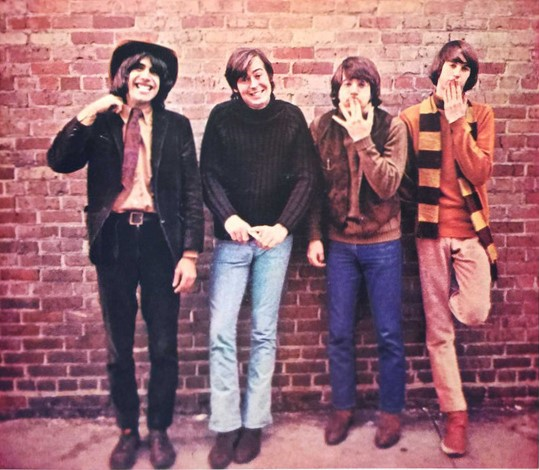
  14. Dillard & Clark: “Train Leaves Here This Morning” (from The Fantastic Expedition of Dillard & Clark, 1968) Written by Gene Clark and Bernie Leadon: “1320 North Columbus was the address that I’d written on my sleeve / I don’t know just what she wanted, might have been that it was getting time to leave…”
  15. Little Feat: “Two Trains” (from Dixie Chicken, 1973) In which Lowell George extends the metaphor of Muddy Waters’ “Still a Fool (Two Trains Running)”: “Two trains runnin’ on that line / One train’s for me and the other’s a friend of mine…”
  16. B. B. King: “Hold That Train” (45, 1961) “Oh don’t stop this train, conductor, ’til Mississippi is out of sight / Well, I’m going to California, where I know my baby will treat me right”
  17. Paul Simon: “Train in the Distance” (from Hearts and Bones, 1983) Richard Tee on Fender Rhodes. “What is the point of this story? / What information pertains? / The thought that life could be better / Is woven indelibly into our hearts and our brains.”
  18. Vince Gill: “Jenny Dreams of Trains” (from High Lonesome Sound, 1996) Written by Gill with Guy Clark. Fiddle solo by Jeff Guernsey. Find me something more beautiful than this, if you can.
  19. Muddy Waters: “All Aboard” (Chess B-side, 1956) Duelling harmonicas: James Cotton on train whistle effects, Little Walter on chromatic.
  20. Darden Smith: “Midnight Train” (from Trouble No More, 1990) “And the years go by like the smoke and cinders, disappear from where they came…”
  21. The Blue Nile: “From a Late Night Train” (from Hats, 1989) For Paul Buchanan, the compartment becomes a confessional.
  22. Tom Waits: “Downtown Train” (from Rain Dogs, 1985) “All my dreams, they fall like rain / Oh baby, on a downtown train.” A New York song.

Closing music: Pat Metheny’s “Last Train Home” (from Still Life (Talking), 1987) to accompany the photo of the Birmingham Special crossing Bridge No 201 near Radford, Virginia in 1957 — taken, of course, by the great O. Winston Link. Other appropriate instrumentals: Booker T & the MGs’ “Big Train” (from Soul Dressing, 1962, a barely rewritten “My Babe”) and Big John Patton’s “The Silver Meter Pts 1 & 2” (Blue Note 45, 1963, a tune by the drummer Ben Dixon whose title is a misspelling of the Silver Meteor, a sleeper service running from New York to Miami).

The Ballad of Dennis Hopper

If anyone contained multitudes, it was surely Dennis Hopper. Wild and crazy guy, but also a proper artist. Incarnated the simmering potential of the ’50s, the multicoloured dream of the ’60s, the long scream of the ’70s, and the all-over-the-place uncertainty of the ’80s.

All those movies: not just Rebel Without a Cause, Easy Rider, Apocalypse Now and Blue Velvet but The Trip, The American Friend and Rumble Fish. And the folie de grandeur of The Last Movie. Married to Michelle Phillips for eight days and to Daria Halprin, co-star of Antonioni’s Zabriskie Point, for a little longer. Great photographer, too (he spent so much time with a camera around his neck that his friend nicknamed him “the tourist”). No wonder Mike Scott decided to make a Waterboys album about him.

I took Life, Death and Dennis Hopper on a road trip last weekend and it kept me entertained and fascinated all the way there and back. Its 25 tracks form a mosaic of a life that began in Dodge City, Kansas in 1936 and ended in Venice, California in 2010. “Kansas”, the opening track, is bookended by the sound of a street parade and a departing steam train: the song itself, sung and co-written by Steve Earle, with just the singer’s guitar and Mickey Raphael’s harmonica, is like something from Nebraska‘s country cousin.

Then Scott enters to sing “Hollywood ’55” — the story of Hopper’s arrival in Movieland — against a finger-snapping beatnik swing and we’re into a sequence of snapshots set to era-adjacent music. “Live in the Moment”, about making it, rolls on Mitch Ryder’s Detroit Wheels. “Andy”, referencing his friendship with Warhol, is a smooth uptown pop mix settling somewhere between Broadway and Hollywood & Vine. “The Tourist”, about Hopper and his camera documenting the short life of hippie dream, could be the Strawberry Alarm Clock or H. P. Lovecraft imitating the Jefferson Airplane. “Riding Down to Mardi Gras”, in which Hopper and Peter Fonda make Easy Rider, is a fine piece of outlaw country-rock. And so on, all the way to “Golf, They Say”, a funny song about the late-life experience of Willie Nelson teaching Hopper to swing a club.

But it’s not just a kind of jukebox musical. There are brief interludes — notably five short impressionistic instrumental pieces of contrasting styles and hues, each dedicated to one of Hopper’s five wives — and a couple of recitatives, one a description of the 1967 Monterey Festival in an English posh-hippie voice, the other a parody of an American TV news report of his death.

The two finest individual tracks are the hard-slugging, thick-textured “Ten Years Gone”, referring to Hopper’s lost decade and closing with a passage spoken by Bruce Springsteen, and “Letter From an Unknown Girlfriend”, a painfully stark voice-and-piano ballad in slow waltz time sung and played by Fiona Apple. They’re followed by a snatch of aural hallucination called “Rock Bottom”, evoking the years Hopper spent in the abyss, and then the gorgeous, achingly redemptive “I Don’t Know How I Made It”, somewhat like the Blue Nile covering Blonde on Blonde.

As Scott suggests, you can listen to the tracks indvidually or in any order, but it’s really made to be heard from start to finish, although not in any burdensome or dutiful way. Congratulations to him and his guests and his co-writers and fellow Waterboys, including Paul Brown, James Hallawell, Aongus Ralston, Ralph Salmins and Greg Morrow. It’s a brave thing, executed with flair and imagination.

* The Waterboys’ Life, Death and Dennis Hopper is out now on Sun Records.

Stories old and new

“That was a young man’s song,” Paul Brady said as the applause began to fade at the Bush Hall last night. He’d just sung “Nothing But the Same Old Story”, written at the start of the 1980s to inhabit the world of a narrator who’d arrived in London from Ireland as a teenager looking for work and confronted by hostility in the time of the Troubles: “Living under suspicion / Putting up with the hatred and fear in their eyes…” It’s a song of resistance, one to drink and dance and cry to, and although only a few weeks from turning 78, Brady invested it with all its original innocence and rage.

This was the second of his two nights in Shepherd’s Bush, and he talked a little about how, arriving from Ireland as a member of a folk quartet called the Johnstons in 1969, they’d settled into a flat close by. He spoke fondly of how he’d learned from traditional musicians at pub sessions in west and north London.

I hadn’t seen him live since a gig at the Half Moon in Putney in 1981, when I was blown away by the material from his second solo album, Hard Station. Since then he’s had great success as a songwriter, his work recorded by Bonnie Raitt, Tina Turner and others. But today you can put him on stage alone with a guitar, a mandolin and a keyboard, and it’s the same old storyteller, now with a bit more of a growl but with wit and warmth and enough edge to lift you from your seat.

Sometimes, as in the gorgeous “Wheel of Heartbreak” and “The Long Goodbye”, he seemed like the most accomplished of adult rockers. During “Mother and Son” and “Follow On” (“a dark song that ended up in a butter commercial”) I started thinking that maybe what he was was a modern chansonnier, in the mould of Léo Ferré or Julien Clerc. And then there were the traditional songs that harked back to his time with the Johnstons and Planxty: the brilliant mandolin work on “The Jolly Soldier”, the sheer historical weight beneath the lilt of “Arthur McBride”.

The shows were arranged to greet the release of Paul Brady: The Archive, a four-CD, 63-track set of demos, one-off collaborations (with Dolores O’Riordan, Cara Dillon and Carole King, for example), interesting alternative versions of most of his best-known songs, and other fascinating bits and pieces, copiously illustrated with tickets, posters, photos and newspaper cuttings.

Curiously, the first two CDs begin with two songs that he didn’t write, both from the 1960s, which express polar opposites of the spirit of the time. One is the lovely hippie anthem “Get Together”, written by the American musician best known as Dino Valenti and containing a line I’ve never wanted to get out of my head: “We are but a moment’s sunlight / Fading in the grass.” Brady recorded it in 1999 for a set of songs associated with Greenwich Village in the ’60s, and his is a beautiful version, which he reprised last night. The other is “Gimme Shelter”, a song of a very different complexion: his treatment, recorded in 2009 with Bob Thiele Jr’s Forest Rangers for a TV series, Sons of Anarchy, loses nothing by comparison with the Stones’ original.

Those are among the many treasures in the box set. I’m still absorbing it, but I can say that the version of “Paddy’s Lamentation” for voice, piano, tin whistle and military drums, recorded in Dublin in 1980 for a long-vanished compilation album, might alone be worth the 50 quid.

Brady came back for an encore last night and of course it was “The Lakes of Pontchartrain”, the song he recorded in 1978 on his first solo album, Welcome Here Kind Stranger, and which he later taught to Bob Dylan. It’s a traditional song, but it’s his really, and The Archive has a fine version in Gaelic, translated by Prionnsias O’Maonaigh: “Bruach Loch Pontchartrain”.

Last night he sang it in English and gestured to us to sing the last two lines of the final verse with him, acappella: “So fare thee well my bonny o’ girl l’ll never see no more / But I’ll ne’er forget your kindness and the cottage by the shore…” Every heart melted, all over again.

* Paul Brady: The Archive is released by The Last Music Company: http://www.lastmusic.co.uk