Skip to content

Posts from the ‘Rock and roll’ Category

Aces high in Camden Town

On the first floor at the Hawley Arms, a pub in Camden Town, Ted Carroll is spinning the discs. He’s started the session with the Bobbettes’ “Mr Lee”, a record that changed his life when he bought an original copy on the London label. He’ll go on to play Bo Diddley’s “Bo Diddley”, Inez and Charlie Foxx’s “Mockingbird” and other choice stuff before resuming his conversations with guests at last night’s 50th birthday celebration for Ace Records, which he and his co-founders, Roger Armstrong and Trevor Churchill, turned into the most prolific and consistently rewarding of reissue labels.

I used to visit Ted’s stall at the back of 93 Golborne Road, up at the then-untrendy north end of Portobello Road, soon after he opened it in 1971 with a stock built around 1,800 London 45s from the ’50s and ’60s. The equivalent of New York’s Village Oldies and House of Oldies, it attracted a clientele of people — some of them famous — looking for rare old R&B, rock and roll and doo-wop vinyl. He added a stall in Soho later in the decade before opening the Rock On shop on Kentish Town Road, next door to Camden Town tube station, from where he also ran the Chiswick label.

Ace began with the acquisition of Johnny Vincent’s label of the same name, out of Jackson, Mississippi. That was the first of many such deals made with some of the great American post-war record men, including Art Rupe of Specialty, Hy Weiss of Old Town and the Bihari brothers of Modern, a species now extinct. Carroll, Armstrong and Churchill had set off on their mission of creating high-class reissues of neglected music, assembled with love, care, and thousands of hours spent in tape vaults across the US. Among later additions would be the Fantasy group of labels, which included Stax/Volt, thus enabling Armstrong, as he told me last night, to stumble open-mouthed upon the session tapes of “Sitting on the Dock of the Bay”.

Personally, I’m profoundly grateful to such compilers as Mick Patrick, Ady Croasdell, Tony Rounce, John Broven, Dean Rudland and Alec Palao for the enthusiasm and scholarship behind dozens of wonderful CDs devoted to stuff I care about. There’s the imaginatively programmed songwriters’ and producers’ series, covering the works of Goffin & King, Leiber & Stoller, Greenwich & Barry, Mann & Weil, Jackie DeShannon, Randy Newman, Laura Nyro, P. F. Sloan & Steve Barri, Bob Gaudio, Dan Penn & Spooner Oldham, Bert Berns, Jerry Ragovoy, and others. There’s the four-volume Sue story, put together by Rob Finnis, and the epic five discs of the late Dave Godin’s Deep Soul Treasures. There’s Ady Croasdell’s beautiful Lou Johnson anthology, his two-volume This Is Lowrider Soul, and his compilation of Doré label tracks called L. A. Soul Sides, including Rita and the Tiaras’ magical “Gone With the Wind Is My Love”. There’s Mick Patrick’s collection of Teddy Randazzo’s great productions and, going back to 1984, Where the Girls Are, his first compilation and one of many devoted to the beloved girl-group genre.

That’s just scratching the surface. And whether pop, blues, R&B, Northern Soul, funk, gospel or jazz, the packaging of Ace’s releases has always been exemplary, thanks to the informative and enjoyable annotations and picture research by the compilers, and to intelligent artwork by designers including Neil Dell, who worked on many of the CDs I’ve mentioned.

The label was sold a couple of years ago. Its new owners, a Swedish company called Cosmos Music, seem committed to continuing on the same path, with the same managers and contributors. A lot of them were at last night’s very convivial party, which started well for me when I walked in to the sound of Dean Rudland playing Oscar Brown Jr’s “Work Song” off a French EP, followed by Ray Charles giving the Raelettes’ Margie Hendrix her finest hour — well, 16 bars — on “You Are My Sunshine”.

Ted, who followed Dean on the decks, now runs a new incarnation of Rock On in the lovely market town of Stamford in Lincolnshire, just off the A1; a bit different from Camden Town — where, as I walked back to the tube, a trio called Thistle were trying to convince their audience that the ground-floor room of the Elephants Head pub was CBGB, this was 1975, and the next band on the bill would be the Patti Smith Group.

Fifty years ago Ted, Roger, Trevor and their helpers did a great thing by starting Ace. When a label introduces you to such gems as Margaret Mandolph’s ” I Wanna Make You Happy” (on Croasdell’s Tears in My Eyes compilation from 1985) and the Vogues’ “Magic Town” (on Glitter and Gold, the first of Patrick’s two Mann & Weil CDs), you can only raise a glass to the work they’ve done and thank them for the happiness it continues to bring.

Everybody Loves a Train

About twenty years ago, my friend Charlie Gillett was compiling a series of themed CDs for a Polygram label called Debutante, under the aegis of the former Island A&R head Nick Stewart. Charlie asked me if I’d like to put one together, and if so, what the theme might be. “Trains,” I said, after about ten seconds’ thought, and then I went away to assemble a running order. It took a while, because I enjoyed the process so much.

Sadly, the series came to a sudden end before my contribution could see the light of day. But I’d edited together a disc of how I wanted it to go. I called it Everybody Loves a Train, after the song by Los Lobos. It has all sorts of songs, some of which speak to each other in ways that are obvious and not. I avoided the most obvious candidates, even when they perfectly expressed the feeling I was after (James Brown’s “Night Train” and Gladys Knight’s “Midnight Train to Georgia”) and instrumentals, too (see the footnote).

Every now and then I take it out and play it, as I did this week, with a sense of regret that it never reached fulfilment. Here it is, with a gentle warning: not all these trains are bound for glory. Remember, as Paul Simon observes, “Everybody loves the sound of a train in the distance / Everybody thinks it’s true.”

  1. Unknown: “Calling Trains” (From Railroad Songs and Ballads, Rounder 1997) Forty-odd seconds of an unidentified former New Orleans station announcer, recorded at Parchman Farm, the Mississippi state penitentiary, in 1936, calling from memory the itinerary of the Illinois Central’s “Panama Limited” from New Orleans to Chicago: “…Ponchatoula, Hammond, Amite, Independence… Sardis, Memphis, Dyersburg, Fulton, Cairo, Carbondale…” American poetry.
  2. Rufus Thomas: “The Memphis Train” (Stax single, 1968) Co-written by Rufus with Mack Rice and Willie Sparks. Produced by Steve Cropper. Firebox stoked by Al Jackson Jr.
  3. Los Lobos: “Everybody Loves a Train” (from Colossal Head, 1996) “Steel whistle blowin’ a crazy sound / Jump on a car when she comes around.” Steve Berlin on baritone saxophone.
  4. Bob Dylan: “It Takes a Lot to Laugh, It Takes a Train to Cry” (from Highway 61 Revisited, 1965) “Don’t the brakeman look good, mama, flaggin’ down the Double E?”
  5. Joe Ely: “Boxcars” (from Honky Tonk Masquerade, 1978) A Butch Hancock song. Ponty Bone on accordion, Lloyd Maines on steel guitar.
  6. Counting Crows: “Ghost Train” (from August and Everything After, 1993) “She buys a ticket ’cause it’s cold where she comes from / She climbs aboard because she’s scared of getting older in the snow…”
  7. Rickie Lee Jones: “Night Train” (from Rickie Lee Jones, 1979) It was a plane she took from Chicago to LA to begin her new life in 1969, and an old yellow Chevy Vega she was driving before she cashed the 50K advance from Warner Bros ten years later. But, you know, trains.
  8. The Count Bishops: “Train, Train” (Chiswick 45, 1976) London rockabilly/pub rock/proto-punk. Written by guitarist/singer Xenon De Fleur, who died a couple of years later in a car crash, aged 28, on his way home from a gig at the Nashville Rooms. Note that comma. I like a punctuated title.
  9. Julien Clerc: “Le prochain train” (from Julien, 1997) My favourite modern chansonnier. Lyric by Laurent Chalumeau.
  10. Blind Willie McTell: “Broke Down Engine Blues” (Vocalion 78, 1931) Born blind in one eye, lost the sight in the other in childhood. Maybe he saw trains in time to carry their image with him as he travelled around Georgia with his 12-string guitar.
  11. Laura Nyro: “Been on a Train” (from Christmas and the Beads of Sweat, 1970) One song she didn’t do live, as far as I can tell. Too raw, probably.
  12. Chuck Berry: “The Downbound Train” (Chess B-side, 1956) When George Thorogood covered this song, he renamed it “Hellbound Train”. He didn’t need to do that. Chuck had already got there.
  13. Bruce Springsteen: “Downbound Train” (from Born in the USA, 1984) “The room was dark, the bed was empty / Then I heard that long whistle whine…”
  14. Dillard & Clark: “Train Leaves Here This Morning” (from The Fantastic Expedition of Dillard & Clark, 1968) Written by Gene Clark and Bernie Leadon: “1320 North Columbus was the address that I’d written on my sleeve / I don’t know just what she wanted, might have been that it was getting time to leave…”
  15. Little Feat: “Two Trains” (from Dixie Chicken, 1973) In which Lowell George extends the metaphor of Muddy Waters’ “Still a Fool (Two Trains Running)”: “Two trains runnin’ on that line / One train’s for me and the other’s a friend of mine…”
  16. B. B. King: “Hold That Train” (45, 1961) “Oh don’t stop this train, conductor, ’til Mississippi is out of sight / Well, I’m going to California, where I know my baby will treat me right”
  17. Paul Simon: “Train in the Distance” (from Hearts and Bones, 1983) Richard Tee on Fender Rhodes. “What is the point of this story? / What information pertains? / The thought that life could be better / Is woven indelibly into our hearts and our brains.”
  18. Vince Gill: “Jenny Dreams of Trains” (from High Lonesome Sound, 1996) Written by Gill with Guy Clark. Fiddle solo by Jeff Guernsey. Find me something more beautiful than this, if you can.
  19. Muddy Waters: “All Aboard” (Chess B-side, 1956) Duelling harmonicas: James Cotton on train whistle effects, Little Walter on chromatic.
  20. Darden Smith: “Midnight Train” (from Trouble No More, 1990) “And the years go by like the smoke and cinders, disappear from where they came…”
  21. The Blue Nile: “From a Late Night Train” (from Hats, 1989) For Paul Buchanan, the compartment becomes a confessional.
  22. Tom Waits: “Downtown Train” (from Rain Dogs, 1985) “All my dreams, they fall like rain / Oh baby, on a downtown train.” A New York song.

Closing music: Pat Metheny’s “Last Train Home” (from Still Life (Talking), 1987) to accompany the photo of the Birmingham Special crossing Bridge No 201 near Radford, Virginia in 1957 — taken, of course, by the great O. Winston Link. Other appropriate instrumentals: Booker T & the MGs’ “Big Train” (from Soul Dressing, 1962, a barely rewritten “My Babe”) and Big John Patton’s “The Silver Meter Pts 1 & 2” (Blue Note 45, 1963, a tune by the drummer Ben Dixon whose title is a misspelling of the Silver Meteor, a sleeper service running from New York to Miami).

Riding with John Hiatt

In his heyday, John Hiatt wrote songs about cars and girls with a fine wit and a firm grasp of rock and roll essentials. On the eve of the Grammy awards last Saturday night, the Americana Music Association organised a celebration of his career at the Troubadour in West Hollywood. I read about it in Bob Lefsetz’s newsletter, and wished very much that I’d been there.

The evening began with various luminaries performing a selection of Hiatt’s songs: Lyle Lovett (“Train to Birmingham”), Michael McDonald (“Have a Little Faith in Me”), Joe Bonamassa (“Perfectly Good Guitar”), Tom Morello (“The River Knows Your Name”), Cedric Burnside (“Icy Blue Heart”), Joe Henry (“The Way We Make a Broken Heart”), Hiatt’s daughter Lilly singing “You Must Go”, and various members of Little Feat — Bill Payne, Fred Tackett and Kenny Gradney — doing “Slow Turning”. Los Lobos presented one of their own songs, “Down by the Riverbed”, to the recording of which Hiatt had contributed vocals. Maggie Rose sang “Riding with the King”, one of the best of the many songs inspired by Elvis Presley.

Then Hiatt himself took the stage, singing “Memphis in the Meantime”, “Across the Borderline”, and — with Brandy Clark — “Thing Called Love”, the song that gave Bonnie Raitt a top 10 hit in 1989. I’m guessing that its inclusion on her five-million-selling Nick of Time probably earned its composer more than the rest of his copyrights put together.

When I first saw Hiatt, it was at the Apollo Victoria in 1980. He was a member of Ry Cooder’s Radio Silents, stepping into the spotlight to give a memorable rendering of O. V. Wright’s R&B drama “Eight Men and Four Women”. The next time was in 1992 with Little Village — a short-lived supergroup comprising Hiatt, Cooder, Nick Lowe and Jim Keltner — at Hammersmith Odeon, where their repertoire included “Don’t Think About Her When You’re Trying to Drive”, Hiatt and Cooder’s great heartbreak ballad.

In between times, he’d made a bunch of solo albums, of which the best received was 1987’s Bring the Family, which established the template for Little Village and included memorable songs: “Memphis in the Meantime”, “Have a Little Faith in Me” and “Lipstick Sunset”. It was the first of his four albums for A&M, and the second of them, Slow Turning, released in 1988, remains for me one of the very finest albums of that decade. Maybe it’s even one of the last great albums of classic guitar-led rock and roll with roots firmly planted in Chuck Berry and Hank Williams.

The album’s solid backing band includes the slide guitarist Sonny Landreth, and there isn’t a weak song among the dozen tracks. In the fast-moving “Tennessee Plates”, Hiatt joyfully channels Berry’s gift for storytelling and wry humour, while “Drive South” is the sort of song that makes you want to put the top down and step on the gas. “Trudy and Dave” is a great little story about a couple, their baby, a pistol and a laundromat. In “Georgia Rae”, he even gets away with serenading his infant daughter.

Best of all, “Icy Blue Heart” is a beautiful ballad with one of the great barroom lyrics: “She came on to him like a slow-movin’ cold front / His beer was warmer than the look in her eyes / She sat on a stool / He said, ‘What do you want?’ / She said, ‘Give me a love that don’t freeze up inside.'” But the singer knows all too well what will happen next, when he turns a heart “that’s been frozen for years / into a river of tears.” The metaphor is sustained through every line.

Hiatt has released 15 solo albums since Slow Turning. Some of them include fine songs, like “Perfectly Good Guitar” “Terms of My Surrender”, and “The Most Unoriginal Sin” (which opens thus: “What there was left of us / Was covered in dust and thick skin / A half-eaten apple / The whole Sistine Chapel / Painted on the head of a pin”), and fine musicians, including Doug Lancio, currently playing guitar in Bob Dylan’s touring band, and the brothers Luther and Cody Dickinson of the North Mississippi Allstars. On the most recent, Leftover Feelings, released in 2021, he shares the spotlight with the dobro genius Jerry Douglas.

His albums are always worth hearing, because he’s a fine craftsman steeped in the blues, country music and bluegrass. But Slow Turning is a pinnacle, one that never gets old.

* The photo of John Hiatt, taken by Jack Spencer, is from the cover of his album The Open Road, released on the New West label in 2010. There’s a nice piece on Hiatt by my old colleague Neil Morton here: https://www.herecomesthesong.com/post/2017/08/22/john-hiatt-the-goners-the-most-unoriginal-sin

Chan Romero 1941-2024

There was a time when Chan Romero’s “The Hippy Hippy Shake” was a song you had know. It was to the Beat Boom as “I Got My Mojo Workin'” was to the R&B scene. When Paul McCartney got hold of a copy and started singing it with his then-unknown group at the Star Club in Hamburg and the Cellar Club in Liverpool, it caught on fast. And when the Swinging Blue Jeans, another Liverpool group, recorded it in 1963, they took it to the top of the UK charts.

Like “I Got My Mojo Workin'”, it was basically a 12-bar blues — as was “Hound Dog”, the song that, when the 15-year-old Romero saw Elvis Presley singing it on the Ed Sullivan Show on his family’s black and white TV at home in Billings, Montana in 1956, introduced him to his destiny. “It just took me over,” he remembered. “I said, this is what I want to do.”

Romero, who has died aged 82, was born in Billings to a father of Spanish and Apache heritage and a mother of mixed Mexican, Cherokee and Irish descent. His mother sang and his brothers played guitars. He followed their example, and began writing songs. During his summer holiday from Billings Senior High School, he hitchhiked to East Los Angeles to stay with some relatives. A cousin drove him to Specialty Records in Hollywood, where the A&R man, Sonny Bono, liked his song “My Little Ruby” and told him to come back when he’d polished it up.

Back in Billings, Romero auditioned for a local DJ, Don “The Weird Beard” Redfield, who became his manager and sent a demo to Bob Keane at Del-Fi Records in Hollywood. Keane had recorded the Chicano singer Richie Valens, enjoying hits with “Donna” and “La Bamba”. It seemed a good match and Keane promptly signed Romero.

When Valens was killed at 19 years of age, along with Buddy Holly and the Big Bopper, in the February 1959 air crash in Iowa, Romero must have seemed his logical heir. Indeed, Keane introduced him to Valens’s grieving parents, with whom he later often stayed at their home in Pacoima, East LA.

“The Hippy Hippy Shake” was his first release on Keane’s label. It didn’t make much impact in the US, but it went down well in Canada and Australia. In the UK it was released on EMI’s Columbia label. “My Little Ruby” was the B-side of the the follow-up, “I Don’t Care Now”, and that was pretty much that, although Romero toured with his backing band, the Bell Tones, and found himself turning away girls. “I haven’t got a girlfriend,” he told the Billings Gazette, “because I can’t tell if a girl likes me for myself or because I’m a singer.”

The original version of “The Hippy Hippy Shake” has everything you’d want from a rock and roll record in 1959: the urgent teenage voice, the twangy guitar, the rackety drums, all wrapped up inside a minute and 45 seconds. Thank you, Chan Romero, for your moment in history.

Under the same sky

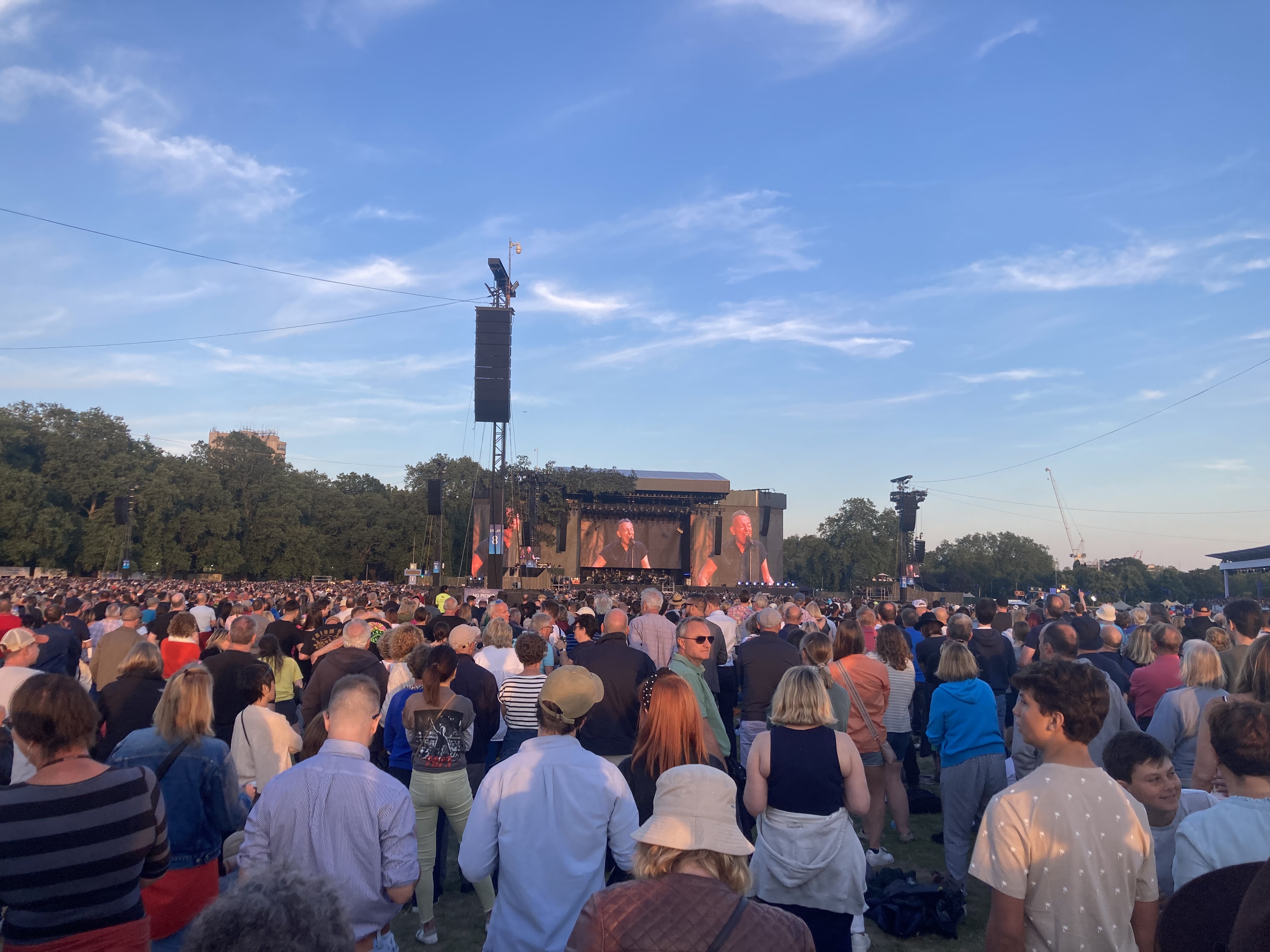
It’s 10 years since the veteran countercultural insurrectionist Mick Farren died. In 1976, in a celebrated polemic for the NME headlined “The Titanic sails at dawn”, he asked: “Has rock and roll become another mindless consumer product that plays footsie with jet set and royalty, while the kids who make up its roots and energy queue up in the rain to watch it from 200 yards away?” I thought of his words while watching — from a range of almost exactly 200 yards, as it happened, albeit on a warm, dry afternoon — Bruce Springsteen and the E Street Band giving the first of their two concerts in Hyde Park.

Farren wrote his piece only seven years after the Rolling Stones had played a free concert in Hyde Park to an audience of perhaps a quarter of a million (although I’ve always questioned that figure): a significant event in the history of both the band and the Sixties youth culture of which it was a part. All you had to do was turn up and find yourself a space on the grass. There were no merchandise stalls, because there was no merchandise. If you wanted anything to eat, drink or smoke, you had to bring it with you.

By contrast, Springsteen’s gigs (and others in the British Summer Time series) were sponsored by American Express. To secure a couple of tickets, even those very far away from the privileged enclosures housing the jet set (and perhaps even royalty), you needed to spend a few hundred quid. In the days leading up to the event, there were messages via a special app telling you what to expect and what you could and couldn’t do, with a map of the site, a list of prohibited items (including food and drink), and so on. And it all worked fine. Pleasant attendants, a variety of refreshment outlets and the provision of adequate toilet facilities made it a civilised experience. The weather was warm but not too hot, and the setting sun provided the golden light that enhances any performance.

Once upon a time Springsteen made concert halls feel like clubs. Then he made stadiums feel like concert halls. At 73 he still performs for three hours with impressive vigour and generosity of spirit (he gives the band a mid-set break rather than taking one himself), but nowadays his big gigs feel like big gigs. That’s the price, I guess, of having such a massive following. But although I liked hearing “Darlington County” and “Mary’s Place” and “Badlands” and “Wrecking Ball”, and enjoyed his decent stab at the Commodores’ “Nightshift”, a lot of the set sounded coarsened, which was not how it used to be. Maybe the band is now so big — all those horns and voices — that the music has lost the agility which was such a vital part of its early charm.

And, of course, from 200 yards, each figure on stage was about a quarter the size of a matchstick. So you watched it all on the big screens. Which, inevitably, were not quite synched with sound travelling such a distance to where I was standing. That was about halfway back in a crowd of 62,000, some of whom said afterwards that it was the best Springsteen show they’d ever seen. In the Guardian, Jonathan Freedland wrote an affecting piece about his reaction to the concert’s valedictory tone and its message for a generation now growing old.

I don’t begrudge anyone their enjoyment in Hyde Park. I’ve seen Springsteen at other times and in other places when the shows he delivered were as good as anything of their kind could possible be. But when I think about the corporate infrastructure of the Hyde Park concerts, and about the row over “dynamic pricing” in the US, and about the stories of what people are having to go through (and spend, of course) to see Taylor Swift on her forthcoming tour, I think Mick Farren’s point was so well made that its meaning has only grown louder over the years.

When he wrote that piece, punk rock was coming down the track. For a while that movement seemed to destabilise the commercial edifice built up around the music. Then the music industry found ways to reassert its authority, to globalise its product while building an impenetrable wall around it. Whatever the instincts and virtues of Springsteen, Swift and others, however immaculate and sincere, their gigantic tours are now an expression of that authority.

I’m probably sounding naive, because in a sense it’s nothing new. At the time of their free concert in Hyde Park, the Stones were managed by Allen Klein, the American hustler whose involvement was emphatically not motivated by countercultural concerns. Mick Farren also wrote books about Elvis Presley, and he knew perfectly well that Colonel Tom Parker didn’t care about Elvis’s audience or the culture they represented. He cared about making a buck.

Listening to the music of time

By the time I started listening to Charlie Parker, he’d been dead for five or six years. I was in my early teens, too young to have heard “Parker’s Mood” and “Ko Ko” and the rest of his music as it emerged, first as 78s on the Savoy and Dial labels and then on Verve albums, interacting in real time with everything else around it. That didn’t stop me forming opinions and eventually writing about it. But it was a long time before I realised that older listeners might consider their opinions to be worth more than mine, simply by virtue of their perspective on the music’s initial impact.

I think the penny dropped in the 1970s during a bad-tempered exchange of letters with Derek Jewell, then the jazz and pop critic of the Sunday Times. Twenty years older than me, he tried put me in my place by telling me that he’d been listening to Parker’s records when they were new, while doing his national service in, if I remember correctly, the RAF. With the arrogance of youth, I answered back. But I did so with the uneasy recognition that, however much we both loved Parker’s music, his feelings about it might be intrinsically different from mine, his connection more intimate.

Now, half a century later, it’s my turn to have the sort of feelings that underpinned his words. Occasionally I find myself wondering how someone in their twenties or thirties today can possibly understand the music of Jimi Hendrix, or Martha and the Vandellas, or Albert Ayler, or Anne Briggs, or Curtis Mayfield, or Laura Nyro the way I think I do. I mean, you had to discover “Heat Wave”. “Quicksand”, “Live Wire”, In My Lonely Room”, “Dancing in the Street”, “Wild One” and “Nowhere to Run” in sequence, at the time, to make proper sense of them, didn’t you?

Soon nobody alive will know how it felt to experience that music as it came into the world, all brand new. But people will still want to have opinions about it. And there’s a possibility — heavens above! — that their opinions will be just as valid as mine, and possibly a lot more interesting.

This came home to me while watching Lisa Cortés’s new documentary about Little Richard in order to review it for Uncut magazine (seen above in a page from the June issue). I found it an extraordinary piece of work, on two levels. First, and most obvious, is the enduring charisma of Richard himself, who sets fire to the screen every time he’s shown either performing or giving an interview. The second and more unexpected level is the one on which it made me listen to the director’s choice of talking heads: young academics of colour, female and male, some gay, from American institutions, discussing Richard in terms of his self-presentation — derived from a sexually fluid segment of the black entertainment world — and its wider impact.

White rock critics of my generation, in other words the sort of people who generally get rolled out for such projects, are conspicuous by their absence from this project. But, as I say in the review, I listened to the views of Zandria Robinson, Fredara Hadley, Jason King and others, threaded throughout Little Richard: I Am Everything, with the feeling that I was hearing a new kind of voice discussing a familiar subject from a different and extremely valuable perspective. It gave me a jolt, but an inspiring one.

It’s possible that none of those young academics could list Richard’s first half-dozen Specialty singles in chronological order. Certainly none is anywhere near old enough to remember the precise cultural explosion each one caused on its release, just as I’ll never know how it felt to absorb Duke Ellington’s compositions as they emerged, one after another, on 78s in the 1920s and ’30s. But at this stage, perhaps there are more interesting things to know, and more important things to be said.

* Little Richard: I Am Everything is in selected UK cinemas on 28 April. The June issue of Uncut is out now.

Art Laboe 1925-2022

I’m sure we all have a list of times and places to which we yearn to be transported in order to bear witness to particular musical events. My own would include the Miles Davis Nonet at the Royal Roost in 1948, Charlie Parker, Fats Navarro and Bud Powell at Birdland in 1950, Thelonious Monk with John Coltrane at the Five Spot in 1957, James Brown at the Apollo in 1963 and Andy Warhol’s Exploding Plastic Inevitable at the Dom in 1966. That’s a lot of time-machine trips to New York. But also very high on the list would have been one of the weekly dances hosted by the disc jockey Art Laboe at El Monte Legion Stadium, east of Los Angeles, where between 1955 and 1961 he presented star singers and vocal groups, mostly doo-wop and R&B, to a young and mixed audience of Hispanics, blacks and whites. Mr Laboe died in Palm Springs last Friday, aged 97, the day after taping his final radio show, and I’ve just finished writing his obituary for the Guardian. In 1963, two years after the last of the dances, Frank Zappa and Ray Collins wrote a song in tribute, which they recorded with Cleve Duncan of the Penguins. “Memories of El Monte” always makes me feel as though I know exactly how it must have felt to be there.

Lenny the K strikes again

The last time Lenny Kaye put together a compilation album, it changed the world. Well, a significant part of it, anyway. The meticulously assembled double album released in 1972 under the title Nuggets: Original Artyfacts from the First Psychedelic Era 1965-68 became a touchstone for the generation that created the punk movement, first in the US and then in the UK. Listening to the Standells, the Seeds, Count Five and the 13th Floor Elevators, kids who’d been drowning in Tales from Topographic Oceans discovered that pop songs worked best when they were two minutes long and built on a minimum of chords, with lyrics that stuck to the teenage basics.

It’s funny to think that although it made its appearance only four years after the release of its most recent track, Nuggets was — intentionally or otherwise — a historical document. But it has never sounded dated, then or now.

Lightning Striking is something different. A two-CD set, it’s the support act to Lenny’s new book of the same name, subtitled Ten Transformative Moments in Rock and Roll, in which he reminds us of the talent that was lost to music writing when he swapped his Remington for a Stratocaster and threw in his lot with a young poet named Patti Smith in 1971.

I met him the year before that, when he was working at Village Oldies on Bleecker Street — “ten dollars a shift and all the records I could filch,” he writes in the book — and contributing to publications including Rolling Stone and Cavalier, a Playboy rival. His album reviews for Jann Wenner’s rock-culture magazine were outstanding, written with an evident love for the music. We bonded over doo-wop and the Velvet Underground, and In New York in 1971 he showed me where the individual Velvets had taken their places on stage during their nine-week season the previous summer upstairs at Max’s Kansas City, where he’d been to see them many times.

Back in 2004 Lenny wrote a fine book titled You Call It Madness, on an unexpected subject: a study of the crooners of the 1930s, including Rudy Vallee, Russ Columbo and Bing Crosby. Now, a few weeks after his unforgettable appearance with Patti at the Albert Hall, comes his history of rock and roll in a series of very enjoyable vignettes, from Memphis in 1954 to Seattle in 1991 via New Orleans, Philadelphia, Liverpool, San Francisco, Detroit, New York City, London, and Los Angeles and Norway, who share the penultimate chapter (on Metal, of course).

It occurs to me that Lenny and I — born three months apart — belong to the last generation with first-hand engagement in the whole story, from hearing Bill Haley, Elvis Presley and Frankie Lymon before we were into double figures and the Beatles, the Stones and Motown when we were in our early teens. I’m not sure of the deeper significance of this, but in Lenny’s case it certainly informs his writing with a precious first-hand enthusiasm. And I’m glad he’s chosen to frame the story of the music through that lens.

In the chapter called “Liverpool 1962”, for instance, he illustrates the effect the Beatles had on him when the British Invasion was in full spate: “It made me want to find out, or at least feel what it felt like. In the summer of 1964, after patiently absorbing barre chords from a friend who could play some of the diminished progessions that Paul brought to ‘Till There Was You’, I bought a cherry red Gibson Les Paul Special and a Magnatone 280 amp (true vibrato, the same kind Buddy Holly played) from a kid down the street who had given up the calling. On November 7 the Vandals (Bringing Down the House With Your Kind of Music!) debuted at the Chi Psi fraternity on the Rutgers University campus.”

I love how he freewheels through the early history. “How to sing like a girl. In the voice of a girl. That is Philadelphia’s tradition.” That’s true from Frankie Avalon to the Stylistics. By 1966 he’s getting closer to the music. A lyricist uncle bankrolls and co-writes Lenny’s first recording, a 45 called “Crazy Like a Fox”, a folk-rock-protest disc released under the name Link Cromwell. A year later he’s speeding across America with his friend Larry in a ’56 Ford, heading for San Francisco and the Summer of Love, seeing Big Brother and the Holding Company at the Avalon and Quicksilver Messenger Service at the Fillmore. In a chapter called “Detroit 1969” he’s great on the story of the MC5, who foreshadowed so much, and the Stooges, with roles for the likes of John Sinclair, Danny Fields, Jac Holzman and Jon Landau.

Back in New York in 1971, he’s invited to accompany the unknown Patti Smith at St Mark’s Church on 10th Street. It was Sam Shepard’s idea. One rehearsal, in her apartment: “She chanted poems and I followed along, watching how she breathed. Simple chords, all I knew.” The story of how the Patti Smith Group emerged from the scuzzy Downtown scene of the early ’70s, intertwined with those of the New York Dolls, CBGBs, Television and the Ramones, is the centrepiece of the book and worth the price of admission alone. And it was Lenny who, before a show in Detroit in 1976, introduced Patti to the MC5’s Fred “Sonic” Smith, her forever soulmate.

Later on he takes us through Grunge and Death Metal, although the tracks representing those chapters on the album will probably be the least played in my house. But there are some gems: I didn’t know the hair-raisingly direct “I’m Gonna Murder My Baby” by the ’50s Chicago blues guitarist Pat Hare or “Marcella” by the Castelles, a gorgeous slice of Philly doo-wop. And there’s the trick that compilations sometimes pull off, of making you listen to something extremely familiar with fresh ears. In this case, for me, it’s Elvis’s “That’s All Right” and Cliff’s “Move It”, both of which suddenly sounded once again like messages from another planet.

If the album is fun, the book that inspired it is a wonderful extended blast of insider knowledge with outsider perspective, expressed in the language of rock and roll. Lenny’s mission with Nuggets almost 50 years ago was, he says, “to make sure my favourite records kept on living.” Apart from anything else, Lightning Striking shows how well he did his job.

* Lenny Kaye’s Lightning Striking is published in the US by Ecco and in the UK by White Rabbit. The album, compiled by Lenny Kaye and Alec Palao, is on Ace Records.

Dylan 1980-85

While reading an interview with the filmmaker Jesse Dylan in the (London) Times last week, one quote caught my eye. The interviewer asked him about the continued productivity of his father, who is now in his ninth decade. Jesse replied that his dad wasn’t trying to outdo himself. “He’s just thinking, ‘Should I paint a picture today? Should I write a song?'”

It reminded me of of my own reaction to visiting the Musée Picasso in Paris a few years ago and realising how wonderful it must have been to be him, to get up in the morning and think, “Shall I paint a picture today? Shall I paint a few plates? Shall I make a bull’s head out of a pair of bicycle handlebars or a guitar out of a matchbox and some rubber bands?”

That’s not the only point of comparison between the two, for sure. But Dylan transforms farm implements into sculpture and photographs into paintings with the same unstoppable desire to make stuff. He’s not expecting everything he creates to be the equal of “Desolation Row”, just as Picasso didn’t think a painted soup dish needed to be a rival to the Demoiselles d’Avignon.

Jesse Dylan’s remark might have helped me to make a different kind of sense of the latest volume of the Bootleg Series, titled Springtime in New York and assembled from recordings made in the first half of the 1980s. This was a period that included Shot of Love, Infidels and Empire Burlesque, and most of the tracks on the deluxe five-CD version of the new release are outtakes from those sessions, in Los Angeles as well as New York, plus material from various tour rehearsals and a couple of live tracks (“Enough Is Enough” from Slane Castle in 1984 and “License to Kill” from the same year’s David Letterman show).

There are works of genius here, the two takes of “Too Late” and its eventual metamorphosis into “Foot of Pride” being the prime exhibit, showing Dylan functioning in 1983 at the peak of his powers, creating something that only his imagination could have produced, working away at its shape and structure and detail and angle of attack (and then still not being satisfied enough to put it on the relevant album). “New Danville Girl” has long been loved by bootleggers as a prototype of what would become, 18 months later, the epic “Brownsville Girl”, featuring a friendlier arrangement and more modest production but lacking some of the final version’s finer points. “Let’s Keep It Between Us” is a Dylan song recorded by Bonnie Raitt in 1982 and here performed two years earlier as a confiding southern soul ballad, with wonderful B3 interjections from Willie Smith.

By and large, however, this is an assembly of lesser material. Unlike The Cutting Edge or More Blood, More Tracks, it’s not the sort of compilation that enables the dedicated student to make a close scrutiny of Dylan’s working method over a tightly defined period of time. It’s a whole lot looser than that, and variable in quality. You don’t necessarily need Dylan’s versions of “Fever”, “I Wish It Would Rain”, “Green, Green Grass of Home”, “Abraham, Martin and John” or “Sweet Caroline” — or Jimmy Reed’s “Baby What You Want Me To Do”, which isn’t noticeably better than those performed by a hundred young British R&B bands in the mid-’60s (including my own). You might, of course, need his gorgeous version of Willie Nelson’s “Angel Flying Too Close to the Ground”. But what all of them do is remind us of what Dylan’s backing musicians often say, that he knows a very large number of songs — and if you’re in his band, you have to be ready to play them, at least in rehearsals.

Taken together with the outtakes of songs like “Blind Willie McTell”, “Jokerman”, “I and I”, “Don’t Fall Apart on Me Tonight”, “Sweetheart Like You”, “Tight Connection to My Heart”, “Seeing the Real You at Last” and “Dark Eyes”, some of them pleasingly devoid of the production touches added to the versions released on the original albums, they made me think of what it might be like if Bob Dylan turned up in your village with his band, rented the parish hall and spent an evening entertaining the locals. It wouldn’t be a show. It wouldn’t be for posterity. Nobody would be taking notes or keeping score. There might be false starts and missteps and re-runs. There would certainly be some things that didn’t work quite as well as others. Playing these five discs end to end, flattening out the artistic highs and lows, allowing the kaleidoscope of Dylan’s approach to American music to form and disperse and reform, you get a sense of how much fun that would be.

* Bob Dylan’s Springtime in New York: The Bootleg Series 1980-85 is out now in various formats and configurations on the Columbia Legacy label. The photograph of Dylan in New York is from one of the booklets that come with the deluxe version and was taken by Lynn Goldsmith.

Bob Moore 1932-2021

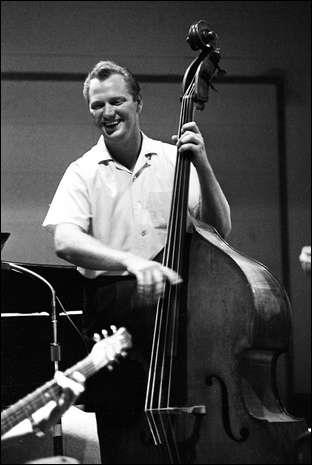
The bassist Bob Moore, a member of Nashville’s legendary A-team of studio musicians, has died at the age of 88. He played on some of my favourite pop records of the 1960s, but to be honest I’m not sure that I ever noticed the bass on any of them. That’s how good he was.

As a boy he had a shoeshine stand on a street corner close to the rear entrance of the Ryman Suditorium, home of the Grand Ole Opry, and he got his start after putting a regular five-cent polish on the cowboy boots of Ernest Tubb’s bassist, Jack Drake, who gave him informal lessons. His break came in his early teens when the great pianist and producer Owen Bradley called him in for his first session.

He wasn’t a James Jamerson or a Bootsy Collins, in the sense that he became famous for changing the role of the bass in popular music. But here are some of the hits on which he played: Patsy Cline’s “Crazy”, “Walkin’ After Midnight” and “I Fall to Pieces”. Elvis Presley’s “(Marie’s the Name) His Latest Flame”, “All Shook Up” and “Return to Sender”. Roy Orbison’s “Only the Lonely”, “Running Scared” and “Dream Baby”. Tammy Wynette’s “Stand By Your Man”. Don Gibson’s “Sea of Heartbreak”. Jim Reeves’ “He’ll Have to Go”. Leroy Van Dyke’s “Walk On By”. Hank Snow’s “I’m Movin On”. Brook Benton’s “Rainy Night in Georgia”. Floyd Cramer’s “Last Date”. Marty Robbins’s “El Paso”. Conway Twitty’s “It’s Only Make Believe”. Brenda Lee’s “Sweet Nothings”. Claude King’s “Wolverton Mountain”. George Jones’s “She Still Thinks I Care” and “He Stopped Loving Her Today”. Jeannie C. Riley’s “Harper Valley PTA”.

Some people, Moore once said, can play a hundred notes a second without making a contribution. Another person can play the one note that makes a better record. It’s not hard to guess in which category he belonged.