Skip to content

Posts from the ‘R&B’ Category

Steve Cropper 1941-2025

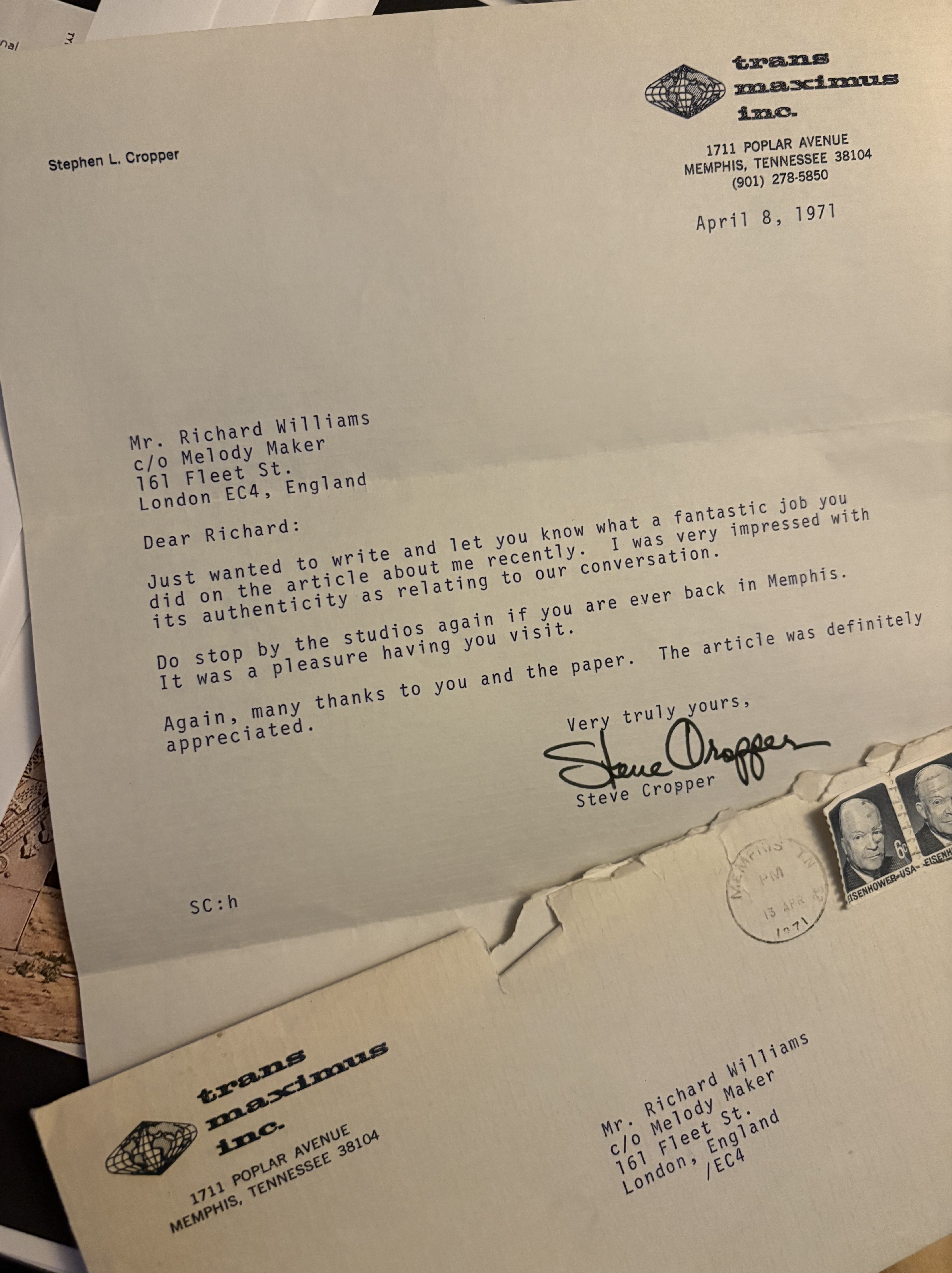
You don’t expect the people you interview to write thank-you letters, but it’s quite nice when they do. Particularly when it comes from someone like Steve Cropper, as happened to me in 1971 after I’d interviewed him for the Melody Maker at his new studio in Memphis on a break from a session he was producing for his old friend Eddie Floyd. I kept the letter, of course, as you would.

Cropper died this week, aged 84. Here’s the obituary I wrote yesterday for the Guardian. I hope I did him some kind of justice. He was a hero of mine, as were the other members of the MGs, ever since I first heard “Green Onions” in 1962. I have all their albums, all the way up to 1994’s That’s the Way It Should Be, and they’re among the last things I’d part with. My favourite is probably Soul Dressing, from 1965, even thought it was the one whose mediocre sales persuaded them that instrumental albums needed covers of familiar tunes in order to attract buyers.

Hence, on subsequent albums, things like their fine versions of the Temptations’ “Get Ready”, Gershwin’s “Summertime”, Cliff Nobles’ “The Horse”, the Delfonics’ “La-La Means I Love You” and Aretha’s “(Sweet Sweet Baby) Since You’ve Been Gone”. I listen to those alongside the MGs’ originals I love: “Big Train”, “Soul Sanction”, “Double or Nothing”, “Kinda Easy Like”, “Last Tango in Memphis”, “Cruisin'”, “Sarasota Sunset” and the rest. It was nice of Steve to take the trouble to express his thanks all those years ago. So now I’ll say thank you back to him, for all of it.

Everybody Loves a Train

About twenty years ago, my friend Charlie Gillett was compiling a series of themed CDs for a Polygram label called Debutante, under the aegis of the former Island A&R head Nick Stewart. Charlie asked me if I’d like to put one together, and if so, what the theme might be. “Trains,” I said, after about ten seconds’ thought, and then I went away to assemble a running order. It took a while, because I enjoyed the process so much.

Sadly, the series came to a sudden end before my contribution could see the light of day. But I’d edited together a disc of how I wanted it to go. I called it Everybody Loves a Train, after the song by Los Lobos. It has all sorts of songs, some of which speak to each other in ways that are obvious and not. I avoided the most obvious candidates, even when they perfectly expressed the feeling I was after (James Brown’s “Night Train” and Gladys Knight’s “Midnight Train to Georgia”) and instrumentals, too (see the footnote).

Every now and then I take it out and play it, as I did this week, with a sense of regret that it never reached fulfilment. Here it is, with a gentle warning: not all these trains are bound for glory. Remember, as Paul Simon observes, “Everybody loves the sound of a train in the distance / Everybody thinks it’s true.”

  1. Unknown: “Calling Trains” (From Railroad Songs and Ballads, Rounder 1997) Forty-odd seconds of an unidentified former New Orleans station announcer, recorded at Parchman Farm, the Mississippi state penitentiary, in 1936, calling from memory the itinerary of the Illinois Central’s “Panama Limited” from New Orleans to Chicago: “…Ponchatoula, Hammond, Amite, Independence… Sardis, Memphis, Dyersburg, Fulton, Cairo, Carbondale…” American poetry.
  2. Rufus Thomas: “The Memphis Train” (Stax single, 1968) Co-written by Rufus with Mack Rice and Willie Sparks. Produced by Steve Cropper. Firebox stoked by Al Jackson Jr.
  3. Los Lobos: “Everybody Loves a Train” (from Colossal Head, 1996) “Steel whistle blowin’ a crazy sound / Jump on a car when she comes around.” Steve Berlin on baritone saxophone.
  4. Bob Dylan: “It Takes a Lot to Laugh, It Takes a Train to Cry” (from Highway 61 Revisited, 1965) “Don’t the brakeman look good, mama, flaggin’ down the Double E?”
  5. Joe Ely: “Boxcars” (from Honky Tonk Masquerade, 1978) A Butch Hancock song. Ponty Bone on accordion, Lloyd Maines on steel guitar.
  6. Counting Crows: “Ghost Train” (from August and Everything After, 1993) “She buys a ticket ’cause it’s cold where she comes from / She climbs aboard because she’s scared of getting older in the snow…”
  7. Rickie Lee Jones: “Night Train” (from Rickie Lee Jones, 1979) It was a plane she took from Chicago to LA to begin her new life in 1969, and an old yellow Chevy Vega she was driving before she cashed the 50K advance from Warner Bros ten years later. But, you know, trains.
  8. The Count Bishops: “Train, Train” (Chiswick 45, 1976) London rockabilly/pub rock/proto-punk. Written by guitarist/singer Xenon De Fleur, who died a couple of years later in a car crash, aged 28, on his way home from a gig at the Nashville Rooms. Note that comma. I like a punctuated title.
  9. Julien Clerc: “Le prochain train” (from Julien, 1997) My favourite modern chansonnier. Lyric by Laurent Chalumeau.
  10. Blind Willie McTell: “Broke Down Engine Blues” (Vocalion 78, 1931) Born blind in one eye, lost the sight in the other in childhood. Maybe he saw trains in time to carry their image with him as he travelled around Georgia with his 12-string guitar.
  11. Laura Nyro: “Been on a Train” (from Christmas and the Beads of Sweat, 1970) One song she didn’t do live, as far as I can tell. Too raw, probably.
  12. Chuck Berry: “The Downbound Train” (Chess B-side, 1956) When George Thorogood covered this song, he renamed it “Hellbound Train”. He didn’t need to do that. Chuck had already got there.
  13. Bruce Springsteen: “Downbound Train” (from Born in the USA, 1984) “The room was dark, the bed was empty / Then I heard that long whistle whine…”
  14. Dillard & Clark: “Train Leaves Here This Morning” (from The Fantastic Expedition of Dillard & Clark, 1968) Written by Gene Clark and Bernie Leadon: “1320 North Columbus was the address that I’d written on my sleeve / I don’t know just what she wanted, might have been that it was getting time to leave…”
  15. Little Feat: “Two Trains” (from Dixie Chicken, 1973) In which Lowell George extends the metaphor of Muddy Waters’ “Still a Fool (Two Trains Running)”: “Two trains runnin’ on that line / One train’s for me and the other’s a friend of mine…”
  16. B. B. King: “Hold That Train” (45, 1961) “Oh don’t stop this train, conductor, ’til Mississippi is out of sight / Well, I’m going to California, where I know my baby will treat me right”
  17. Paul Simon: “Train in the Distance” (from Hearts and Bones, 1983) Richard Tee on Fender Rhodes. “What is the point of this story? / What information pertains? / The thought that life could be better / Is woven indelibly into our hearts and our brains.”
  18. Vince Gill: “Jenny Dreams of Trains” (from High Lonesome Sound, 1996) Written by Gill with Guy Clark. Fiddle solo by Jeff Guernsey. Find me something more beautiful than this, if you can.
  19. Muddy Waters: “All Aboard” (Chess B-side, 1956) Duelling harmonicas: James Cotton on train whistle effects, Little Walter on chromatic.
  20. Darden Smith: “Midnight Train” (from Trouble No More, 1990) “And the years go by like the smoke and cinders, disappear from where they came…”
  21. The Blue Nile: “From a Late Night Train” (from Hats, 1989) For Paul Buchanan, the compartment becomes a confessional.
  22. Tom Waits: “Downtown Train” (from Rain Dogs, 1985) “All my dreams, they fall like rain / Oh baby, on a downtown train.” A New York song.

Closing music: Pat Metheny’s “Last Train Home” (from Still Life (Talking), 1987) to accompany the photo of the Birmingham Special crossing Bridge No 201 near Radford, Virginia in 1957 — taken, of course, by the great O. Winston Link. Other appropriate instrumentals: Booker T & the MGs’ “Big Train” (from Soul Dressing, 1962, a barely rewritten “My Babe”) and Big John Patton’s “The Silver Meter Pts 1 & 2” (Blue Note 45, 1963, a tune by the drummer Ben Dixon whose title is a misspelling of the Silver Meteor, a sleeper service running from New York to Miami).

‘The Black Chord’

David Corio is a fine British photographer whose book The Black Chord, with text by the writer Vivien Goldman, first appeared in the UK 25 years ago. A new edition, published by Hat & Beard, a Los Angeles-based imprint, presents his images of black musicians via a much more elegant design.

Corio was born in London in 1960 and had his first work published when he was 18. Where he differs from Roy DeCarava and Val Wilmer, two other great photographers of black music, is that most of his subjects are caught in performance, on or off stage. DeCarava and Wilmer both sought particular kinds of intimacy, spiritual or domestic. Corio’s images tend to look outward, making a direct address to the viewer, which means they work well in magazine features and on album covers, and the 200-odd photographs here, beautifully reproduced, combine to make an exhilarating book.

The subjects range from the drummers of Burundi and a Santeria ceremony in Cuba through John Lee Hooker, Fats Domino, Bobby Bland, Aretha Franklin, Art Blakey, Celia Cruz, Fela Kuti, Abbey Lincoln, Ray Charles, Barry White, Millie Jackson, Lee Perry, Ornette Coleman, Al Green, Toots Hibbert, Salif Keita, De La Soul, August Darnell, Sade, the Last Poets, Alton Ellis, PM Dawn, Miles Davis, Foday Musa Susa, Nile Rodgers, Don Cherry, Missy Elliott, and of course Bunny, Tosh and Bob. And many, many others. Goldman’s love of this music, from blues to jazz via R&B, soul, reggae, salsa, afrobeat and hip-hop, originally on view in her work in the 1970s for Sounds, the Melody Maker and the NME, infuses the lively essays that intersperse the groupings of photographs.

One of the pictures I like best contains no performers: over a double-page spread, half a dozen boys perch together around a sound system in London in 1978, shot from below, exuding life and possibilities despite the implicit challenge of the world around them. It has poetry in it. As, more obviously, does the portrait of Nina Simone seen above and also on the book’s cover, taken during a performance at Ronnie Scott’s in 1984, a photograph to make you think a lot about troubled genius. That, too, is Corio at his best.

* The Black Chord by David Corio with text by Vivien Goldman is published by Hat & Beard (hatandbeard.com), price $60.

Down the Dungeon

You can still find men and women in their late 70s prepared to argue over the best act they ever saw at the Dungeon Club. Was it Little Stevie Wonder, then 15 years old, or Little Walter? The Who or the Small Faces? Patti LaBelle and the Bluebelles or Inez and Charlie Foxx? The Yardbirds or the Moody Blues? T-Bone Walker or Sonny Boy Williamson? Sugar Pie DeSanto or the Soul Sisters? The Action or the Move? Lee Dorsey or Wilson Pickett? The Alan Bown Set or the Jimmy Brown Sound?

Stanford Street is an unremarkable stretch of road, about a hundred yards long, leading up from the empty shopfronts of Lister Gate in the centre of Nottingham towards the hill on which the Castle stands. It’s amid something of a wasteland now, close to the demolished remains of the Broadmarsh shopping centre, which awaits the money for redevelopment as an urban park. The estate agents’ website currently offering office space at No 6 — “to be refurbished to a high standard throughout” — mentions the building’s period features but nothing about its history, which I’m guessing began in the late 19th century with an involvement in the city’s then-thriving textile industry.

On July 10, 1964 — 60 years ago this week – the ground floor and basement of 6 Stanford Street were opened by a man called Mick Parker as a club for live music with room for two or three hundred teenagers and no drinks licence. It lasted three and half years. During its short but hectic life, the Dungeon’s basement stage hosted the artists mentioned above, and many others, including Georgie Fame and the Blue Flames, the Exciters, Long John Baldry’s Hoochie Coochie Men, the Moody Blues and the Dixie Cups (with Alvin “Shine” Robinson on guitar).

In those years Manchester had its Twisted Wheel, Sheffield had its Mojo and Newcastle had its Club A Go Go. London, of course, had its Flamingo and Marquee. But we in Nottingham felt lucky. We had the Dancing Slipper, where the acts booked by Bill “Foo” Kinnell (say it quickly) evolved from trad jazz to R&B (and where I first saw the 19-year-old Rod Stewart with Baldry’s band). We had the three rowing clubs, cheek by jowl along the towpath by Trent Bridge: the Union, the Britannia and the Boat Club, all of them with upstairs rooms presenting live music three or four nights a week: Graham Bond, Herbie Goins, John Mayall, Freddie Hubbard, eventually even the Pink Floyd. In the Lace Market there was the Beachcomber, where we were fortunate enough to see Jimi Hendrix, Martha and the Vandellas and the complete Ike & Tina Turner Revue at very close quarters.

But the Dungeon was a special place, which is why this week there will be an event commemorating its 60th anniversary. It was the centre of mod culture in the region, where the music you danced to and the clothes you wore seemed like the only things that mattered in life.

I was lucky enough to play there a number of times in a local semi-pro R&B band called the Junco Partners — not to be confused with the slightly better known Newcastle band who’d also borrowed their name from a record made in 1952 by the Texas-born singer James Wayne. I joined them in the autumn of 1964, playing drums alongside Mick Dale (lead guitar), Dave Turner (rhythm guitar, harmonica and vocals), an art student from down south called Ian Taylor on electric piano, and our leader, Rae Drewery, on bass guitar and vocals. (Rae was a builder by trade and after work he’d clear out his Transit van to take us and our gear to gigs; he was already the father of a small daughter who would become the wonderful Corinne Drewery of Swing Out Sister.)

We were all blues fans, missionaries for this music, and our repertoire included Sonny Boy’s “Don’t Start Me to Talkin'”, Howlin’ Wolf’s “Smokestack Lightnin'”, Jimmy Reed’s “Baby What You Want Me to Do”, Muddy Waters’s “Hoochie Coochie Man”, Bo Diddley’s “Before You Accuse Me” and “Mama Keep Your Big Mouth Shut”and John Lee Hooker’s “Boom Boom” and “Dimples”. Cultural appropriation on a grand scale, in other words. But, you know, at that stage everybody — us, the audience, the originators — benefited from this enthusiasm.

We were getting about £25 a night, as I recall, and it took us a few months to move up from art college hops, blues clubs and pub gigs to the comparative big time of the Dungeon. When an act couldn’t make it one Sunday just before Christmas, Parker called us in at a couple of hours’ notice to play what amounted to an audition. We must have passed because he booked us in to play on a Saturday night in January 1965, supporting the Original Checkmates.

Eight days later we were back in support of the Applejacks. A month later we were supporting Screamin’ Jay Hawkins, then the Lancastrians. In March we supported Robb Storme and the Whispers, Screamin’ Lord Sutch and the Savages, and the Moody Blues, a couple of months after “Go Now” had topped the chart. In April we supported Baldry, Mark Fayne and the Fontaines, and Eden Kane and his Downbeats. And on Friday 4 June we were the sole attraction: topping the bill.

A couple of weeks later I played my last gig with Rae, Mick, Dave and Ian, and went off to get a haircut and start a job. You can see us in those two photos (alas, only the top of Ian’s head), taken on one of those nights at the Dungeon. There’s also my membership card, with which I was able to dance with my friends to the likes of James Brown’s “Out of Sight” and Jr Walker’s “Shotgun”. I can’t be there to celebrate the anniversary this week, but a feeling for the place has never left me.

Mod dreams

Q: Were there ways of walking?

A: Yeh. You walked speed-wise which is you put your hands in your mod jacket, in your Tonik jacket, which had three-inch lapels and a seven-inch centre vent, and breast pleats to give it enough tuck. It was a very solid cloth, a very heavy cloth, so you’d tuck your hands in there and you’d have flaps on the pockets. You’d have your jeans turned up and you’d have Hush Puppies with a pair of white socks. You’d be walking with three other friends up Great Windmill Street or Wardour Street at five or six in the morning just as light is coming up. Your head is bent against the wind, you’ve got your head down…

That’s Peter Meaden talking, interviewed by the writer Steve Turner in 1975, three years before he died at the age of 36, felled by barbiturates and vodka in his parents’ house in North London, where he had dreamed his mod dreams many years earlier, finding the Who and turning them from the Detours into the High Numbers — turned them into mods, getting them the French crop haircuts and the correct clothes, and writing the words for their first single — before accepting £500 to hand over their management to Kit Lambert and Chris Stamp.

Meaden was one of those people, like Guy Stevens, Andrew Oldham and Tony Hall, who shaped the London music scene in those vital years between 1963 and 1965. He deserves a book of his own, and now he has it. Steve Turner’s King Mod is his story, in all its slender, obsessive, doomed glory.

Once asked to define modism, Meaden came up with a much repeated phrase: “Clean living in difficult circumstances.” He provides another version here: “Mod is another aphorism for precision in life.” Romantic nonsense, of course. But part of the legend.

“Modism was my dream,” Meaden says in the unedited transcript of the interview that constitutes the second half of the book, after Turner has taken us through a relatively conventional narrative. Meaden’s words are rambling, repetitive, sometimes inaccurately recalled, the strange and touching testimony of a man who had a dream and saw it come more or less true but lacked, as Turner says, the business acumen and ruthlessness to profit from his vision as others did.

Stevens, who played records from his collection of red-hot R&B obscurities at the Scene Club in Ham Yard, just off Great Windmill Street, and had the 45s from which Meaden borrowed the music for his High Numbers songs, went on to involvement with Island Records, Spooky Tooth, Mott the Hoople, Free and the Clash. Oldham, who had partnered Meaden in a short-lived PR company, managed the Stones until they were taken from him, and created the Immediate label. Hall was one of the great promotion men of the British music business, a cool cat who moved smooth from the bebop ’50s to whatever came next, and who once threw Meaden out of a reception for Ben E. King with the words, “You’re a pilled-up mod!”

Which Meaden certainly was, as he goes to some lengths to explain in his descriptions of the virtues of Drinamyl — “good old Purple Hearts” — particularly when mixed, as was his preference, with cider. “It was bliss. Cocaine they say is bliss these days but it’s not bliss like a bit of speed in you, a couple of pints of cider maybe, down there bopping round from Friday night through until Sunday morning. Say no more!” One of the things he liked about Drinamyl was that it suppressed the libido. “You no longer have to worry about pulling a chick and making it because that’s what you feel the world made you for.” With girls out of the picture, there would be more time for the purer pursuits of choosing the right shirt at Austin’s on Shaftesbury Avenue or the right boots from Anello and Davide on Charing Cross Road.

Then acid arrived on the scene, and the picture — once so sharp and precise — started to go fuzzy. Some, like Townshend, who gave Meaden his first trip, could cope. Meaden was one who couldn’t, spending chunks of the years before his death in psychiatric care, as much of a casualty as Nick Drake or Syd Barrett.

It’s a curious book. More meticulous editing would have removed a plethora of irritating misspellings and inconsistencies: Kingley Street, vocal chords, Petula Clarke, Roger Daltry and Rick Gunnell are just a few of them, while a Miracles song that the High Numbers covered appears on the same page as “You Gotta Dance to Keep from Crying” (in the text) and “I Gotta Dance to Keep from Crying” (in a caption). And there is the increasingly common habit, infuriating to me, habit of capitalising the definite article in references to The Who, The Beach Boys, The Goldhawk Social Club, and so on.

But it’s clearly a labour of love by an author whose previous works have dealt with the Beatles, U2, Marvin Gaye, Johnny Cash, Van Morrison and religion in rock, and it’s very well illustrated. For anyone to whom the all too short era of modism — to use Meaden’s term — was something precious, its historical value in unquestionable.

* Steve Turner’s King Mod: The Story of Peter Meaden, the Who, and the Birth of a British Subculture is published by Red Planet Books (£25).

Val Wilmer: ‘Blue Moments, Black Sounds’

Val Wilmer is one of the most remarkable people I know, and you’ll know that too if you’ve seen her photographs. Whether it’s Muddy Waters playing cards with Brownie McGhee backstage at the Fairfield Halls in 1964, Archie Shepp sitting beneath a Jimi Hendrix poster in his New York apartment, or a joyful couple whose names we’ll never know at a blues dance in Bentonia, Mississippi half a century ago, she finds the essence of the human spirit.

Those three images are among the several dozen included in Blue Moments, Black Sounds, an exhibition of her photographs which opened this week. It’s on until the end of November at a very nice little gallery in Queen’s Park, North London, which specialises in music photography and where you can also go to get your own pictures framed.

I was particularly moved by the only photograph in the show that has an extended caption, written by Wilmer, in which she tells of going to see Louis Armstrong at Earl’s Court in 1956, when she was a 14-year-old schoolgirl. When Armstrong and the All Stars left the country, catching a plane to Ghana, she and her brother went to see them off at the airport. She took her mother’s Box Brownie camera, asked Louis if she could take his photograph, and got a lovely shot that put her, as she says, “on my way to a lifetime of learning.”

Then she adds something interesting and important: “Through getting to know the musicians, I learnt the importance of positive representation.” That doesn’t mean she learnt how to take PR photographs. It means she learnt to appreciate the importance of immersing herself in the world of her subjects, in order to portray them with greater sensitivity to their lives and to the art that came from it, and to realise that pictures of Ornette Coleman playing pool with Anthony Braxton or members of the Count Basie orchestra snoozing on the band bus can actually tell us more than photos of them on stage.

Those photographs, like most of the ones in the new show, could only have been taken by someone possessing not just painstakingly acquired technical skills but a deep sympathy with the music and the lives of those who make it, and with the courage and humility to take her own place in their world, and to find her unique vantage point.

* Val Wilmer’s Blue Moments, Black Sounds is at the WWW (Worldly, Wicked & Wise) Gallery, 81 Salusbury Road, London NW6 6NH until 30 November: wwwgallery@yahoo.com. Deep Blues 1960-1988, a pamphlet of Wilmer’s photographs from the world of the blues, edited by Craig Atkinson, has just been published by Café Royal Books: caferoyalbooks.com. Wilmer’s As Serious As Your Life: Black Music and the Free Jazz Revolution 1957-1977 is published by Serpent’s Tail.

Our Island Story

To those who found Chris Blackwell’s 2022 autobiography, The Islander, long on charm but, shall we say, short on detail, The Island Book of Records Vol 1 1959-68 will be the answer to their prayers. Here is the story of the UK’s most charismatic independent label during its formative years, in which the foundations were laid for the company that would later become the home of King Crimson and ELP, the Wailers and Bob Marley, Roxy Music, Bryan Ferry and Brian Eno, Sandy Denny, Sparks, John Martyn, U2 and Grace Jones before Blackwell sold it to Polygram in 1989.

Comprehensively compiled and meticulously edited by Neil Storey, who worked in the label’s press office (and was more recently responsible for the Hidden Masters archive box sets devoted to Chris Wood and Jess Roden), the book’s large square format — handsomely designed by Jayne Gould — enables LP covers to be reproduced at their original size. The scale also allows the enormous amount of information to breathe amid the mass of photographs, press cuttings, record labels and other paraphernalia and ephemera, plus masses of oral history from figures both famous and unknown to the general public but significant to the way the label was run, all deployed to inform and entertain.

After Storey’s discursive and amusing introduction, it begins by describing Blackwell’s origins in Jamaica and the UK, including a Daily Mirror clipping from 1933 showing a picture of his mother on her way to Buckingham Palace be presented as a debutante to King George V and Queen Mary, and his own Harrow School house photo from 1954. Island’s first release, the cocktail pianist Lance Haywood’s At the Half Moon Hotel, Montego Bay, from 1959, is accompanied by quotes from Blackwell, the guitarist Ernest Ranglin, the drummer Clarence “Tootsie” Bear, and the daughter of the hotel’s director, who invited Blackwell — then a water-ski instructor — to listen to the trio performing in the lounge, an encounter on which history hinged.

That’s the degree of depth the reader can expect, whether the subject is Jackie Edwards, Millie Small, Traffic, Jimmy Cliff, Spooky Tooth and the nascent Fairport Convention or the American artists — Ike & Tina Turner, James Brown, Inez & Charlie Foxx, J. B. Lenoir, Billy Preston, Jimmy McGriff, the pre-Spector Righteous Brothers and Huey “Piano” Smith — released on the Sue label by Guy Stevens, the DJ at the Scene club in Ham Yard whose vision was recognised and given free rein by Blackwell, to the lasting benefit of me and many other ’60s teenagers.

The more obscure bands — Wynder K. Frog, Art, Nirvana, the Spontaneous Music Ensemble — are covered in full, as are the projects undertaken to pay the bills while providing a laugh along the way: That Affair (about the Christine Keeler scandal), Music to Strip By (with a lace G-string stuck on to the cover), For Adults Only (comedy) and Big Theo (Johnson)’s Bawdy British Ballads. The company’s first gold disc was apparently secured by Why Was He Born So Beautiful by the Jock Strapp Ensemble, the first of several volumes of rugby songs, at least one of which was recorded at Sound Techniques by the engineer John Wood, who would later record Nick Drake and the other Witchseason artists at the same Chelsea studio.

The making of all these is illuminated by the people who were there, not just the artists but those who were playing important roles in the background, whether by working in the Basing Street office — where everyone sat at round tables, erasing a sense of explicit hierarchy — or by going around the country selling the records, or simply by being Blackwell’s friends. How they all made it up as they went along, and how the founder encouraged and allowed it to happen, is an object lesson in human and cultural dynamics.

“I’m not a collector,” Blackwell says. “I was always looking forward.” Island maintained no real-time archive during his era (which, of course, made Storey’s task of research more demanding and almost certainly more entertaining). When I worked in A&R there, in the mid-’70s, someone told me one morning that the Richmond branch of the Blackwell-owned One Stop Records was closing that evening and that the basement contained a cache of the company’s old 45s. They were going to be chucked out and did I want to do something about them? Collectors had better close their eyes at the next bit: I drove straight down there, found boxes and boxes of mint Sue and white-label Island singles from the ’60s, sorted out two of each — one for the company, one for my office — and sent the rest to be melted down. I have no idea what happened to the ones I saved after I left in 1976. Everyone was looking forward, which is the right way to run a record company.

* The Island Book of Records Vol 1 1959-68, edited by Neil Storey, is published by Manchester University Press (£85).

Sly Stone’s testament

On Thursday, September 3, 1970, a few days after Sly and the Family Stone had appeared at the Isle of Wight festival, I had an appointment to interview him for the Melody Maker at the Londonderry House Hotel on Park Lane. He blew me out, and the appointment was rearranged.

I turned up again at the hotel promptly at 6.30pm on Monday, September 14. I was shown up to his suite and invited to take a seat in the drawing room, where I could wait for him to emerge. Then I was left alone.

The door to the bedroom was ajar. From inside I could hear the sounds of what sounded like two people. They were intimate sounds. Giggling. Gasping. Other noises. It was hard to know whether someone was putting on a show for my benefit, but I chose to assume it wasn’t an invitation to join in.

So I stayed in my chair and waited. The sounds continued. No one emerged. After what may have been 15 or 20 minutes, I gave up and left, without an interview. Two nights later I saw Sly and his band give a performance at the Lyceum that started late and lasted barely an hour but in the end comfortably overcame the handicap of a very poor PA system.

What had been going on? There’s a clue in Thank You (Falettinme Be Mice Elf Agin), Sly’s new autobiography. Writing about that visit to London, he mentions meeting up with Ginger Baker. “Ginger showed off some high-quality coke, pharmaceutical grade, and then he mentioned a big party that night where Jimi Hendrix would be. He had an idea of sharing the coke with Jimi, only the best for the best. I was eager to see Jimi. We were scheduled to have a jam session the night before, or maybe that night, but Jimi had gone to Ronnie Scott’s instead to jam with Eric Burdon and War. And Jimi wasn’t at the party either. ‘We’ll catch him tomorrow,’ someone said. As it turns out, there was no tomorrow, at least for Jimi.”

Most drug-related deaths of stars who came up in the ’60s happened fast, their lives ending while they were still shockingly young. By contrast, Sly’s happened in slow motion, killing first his concentration and then his creativity, and of course it isn’t over yet.

Now he’s 80, apparently freed from his long-term crack addiction and seemingly in good enough shape to have given a co-writer, Ben Greenman, the material from which to fashion a ghosted autobiography. I read it without, I’m afraid, much enthusiasm. You may feel differently about the blurred, indistinct story of a man whose most characteristic utterance, at least as far as the specificity of the narrative is concerned, is “I heard about it later, but it was too late.”

He was, of course, a genius. If you were around in 1967, you’ll know that “Dance to the Music” proposed nothing less than a new kind of pop music. The only other record of that year which brought black and white into such fruitful creative miscegenation was “Purple Haze”. Out of those two records came an entire universe. With another hit single, “Thank You (Falettinme Be Mice Elf Agin)”, Sly kicked funk up a gear. And There’s a Riot Goin’ On, in all its self-indulgence, is one of the key documents of the early ’70s. Nothing quite chills the blood like that rusted-out voice opening a No. 1 single with “One child grows up to be / Somebody that just loves to learn / Another child grows up to be / Somebody you’d just love to burn.”

So it made me sad to read this book, a chronicle of waste and unreliability. What might Sly Stone have achieved, had he grow out of his addictions much earlier in the way that, say, John Coltrane did? Some will respond that what he achieved was enough, that he could only do those things by being himself, and maybe that’s right. Many of those people will no doubt enjoy what he has to say, and I wouldn’t want to put them off.

His ghostwriter has clearly mined the cuttings file in order to provide the detail. That makes reading it an uneven experience, as passages of woozy semi-recall concerning family feuds or disputes with managers and record companies are suddenly interrupted by something curiously precise, whose source might be a TV interview preserved on YouTube. Sadly, my experience of failing to interview him means that I can’t tell you whether Greenman has found a way, as a good ghost should, to translate Sly’s authentic voice on to the page. But in the end I didn’t feel I’d been told anything surprising. It’s the book of the guy who, one September evening in 1970, wouldn’t come out of his bedroom.

* Sly Stone’s Thank You (Falettin Me Be Mice Elf Agin) is published in the UK by White Rabbit on 17 October.

Chapel of love

This September it will be 70 years since Roebuck Staples took his daughters Cleotha and Mavis and his son Pervis into a studio in Chicago where, accompanied by his guitar and the piano of Evelyn Gay, they made their first recordings. Mavis had just turned 14, but the unearthly power of her voice was already transfixing congregations in the local churches where they sang. Now the only survivor of the Staple Singers, she’ll turn 84 in a few days’ time, and this week she returned to London to fill the Union Chapel to capacity two nights in a row, still growling and roaring out her message of love, still a tireless soldier in the army of her Lord.

She’s a monument, and that’s all there is to it. To attempt to “review” her would be an insult. It’s enough to say that she and her two female singers and three-piece rhythm section delivered a well chosen repertoire with vigour and warmth to a clamorously admiring and affectionate response. She spoke of the Union Chapel, a Grade 1-listed nonconformist church built in 1870s and still doing work for the homeless, isolated and dispossessed, being “home”, and that’s how it felt.

The songs she performed included beautifully minimalist versions of Norah Jones’s “Friendship” and Ike Cargill’s “Are You Sure”, and trenchant readings of Stephen Stills’s “For What It’s Worth”, Talking Heads’ “Slippery People”, Funkadelic’s “Can You Get to That” and Dottie Peoples’ “Handwriting on the Wall”. And, most of all, “Respect Yourself”, a song by Luther Ingram and Mack Rice that the Staple Singers recorded in Muscle Shoals, Alabama in 1971, and whose sentiments carry even greater force half a century later. If the song’s brand new day has yet to come, it’s not Mavis’s fault. As she once sang, she’ll never turn back.

Still Kokomo

No band is more likely to make me smile from the first note than Kokomo. Almost 50 years after they emerged in the pubs of London, they’re still at it. Much changed, as we all are since we first gathered in Islington’s Hope & Anchor to marvel at the authenticity of their feeling for funk, but still keeping the faith.

Of the original members, the singer Frank Collins, the singer/keyboardist Tony O’Malley, the percussionist Jody Linscott and the guitarists Jim Mullen and Neil Hubbard were present last night at the Half Moon in Putney, one of their favourite venues. They were joined by the bassist Jennifer Maidman and the drummer Andy Treacey, long-term replacements for Alan Spenner and Terry Stannard, the saxophonist Jim Hunt, filling Mel Collins’s shoes, and the singers Helena May Harrison and Charlotte Churchman, who since 2014 and 2017 respectively have replaced the late Dyan Birch and Paddie McHugh.

The repertoire doesn’t change much as these reunions come around. No Kokomo fan would go away entirely happy without having heard Bill Withers’ “Lonely Town Lonely Street”, O’Malley’s instrumental “Tee Time”, Allen Toussaint’s “Yes We Can”, Hubbard’s sweetly soaring “Anytime” or their traditional showstopper, Bobby Womack’s “I Can Understand It”.

The sound was rough last night, and one or two instrumental stretches went on a bit too long, but the general vibrancy made up for it. The highlights for me were Churchman’s storming delivery of Stevie Wonder’s great “So What the Fuss”, Harrison bossing “Stuff Like That”, the divine Linscott’s beautifully subtle conga-playing on the closing “Third Time Around”, and Jim Hunt’s gruff Texas tenor touches throughout. It all made me very glad that there are still nights like these.