Skip to content

Posts from the ‘Pop’ Category

The art of the songwriter

Bacharach 1The biggest mistake Burt Bacharach ever made was to place an international call to Hal David one day in 1972 and tell him he wanted a bigger share of the five per cent royalty due to the pair from their songs for the film Lost Horizon, a misbegotten musical remake of Frank Capra’s pre-war classic. Until that point the composers of “Anyone Who Had a Heart”, “Do You Know the Way to San Jose?” and so many others had split the proceeds of their work straight down the middle. But suddenly it occurred to Bacharach that here he was, working himself to the bone in the studio on the arduous task of recording the songs and the background score, while David, having done his job by furnishing the lyrics, was down in Mexico, playing tennis. In Bacharach’s view, a 3:2 split would more accurately reflect the relative amounts of effort involved.

David’s answer, quite understandably, was a brusque negative. From the lyricist’s standpoint, it was the suavely handsome and charismatic Bacharach who had already been attracting the lion’s share of the personal publicity accruing from their success; he was the one who appeared in concerts and on television and made his own albums devoted to instrumental albums of their songs. By contrast, David was a charisma-free zone, but the words he provided were certainly as important as the music in what had become known, to his quiet chagrin, as “Bacharach songs”. And that dispute marked, to all intents and purposes, the end of one of the greatest songwriting partnerships in the history of 20th century popular music.

Bacharach tells the story in Anyone Who Had a Heart: My Life and Music, an autobiography ghosted by Robert Greenfield and just published by Atlantic Books. He’s a classic unreliable narrator, a fact tacitly acknowledged by the inclusion of sometimes corrective first-person testimony from ex-wives, lovers and former collaborators, but he leaves us in no doubt that he rues his hot-headed decision to reply to David’s refusal with these words: “Fuck you and fuck the picture.” In the short term, it led to Dionne Warwick suing both of them for their failure to come up with the songs promised for her next album, her first for Warner Brothers; there were countersuits, and the three of them didn’t speak to each other, let alone work together, for 10 years. “It was stupid, foolish behaviour on my part and I take all the blame for it,” Bacharach says now. Later in the book he ruminates on how many great songs might have been lost to that sudden rupture.

Ah well, the years of full production were wonderful while they lasted. It would be impossible to  convey to a young person the shock and awe one felt on hearing Dionne’s “Anyone Who Had a Heart” for the first time in 1963: it sounded like a completely new form of music, something that blended the grown-up sophistication of the great Broadway songwriters with the emotional directness and urgency of the combination of R&B and gospel that was at that moment giving birth to soul music. Bacharach recognises how fortunate he was to find Warwick, the perfect interpreter of their songs, but if there is one thing missing from the book, it is his considered analysis of why black voices were in general so much more effective that white ones on the songs he and David wrote. There were exceptions, of course (one thinks of Dusty Springfield’s versions of their early songs, particularly “The Look of Love”, Herb Alpert’s “This Guy’s in Love With You” or Gene Pitney’s “Twenty Four Hours from Tulsa” and “Only Love Can Break a Heart”), but Warwick, the Shirelles, Lou Johnson, Chuck Jackson and Jimmy Radcliffe added an uptown quality that gave the material a priceless extra dimension.

There’s interesting stuff in the book about Bacharach’s childhood and apprentice years, about his time spent as Marlene Dietrich’s musical director, and a great deal about his four wives — including the actress Angie Dickinson, the second, and the songwriter Carole Bayer Sager, the third — and his many lovers. It’s seldom less than interesting, and when it comes to the description of the life and tragic death of Nikki, his daughter with Dickinson, who was born and lived most of her 30 years with undiagnosed Asperger’s syndrome, it is deeply upsetting.

The stuff about the music is less detailed. I’d have liked much more about the thinking behind, say, his preference for legit-toned rather than jazz-toned saxophones and his liking for twangy guitars, but there are still plenty of nuggets about such topics as his fondness for using a pair of flugelhorns (e.g. on Dionne’s “Walk On By”, which also has a pair of pianos, played by Paul Griffin and Artie Butler), a few enlightening bits and bobs about the sessions in New York and London, and some insights into the variety of approaches he and David employed in order to dovetail their contributions. There doesn’t seem to have been a strict music-first or words-first formula; the constant, we are led to believe, was Bacharach’s insistence on finding the right note and harmonic colouration for each word. It’s a shame they got sidetracked by the lure of Broadway musicals and the movies, a temptation which eventually did for them. The business of crafting their jewel-like individual songs should have been enough, as Bacharach now seems to recognise.

I’m pleased that he devotes a couple of pages to the album he made with Ronald Isley in 2003 for the DreamWorks label. Here I Am, which borrows its title and its lovely title song from my favourite Dionne Warwick LP, is a magnificent recital of mostly familiar material, with quite startlingly exquisite versions of “Alfie” and “Anyone Who Had a Heart” in particular, all recorded live in the studio — vocals and orchestra at the same time, with only the tiniest bits of vocal patching required. Listen to “Alfie”: you won’t hear better singing anywhere, and it was a first take. Unfortunately, as Bacharach relates, the album came out just as DreamWorks was being bought by Universal and got lost in the shuffle. It’s a half-buried classic.

Probably even fewer people heard Bacharach’s last solo album, At This Time, released in 2005. Most of the lyrics were written by Tonio K, and some by Bacharach himself. Interestingly, they express his anger at the crimes of George W. Bush’s neo-con gang. It’s a reminder that he and David also produced a couple of the Sixties’ gentlest protest songs: “What the World Needs Now Is Love” and “The Windows of the World”. What a pity circumstances conspired to silence their collaboration.

Just about to start a short tour of the UK, Bacharach is promoting the book and a new six-CD box called The Art of the Songwriter, whose compilers have made some pretty strange choices, such as the complete absence of anything by Lou Johnson, who came close to becoming the male equivalent of Dionne Warwick, and whose early work with Bacharach and David is compiled on a fine Ace disc titled Incomparable Soul Vocalist. Bacharach is appearing in concert at the Royal Festival Hall in London on Wednesday, Glasgow on Friday, Edinburgh on Saturday, Bournemouth on July 5 and the Festival Hall again on July 7, which is when I hope to hear him.

In the meantime, here’s my all-time Bacharach top 10: 1 Chuck Jackson: “Any Day Now” 2 Dionne Warwick: “(Here I Go Again) Looking With My Eyes (Seeing With My Heart)” 3 Ronald Isley: “Alfie” 4 Burt Bacharach Orchestra: “Wives and Lovers” 5 Fifth Dimension: “One Less Bell to Answer” 6 Dionne Warwick: “If I Ever Make You Cry” 7 Lou Johnson: “Kentucky Bluebird (Message to Martha)” 8 Herb Alpert: “This Guy’s in Love With You” 9 Dusty Springfield: “The Look of Love” 10 Jimmy Radcliffe: “Long After Tonight is All Over”.

Darkness on the edge of London

BruceBruce Springsteen took everyone by surprise with the announcement, about an hour into last night’s Wembley concert, that he and the E Street Band were going to stop answering requests and instead play Darkness on the Edge of Town, his great LP from 1978, in its entirety, from start to finish. This, after all, was a stop on the Wrecking Ball tour, promoting his latest album; it’s two and a half years since the documentary recounting the making of Darkness was released, with a great deal of attendant publicity. But what a fabulous decision it turned out to be.

The group of musicians on stage,  nowadays numbering about 17, was stripped back to something closer to the original E Street line-up as they set off into “Badlands”, hardly drawing a breath until the last chord of the title song died away three-quarters of an hour later. They gave the 10 songs a performance of unbroken seriousness and intensity, with several emotional peaks. For me, those came with a brutal “Adam Raised a Cain”, the shiver-inducing slalom through “Candy’s Room”, the finest reading of “Racing in the Streets” I’ve ever heard him give, and a majestic conclusion with “Darkness” itself.

For most artists, those 45 minutes would be enough to justify taking the audience’s money. Springsteen, however, gave us another two and a half hours of fun, games, and tears. I wished Curtis Mayfield had been alive to hear “People Get Ready” appended to the set-opening “Land of Hope and Dreams” as a coda and benediction; he would have been proud and delighted to hear his great anthem put to such fine use. The communal singing of the first verse of “Hungry Heart” and various bits of “Dancing in the Dark” reminded me for the umpteenth time that Springsteen is happy to give everyone in the audience a chance to share the experience of being the lead singer with the E Street Band. “Twist and Shout” came in a cowbell-paced version that would have pleased Bert Berns, the song’s co-writer and the master of bringing Latin accents to uptown pop-R&B, and might have come off a 1966 Bang Records 45. And to finish off, after the band had left the stage for the last time, their leader returned, alone with an acoustic guitar and a harmonica harness, to do that other trick of his: bestowing upon you the illusion that he’s chosen one of the night’s song just for you, personally. On this occasion it was a lovely unadorned version of “Thunder Road”, the first song he played on his London debut — his first concert outside the United States, in fact — back in 1975.

I have couple of criticisms. While the idea of replacing the sadly departed Clarence Clemons with a five-piece horn section is a good one (and Jake Clemons, Clarence’s nephew, does a lively job of filling the hole left by his uncle’s sound and personality), there are now too many musicians on stage: the sound is often too full, too massive, with Max Weinberg’s technically flawless big-band drumming filling too many holes, and the ensemble loses the precious sense of mobility and flexibility that was its hallmark (and which was immaculately reconstituted on the Darkness songs). On this night, too, from my pretty good seat, the sound was affected by a strong echo reflecting back from the stadium’s upper tiers, by a frequent indefinable booming sound in the lower frequencies, and by an occasional lack of muscle in the midriff.

That’s small stuff, however, when compared with the pleasures of an evening spent in the company of a man whose humanity and generosity of spirit continue to make his every concert a unique experience.

Notes on Modernism

Ben Sherman 2The archetypal Mod was male, sixteen years old, rode a scooter, swallowed pep pills by the hundred, was obsessed by cool and dug it. He was also one hundred per cent hung up on himself, on his clothes, hair and image; he thought of women as a completely inferior race. In every way, he was a miserable narcissistic little runt.

Richard Weight uses those words by Nik Cohn, from a 1989 essay, as an epigraph to the final chapter of his book Mod: A Very British Style, just published by Bodley Head. There could hardly be a more authoritative source: Cohn was in London when it all happened, he became a close friend of Pete Townshend, and his books Awopbopaloobam Alopbamboom and I Am Still the Greatest Says Johnny Angelo were arguably the first really credible works of literature to come from the pen of an author whose background was in writing about post-war pop music, long before Nick Tosches, Peter Guralnick, Stanley Booth or Greil Marcus could be found between hard covers. I’ve always loved his stuff. But in this case I disagree with almost every word.

Mod has passed into socio-cultural history as a set of codes, mostly to do with appearance and attitude: the scooters, the purple hearts, the mohair suits, the parkas, the roundel T-shirt, the blocked stare, the fights with rockers in Margate and Brighton. That was one dimension of the Mod world, for sure, and you’ll find it immortalised and exploited in any of the thirty-odd Ben Sherman stores currently doing business around the world, not to mention in the persons of such celebrated revivalists as Paul Weller and Brad Wiggins. But in reality that wasn’t more than a part of the story; it just happened to be the part that appealed to the media and won space for itself in the magazines, the tabloid newspapers and the TV news.

If I tried to tell you that from my perspective, living through it and feeling strongly as though I were a part of it, Mod had nothing to do with scooters or misogyny, and not much to do with pills, you probably wouldn’t want to believe me. You might be like the newspaper editor in The Man Who Shot Liberty Valance, who tells his companion: “This is the West. When the legend becomes fact, print the legend.” And I might respond by telling you about a conversation I had a few years ago with a man who figured in a book I’d written. Rather foolishly, I asked him if he’d read it. “No, Richard,” he said. “I haven’t. I don’t need to. I was there.”

Mod was certainly Sabre knitwear, boots from Raoul, hard-edged graphic design, trying to imitate Alain Delon’s haircut and perfecting the right kind of nonchalant dance, based on little more than the almost imperceptible oscillation of the right knee. But it was also L’Etranger and Kind of Blue. There was more to Mod than a class-based movement: it was much subtler and more various. And it was not, from where I was standing, remotely misogynistic; quite the opposite, since girls shared the obsessions on an equal footing.

Richard Weight’s book examines the era in question but also goes much further. It is an investigation into the various movements that dominated British youth style over the last 60 years, taking in glam, punk, new romanticism and Britpop as well as the Mod revival. To Weight, the attitudes that gave rise to Mod provide the connective tissue, and this is a work of social anthropology as much as a history of style. It may be merely a reflection of my limited outlook that I’d have preferred an authorial focus more clearly based on the promise of the book’s title, in other words concentrating on a period that began for me in 1962 — the first Chelsea boots — and ended in 1967, when the ominous tinkle of Tibetan prayer bells was heard in the land.

Since this blog is supposed to be about music, and since music was the most potent of all the factors that united the people who thought of themselves as Mods, here’s a list of 20 club records that, while not necessarily being my absolute favourites, summon the mood and the spirit of the era as I remember it. They are in no order.

1 Bobby Parker: “Watch Your Step” 2 John Lee Hooker: “Boom Boom” 3 Earl Van Dyke: “All For You” 4 Rex Garvin and the Mighty Cravers: “Sock It to ‘Em, J.B.” 5 Billy Preston: “Billy’s Bag” 6 The Drifters: “At the Club” 7 The Hit Pack: “Never Say No to Your Baby” 8 Solomon Burke: “Everybody Needs Somebody to Love” 9 Jimmy Hughes: “Goodbye My Love” 10 Jr Walker and the All Stars: “Road Runner” 11 The Astors: “Candy” 12 Jackie Ross: “Selfish One” 13 Marvin Gaye: “Take This Heart of Mine” 14 Jimmy McGriff: “The Last Minute” 15 James Brown: “Night Train” 16 Martha & the Vandellas: “In My Lonely Room” 17 Roy Head: “Treat Her Right” 18 Soul Sisters: “I Can’t Stand It” 19 Stevie Wonder: “Love A Go-Go” 20 Doris Troy: “Whatcha Gonna Do About It”.

* The Ben Sherman shirt pictured above, vintage 1966, belongs to the author.

Something in the Air

Apres MaiIt wasn’t really a surprise that so many British film critics greeted Olivier Assayas’s Something in the Air with such a grudging response on its release last month (among the honourable exceptions, inevitably, was the Observer‘s Philip French). The film’s French title, Apres mai, is a reference to the disturbances of May 1968, and on this side of the Channel there is always a tendency to sneer at the youthful idealism that lay behind les evenements. Some form of cultural and/or generational jealousy at work there, I imagine.

Please take it from me that this is no two-star film, as some seemed to think. It may not be a five-star classic, either, but the director succeeds completely in achieving his aim of portraying the uncertainties of a group of young French people who were leaving school and starting a college education two or three years after the historic events in question, hoping to emulate their predecessors but discovering that the world had changed — and not in the way that such soixante-huitards as Daniel Cohn-Bendit or Jean-Jacques Lebel might have hoped.

As far as this blog is concerned, however, the point is that Assayas makes the soundtrack an integral part of his film, and he gets that right, too. For his party and bedsitter scenes (see the still above) he uses the kind of music that would have been heard at UFO or the Round House in that era: the early Soft Machine, Nick Drake, the Incredible String Band, Dr Strangely Strange, Amazing Blondel, Captain Beefheart (“Abba Zabba” from Safe as Milk) and Tangerine Dream. There is a very amusing scene in which the young protagonist flicks through his album collection: Blind Faith, Electric Ladyland etc. The Soft Machine’s “Why Are We Sleeping” makes a particularly powerful contribution to the evolving drama, and Kevin Ayers’ “Decadence” forms a resonant coda. (The song from which the film’s English title is borrowed, Thunderclap Newman’s “Something in the Air”, doesn’t feature.)

I’m afraid, however, that in terms of sheer enduring quality one piece of music blows the rest of the soundtrack into the weeds, and it comes from almost a decade earlier: the freshness, clarity and authority of Booker T and the MGs’ “Green Onions” make this simple riff-based 12-bar-blues sound as though it was recorded last week rather than in 1962. If you were being cynical, or perhaps a British movie critic, you might argue that the post-psychedelic “progressive” music of the late Sixties and early Seventies mirrored the fumbling evanescence of the political ideas and movements to which it supplied the accompaniment. But I’m not the one to trample on all that idealism, social or musical. See the film, anyway; thanks to those discouraging reviews, it probably won’t be around much longer.

Abba: my part in their rise to world domination

Agnetha 1A new museum dedicated to Abba is opening this week in Stockholm, in the presence of 75 per cent of the group: Bjorn Ulvaeus, Benny Andersson and Anni-Frid Lyngstad. I have three things to say about this.

1.

Here’s a memory from one day in 1980, when a review copy of their new single, “The Winner Takes It All”, arrived at the Melody Maker office, then located in a Nissen hut just south of Blackfriars Bridge in London. This was long before Abba acquired any sort of hipster credibility, or even the respect due to people who make great pop records, but I’d loved “Dancing Queen”, “Knowing Me, Knowing You” and “The Name of the Game” and I wanted to hear this one. So I dashed towards the listening room and opened the door. Already in there was Ian Birch, one of the paper’s writers, sitting with a couple of people whose backs were towards me. I couldn’t see  who they were.

“Sorry, Ian,” I said, “but I really have to listen to this — it’s the new Abba single.” A look of horror crossed his face. The two people with him swung round in amazement. They were Phil Oakey and Joanne Catherall from the Human League, then at the very beginning of their journey to pop stardom. With Ian, they were doing something called Blind Date: a weekly feature in which a pop star was played a bunch of new records without being told what they were, and was invited to comment. I’d interrupted their seance, and they clearly thought they were in the presence of a madman. I couldn’t have seemed more utterly uncool had I said I wanted to listen to a klezmer remake of “We’ll Gather Lilacs”. I made my excuses and left.

2.

We all want to leave a footprint on history, and here is mine, as recorded in Bright Lights Dark Shadows: The Real Story of Abba, by Carl Magnus Palm, published by Omnibus Press in 2001. Palm tells the story of how Michael Tretow, then a young studio engineer, was working with Bjorn and Benny, and wanted to make their records sound better. No one in Sweden, however, understood the techniques used by American and British record producers. There was no literature available. Then, one day…

One of the more open-minded booksellers was located in central Stockholm, he writes. Michael would pop in every now and then to see if any interesting titles were available. One day in the autumn of 1972 he finally found the book he’d been dreaming about. It was called Out of His Head: The Sound of Phil Spector. The author was Richard Williams, the assistant editor of Britain’s Melody Maker magazine, and the volume had just recently been published. Michael didn’t hesitate, and headed straight for the cashier with this find before anyone else snapped it up.

Bjorn, Benny and Michael were all roughly the same age, and like most of their generation had discovered rock through Elvis Presley. They were also big fans of the records made by the producer Phil Spector in the early Sixties. His “wall of sound” had been the foundation for dozens of legendary recordings he had produced for several American girl groups, as well as artists like the Righteous Brothers and Ike and Tina Turner.

What Michael wanted to know was how Spector achieved that enormous sound. Although he was not entirely sure, he thought he had a hunch — and now Out of His Head revealed all the secrets. “Then He Kissed Me” by the Crystals used “a whole gang of guitars”, the book established. On the following pages, a section about the Ronettes’ classic “Be My Baby” went into even greater detail. “The orchestra, outrageously gigantic, had pianos and basses arrayed in ranks in the studio,” wrote Williams, “and everyone joining in to play the percussion which Spector had arranged with almost militaristic precision.”

Michael nodded to himself. “That explained why it sounded like five guitars,” he recalled. “It was because Spector really did use five guitars.” But having several guitarists, pianists, bassists and so on in the studio at the same time would have been far too expensive for comparatively low key Swedish productions. If a similar effect was to be achieved, they would have to do several overdubs of each of the instruments instead. Michael knew he simply had to try it sometime. 

The opportunity arrived soon enough, for the Metronome studio had been booked for Wednesday, January 10, 1973. That was when Bjorn and Benny were going to record “Ring Ring”, their new song for the Eurovision Song Contest. The night before the session, the three friends met at Michael’s place, discussing the best way of recording the song. Michael told them what he’d read about Phil Spector’s recording techniques. Wouldn’t that be a good thing to try on this new song, to record the backing track at least twice? Bjorn and Benny enthusiastically agreed.

And the rest is history, as Palm goes on to describe. “Ring Ring” gave them their breakthrough hit in several countries. It didn’t win the Eurovision Song Contest, but in terms of shaping their sound it served as a template for the one that did, “Waterloo”, and for the hits that followed.

So there it is. I didn’t make this up. And I’m sorry, but I’ve been dying to tell someone about it. You know: 310 million albums and singles, all those sold-out concerts, 42 million tickets for Mamma Mia!, an official museum in Stockholm — it might never have happened.

3.

Agnetha Faltskog won’t be at the opening the museum because she’s out of the country, promoting her new solo album. It’s her first since 2004, when she released My Colouring Book, consisting of cover versions of songs that meant a lot to her, particularly when she was a young girl. I liked it straight away for its wistfulness and its authenticity: this really does sound like a woman of a certain age recalling the important feelings of her youth and honouring the records that reflected her adolescent emotions. All her versions are excellent, and some are exceptional, beginning with the title track, which she first heard in Dusty Springfield’s version. On Jackie De Shannon’s “When You Walk in the Room” she outdoes every previous version, including those by the composer, the Searchers and Bruce Springsteen (who performed it at Hammersmith Odeon in 1975). “What Now My Love” has the epic quality of a Spector classic, but with modern textures. It was brave of her to accept the challenge of reinterpreting the Shangri-Las’ “Past, Present and Future”, and she does justice to a masterpiece. Over the years My Colouring Book has become nothing less than one of my favourite pop albums.

* The photograph of Agnetha Faltskog is taken from the cover of My Colouring Book, and is by Jimmy Backius.

* It’s been pointed out to me that the incident at the Melody Maker can’t have taken place in 1979, as I originally wrote, since “The Winner Takes It All” was released in 1980. So I’ve made the correction. I’m delighted that the blog is attracting such eagle-eyed readers as @marcellocarlin.

L’amour fou

F Hardy 1

It was only a couple of hours after buying her new CD in Paris the other day that I picked up an English newspaper and read an interview in which Françoise Hardy was characterised as a “muse” to leading male artists of her era: Dylan, Jagger, and so on. The writer may have intended it as a compliment to one of the great 60s beauties but it seemed more like an insult because the term usually suggests a passive supplier of  inspiration, and Hardy was never that. What’s often forgotten is that she wrote her first hit, “Tous les garçons et les filles”, herself in 1962, when she was a mere 18 years old, and over the years she has turned into a singer and writer whose albums are seldom less than compelling.

Since the excellent Decalages arrived in 1988 I’ve bought pretty well all of them as a matter of course, with Clair-obscur (2000), Tant de belles choses (2004) and La Pluie sans parapluie (2010) being particularly worth the trouble. And in 2008 there was her autobiography, Le Desespoir des singes et autres bagatelles (The Monkeys’ Despair and Other Trifles), in which she recounted the tale of a rather extraordinary life with clarity, honesty, humour and the sort of style you’d expect from someone who, albeit briefly, studied literature at the Sorbonne. (And there’s a particularly good passage about spending time with Dylan in Paris in 1965: he was more impressed than she was.)

Most of her music has been made in association with others, from Michel Berger and Gabriel Yared to her husband Jacques Dutronc, and her new album, L’amour fou, finds her  working with a selection of collaborators. Names unlikely to be familiar to most British listeners are sprinkled among the songwriting credits, including those of Thierry Stremler, Calogero, Pascal Colomb, Alain Lanty and Benoit Carre, but at no cost to the unity of mood found throughout this sequence of the 10 songs.

These are modern chansons, blue-hour ballads of loss and regret elegantly cloaked in discreet arrangements — piano and strings, mostly — that accentuate the mood and never get in the way of a voice that is very slightly (and appropriately) deeper and richer but still recognisably that of the woman who, in her young days, sang “La fin de l’ete” and “Comment te dire adieu?”: the girl on the cover of Salut les copains and Mademoiselle Age Tendre, of course, but always much more than that.

There doesn’t seem to be a promo clip of my favourite track, “Mal au coeur”, but here’s one of the title song:

The Memphis blues, again

boz scaggs

A new Boz Scaggs album is always a welcome arrival in this quarter. Whether it’s a collection of R&B warhorses, a set of jazz standards or — best of all — a clutch of new original songs, there’s a better than even chance that it will throw up an enduring personal favourite like “Loan Me a Dime” (from the first solo album he  made after leaving the Steve Miller Band in 1969), “Runnin’ Blue” (from 1971’s Boz Scaggs and Band), “We Were Always Sweethearts” and “Near You” (Moments, also 1971), “Breakdown Dead Ahead” (Middle Man, 1980), the sublime “Sierra” (Some Change, 1994), “Ask Me ‘Bout Nothin’ (But the Blues)” (Come On Home, 1997), and “King of El Paso” and “Thanks to You” (Dig, 2001).

I’ve interviewed him a couple of times, first in 1971, when he was spending time in London (and played a memorable gig at the old Country Club on Haverstock Hill with the fine band from his second album), and then in 1994, on a plane from San Francisco to Los Angeles, when Some Change had just come out, ending a long silence caused by his decision to stay at his Bay Area home in order to be close to his growing sons, following the end of his first marriage. I liked him a lot. He seemed to be a man who had the whole thing in perspective. By pacing his career carefully and not getting too carried away when “Lowdown” and “Lido Shuffle” turned him into a white-suited pop star in the late 1970s, and by holding on to his enthusiasm for music, he’s managed to maintain a consistency so impressive that there’s virtually no one of his generation whose releases I look forward to more, even though I know they’re not going to be pushing back any boundaries.

The new one is called Memphis, because that’s where it was recorded. In Willie Mitchell’s Royal Recording Studios, in fact, with a basic band of Scaggs himself and Ray Parker Jr on guitars, Willie Weeks on bass and Steve Jordan on drums, plus guests including Charles Hodges on organ, Spooner Oldham on various keyboards, Keb’ Mo’ and Eddie Willis on guitars, Charlie Musselwhite on harmonica, the crack horn section of Ben Cauley (trumpet), Jack Hale (trombone), Lannie McMillan (tenor) and Jim Horn (baritone), and a small string section arranged by Mitchell and Lester Snell.

Many of the songs will be familiar to fans of rock ‘n’ soul, among them Brook Benton’s “Rainy Night in Georgia”, the Moments’ “Love on a Two Way Street”, Tyrone Davis’s “Can I Change My Mind”, Jimmy Reed’s ‘You Got Me Cryin'”, Al Green’s “So Good to Be Here” and — the biggest surprise — Steely Dan’s “Pearl of the Quarter”. They’re done in the way you’d expect from Boz, which is to say with taste and finesse and respect. Too much of all those qualities for some people, probably, but it doesn’t bother me, although I’m not as bowled over by his gentle version of “Corrina, Corrina” as others seem to be: I’m happy to stick with the reading of this lovely song included 50 years ago in The Freewheelin’ Bob Dylan. “Rainy Night in Georgia”, “Can I Change My Mind” and Moon Martin’s “Cadillac Walk” are also a little on the underwhelming side. An immaculately sharp treatment of Willy DeVille’s “Mixed Up, Shook Up Girl” (nothing to do with Patty and the Emblems’ girl-group classic of the same name) is the track I’m going to take away from this album, along with the opener, a slinky Scaggs original called “Gone Baby Gone” in which he taps into the real Memphis vibe. And that’ll do for me.

The echo of an echo

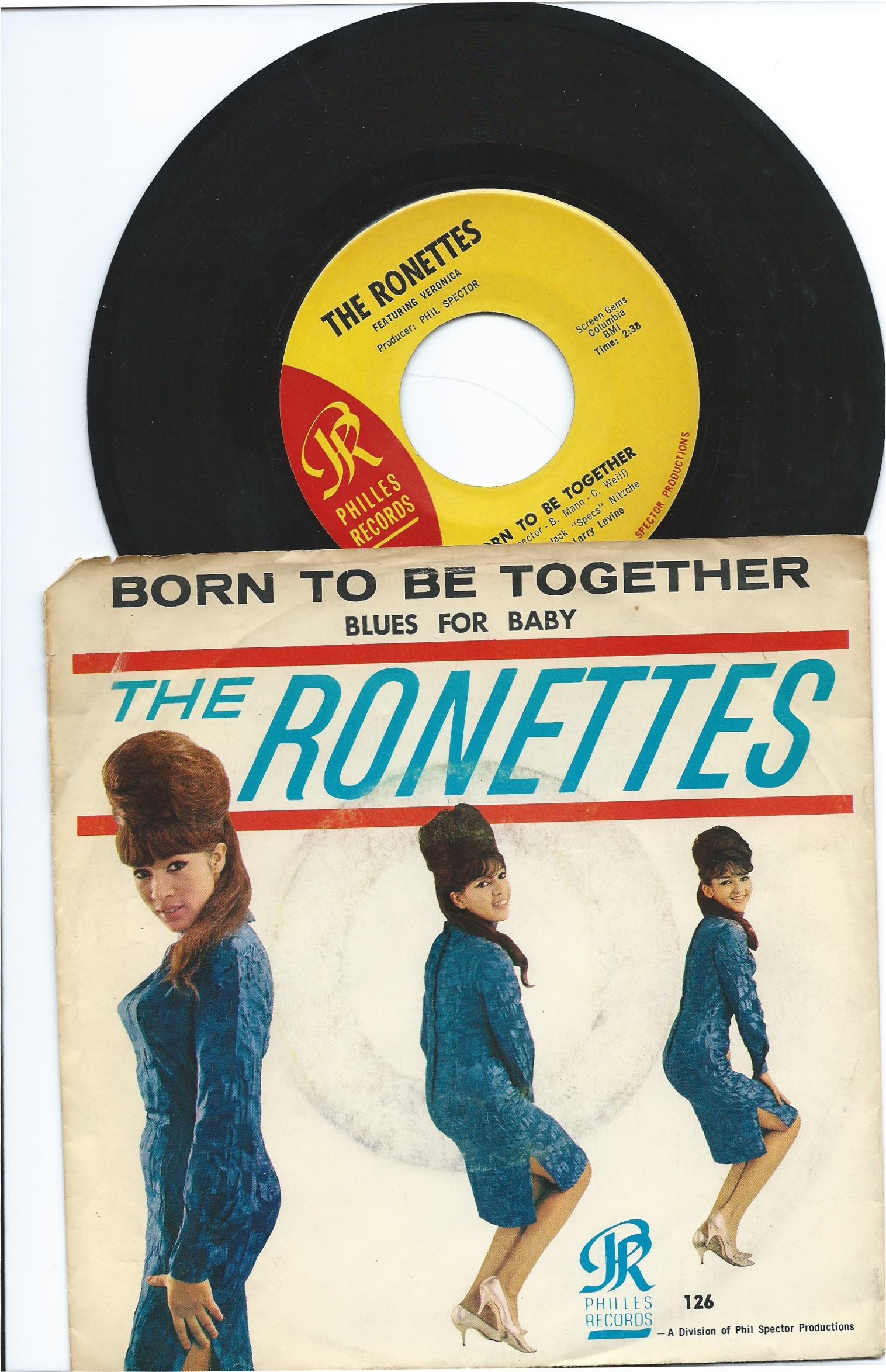
Ronettes:Born to Be TogetherIt was during the sessions for John Lennon’s “Happy Xmas (War is Over)” at New York’s Record Plant studio in October 1971 that Phil Spector showed me how he procured the characteristic string sound that hung like a silver mist over so many of his finest records. The secret, he said, was to send the signal to an echo chamber, and to use only the echo, not the primary signal, in the final mix. By robbing the strings of their attack, the trick lent his records, from the Paris Sisters onwards, an air of diaphanous romanticism. In some of them, too, it was used to counterpoint the ferocious pounding of a rhythm section that, by the mid-’60s, had grown to gargantuan proportions.

Nowhere was this more perfectly achieved than in the Ronettes’ “Born to Be Together”, to my mind the greatest of the recordings by the sisters Veronica and Estelle Bennett and their cousin Nedra Talley, even though it became the first of their Philles singles to fail to make the US Top 50 on its release in the summer of 1965. (In her autobiography, Ronnie Spector accuses Phil of failing to promote the group’s career because he did not want his wife-to-be to become too famous, although it seems just as likely that, after “Be My Baby”, “Baby I Love You”, “(The Best Part of) Breakin’ Up”, “Do I Love You” and “Walking in the Rain”, the public was growing a little weary of their distinctive sound.)

The song gives its name to the latest release in Ace Records’ invaluable Songwriter series: Born to Be Together: The Songs of Barry Mann and Cynthia Weil. Remastered here with greater warmth and richness than versions on the earlier ABKCO or Sony anthologies of Ronettes recordings (although not, of course, with the bite of the original US vinyl 45), it remains one of Spector’s unacknowledged masterpieces, particularly notable for the way the producer and his arranger, Jack Nitzsche, withhold the drums — probably Hal Blaine and Earl Palmer in tandem, by the sound of it — through the verses before bringing them crashing in for the chorus. Above their hammering, the strings sound simply celestial. Listen, too, for the way Ronnie applies her dramatic vibrato to the final syllable of each line — and, in the case of the climactic appearance of the word “together”, to the second and fourth syllables. That’s proper singing.

For this album, a second helping of Mann/Weil compositions to follow 2009’s Glitter and Gold, the compiler Mick Patrick also plunders the Spector archives for the Crystals’s “Uptown”, the Righteous Brothers’ “You’ve Lost that Loving Feeling” and Dion’s “Make the Woman Love Me”. I’m particularly grateful for Doris Day’s “Love Him” (destined to become “Love Her” in the hands of the Walker Brothers), Ruby and the Romantics’ charming “We’ll Love Again”, Dusty Springfield’s “I Wanna Make You Happy” (although I marginally prefer Margaret Mandolph’s version of this lovely Titelman/Weil song) and Len Barry’s “You Baby”. And just as Glitter and Gold reintroduced me to the Vogues’s glorious “Magic Town”, so the second volume provides a reminder of how much I always liked Slade’s “Shape of Things to Come”, a dynamic slice of quasi-psychedelic youthquake proto-punk produced in 1970 by Chas Chandler before the Black Country quartet started writing their own material and getting famous.

The Shadow knew

I’ve never forgotten the first time I heard a record created by George “Shadow” Morton, one of the great visionaries of ’60s pop music, who died of cancer in Laguna Beach, California on Thursday, aged 71. It was the Shangri-Las’ “Remember (Walking in the Sand)”, released in 1964, and even to ears prepared by Phil Spector’s records with the Crystals and the Ronettes it seemed to set a new standard in pop records that aspired to be teenage mini-operas.

“Remember” came out on the then-new Red Bird label, owned by Jerry Leiber and Mike Stoller in partnership with the music business hustler George Goldner and the songwriters Jeff Barry and Ellie Greenwich. Here’s how Leiber remembered Morton in a passage from Hound Dog: The Leiber and Stoller Autobiography (Omnibus Press, 2009):  “I called him Shadow… a guy who appeared in the room without you ever realising that he ever walked in. And he was never there when you looked for him. Shadow was elusive. He was good looking and packed a self-invented mythology that intrigued me. For a guy from New York, he spoke with a strange Southern drawl. He had a sweet temperament and was physically as strong as a bull. As a producer, Shadow threw in everything but the kitchen sink. He created a cacophony, but one that made musical sense — and story sense, as well.”

Maybe the most striking story of all was the one told by the Shangri-Las’ Mary Weiss in 1966 in “Past, Present and Future”, their 11th single (and lovingly recreated a few years ago on Agnetha Faltskog’s album My Colouring Book, which I would need only the slightest encouragement to write about at greater length one day). It’s a piece of pop art as striking as anything Roy Lichtenstein ever produced.

Morton didn’t really train on, as they say in horse-racing circles, and effectively bowed out with the New York Dolls’s second album, Too Much Too Soon, in 1974. In between the Shangs and the Dolls, however, he produced the first Vanilla Fudge album, which has always seemed to me to be another pop-art classic: it’s the one in which they take a series of rock and soul classics — “Ticket to Ride”, “You Keep Me Hangin’ On”, “Bang Bang”, “She’s Not There”, “Eleanor Rigby” etc — and slow them right down in order to extract maximum melodrama.

They were a Long Island band with roots in soul and R&B, like the Young Rascals, with whom Morton also did some advisory work, and in Mark Stein they had a devastatingly powerful singer/organist. I saw them at Nottingham University in 1967, the year the album was released, and they were simply perfect. They did the album, of course, but they added a couple more songs which, perversely, they speeded up: I forget the identity of one (it might have been “Gimme Some Lovin'”) but the other was definitely the Yardbirds’ “For Your Love”. It was a great, great gig — but without Morton’s help, they’d probably never have made it out of the Long Island bars.

There’s an excellent New York Times obituary by Margalit Fox here — it reveals that Morton was born in Richmond, Virginia, which explains the Southern drawl, and includes the information that he ended up designing golf clubs. Here is a link to a fine interview (in two parts) conducted by my old friend Lenny Kaye, published in the Melody Maker and now available via the essential http://www.rocksbackpages.com (you’ll need to register). It’s from 1974, when Morton was in the studio with the Dolls (and Lenny had yet to find fame with Patti Smith). “I knew the music business couldn’t exist without me,” he said.

Bricklayers

It’s Reg Presley’s funeral this week. I didn’t know him in the ’60s, but I met him a few times in recent years at a biannual event called the Strummers, Thumpers and Scribblers Lunch (self-explanatory, really). At one of those functions I found myself out on the balcony of the restaurant, listening to a conversation between Reg and Bill Wyman: they were discussing in some detail the finer points of the building’s exterior brickwork. Reg had started as a brickie, and Bill’s dad had been one. Somehow I can’t imagine, in 30 or 40 years’ time, a similar conversation between a Radiohead and a Foal.