Skip to content

Posts from the ‘Photography’ Category

Café Society in wartime
`

I imagine I picked up a copy of Life magazine’s edition of October 16, 1944 from a flea market many years ago because its cover featured the 20-year-old Lauren Bacall, making her screen debut in To Have and Have Not opposite Humphrey Bogart: “Midway through the first reel the sulky-looking girl shown on the cover saunters with catlike grace into camera range and in an insolent, sultry voice says, ‘Anybody got a match?'”

But along with that, I got something that now seems much more interesting.

Between full-page ads for Packard and Pontiac cars, Texaco oil, Budweiser beer, National Dairy, Stromberg-Carlson radios and Chesterfield cigarettes, all using the military as a motif and/or urging citizens to buy war bonds, there’s a story describing how, in New York, “hotels are booked solid for weeks in advance and guests spend more money” and “the boom reaches a peak in the sale of luxury goods at department stores.” In a month when Allied troops are fighting their way into Germany, this is part of report on the vigorous economic upsurge created by the US participation in the Second World War.

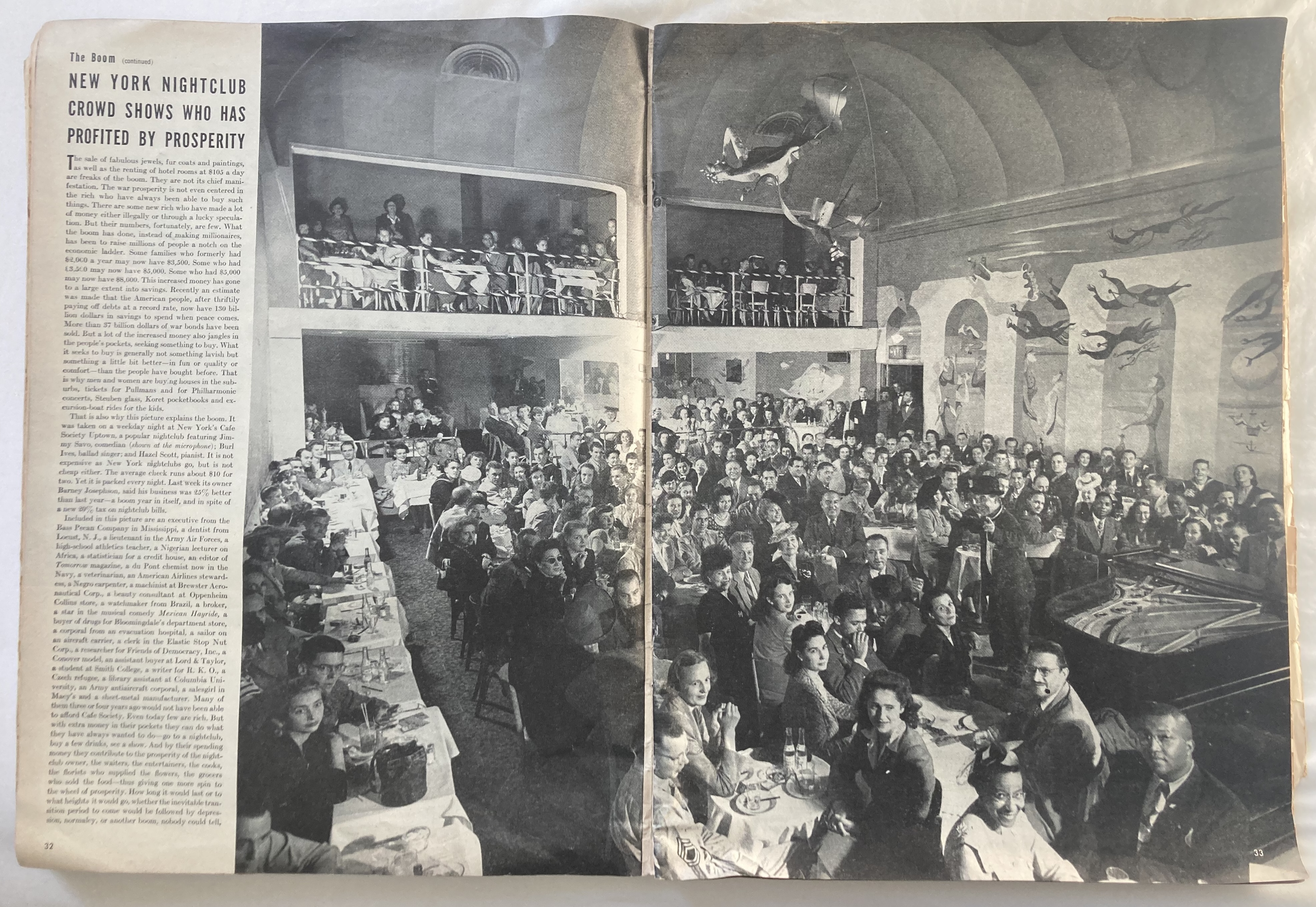
To illustrate the upbeat mood, the editors present a double-page spread on a flourishing nightclub, Café Society Uptown. Located on East 58th Street, between Lexington and Park Avenues, it’s an adjunct to the original Café Society on Washington Square in Greenwich Village. Both were run by Barney Josephson, who booked Billie Holiday for opening night in 1938 at the Village establishment, where she would sing “Strange Fruit” for the first time a year later. The second club opened in 1940. Both were notable for the welcome they extended to all races.

The current attractions at the East 58th Street joint in the autumn of 1944 were the fine jazz pianist Hazel Scott, the folk singer Burl Ives and the comedian Jimmy Savo, who can be seen at the microphone. Higher wartime wages meant that business was up 25 per cent on the previous year, so Josephson told the magazine, and patrons were spending an average of $10 a head.

I could spend hours scanning the faces looking up at the lens deployed at a high angle by Herbert Gehr, a German-Jewish photographer who had escaped Nazism and photographed the Spanish Civil War before arriving in the US, where he joined the staff of Life. I wish there were a key giving the details of each individual in the teeming frame. But the magazine’s caption writers do their best in giving us an anonymised but still vivid snapshot of the diversity of the evening’s audience:

“Included in this picture are an executive from the Bass Pecan Company in Mississippi, a dentist from Locust, N. J., a lieutenant in the Army Air Forces, a high-school athletics teacher, a Nigerian lecturer on Africa, a statistician for a credit house, an editor of Tomorrow magazine, a du Pont chemist now in the Navy, a veterinarian, an American Airlines stewardess, a Negro carpenter, a machinist at Brewster Aeronautical Corp., a beauty consultant at Oppenheim Collins store, a watchmaker from Brazil, a broker, a star in the musical comedy Mexican Hayride, a buyer of drugs for Bloomingdale’s department store, a corporal from an evacuation hospital, a sailor on an aircraft carrier, a clerk in the Elastic Stop Nut Corp., a researcher for Friends of Democracy, Inc., a Conover model, an assistant buyer at Lord & Taylor, a student at Smith College, a writer for R. K. O., a Czech refugee, a library assistant at Columbia University, an Army anti-aircraft colonel, a salesgirl in Macy’s and a sheet-metal manufacturer.”

I’ve been trying to spot the “Conover model”, who would have been someone on the books of the agent Harry Conover. His roster included Eugenia “Jinx” Falkenburg, a former Hollywood High School student who posed for Edward Steichen, was named “Miss Rheingold” in a series of beer ads, and by 1944 had became famous enough to play herself alongside Rita Hayworth and Gene Kelly in Charles Vidor’s romantic comedy Cover Girl, with songs by Jerome Kern and Ira Gershwin. Four years later her younger brother Bob would win the Wimbledon men’s singles title. Maybe Jinx is there in the crowd.

But the conclusion reached by the caption writers, pursuing the theme of a wartime boom, is this: “Many of them three or four years ago would not have been able to afford Café Society. Even today few are rich. But with extra money in their pockets they can do what they have always wanted to do — go to a night club, buy a few drinks, see a show. And by their spending money they contribute to the prosperity of the night-club owner, the waiters, the entertainers, the cooks, the florists who supplied the flowers, the grocers who sold the food — thus giving one more spin to the wheel of prosperity. How long it would last or to what heights it would go, whether the inevitable transition period to come would be followed by depression, normalcy or another boom, nobody could tell.”

The Ballad of Dennis Hopper

If anyone contained multitudes, it was surely Dennis Hopper. Wild and crazy guy, but also a proper artist. Incarnated the simmering potential of the ’50s, the multicoloured dream of the ’60s, the long scream of the ’70s, and the all-over-the-place uncertainty of the ’80s.

All those movies: not just Rebel Without a Cause, Easy Rider, Apocalypse Now and Blue Velvet but The Trip, The American Friend and Rumble Fish. And the folie de grandeur of The Last Movie. Married to Michelle Phillips for eight days and to Daria Halprin, co-star of Antonioni’s Zabriskie Point, for a little longer. Great photographer, too (he spent so much time with a camera around his neck that his friend nicknamed him “the tourist”). No wonder Mike Scott decided to make a Waterboys album about him.

I took Life, Death and Dennis Hopper on a road trip last weekend and it kept me entertained and fascinated all the way there and back. Its 25 tracks form a mosaic of a life that began in Dodge City, Kansas in 1936 and ended in Venice, California in 2010. “Kansas”, the opening track, is bookended by the sound of a street parade and a departing steam train: the song itself, sung and co-written by Steve Earle, with just the singer’s guitar and Mickey Raphael’s harmonica, is like something from Nebraska‘s country cousin.

Then Scott enters to sing “Hollywood ’55” — the story of Hopper’s arrival in Movieland — against a finger-snapping beatnik swing and we’re into a sequence of snapshots set to era-adjacent music. “Live in the Moment”, about making it, rolls on Mitch Ryder’s Detroit Wheels. “Andy”, referencing his friendship with Warhol, is a smooth uptown pop mix settling somewhere between Broadway and Hollywood & Vine. “The Tourist”, about Hopper and his camera documenting the short life of hippie dream, could be the Strawberry Alarm Clock or H. P. Lovecraft imitating the Jefferson Airplane. “Riding Down to Mardi Gras”, in which Hopper and Peter Fonda make Easy Rider, is a fine piece of outlaw country-rock. And so on, all the way to “Golf, They Say”, a funny song about the late-life experience of Willie Nelson teaching Hopper to swing a club.

But it’s not just a kind of jukebox musical. There are brief interludes — notably five short impressionistic instrumental pieces of contrasting styles and hues, each dedicated to one of Hopper’s five wives — and a couple of recitatives, one a description of the 1967 Monterey Festival in an English posh-hippie voice, the other a parody of an American TV news report of his death.

The two finest individual tracks are the hard-slugging, thick-textured “Ten Years Gone”, referring to Hopper’s lost decade and closing with a passage spoken by Bruce Springsteen, and “Letter From an Unknown Girlfriend”, a painfully stark voice-and-piano ballad in slow waltz time sung and played by Fiona Apple. They’re followed by a snatch of aural hallucination called “Rock Bottom”, evoking the years Hopper spent in the abyss, and then the gorgeous, achingly redemptive “I Don’t Know How I Made It”, somewhat like the Blue Nile covering Blonde on Blonde.

As Scott suggests, you can listen to the tracks indvidually or in any order, but it’s really made to be heard from start to finish, although not in any burdensome or dutiful way. Congratulations to him and his guests and his co-writers and fellow Waterboys, including Paul Brown, James Hallawell, Aongus Ralston, Ralph Salmins and Greg Morrow. It’s a brave thing, executed with flair and imagination.

* The Waterboys’ Life, Death and Dennis Hopper is out now on Sun Records.

‘The Black Chord’

David Corio is a fine British photographer whose book The Black Chord, with text by the writer Vivien Goldman, first appeared in the UK 25 years ago. A new edition, published by Hat & Beard, a Los Angeles-based imprint, presents his images of black musicians via a much more elegant design.

Corio was born in London in 1960 and had his first work published when he was 18. Where he differs from Roy DeCarava and Val Wilmer, two other great photographers of black music, is that most of his subjects are caught in performance, on or off stage. DeCarava and Wilmer both sought particular kinds of intimacy, spiritual or domestic. Corio’s images tend to look outward, making a direct address to the viewer, which means they work well in magazine features and on album covers, and the 200-odd photographs here, beautifully reproduced, combine to make an exhilarating book.

The subjects range from the drummers of Burundi and a Santeria ceremony in Cuba through John Lee Hooker, Fats Domino, Bobby Bland, Aretha Franklin, Art Blakey, Celia Cruz, Fela Kuti, Abbey Lincoln, Ray Charles, Barry White, Millie Jackson, Lee Perry, Ornette Coleman, Al Green, Toots Hibbert, Salif Keita, De La Soul, August Darnell, Sade, the Last Poets, Alton Ellis, PM Dawn, Miles Davis, Foday Musa Susa, Nile Rodgers, Don Cherry, Missy Elliott, and of course Bunny, Tosh and Bob. And many, many others. Goldman’s love of this music, from blues to jazz via R&B, soul, reggae, salsa, afrobeat and hip-hop, originally on view in her work in the 1970s for Sounds, the Melody Maker and the NME, infuses the lively essays that intersperse the groupings of photographs.

One of the pictures I like best contains no performers: over a double-page spread, half a dozen boys perch together around a sound system in London in 1978, shot from below, exuding life and possibilities despite the implicit challenge of the world around them. It has poetry in it. As, more obviously, does the portrait of Nina Simone seen above and also on the book’s cover, taken during a performance at Ronnie Scott’s in 1984, a photograph to make you think a lot about troubled genius. That, too, is Corio at his best.

* The Black Chord by David Corio with text by Vivien Goldman is published by Hat & Beard (hatandbeard.com), price $60.

And on drums, Jimi Hendrix…

Stevie Wonder can play the drums (listen to “Creepin'”). So can Paul McCartney, after a fashion (“Maybe I’m Amazed”). But I didn’t know that Jimi Hendrix knew how to use a pair of sticks, too.

The proof is in American Drummers 1959-88, Val Wilmer’s new book of 36 photographs of drummers she has observed on and off the stage — and in the case of Hendrix (the only one of her subjects better known for something else), during a sound-check before his show with the Experience at the Royal Albert Hall in London on November 14, 1967.

It’s tempting to assume that Hendrix was just messing around when he sat behind Mitch Mitchell’s kit and picked up a pair of his sticks. But the photo is the evidence that he knew what he was doing. He was left-handed, of course. And he’s holding his right-hand stick in the way that a right-handed drummer would hold his left stick, were he using what is known as the orthodox grip, in which the stick rests in the cradle formed by the clefts between the thumb and forefinger and the second and third fingers.

You can see it on the opposite page in the photo of Andrew Cyrille, a great jazz drummer who has played with Cecil Taylor and many others. Cyrille is a high accomplished technician and most of the time he uses the orthodox grip. The alternative is the matched grip, in which both hands hold the sticks in the same way, as if (to make a crude analogy) they were saucepan handles. Charlie Watts used the orthodox style, Ringo Starr the matched grip.

Drummers sometimes switch from orthodox to matched when they want a particular kind of power — playing the Bo Diddley beat, for instance. And it’s the way most people who aren’t drummers hold the sticks if they’re given the chance to hit something.

But Hendrix is unmistakably using the orthodox grip, which set me thinking. Did he learn it from someone who played drums in one of the bands he’d been in, backing the Isley Brothers and others? Or from Mitch Mitchell, whose early leaning was towards jazz? That seems a bit unlikely to me. You don’t generally learn the orthodox grip unless there’s a very good reason.

So it sent me back to his days in the US Army, drafted into the 101st Airborne Division (the “Screaming Eagles”) in 1961 as an alternative to a jail sentence for joyriding in stolen cars when he was still in his teens. He hated it and lasted barely a year, given a discharge after breaking his ankle in a parachute jump. The only reference I can find to musical involvement during that year was when he asked his father in a letter from Fort Campbell on the Kentucky-Tennessee border to send him the guitar he’d left at a girlfriend’s house in Seattle.

But what if he’d been given the chance to join a marching band, and received basic tuition in playing a shoulder-slung snare drum? That would require a mastery of the orthodox grip, because that’s what it was invented for. And although it might seem at first to be awkward and unnatural, once you learn it, it never goes away.

Val’s photos are full of all the qualities that make her work so special (and which I wrote about when she had an exhibition last year). Yes, there are pictures here of musicians playing on stage — Philly Joe Jones, Max Roach, Kenny Clarke, Tony Williams, Billy Higgins, Elvin Jones, Milford Graves — but also in other, different moments: Sunny Murray reading the paper, Marquis Foster getting his drums out of the trunk of his car, Denis Charles loosening up with a practice pad.

And there are other stories, hidden and half-hidden. A well known New Orleans drummer called Freddie Kohlman is pictured playing a snare drum with the Onward Brass Band at a funeral in 1972. Val told me this week that Kohlman — who died in 1990, aged 75 — had told her how the fledgling Motown label had paid for him, and one or two others, to travel to Detroit to teach the company’s studio musicians how to play the New Orleans rhythms that were the basis of R&B and rock and roll.

Musicians trusted Val, so she could capture them in less formal settings. Below you can see a scene in the Professional Percussion Center on New York’s Eighth Avenue one day in 1971, with the proprietor, Frank Ippolito (who played with Glenn Miller’s Army Air Force Band during WW2), behind the counter, chatting to a trio of customers.

On the left is “Papa” Jo Jones, whose work with Count Basie in the 1930s survives somewhere within the work of every jazz drummer today. In the middle is Jeff Williams, a 21-year-old Berklee graduate from Ohio about to embark on a professional career with the bands of Lee Konitz and Stan Getz (and who has been based for many years in the UK, teaching at the Royal Academy of Music and the Birmingham Conservatoire). On the right is Oliver Jackson, one of Papa Jo’s acolytes, an underrated player with a sense of swing to match that of Roach, Higgins or Frank Butler, as you can hear if you listen to King Curtis’s “Da Duh Dah”.

Just a bunch of guys shooting the breeze in a drum shop one day half a century ago. And, like a lot of Val’s photos, it invites us to share the privileged access that produced this lovely little book.

* Val Wilmer’s American Drummers 1959-1988 is published by Café Royal Books (caferoyalbooks.com), price £6.70.

Daniel Kramer 1932-2024

Bob Dylan was fortunate in the photographers who recorded his progress from his arrival in New York in January 1961 to his motorcycle accident in Woodstock in July 1966. John Cohen, a member of the New Lost City Ramblers, and the Village Voice staffer Fred W. McDarrah chronicled his early days in Greenwich Village. Richard Avedon caught him on the New York waterfront in 1963. Jim Marshall was at Newport and in San Francisco when Dylan hung out with the Beat poets. Don Hunstein took the Freewheelin’ cover shot on Jones Street and was there for the “Like a Rolling Stone” session, as was W. Eugene Smith. Jerry Schatzberg caught the amphetamine Dylan of early 1966 in formal portraits and took the Blonde on Blonde cover. Barry Feinstein was in the limos and the dressing rooms on the European tour that summer, present as Dylan spent time with John Lennon and Françoise Hardy.

But I’m probably not the only one who has a special fondness for the photos taken in 1964-65 by Daniel Kramer, who has died aged 91. Brooklyn-born, the young Kramer worked as an assistant to Diane Arbus and Philippe Halsman. He had just set up his own studio and knew little about Dylan when he first saw him on TV early in 1964 but then spent six months petitioning Albert Grossman to allow him access. The first session, at Grossman’s house in Woodstock that August, established a rapport between the photographer and the singer, and there would be many more encounters over the following 12 months.

Kramer photographed Dylan being swept off his feet — quite literally — by Joan Baez at a post-concert party, cheerfully (and top-hattedly) signing photographs for fans in Philadelphia, and relaxing by playing pool and pinball and (see the photo above) reading the NY Herald Tribune, again at Grossman’s house, with Sally Grossman, who has just come in from swimming, at the edge of the shot. She was also featured on the front of Bringing It All Back Home, the first of Kramer’s two great narrative cover photos (the other being Highway 61 Revisited). And he was there in Columbia’s Studio A as Dylan rewrote and recorded “Positively 4th Street”, framed by a forest of microphone booms and music stands.

In 1967 Kramer published a book of his work with Dylan, adding a commentary. His words and pictures were, as Michael Gray observes in his Bob Dylan Encyclopedia, “recurrently revealing but never prurient or obtrusive… respectful but clear-sighted.” As well as their observational and technical qualities, there was a humanity in Kramer’s photographs that gave us Dylan from a very special perspective.

* Daniel Kramer’s photographs of Dylan, along with those of Barry Feinstein and Jim Marshall, are in Early Dylan, published in the UK by Pavilion Books in 1999, and in Bob Dylan: A Year and a Day, published by Taschen in 2018.

Val Wilmer: ‘Blue Moments, Black Sounds’

Val Wilmer is one of the most remarkable people I know, and you’ll know that too if you’ve seen her photographs. Whether it’s Muddy Waters playing cards with Brownie McGhee backstage at the Fairfield Halls in 1964, Archie Shepp sitting beneath a Jimi Hendrix poster in his New York apartment, or a joyful couple whose names we’ll never know at a blues dance in Bentonia, Mississippi half a century ago, she finds the essence of the human spirit.

Those three images are among the several dozen included in Blue Moments, Black Sounds, an exhibition of her photographs which opened this week. It’s on until the end of November at a very nice little gallery in Queen’s Park, North London, which specialises in music photography and where you can also go to get your own pictures framed.

I was particularly moved by the only photograph in the show that has an extended caption, written by Wilmer, in which she tells of going to see Louis Armstrong at Earl’s Court in 1956, when she was a 14-year-old schoolgirl. When Armstrong and the All Stars left the country, catching a plane to Ghana, she and her brother went to see them off at the airport. She took her mother’s Box Brownie camera, asked Louis if she could take his photograph, and got a lovely shot that put her, as she says, “on my way to a lifetime of learning.”

Then she adds something interesting and important: “Through getting to know the musicians, I learnt the importance of positive representation.” That doesn’t mean she learnt how to take PR photographs. It means she learnt to appreciate the importance of immersing herself in the world of her subjects, in order to portray them with greater sensitivity to their lives and to the art that came from it, and to realise that pictures of Ornette Coleman playing pool with Anthony Braxton or members of the Count Basie orchestra snoozing on the band bus can actually tell us more than photos of them on stage.

Those photographs, like most of the ones in the new show, could only have been taken by someone possessing not just painstakingly acquired technical skills but a deep sympathy with the music and the lives of those who make it, and with the courage and humility to take her own place in their world, and to find her unique vantage point.

* Val Wilmer’s Blue Moments, Black Sounds is at the WWW (Worldly, Wicked & Wise) Gallery, 81 Salusbury Road, London NW6 6NH until 30 November: wwwgallery@yahoo.com. Deep Blues 1960-1988, a pamphlet of Wilmer’s photographs from the world of the blues, edited by Craig Atkinson, has just been published by Café Royal Books: caferoyalbooks.com. Wilmer’s As Serious As Your Life: Black Music and the Free Jazz Revolution 1957-1977 is published by Serpent’s Tail.

Nina & Monk, etc

If you happen to be in Paris this week, you might wander along to the little bookshop and gallery of Robert Delpire, tucked away on a street beside the church of Saint-Germain-des-Prés, to see a small show of photographs taken by the Baroness Pannonica de Koenigswater.

Nica, as she was known, took snapshots of many great jazz musicians during her encounters with them in the 1950s and ’60s. To them — the pianists Thelonious Monk and Barry Harris in particular, but many others, too — she was a friend, patron and benefactor, which means that her photographs, taken in dressing rooms and hotel rooms and kitchens, have a rare intimacy and candour.

The photo above, of Thelonious Monk and Nina Simone, is one of about a dozen of the original Polaroids framed and mounted on the walls of the gallery. Many more — of Hank Mobley, Sonny Clark, Coleman Hawkins, Oscar Pettiford, Billy Higgins, Paul Chambers and others — are included in a new book called Dans l’oeil de Nica (Through Nica’s Eye).

Her photos have the tonal richness and warmth characteristic of Polaroids. They were also badly stored for decades and are presented as found, many of them in a semi-distressed condition that inevitably enhances their romantic allure.

The new book is a follow-up to Three Wishes, published in English by Abrams Image in 2006, in which Nica’s photos were accompanied by the answers given to her by dozens of musicians when she asked them the question implied in the title. Many of them are very personal, others poignant, viz. Eric Dolphy: “1: To continue playing music all my life. 2: A home and a car in New York. That’s all!”

* The exhibition is at Delpire & Co, 13 Rue de l’Abbaye, Paris 6, until Saturday 28 October (Wed-Sat 12-6pm). Dans l’oeil de Nica is published by Buchet/Chastel (€44). Nica’s remarkable story is well told in The Baroness, a biography by her niece Hannah Rothschild, published by Virago in 2013.

Bookshelf 4: Jazz Power!

Billie Holiday was a fantastic subject for a photographer. Whatever the location or situation, whatever the lighting or the angle, the turn of her head or the expression on her face, the result was almost always extraordinary. Here’s an example, taken in Paris by Jean-Claude Bernath in 1958, during the second of her two visits to Europe. It was first used in France’s Jazz Magazine, and is among the images reproduced in a two-volume publication accompanying “Jazz Power!”, an exhibition of the monthly magazine’s photographs and artwork between 1954 and 1974, currently in show at the Rencontres d’Arles, the annual festival of photography.

The first of the two paperback volumes folds out into a panoramic reproduction of spreads from the magazine through those years, from Louis Armstrong, Lionel Hampton and Clifford Brown to Sun Ra, Sam Rivers and Sonny Sharrock. It’s a reminder of how, founded by Nicole and Eddy Barclay, nurtured by Frank Ténot and Daniel Filipacchi, with editors including Jacques Souplet, Jean-Louis Ginibre and Philippe Carles, Jazz Magazine did a wonderful job of reflecting the excitement of the music and its evolution during those 20 years. As it still seems to be doing under the current editor in chief, Frédéric Goaty.

The second of the volumes contains a text history of the magazine and full-page A4 reproductions of 22 memorable images from its history, of which the photo of Holiday is one. On the reverse of each is a reproduction of the back of the original print, with its photographer’s stamp and the mark-up pencilled in by the sub-editor or designer responsible for sizing it up and indicating how it was to be cropped it for use.

What you see on the reverse of the Holiday print is a set of marks clearly indicating that the page designer wanted to tighten the image to concentrate the focus on the singer, completely eliminating two of the three men surrounding her. That’s understandable in the light of the editorial priority: a picture of Billie Holiday, not of some bystanders. Looking at it today, more than 60 years later, we’re interested in the context.

Besides Bernath, who also took the image on the cover of Chet Baker’s celebrated album of Bob Zieff tunes, recorded for the Barclay label in Paris in 1954, those whose work is featured in the exhibition and the book include such great names of jazz photography as Jean-Pierre Leloir, Herman Leonard, Giuseppe Pino and Val Wilmer. Under its various editors, Jazz Magazine used their images well, consistent in its desire to stress the role of the emerging black consciousness and of women as full participants in the music.

Twenty-odd years ago I was fortunate enough to be in Arles on the eve of the Rencontres, and I remember the wonderful atmosphere surrounding the festival. No doubt the “Jazz Power!” exhibition would be worth the detour, if such a thing were possible this summer. As things are, this handsome publication will have to do.

* Jazz Power: L’aventure Jazz Magazine 1954-74 by Clara Bastid and Marie Robert is published by and available from Delpire & Co, €58 (www.delpireandco.com). Exhibition details are here: https://www.rencontres-arles.com/fr/expositions/view/992/jazz-power

The Japanese for ‘pathos’

Sonny Clark F Wolff

The hip Sonny Clark album, as everyone knows, is Cool Struttin’, a quintet date from 1958 which has come to epitomise what we think of as the Blue Note style: relaxed but compact hard bop, rooted in a deep swing and with the blues never far away. Clark died of a heroin overdose in 1963, aged 31, with nothing to his name beyond his appearances on some exceptional recordings. He would no doubt be astonished to learn that his most celebrated album would sell over 200,000 copies between 1991 and 2009 — almost 180,000 of those copies in Japan, where Cool Struttin’ mysteriously became one of the biggest jazz albums of all time.

My favourite Clark album is something different: a trio session that didn’t see the light of day until its release in Japan more than three decades after the pianist’s death. Blues in the Night is a comparatively modest effort: only 26 minutes long, or 33 minutes if you count the alternate take of the title track. Presumably that’s why it wasn’t released at the time: simply not enough music to make a full 12-inch LP.

Clark was a fine composer, but Blues in the Night is all standards: “Can’t We Be Friends”, “I Cover the Waterfront”, “Somebody Loves Me”, “Dancing in the Dark”, “All of You”. It’s a supper-club set, with nothing to upset the horses. But it’s also, in its quiet and unassuming way, pure treasure. With the great Paul Chambers on bass and Wes Landers — otherwise unknown to me — on drums, Clark makes his way through these tunes at a variety of comfortable tempos with a wonderful touch perfectly highlighted by the simplicity of the setting. I can listen to it all the way through just concentrating on how he articulates a triad: putting down his fingers in a way that makes the chord far more than three notes being played at the same time, the minute unsynchronisations that make it human. And what he finds, I suppose, is a sweet spot between Bud Powell’s probing, restless single-note lines and the swinging, transparently joyful lyricism of Wynton Kelly. Which is a place I’m very happy to be.

I’m indebted for the Cool Struttin’ sales figure to an extraordinary chapter devoted to Clark in a book by Sam Stephenson called Gene Smith’s Sink, a kind of discursive biographical appendix to The Jazz Loft, an earlier book in which Stephenson gave a detailed history of the rackety loft apartment on New York City’s Sixth Avenue, in what used to be called the Flower District, where the great photographer W. Eugene Smith kept a kind of open house for beatniks and other outsiders, recording all their comings and goings on camera film and reel-to-reel tape. From 1957 to 1965 Smith’s loft was the location of an endless jam session featuring the likes of Thelonious Monk and Zoot Sims. Sara Fishko’s 2015 documentary film, The Jazz Loft According to W. Eugene Smith, is based on the book and is highly recommended.

Clark was a regular at the loft, and in Gene’s Sink the author recounts how Smith’s obsession with recording everything around him — even TV and radio news bulletins — extended to the sound of the pianist barely surviving another overdose. Stephenson himself fell in love with Clark’s playing when hearing another posthumous Blue Note release, Grant Green’s The Complete Quartets with Sonny Clark. He writes about him with enormous sensitivity, piecing together the story of a life that began as the youngest of a family of children in a Pennsylvania town called Herminie No 2, named after the mineshaft that gave the place its reason for existence.

If you’re interested in Sonny Clark’s progress from Pennsylvania coal country via Southern California to the New York jazz scene of the late 1950s, Stephenson’s beautiful piece of writing is the thing to read. And it was while following in Gene Smith’s footsteps to Japan (where the photographer documented the horrendous effects of mercury poisoning on the people of the fishing village of Minamata in the 1970s) that the author came across the ideograms most commonly used by Japanese jazz critics in discussions of Clark’s playing: they can be translated as “sad and melancholy”, “sympathetic and touching”, “suppressed feelings”, and one which combines the symbols for “grieving”, “autumn” and “the heart” to suggest “a mysterious atmosphere of pathos and sorrow”.

That mood isn’t really reflected in my favourite Sonny Clark record. What I hear, funnily enough, is an expression of pleasure in being alive to play the music he loved and for which he had such a precocious talent. I’m guessing he sometimes felt like that, too.

* Sam Stephenson’s Gene’s Sink: A Wide-Angle View was published by Farrar, Straus and Giroux in 2017. The Jazz Loft Project was published by Knopf Doubleday in 2012. The portrait of Sonny Clark is from Blue Note Jazz Photography of Francis Wolff, by Michael Cuscuna, Charlie Lourie and Oscar Schnider, published by Universe in 2000 (photo © Mosaic Images). Clark’s Blues in the Night was first released in Japan in 1979 and issued on CD in 1996. The tracks are also available on Clark’s Standards CD, released in 1998.

Spector / Hopper


Phil Spector noir

These days, nobody talks about him. I hardly ever listen to the string of epic records he made in the 1960s, and I once wrote a book about him. He’s nine years into a 19-year sentence for second-degree murder, and currently being held at a prison hospital in Stockton, California. He’ll be 88 when he comes out.

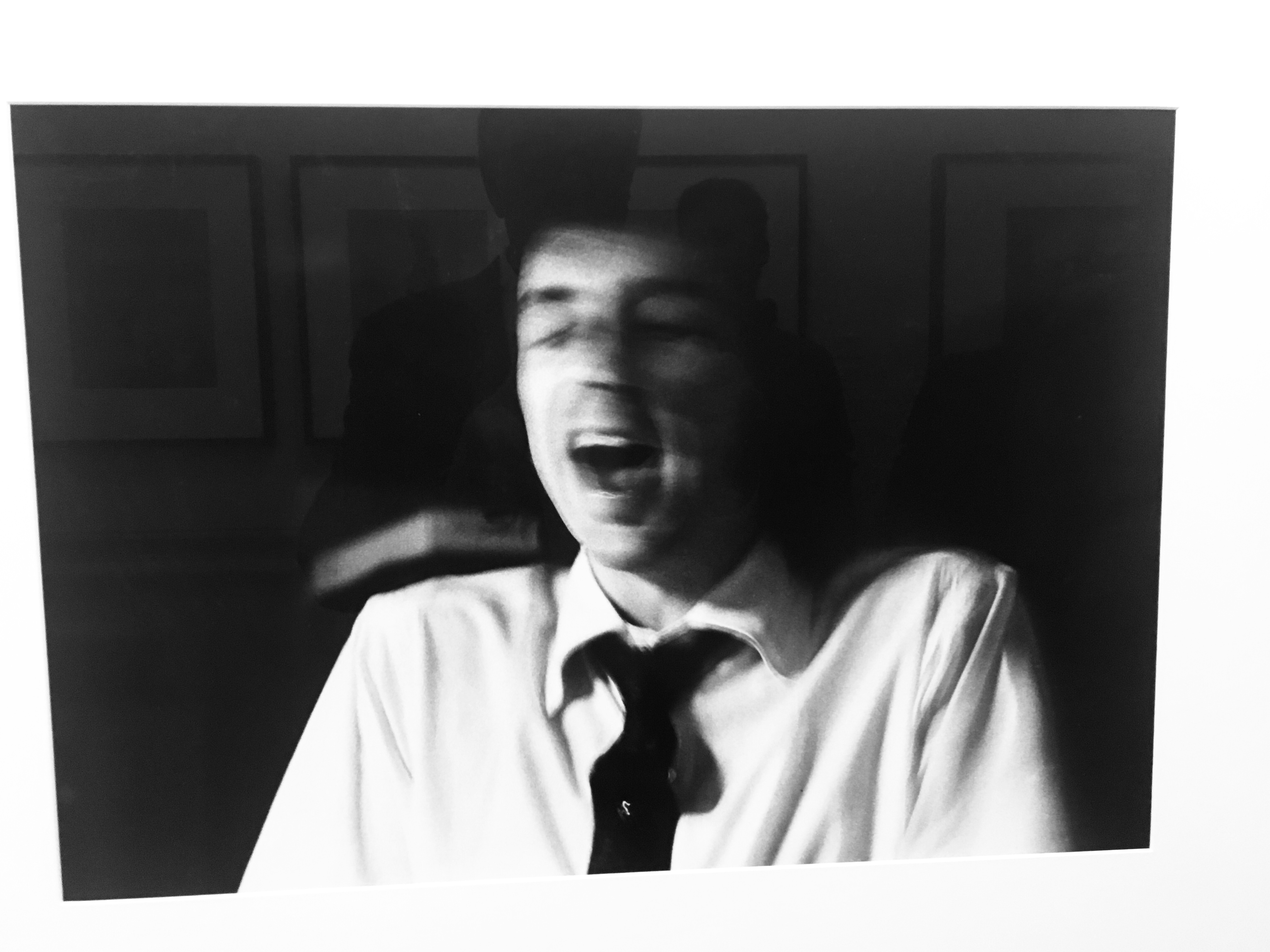
So there he was this afternoon, hanging on a wall in Somerset House at this year’s Photo London exhibition, immortalised by his friend Dennis Hopper in 1965.

Back in the days when Phil Spector was making his classic records at the Gold Star studio in Los Angeles, Hopper, who had acted with James Dean in Rebel Without a Cause and Giant, was one of those who sometimes dropped by. Spector always liked an audience.

“We hit it off right from the beginning, hanging out at Canter’s, chasing girls,” Hopper told Mick Brown, the author of Tearing Down the Wall of Sound, the definitive Spector biography. Hopper was also pursuing a side-career as a photographer, and after attending the sessions for “River Deep — Mountain High” he shot the cover photo for Ike and Tina Turner’s only Philles album.

In 1967 Spector became involved in a Hopper film project, The Last Movie, which collapsed the following year (and was revived and completed in 1970). In 1968 he played a coke dealer in the era-defining Easy Rider, written by Hopper, Peter Fonda and Terry Southern, produced by Fonda and directed by Hopper. The Christmas following the movie’s release, Spector sent his friends a card featuring a still from his scene and the motto “A little snow at Christmas never hurt anyone…”

Hopper’s photograph of Spector laughing maniacally — blurred so that it looks oddly like one of Francis Bacon’s screaming Popes — catches him at his peak. Or just after it, actually. 1965 was the year of the Ronettes’ “Born to be Together”, the Righteous Brothers’ “Unchained Melody” and Tom Wolfe’s essay for the Sunday magazine of the New York Herald Tribune, “The First Tycoon of Teen”. It was the year after the matchless triumph of “You’ve Lost That Lovin’ Feelin'”, the year before the crippling debacle of “River Deep”.

The framed gelatin silver print is being offered by the Johannes Faber gallery of Vienna. It’s yours for £16,000.

* Photo London ends on Sunday, May 20.