Skip to content

Posts from the ‘Mod culture’ Category

Down the Dungeon

You can still find men and women in their late 70s prepared to argue over the best act they ever saw at the Dungeon Club. Was it Little Stevie Wonder, then 15 years old, or Little Walter? The Who or the Small Faces? Patti LaBelle and the Bluebelles or Inez and Charlie Foxx? The Yardbirds or the Moody Blues? T-Bone Walker or Sonny Boy Williamson? Sugar Pie DeSanto or the Soul Sisters? The Action or the Move? Lee Dorsey or Wilson Pickett? The Alan Bown Set or the Jimmy Brown Sound?

Stanford Street is an unremarkable stretch of road, about a hundred yards long, leading up from the empty shopfronts of Lister Gate in the centre of Nottingham towards the hill on which the Castle stands. It’s amid something of a wasteland now, close to the demolished remains of the Broadmarsh shopping centre, which awaits the money for redevelopment as an urban park. The estate agents’ website currently offering office space at No 6 — “to be refurbished to a high standard throughout” — mentions the building’s period features but nothing about its history, which I’m guessing began in the late 19th century with an involvement in the city’s then-thriving textile industry.

On July 10, 1964 — 60 years ago this week – the ground floor and basement of 6 Stanford Street were opened by a man called Mick Parker as a club for live music with room for two or three hundred teenagers and no drinks licence. It lasted three and half years. During its short but hectic life, the Dungeon’s basement stage hosted the artists mentioned above, and many others, including Georgie Fame and the Blue Flames, the Exciters, Long John Baldry’s Hoochie Coochie Men, the Moody Blues and the Dixie Cups (with Alvin “Shine” Robinson on guitar).

In those years Manchester had its Twisted Wheel, Sheffield had its Mojo and Newcastle had its Club A Go Go. London, of course, had its Flamingo and Marquee. But we in Nottingham felt lucky. We had the Dancing Slipper, where the acts booked by Bill “Foo” Kinnell (say it quickly) evolved from trad jazz to R&B (and where I first saw the 19-year-old Rod Stewart with Baldry’s band). We had the three rowing clubs, cheek by jowl along the towpath by Trent Bridge: the Union, the Britannia and the Boat Club, all of them with upstairs rooms presenting live music three or four nights a week: Graham Bond, Herbie Goins, John Mayall, Freddie Hubbard, eventually even the Pink Floyd. In the Lace Market there was the Beachcomber, where we were fortunate enough to see Jimi Hendrix, Martha and the Vandellas and the complete Ike & Tina Turner Revue at very close quarters.

But the Dungeon was a special place, which is why this week there will be an event commemorating its 60th anniversary. It was the centre of mod culture in the region, where the music you danced to and the clothes you wore seemed like the only things that mattered in life.

I was lucky enough to play there a number of times in a local semi-pro R&B band called the Junco Partners — not to be confused with the slightly better known Newcastle band who’d also borrowed their name from a record made in 1952 by the Texas-born singer James Wayne. I joined them in the autumn of 1964, playing drums alongside Mick Dale (lead guitar), Dave Turner (rhythm guitar, harmonica and vocals), an art student from down south called Ian Taylor on electric piano, and our leader, Rae Drewery, on bass guitar and vocals. (Rae was a builder by trade and after work he’d clear out his Transit van to take us and our gear to gigs; he was already the father of a small daughter who would become the wonderful Corinne Drewery of Swing Out Sister.)

We were all blues fans, missionaries for this music, and our repertoire included Sonny Boy’s “Don’t Start Me to Talkin'”, Howlin’ Wolf’s “Smokestack Lightnin'”, Jimmy Reed’s “Baby What You Want Me to Do”, Muddy Waters’s “Hoochie Coochie Man”, Bo Diddley’s “Before You Accuse Me” and “Mama Keep Your Big Mouth Shut”and John Lee Hooker’s “Boom Boom” and “Dimples”. Cultural appropriation on a grand scale, in other words. But, you know, at that stage everybody — us, the audience, the originators — benefited from this enthusiasm.

We were getting about £25 a night, as I recall, and it took us a few months to move up from art college hops, blues clubs and pub gigs to the comparative big time of the Dungeon. When an act couldn’t make it one Sunday just before Christmas, Parker called us in at a couple of hours’ notice to play what amounted to an audition. We must have passed because he booked us in to play on a Saturday night in January 1965, supporting the Original Checkmates.

Eight days later we were back in support of the Applejacks. A month later we were supporting Screamin’ Jay Hawkins, then the Lancastrians. In March we supported Robb Storme and the Whispers, Screamin’ Lord Sutch and the Savages, and the Moody Blues, a couple of months after “Go Now” had topped the chart. In April we supported Baldry, Mark Fayne and the Fontaines, and Eden Kane and his Downbeats. And on Friday 4 June we were the sole attraction: topping the bill.

A couple of weeks later I played my last gig with Rae, Mick, Dave and Ian, and went off to get a haircut and start a job. You can see us in those two photos (alas, only the top of Ian’s head), taken on one of those nights at the Dungeon. There’s also my membership card, with which I was able to dance with my friends to the likes of James Brown’s “Out of Sight” and Jr Walker’s “Shotgun”. I can’t be there to celebrate the anniversary this week, but a feeling for the place has never left me.

Mod dreams

Q: Were there ways of walking?

A: Yeh. You walked speed-wise which is you put your hands in your mod jacket, in your Tonik jacket, which had three-inch lapels and a seven-inch centre vent, and breast pleats to give it enough tuck. It was a very solid cloth, a very heavy cloth, so you’d tuck your hands in there and you’d have flaps on the pockets. You’d have your jeans turned up and you’d have Hush Puppies with a pair of white socks. You’d be walking with three other friends up Great Windmill Street or Wardour Street at five or six in the morning just as light is coming up. Your head is bent against the wind, you’ve got your head down…

That’s Peter Meaden talking, interviewed by the writer Steve Turner in 1975, three years before he died at the age of 36, felled by barbiturates and vodka in his parents’ house in North London, where he had dreamed his mod dreams many years earlier, finding the Who and turning them from the Detours into the High Numbers — turned them into mods, getting them the French crop haircuts and the correct clothes, and writing the words for their first single — before accepting £500 to hand over their management to Kit Lambert and Chris Stamp.

Meaden was one of those people, like Guy Stevens, Andrew Oldham and Tony Hall, who shaped the London music scene in those vital years between 1963 and 1965. He deserves a book of his own, and now he has it. Steve Turner’s King Mod is his story, in all its slender, obsessive, doomed glory.

Once asked to define modism, Meaden came up with a much repeated phrase: “Clean living in difficult circumstances.” He provides another version here: “Mod is another aphorism for precision in life.” Romantic nonsense, of course. But part of the legend.

“Modism was my dream,” Meaden says in the unedited transcript of the interview that constitutes the second half of the book, after Turner has taken us through a relatively conventional narrative. Meaden’s words are rambling, repetitive, sometimes inaccurately recalled, the strange and touching testimony of a man who had a dream and saw it come more or less true but lacked, as Turner says, the business acumen and ruthlessness to profit from his vision as others did.

Stevens, who played records from his collection of red-hot R&B obscurities at the Scene Club in Ham Yard, just off Great Windmill Street, and had the 45s from which Meaden borrowed the music for his High Numbers songs, went on to involvement with Island Records, Spooky Tooth, Mott the Hoople, Free and the Clash. Oldham, who had partnered Meaden in a short-lived PR company, managed the Stones until they were taken from him, and created the Immediate label. Hall was one of the great promotion men of the British music business, a cool cat who moved smooth from the bebop ’50s to whatever came next, and who once threw Meaden out of a reception for Ben E. King with the words, “You’re a pilled-up mod!”

Which Meaden certainly was, as he goes to some lengths to explain in his descriptions of the virtues of Drinamyl — “good old Purple Hearts” — particularly when mixed, as was his preference, with cider. “It was bliss. Cocaine they say is bliss these days but it’s not bliss like a bit of speed in you, a couple of pints of cider maybe, down there bopping round from Friday night through until Sunday morning. Say no more!” One of the things he liked about Drinamyl was that it suppressed the libido. “You no longer have to worry about pulling a chick and making it because that’s what you feel the world made you for.” With girls out of the picture, there would be more time for the purer pursuits of choosing the right shirt at Austin’s on Shaftesbury Avenue or the right boots from Anello and Davide on Charing Cross Road.

Then acid arrived on the scene, and the picture — once so sharp and precise — started to go fuzzy. Some, like Townshend, who gave Meaden his first trip, could cope. Meaden was one who couldn’t, spending chunks of the years before his death in psychiatric care, as much of a casualty as Nick Drake or Syd Barrett.

It’s a curious book. More meticulous editing would have removed a plethora of irritating misspellings and inconsistencies: Kingley Street, vocal chords, Petula Clarke, Roger Daltry and Rick Gunnell are just a few of them, while a Miracles song that the High Numbers covered appears on the same page as “You Gotta Dance to Keep from Crying” (in the text) and “I Gotta Dance to Keep from Crying” (in a caption). And there is the increasingly common habit, infuriating to me, habit of capitalising the definite article in references to The Who, The Beach Boys, The Goldhawk Social Club, and so on.

But it’s clearly a labour of love by an author whose previous works have dealt with the Beatles, U2, Marvin Gaye, Johnny Cash, Van Morrison and religion in rock, and it’s very well illustrated. For anyone to whom the all too short era of modism — to use Meaden’s term — was something precious, its historical value in unquestionable.

* Steve Turner’s King Mod: The Story of Peter Meaden, the Who, and the Birth of a British Subculture is published by Red Planet Books (£25).

Living for the weekend

To understand the full impact of Ready Steady Go!, you really had to live through the succession of British TV pop shows that preceded it: 6.5 Special (BBC, Jan 57-Dec 58, 96 episodes), Oh Boy (ITV, Sept 58-May 59, 38 episodes), Drumbeat (BBC, April-Aug 59, 22 episodes), Boy Meets Girls (ITV, Sept 59-Feb 60, 26 episodes), and Thank Your Lucky Stars (ITV, April 1961-June 1966, 250 episodes). Each of those series had something to offer the pop-starved teenager, but all of them — even the ones created by the great Jack Good — felt essentially as though they were made by grown-ups. That’s where Ready Steady Go! was different.

From its debut on the ITV network on 9 August 1963, it made a direct connection with its audience. Its creator, Elkan Allan, was smart enough to trust the creative instincts of the people around him — particularly those of the young Vicki Wickham, who started as Allan’s secretary but whose instinctive love of black music, absorbed from friends such as Dusty Springfield and Madeline Bell, became the show’s guiding spirit. Without Wickham’s enthusiasm and energy there would have been no Motown special, no James Brown special, no Otis Redding special to go alongside the regular appearances by the Who, the Beatles, the Stones, the Kinks and the Yardbirds. In essence, you knew that the people who made this programme believed, as you did, that Cilla Black’s cover version of “Anyone Who Had a Heart” was not a patch on Dionne Warwick’s original.

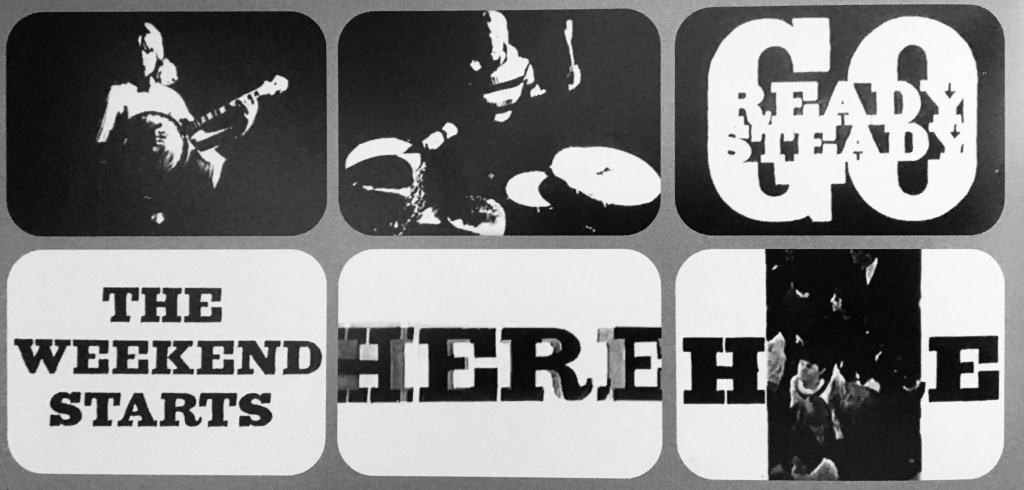
If you lived the the provinces, as I did, RSG! was an essential guide to what was happening in inaccessible London clubs like the Scene, the Ad Lib and the Scotch of St James. The show’s directors, from Bill Turner through Daphne Shadwell, Robert Fleming and Rollo Gamble to the brilliantly innovative Michael Lindsay-Hogg, allowed the members of the audience to crowd around the stage as if they were in a club and took the radical step of treating the cameras as part of the set. Graphics by Clive Arrowsmith and Arnold Schwartzman set the tone in the title sequences, which made use of fast-cutting images from popular culture. Responsible for shaping the whole package was the programme’s editor, Francis Hitching.

The story of RSG! has been told many times before, most recently in a fine documentary shown on BBC4 earlier thus year, but never so thoroughly, informatively and entertainingly as in Ready Steady Go! The Weekend Starts Here, a large-format (12″x12″) history by Andy Neill, who has been everywhere one could possibly go to unearth every scrap of information on the show’s birth, life and death.

You want a list of the precise contents of every episode? It’s here. You want a fantastic assembly of ephemera, such as tickets for the recordings at the original Associated Rediffusion studios in Kingsway and the later venue in Wembley, and hundreds of newspaper clippings? Also here. You want the memories of dozens of participants, from Mick Jagger to the dancers Patrick Kerr and Sandy Serjeant to Barbara Hulanicki, the founder of Biba and a regular at Kingsway? You want to know more about the presenters Cathy McGowan and Michael Aldred and the members of the production staff? You want the stories behind Ready Steady Goes Live, Ready Steady Win (the talent competition won by the Bo Street Runners), the Mod Ball and Ready Steady Allez!, the show broadcast live from the Locomotive in Paris in March 1966, with the Yardbirds, the Who, Hugues Aufray, Mireille Mathieu and Eddy Mitchell? You want an informed history of British TV’s treatment of pop music, along with Dennis Potter’s Daily Herald review of an early Beatles appearance on RSG!? You want a detailed history of its ratings, as well as the stories about Françoise Hardy’s refusal to sit down while wearing her new trouser suit and the letters from viewers disgusted by James Brown’s show? All here, in a volume with a great anecdote on practically every page, along with a fantastic selection of photographs.

Jagger talks about how he used to go along even when the Stones weren’t on, just to be there. “RSG! wasn’t safe, it took risks,” he tells Neill. “It waded right into the wonderful chaos of the times. You always thought you were slightly on the edge there.” Pete Townshend agrees: “It reflected the colour and vivacity of the times better than almost any other medium.” He remembers how, for the first of the Who’s 16 appearances, performing “I Can’t Explain” in 1965, they were allowed to bring along their own fans from the Goldhawk Club in Shepherds Bush. Wickham and Lindsay-Hogg, he says, “conveyed the sense that we were, all of us, breaking every rule of television. I felt they were breaking societal rules as well.”

My old friend Keith Altham, then a journalist on Fabulous magazine, remembers it as a meeting place for young people starting out in the music business. “It was like a glorified youth club where your mates played guitars or drums or were in the business of reporting on the beat phenomenon. The writers and musicians were all contemporaries.” And afterwards there would be parties for the in-crowd, maybe at Tony Hall’s flat in Mayfair, with a Beatle and a Ronette and a Stone in attendance.

The programme was killed in December 1966 after 173 episodes. Jimi Hendrix and Marc Bolan were featured in the penultimate show and Chris Farlowe duetted with Jagger on “Out of Time” and “Satisfaction” in the final episode, two days before Christmas. Times and tastes were changing, and the sense of novelty and excitement had dulled. The mainstream audience was getting its fix of chart music from Top of the Pops (BBC, January 1964-July 2006, 2,267 episodes) while the mods were turning into hippies and no longer looked for guidance from television programmes. But it would be a long time before anything came along to replace it.

I can’t think of anything I’d want this book to have that it doesn’t include. As a thoroughly comprehensive and endlessly entertaining time-capsule, put together in exactly the spirit that the show was made, it’s something to cherish. The story of what Elkan Allan, Vicki Wickham and their friends and colleagues created will never be better told.

* Andy Neill’s Ready Steady Go! The Weekend Starts Here is published by BMG (£39.99). Recommended listening: The ‘Sound’ of the R&B Hits, the first anthology of Motown tracks released in Britain back in 1964, now expanded from 14 to 28 tracks and released by Ace Records. For more about pop and rock on the small and large screen, there’s Docs That Rock, Music That Matters by Harvey Kubernik, published in the US by Otherworld Cottage (about £35), including chapters on American Bandstand, D. A. Pennebaker, Peter Whitehead’s Charlie Is My Darling, Concert for Bangladesh and many other subjects. The sequence of images at the top of this piece was created by Clive Arrowsmith for RSG!‘s title sequence in December 1964.

Lambert & Stamp

Lambert & StampIt amazes me that so many documentary makers fail to heed the principal lesson of Asif Kapadia’s Senna, which is that any relevant archive footage, however scrappy, is more interesting than a talking head. It’s a pity that James D. Cooper didn’t learn it before he started putting together Lambert & Stamp, his film about the two men who managed the Who from their first success in 1964 until the relationship broke down in acrimony 10 years later.

A compelling subject is enough to carry the first half of the film. After that the viewer tires of extended close-ups of Pete Townshend, Chris Stamp and Roger Daltrey sitting in hotel rooms or studios, even when they’re saying interesting things. The archive clips are chopped up and edited fast on the eye, to borrow Bob Dylan’s phrase. Too fast, in fact. The eye wants to rest on them, to be given time to absorb the details. A technique wholly suited to the titles of Ready Steady Go! is not appropriate to this very different project. The exception is a wonderful piece of footage of Stamp and Kit Lambert encountering Jimi Hendrix and Chas Chandler in a London club, possibly the Ad Lib or the Bag O’Nails; we do get to look at that properly, thank goodness.

It’s a story that certainly deserved to be told. Stamp — born in London’s docklands, the son of a tugboat captain — brother of Terence, the male face of ’60s London — almost as good looking but sharp and tough, with more front than Harrods. Lambert — Lancing, Oxford, the Army — the gay son of a celebrated English composer — explaining mod culture to foreign TV interviewers in fluent French and German — empathising immediately with Townshend’s latent talent and Keith Moon’s very unlatent lunacy.

A pretty bruiser and a bruised prettiness: it was a potent combination. “I fell in love with both of them immediately,” Townshend recalls. It’s easy to see how he and, to varying degrees, the other members of the Who were jolted into self-actualisation by the vision and audacity of a pair of energetic wide boys whose real ambition was to get into the film business and who initially saw the music as a vehicle for their ambition.

The viewer does not come away with the impression that the whole truth about the break-up in 1974 has been told, and a few other salient features of the story have gone missing. One is any acknowledgment of Peter Meaden, their first manager when they were still the High Numbers: an authentic mod who helped establish their direction. Another is Shel Talmy, the producer of their first three (and greatest) singles, given only a passing and mildly derogatory mention, without being named.

Lambert died in 1981, aged 45, worn out by his destructive appetites, although the immediate cause of death was a cerebral haemorrhage following a domestic fall. Stamp had conquered his own addictions long before his death in 2012 at the age of 70, having spent many years as a therapist and counsellor. His interviews with the director are used extensively but, lacking the matching testimony of his former partner, his wry eloquence inevitably seems to unbalance the narrative.

At 120 minutes, the film eventually feels bloated. If the first hour passes like a series of three-minute singles, the second is a bit of a rock opera, the occasional interesting fragment separated by long stretches of filler. But, of course, anybody interested in the era should see it.