‘What dives!’ Soho, 2/11/63
While clearing out the other day, I came across a brief attempt to keep a narrative diary during the winter of 1963/64. I was 16 years old and a few months away from being invited to leave school, to put it politely. Most of the diary was about girls, so toe-curling that it went straight to the shredder. But this page seemed worth preserving. It describes a school trip from Nottingham to London, arranged by one of our English masters, to see Joan Littlewood’s new musical Oh, What a Lovely War!, which had had just transferred from its first run at the Theatre Royal Stratford East to Wyndham’s Theatre on Charing Cross Road, Soho’s eastern border. As the diary entry describes, we arrived in Soho and were left to our own devices. Samuel Pepys it is not, but it is a little snapshot of something. Further notes below.
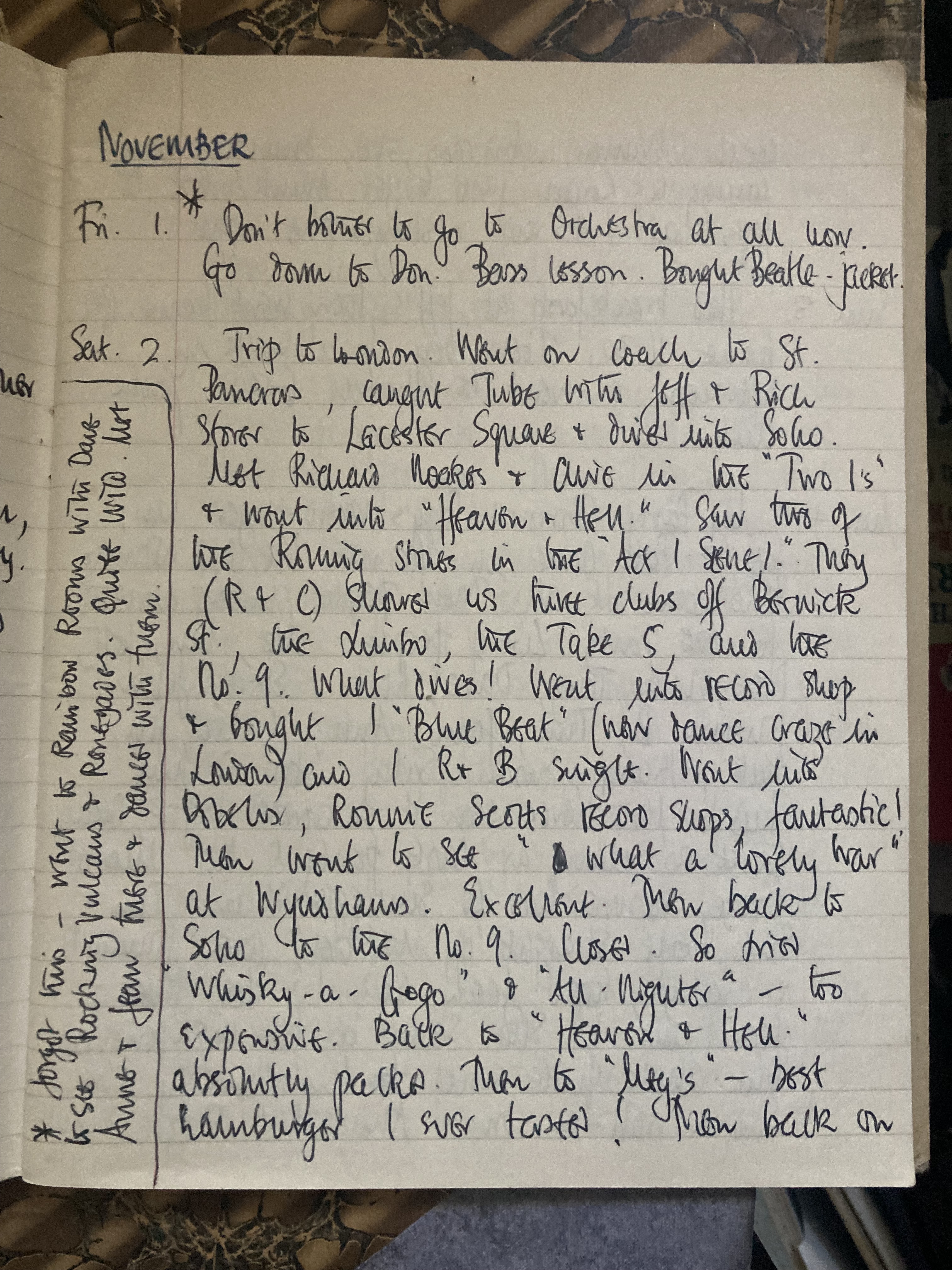
As you’ll see, the day before the trip I skipped the school orchestra rehearsal, visited a local coffee bar whose full name was the Don Juan, had a double bass lesson, and bought a Beatle jacket (brown, round neck, some kind of decorative buttons, 19/6d or thereabouts from C&A, I think). That night a friend and I went to the Rainbow Rooms, an occasional venue for beat groups, to see the Renegades, a band from Birmingham, and the Rocking Vulcans, a local outfit, and to dance with a couple of girls called Anne and Jean.
Once in Soho, the ambition seemed to be to visit as many coffee bars as possible, notably the 2i’s and Heaven & Hell, next door to each other on Old Compton Street. I remember (but didn’t write down) that as we stood outside, a couple naked from the waist up (at least) poked their heads out of a first floor window to chat with someone across the road; this, I thought, must be the life. We also visited Act 1 — Scene 1, directly across the road, and Le Macabre, on Meard Street, where the customers sat on coffins.
And there were record shops, including Ronnie Scott’s short-lived effort on Moor Street and, inevitably, Dobell’s. It must have been at Harlequin on Berwick Street (opened two years earlier) that I bought a Prince Buster 45 on the Blue Beat label (which gave its name to the idiom later known as ska) and “Orange Street” b/w “JA Blues” by the Blue Flames. That was on the R&B label, which I now know to have been named after its founders, Rita and Benny King (formerly Isen or Issel), who ran a record shop in Stamford Hill and had a label on the side, catering to the many West Indians who had recently populated the area.
After the brilliant and very moving show at Wyndham’s, performed by the original cast, including Barbara Windsor and Victor Spinetti, we wandered to the bottom end of Wardour Street to discover that the Whisky A Go-Go and the Flamingo’s All Nighter were out of our price range. But somewhere called Meg’s provided the “best hamburger I ever tasted” — almost certainly the first one that wasn’t a Wimpy.
The “Jeff” who accompanied me on these little adventures was Jeffrey Minson, a fellow member of our folk trio and eventually the author of Genealogies of Moral: Nietzsche, Foucault, Donzelot and the Eccentricity of Ethics. I just wish I could remember which two members of the Rolling Stones we spotted in Act 1 — Scene 1 that afternoon; their second single, “I Wanna Be Your Man”, had been released the day before.
(The missing word at the end of the page is “coach.”)

 thebluemoment.com