Skip to content

Posts from the ‘Jazz’ Category

Upper and lower Pharoah
In 1962, when the editors of Down Beat magazine received copies of John Coltrane’s Live at the Village Vanguard, the first recorded evidence of the extended improvisational methods being explored by the saxophonist’s extraordinary quartet in front of jazz-club audiences, they broke from the standard practice by inviting not one but two reviewers to give their judgments. This was a recognition of the significance and the controversial nature of an album whose centrepiece was the track titled “Chasin’ the Trane”, a 16-minute manifesto for the new freedoms. Those editors must have been gratified by the response: one critic welcomed the sense of opening up fresh territory, while the other threw up his arms in horror.

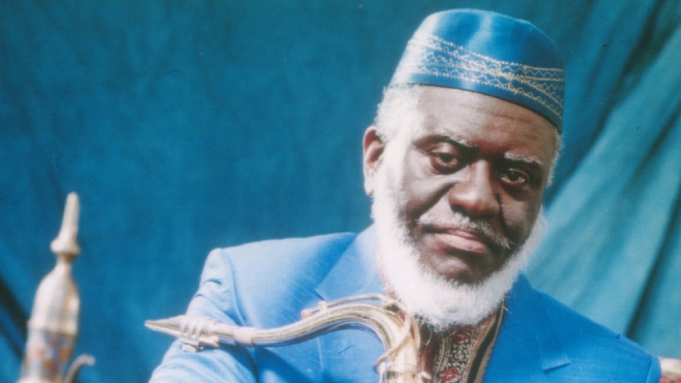
Confronted by the latest recording to feature the distinctive tenor saxophone of Pharoah Sanders, Coltrane’s former colleague, I feel like slipping into both roles. Promises by Floating Points, Pharoah Sanders and the London Symphony Orchestra provokes two entirely different responses, perhaps of equal validity.

Floating Points is the name adopted by the DJ and electronic musician Sam Shepherd. The album consists of one Shepherd composition, 47 minutes long, divided into nine movements and created in collaboration with his featured soloist. It is, in effect, a concerto grosso for tenor saxophone, with Sanders drifting and out of the instrumental passages, and also — as has been his wont in the past — adding a brief wordless vocal to one passage.

The LSO’s equal billing is a little misleading. Their resources are used sparingly; nowhere is there the sense of an orchestral tutti, although the brief final movement, which feels like an epilogue, is for the string section alone. Shepherd’s various keyboards — synths, B3, celeste, piano, harpsichord — provide the basic palette, stating a basic seven-note motif that runs, with slight variations, through the first eight movements. If I were to reach for an easy description of the mostly subdued, mostly slow-moving sound he creates, I might say that it resembles like the result of an imaginary collaboration between Nils Frahm and Brian Eno’s generative music app, with the spirits of Terry Riley and Arvo Pärt smiling down on the proceedings. There’s a bit of Necks in there, too, particularly when the B3 takes over in the eighth movement.

And that’s fine, as far as it goes. Perhaps even more than fine. The sounds are carefully chosen and artfully deployed — I’m tempted to say “curated” — in order to fashion something a little more active than ambient music: the colours and densities shift regularly enough to retain the interest. Sanders adds the necessary individual voice, as Wayne Shorter did to Gil Evans’s “The Barbara Song”. Yet his unmistakeable tone arrives almost more like a benediction than as a full participant.

Which is the problem (if there is one, of course). Sanders comes from a musical idiom that emphasises collective interplay and creativity in the moment. There’s none of that here. He plays quite beautifully through the first two movements, filling the spaces between the keyboard leitmotif with finely grained and graded phrases, but even on the fifth and seventh movements, where he stretches out a little, he’s applying his figurations on to an essentially passive undercoat. It couldn’t really be further than the stuff he got up to on Coltrane’s Live at the Village Vanguard Again! in 1966, when the point was to shock the listener into a heightened awareness rather than lull him or her into a beatific trance.

The younger man in me revolts against this. Of course I’m 50-odd years older now, and so is Sanders, who turned 80 last year, and the times are different. But stimulating new settings can be devised for even the freest improvisers of Sanders’s vintage. In 2004 Ashley Wales and John Coxon of Spring Heel Jack invited the saxophonist John Tchicai to respond to a series of electronic pieces and were rewarded with John Tchicai with Strings, a real classic. Alexander Hawkins drew a similar reaction from another distinguished saxophonist, Evan Parker, on the recent Togetherness Music.

On the other hand… Sanders was always looking for different trajectories to transcendence. Tauhid, the first of his recordings for the Impulse label, remains one of my favourite albums of the Sixties, not least for the gentle, blissful “Upper and Lower Egypt”, although it was created in real time with improvisers of the calibre of Sonny Sharrock, Dave Burrell, Henry Grimes, Roger Blank and Nat Bettis, all of whom were rising to meet a challenge. There’s no such challenge in Promises, if challenges are what you’re looking for in music. What is it, then? Is it a lower form of the art? As I discovered at the weekend, it’s perfect Sunday-morning music. And thus I remain divided, content to have bought it because I know I’ll play it again, with enjoyment. But I also know that while it’s on, I’ll be feeling that probably I ought to be listening to something that makes a few more demands.

* Promises is out on the Luaka Bop label.

Hemphill bid’ness

The saxophonist and composer Julius Hemphill was born in 1938 in Fort Worth, Texas, where he attended the same high school at Ornette Coleman, who was eight years his senior and said to be his cousin. By the time he reached his early twenties Hemphill was in St Louis, Missouri, where he joined the Black Artists Group. In 1972 he led a recording session that, when released first on his own small Mbari label and then more widely on Arista Freedom, made a lasting impression on many who heard it. On the initial album, called Dogon A.D., Hemphill seemed to have extended the possibilities of the union between the most basic blues and the avant-garde that was implicit in Coleman’s music.

A second album, which he gave the challenging title Coon Bid’ness, contained a track from that first session, titled “The Hard Blues”, in which Hamiet Bluiett’s baritone saxophone was added to Hemphill’s alto, Baikida Carroll’s trumpet, Abdul Wadud’s cello and Philip Wilson’s drums. It had an even more powerful impact on me. Hemphill seemed to have fused the harsh, elemental sound of John Lee Hooker, the warmth and colour of an Ellington small group and the collective exuberance of a Mingus ensemble into something that pointed a way to the future.

Hemphill moved to New York in the early ’70s and immersed himself in the loft scene. He was a busy man between those first recordings and his death in 1995, perhaps most notably with the World Saxophone Quartet, for which he wrote and arranged many pieces. His own albums ranged from solo saxophone recitals to a full big band. Many of them featured the cello of Wadud, with whom Hemphill had a special rapport: as close a relationship between two instrumentalists as any I can think of in jazz. He had a fondness for exposing the music’s overlooked roots, as when he sometimes adopted the name Roi Boyé, or M’Boyé, as a rubric for his projects, harking back to African kingdoms and southern minstrel shows.

The Boyé Multi-National Crusade for Harmony is the title of a new box of seven CDs compiled by one of his acolytes, the saxophonist Marty Erlich, from the contents of the Hemphill archive in the Fails Library at New York University. It’s an extraordinarily rich piece of musical archaeology which covers many aspects of Hemphill’s art at satisfying length.

Most of it is culled from live performance, from the 1978 quartet performance with Olu Dara on trumpet, Wadud and the drummer Warren Smith with which the set begins to a coruscating concert by Hemphill and Carroll with Dave Holland on bass and Jack DeJohnette on drums in a Woodstock club in 1979 with which it concludes. Other participants in the various small groups include the brothers Nels and Alex Cline on guitar and drums, John Carter on clarinet, the guitarist Jack Wilkins, the bass guitarist Jerome Harris and the drummer Michael Carvin. One disc features Hemphill playing with the poets K. Curtis Lyle and Malinké Elliott.

Throughout the listener is struck by how effectively Hemphill was able to blend free blowing with structured composition. Some of his themes have the intensity of bebop leavened with the humour of Monk, but with a down-home flavour that was Hemphill’s own. Whether on alto or soprano, he was a stunningly fluent improviser who took off from a space between Charlie Parker and Ornette Coleman and headed out into his own territory.

Vigorous and ceaselessly inventive, on alto and soprano he had a marvellously human tone that was most perfectly matched with the sound of Wadud’s cello. What Erlich, in his extensive notes, describes as the “Rosetta stone” of the set is an entire disc of duets recorded in Washington DC in 1989. Somehow Wadud finds a role that combines the functions of bass and guitar while retaining the cello’s own characteristics. He plucks, he bows, he plays double-stops and strums passing chords, while providing a source of energy to match Hemphill’s own. Some of the music is certainly composed, but everything retains the spontaneous urgency of improvisation. On the last of the six pieces, “Downstairs”, which turns out to be a variation on the “Hi-Heel Sneakers”/”Can I Get a Witness” riff, the two men return to the basics they explored on “The Hard Blues” and “Dogon A.D.”.

More unexpected is the inclusion of the arrangements of three Mingus compositions — “Nostalgia in Times Square”, “Alice’s Wonderland” and “Better Git It in Your Soul” — for strings, recorded by the Daedalus String Quartet, Hemphill infusing the ardour characteristic of the composer’s music with an astringency of his own. Recorded at the same Boston concert devoted to Hemphill’s music in 2007 was “Parchment”, a piece for solo piano written for and performed by the pianist Ursula Oppens, his partner in his later years. Two untitled extended pieces for a wind quintet made up of Erlich, the reeds player John Purcell, the bassoonist Janet Grice, the trumpeter Bruce Purse and the trombonist Ray Anderson, recorded in 1981, further demonstrate Hemphill’s interest in classical chamber music and his ability to range between idioms.

Next to the Hemphill/Wadud duets, however, the set’s most valuable disc is the concert with Carroll, Holland and DeJohnette, a decade after the bassist and drummer had first played together, with Miles Davis and then Stan Getz. Throughout three long pieces, Hemphill’s themes trigger ferociously intense playing. The opener, “Mirrors”, contains perhaps the most violent playing I’ve ever heard from DeJohnette, a bold barrage of free creative commentary — particularly under the leader’s long and impassioned improvisation — that culminates in a densely packed solo. Holland emerges in “Dung” with a stunning solo of his own. The final piece, “Would Boogie”, a humorous two-beat exercise in the vein of Mingus’s “My Jelly Roll Soul”, gives DeJohnette an opportunity to take out his melodica, on which he improvises over a noble walking bass.

At $111.93 or £84.99 (see below), this box set isn’t cheap. But its musical and historical value, and the knowledge and care with which it was put together, justify every cent. Julius Hemphill was an important figure in jazz at a time when it was fighting for its identity and its future. His was a voice that reminded us of the enduring potential of the music’s core truths and values, paving the way for the likes of Matana Roberts and Ambrose Akinmusire, and this is a most handsome memorial.

* The photograph of Julius Hemphill was taken by John Begansky Jeffoto in 1980 and is from the booklet accompanying The Boyé Multi-National Crusade for Harmony, which is available from New World Records at http://www.newworldrecords.org and from Proper Music in the UK: https://www.propermusic.com/nw80825-the-boye-national-crusade-for-harmony-7cd.html

ICP in Friesland

Back in the 1970s it was an exquisite shock to hear musicians associated with Instant Composers Pool, the Amsterdam-based collective of free improvisers, playing a dance-band version of “Our Day Will Come”, the old Ruby and the Romantics hit, with no outward signs of irony. It was post-modern, in a way, but it wasn’t arch or condescending. It was just the way they saw things. And that was one of their contributions to the jazz of the last half-century.

Founded in 1967 by the pianist Misha Mengelberg, the saxophonist Willem Breuker and the drummer Han Bennink, ICP is still going strong, despite losing its state funding last year, and its members are still playing dance-band tunes, as you can hear in the clip above, where they perform “De Linkerschoen, de Rechterschoen”, a delightful tune by their bassist, Ernst Glerum, in best palais-glide style. It’s the first of two versions of the tune included in the latest album on their own label: Komen & Gaan by the ICP Septet + Joris Roelofs, Terrie Ex and Mara’s Pianola, which shows the ICP bunch to be as full of irreverent life as ever.

Recorded live at Le Brocope, a jazz and theatre café in Oldeberkoop, a village in Friesland, in north of the Netherlands, it represents an interesting response to the problems presented by the Covid-19 pandemic. To celebrate the venue’s 10th anniversary last October, the musicians were invited to spend a weekend there, eating and drinking and socialising and playing. I don’t know what the lockdown deal was in the Netherlands at the time, but the clip shows the congenial atmosphere they created.

I like this quote in the sleeve note by Mara Eijsbouts, the proprietor of Le Brocope: “As a painting chef, who also happens to be an interior designer, or a designing music lover who loves to cook, a mother of two beautiful daughters, and a historian who likes to write about matters that touch upon the future, entrepreneur, scatterbrain, and hostess in a house with walls that are made of musical energy, and as a jazz lover, I adhere to the adage of jazz: Just play what you like, as long as it fits.”

Throughout the album there are other fragments of the musical history in snatches of “The Sound of Music” and “Ain’t Misbehavin'”, thrown into the mix with the now familiar Dutch mixture of skill and irreverence. But there’s also a lot of free improvisation — sometimes unruly, sometimes exquisite — from the likes of Ab Baars on reeds and shakuhachi, Mary Oliver on violin and viola, Wolter Wierbos on trombone, the pianist Guus Janssen, Michael Moore on alto and clarinet, the great Bennink, the last survivor of the original founding trio, whose inimitable artwork is to be found on the album’s cover, and the two guests, the guitarist Terrie Ex and the bass clarinetist Joris Roelofs.

It’s hard to imagine a more gleefully anarchic piece of music being released in 2021 than the variations on Bach’s Toccata and Fugue in D Minor perpetrated on this album by Janssen and Ex. While Janssen fractures and reorganises Bach’s notes at a ridiculous speed, Ex strafes his efforts with skittering bottleneck noise before the two musicians accelerate together into a grandiose finale that includes a few seconds in which they sound as if they’re falling over each other’s feet. Ending with a pratfall thud, it’s a typical piece of ICP surrealism, being simultaneously funny and rather beautiful.

* Komen & Gaan is available, like other ICP albums and publications, from http://www.icporchestra.com

Bearing witness

It was by concidence, or so I imagine, that a CD titled Cwmwl Tystion dropped through my letterbox on St David’s Day, which falls on March 1. Cwmwl Tystion — whose English title is Witness — happens to be an album of new jazz by Welsh musicians, devoted to themes of Welsh culture and nationhood.

The literal translation of “cwmwl tystion” is “cloud of witnesses”, a phrase taken from a translation (by Rowan Williams, the former Archbishop of Canterbury) of a poem called “What is Man?” by Waldo Williams (1904-1971), a celebrated Welsh poet, nationalist and peace activist:

What is it to be a people? A gift
lodged in the heart’s deep folds.
What is love of country? Keeping house
among a cloud of witnesses.

Six of the seven pieces on the album were written by the trumpeter Tomos Williams (the exception is the traditional “Glyn Tawe”) and performed by him with Francesca Simmons (violin and saw), Rhodri Davies (harp and electronics), Huw Warren (piano), Huw V. Williams (bass), and Mark O’Connor (drums). The titles make reference to Paul Robeson’s historic performance at the miners’ eisteddfod in Porthcawl in 1957; to the Blue Books of 1847, in which the teaching of the Welsh language was officially discouraged; and to the infamous obliteration of an entire North Wales village in 1965 in order to create a reservoir to provide water for the people of Liverpool.

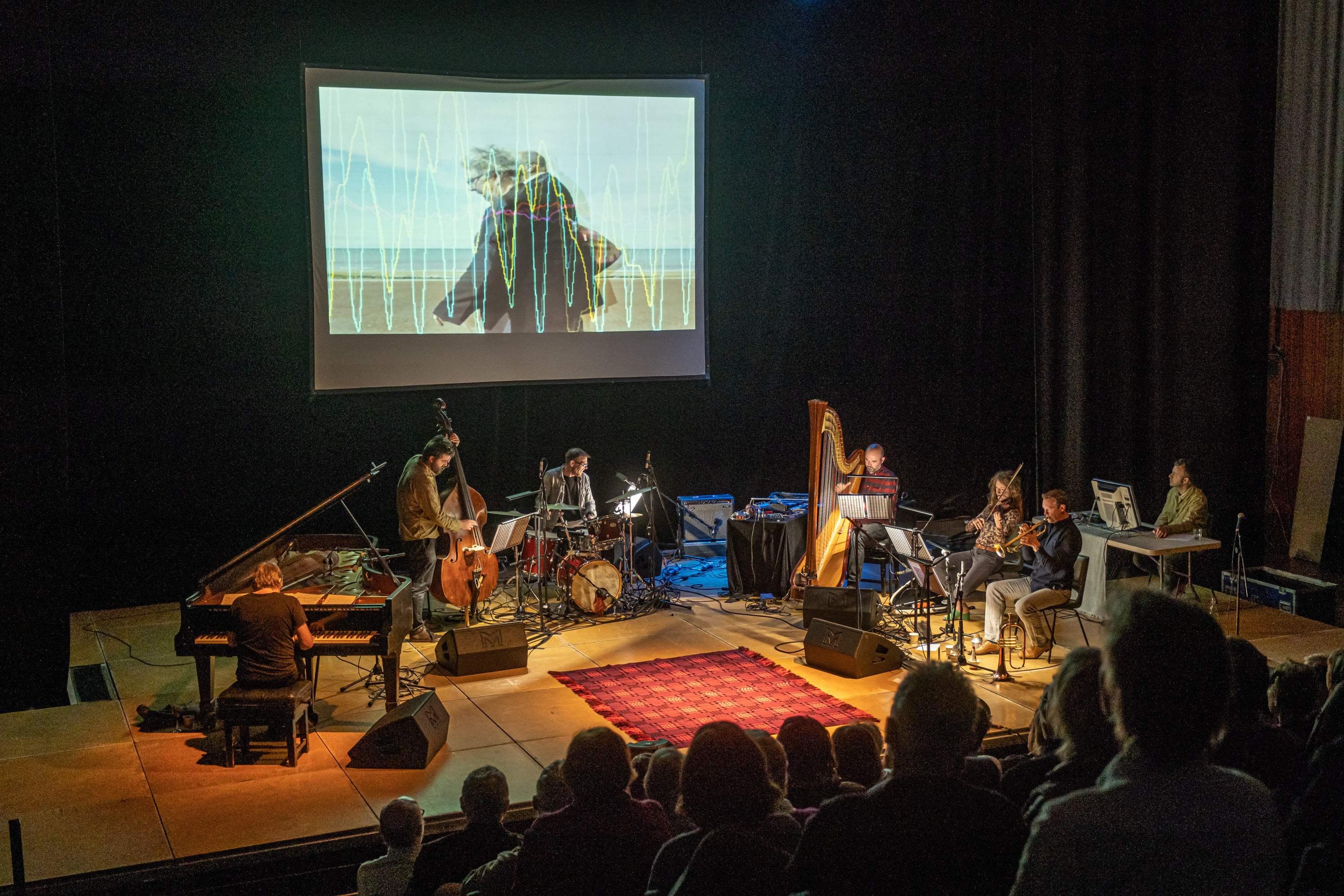
This would be all very well and good, but perhaps pleasing primarily to Welsh hearts, were it not that the music produced by Tomos Williams and his colleagues is of the very highest class. Supported by Ty Cerdd (Music Centre Wales), on whose label the CD was released this month, The Cwmwl Tystion Suite was given five concert performances — with live visuals by Simon Proffitt — in 2019, from which these recordings were taken.

What Tomos Williams has done is subtly infiltrate contemporary jazz practices with textures drawn from the music of his native land, but in a very non-literal way. So while the sound of Rhodri Davies’ harp is a reminder of traditional Welsh music, it also carries an echo of Alice Coltrane: the spirituality shared by both infuses the music without dominating it. Davies’s use of electronics adds different colours and dimensions to the music, as an equal voice with the acoustic instruments or as a soundwash. The unusual instrumentation is thoughtfully deployed — as in the trumpet/violin statement of the opening “Mynyddoedd Cymru (Mountains of Wales)” — and shrewdly rotated to maximise its possibilities and its freshness.

All the soloists bring character to their improvisations. Tomos Williams plays as Wadada Leo Smith might do, had he been born in Aberystwyth: a different kind of blues. Francesca Simmons finds interesting ways of applying lyricism to these often astringent textures, and her rich tone is spotlit on “Glyn Tawe”. Huw V. Williams is a powerful force on bass, taking the spotlight on the tribute to Robeson, and Huw Warren’s glistening solo on the closing track, “What is Man?”, mines the creative space between Bill Evans and Herbie Hancock. Mark O’Connor’s drumming is beautifully sensitive and exquisitely detailed, radiating light and swing.

Jazz is an African American music generous enough to allow others to inhabit its spirit and to shape it to their own ends. Django Reinhardt proved that, as have Tomasz Stanko, Dudu Pukwana, Han Bennink, Don Drummond, Giorgio Gaslini, John Surman, Masabumi Kikuchi, Gato Barbieri, and many others. If the music can “belong” to Sinti, Poles, South Africans, Dutch, Jamaicans, Italians, English, Japanese and Argentinians, then it can belong to the Welsh, too.

Small country, big heart — a heart that beats firmly throughout this excellent album, a showcase for skill, imagination, soul and originality. Even without a spasm of hiraeth — the Welsh yearning for the homeland — I’d be disposed to recommend it very highly indeed.

* The photograph was taken at Aberystwyth Arts Centre by Keith Morris. Further information: http://www.tycerdd.org or http://www.tycerddshop.com

Music for Black Pigeons

Jorge Rossy, Jakob Bro, Arve Henriksen (photo: Andreas Koefoed/ECM Records

To be perfectly honest, I couldn’t think of a headline for this piece. So I used the title of a composition from Jakob Bro’s new album, which features the Danish guitarist with the Norwegian trumpeter Arve Henriksen and the Spanish drummer Jorge Rossy. I just liked the sound of it. Or maybe I liked the idea of what sort of music might appeal to black pigeons. And if you’re asking yourself, as I did, whether there actually are black pigeons, the answer is that the black imperial pigeon, Ducula melanochroa, also known as the Bismarck imperial pigeon, is native to the Bismarck Archipelago, a group of islands off the north-east coast of New Guinea.

The album is titled Uma Elmo and is a good example of the procedure developed by the producer Manfred Eicher early in the life of his label, ECM Records. He assembles a group of musicians from among his repertory company, puts them in a sympathetic recording environment and sees what happens. In this case the three musicians receive equal billing, displayed on the sleeve in alphabetical order, although the fact that all eight compositions are by Bro suggests that he is in some sense the leader of the session, or at least the agenda-setter.

I love Bro’s playing and the records he makes. He has an understated take on modern guitar-playing, more painterly than most. Thought goes into every note, which is why in the past he’s worked so well with the bassist Thomas Morgan, who appeared on Bro’s first four ECM albums. Morgan isn’t here this time, but Henriksen and Rossy (who is probably best known for his long tenure with the trio of Brad Mehldau) have a similar sense of economy and of the need to play only the right notes.

The pieces on this album are tone poems, more abstract than Bro’s usual creations. Each one floats in its own pool of texture, subtle in effect and gradual in momentum, but employing a surprisingly wide dynamic and emotional range. Exquisite but never effete, they invite the musicians to explore their individual instrumental vocabularies as part of a collective creation. Solos are not the point here. But all of them play at the top of their form: Bro making fascinating use of loops, Henriksen producing his most lyrical flights, and Rossy proving himself to be a master colourist in this largely tempo-free music.

Highly recommended, then, and not just to Bismarck imperial pigeons. Ducula melanochroa is not, I’m pleased to report, an endangered species. They flourish, just like these three exceptional modern musicians.

* Here’s a link to the promo clip for Uma Elmo: https://youtu.be/UZQZNF4qwwo

Just like Elvin, Art, Max…

All the way through the ’60s, starting at the age of 13, I’d buy a copy of Down Beat every fortnight from a newsagent that stocked foreign publications. Thirty five cents in the US, it cost half a crown in the UK — a lot of money when I was still at school. Of course I wanted to read interviews with people like John Coltrane and Ornette Coleman, and to absorb the wisdom of critics and columnists such as Pete Welding, Don DeMichael, John A. Tynan and LeRoi Jones. But I also wanted to gaze at the full-page ads for Gretsch drums.

Other manufacturers also used famous players as their pitchmen: Shelly Manne used Leedy drums, we were told, while Buddy Rich played Rogers, Rufus Jones played Slingerland, and Joe Morello had a Ludwig kit. But the Fred Gretsch Manufacturing Co. of Brooklyn, NY… well, as you can see above, they had Elvin Jones, Art Blakey, Max Roach, Philly Joe Jones and the teenaged prodigy Tony Williams, all of them drummers I worshipped, and most issues of Down Beat included an ad showing one of them with the kit he favoured. That was enough to give me a lifelong yearning to own a set of Gretsch drums: a jazz kit with an 18-inch bass drum and 12- and 14-inch toms, all in that nice black finish that Tony used with Miles, and a five-inch chrome-shelled snare drum. Since you’re asking.

I know it’s stupid to fetishise makers of percussion instruments; after all, one of the most effective drum kits in music history — the one in Motown’s main studio throughout the ’60s, played by Benny Benjamin, Richard “Pistol” Allen and Uriel Jones on countless classic hits — was a hotch-potch bearing the logos of Ludwig, Slingerland, Rogers and Gretsch. And how great did that sound?

Still, we can dream, and my particular yearning was partially satisfied a few years ago when I was asked what I wanted for Christmas and the only thing I could think of, within sensible limits, was a Gretsch snare drum. So now I have one, just to keep my wrists in shape, although a fear of annoying the neighbours leads me to muffle it with a thick duster, which removes a fair amount of the fun. (The kid across the street who started playing a full kit from scratch a year ago has no such compunction, but at least he’s got a future and I can hear him improving by the month.)

And the point of this, you’re asking? It’s that next month there’s an online auction of equipment from the Gretsch factory, with the proceeds apparently going to the company’s charitable foundation, whose activities include organising drum circles for child refugees from Africa and the Middle East. Here’s a link. You’ll see that among the offerings are not just drums and some of the guitars for which the company also became famous — including the Chet Atkins and Duane Eddy models — but an intriguing miscellany of items including “vintage guitar neck patterns, a rolling rack with ten drawers of saw blades, metal clamps with a large wooden hand drill, an antique cabinet, body forms, wrenches, a sanding table, vintage four-wheel open carts and more…”

I won’t be bidding. I’ve got my drum with a Gretsch badge on it. Just like Elvin, Art, Max, Philly Joe and Tony, right?

Cats, herded

Alexander Hawkins and Evan Parker (photo: Dawid Laskowski)

Organising free improvisers might seem like a fool’s task. Why would the special breed of players who spend their lives resolutely creating music from scratch suddenly want to submit to the will of a composer? Nevertheless, history proves that sometimes it works: notable successes were recorded by Michael Mantler with the original Jazz Composer’s Orchestra, Alexander von Schlippenbach with his Globe Unity Orchestra and Barry Guy with the London Jazz Composers’ Orchestra. Each project depended to some extent on the leader/composer’s familiarity with the techniques of contemporary European straight music, but the idea was given new impetus with the introduction of the looser and perhaps more organic-to-the-idiom technique of “conduction”, pioneered by the late Butch Morris and pursued by George Lewis and Tyshawn Sorey, among others. Slightly to one side were the adventures of the British duo Ashley Wales and John Coxon, known as Spring Heel Jack, who created stimulating modern environments for many individual improvisers, including Wadada Leo Smith and John Tchicai.

The first sound heard on Togetherness Music: For Sixteen Musicians, Alexander Hawkins’ new album, is that of Evan Parker’s soprano saxophone, unwinding its always surprising coils of sound, the seemingly unbroken skeins of notes punctuated by split-second darts and lurches into other registers. As usual, it’s exhilarating and mesmerising, particularly when the sound of the isolated soprano blooms with reverberation, which may or may not be the natural property of Challow Park Studios in Oxfordshire, where the set was recorded. But then Hawkins introduces his other resources: the five string players of the Riot Ensemble and nine other musicians, including the trumpeter Percy Pursglove, the saxophonist and flautist Rachel Musson, the cellist Hannah Marshall, the bassist Neil Charles, the drummer Mark Sanders, and Matthew Wright on electronics, all conducted by Aaron Hollway-Nahum. Gradually they add sombre pedal-points, heightening the atmosphere before Parker drops out and the strings begin to slip and slide until the piece ends, after almost 10 minutes, with several of them holding a tentative D natural.

Sanders and Pursglove are the next to get the concerto grosso for improvisers treatment, a layer of restless percussion under the silvery trumpet continuing into a dialogue with written lines for flute/bass clarinet and viola/cello. On the third piece Parker returns for a pointilliste conversation with Hawkins’ scrambling piano in which the Riot Ensemble make their full presence known, soaring and churning as the music holds itself together through some mysterious centripetal force.

Hawkins, the 16th musician, is featured on the fourth piece, against a walking line played by two basses (Charles and Marianne Schofield) and possibly one of the two cellos, too. Showing the pianist at his most inventive and hyper-alert, it has the loping gait and harmonically ambiguous flavour of the music created by young Cecil Taylor and the bassist with his early groups, Buell Neidlinger, before Parker pipes up with a reminder of another early Taylor collaborator, Steve Lacy, in a passage of ensemble agitation that resolves into an elegant, ruminative diminuendo.

The strings dominate the fifth piece, a collective statement in which the individual instruments glide around each other as if in mismatched orbits, the fine details of tone and timbre revealed within an aural space that feels busy yet uncluttered. The sixth and final composition opens with a trio of Charles, Sanders and Wright, bass and drums working around light electronic taps, thuds and crackles. Pursglove and Hawkins emerge with staccato trumpet figures and a purposefully wandering single-note piano line, continuing as Sanders briefly dominates with thrashing brushwork before the other musicians reappear in a crescendo of exultant sound. A graceful withdrawal gives the last word to Parker and Hawkins, two improvisers who share a near-infallible instinct for an ending.

The six pieces are titled, in order, “Indistinguishable from Magic”, “Sea No Shore”, “Ensemble Equals Together”, “Leaving the Classroom of a Beloved Teacher”, “Ecstatic Baobabs” and “Optimism of the Will”. I’ve described them in such details because the more you listen, the more distinctive they become: each one a living organism with its own cellular structure, texture and micro-climate. I’ve said before that Hawkins has a rare understanding of how to combine composition and improvisation, and here, in this very special recording, we have a perfect example of his gift.

Perhaps I’ve found Togetherness Music particularly valuable because I’ve missed attending live performances of free improvisation very much over the past year. Recordings of small groups, however excellent, aren’t the same thing as hearing and seeing this music conjured in front of you. But by framing improvisation so creatively, Hawkins brings it to life in a different way.

* Alexander Hawkins’ Togetherness Music is out now on the Intakt label (www.intaktrec.ch)

Live at the Village Vanguard

Something Sonny Rollins said in an excellent interview in the March issue of Uncut magazine reminded me of how much I miss being in clubs. The thing with live music, Rollins told John Lewis, is that “everybody has a role — even the audience. The guy nodding his head, the girl who’s smiling, the sceptic who’s not impressed — they all make you play better.” He was answering a question about his youthful experiences in clubs on 52nd Street, but the thought is eternal.

The Village Vanguard, the legendary club on Seventh Avenue South where John Coltrane, Bill Evans and many others made historic recordings, is currently programming a series of livestreamed gigs. You pay $10 and you can either watch the performance live or at any time in the following 24 hours. It’s a way of staying close to the practitioners of an idiom that places such a premium on communication, as well as supporting an institution.

I caught the second of the weekend’s two gigs by the drummer Tyshawn Sorey, the saxophonist Joe Lovano and the guitarist Bill Frisell. Sorey was billed as the leader, and I guess the tunes must have been his, but this was a meeting of three creative minds in a relaxed chamber-jazz environment. I particularly enjoyed seeing Tyshawn — who can do anything — at work on a small jazz kit, swinging with a loose, easy but totally alert feeling that makes me think of Billy Higgins and Tony Williams at the same time.

Lovano and Frisell played together for many years in a trio with the late drummer Paul Motian. There’s no replacing the kind of rapport those three developed over time, but it was fascinating to hear the music the two of them made with Sorey deepen and intensify over the course of an hour. One day maybe we’ll be in the same room as these musicians again, playing our little parts in the ceremony.

* The Vanguard’s coming attractions include the trio of the great pianist Kris Davis and solo performances by the guitarist Ben Monder and the drummer Bill Stewart. Go to http://www.villagevanguard.com and hit the livestream button. You’ll need to register.

The art of the bolero

When someone mentions the bolero, most of us probably think of the hypnotic Ravel piece in slow three-quarter time used in the 1979 Hollywood comedy 10 as a signifier for sex and at the 1984 Winter Olympics by the ice-dancing champions Jayne Torvill and Christopher Dean. That kind of bolero was hybridised from Spanish dances and turned into art music. The other type of bolero was the sort that turned up in Cuba in the late 19th century, in the form of romantic ballads whose popularity spread throughout Latin America.

As a boy growing up in a housing project in San Juan, Puerto Rico, the alto saxophonist Miguel Zenón heard boleros sung by the likes of Arsenio Rodriguez, La Lupe, Benny Moré and Sylvia Rexach: like French chanson, it was a music that transcended generations. His latest album, titled El Arte del Bolero, is a series of duets with the pianist Luis Perdomo — a member of his regular quartet — on the songs he heard back then, delivered with respect, understanding and affection.

Zenón, who was born in 1976, learnt the saxophone from the age of 10 and eventually won a place at a local music school. At 20 he left home with a scholarship to study at Berklee College in Boston, where he fell in with some interesting contemporaries from around the world. Since then he has become widely renowned not just as a wonderful improviser but as a composer, a bandleader, and a distinguished educator. For almost 10 years he has run a project called Caravana Cultural, taking free jazz concerts to young audiences and musicians in Puerto Rico’s rural areas. Grammy nominations and fellowships from the Guggenheim and MacArthur foundations have come his way.

I was first made aware of his playing on Not in Our Name by Charlie Haden’s Liberation Music Orchestra and several albums by the SFJAZZ Collective, an all-star band whose shifting personnel has featured the likes of Joshua Redman, Bobby Hutcherson, Mark Turner and Nicholas Payton. He is also a member of Guillermo Klein’s Los Guachos. In 2015 I invited him to play at Jazzfest Berlin with his quartet, a long-established line-up completed by Perdomo, the Austrian bassist Hans Glawischnig and the drummer Henry Cole, sharing the bill with Keith Tippett’s Octet. Their repertoire included some of the pieces from a recent album, Identities Are Changeable, in which the four-piece was augmented to become a big band and blended with the voices of immigrants; the music retained its potency in the reduced format.

Zenón is a wonderful jazz improviser, clearly influenced by Charlie Parker but with a voice of his own — a warm, fibrous tone throughout the registers with phrasing as elegant at fast tempos as on ballads. El Arte del Bolero is the latest of several albums in which he examines the music of his heritage, but it isn’t a Latin album as such: it’s a record of thoughtful, beautifully balanced explorations with the occasional fleeting venture into ‘outside’ flurries (on Rexach’s “Alma Adentro”, which he first recorded several years ago with an ensemble arranged by Klein) and bebop (Bobby Capó’s “Juguete”, from the repertoire of Cheo Feliciano).

Recorded (without an audience) at the Jazz Gallery in New York last September, this is music of great intimacy, the saxophone so close-miked that you can sometimes hear the soft slap of the pads, the two musicians working as one to create music that combines passion and sophistication in perfect proportions. I can imagine it becoming one of those albums that you keep close at hand, ready for those times when all you want is to hear something beautiful.

* Released via the Miel Music label, Miguel Zenón’s El Arte del Bolero is available on Bandcamp: https://miguelzenon.bandcamp.com/album/el-arte-del-bolero. The photograph of Zenón was taken by Camille Blake on stage at the Haus der Berliner Festspiele in 2015.

Group Sounds Four & Five

From left: Jack Bruce, Lyn Dobson, Henry Lowther, Tom McGuinness, Mike Hugg and Manfred Mann

Tom McGuinness remembers a Sunday night in 1965 when he, Manfred Mann and Mike Hugg visited the Green Man pub on Blackheath Hill to see a modern jazz outfit called Group Sounds Five. He thinks they must have had a motive, because the band’s two horn players — the trumpeter Henry Lowther and the saxophonist Lyn Dobson — soon became members of Manfred Mann, staying until the summer of 1966. After the departure of Mike Vickers, and Tom’s switch from bass back to guitar, they were also joined by Jack Bruce. Tom recalls that Manfred lured Bruce away from John Mayall, who was miffed enough to write a song about the defection: “Double Crossing Time” appeared on the Blues Breakers album.

Group Sounds Five had acquired the habit of rehearsing three times a week, even though they landed on average no more than one gig a month, according to their drummer, Jon Hiseman, and Lowther and Dobson continued with them even after joining the Manfreds. The departure of their pianist, Ken McCarthy, turned them into Group Sounds Four, with Bruce taking over from Ron Rubin on double bass. Both incarnations appear for the first time on record in a new release called Black and White Raga, documenting recordings made by for the BBC Light Programme’s Jazz Club in November 1965 and April 1966, preserved in the extensive personal tape collection of Hiseman, who died in 2018.

This was a remarkably creative time in the London scene, with musicians like Dick Heckstall-Smith, Ginger Baker, Harry Beckett, Danny Thompson, Brian Auger and John McLaughlin switching back and forth between the modern jazz and R&B scenes. Alexis Korner’s Blues Incorporated, George Fame’s Blue Flames, Herbie Goins’s Nightimers and the Graham Bond Organisation welcomed players comfortable with both idioms. Lowther, Dobson and Bruce were able to make a living with Manfred Mann — whose repertoire included tunes like Cannonball Adderley’s “Sack o’ Woe” and Herbie Hancock’s “Watermelon Man” alongside “Do Wah Diddy Diddy” and “Oh No, Not My Baby” — while continuing to pursue their commitment to the sort of avant-garde jazz exemplified by John Coltrane and Ornette Coleman.

The four pieces on the album by Group Sounds Five, with McCarthy on piano and Rubin on bass, most strongly reflect the Coltrane influence. An emphasis on modal structures is evident through “Red Planet” (a Coltrane original also known as “Miles’ Mode”), a hard-bop recasting of Cole Porter’s “Night and Day”, McCarthy’s driving “Celebrity Stomp” and an extended treatment of Mike Taylor’s complex “Black and White Raga”, based on shifting between the black and white keys of the piano. The brilliant but ill-fated Taylor was an admirer of the group (Hiseman, Rubin and Bruce recorded with him), and gave them this piece, which he never recorded himself; he would have been pleased with this intense and compelling treatment, which maintains its tension and narrative thread through 11 absorbing minutes.

Seven months later, now down to a quartet, the band recorded three tracks: Sigmund Romberg’s “Softly, as in a Morning Sunrise”, Bruce’s “Snow” and Dobson’s “Straight Away”. These are even more impressive: the confidence has grown, individually and collectively, and there is the feeling that something genuinely original is beginning to emerge. It’s most fully evident in “Snow”, a five-minute tone poem in which the composer’s bowed bass converses with the two horns, eventually joined by Hiseman’s mallets. There’s a distinctly Northern European cast to this piece, reminiscent of the writing of Krzysztof Komeda and Palle Mikkelborg.

It would be hard to overpraise the quality of improvising, particularly on the later tracks. Lowther’s endless flow of ideas and Dobson’s rhythmical fluency and tempered aggression are matched by the response of the bass and drums, Hiseman making a particularly powerful impression with a solo on “Straight Away” as architecturally coherent as it is technically advanced. Had this band been given the chance to make an album, the product would no doubt have stood alongside Joe Harriott’s “Abstract” and Mike Taylor’s “Trio” as an fine example of the forward-looking music being made in London at the time. Thanks to Hiseman’s archival instinct, this rediscovery fills an important gap.

Between these two sessions, on March 18, 1966, the Manfreds found themselves at Abbey Road recording a song called “Pretty Flamingo”. Jack Bruce sang the high harmony and Lyn Dobson played the distinctive flute part on what became the band’s second UK No 1 hit. Those were different times.

* Black and White Raga is out now on the Jazz in Britain label (jazzinbritain.org). The photograph is taken from the cover of Manfred Mann’s 1966 EP Instrumental Asylum, and is the only one I can find featuring all three of Jack Bruce, Lyn Dobson and Henry Lowther.