Skip to content

Posts from the ‘Jazz’ Category

William Blake in Piccadilly

Although any performance of the Westbrook Blake — as Mike Westbrook’s settings of William Blake’s words have been known for more than 40 years — is a powerful event, the emotional impact of last night’s concert by Mike and Kate Westbrook and their musicians at St James’s Church, Piccadilly was intensified by the knowledge that this Christopher Wren church, consecrated in 1684, was the place where the English poet, painter and visionary was baptised in 1757, soon after his birth in Soho.

Titled Visions and Voices: Echoes of William Blake, the evening began with Kate Westbrook delivering “London”, one of the most harrowing poems in the English language, before Phil Minton took over for “Let the Slave”, the next in the sequence of poems linked and illuminated by instrumental solos. Billy Thompson’s fiddle summoned angels and demons, Chris Biscoe’s alto saxophone spoke to the human capacity for joy, Mike Westbrook and a guest, Matthew Bourne, delivered absorbing piano solos, Steve Berry’s bass was lifted out of a solemn reverie by artful background figures, and most of all the accordion of the remarkable Karen Street transfixed the audience with a long unaccompanied improvisation that soared and dived and spun as if a flock of birds of many shapes and sizes but linked by an avian telepathy had found their way into the church. It was, I think, the most astonishing single piece of playing I’ve heard this year.

You might have seen the Westbrook Blake a few times over the years, and be familiar with the recordings, but its grip never slackens. In fact as the country collapses, hollowed out by a greed that Blake identified two centuries ago, it grows more strikingly relevant. As usual, Mike Westbrook recited passages as urgent and resonant in today’s seemingly very different circumstances as they were when first written:

Compel the poor to live upon a crust of bread, by soft mild arts.
Smile when they frown, frown when they smile; and when a man looks pale
With labour and abstinence, say he looks healthy and happy;
And when his children sicken, let them die; there are enough
Born, even too many, and our earth will be overrun
Without these arts.
..

A few years years after creating his Blake settings, Mike Westbrook composed an extended work for band and orchestra titled London Bridge Is Broken Down, commissioned by and first performed at a festival in Amiens in 1987. Inspired by travels around Europe and meditations on its history at a time when an old order was falling apart, it is divided into sections titled London Bridge, Wenceslas Square, Berlin Wall, Vienna and Picardie. A much admired studio version came out on Virgin the following year. Now there’s the release of the recording of a performance in Zürich in 1990, with Westbrook’s 11-piece unit and the 35-piece Docklands Sinfonietta. Even if you already have the original release, I recommend hearing this one, too, for the exceptional spirit with which the work is played and sung (by Kate Westbrook, using texts from Goethe, Siegfried Sassoon and others).

All Westbrook’s virtues and trademarks are allowed to flower in this 80-minute performance, which stands tall among his catalogue of extended works. The 23-minute sub-section of Vienna titled “Für Sie”, with solos by Alan Wakeman on soprano saxophone, Paul Nieman on trombone, Chris Biscoe on baritone and Pete Whyman on alto, is a slowly unfolding kaleidoscope of exquisite shapes, sounds, trajectories and textures.

* Mike Westbrook’s London Bridge: Live in Zürich 1990 is released on Westbrook Records (www.westbrookjazz.com)
Michael Gibbs / Vortex

Tom Challenger soloing with the Trinity Laban Jazz Orchestra at the Vortex

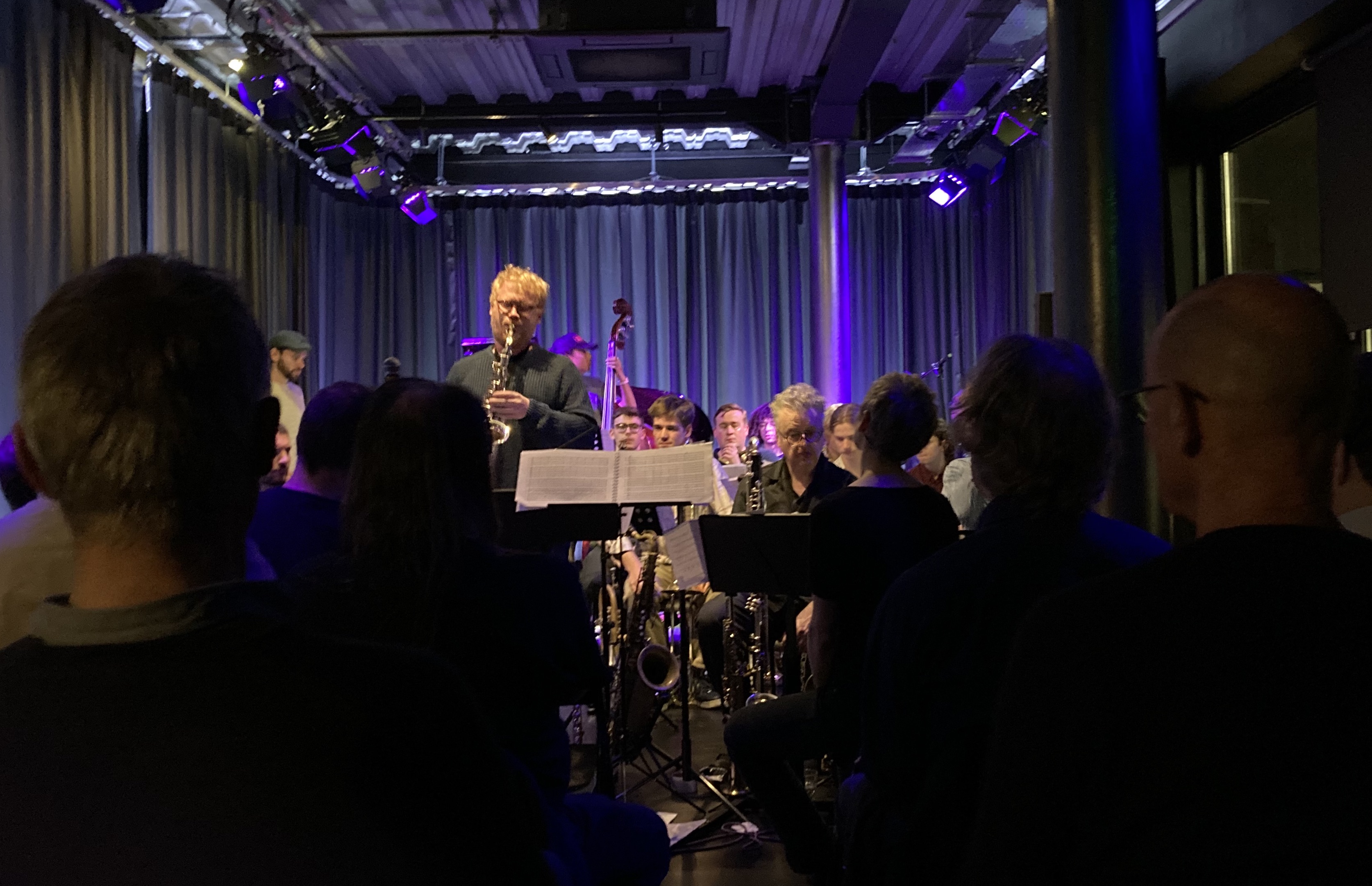
Small space, big band. Can’t beat it. Five trumpets, four trombones, four reeds, five rhythm, making the air move within the confines of a proper jazz club. Even the smallest concert hall wouldn’t be the same. And sitting just behind me at the Vortex last night was Mike Gibbs, smiling and cheering as the Trinity Laban Jazz Orchestra, conducted by Josephine Davies, performed a selection of his compositions and arrangements in one of four sets arranged over two nights as part of the EFG London Jazz Festival, in celebration of his recent 85th birthday.

The finest tribute to the great man was the spirit shown by the young musicians of the orchestra, buttressed by a few distinguished elders, including Julian Siegel and Tom Challenger on saxophones, Lewis Wright on vibes, Hans Koller on piano and Gene Calderazzo on drums. Challenger’s alto soared unstoppably on a heart-lifting “Almost Ev’ry Day”, Wright proved yet again on “Ramblin'” that he doesn’t know how to play an uninteresting phrase, Siegel took firm control of “Round Midnight”, and Calderazzo kept the music on its toes. But the newer faces also had points to make: Kobe Heath Ngugi’s bass matched the drummer’s power and agility, Talfan Jenkins delivered a poised alto solo on Gibbs’ fascinating arrangement of Eberhard Weber’s “Mauritius”, Alex Polack’s trumpet cut through on the closing sequence of “Round Midnight”, and the guitar comping of Joseph Leighton behind Koller and Wright on “Ramblin'” was stimulating enough to remind me of Ray Crawford’s contribution to Gil Evans’s “La Nevada”, than which there can be no higher praise. These are all student at the Trinity Laban Conservatoire, and all names to watch.

Gibbs has worked with many musicians and orchestras in his long career — Kenny Wheeler, Gary Burton, Joni Mitchell, John McLaughlin, John Scofield and so on — but not much can have been more fun than this. At the end of the set, he was presented with a birthday cake while the band stood to play “Happy Birthday”. The fizzing candle was only one of the night’s fireworks.

* If you hurry, there are two more sets tonight: https://www.vortexjazz.co.uk/events/?s=Mike+Gibbs

Binker Golding / Purcell Room

There were times tonight when it felt as though Binker Golding was inventing a new kind of music. He wasn’t, of course, not really. But by combining and recombining familiar elements, and putting them through the filter of his own personality, the saxophonist and composer was doing something that jazz has always done, often to its great and lasting benefit.

On the opening night of the 2022 EFG London Jazz Festival, Golding arrived at the Purcell Room with the music from his recent album, Dream Like a Dogwood Wild Boy, and the brilliant musicians with whom he made it: Billy Adamson (electric and acoustic guitars), Sarah Tandy (piano), Daniel Casimir (bass) and Sam Jones (drums). But he added a whole extra dimension through the presence of the singer and violinist Alice Zawadzki and the harmonica player Philip Achille, who fleshed out the themes and tags that distinguish a set of tunes taking their inspiration as much from the influences behind 1970s singer-songwriter music — folk, gospel, pop — as from the free and post-bop jazz with which Golding has been associated.

He started the concert from a different angle, with the band minus piano and drums playing chamber versions of songs he loves, including Carole King’s “Way Over Yonder”, the Smashing Pumpkins’ “To Sheila”, the traditional “I’ll Fly Away” and Richard Thompson’s “Dimming of the Day”, all featuring Zawadzki’s pure voice. When Tandy and Jones arrived, the enlarged band slammed straight into “(Take Me to the) Wide Open Lows”, the new album’s irresistible opening track, on which Golding and Tandy soared in solos that built to ecstatic heights, with the saxophonist finding an unexpected sweet spot somewhere between Pharoah Sanders and Junior Walker.

Most of all though, it’s the pervasive sense of melody that makes Golding’s new music so appealing. The edge of hard bop is still there in something like “Howling and Drinking in God’s Own Country”. But it’s applied to the cadences of gospel and country, and to chord changes that come from pop music, including Motown, but all metabolised into something with its own organic integrity. Tonight Zawadzki’s fiddle and Achille’s agile chromatic mouth harp immeasurably enhanced these flavours. There was a hoedown mood to the music, a sense of joy, a freshness, a feeling that this was something you really ought to be dancing to.

* Binker Golding’s Dream Like a Dogwood Wild Boy is on Gearbox Records.

Just before the world changed

Sixty years ago this month, “Love Me Do” made the charts and the world changed. But what was it changing from? Not just the drab, complacent cardigans-and-Billy Cotton caricature of post-war British culture. Before the Beatles and Stones came along to provide a focus, there were plenty of signs, if you were looking, that something was about to happen. And two dozen of them are collected in A Snapshot in Time, a new compilation of sounds from 1960-63 that can be seen today as a series of premonitions.

I was 15 at the time, primed for change and and looking for those signs, in particular anything that resembled the incursion of the blues or modern jazz into mainstream pop music. “Sugar Baby Pts 1 and 2” by Jimmy Powell, a raw-voiced R&B singer from Birmingham was one. The more decorous Lyn Cornell — formerly of Liverpool’s Vernons Girls — singing Jon Hendricks’s lyric to Bobby Timmons’ “Moanin'” was another. Anthony Newley’s skewed Cockney-hipster version of “Strawberry Fair”, too. They’re included in this collection, which is subtitled “Society, scandal and the first stirrings of modernism 1960-63”.

One of the defining events of this fast-changing culture was the broadcast of the first episode of the satire show That Was the Week That Was by the BBC in November 1962. One track is a reminder of the national mood caught and amplified by TW3: “Christine” by Miss X exploits the Profumo affair in a cocktail-piano rhumba punctuated by lubricious faux-ingénue vocal interjections from Joyce Blair (sister of Lionel). Produced by John Barry, with the piano played by the Spanish aristocrat and film actor Jaime Mora y Aragón, and released on Jeff Kruger’s Ember label, it was propelled into the lower end of the charts by scandalised newspaper stories.

More seriously indicative of the future was the music evolving among those who had come out of the skiffle, folk and trad scenes, like Long John Baldry singing Willie Dixon’s “Built for Comfort” with Blues Incorporated, the guitarist Davy Graham’s solo set-piece “Anji” and two tracks, “Country Line Special” and “Chicago Calling”, released as the first single by the singer and harmonica player Cyril Davies, the Ken Colyer of British R&B. Others also came by way of the jazz scene, like the tenorist Red Prince with the Danger Man theme and the trombonist Don Lang with “Wicked Woman” (composed by the person who was to become P. J. Proby). Oh, and Sounds Incorporated’s Markeys-like “Sounds Like Locomotion” and “Why Should We Not”, Manfred Mann’s first single, a jazz-waltz instrumental heavy on alto saxophone, organ, harmonica and tom-toms.

A number of the tracks — including those by Powell, Lang and Cordell — came into being because Jack Good, the great producer of the TV show Oh Boy, had an A&R deal with Decca Records. Good was a visionary who wrote columns in the music press extolling the virtues of US records such as Gene Chandler’s “Duke of Earl” and Bruce Channel’s “Hey Baby” (which, of course, provided the inspiration for John Lennon’s harmonica on “Love Me Do”). Among the three Powell tracks is a version of “Tom Hark”, a South African kwela song that had been a hit for Elias and his Zig-Zag Jive Flutes, a pennywhistle band from Johannesburg, in 1958.

The track that sums it up best for me is “Orange Street”, a finger-snapping instrumental by the Blue Flames, with Georgie Fame on Hammond organ. I bought it on a school trip to London and yearned to be a part of the groovy scene to which it provided a soundtrack. Pretty soon, we all were.

* A Snapshot in Time, compiled by Rob Finnis and Roger Armstrong, is released on the Ace label.

The spirit of 1971

On an earlier re-release of the first and only album by Centipede, the 50-strong (and therefore 100-footed) band assembled by Keith Tippett, RCA’s marketing department used a quote from the Melody Maker‘s original review: “No one who wants a permanent record of where our music was at in 1971 will want to be without Septober Energy.” It was true at the time and today, listening to a remastered and reissued version of the double album made by an ensemble containing actual and former members of Soft Machine, King Crimson, the Blue Notes, the Spontaneous Music Ensemble, the Blossom Toes, Nucleus, Patto, the Steam Packet and Dantalian’s Chariot, it still feels right.

In his notes to the new Septober Energy reissue, Sid Smith quotes my description of it at the time as “a miracle”, but as miracles go it was an eminently achievable one, given the spirit of creativity, goodwill and mutual encouragement in which it was conceived and implemented under Tippett’s inspired guidance. This was the first of his large-ensemble projects; if it lacked some of the finesse of later endeavours, it wanted for nothing in terms of spirit.

The clue was in the title. “Energy” was a word much applied back then to the kind of improvising habitually done by the freer players here — the tenorists Gary Windo and Alan Skidmore and the trombonist Paul Rutherford, for example, the singers Julie Tippetts and Maggie Nichols, and the three marvellous South Africans: the trumpeter Mongezi Feza, the altoist Dudu Pukwana and the bassist Harry Miller. But others from related fields were cheerfully infected by the same vibe: the trumpeter Ian Carr, the guitarist Brian Godding, the oboeist Karl Jenkins and the 19 string players led by the violinist Wilf Gibson. And then there were the horns from Tippett’s own sextet, already borrowed by Soft Machine and King Crimson: the cornetist Mark Charig, the trombonist Nick Evans and the altoist Elton Dean. There were five bass players in all, including Jeff Clyne and Roy Babbington, and three drummers, two of them being Robert Wyatt and John Marshall. Robert Fripp played guitar on stage and produced the album.

I seem to remember that the announcement of their debut concert, at the Lyceum in November 1970, made the front page of the MM. After that first gig, boisterously exhilarating but inevitably chaotic, they went on the road in Europe and had a great time. The following June they went into Wessex Studios in north London, located in an old church hall, with just four days for recording the 80-minute piece under Fripp’s supervision and a couple more days for him to mix and edit the results into four movements, each one fitting a side of the double album. Their last appearance was at the Albert Hall in December 1971.

All the enthusiasm of the time, as yet unspoiled by time and the depredations of the music industry, is there on the album. And so, thanks to the skills of the composer and the producer, is a clear view of the individual strengths of the featured soloists (meaning practically everybody), as well as their readiness to attempt a coalescence into something greater than the sum of the parts.

Part 1 begins with the sound of small percussion, like something from a Shinto temple, before long tones — strings, voices — emerge and hover, soon disrupted by the first hints of the storms to come. Gradually the brilliant disposition of the orchestral resources comes into focus as Tippett balances the roistering horns and thunderous drums with subtler deployments and great control of crescendo and diminuendo. The wrapover to Part 2 is a lovely bass conversation — one bowed, one plucked, one playing harmonics con legno — leading to a very period-correct jazz-rock sequence with Tony Fennell’s drums and Babbington’s bass guitar accompanying quarrelsome saxes over a brass choir, suddenly interrupted by giant overlapping unison riffs in which, metaphorically, the entire band seems to have been fed through a fuzz-box. A space is cleared for Carr’s serene trumpet and Skidmore’s urgent tenor to take solos against the rhythm section, both exploiting the lift of lyrical chord sequence, before Godding’s distortions announce the return of the heavy artillery. An improvised trombone quartet adds another contrasting texture.

Part 3 opens with the four singers — Tippetts, Nichols, Zoot Money, Mike Patto — delivering Julie’s lyric without accompaniment: “Unite for every nation / Unite for all the land / Unite for liberation / Unite for the freedom of man.” Then the trio of drummers take over for a powerful conversation, each individual carefully separated in the stereo picture, leading into a long ensemble passage that builds to a shuddering climax before a slow electronic fade leads to the two female singers improvising over the strings, like a giant version of the SME, the same forces combining in a disquieting written section that ends the side. Tippett’s solo piano announces Part 4, sliding into a broad, swelling theme for brass, mutating through a long Elton Dean soprano solo into a trenchant restatement of the “Unite for…” song, and ending with a pensive coda for piano and cornet.

Of course it sprawls, and not every note played over the course of almost an hour and a half could be described as deathless or essential. But it was and remains a triumph of conception and execution, a vision of musical scale with, as it were, the Little Theatre Club at one end and Woodstock at the other. It also set me thinking about the form an equivalent project might take today, with similarly open-minded and collaboratively inclined musicians drawn from newer generations. Jonny Greenwood and Thom Yorke from Radiohead would have to be there. Shirley Tetteh, Shabaka Hutchings, Olie Brice, Sheila Maurice Grey, Moses Boyd, Nubaya Garcia, Rachel Musson, Tom Skinner, Rosie Turton, Cassie Kinoshi and Theon Cross from the new London jazz scene. Beth Gibbons and Adrian Utley from Portishead. Keiran Hebden (Four Tet) and Sam Shepherd (Floating Points). Well, you can make your own list.

* The CD reissue of Centipede’s Septober Energy is on the Esoteric label. I don’t know who took the photograph at the Lyceum show.

Remembering John Stevens

I’d been working at the Melody Maker only a few weeks in the autumn of 1969 when the drummer John Stevens and the saxophonist Trevor Watts arrived to see me, unannounced, at the paper’s offices in Fleet Street. They’d sensed the presence of a writer sympathetic to their music and they’d brought me a copy of the Spontaneous Music Ensemble’s new album, recorded for Giorgio Gomelsky’s Marmalade label. I already knew about them, of course, and over the years I saw John play on many occasions and in many different musical environments. His death from a heart attack in 1994, at the age of 54, deprived the London scene of a musician who, his own great gifts aside, had devoted much of his life to encouraging others to express their creativity.

“John didn’t just change my life — he saved it,” the singer Maggie Nichols said at the Café Oto last night, while introducing an evening of hitherto unseen films featuring Stevens in a variety of contexts. They had been put together by the music and label owner Mark Wastell from a cache of videos owned by John’s widow, Anne, and his children, Ritchie and Louise. There is, as Wastell remarked, so little filmed evidence of John’s life and work available to be seen that anything is to be treasured — and these films brought him back to life in full strength.

Four films were shown. I was able to see the first three, each half an hour long. The first, filmed at the Third Eye Centre in Glasgow in 1976 on a single hand-held camera in black and white, captured a date on a tour by the trio of Stevens, Danny Thompson on bass and John Tchicai on soprano and alto saxophones. This was the bearded, roaring John Stevens with the bearded, roaring Danny Thompson — together in another incarnation as John Martyn’s accompanists — giving Tchicai the most enthusiastic and empathetic encouragement.

The second film, shot at a club in Stavanger by Norwegian TV in 1991, was a far more polished affair in every way. The music produced by this trio, completed by the American bassist Kent Carter and the Norwegian altoist Frøde Gjersted, was just as impassioned, running through different modes of collective improvisation: time, no time, and the sort of pointillism that recalled John’s famous “click pieces”, when the SME or workshop groups were instructed to use the shortest possible sounds to create their improvisations. This film included a joint interview with the three musicians, during which Carter memorably summarised his philosophy of constant renewal: “If the audience can recognise what we’re doing, it’s already been done.”

A year later, in 1991, Channel 4 filmed John’s new quartet, with the saxophonist Ed Jones, the trumpeter Byron Wallen and the bassist Gary Crosby, performing a Stevens composition dedicated to the then recently deceased Dudu Pukwana, called “Dudu’s Gone”. Not a lament but a celebration, recalling Ornette Coleman’s bounciest medium-tempo tunes, it showcased John’s beautiful time playing, with its strong echoes of Max Roach’s drive and Billy Higgins’s float. The unedited takes we were shown included an interview in which John was asked what it took to play free music. “It’s a freedom that demands high discipline and high articulation,” he replied.

Regrettably, I wasn’t able to stay to see the final episode of the evening, a 70-minute film of John playing and talking with Derek Bailey at Jazz Rumours in London in 1992, released in an edited form on video cassette by the Incus label in 1996. But I left with some more of Maggie Nichols’s words in my head, about the experience of being introduced by John to the practice of free improvisation back in the late ’60s: “It was like walking off a cliff — terrifying and ecstatic at the same time.”

Tom Skinner at Church of Sound

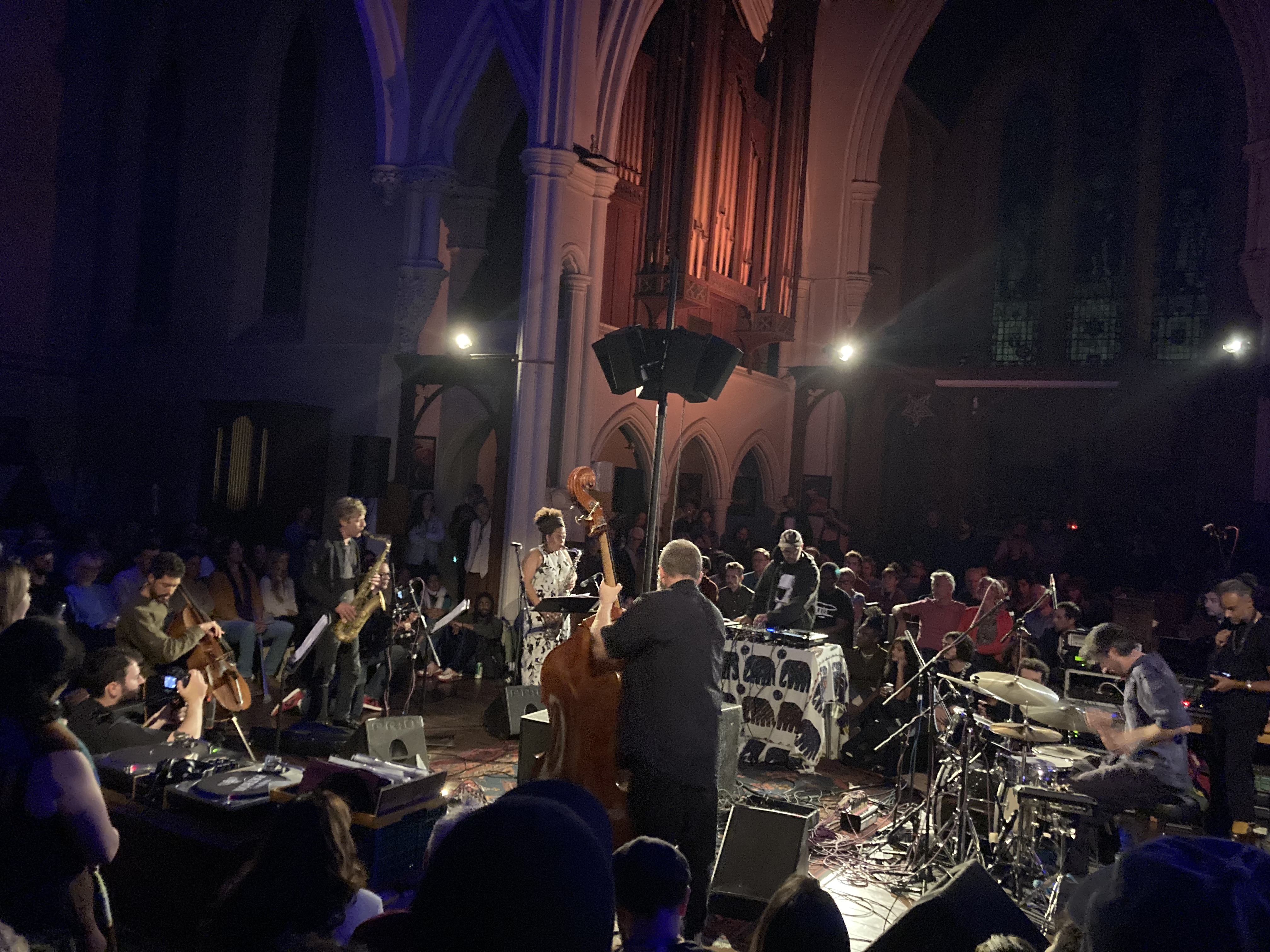
Long before hearing of Abdul Wadud’s death in August at the age of 75, Tom Skinner had been preparing his homage to the great cellist. Last night’s Church of Sound concert at St James the Great in Lower Clapton was a wonderful tribute from one musician to another, transmuting elements of Wadud’s solo album, By Myself, into a framework for a six-piece band called Voices of Bishara.

Taking their name from that chosen by Wadud for the label on which his album was released in 1977, the musicians were Chelsea Carmichael (tenor saxophone and flute), Robert Stillman (tenor saxophone and bass clarinet), Kareem Dayes (cello), Tom Herbert (bass), Paul Camo (samples) and Skinner himself (drums). Church of Sound is a terrific gig: the place was packed for the debut of a project led by a man known from his work with Sons of Kemet and more recently with Thom Yorke and Jonny Greenwood. Not many among the audience would have known of Wadud before last night, although there were a few whoops when Skinner mentioned the name of Julius Hemphill, with whom the cellist worked so memorably in the 1970s and ’80s, but they certainly responded to the music created in his honour.

Even at its most sophisticated there was something elemental about Wadud’s playing, something steeped in African ancestry, to which the name Bishara — ”gospel” or “good news” in a variety of languages, including Arabic and Swahili — made reference. Skinner’s arrangements enhanced this core sensibility, using the two stringed instruments and Camo’s samples to create a kind of desert blues atmosphere, floating on the drummer’s own loose-jointed propulsion and providing the setting for the two horn soloists. (At times it recalled the use of Ahmed Abdul-Malik’s oud and the basses of Jimmy Garrison and Reggie Workman on Coltrane’s 1961 Village Vanguard recordings). Dayes made fine contributions with his scrabbled pizzicato figures and keening arco, while Herbert raised the temperature in the second half with a majestic solo, setting up a two-tenor juxtaposition of Stillman’s asymmetrical agility and Carmichael’s confident power.

At St James the Great the musicians play in the round, and the church’s architecture means that the quality of the sound depends on where you’re sitting or standing. I moved after the interval and found that what had previously been swimming in echo now came into proper focus. The activities of two camera operators, filming the musicians at close quarters, was unhelpful and at times a distraction, but there’s an album of this music out soon, and on the evidence of the concert I’m looking forward to it very much. Rather than just settle for saluting the source of his inspiration, Skinner has found a way of going beyond it to discover something of his own.

* Here’s my Guardian obit of Abdul Wadud. As Tom Skinner told the audience, Wadud’s By Myself can now be found on YouTube: https://www.youtube.com/watch?v=Mff74JJKD40&ab_channel=HeathZiebell. The Voices of Bishara album is out in November.

Complain to the frog

On a fine but chilly day in January 2016, I took the train from Christopher Street in the West Village to Hoboken for a cup of coffee with Steve Lehman, the alto saxophonist and composer whose octet I was hoping to present at JazzFest Berlin later in the year. I’d seen them in Amsterdam and they’d confirmed the impression created by their albums that here was a band with a rare ability to use highly sophisticated compositional techniques as a vehicle for a group of superlative improvisers.

Lehman did indeed appear with the octet in the formal surroundings of the Haus der Berliner Festspiele that November, but something he said during our conversation on the western shore of the Hudson River led to a second gig the following year. When I asked what else he was up to, this tall, thin, bespectacled, generally studious-looking man, who studied the “spectral music” of Olivier Messaien in France, has lectured at the Royal Academy of Music in London and was about to head west to take up a post as a professor of music at the California Institute of the Arts, mentioned that he was working with a couple of MCs, one of whom rapped in English, the other in Wolof, the language of Senegal and the Gambia.

That project turned into a band called Sélébéyone, whose first album came out in 2017, shortly before Lehman brought them to Berlin to appear at the old Lido cinema in Kreuzberg as part of a two-night prelude to the main festival which also featured Amirtha Kidambi’s Elder Ones, Shabaka and the Ancestors, and Heroes Are Gang Leaders. They were brilliant. And now their second album — Xaybu: The Unseen — continues their remarkable exploration of ancient and modern.

Sélébéyone are the MCs Gaston Bandimic and HPrizm, who write and rap in Wolof and English respectively, the drummer Damion Reid and the soprano saxophonist Maciek Lasserre, who shares the compositional duties and the instrumental solos with Lehman. The 15 tracks of Xaybu are as carefully constructed, intricately detailed and richly textured as the music of the octet, making extensive use of electronics to modify and layer the source sounds. Lehman’s alto improvisations, always bearing the thoughtfully metabolised influence of his teacher and mentor Jackie McLean, fit beautifully between the spoken words and Reid’s endlessly creative beat-making, as do Lasserre’s citrus-flavoured soprano solos.

The words you catch strike home, and it’s worth reading the translation on the record label’s website to find something like this: “Kou dakoroul sin Ou yalla ndogale clamel god / Kou goki gokk tere nelaw goudi blamel mboot (If you don’t agree with God’s decisions, complain to God / If the frog’s sound keeps you up at night, complain to the frog).” Not your usual hip-hop message. Not your usual hip-hop music, either, or even your usual jazz/hip-hop fusion, but something deep, distinctive, urgent and often exhilarating.

* The photograph of Steve Lehman performing with Sélébéyone in Berlin in 2017 is by Camille Blake. Xaybu: The Unseen is on the Pi Recordings label. Lyrics: https://pirecordings.com/selebeyonelyrics/

Olie Brice / JLG

Jean-Luc Godard once compared watching the great Hungarian football team of the 1950s to listening to free jazz. A few hours after the announcement of the great director’s death, it was possible to reflect on the meaning of his comparison during a performance at the Café Oto by the trio and octet of Olie Brice, launching the bassist’s new double album, Fire Hills.

Nowadays when we use the term free jazz we tend to mean music created from scratch, on the spot, with no prepared material. Back in the early ’60s, it tended to mean the use of composition to inspire improvisers to stretch the traditional boundaries, using the material as a launch-pad rather than a template while freeing soloists and accompanists to exchange roles. All that could be heard in the music made by Brice’s groups, both of them benefitting from his ability to use his role as a composer to guide rather than prescribe.

The first half featured the trio, completed by the tenor saxophonist Tom Challenger and the drummer Will Glaser, moving with great empathy through compositions dedicated to Johnny Dyani, Eric Dolphy and Andrew Hill. Linking two of the pieces, Glaser delivered a extraordinary solo that began with mallets rolling fast around his snare drum and two tom-toms, using the three pitches to produce something that had the quality of a song, before reversing one of the mallets to introduce a kind of counter-line. Drum solos are seldom poetic, but this was.

Between the two sets, the Oto sound system quietly played selections from the soundtracks of Godard’s movies, including Georges Delerue’s gorgeous orchestral compositions for Le Mépris: a nice touch on a day when a key figure of contemporary culture left the scene.

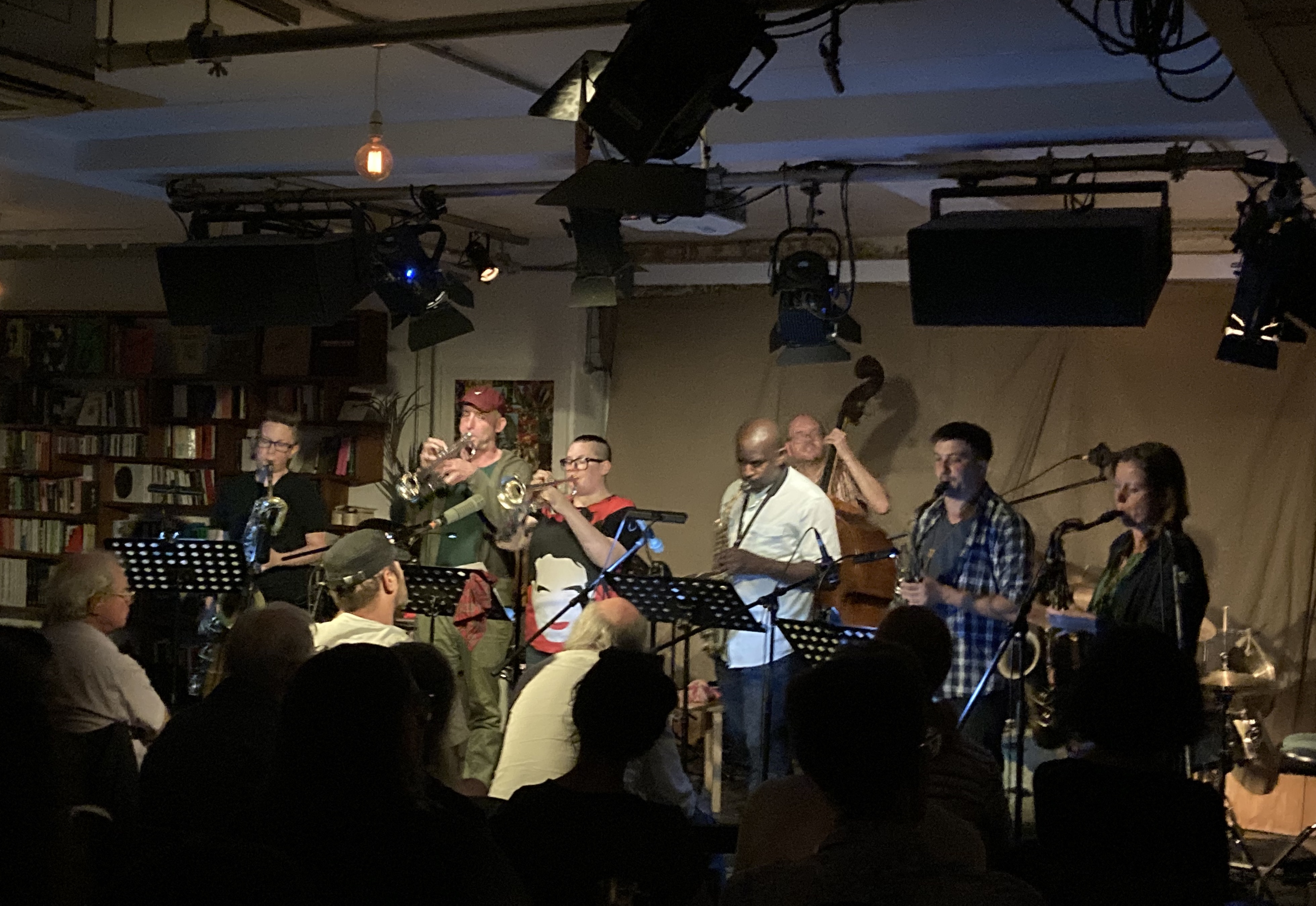
The six horns of Brice’s octet were assembled in a single line, but it soon became apparent that he would be using them as two units: a pair of trumpets (Kim Macari and Alex Bonney) and a baritone saxophone (Cath Roberts) to the left, an alto saxophone (Jason Yarde) and two tenors (George Crowley and Rachel Musson) to the right, with the drummer Johnny Hunter joining Brice in the rhythm section.

The short ensemble passages — sometimes just punctuations between the improvisations — had the kind of loose-woven, slightly ragged ebullience that could remind you of Mingus’s bands or Charlie Haden’s Liberation Music Orchestra, without borrowing moves from either. That made sense, since Mingus and Haden also figure strongly as inspirations for Brice’s own playing, in which virtuosity and passion are equally mixed.

The first two solos, by Macari and Musson, were the kind you want to wrap up and take home: on-the-nose power from the trumpet, beautifully controlled tonal distortion from the tenor. There were many duets, notably one between the soaring Yarde and the agile Bonney. One or two of the solos outstayed their momentum, but with this music that’s a risk worth taking. And what the evening showed was that Brice has his own way of applying organisation to music, shaping it in interesting ways without compromising the crucial spontaneity of expression and interaction.

* Olie Brice’s Fire Hills is on the West Hill label: https://westhill.bandcamp.com/album/fire-hills

The last of AMM

It seemed fitting that the final performance of AMM, the pioneering London-based improvising ensemble, should have featured two of the musicians who started the group in 1965. Eddie Prévost, with a small array of gongs, cymbals and drums, and Keith Rowe, originally a guitarist but now manipulating small boxes to trigger and modify samples or electronic signals, appeared together at Café Oto in Dalston last night in the fourth and last event held in celebration of Prévost’s recent 80th birthday.

AMM, whose name remains defiantly undecoded, started out with the saxophonist Lou Gare alongside Rowe and Prévost in a trio that quickly began to unshackle itself from the musicians’ jazz roots. Soon additional members — the pianist/cellist Cornelius Cardew, the accordionist/cellist Lawrence Sheaff, the percussonist Christopher Hobbs, the pianist John Tilbury, the cellist Rohan de Saram — were coming and going. There were occasional guests, such as the saxophonist Evan Parker and the pianist Christian Wolff. Sometimes they were a quartet, sometimes a quintet, often a duo — Prévost and Gare, Prévost and Tilbury, Prévost and Rowe. Tilbury was to have made it a trio last night, but health considerations intervened.

Prévost began and ended the hour-long set with the sound of bowed cymbals, gongs and bowls, an art of which he is a master. Snare and bass drums were used as additional timbral devices, activated by beaters or an electric toothbrush. Rowe deployed his resources with great economy, dropping in samples of male, female and brass chorales, the absent Tilbury’s piano and fragments of speech alongside the radio-scanner cracklings and howls. A packed room listened intently and in complete stillness. At the end, the applause went on for several minutes. This was not just in recognition of the significance of the event, to which Prévost had alerted us beforehand, but in response to the degree and intensity of emotion evoked by the sounds — so seemingly austere, so demanding of listeners, so resistant to any form of literal interpretation — that the two men created together. As a farewell, it could not have been bettered.

* AMM’s first album, AMMusic, was recorded for the Elektra label in 1966 and subsequently reissued in both CD and vinyl formats. Other recordings have been released on the Matchless label (www.matchlessrecordings.com). Eddie Prévost’s books on AMM and related historical and dialectical issues include No Sound is Innocent (1995) The First Concert (2011), and his autobiography, An Uncommon Music for the Common Man (2020), all published by Copula.