Skip to content

Posts from the ‘Jazz’ Category

At Blackheath Halls

Yesterday, the eve of the winter solstice, turned out to be a good one for music. Looking for a Christmas present, I found myself in a clothes shop where the sound system was playing Al Green’s version of Kris Kristofferson’s “For the Good Times”, making me wonder for a moment if there had ever been a finer performance by a soul singer of a country ballad. Then, while I was having a cup of coffee, the café’s playlist surprised me by including Bob B. Soxx and the Blue Jeans’ soaring “The Bells of St Mary”, from Phil Spector’s Christmas Album, a piece of art which seems — unlike Gesualdo’s madrigals and Caravaggio’s paintings — to have been widely cancelled in the present era.

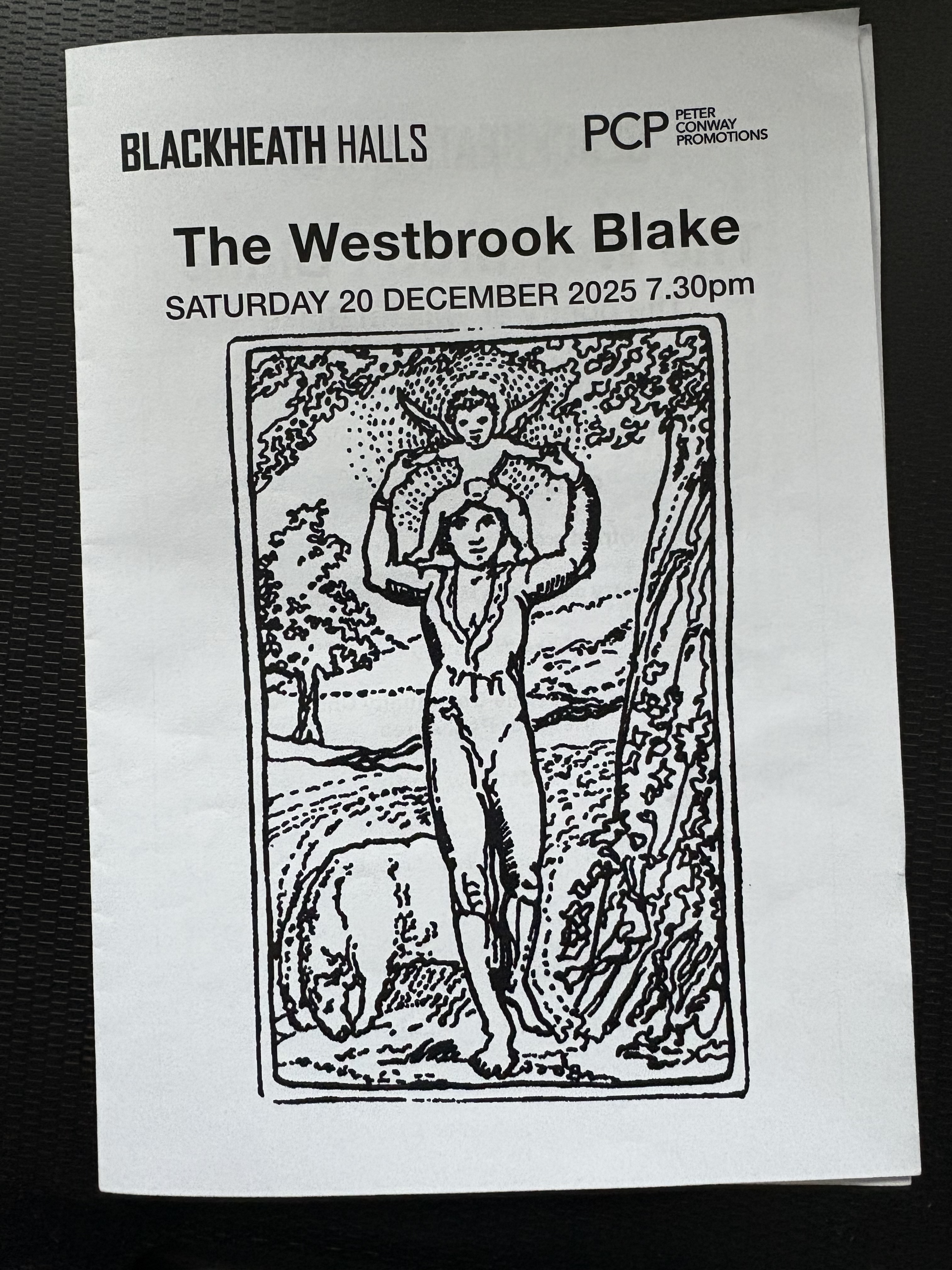
In the evening I took myself to Blackheath Halls, a really splendid venue for music, to hear The Westbrook Blake, a suite of pieces which has been in constant evolution since in 1971, when Adrian Mitchell invited Mike Westbrook to provide musical settings for some of William Blake’s poems, as part of a piece for the National Theatre called Tyger.

I’ve written about it before, here and here, so I won’t repeat myself, except to say that it’s one of the glories of contemporary English music, and the chance to see any performance of it is to be grabbed with some urgency. Last night the two wonderfully expressive solo singers (as always, Kate Westbrook and Phil Minton) and the five-piece band were joined by the 30 or so singers of the Blackheath Halls Community Singers, directed by Paul Ayers.

While Mike Westbrook’s place at the piano was taken by the brilliant Matthew Bourne, the composer himself took the stage in a wheelchair, from which he recited a couple of Blake’s more trenchant poems with clarity and feeling. The spectacular solos from the accordion of Karen Street, the violin of Billy Thompson and the alto saxophone of Chris Biscoe were more than worthy of the spontaneous applause they drew. It was an evening of proper music-making, full of communal warmth, often thought-provoking, and generally good for the soul.

Kind of Dukish

The idea of jazz as a repertory music is so fraught with dangers that it tends to evoke my instinctive distrust. Sometimes, though, you can only give in and enjoy it. The Pocket Ellington, as the pianist Alex Webb calls his septet devoted to the music of the immortal Duke, turns out to be a very good idea.

This is not a recreation of the great Ellington splinter groups of the early 1940s, whose recordings were issued under the names of Johnny Hodges, Rex Stewart and Barney Bigard. At the Pizza Express in Soho last night the Pocket Ellington entertained a sold-out house with Webb’s artful arrangements of some of Duke’s (and Billy Strayhorn’s) best known compositions, rendered for the trumpet of Andy Davies, the trombone of David Lalljee, the alto and baritone saxophones and clarinet of Alan Barnes, the tenor saxophone of Tony Kofi, the double bass of Dave Green and the drums of Winston Clifford.

To miniaturise what were originally big-band compositions can have the effect of bringing unexpected facets into the light. I enjoyed the way the ensemble brought out an elliptical quality seeming to anticipate bebop in the melodies of Duke’s “Cotton Tail” and Strayhorn’s “Johnny Come Lately”, written in 1940 and 1942 respectively, an impression heightened by the work of the rhythm section behind Kofi’s solo on the former.

Webb resists the temptation to stretch the material to suit modern time-frames. Miniatures such as “Ko-Ko”, “Le Sucrier Velours” (from The Queen’s Suite, written in 1959 for Elizabeth II), the title piece from Such Sweet Thunder and “Chelsea Bridge” retained their original exquisite proportions. Even the medleys of “Main Stem”/”Rockin’ in Rhythm” and “Harlem Air Shaft”/”Drop Me Off in Harlem” remained brisk and crisp, leaving the listener wanting more.

The singer Marvin Muoneké joined the line-up for “Jump for Joy”, “I’m Beginning to See the Light” and other favourites, making an excellent job of Webb’s amusing lyric to “Johnny Come Lately” and handling the stately contours of “Sophisticated Lady” with appropriate delicacy.

Naturally, Webb’s chosen format can’t provide the heft and occasional lushness of a full big band. But there are plenty of compensations, including Kofi’s pensive unaccompanied coda to “Chelsea Bridge” and everything Barnes did, including an eloquent alto passage on “What Am I Here For”. And, of course, the presence of Dave Green, an important figure on the British jazz scene for six decades and still, at 83, keeping his bandmates honest.

Jazz mustn’t become a museum, and more fine young musicians than ever need the world to pay attention as they try to move the music forward. But when the past is respectfully addressed and reinvigorated with such skill as that shown by Webb and his colleagues, principles can happily be suspended.

Voces humanae

Amazing, isn’t it, that even in this Tower of Babel an individual human voice can be unmistakeable. Mavis Staples sounds like Mavis Staples. Boz Scaggs sounds like Boz Scaggs. No one else. And over the decades those voices become trusted friends. Each of them has a new album out that suggests, as they head towards the inevitable end of long careers (Mavis is 86, Boz is 81), that they could never outstay their welcome.

After albums with Ry Cooder, Jeff Tweedy and Ben Harper in the producer’s chair, it’s the turn of Brad Cook, whose credits include Bon Iver and Nathaniel Rateliff and the Night Sweats, to supervise Mavis’s new album. He doesn’t let her down.

The song selection on Sad and Beautiful World is thoughtful and empathetic, starting with the conscious boogie-shuffle of Tom Waits and Kathleen Brennan’s “Chicago” and proceeding through Gillian Welch and David Rawlings’ “Hard Times”, Curtis Mayfield’s “We Got to Have Peace” and Leonard Cohen’s “Anthem” to Eddie Hinton’s “Everybody Needs Love” via material less familiar to me. The most striking of those is Frank Ocean and James Ho’s “Godspeed”, set in a dense instrumental weave that summons all the best elements of Americana into one perfect arrangement.

There’s no showing off by the many fine players involved on the 10 tracks, but I love Derek Trucks’ beautiful slide guitar decorating “Hard Times” and the glinting pedal steel of Colin Croom on “A Satisfied Mind”, the gorgeous country song by Red Hayes and Jack Rhodes, whose many cover versions go back to 1954 and Mahalia Jackson — perhaps the exemplar Mavis had in mind. And to take us out, there’s a backing choir on “Everybody Needs Love” consisting of Bonnie Raitt, Patterson Hood, Kate Crutchfield and Nathaniel Rateliff. Everybody loves Mavis, don’t they?

For Detour, Boz Scaggs returns to the sort of American standards he investigated on But Beautiful in 2003 and Speak Low in 2008, although it sells a dummy straight away by opening with a night-club version of Allen Toussaint’s “It”s Raining” before settling into the likes of “Angel Eyes”, “The Very Thought of You” and “We’ll Be Together Again”. After the very fine arrangements by Gil Goldstein that helped make Speak Low such a success, here Scaggs favours the more stripped-back setting of a piano trio with the lightest touches of string arrangements here and there.

OK, you could say that his “Angel Eyes” and “Once I Loved” don’t match those of, say, Sinatra and Shirley Horn respectively, but if you like Scaggs’ voice as much as I do, you won’t be worried by that — and you’ll be delighted to hear him excavate “I’ll Be Long Gone”, a waltz-time song from his very first solo album back in 1969, refurbishing it with a deeper, richer, more controlled approach.

Sometimes these American Songbook projects work (Bob Dylan) and sometimes they don’t (Rod Stewart), their success largely dependent on what their significance is to the singers and how much real appreciation they have of the art of the men wrote the melodies and lyrics. I don’t think there’s much doubt on which side of the divide Boz Scaggs falls.

Twang. Thump. Crash. More twang.

Finding Ways is the name of the drummer/composer Seb Rochford’s new band. It’s also the title of their debut album, which they played at the Cockpit Theatre in north-west London last night, as part of the Jazz in the Round series. It was one of the events featured on the closing night of the 2025 EFG London Jazz Festival, and I couldn’t imagine a happier way of ending the 10-day programme.

Rochford has made some intriguing choices in his career, but probably none more surprising than this. Finding Ways is a guitar-instrumental band: three guitarists, to be precise, plus bass guitar and drums. I don’t think I’ve seen such a line-up live since an early incarnation of Fleetwood Mac with Peter Green, Danny Kirwan and Jeremy Spencer back In 1968. Or at least not one so memorable.

Last night’s guitarists were David Preston, Tara Cunningham and Matt Hurley, joined by Anders Christensen on bass guitar. One thing that stuck out straight away was the absence of pedal boards or other effects. No wah-wahs, no phasing, no tremolo arms. This, apparently, was at Rochford’s insistence. So what we heard was three versions of the sort of sound you made when you got your first electric guitar, hit an E major chord and then looked for a way to make the strings twang. A sound with innocence intact. And an interesting approach to apply to three very sophisticated players.

So what was the result? Surf music in space, maybe. The Ventures or Dick Dale and the Del-Tones with Derek Bailey or Sonny Sharrock sitting in. Rochford’s tunes for this line-up are sometimes based on simple two-bar chord modules reminiscent of the twangtastic “Walk, Don’t Run” or “Misirlou” (and occasionally finding beguiling elaborations of the format, as on the soaring “People Say Stuff, Don’t Be Disheartened”). Also springing to mind: the free-form guitar conversations of Jerry Garcia and Bob Weir in the Grateful Dead and of Tom Verlaine and Richard Lloyd in Television: “Dark Star” or “Marquee Moon” but with different perspectives.

It was great to see the band in this environment, arranged in a circle, the musicians locked into each other, watching for cues, tidying up small errors but letting rough edges show as they exploited the spaces left for spontaneity within the structures. Furiously loud in some places (driven by Rochford’s brutal energy), it was surprisingly lyrical in others; I don’t think I’ve ever heard three electric guitars played as softly as in the filigreed three-way conversation between Cunningham, Hurley and Preston that formed the delightfully unexpected coda to “Community”, which had started out as a reggae piece.

In this intimate setting, the musicians’ very visible sharing of their pleasure extended to the audience and was washed back in return. They were having fun, and so were we.

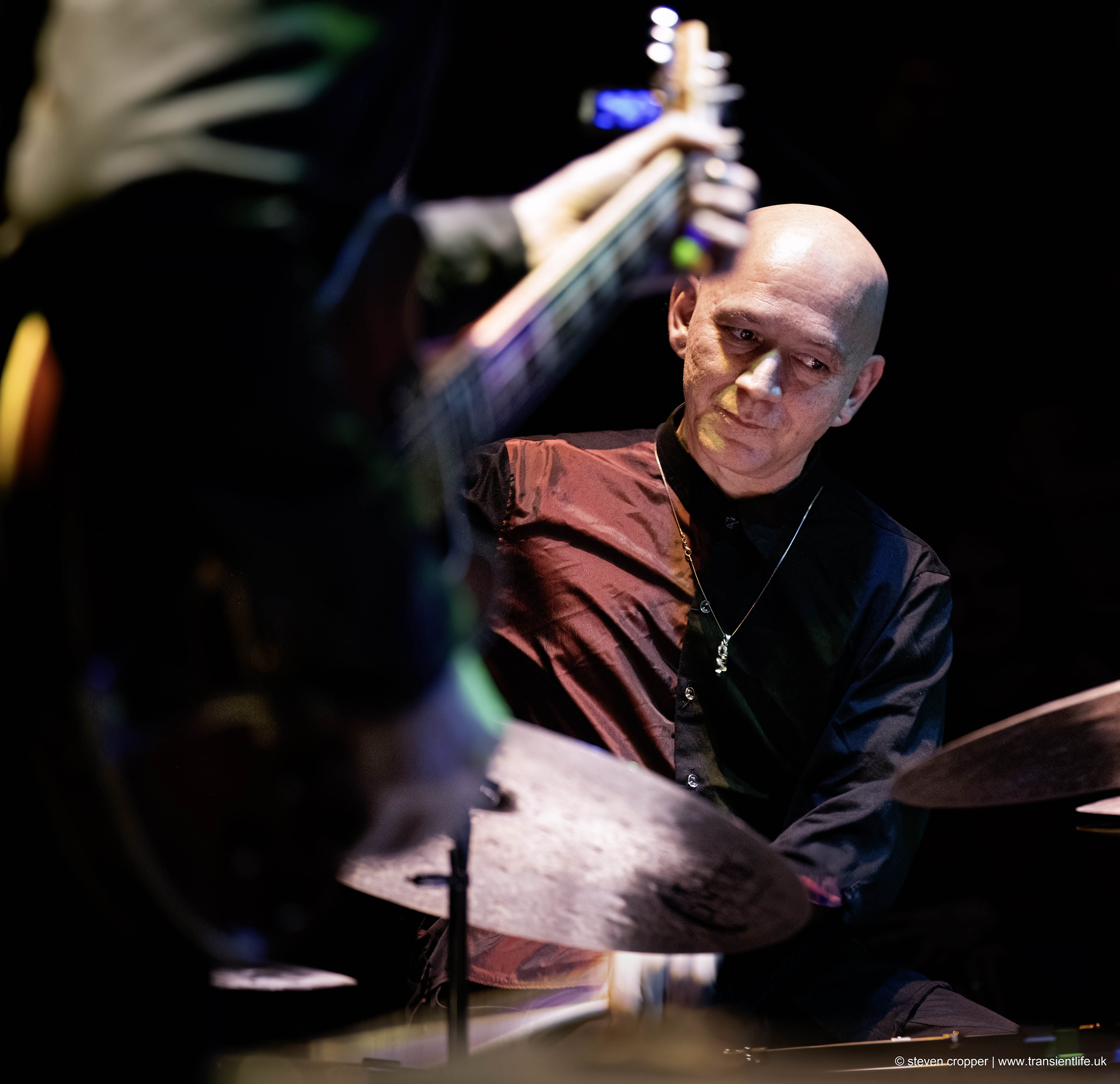
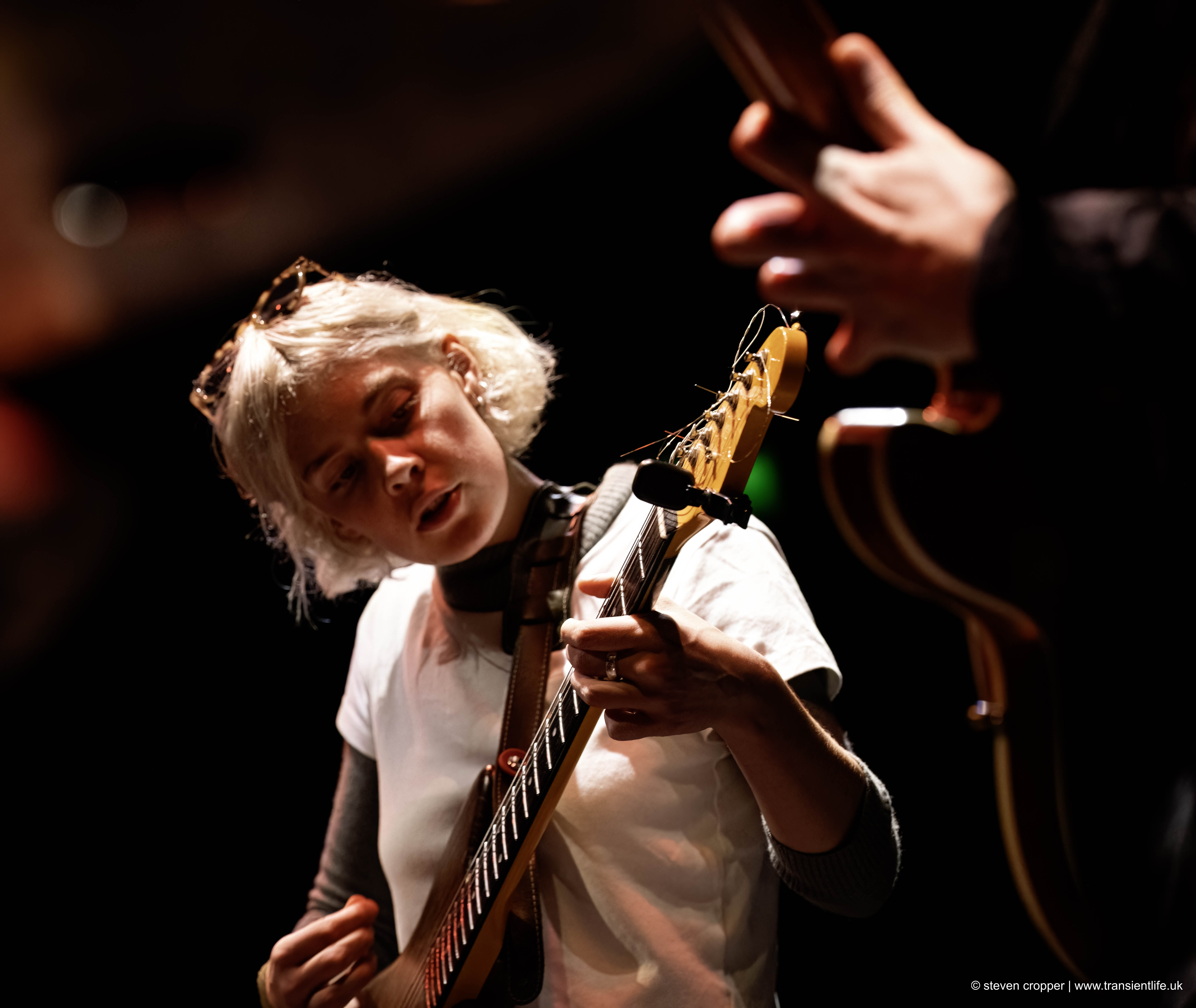
* Finding Ways is out now on Edition Records. The photos of Sebastian Rochford and Tara Cunningham at the Cockpit were taken by Steven Cropper and are used by kind permission.

Tom Skinner at the QEH

The trouble with the EFG London Jazz Festival is that it’s all too much. Given 300 gigs in 10 days, there’s always going to be something you regret missing. Last night I badly wanted to hear the Weather Station — the marvellous Canadian singer-songwriter Tamara Lindeman — with a string quartet at EartH in Dalston. But I also wanted to hear the drummer-composer Tom Skinner and his band perform their new album, Kaleidoscopic Visions, at the Queen Elizabeth Hall. I’d seen the Weather Station in Islington at the start of this year. I hadn’t seen Skinner since 2022. So that’s how my decision was made.

In the end, any regrets were overwhelmed by events. Skinner and his six colleagues — Chelsea Carmichael (flute and tenor saxophone), Robert Stillman (soprano and tenor saxophones), Yaffra (keyboards, voice and percussion), Adrian Utley (guitar), Kareem Dayes (cello) and Caius Williams (bass) — started the concert with watchful discretion. But over the course of 90 minutes they built the music until it had become a living, pulsing thing, full of narratives, individual and collective.

Skinner writes deceptively simple, sometimes folk-like melodies that exist in essential dialogue with the riffs and other figures devised to help form a unified matrix. The textures are airy, with room for light and shade. (That’s a reflection of his superbly flexible drumming, in which power is used with restraint.) There are solos on top of prepared accompaniment — those from Utley and Carmichael, cutting loose on tenor, were quite remarkable — but often the improvising is done in small groupings.

A string trio of Williams’s bowed bass, Dayes’ pizzicato cello and the guitar of Utley, making use of sustain and the volume pedal to eliminate attack, was beautifully realised, as was an unaccompanied tenor saxophone duet by Stillman and Carmichael. I’d been listening to their spontaneous interlocking pointilliste figures for a couple of minutes before I realised that the dialogue sounded like a solo tenor improvisation by Evan Parker, its components broken down and distributed between the two players to create an actual version of the conversation that Parker’s playing often resembles. And there was also a real conversation between Skinner and Yaffra, who moved from his keyboards to play a pair of tom-toms with tympani beaters, the two of them sending a gentle thunder rolling around the hall.

I wrote with some enthusiasm about the album a few weeks ago, but the concert did what concerts should do: it warmed the blood in the music’s veins, allowing it to grow. I’d have been very sad to miss it. Now I hope Skinner follows the practice he established with his earlier project, Voices of Bishara, and releases the live version of Kaleidoscopic Visions. Last night’s, if possible.

In the Unreal City

Snow fell in London yesterday morning. It seemed the right sort of day for a performance of T. S. Eliot’s The Waste Land at the Queen Elizabeth Hall. Although the poem contains all kinds of weather in all kinds of places, from the cracked earth of endless plains to thunder in the mountains and a summer shower on a Bavarian lake, taking the short walk from Waterloo station in a cold and dark London (the poet’s “Unreal City”) was like strolling straight into its heart.

Mounted as part of the EFG London Jazz Festival, the performance offered an expanded version of the treatment commissioned 10 years ago by the Beckett festival in Enniskillen from the Irish actor Adrian Dunbar. With the permission of the famously strict Eliot estate, Dunbar was able to devise an arrangement of the poem for four actors (two women and two men) plus a jazz quintet playing music by the saxophonist and composer Nick Roth.

I was 15 when an English teacher named Keith Yorke took us through The Waste Land, decoding its mysteries. I could never thank him enough. Dunbar, introducing last night’s performance, in which the quintet was augmented by a 25-piece orchestra, said he had encountered it while studying at the Guildhall School of Music and Drama 40 years ago; clearly, its impact on him was similarly profound. My previous experience of a live performance of the poem was the actress Fiona Shaw reciting it from memory beneath a single bare lightbulb on stage at the historic Wilton’s Music Hall in the East End on New Year’s Eve, 1998. In my eyes, that gave Dunbar and his crew a lot to live up to.

The readers were Anna Nygh, Orla Charlton, Frank McCusker and Stanley Townsend. Dunbar divided the lines between them, as appropriate to Eliot’s shifting cast of characters. Passages were rendered with German, Irish, American and Cockney accents. I was worried to begin that it might all seem a bit contrived, a bit stagey. That unease evaporated within a few minutes. The polyphony of the reading brought a different kind of life to an already highly polyphonic poem.

Ross’s music was used as an overture and as interludes between the five episodes. The overture, scored for the Guildhall Sessions Orchestra, evoked the European modernist classical music of the inter-war years: bold gestures, hints of dissonance. The first interlude had a ragtime flavour (“that Shakespeherian Rag… so elegant… so intelligent”). For the second, the quintet — Alex Bonney (trumpet), Roth (saxophones), Alex Hawkins (piano), Oli Hayhurst (bass) and Simon Roth (drums) — brilliantly created something that sounded like one of Charles Mingus’s bands paying homage to the pre-war Ellington small groups, or possibly vice versa. The third found the group moving towards free jazz, with Hawkins flailing the keyboard à la Cecil Taylor. The fourth exploited Bonney’s expert manipulation of electronic sound. Did that chronological progression echo something buried within the text? If certainly added a new perspective and a contemporaneity.

Nothing will ever dim the memory of Shaw’s spellbindingly majestic recitation, but Dunbar’s gamble paid off. The drama intensified until, by the time the closing lines of the fifth and final section were reached — “These fragments have I shored against my ruins / Why then Ile fit you / Hieronymo’s mad againe / Datta. Dayadhvam. Damyata. / Shantih shantih shantih” — the words and sounds had transformed the climate of a well-warmed hall and I felt a shiver run through me.

Mulatu Astatke says goodbye

A month shy of his 82nd birthday, Mulatu Astatke brought his farewell tour to a close with two sold-out dates at the start of the EFG London Jazz Festival this week. I went to the first of them, at the Royal Festival Hall, to celebrate the work of the man generally credited with the creation of “Ethio-jazz”.

It takes more than one person to create a genre, but Astatke, who left Ethiopia as a teenager in the late 1950s to study vibraphone, his main instrument, and composition at Trinity College in London and Berklee College in Boston, was certainly a catalyst. He began making records in the US in the 1960s before returning to Ethiopia, where conditions changed after the takeover by a military junta in 1975, restricted Addis Ababa’s lively creative scene. He already had a large hipster following when the use of his music in Jim Jarmusch’s Broken Flowers in 2005 expanded his audience considerably.

On Sunday night he began the concert with Steps Ahead, his seven-piece European band, including such familiar figures as the trumpeter Byron Wallen, the pianist Alexander Hawkins and the double bassist John Edwards. The first half of the 90-minute set featured some of the compositions revived for a recently released album, Mulatu Plays Mulatu, including “Yekermo Sew”, with strong echoes of Horace Silver, and “The Way to Nice”, which plays a game with the James Bond riff. This music sounds like early-’60s hard bop filtered through Ethiopian modes and intonation, infusing it with as distinctive a flavour as the Skatellites and the Blue Notes imparted to similar material in Jamaica and South Africa respectively.

I was struck by the use of Danny Keane’s cello, sometimes strummed like a rhythm instrument, at other times interjecting short percussive phrases with a dry tone, and often combining to powerful effect with Edwards’ bass. It was intriguing to hear Edwards, Hawkins and the saxophonist James Arben delivering solos using the language of free jazz in the context of this mostly riff-based music, and receiving ovations for their efforts. While Astatke was spinning out his mellifluous extended vibes solos over the deep groove provided by the kit drummer, Jon Scott, and the percussionist, Richard Olatunde Baker, on something like “Netsanet”, I felt perfectly contented.

For the second half of the set, the band was joined by two dancers, a man and a woman, and two more musicians, playing the masengo, a single-stringed bowed lute, and the krar, a six-stringed lute. This was more of a folkloric experience, inviting the sort of mass participation that can seem awkward in a modern western concert hall. But it would be wrong to suggest that it was not greatly enjoyed, or that Astatke was not given the warmest and most rousing of valedictory salutes.

* Mulatu Plays Mulatu is out now on the Strut label.

‘Play slower…’

In his sleeve note to Masabumi Kikuchi’s album Black Orpheus, a recording of the Japanese pianist’s last solo concert, Ethan Iverson noted a piece of paper placed on the piano with the instruction: “Play slower. I sound better when I play slower.” Kikuchi took his own advice to heart. In the solo performances recorded in the 20 years before his death in 2015, aged 75, his playing decelerated to the point where the music’s metabolism seemed to enter another level of existence.

The final evidence was gathered in a session on a vintage Steinway D at New York’s Klavierhaus in 2013, its first fruit released four years ago by the Red Hook label under the title Hanamichi. Now there’s a second helping from the same source: Hanamichi, The Final Studio Recording Vol II. Like its predecessor, it mixes untitled improvised pieces with the standard tunes he loved to explore, in this case “Manha de Carnaval”, “Alone Together”, “I Loves You, Porgy” and “My Ship”.

I’ve previously written about Black Opheus here and the first volume of Hanamichi here, so I’m not going to repeat myself. I’ll only say that this version of “Manha de Carnaval” is the most fully realised of the three I have by him on record (the first two from 1994 and 2012), and his interpretation of “Alone Together” so beautifully illuminates the emotional contours of the 1932 Broadway ballad by Arthur Schwartz and Howard Dietz that it becomes a definitive instrumental exploration, to match Jo Stafford’s 1945 vocal reading.

It’s no accident that two of the standards here, “I Loves You, Porgy” and “My Ship”, were recorded by Miles Davis and Gil Evans in the late ’50s. The two pieces are irradiated by the memory of Kikuchi’s friendship with Evans, who helped him move to the United States in the early ’70s, and in whose bands he played during that decade. But if they inhabit the spirit of those earlier orchestral pieces, they also distil Kikuchi’s own remarkable essence.

There’s a short trailer here, with a snatch of “Manha de Carnaval”. You’ll get the idea.

* Masabumi Kikuchi’s Hanamichi: The Final Studio Recording, Vol II is out now on Red Hook Records: https://www.redhookrecords.com/ The photograph of Kikuchi is by Abby Kikuchi and is borrowed from the booklet accompanying Black Orpheus (ECM).

Silence and slow time

“Silence and slow time…” John Keats’s beautiful phrase finds an echo in some of the music I love, the kind that emerges from a stillness to which it eventually returns, taking its time and not raising its voice to attract attention. Here are five brand-new examples of music with healing qualities, all highly recommended.

1 The Necks: Disquiet (Northern Spy)

Three hours of glorious studio-recorded collective interplay on three CDs. “Rapid Eye Movement” is a 57-minute exploration of densities, starting with Chris Abrahams’ Rhodes piano, punctuated by Lloyd Swanton’s abrupt double bass figures. It changes slowly, like the weather, eventually reaching a passage of single-note cascades from the acoustic piano over Tony Buck’s rumbling tom-toms, leading to an exquisitely tapered ending. “Ghost Net” is 74 minutes of lurching, clattering, gradually darkening polyrhythmic layering, with each musician apparently playing in 12/8, but in three different 12/8s. Using what sounds like a Farfisa organ, it’s as though they’ve suddenly found the sweet spot between Thelonious Monk and ? and the Mysterians. The other two tracks divide an hour between them. “Causeway” opens with echoing guitar and celestial organ and contains a completely intoxicating E minor/B minor/A minor vamp — the Necks’ own three-chord trick — with piano above guitar and organ before a sudden gearchange, involving the addition of thrashing drums, turns a reverie into something soaringly urgent. “Warm Running Sunlight” is an essay in textures and the contemplative space between them: string bass going from plucked to bowed and back, splashing cymbals, Rhodes heavy on the reverb. A lot to take in, but among their very best, I’d say.

2 Tom Skinner: Kaleidoscopic Visions (Brownswood)

The drummer and composer whose Voices of Bishara project I liked so much, in both its studio and live incarnations, takes a slightly different tack here. The music is built around his regular bandmates — the saxophonists Chelsea Carmichael and Robert Stillman, the bassist Tom Herbert and the cellist Kareen Dayes — but with a handful of guests: Meshell Ndegeocello layering her voices on one track, Portishead’s Adrian Utley adding his guitar to a couple more, the singer Contour (Khari Lucas) from South Carolina gently intoning the poetic lyric of “Logue”, and Yaffra (London-born, Berlin-residing Jonathan Geyevu) reciting the poem “See How They Run” over his own piano and Skinner’s overdubbed keyboards, vibes, bass, guitar and percussion. Music without boundaries, full of human feelings, ancient to the future.

3 Jan Bang / Arve Henriksen: After the Wildfire (Punkt Editions)

The two Norwegians devise eight pieces featuring Henriksen’s distinctive trumpet with Bang’s samples, Eivind Aarset’s guitar, Ingar Zach’s percussion, three singers, the Fames Institute Orchestra, a cellist, two Balkan instruments — the tapan (a double-headed drum) and the kaval (an end-blown flute) — and the zurla, a Turkish double-reed instrument. Ravishing from beginning to end, starting with “Seeing (Eyes Closed)”, which made me think that Miles Davis and Gil Evans had been reincarnated as graduates of the contemporary Norwegian jazz scene, to “Abandoned Cathedral II”, a continuation of Henriksen’s classic 2013 album, Places of Worship.

4 Rolf Lislevand: Libro Primo (ECM New Series)

Another Norwegian, this time an exponent of the archlute and the chitarrone, examining the works written for the lute and its variants by the 16th and 17th century composers Johann Hieronymus Kapsberger, Giovanni Paolo Foscarini, Bernardo Gianoncelli and Diego Ortiz. Lislevand’s sleeve essay explains the revolution in which these composers were involved, and he brings them into the present day with free, fluid interpretations that make this music ageless. His own riveting “Passacaglia al Modo Mio” is both a salute and a declaration of possibilities. Anyone with a fondness for Davy Graham or Sandy Bull will enjoy this enormously.

5 Charles Lloyd: Figures in Blue (Blue Note)

For the latest in his series of drummerless chamber trios, the great saxophonist is joined by an old colleague, the pianist Jason Moran, and a newer one, the guitarist Marvin Sewell. This two-CD set begins with what is surely the first version of “Abide with Me” to appear on a jazz album Monk’s Music in 1957 and ends with a exquisite rumination on the standard “My One and Only Love”. In between Lloyd invokes the spirits of Duke Ellington, Billie Holiday, Langston Hughes and Zakir Hussain. On two tracks he also makes fine use of Sewell’s command of bottleneck techniques, leading one to wish that more modern jazz musicians would explore the blues in the way Gil Evans did with “Spoonful” and Julius Hemphill with “The Hard Blues”.

Danny Thompson 1939-2025

The first time I saw Danny Thompson, he was playing with Alexis Korner’s Blues Incorporated at the Dungeon Club in Nottingham. This would have been the spring of 1965. I must have liked his playing a lot because I got him to autograph a paperback copy of Nat Hentoff’s The Jazz Life that I happened to be carrying that night.

A couple of years later I saw him with the Pentangle, a band that to my ears never equalled the sum of its parts. It was his long-standing partnership with John Martyn that brought out his best, whether racing alongside the effects-driven guitar on “I’d Rather Be the Devil” or adding a darkly poetic arco line to “Spencer the Rover”.

Danny, whose death at the age of 86 was announced this week, was a member of a generation of great double bassists who emerged in and around the British jazz scene in the ’60s. If you wanted to line them up in some kind of taxonomy of interests and instincts across a spectrum of the music with which they were associated, starting with folk and proceeding to contemporary classical, it would probably go something like this: Danny, Ron Matthewson, Dave Green, Jeff Clyne, Harry Miller, Dave Holland, Chris Laurence, Barry Guy. Obviously that’s not everyone.

Danny was the Charlie Haden of British bassists, his playing warm and deep-toned, as rooted in folk modes as Haden was in bluegrass music, but just as capable of dealing with the most advanced and abstract forms.

Maybe the best way to celebrate his life is to listen to Whatever, the album he recorded for Joe Boyd’s Hannibal label in 1987. It finds him with a trio completed by two relatively unsung heroes of the scene, the wonderful Tony Roberts on assorted reeds, flutes and whistles and the terrific guitarist Bernie Holland.

I remember giving it an enthusiastic review in The Times, commending its highly evolved fusion of folk materials and jazz techniques. It’s a little bit like a British version of Jimmy Giuffre’s Train and the River trio, unafraid of the bucolic and the open-hearted.

Most of the pieces are credited as joint compositions but some are arrangements of traditional pieces, such as “Swedish Dance”, which opens with a bass solo rich in disciplined emotion before moving into an ensemble workout on a light-footed tune whose complex rhythms are made to sound as charming as a children’s song. The stately melody of “Lovely Joan” is delivered by Roberts on a set of Northumbrian pipes — mellower than their Scottish or Irish equivalents — before he switches to soprano saxophone for an intricate conversation with Holland’s nimble acoustic picking and Thompson’s firmly grounded bass. Of the originals, “Minor Escapade” adds elements of the classic John Coltrane Quartet to this trio’s distinctive approach.

Not having played it for some years, I’d forgotten what a truly exhilarating album it is. Now it’ll be at the top of the pile for some time to come, adding the sparkle and freshness of its understated virtuosity to the room. RIP, Danny.

* The photo of Danny Thompson is from the cover of Whatever and was taken by Nick White.