Skip to content

Posts from the ‘Improvised music’ Category

Silence and slow time

“Silence and slow time…” John Keats’s beautiful phrase finds an echo in some of the music I love, the kind that emerges from a stillness to which it eventually returns, taking its time and not raising its voice to attract attention. Here are five brand-new examples of music with healing qualities, all highly recommended.

1 The Necks: Disquiet (Northern Spy)

Three hours of glorious studio-recorded collective interplay on three CDs. “Rapid Eye Movement” is a 57-minute exploration of densities, starting with Chris Abrahams’ Rhodes piano, punctuated by Lloyd Swanton’s abrupt double bass figures. It changes slowly, like the weather, eventually reaching a passage of single-note cascades from the acoustic piano over Tony Buck’s rumbling tom-toms, leading to an exquisitely tapered ending. “Ghost Net” is 74 minutes of lurching, clattering, gradually darkening polyrhythmic layering, with each musician apparently playing in 12/8, but in three different 12/8s. Using what sounds like a Farfisa organ, it’s as though they’ve suddenly found the sweet spot between Thelonious Monk and ? and the Mysterians. The other two tracks divide an hour between them. “Causeway” opens with echoing guitar and celestial organ and contains a completely intoxicating E minor/B minor/A minor vamp — the Necks’ own three-chord trick — with piano above guitar and organ before a sudden gearchange, involving the addition of thrashing drums, turns a reverie into something soaringly urgent. “Warm Running Sunlight” is an essay in textures and the contemplative space between them: string bass going from plucked to bowed and back, splashing cymbals, Rhodes heavy on the reverb. A lot to take in, but among their very best, I’d say.

2 Tom Skinner: Kaleidoscopic Visions (Brownswood)

The drummer and composer whose Voices of Bishara project I liked so much, in both its studio and live incarnations, takes a slightly different tack here. The music is built around his regular bandmates — the saxophonists Chelsea Carmichael and Robert Stillman, the bassist Tom Herbert and the cellist Kareen Dayes — but with a handful of guests: Meshell Ndegeocello layering her voices on one track, Portishead’s Adrian Utley adding his guitar to a couple more, the singer Contour (Khari Lucas) from South Carolina gently intoning the poetic lyric of “Logue”, and Yaffra (London-born, Berlin-residing Jonathan Geyevu) reciting the poem “See How They Run” over his own piano and Skinner’s overdubbed keyboards, vibes, bass, guitar and percussion. Music without boundaries, full of human feelings, ancient to the future.

3 Jan Bang / Arve Henriksen: After the Wildfire (Punkt Editions)

The two Norwegians devise eight pieces featuring Henriksen’s distinctive trumpet with Bang’s samples, Eivind Aarset’s guitar, Ingar Zach’s percussion, three singers, the Fames Institute Orchestra, a cellist, two Balkan instruments — the tapan (a double-headed drum) and the kaval (an end-blown flute) — and the zurla, a Turkish double-reed instrument. Ravishing from beginning to end, starting with “Seeing (Eyes Closed)”, which made me think that Miles Davis and Gil Evans had been reincarnated as graduates of the contemporary Norwegian jazz scene, to “Abandoned Cathedral II”, a continuation of Henriksen’s classic 2013 album, Places of Worship.

4 Rolf Lislevand: Libro Primo (ECM New Series)

Another Norwegian, this time an exponent of the archlute and the chitarrone, examining the works written for the lute and its variants by the 16th and 17th century composers Johann Hieronymus Kapsberger, Giovanni Paolo Foscarini, Bernardo Gianoncelli and Diego Ortiz. Lislevand’s sleeve essay explains the revolution in which these composers were involved, and he brings them into the present day with free, fluid interpretations that make this music ageless. His own riveting “Passacaglia al Modo Mio” is both a salute and a declaration of possibilities. Anyone with a fondness for Davy Graham or Sandy Bull will enjoy this enormously.

5 Charles Lloyd: Figures in Blue (Blue Note)

For the latest in his series of drummerless chamber trios, the great saxophonist is joined by an old colleague, the pianist Jason Moran, and a newer one, the guitarist Marvin Sewell. This two-CD set begins with what is surely the first version of “Abide with Me” to appear on a jazz album Monk’s Music in 1957 and ends with a exquisite rumination on the standard “My One and Only Love”. In between Lloyd invokes the spirits of Duke Ellington, Billie Holiday, Langston Hughes and Zakir Hussain. On two tracks he also makes fine use of Sewell’s command of bottleneck techniques, leading one to wish that more modern jazz musicians would explore the blues in the way Gil Evans did with “Spoonful” and Julius Hemphill with “The Hard Blues”.

Meet the house band

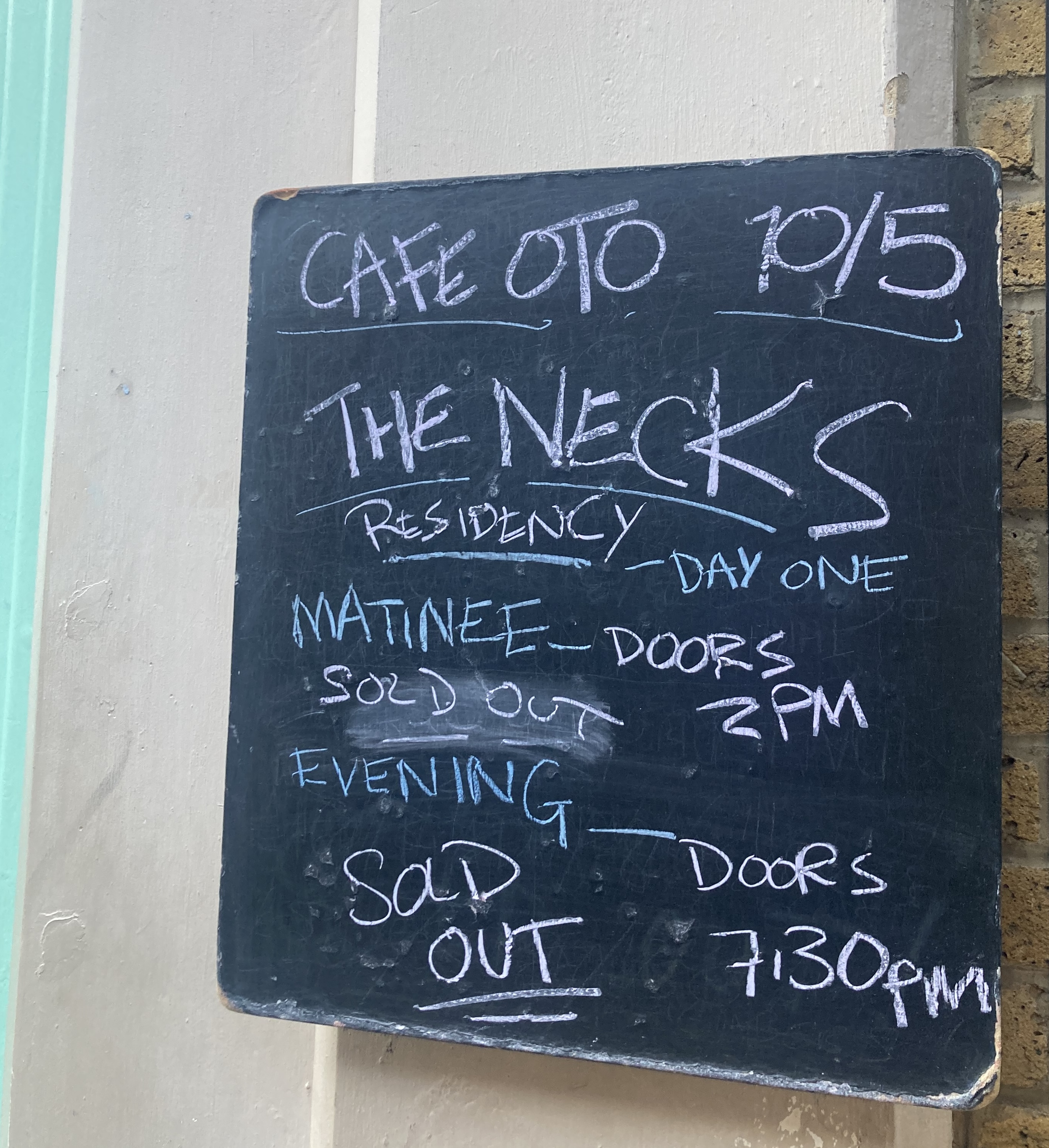
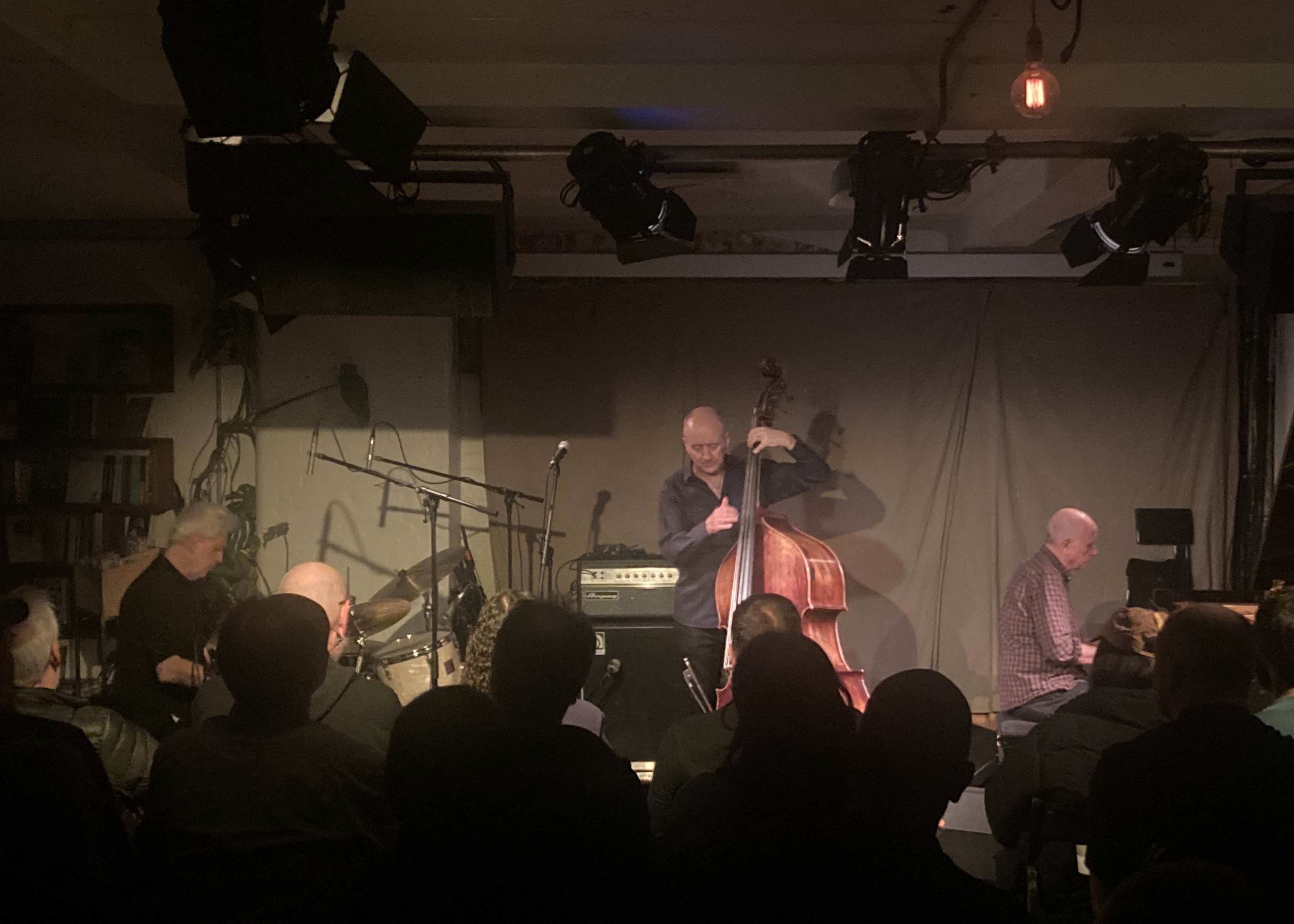
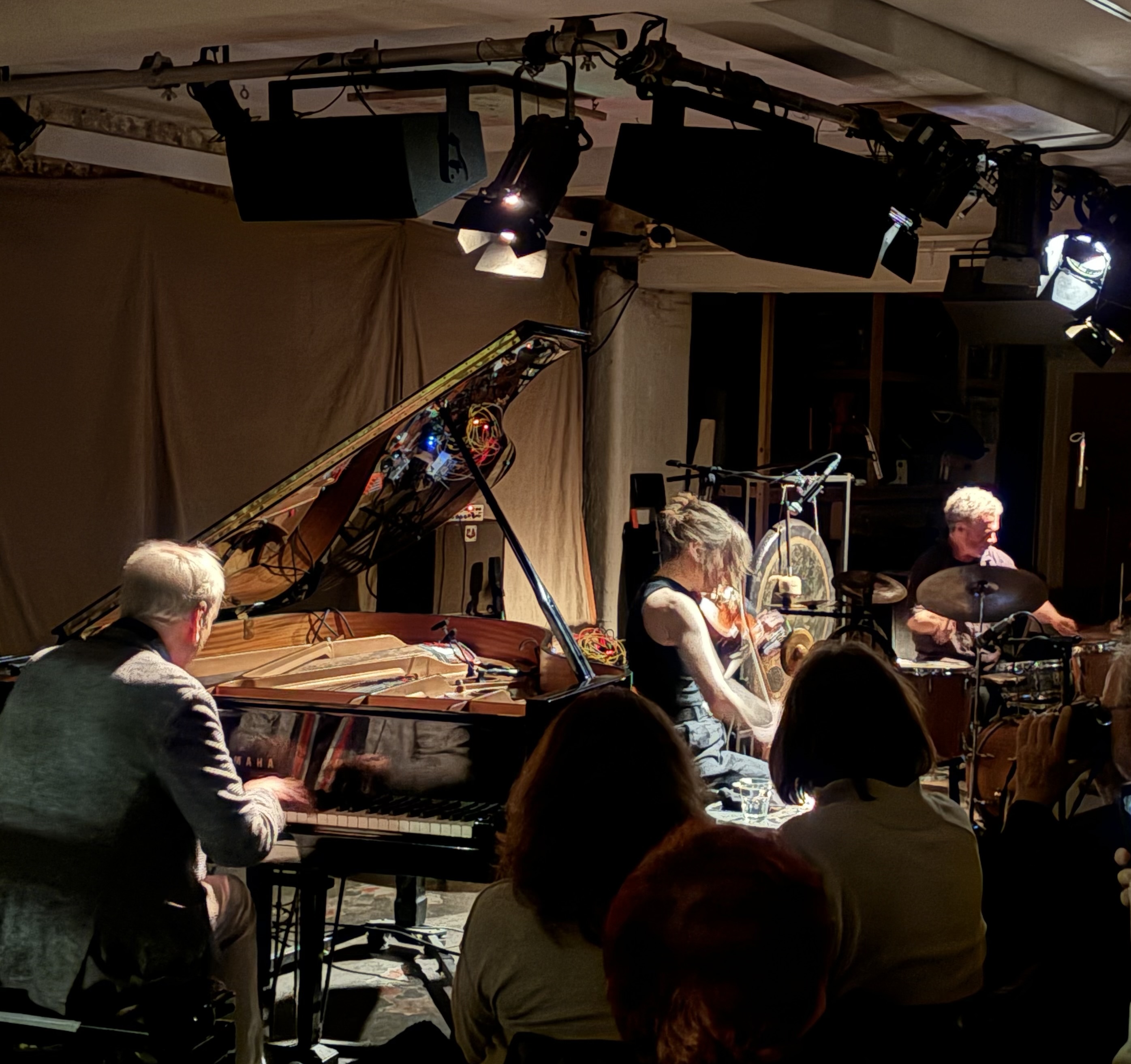
Before the evening show on the first of their two days at Cafe Oto on Saturday, the Necks were announced to the audience as “the house band”. We laughed, and so did they. But it seemed to fit. The Australian improvising trio have played in many London venues, but the little space on Ashwin Street in Dalston seems to suit them best.

Once the house was quiet, they began with Chris Abrahams picking out short melodic phrases in the piano, lightly hammering each note with the two fingers: the index finger of each hand. It was a lovely effect, almost like a santur or cimbalom. The phrases sounded vaguely Moorish, which might seem a bit vague and superficial as a description but is intended to suggest that they felt like fragments of ancient wisdom, conveyed without adornment.

Tony Buck was rubbing two old cymbals on the heads of his snare drum and floor tom-tom. They he began playing a medium fast 1-1-1-1 rhythm with his left hand on the top cymbal of his hi-hat, using a long slender stick. That cymbal stroke formed the basis of his contribution over the next 40 minutes, building in volume and density but retaining a silvery delicacy.

Meanwhile Lloyd Swanton plucked the open D string on his bass with emphasis, letting it ring. That became the tonal centre of the entire collective improvisation, the only fixed point as each of the three explored his own avenue of rhythmic and melodic creation, the symbiosis built up over 30 years enabling them to operate in seeming independence of each other and yet in complete communion. It takes the idea of listening to each other to a different place: listening without listening.

As is usual, but not inevitable, the music gathered power and volume until, by some unspoken intuition, the musicians broke it down, stripping back all the chosen materials until we were returned to the silence.

It’s always tempting to search for analogies and metaphors. Tempting, but unnecessary. Still, on Saturday I thought of the sea breaking on a shore, composed of countless waves and wavelets, all surging and cresting according to their own individual strengths and sub-trajectories, yet responding to a single tidal pulse. It’s an amazing thing to witness in person, when you see how these musicians never even look at each other in performance (Abrahams actually sits side-on, facing offstage) but are linked by something unique.

* The Necks are at Band on the Wall in Manchester tomorrow night (May 13), the Empire, Belfast (14), the Sugar Club, Dublin (15), and thereafter in Switzerland, Portugal, the Netherlands, Croatia, Greece, Poland, Spain, Italy and Belgium: https://shop.thenecks.com/tour-dates

Brutalised

Maybe you saw Daniel Blumberg’s acceptance speech for the best soundtrack award during the Academy Awards ceremony at the weekend. Honoured for his work on The Brutalist, he finishes off with a mention of Cafe Oto, which is less of a surprise when you’ve noticed, among the musical credits, the names of such Oto-adjacent improvisers as the saxophonists Seymour Wright and Evan Parker, the pianist John Tilbury and the trumpeter Axel Dörner.

After seeing Brady Corbet’s ambitious film at the IMAX in London today, I came away with mixed feelings. Sometimes it feels like three different and much shorter films, maybe four, trapped together in a very large sack and left to fight it out for three and a half hours.

But the real reason I went was to find out what use Blumberg had made of Evan Parker’s unique qualities. The saxophonist is featured in a sequence filmed amid the marble quarries at Carrara, in the hills above the Tuscan coast, the source of the material from which Michelangelo’s David was wrought, along with Rome’s Pantheon and London’s Marble Arch.

As a camera hovers over the spectacularly gorgeous hewn terraces of white stone, the air is filled with the sound of Parker’s soprano saxophone. Unbroken skeins of squiggling multiphonic sound are shaped with a sound-sculptor’s skill and imagination, soaring like birds above a sombre low-brass chorale.

Given the film’s narrative requirements, it’s a moment of audio-visual magic that can’t last long. But I could happily have taken three and a half hours of that alone, without all the plot-driven drama that surrounds it. Right there, perhaps, was yet another film struggling to escape: a potential classic of slow cinema.

Dave Tomlin 1934-2024

I never met Dave Tomlin, or heard him play live, but the news of his death at the age of 90 rang a bell that echoed back to London in the late 1960s. A Tibetan prayer bell, probably: among other distinctions, Tomlin was the founder of the wonderfully named Giant Sun Trolley, a group who were one of the early attractions, along with Pink Floyd and the Soft Machine, at UFO, the legendary psychedelic club which opened in December 1966 in a Tottenham Court Road basement, where it ran weekly until July 1967.

Originally an army bugler, then a clarinetist with Bob Wallis’s Storyville Jazzmen during the Trad boom, Tomlin switched in the mid-’60s to soprano saxophone, the instrument on which he was featured in the Mike Taylor Quartet, a Coltrane-influenced group led by a strikingly adventurous but troubled British pianist. A recording of a January 1965 gig, with Tony Reeves on bass and Jon Hiseman on drums, emerged under the title Mandala four years ago, supplementing their official release, Pendulum, recorded in October of that year by Denis Preston in his Notting Hill studio.

Taylor’s mental problems, seemingly exacerbated by the prolonged use of LSD, would soon destroy his musical career. According to Ron Rubin, who took over from Reeves as the group’s bassist and played on Pendulum, he was so disturbed that at one point he threatened to kill Tomlin. In January 1969, after a period during which he had been seen busking on the streets with an Arabian clay drum, Taylor’s drowned body was found washed up on an Essex shore, the cause of his death, whether accident or suicide, unexplained.

Tomlin, by contrast, survived the mind-expanding journeys of the time. Glen Sweeney, a jazz drummer when he joined Giant Sun Trolley, met him at the London Free School in 1966 and said in an interview with the archivist Luca Ferrari that he “was known as an ace guy — he’d taken a lot of drugs and dropped out.” Sweeney became Tomlin’s first recruit to Giant Sun Trolley; they were sometimes joined by bassist Roger Bunn (later to become the original Roxy Music guitarist) and a trombonist named Dick Dadem. They split up when Tomlin decided to spend some time in Morocco in 1967, leaving behind no aural evidence of the band’s time together.

Sweeney switched to tablas and formed the Third Ear Band, who became a fixture at underground events. One track of their 1969 debut album for EMI’s Harvest label featured a guest appearance by Tomlin, playing violin on his own composition “Lark Rise”.

Thereafter music seemed to play a smaller role in Tomlin’s life. He was a poet, novelist and memoirist, and between 1976 and 1991 devoted much of his time to the Guild of Transcultural Studies, a community of artists from many disciplines who took informal occupation of London’s unoccupied Cambodian Embassy.

He died three months ago, but I didn’t know about it until one of his sons wrote a short obituary for the Guardian. His death removes another link with the particular Notting Hill microclimate of artistic and social optimism embodied by UFO, the Free School, Blackhill Enterprises, Joe Boyd’s Witchseason and IT. He never became a big name, and probably never wanted to be, but the sound of his soprano saxophone survives on those challenging, sometimes exhilarating Taylor quartet recordings as evidence of a man in his element.

* The Mike Taylor Quartet’s Mandala is a CD on the Jazz in Britain label. Pendulum, originally issued on Columbia, was reissued in 2007 on Sunbeam Records. The Third Ear Band’s three albums were reissued in 2021 in a box set of CDs titled Mosaics by Esoteric/Cherry Red. The photo of Tomlin is taken from Luca Ferrari’s archive: http://www.ghettoraga.blogspot.com

Barre Phillips 1934-2024

Barre Phillips, who died in Las Cruces, New Mexico on December 28, aged 90, was a poet of the double bass, a member of a generation of players who, building on the achievements of Jimmy Blanton, Oscar Pettiford, Charles Mingus and Paul Chambers, lifted the instrument to new levels of flexibility and expression.

One of jazz’s great contributions to music has been to extend instrumental vocabularies, a process accelerated by the idiom’s rapid stylistic evolution through the last century. No instrument developed more spectacularly than the bass, and Barre — who was born in San Francisco but lived in Europe between 1968 and 2023 — played a significant role in that process.

His first album of unaccompanied solo improvisations was recorded in London in November 1968 in the church of St James Norlands in Notting Hill. Originally released as Journal Violone in an edition of 500 on the Opus One label, it came my way the following year when it was reissued, again in an edition of 500, as Unaccompanied Barre on the Music Man imprint. I think my copy may have come from the producer Peter Eden.

It was a pioneering effort, and a very striking one. I seem to remember making it the Melody Maker‘s jazz album of the month, which raised a few eyebrows. Entirely solo albums by improvising instrumentalists (other than piano players) weren’t yet a thing. Now look how many there are. Among bassists alone, Barre’s album paved the way for unaccompanied recordings by Gary Peacock, Dave Holland, Barry Guy, William Parker, Henry Grimes, John Edwards and others, including, most recently, Arild Andersen.

Barre made several more albums in the same format, including Call Me When You Get There (1984) and End to End (2018) for the ECM label. That’s where Peacock, Holland and Andersen’s solo efforts also appeared, which is hardly surprising, since the label’s founder, Manfred Eicher, started out as a bassist.

I first heard Barre’s playing on Bob James’s ESP album, Explosions, and Archie Shepp’s On This Night. He came to Europe for the first time in 1964 with George Russell’s sextet and returned later in the decade, staying first in London before eventually making France his home. Evidence of his early collaborations with British or British-based musicians can be found on John Surman’s How Many Clouds Can You See?, Mike Westbrook’s Marching Song, and his two sessions with Chris McGregor’s sextet (Up to Earth) and trio (Our Prayer), all recorded in 1969.

In 1970 he joined Surman and the drummer Stu Martin in The Trio, recording a self-titled debut with the basic combo and Conflagration! with an augmented line-up. Thereafter he played with all kinds of partners, from Derek Bailey to Robin Williamson, and was a regular member of his friend Barry Guy’s London Jazz Composers Orchestra. Two ECM albums with Paul Bley and Evan Parker, Time Will Tell (1995) and Sankt Gerold (2000), are favourites. His last release was ECM’s Face à Face, a duo recording with the electronics of György Kurtág Jr, released in 2022.

He was intense about music and what it meant to create it, as became obvious when I interviewed him in London in 1970.

“I’m interested in the process of making music,” he said. “I’m not really interested in the product at all, because I’ve got enough confidence to know that if I’m into it the product is really going to be OK anyway. That’s my personal reason — to have something to communicate to an audience besides the product. If I can show my process to people, perhaps they can understand themselves a lot better.””

The conventional role of the bass, he said, was of little interest to him.

“That’s product-producing. I’m coming from somewhere were the product was important, and I worked and worked until I could get on stage and produce it. But what’s really important is: how did I get from birth to the product? If I go on to a deeper level where the responses are reflecting off my central nervous system, then I’m living my whole life with every instant. Because you’re living in the process of making the music, and to me the biggest thing I’m playing is my birth.”

* The photograph, by an unknown photographer, is taken from Traces: Fifty Years of Measured Memories, a career summary in the form of an illustrated discography, a DVD, and the only CD reissue of Journal Violone. It was published by Kadima Collective in 2012.

Outer and inner space

On the 243 bus ride to yesterday’s matinee show at Cafe Oto, I finished Samantha Harvey’s short novel Orbital, the winner of this year’s Booker Prize. Starting as a description of the lives of six astronauts aboard a space station, it finishes as a meditation on the world — the planet, the universe — and our place in it.

With that in my head, listening to Evan Parker, Matthew Wright and their four colleagues in this edition of Transatlantic Trance Map create their intricate musical conversations was like zooming in on the smallest level of earthly detail: an example of our human potential, in the face of cosmic irrelevance.

For two shortish sets of unbroken free improvisation, Parker (soprano saxophone) and Wright (turntables and live sampling devices) were joined by Hannah Marshall (cello), Pat Thomas (electronics), Robert Jarvis (trombone) and Alex Ward (clarinet). The music was calm, collective, and often very beautiful in its constant warp and weft. Maybe it was the occasional (very subtle and always appropriate) pings and hums from the electronics that reinforced the connection in my mind with Orbital: the whoosh of a closing airlock, the light clang of a piece of space junk against a titanium hull. But that was obviously just me.

Many years ago I went to interview Evan at his home in Twickenham. One thing I noticed was that his shelves of LPs had a particularly long stretch of orange and black spines: John Coltrane on the Impulse label, of course. Evan has never sounded like Coltrane, but his study of the great man was foundational to his own development and his interest remains deep. Yesterday, for example, he was keen to tell me about the extraordinary sound quality of the reissue of the 1962 Graz concert by Coltrane’s classic quartet on Werner Uehlinger’s ezz-thetics label. “You can hear the ping of Elvin’s ride cymbal,” he said.

So it was by an interesting coincidence that I went on from Dalston to another event on the last day of the EFG London Jazz Festival, a concert at the Queen Elizabeth Hall called Coltrane: Legacy for Orchestra. For this performance of arrangements by various hands of some of Coltrane’s compositions (“Impressions”, “Central Park West”, “Giant Steps”, “Naima” etc), and a few other pieces that he recorded (including “So What”, “Crepuscule with Nellie” and “Blue in Green” and a handful of standards, including “My Favourite Things”), the full BBC Concert Orchestra, conducted by Edwin Outwater, was joined by two horn soloists, the young American trumpeter Giveton Gelin and the experienced British saxophonist Denys Baptiste, and the trio of the pianist Nikki Yeoh, with Shane Forbes on drums and Ewan Hastie on bass.

Inevitably, I suppose, there were times when it felt as though Coltrane was being reduced to something close to light music; there was certainly no attempt to get to grips with the turbulence of the music he made in the last three years of his life in albums such as Interstellar Space. But there were moments of distinction, too. Baptiste tore into “Impressions”, while Gelin — a New York-based Bahamian in his mid-twenties — earned ovations for his poised reading of “My One and Only Love” and for a lovely coda to “In a Sentimental Mood”, mining the elegant post-bop tradition of Clifford Brown, Lee Morgan and Freddie Hubbard.

In terms of the response from a full house, it was a great success. But there was one moment when the music went deeper, closer to what Coltrane was really about, and it came in the arrangement of “Alabama” by Carlos Simon, a composer in residence at the John F. Kennedy Centre for the Performing Arts in Washington DC, and the principal begetter of this project.

“Alabama” is Coltrane’s most sacred song, a slow, heavy hymn to the memory of the four African American schoolgirls murdered by racists in the bombing of a church in Birmingham, Alabama on September 15, 1963. Simon chose to orchestrate it in the way Eric Dolphy and McCoy Tyner might have done, had it been written in time for inclusion in 1961 in Coltrane’s first Impulse album, Africa/Brass, on which Dolphy and Tyner made dramatic use of low brass.

Here, Simon added trombones and French horns, using tympani and a gran cassa to augment Shane Forbes’s mallets on his tom-toms, thus amplifying the effect of Elvin Jones’s original rolling thunder behind Baptiste’s emotionally weighted statements of the rubato theme. Like the tenorist’s extended but carefully shaped solo on the in-tempo passage, it honoured not only Coltrane’s memory but his intentions, and will be worthy of special attention when Radio 3 broadcasts the concert later this week.

* Transatlantic Trance Map’s album Marconi’s Drift is out now on the False Walls label (www.falsewalls.com), which is also about to release a four-CD box set of Evan Parker’s solo improvisations, titled The Heraclitean Two-Step, Etc. The live recording of Coltrane: Legacy for Orchestra will be broadcast on BBC Radio 3 between 19:30 and 21:45 on Thursday 28 November, thereafter available on BBC Sounds.

Other sounds 1: Rachel Musson

Olie Brice’s new quartet made a very promising debut at Café Oto last night, and one the reasons was Rachel Musson, whose tenor saxophone traced and explored the contours of the bassist’s characteristically intriguing themes (and Don Cherry’s perky “Awake Nu”) with alert and graceful lyricism. The piano of Alexander Hawkins and the drums of Will Glaser rounded out a group that was heading into a studio the next day to record what will surely be a most interesting album.

A fellow listener observed that Musson’s playing in this context made quite a contrast with her work in her more familiar setting of free improvisation, where multiphonics and other techniques come into play. Last night her fibrous tone and mobile phrasing suggested that she’d located a very fruitful spot within an area defined by Sam Rivers and Pharoah Sanders (at his most songlike). I was reminded, too, that one of her early inspirations was Lee Konitz.

At the merch table during the interval I bought her new CD, titled Ashes and Dust, Earth and Sky in English and Lludw a Llwch, Daear a Nef in Welsh. To be honest, I bought it not just because I’d been enjoying her playing in the first half, or because of the Welsh element, but because I liked the look and feel of the packaging. Sometimes a sleeve design really can tell you about what’s inside.

Inspired during lockdown by researches into her family’s history in Pembrokeshire/Sir Benfro during lockdown, the album was recorded and mixed in 2021. It combines field recordings in West Wales with her saxophones, flute, piccolo, wind chimes, singing bowl and tro (a Cambodian spike fiddle).

Birdsong, wind, church bells — these form the material into which Musson weaves her own contributions, shaping a 40-minute tapestry beyond definition. Birds are the first thing you hear, chirping and cawing, and soon a song is being mimicked by her flute, which reminded me of something Eric Dolphy, another flautist, said long ago: “At home I used to play, and the birds always used to whistle with me. I’d stop what I was working on and play with the birds.” A piccolo joins in, while a singing bowl and the patter of saxophone pads add to the mix before a brief passage of restrained free-style tenor ends the piece.

The music creates and sustains its own space, with frequent individual highlights. The second and fifth of the six tracks, “Bethink and Lay to Heart” and “Windblown”, contain lovely saxophone chorales emerging out of the ambiance and speaking to it, while the finale, the 10-minute title track, opens with a pair of piccolos conversing like blackbirds, introducing the altered sound of bells and other distorted samples which loom and linger until they recede into the silence, having made their quiet but lasting impression.

* Rachel Musson’s album is on Soundskein Records: https://rachelmusson.bandcamp.com/album/ashes-and-dust-earth-and-sky-lludw-a-llwch-daear-a-nef

The Necks at Cafe Oto

“We’ve never really been an emotional band,” Lloyd Swanton observed drily after the first set on the last of the Necks’ four nights at Cafe Oto in London this week, “but it seems to be creeping in.”

I’d been trying to tell him, somewhat incoherently, how moved I’d been by what they’d just played, and in particular how it seemed to express something about the current state of the world. His reflexive response indicated that what he and his colleagues in the Australian trio do is principally about the notes, about the process of three musicians improvising together with no preset material and certainly with no programmatic content in mind. Which is not to say that listening to them isn’t an emotional experience. It is, almost invariably, but the emotions they generate are usually non-specific.

To me, at least, it seemed that there was something different about Thursday’s first set. It started out normally enough, after they and the audience had settled, with one member — Swanton, on this occasion — breaking the silence. As he plucked an isolated note on his double bass, repeating it and echoing it an octave down, sometimes switching to his bow, and initially with long pauses, Tony Buck joined in with mallets gently rolling around his tom-toms and cymbals, followed by Chris Abrahams picking out pensive Moorish figures in the middle-upper octaves of the piano.

For a while, not much seemed to be happening. No surprise there, necessarily. Later Buck said that he’d worried it had started out “a bit washy”. But in 20 years of attending their performances I’ve learnt to wait, to show the kind of patience as a listener that they show as players, in the knowledge that the surprise will come. In fact, they are the proof that the sound of surprise can emerge slowly, by gradual accretion.

This time the process of accretion led to something extraordinary. As the playing of all three grew busier, the textures thickened, the spaces closed and the volume increased, all of it occurring almost imperceptibly, you began to feel that you were hearing things: bells, cries, gunfire. It was an illusion. They weren’t there, and neither was anyone trying to produce them. But somehow they were present — for me, anyway — in the harmonics reflecting off the piano lid, the scrabbling and keening of the bass, and the hard crack of the bass drum against the overlapping splashes of the cymbals.

Eventually it reached a pitch of intensity that was sustained for maybe 15 minutes before being gradually wound down through a collective diminuendo into silence once again. And in those 15 minutes I couldn’t help replaying the images we’ve been seeing on the TV news every night for months — images of buildings, streets, whole cities lying in ruins, of the dead being counted and the living in flight, the sort of total war we may stupidly have believed was safely consigned to a distant past.

That’s not, I’m sure, what the members of the Necks were thinking of while they were summoning the music into being. It’s more the sort of thing the pianist Vijay Iyer had in mind when, with the bassist Linda May Han Oh and the drummer Tyshawn Sorey, he recorded a new trio album whose title, Compassion, explicitly indicates its theme. “Music is always about, animated by, and giving expression to the world around us: people, relations, circumstances, revelations,” Iyer writes in the sleeve note, describing the responsibility, as he sees it, of making art in a time of suffering.

I’ve heard the Necks play music unafraid of ugliness before (a hair-raising triple-forte set at Café Oto in 2013 stands out in the memory), but never anything in which the kind of responses they normally evoke — including but not restricted to euphoria and elevation — were so strikingly replaced by this very different kind of transcendence, a sustained howl expressing something beyond words yet somehow very specific.

So that was the fifth of the six sets I heard them play this week, and the sixth was, as usual, quite different. Abrahams opened it with a reversion to the sort of thing that provokes the use of adjectives like “luminous” and “lambent”. But again there was a surprise when the piece evolved into an essay in the use of asynchronous rhythms, a field they’ve opened up in recent years, in which each one establishes his own pulse or metre and, without forfeiting closeness of listening to the others, maintains it as the piece develops. At its best, it leads to a kind of higher interplay — and this was the practice at its very best, creating a rhythmic maelstrom that activated a very different response in the audience.

All a long way from the sort of passive music for Zen meditation with which they are sometimes erroneously associated, and irrefutable evidence of their commitment, now extending well into its fourth decade, to a constant self-regeneration of which we are the fortunate beneficiaries.

* The Necks continue their European tour at Peggy’s Skylight in Nottingham on Monday (already sold out) and the Tung Auditorium in Liverpool on Tuesday, April 8 and 9 respectively. Their most recent album, Travel, was released in 2022 on the Northern Spy label. Compassion, by Vijay Iyer, Linda May Han Oh and Tyshawn Sorey, was released earlier this year by ECM.
For Martin Davidson

Martin Davidson, who died just before Christmas at the age of 81, was a valued friend of improvised music in Britain and elsewhere. Most significantly, he ran the Emanem label, which made its debut in 1974 with Steve Lacy’s first album of unaccompanied soprano saxophone pieces. Emanem went on to amass a catalogue of new and archive vinyl releases featuring the first generation of London-based improvisers — John Stevens, Trevor Watts, Evan Parker, Derek Bailey, Paul Rutherford and so on — and then, following its re-emergence as a CD label in the mid-’90s, of their successors and many others.

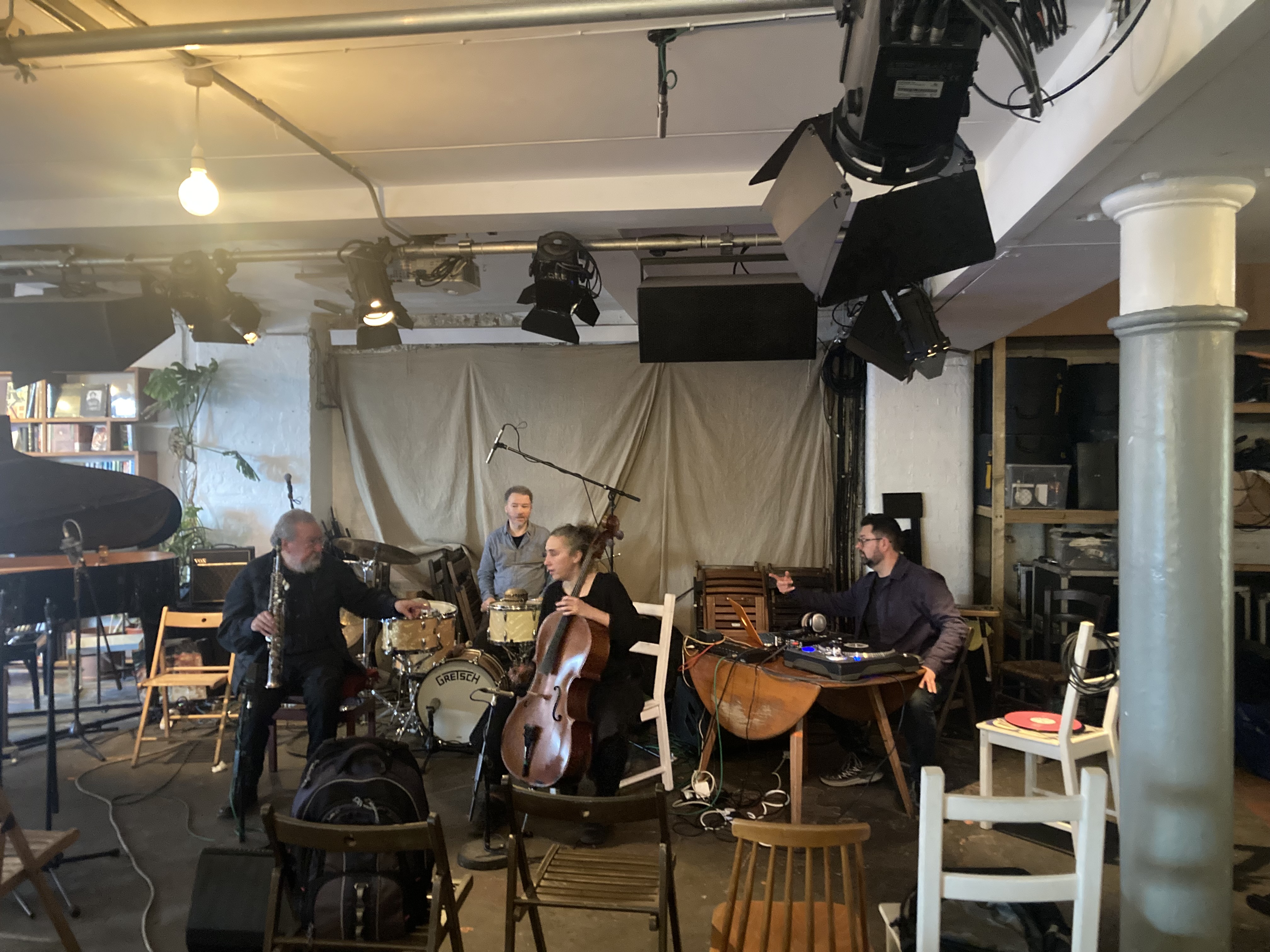
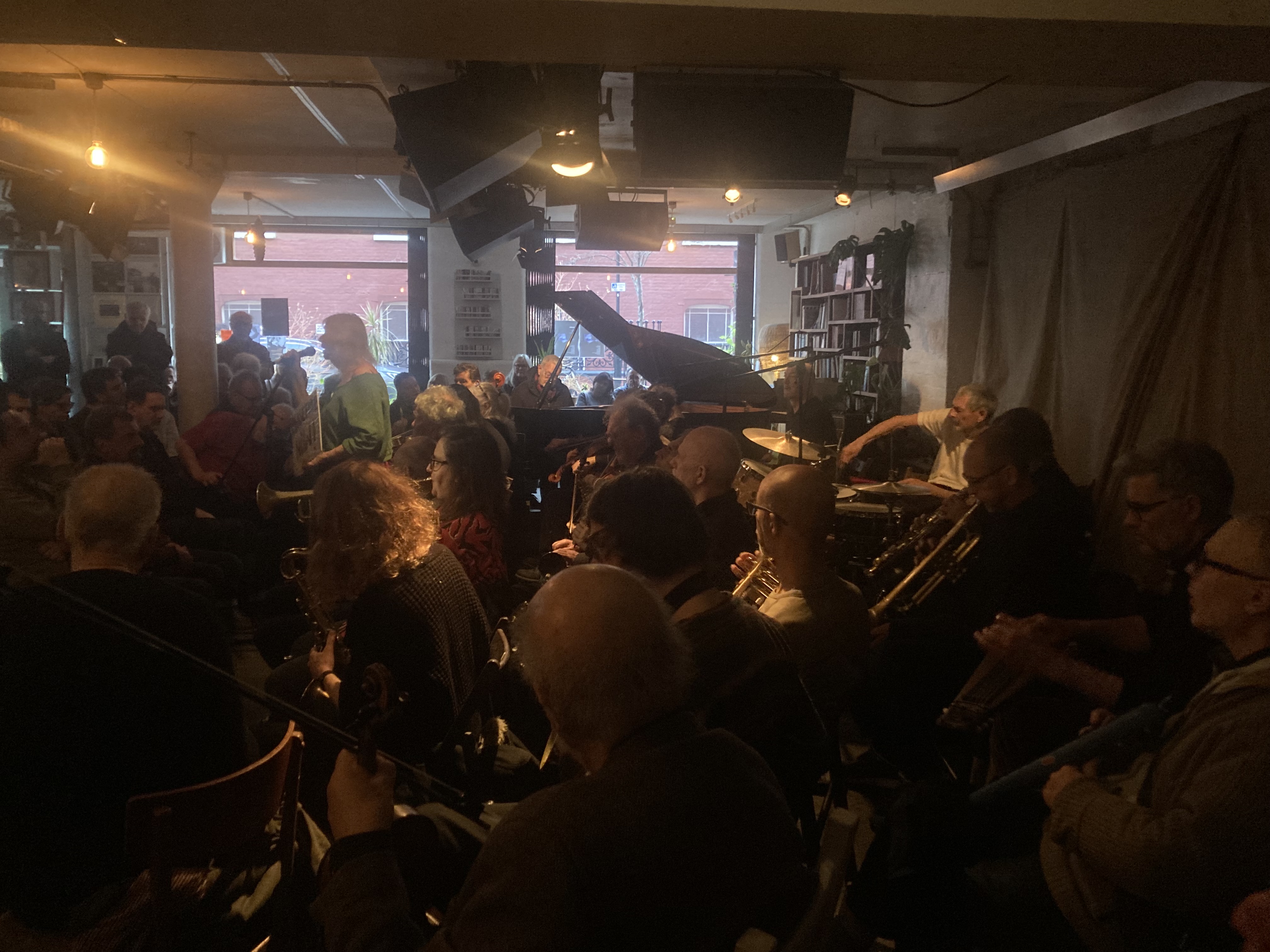
Today at Café Oto and the Vortex many of those artists performed in celebration and commemoration of Martin’s life. It was my privilege to introduce the Café Oto gig, which began with a set from the quartet pictured above during their soundcheck — Parker, Mark Sanders, Hannah Marshall and Matt Wright — and continued with the duo of the altoist Caroline Kraabel and the pianist Veryan Weston before concluding with the 27-strong London Improvisers Orchestra.

I met him 11 August 1969. I remember it because it was my first day in London, my first day at the Melody Maker, and I was sent to review Mike Westbrook’s band at the 100 Club that night. Martin was the man with a box of very desirable albums for sale, set up on a table in the space between the end of the bar and the stage. I soon learned that he was a man of views that were carefully considered and firmly held, some of them expressed in reviews for the MM over the next couple of years.

I was able to share with the audience a handful of the characteristic aphorisms from his New Musical Dictionary, which he posted online. Easy Listening: Music that is extremely difficult to listen to for anyone who really listens to music. Post-modernism: New things for people who don’t like new things. An Improviser: A musician who combines the roles of both composer and interpreter, yet usually receives less respect and remuneration than either.

At the request of Mandy Davidson, Martin’s widow (and the other Em in Emanem), all the proceeds from the gigs, for which the musicians waived their fees, will go to B’Teselem, a Jerusalem-based non-profit organisation documenting human rights violations in Israeli-occupied Palestine. At the end of the LIO set, which consisted of ensemble improvisations conducted by Terry Day, Ashley Wales and others, Maggie Nichols — who met Martin when she was a member of the SME — read a verse by a Palestinian poet killed in the Gaza fighting. That’s what you can see in the picture below, as she holds up a placard saying CEASEFIRE NOW!!

For Jason Yarde

Xhosa Cole and Caroline Kraabel arrive at Café Oto

In the middle of the afternoon, an outsized multicoloured scarf walked through the door into the Vortex, playing an alto saxophone. It turned out, after he had unwrapped himself, to be Xhosa Cole, who carried on playing as he made his way to the stage. There he fitted seamlessly into a free improvisation being devised by the trumpeter Chris Batchelor, the tenorist Julian Siegel, the cellist Shirley Smart and the pianist Liam Noble as part of a three-venue benefit for the saxophonist Jason Yarde.

Yarde, who is one of Britain’s very greatest jazz musicians, collapsed on stage in south-west France in mid-October after suffering a massive stroke. The presence of a couple of medics in the audience may have saved his life, and the process of treatment for a bleed on his brain continued at a hospital in Toulouse. He is recovering at home now, but an appeal for funds to meet his costs has met a predictably warm response, leading to the three jazz clubs in Dalston — the Vortex, Café Oto and Servant Jazz Quarters — getting together to organise a highly unusual benefit.

Starting at two o’clock in the afternoon, several dozen musicians of diverse age, gender and ethnicity spent two and a half hours migrating between the three adjacent venues, joining up for collective improvisation in spontaneously self-selected ensembles. I began my listening at the Vortex, where a group featuring the altoist Caroline Kraabel, the tenorists Dave Bitelli and Harrison Smith, the guitarist Dave Okumu, the bassist Dominic Lash and the drummer Sebastian Rochford surged through free passages into a charging section of unruly swing that reminded me of Charles Mingus’s “Hog Callin’ Blues”. Later Cole joined a group with Loz Speyer (trumpet), Neil Charles (bass) and Rochford again on drums, whose interplay was agile and intuitive.

Arriving at Café Oto, I discovered I’d just missed a line-up featuring Evan Parker and Eddie Prévost. Instead I heard a set by a group including the singer Cleveland Watkiss, the baritone saxophonist Cath Roberts, the trumpeter Charlotte Keeffe and the violinist Benedict Taylor, in which the pianist Veryan Weston played a duet with the improvising tapdancer Petra Hasler. As I was leaving, a re-scarfwound Cole was marching towards the Oto’s entrance, accompanied by Kraabel, together creating al fresco counterpoint for two altos.

Next, over in the basement at Servant Jazz Quarters, I had said hello to the pianist Steve Beresford and heard a couple of minutes of a set featuring the tabla player Ansuman Biswas and several string players. But then, with a loud BANG, the lights went out and the music stopped dead. A water leak from adjacent building works had found its way into the club’s electrics. No injuries but plenty of confusion. End of music.

Back at the Vortex, the altoist Dee Byrne, the pianist Laura Cole, the guitarist Daniel Thompson and the drummer Mark Sanders, with Taylor on violin and Lash on bass, had just got started when Charlotte Keeffe and Cath Roberts arrived to join them, already playing as they made their way up the stairs. Soon they were joined by another violinist, Sylvia Hallett, and together they conjured something that soared at first noisily and then gently before floating to earth in the sort of inspired ending that is one of the joys of free improvisation.

It was the kind of a day when the music really does turn itself into a common property, its barriers dismantled and prejudices abandoned, available to all. A day that fully reflected the qualities of the inspired and inspiring musician to whose recovery it was dedicated.

* For those who didn’t know about Jason Yarde’s stroke, or who couldn’t make it to the benefit, and would like to make a donation, here’s the crowdfunding link: https://www.gofundme.com/f/jason-yardes-stroke-rehabilitation-journey?utm_campaign