Skip to content

Posts from the ‘Folk-rock’ Category

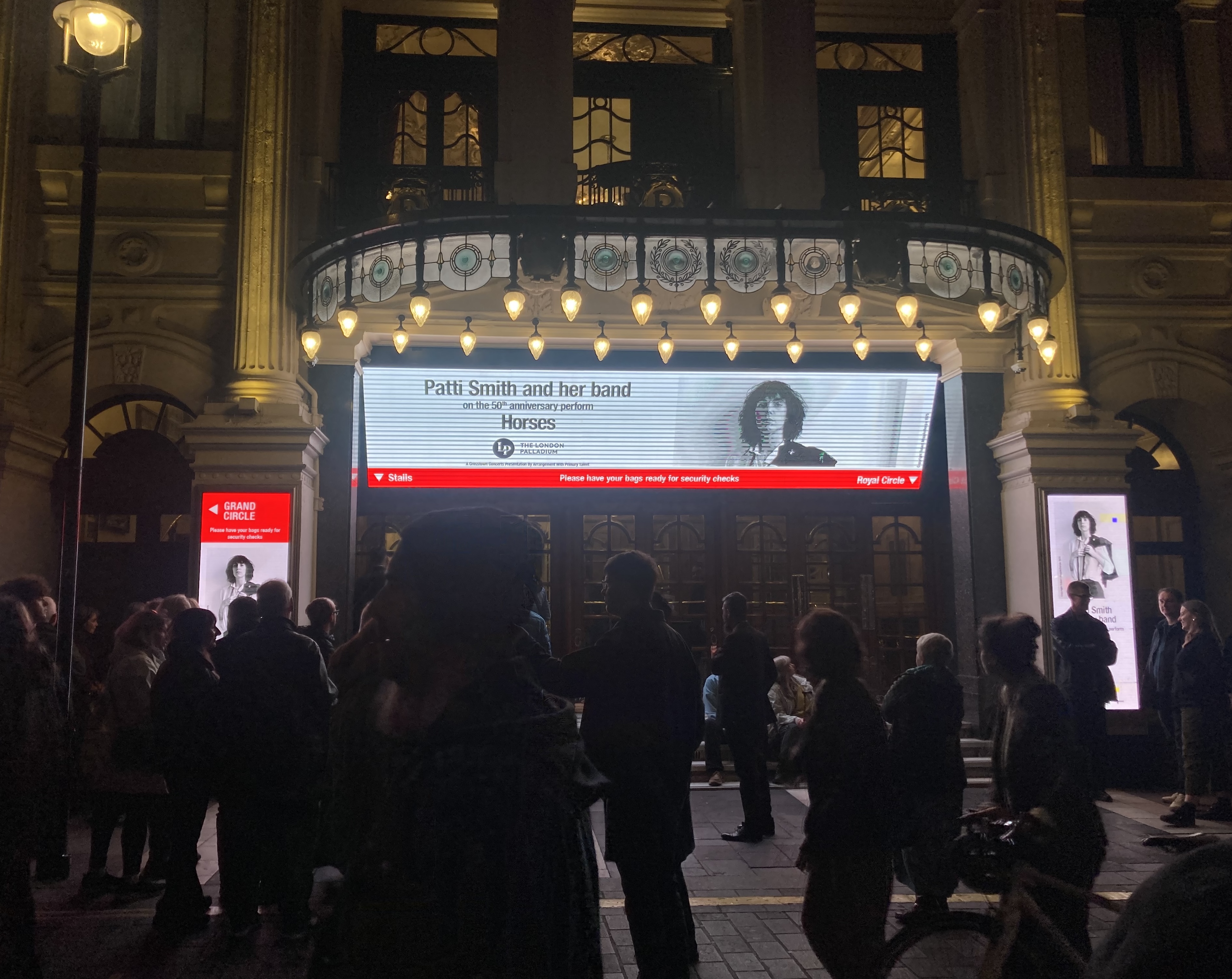
At the London Palladium

Two poets took the stage at the London Palladium this week. The first, Patti Smith, was celebrating the 50th anniversary of the release of the epochal album Horses by playing it all the way through with a band including two of her original confrères. The second, Al Stewart, had made it part of his farewell tour, and thus his final appearance in the city where he once shared a flat with the young Paul Simon and had a residency at Bunjie’s, a folk club a shortish walk across Soho from where he was saying his goodbyes.

Smith is 78. Stewart is 80. Horses came out in 1975, the year before Stewart enjoyed his biggest hit with the title track from Year of the Cat. Both drew full houses — Smith on two nights running — and performed with a vigour that reanimated the work of their youth.

We know Smith as a poet who rammed literary and musical forms together to great and lasting effect. Stewart’s success in turning big subjects — the Basque separatist movement, the French Revolution, Operation Barbarossa — into long narrative folk-rock songs reflected a creative use of the early impact of Bob Dylan on his songwriting. But where the enduring glamour of the New York era of CBGB and Max’s Kansas City ensures Smith’s continuing credibility, Stewart’s soft-rock associations have probably restricted his following to his original audience. There was no measurable difference in the enthusiasm that greeted both artists on a celebrated stage.

If the guitarist Lenny Kaye and the drummer Jay Dee Daugherty provided valued historical support for Horses, assisted by Jackson Smith and Tony Shanahan on keyboard and bass guitar, Stewart (and his four-piece band from Chicago, the Empty Pockets, plus the saxophonist/flautist Chase Huna) benefited from the guest presence of his old collaborator Peter White, who added beautiful guitar decoration to “Time Passages”, which he co-wrote, and “On the Border”, and remodelled the rhapsodic piano introduction — including “As Time Goes By” — to “Year of the Cat”.

To be honest, I hadn’t listened to Stewart for decades before last night. I bought the tickets as a treat for my wife, who knew him a little in Bristol folk scene of the late ’60s and remembers once giving him a lift to London. But as thrilled as I was to hear Smith declaiming “Redondo Beach” and “Birdland”, I was just as beguiled by Stewart’s “The Road to Moscow” and “The Dark and the Rolling Sea”.

Today Smith, of course, looks even more like a poet than she did in 1975. Stewart, who lives in Arizona, now resembles someone who might be the secretary of the local bridge club. Good on both of them.

The Bob look

In her 2008 memoir, A Freewheelin’ Time, Suze Rotolo described how Bob Dylan, her boyfriend between 1961 and 1964, developed his look. Apparently it was Dave Van Ronk, a slightly older Greenwich Village folkie, who urged the 21-year-old Dylan to start paying attention to his image.

In Rotolo’s words: “Such things might have been talked about in jest, but in truth they were taken quite seriously. Much time was spent in front of the mirror trying on one wrinkled article of clothing after another, until it all came together to look as if Bob had just gotten up and thrown something on. Image meant everything. Folk music was taking hold of a generation and it was important to get it right, including the look — be authentic, be cool, and have something to say.”

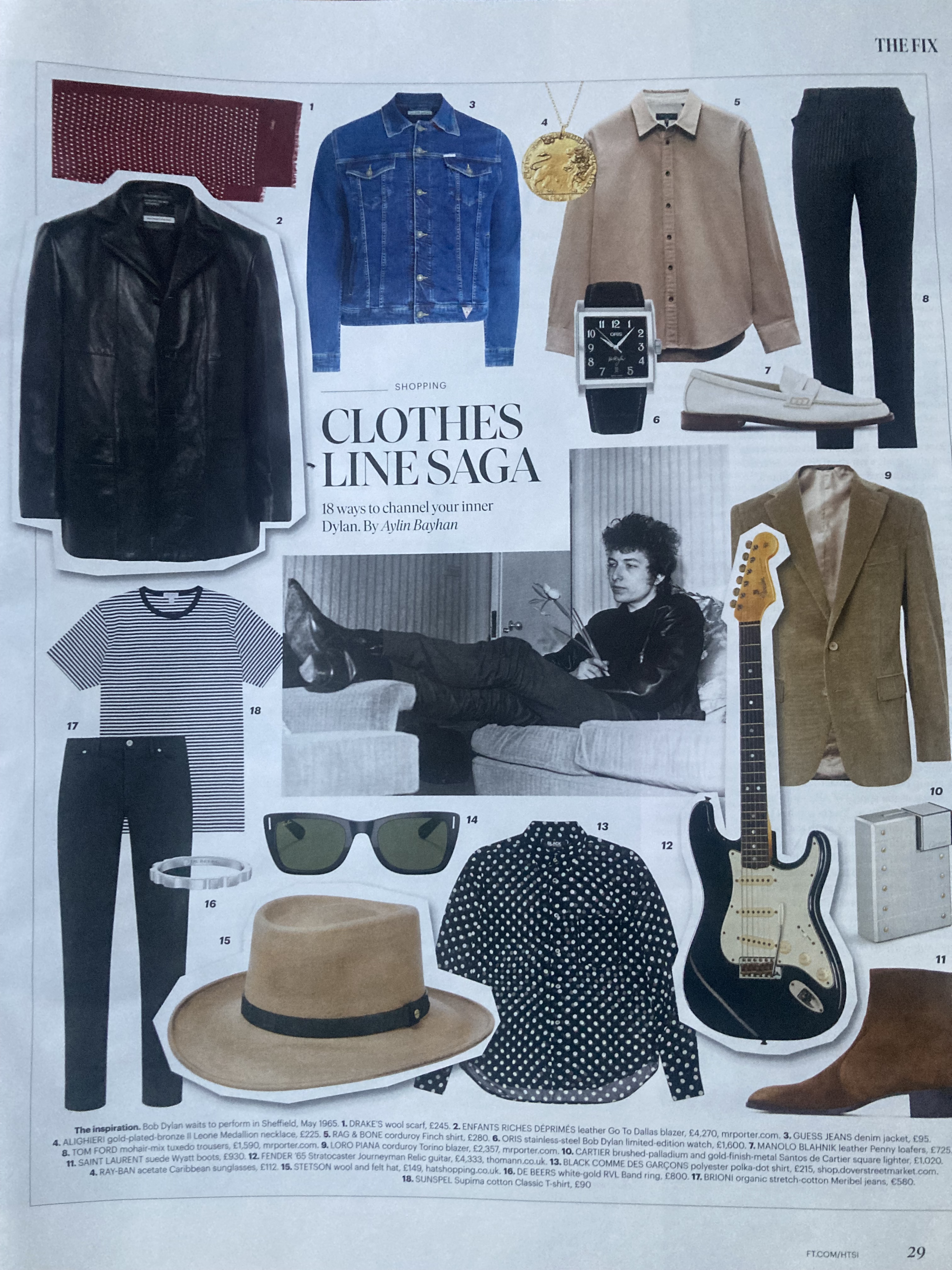
The result was the transfixing sight of Dylan and Rotolo wrapped around each other on the cover of Freewheelin’ in 1963. If you were, say, 16 years old at the time, Don Hunstein’s shot of the couple on Jones Street in Greenwich Village opened up a whole world, and his suede jacket, denim shirt, jeans and boots seemed to offer an easy way in. If you could get hold of them, that is. And now, just six decades later, the Financial Times is telling you how. What you see above is a guide, published in its HTSI (How to Spent It) magazine, showing you to how to look like Bob Dylan.

It’s pegged to the release of A Complete Unknown, James Mangold’s film of Dylan’s life between 1961 and 1965, and it made me laugh quite a lot, for several reasons. The polka-dot shirt they recommend is black and white, which is how it looked in the monochrome photos from the soundcheck at the Newport Folk Festival in 1965; the real thing was green and white — and it was actually a blouse rather than a shirt (the film gets that right). And have you ever seen Dylan in white loafers, never mind 700-quid ones by Manolo Blahnik? The black leather blazer they recommend retails at £4,270. Mine cost a fiver in 1964 from the harmonica player in our band, who was skint at the time and needed rent money. I wish I still had it.

But it’s not just a matter of looking like Bob Dylan. You can try to sound like him, too. The rock critic of The Times went off to the vocal coach who did such good work with Timothée Chalamet in order to try and achieve that distinctive nasal whine. Again it sent me back to 1964 and sitting in my bedroom, strumming an acoustic guitar acquired very cheaply from a girl called Celia and bellowing the words of “The Times They Are A-Changin'” loud enough for my blameless parents to hear: “Come mothers and fathers throughout the land / And don’t criticise what you can’t understand / Your sons and your daughters are beyond your command…”

That was in real time. So was the £5 leather jacket. It was all part of growing up and finding out who you were, and it seems weird now to watch people turn it into a novelty, however good the cause.

As it happens, I enjoyed A Complete Unknown a lot, with only a very few reservations. When Chalamet-as-Dylan sings “The Times They Are A-Changin'” to a festival crowd, Mangold orchestrates the audience’s response in a way that precisely evokes how it felt to experience that song in 1964, with all the emotion of realising that it spoke for you. It was a relief to come out of the screening with the knowledge that I wouldn’t have to be explaining to younger people that it really wasn’t like that at all. Mostly, it was.

Island Records: The Greatcoat Years

No record label has ever had its history subjected to the sort of minutely detailed scrutiny on show in the first two volumes of Neil Storey’s The Island Book of Records, the second of which was published just before Christmas. The initial volume examined the label’s earliest years, 1959-68, from the family background of its founder, Chris Blackwell, to the breakthrough into the new rock mainstream with the debuts of Traffic, Jethro Tull and Fairport Convention. The new one deals with just two years, 1969 and 1970. Their successors will, I gather, each focus on a single year**.

The format is that of an LP-size hardback of considerable heft (432 pages of high-grade paper in case of the new one), an oral history with testimony from participants and interested bystanders lavishly illustrated with photos, sleeve artwork, press cuttings, documents, ads and other ephemera. What 1969-70 means is loads of background (and foreground) material beginning with Steve Winwood’s involvement in Blind Faith and ending with King Crimson’s third album, Lizard. Among those featuring heavily are Spooky Tooth, Free and Mott the Hoople, three classic early Island rock bands whose largely student and mostly male following tended to sport ex-army greatcoats, along with plimsolls, loon pants and cheesecloth shirts.

You get their stories in jigsaw form, pieced together with great diligence in mostly bite-sized chunks of testimony. A good example is the treatment of Nick Drake’s Five Leaves Left: the producer Joe Boyd, the engineer John Wood, the bass player Danny Thompson, the guitarist Richard Thompson and the arranger Robert Kirby help describe its making, while Blackwell and his Island colleagues David Betteridge, Tim Clark, Bob Bell and Barry Partlow and the record shop owners John Clare and Eugene Manzi try to explain why it didn’t sell. (When Boyd sold his Witchseason production company to Blackwell in the ’70, it was with the stipulation in the contract that Drake’s three albums should never be deleted.) Others providing testimony include Gabrielle Drake, Nick’s sister, and Victoria Ormsby-Gore, a well connected friend.

There’s too much stuff here for me to begin to do it justice, but the riches include the triumph of King Crimson’s first album, helped by the fact that their two managers, David Enthoven and John Gaydon, were, like Blackwell, Old Harrovians; the debut album by Quintessence, a quintessentially Island band (i.e. Notting Hill hippies) that it turns out nobody in the company really seemed to like; the Fotheringay debacle, which derailed Sandy Denny’s career; the emergence of two ex-Alan Bown Set singers, Jess Roden and Robert Palmer, respectively with Bronco and Vinegar Joe; and the huge success of Cat Stevens, reinvented as a singer-songwriter with Tea for the Tillerman, and of Emerson, Lake & Palmer.

Alongside epochal releases like Traffic’s John Barleycorn Must Die and Fairport’s Unhalfbricking and Liege & Lief, the book features such bit-part players as Dr Strangely Strange (“a poor man’s Incredible String Band”), Blodwyn Pig and McDonald & Giles (respectively offshoots of Jethro Tull and King Crimson), and White Noise’s somewhat prophetic An Electric Storm, which seemed to typify Island’s propensity, in the early days, for backing weird stuff. Nothing is neglected, including the hugely popular and influential compilations, particularly what might be called the greatcoat anthologies: You Can All Join In, Nice Enough to Eat and Bumpers.

The two years covered by this volume pivot around the move from offices on Oxford Street to a former Congregational church on Basing Street in Notting Hill, converted around the time of the First World War into a factory making dressmakers’ showroom busts and wax figures for Madame Tussaud’s. Blackwell bought it and, with the aid of the acoustic engineer Michael Glickman and the studio technician Dick Swettenham, set about converting into a headquarters that incorporated not just offices for the label’s staff but two studios, No 1 on the ground floor, capable of accommodating 80 musicians, and the more intimate No 2 in the basement. This was where a bunch of talented young engineers set to work with Helios 16-track desks and Studer two-inch tape machines, and we hear from some of those hitherto best known as names the bottom of the list of album credits: Brian Humphries, Phill Brown, Richard Digby-Smith (“Diga”) and Phil Ault.

This was a turning point. Basing Street became a creative hub, a 24-hour hang-out, the office business conducted at round tables seating executives and secretaries in a non-hierarchical environment. Guy Stevens, the former DJ at the Scene Club in Ham Yard, for whom Blackwell had created the Sue label, was a maverick A&R presence, introducing Ian Hunter to a bunch of guys from Hereford and giving them the name Mott the Hoople. Lucky Gordon was the resident chef.

I visited Basing Street quite a lot during those early years, sometimes interviewing various people and other times just hanging out, occasionally in the studios. The buzz was terrific. It was, I suppose, a perfect example of hip capitalism in action. Nothing so perfect lasts for ever, but in this volume of his epic and invaluable series — expensive but, to those with an interest, worth every penny — Neil Storey catches it in glorious ascent.

* The Island Book of Records Vol 2: 1969-70, edited by Neil Storey, is published by Manchester University Press / Hidden Masters (£85)

** Not quite right. Apparently Vol 3 (out in the spring of ’26, all being well) will deal with 1971-72. Vol 4 is 1973-76, Vol 5 is probably 1977-79, and Vol 6 could be 1980-83. Neil Storey says he has always thought of the series as consisting of 10 to 12 volumes, so we’ll see.

Daniel Kramer 1932-2024

Bob Dylan was fortunate in the photographers who recorded his progress from his arrival in New York in January 1961 to his motorcycle accident in Woodstock in July 1966. John Cohen, a member of the New Lost City Ramblers, and the Village Voice staffer Fred W. McDarrah chronicled his early days in Greenwich Village. Richard Avedon caught him on the New York waterfront in 1963. Jim Marshall was at Newport and in San Francisco when Dylan hung out with the Beat poets. Don Hunstein took the Freewheelin’ cover shot on Jones Street and was there for the “Like a Rolling Stone” session, as was W. Eugene Smith. Jerry Schatzberg caught the amphetamine Dylan of early 1966 in formal portraits and took the Blonde on Blonde cover. Barry Feinstein was in the limos and the dressing rooms on the European tour that summer, present as Dylan spent time with John Lennon and Françoise Hardy.

But I’m probably not the only one who has a special fondness for the photos taken in 1964-65 by Daniel Kramer, who has died aged 91. Brooklyn-born, the young Kramer worked as an assistant to Diane Arbus and Philippe Halsman. He had just set up his own studio and knew little about Dylan when he first saw him on TV early in 1964 but then spent six months petitioning Albert Grossman to allow him access. The first session, at Grossman’s house in Woodstock that August, established a rapport between the photographer and the singer, and there would be many more encounters over the following 12 months.

Kramer photographed Dylan being swept off his feet — quite literally — by Joan Baez at a post-concert party, cheerfully (and top-hattedly) signing photographs for fans in Philadelphia, and relaxing by playing pool and pinball and (see the photo above) reading the NY Herald Tribune, again at Grossman’s house, with Sally Grossman, who has just come in from swimming, at the edge of the shot. She was also featured on the front of Bringing It All Back Home, the first of Kramer’s two great narrative cover photos (the other being Highway 61 Revisited). And he was there in Columbia’s Studio A as Dylan rewrote and recorded “Positively 4th Street”, framed by a forest of microphone booms and music stands.

In 1967 Kramer published a book of his work with Dylan, adding a commentary. His words and pictures were, as Michael Gray observes in his Bob Dylan Encyclopedia, “recurrently revealing but never prurient or obtrusive… respectful but clear-sighted.” As well as their observational and technical qualities, there was a humanity in Kramer’s photographs that gave us Dylan from a very special perspective.

* Daniel Kramer’s photographs of Dylan, along with those of Barry Feinstein and Jim Marshall, are in Early Dylan, published in the UK by Pavilion Books in 1999, and in Bob Dylan: A Year and a Day, published by Taschen in 2018.

Summer books 2: ‘Pledging My Time’

I don’t imagine I’m alone in sometimes glancing at a stack of books about (or by) Bob Dylan and thinking, OK, that’s enough now. The last two new volumes, bought hot off the press in the past couple of years, turned out to be expensive time-wasters, prompting the thought that maybe I’d be better off re-reading some of the old ones. Anthony Scaduto’s early biography, maybe, or Suze Rotolo’s memoir, or The Nightingale’s Code. Or even the one Patrick Humphries and the late John Bauldie published in 1990, called Oh No! Not Another Bob Dylan Book. But there’s always an exception, and one such is Pledging My Time by Ray Padgett, subtitled “Conversations with Bob Dylan band members”.

All I know about Padgett is that he has an erudite and entertaining email newsletter called Flagging Down the Double E’s, on which he discusses topics related to Dylan’s live performances. The book is an outgrowth of that newsletter, consisting of interviews with 40 people who have played with Dylan, either in his band or in briefer encounters, or, in a handful of cases, worked with him in slightly different capacities, such as Betsy Siggins, who ran a folk club in Cambridge, Massachusetts in the late ’50s and early ’60s, Chris O’Dell, the Rolling Thunder tour manager, and Keith Dirks, a sound engineer in the early stages of the Never Ending Tour.

You don’t want big names in a book such as this. Most of them have already told their stories many times. You want Ramblin’ Jack Elliott, Happy Traum, David Mansfield, Spooner Oldham, Fred Tackett, Stan Lynch, Christopher Parker, Dickey Betts, Larry Campbell and Benmont Tench, whose impressions are not worn thin by overexposure. You want someone like Jim Keltner, with a lifetime of service to music and a deep love of how it feels to explore it in Dylan’s company: “The thing I love about Bob is his fearlessness. There’s a fearlessness from some artists that transmits to the musicians playing. When that happens, you get the best from the musicians, because the musicians are not worried about tempo or about whether they’re rushing or they’re dragging or whether they’re not in the pocket. It’s not about finding a pocket. It’s more about searching for the vibe, searching for the thing that makes the song live.”

Keltner is not the only one here who likens the experience of playing with Dylan to jazz. It’s not jazz, of course, but it shares some important characteristics. Gary Burke, who played percussion on the 1976 Rolling Thunder dates, says: “Dylan lived more in the present than most musicians I know. The most common question I get is, ‘What’s it like to play with Dylan?’ I say, ‘Oh, it was the greatest jazz gig I ever played.’ People look at me like I’m crazy. I don’t mean stylistically it was like a jazz gig, but in terms of the mindset. It was very spontaneous. You never know where he’s going to go. You weren’t given directions ahead of time.”

The pianist Alan Pasqua had played with the New Tony Williams Lifetime when he joined Dylan for the Street Legal sessions and the 1978 tour. “Bob was a great bandleader,” he says. “I was lucky enough to play with Tony Williams early on in my life. He learned from Miles Davis. Miles never told him what to play, but by how Miles played, he showed Tony what he needed to do. I found Bob to be quite a bit similar to Miles.” He adds: “I didn’t know at the time that Bob was a jazz fan.”

In 2017 Pasqua was asked, out of the blue, to provide piano music against which Dylan could read his Nobel Prize acceptance speech. And then, a couple of years later, he was invited to play on “Murder Most Foul”. “They were playing a demo. I heard it and I just couldn’t believe it. In rock music, things usually have a specific beat and pulse. This was free. The time was free. It was elastic. It wasn’t specific to a certain time, feel, or tempo. It just moved and flowed. When I was done listening to the track, I turned to Bob and I said, ‘My God, Bob, this sounds to me like A Love Supreme.’ He just stopped and looked at me.”

Sometimes other aspects of being Bob Dylan are sharply illuminated. Burke remembers the business that went on at the end of every gig, when Dylan’s security men took charge: “When we would leave a place on the tour, security would go into the room where he was staying and take everything out. Every piece of garbage, everything. They would put it in bags and take it with them so that nobody went in and tried to find the lost verse to ‘Tangled Up in Blue’ or something like that.” That’s a tough way to live, Padgett observes. “It is. You got the feeling he was rubbed raw by it all.”

To Billy Cross, who played guitar in the 1978 band, he seemed “very friendly and very warm. He was lovely, absolutely lovely, considering what he’d been subjected to through his life at that point. Everywhere he goes, someone thinks he’s got the answer that’s blowin’ in the wind. I thought it was unbelievable that he could be as normal and personable and pleasant as he was.”

Padgett is a marvellous interviewer: not just enthusiastic and sympathetic but alert and perceptive, equally good at prompting and just letting people talk. Of course, the testimony is mostly admiring. There’s nothing resembling the interview with the veteran soul singer Betty LaVette in the Daily Telegraph earlier this month, where she described her “contempt” for Dylan, five years after enjoying a warm reception for an excellent album of his songs titled Things Have Changed.

She was annoyed that he never told her how good it is, and to underline her irritation she mentioned an incident from several years earlier, when they encountered each other in Spain and “he ran over to me. He put my face in his hands and kissed me square in the mouth. I don’t offer Bob Dylan a kiss and I’m not a f—ing fan. I was not looking to be kissed. If he thinks I’m good enough to put his mouth on, then he should have opened it to say just one good word about my record. When you’re as big as he is, that can make a huge difference to sales.” She didn’t mention whether she’d ever got in touch to thank him for the songs.

More than most people, Bob Dylan presents himself to the world as a jigsaw puzzle, full of complexities and seeming contradictions and bits that are hard to fit together. Maybe some missing bits, too, and others that once fitted but no longer do. Each of us assembles the puzzle as best we can. The keyboards player Benmont Tench, who once found himself playing “Desolation Row” — which he had listened to “a million times” but never played — with its composer to a festival audience of tens of thousands, is among the most thoughtful interviewees in Padgett’s book. He’s allowed to close it with some words that seem to express the feelings of many who’ve worked with Dylan.

“You can read about Bob’s life,” he says, “and you can pay attention to what he says, and you can learn from it, but when you play music with somebody of that calibre, you learn something entirely different. It can only be passed on by that person. And those of us who have the opportunity to play with that person can pass on what we took away, but we only each take away a certain part of our experience with someone like that. Long may he live, because he’s something else.”

* Ray Padgett’s Pledging My Time is published in hardback and paperback by EWP Press. Padgett’s email newsletter is at dylanlive.substack.com
Dylan 1980-85

While reading an interview with the filmmaker Jesse Dylan in the (London) Times last week, one quote caught my eye. The interviewer asked him about the continued productivity of his father, who is now in his ninth decade. Jesse replied that his dad wasn’t trying to outdo himself. “He’s just thinking, ‘Should I paint a picture today? Should I write a song?'”

It reminded me of of my own reaction to visiting the Musée Picasso in Paris a few years ago and realising how wonderful it must have been to be him, to get up in the morning and think, “Shall I paint a picture today? Shall I paint a few plates? Shall I make a bull’s head out of a pair of bicycle handlebars or a guitar out of a matchbox and some rubber bands?”

That’s not the only point of comparison between the two, for sure. But Dylan transforms farm implements into sculpture and photographs into paintings with the same unstoppable desire to make stuff. He’s not expecting everything he creates to be the equal of “Desolation Row”, just as Picasso didn’t think a painted soup dish needed to be a rival to the Demoiselles d’Avignon.

Jesse Dylan’s remark might have helped me to make a different kind of sense of the latest volume of the Bootleg Series, titled Springtime in New York and assembled from recordings made in the first half of the 1980s. This was a period that included Shot of Love, Infidels and Empire Burlesque, and most of the tracks on the deluxe five-CD version of the new release are outtakes from those sessions, in Los Angeles as well as New York, plus material from various tour rehearsals and a couple of live tracks (“Enough Is Enough” from Slane Castle in 1984 and “License to Kill” from the same year’s David Letterman show).

There are works of genius here, the two takes of “Too Late” and its eventual metamorphosis into “Foot of Pride” being the prime exhibit, showing Dylan functioning in 1983 at the peak of his powers, creating something that only his imagination could have produced, working away at its shape and structure and detail and angle of attack (and then still not being satisfied enough to put it on the relevant album). “New Danville Girl” has long been loved by bootleggers as a prototype of what would become, 18 months later, the epic “Brownsville Girl”, featuring a friendlier arrangement and more modest production but lacking some of the final version’s finer points. “Let’s Keep It Between Us” is a Dylan song recorded by Bonnie Raitt in 1982 and here performed two years earlier as a confiding southern soul ballad, with wonderful B3 interjections from Willie Smith.

By and large, however, this is an assembly of lesser material. Unlike The Cutting Edge or More Blood, More Tracks, it’s not the sort of compilation that enables the dedicated student to make a close scrutiny of Dylan’s working method over a tightly defined period of time. It’s a whole lot looser than that, and variable in quality. You don’t necessarily need Dylan’s versions of “Fever”, “I Wish It Would Rain”, “Green, Green Grass of Home”, “Abraham, Martin and John” or “Sweet Caroline” — or Jimmy Reed’s “Baby What You Want Me To Do”, which isn’t noticeably better than those performed by a hundred young British R&B bands in the mid-’60s (including my own). You might, of course, need his gorgeous version of Willie Nelson’s “Angel Flying Too Close to the Ground”. But what all of them do is remind us of what Dylan’s backing musicians often say, that he knows a very large number of songs — and if you’re in his band, you have to be ready to play them, at least in rehearsals.

Taken together with the outtakes of songs like “Blind Willie McTell”, “Jokerman”, “I and I”, “Don’t Fall Apart on Me Tonight”, “Sweetheart Like You”, “Tight Connection to My Heart”, “Seeing the Real You at Last” and “Dark Eyes”, some of them pleasingly devoid of the production touches added to the versions released on the original albums, they made me think of what it might be like if Bob Dylan turned up in your village with his band, rented the parish hall and spent an evening entertaining the locals. It wouldn’t be a show. It wouldn’t be for posterity. Nobody would be taking notes or keeping score. There might be false starts and missteps and re-runs. There would certainly be some things that didn’t work quite as well as others. Playing these five discs end to end, flattening out the artistic highs and lows, allowing the kaleidoscope of Dylan’s approach to American music to form and disperse and reform, you get a sense of how much fun that would be.

* Bob Dylan’s Springtime in New York: The Bootleg Series 1980-85 is out now in various formats and configurations on the Columbia Legacy label. The photograph of Dylan in New York is from one of the booklets that come with the deluxe version and was taken by Lynn Goldsmith.

Alone and palely strumming…

There they were, half a century ago, alone and palely loitering, with their long dark hair and their flares and their Martin guitars and their debut albums on Transatlantic, regulars at Les Cousins or the Troubadour, peering up from bottom of the bill at Implosion or next weekend’s rain-drenched festival, finding slots on Sounds of the ’70s and the Whistle Test, maybe even Top of the Pops if they struck lucky with the right song — a “Catch the Wind”, a “Baker Street”, a “Where Do You Go To (My Lovely)?”, a “Streets of London” or an “Alone Again (Naturally)”.

British male singer-songwriters mostly came out of the local folk scene, which seemed to imbue them with a leaning towards the wistfully romantic. Their American counterparts, springing from close exposure to the blues and bluegrass traditions, seemed more robust in temperament. The exception would be Paul Simon, who shared the British tendency to what it would be unkind to call feyness — but then he’d spent time playing the London folk clubs as part of his formative experience, soaking up the vibe.

There was more to them than that archetype, of course, and the whole genre is interestingly captured in Separate Paths Together, a new three-CD box subtitled “An Anthology of British Male Singer-Songwriters 1965-75”. Compiled and annotated by David Wells, it parades an extraordinary range of artists in solo guise. Most of the usual suspects are here: Al Stewart, Ralph McTell, John Martyn, Donovan. Others — Kevin Ayers, Peter Hammill, Richard Thompson, Jim Capaldi, Mike Heron, Gary Farr, Dave Cousins — had made their initial reputations as members of bands. Free-standing solo artists range from Pete Atkin, who came out of the Cambridge Footlights putting melodies to Clive James’s effortfully intricate lyrics (maybe the nearest thing ever devised to an English version of French chanson), to Peter Skellern, whose deceptively artless “Hold On To Love” still sounds like a great pop record,

Among my favourites are David McWilliams’s “Days of Pearly Spencer”, as enduringly perfect an evocation of 1967 and the days of pirate radio as could be imagined; Bert Jansch’s brief, unadorned “Tell Me What Is True Love”; Mike Cooper’s “Paper and Smoke”, with its fine horn arrangement; Andy Roberts’s warmly nostalgic “All Around My Grandfather’s Floor”, from a poem by his Liverpool Scene bandmate Mike Evans; and Murray Head’s “Say It Ain’t So, Joe” — a record that everyone at Island in 1975 expected to be a huge hit, but mystifyingly wasn’t.

The alone-and-palely-loitering archetype is particularly well represented by Keith Christmas’s diaphanous “The Fawn”, Dave Cartwright’s poised “Song to Susan” and Duncan Browne’s lovely “Journey”, which kicks off the whole collection and makes me regret a crudely dismissive review I gave him when he supported Lou Reed at the Sundown in Edmonton in 1972 (not the happiest of juxtapositions, it must be said, and I wasn’t much kinder to Lou). I’d offer an apology, but he died of cancer in 1993, aged 46.

The tracks I’ve mentioned are on the first two discs, where the genre is stretched to include something like the heavily arranged “Jesus Christ Junior” by Patrick Campbell-Lyons, a member of the original Nirvana. The third disc is largely devoted to also-rans (Bill Fay, Chris Baker, Paul Brett) and anomalies (Steve Gibbons, Jona Lewie, Crispian St Peters), including Mike Hart’s “Disbelief Blues”, a “Subterranean Homesick Blues” homage, and Al Jones’s extremely creepy “Jeffrey Don’t You Touch”, a clumsy portrayal of a sex abuser that wouldn’t get anywhere near the radio today.

The two most obvious omissions from the set’s 66 tracks represent the genre’s opposite poles: the introspection of Nick Drake and the extroversion of Elton John. I guess their absence is explained by permission issues. Cat Stevens isn’t represented, either. But you already know what they sounded like.

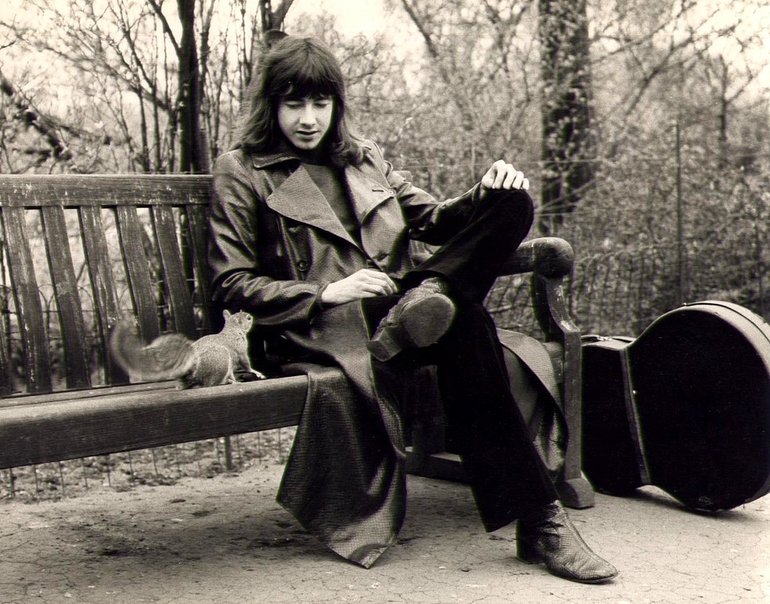
* Separate Paths Together is out now on Cherry Red’s Grapefruit Records label. The photograph is of Duncan Browne; perhaps someone out there can tell me who took it.

Dylan in the shadows

I’d read that Bob Dylan had liked Girl from the North Country, the musical by Conor McPherson based on his songs which transferred from the West End to Broadway shortly before the pandemic closed everything down. The proof was in tonight’s streamed 50-minute concert, Shadow Kingdom, in which a baker’s dozen of his early or earlyish songs were subjected to the kind of treatment devised for the stage show by its musical supervisor, Simon Hale, who assembled a small acoustic band to play in a hotel bar.

That was the mood created for Shadow Kingdom: low-key, intimate, respectful of the songs. Acoustic and lightly amplified guitars, mandolin, accordion, double bass or (on a couple of songs) bass guitar and harmonica were lightly woven around Bob’s voice in three or four different settings, all in deep monochrome chiaroscuro and mostly approximating the ambiance of a funky roadhouse: the audience drinking, smoking, and dancing to one or two of the tunes.

It was all mimed, of that I’m pretty sure because the fingers didn’t always quite match what we were hearing and a microphone mostly obscured the singer’s mouth. But it didn’t matter at all — to me, anyway. Dylan has arrived at an ensemble style which suits songs from every one of his eras, and it’s a joy to hear. When he sat down to sing a beautiful “What Was It You Wanted”, it might have been taken from Rough and Rowdy Ways. That was a highlight for me, but so were a most elegant “Queen Jane Approximately”, a lazily swinging “When I Paint My Masterpiece”, a full-bodied “Pledging My Time”, a Mexicali “Just Like Tom Thumb’s Blues” and a rubato “Tombstone Blues”. The codas and intros linking the sings were a delight, and the whole thing would certainly justify an album release.

The players were masked. Their names were given in the credits as Alex Burke, Janie Cowen, Joshua Crumbly, Shahzad Ismaily and Buck Meek. The director was Alma Har’el and the DP was Lol Crawley. You can catch it again over the next 48 hours, until Tuesday night, at http://www.veeps.com.

Those hard luck stories

Two sides to every story, right? In one of the essays accompanying the wonderful new eight-CD reissue of the collected works of Richard and Linda Thompson, Richard suggests that the indifferent commercial performance of I Want to See the Bright Lights Tonight — the first of their six studio albums — in 1974 could be ascribed to Island’s A&R department, which didn’t know how to categorise them. “They didn’t understand Sandy (Denny), and they didn’t understand Nick Drake,” he says. “I think we were slightly marginalised — what genre is this? Where does it go in the record shop?” Here’s my side of the story.

After I joined Island as head of A&R in the autumn of 1973, one of the first things I did was ask around to find out what Richard was doing. I knew that Henry the Human Fly, his solo album, had been poorly received and sold badly. I also knew that I loved his guitar playing. In reply to my inquiries, I was told that Richard had since made another album, this one with his wife, Linda. The finished tapes had been played to my predecessor, who hadn’t been impressed. That had been some months ago.

My response was to get in touch with John Wood, who had engineered and co-produced the album with Richard at his Sound Techniques studio in Chelsea. John brought in the tapes for me to hear. I was hooked from the first skirl of the Stratocaster on the intro to “When I Get to the Border” , the opening track. The whole album sounded like a coherent and finished statement in a way that Henry hadn’t been, and it seemed obvious that it should be released as soon as possible.

The next step was to play it to the company, meaning the managing director, marketing director, promotion manager, sales manager and press officer. Their enthusiasm was unanimous. Richard was one of the group of Witchseason artists bequeathed to Island when Joe Boyd, who had nurtured them, left London to make movies in Los Angeles just before I joined. They were assets who inspired warmth (in the case of Sandy Denny, for instance) and respect (in the case of Nick Drake, who had already more or less withdrawn from the music world).

Vinyl was in short supply that winter as a result of the oil crisis, but Richard and Linda’s album was scheduled for release in April 1974 and its appearance was accompanied by the best efforts of all the relevant departments. Some people felt that the title track stood a chance of making a hit single, so it was duly released as a 45 and got some play. No one was discouraged when neither the album nor the single went double-platinum. The foundations of something worthwhile seemed to have been laid.

Then Richard came in and told me that he’d asked Jo Lustig to manage them. I knew Jo, who’d begun his career as a press agent on Broadway for Nat King Cole, the Weavers and the Newport Jazz Festival in the ’50s; he was old-school, and most relationships with him featured a phone-melting harangue at some stage. I was a bit surprised that Richard had approached him, but I knew that he got things done and that he’d done a good job for other folk crossover artists, including Julie Felix and Steeleye Span.

The problems began when Richard and Linda became affiliated to a Sufi community based in a squat on a stucco terrace in Maida Vale. Nothing wrong with that, of course. They delivered a second album, Hokey Pokey, which I didn’t care for as much as Bright Lights, but the same effort went into its release, and they were given a support slot on a Traffic tour, which was not small potatoes at the time. The third album, Pour Down Like Silver, was and remains an austere masterpiece: how many albums contain songs as great as “Beat the Retreat”, “Dimming of the Day” and “Night Comes In”? But it didn’t connect with a wider audience, perhaps because to new listeners that austerity would seem like dourness.

They went on the road with a band completed by the accordionist John Kirkpatrick, the bass guitarist Dave Pegg and the drummer Dave Mattacks: an ace line-up, and a perfectly integrated unit with its own sound. John Wood went to Oxford to record them live, and I used the epic versions of “Calvary Cross” and “Night Comes In” from that concert on a double album I compiled with John’s help and advice, rather eccentrically titled (guitar, vocal) and intended to refocus the public’s attention on Richard’s talents. For me, its other highlight was Linda’s delivery of a much stronger version of Richard’s great song “A Heart Needs a Home” than the one that had appeared on Hokey Pokey.

I left Island at that point, sometime in 1976, and a year or so later, after some seemingly unsuccessful attempts to incorporate Sufism into their music, Island dropped them. I don’t know the details of that, but I do know that they were so deeply into their faith that they’d moved to a community in East Anglia and Richard had given up playing the electric guitar, which I have to say didn’t seem like a very good idea. When they re-emerged, a year or so later, Lustig signed them to Chrysalis, where he’d had success with Steeleye, and the search a broader audience began again. The two albums they made for the label, First Light and Sunnyvista, now sound in parts like an attempt to turn them into Fleetwood Mac, which they were never going to be. But there are some good songs there — and in “Lonely Hearts”, on Sunnyvista, one of their greatest ballads, exquisitely delivered . What you can hear from the tracks included from the 1980 sessions produced by their friend Gerry Rafferty is that soft-focus AOR-style production did them no favours at all. Finally they returned to Joe Boyd, for whose Hannibal label they recorded the much crisper Shoot Out the Lights, which became — unintentionally, according to Richard — the soundtrack to their disintegrating marriage.

Hard Luck Stories is the title of the box set, and I suppose it reflects the feeling that some mysterious twist of fate prevented Richard and Linda from finding the audience they deserved. The six albums are all there, with various outtakes and demos and live versions, nicely packed with extensive (albeit poorly copy-edited) background essays. Two discs are devoted entirely to other material: the first to pre-R&LT tracks, such as the rock and roll revivals of the Bunch (with Linda and Sandy singing “When Will I Be Loved”) and a collaboration with the poet Brian Patten, the second to live material from the mid-’70s. It’s on the second that I found the biggest surprise: five long tracks recorded live at the Theatre Royal, Drury Lane for a Capital Radio broadcast in 1977, featuring Richard and Linda with a band of mostly Sufi friends: Abdul Latif (Ian) Whiteman and Haj Amin (Mike) Evans, both formerly of Mighty Baby, on electric piano and and bass guitar respectively, and Abdul-Jabbar (Paul) Pickstock on percussion, plus Preston Hayman, a useful drummer whom I remember joining the Brand X sessions alongside Phil Collins at Island at the start of his long career as a session musician.

What these tracks show is that Richard was on to something when he tried to blend folk-rock with Sufism, locating common ground between the two in the drones and modal structures that underpin the lengthy explorations of songs like “Layla” and “The Madness of Love”, and an excellent version of “Night Comes In” with Linda taking the lead vocal. “A Bird in God’s Garden” has a lyric adapted from the poet Rumi, delivered in beautifully layered three-part harmony by Linda, Richard and Whiteman, developing into a extended but never self-indulgent jam and coming back to the song before finding its resolution with a perfect sense of architecture. Richard later re-recorded it with Fred Frith, Henry Kaiser and John French, but the nine-minute version here is one of the loveliest things I’ve heard this year, almost worth the price of the box set by itself. It certainly makes you wonder what might have been, and in my case it makes me wonder what I might have done better.

* Richard and Linda Thompson’s Hard Luck Stories 1972-1982 was compiled by Andrew Batt and is released by Universal Music. The photograph is from an early Island Records publicity shoot.

** The original version of this post had Richard re-recording “A Bird in God’s Garden” with a group including Mayo Thompson. For some reason I’d included his name instead of that of John “Drumbo” French. Thanks to those who pointed out this episode of brain-fade.

‘Echo in the Canyon’

Laurel_Canyon-3

There’s a lot to like about Echo in the Canyon, a new 90-minute documentary about the Laurel Canyon music scene in the mid- to late-’60s, directed by Andrew Slater. One asset is the constant presence of Jakob Dylan, who has been silent as a recording artist for several years but here proves to be a sensitive interviewer and performer. I suppose it shouldn’t be a surprise that someone who’s grown up as the son of Bob Dylan isn’t sycophantic towards his celebrated interviewees, but his thoughtful silences are often expressive — they give us, too, the chance to think.

It’s an unusual film in that its framing device is the assembling of a group of musicians, led by Dylan, to perform in concert the songs of the Pet Sounds-era Beach Boys, the Byrds, the Mamas and the Papas, and Buffalo Springfield. Dylan’s on-stage guests include Regina Spektor, Beck and Fiona Apple — and, I guess, the members of his band, the Wallflowers. Those he interviews include Roger McGuinn, Brian Wilson, Michelle Phillips, Lou Adler, David Crosby, Stephen Stills, Graham Nash, John Sebastian, Jackson Browne, Eric Clapton and Ringo Starr. There are lots of archive clips, many of them cherishable.

The real focus is very specific. It’s the moment folk music and rock music merged in the Byrds’ version of Bob Dylan’s “Mr Tambourine Man”. Specifically, it’s the moment Roger (then known as Jim) McGuinn got hold of a 12-string Rickenbacker — the second to be produced, we learn — and constructed that famous introduction, which echoed the “jingle-jangle” of the lyric and became a genre in itself, working its way through Tom Petty and ending up as power-pop.

A lot is made of the influence of the Beatles on this movement, quite correctly, and also of the way the Byrds’ early records influenced George Harrison to write “If I Needed Someone”. Personally I think they should have given considerable credit to the Searchers’ versions of Jack Nitzsche and Sonny Bono’s “Needles and Pins” and Jackie DeShannon’s “When You Walk in the Room”, which came out in 1964 and predicted the jingle-jangle sound with great precision. Also, given Nash’s presence, some mention should have been made of the Hollies’ influence.

But then David Crosby doesn’t think much of the pop music that came before… well, before David Crosby. It was, he says, all “moon-and-june and baby-I-love-you”. Oh, right. “I close my eyes for a second and pretend it’s me you want / Meanwhile I try to act so nonchalant.” That’s not poetry, huh? Sure, “To dance beneath the diamond sky / With one hand waving free / Silhouetted by the sea” is poetry, too. Ah well. Tutto fa brodo, as they say.

Having read two biographies of Crosby, Stills, Nash and Young for a Guardian review last year, my appetite for stories of internecine warfare in the Byrds and Buffalo Springfield is pretty well sated, and nothing uttered here adds interesting detail or insight. It’s nice to see Brian Wilson and to hear Michelle Phillips, and Petty’s conversation with Dylan in a guitar shop is apparently the last interview he gave before his death in 2017. But anyone expecting this to be the story of the Laurel Canyon of Joni Mitchell and James Taylor will be disappointed, which makes the presence of Jackson Browne puzzling: he talks well, of course, but really had nothing to do with what the film is talking about.

Apparently Slater was inspired to make the documentary by seeing Jacques Demy’s 1968 film Model Shop, set in Hollywood and starring Anouk Aimée and Gary Lockwood, with a soundtrack by Spirit (who, like Love and the Doors, are never mentioned). I’ve never seen it, but the clips we’re shown certainly make me want to rectify that omission. The director tries to recreate that lost vibe as Dylan cruises the boulevards and wanders from one legendary studio to another: United and Western (now merged), Capitol… not Gold Star, of course, demolished many years ago. The use of Laurel Canyon itself is disappointing: I wanted get more of a sense of the topography and to see the houses where these people lived and (in every sense) played.

Some of the newly performed music is enjoyable, although the chopped-up editing can be frustrating, and having Stills and Clapton perform a guitar duel in studios on different continents wasn’t really a very good idea at all. The best comes at the end: a sensitive version of “Expecting to Fly” is the finale, preceded by Dylan and Beck duetting quite beautifully in front of their band on the Byrds’ arrangement of Goffin and King’s “Goin’ Back”. “A little bit of courage is all we lack / So catch me if you can / …” It made me stand up, grab the nearest air guitar, and find a harmony to sing. And that doesn’t happen every day, I can tell you.

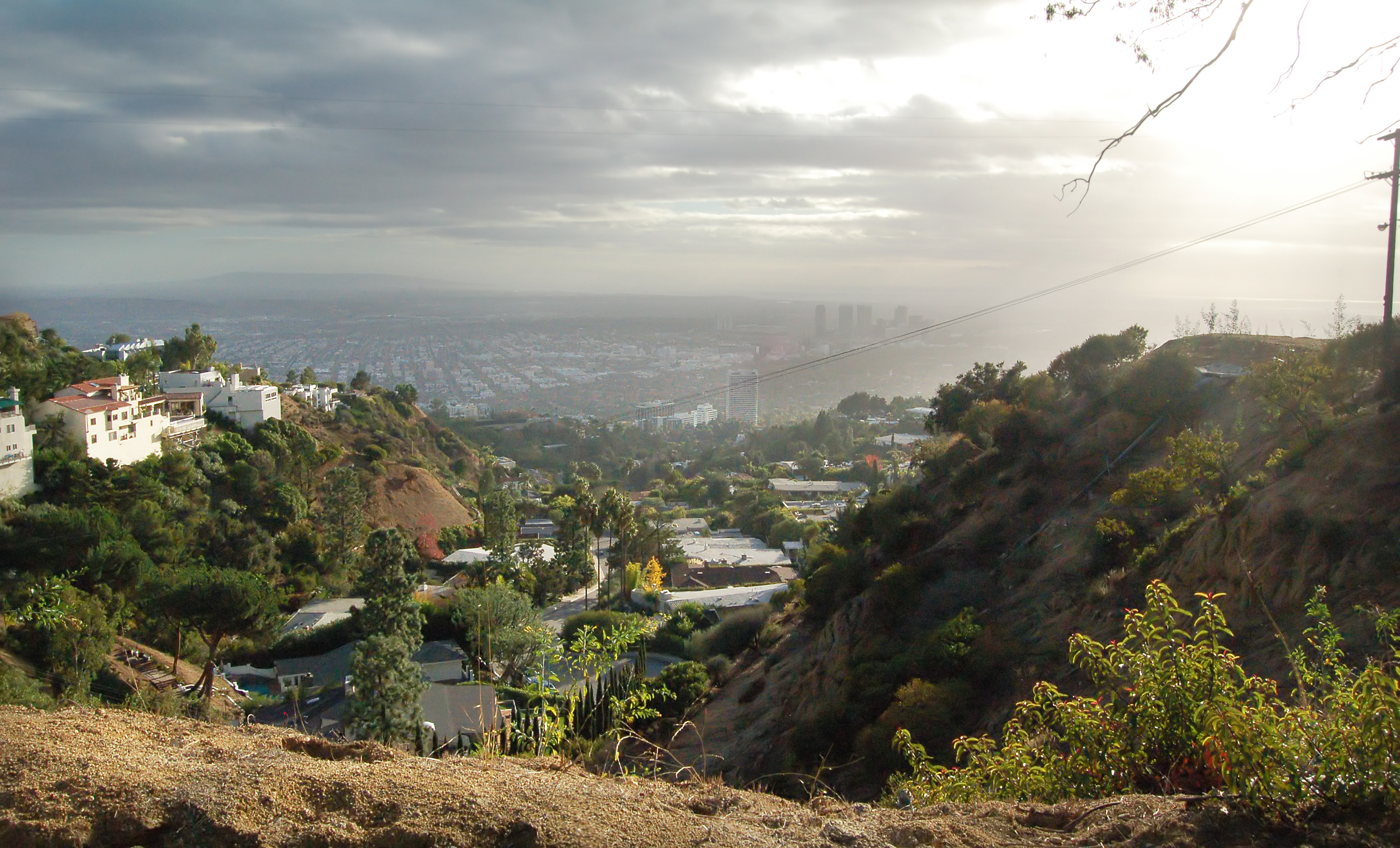
* Echo in the Canyon is on Amazon Prime. The photograph is taken from the Laurel Canyon Radio website: http://www.laurelcanyonradio.com/view-from-laurel-canyon/