Skip to content

Posts from the ‘Folk music’ Category

Young but daily growing

It was difficult to tell what song he wrote and what song he didn’t write, because sometimes I noticed that he said he wrote a song and he didn’t, and other times I thought he didn’t write a song and he did.

Those words have been in my head while listening to the eight CDs and 139 tracks of Through the Open Window, the 18th volume of Bob Dylan’s Bootleg Series, which arrived a couple of weeks ago. A quote from his boyhood friend John Bucklen, it’s a perceptive early observation about Dylan’s approach to making music: a process of listening, absorbing, blending, modifying and recombining in which borrowed and created materials become one and become new. For him, that’s been a permanent process since he first tuned in to the radio and heard Little Richard.

This new set covers his early years. It begins in 1956 with a 15-year-old schoolboy in Minnesota, taping songs with his pals, and ends in 1963, when he’s standing on the stage at Carnegie Hall, in front of a full house, a 22-year-old at the apogee of his first incarnation, feeling the warm glow of real fame.

I don’t know whether or not it’s the “best” volume of the series to date, but it certainly fills me with a powerful set of emotions. While listening to it, I sent an old friend a message saying that it made me realise how lucky I’d been to live my life alongside his. I’m six years younger than Dylan, so I was 16 when I first heard Freewheelin’ in 1963; for members of my generation who discovered him early, he’s been a unique kind of companion, and still is. Through the Open Window does a good job of showing how that came about.

Over about eight hours, we see continuous progression, evolution, growth. We hear Dylan honing his art as an interpreter of the hellhound-haunted blues (a clenched “Baby Please Don’t Go”, “Fixin’ to Die”, “See That My Grave Is Kept Clean”), hooking his young boho audiences with protest ballads based on specific stories (the incendiary “Emmett Till”, the rousing “Davey Moore”, the plodding “Donald White”), playing harmonica with blues elders Victoria Spivey and Big Joe Williams on Spivey’s album Three Kings and a Queen, practising singing in an older person’s voice and inhabiting traditional material with an astonishing level of empathy (“Young But Daily Growing”, “House Carpenter”, “Moonshiner”, the transcendent 1962 Gaslight version of “Barbara Allen”), and carefully building his own legend (“Bob Dylan’s Blues”, “Bob Dylan’s Dream”, “Bob Dylan’s New York Rag”).

You hear how the droning blues jams — and perhaps the influence of John Lee Hooker, with whom he shared the bill at his first significant New York booking, at Gerdes Folk City in April 1961 — inform a certain strand of songs he soon began to write: “The Ballad of Hollis Brown”, “North Country Blues”, “Masters of War”. Songs about bleak, blasted landscapes, both external and internal. When I listened to those songs in 1963-64, I’m sure that somewhere in my mind I was making a connection with what John Coltrane was doing at the same time. Not a literal connection; something beyond that, to do with stretching structures to fit the times we were living in. A year later, and just beyond the time-frame of this set, that strand of songwriting would lead Dylan to the unsurpassable achievement of “It’s Alright, Ma (I’m Only Bleeding)”.

All this comes through loud and clear on a set thoughtfully assembled by the writer Sean Wilentz (who contributes an impeccable essay to the accompanying hardback book) and the veteran producer Steve Berkowitz, particularly in the performances recorded in friends’ homes and small clubs. We hear Dylan trying things out: using humour to beguile his listeners, sometimes telling tall stories to embellish his myth but also unafraid to acknowledge his sources. Introducing “Tomorrow Is a Long Time” — still a work in progress — into a tape recorder at the home of his friend Dave Whitaker in Minneapolis in August 1962, he seems to drop his guard: “My girlfriend, she’s in Europe right now, she’s sailed on a boat over there and she’ll be back September 1st, but till she’s back I never go home and it gets kind of bad sometimes. Sometimes ir gets bad, most times it’s doesn’t. But I wrote this specially thinking about that.”

Suze Rotolo, the “girlfriend” in question, is a presence in many of these songs. She was also an unheard presence in the tender version of “Handsome Molly” recorded at Riverside Church on the Saturday afternoon in July 1961, which is when they first met (“He comes from Gallup, New Mexico,” the MC tell us). The accompanying book contains some lovely outtakes from Don Hunstein’s Freewheelin’ cover shoot in the snow on Jones Street to go with the outtakes from the recording sessions; an astounding “Ramblin’ Gamblin’ Willie” seems to be setting him off on the path that led a dozen years later to “Lily, Rosemary and the Jack of Hearts”.

A few of the selections are notable more for their historical interest than their musical value, which is fine. They’d include the very first track, a snatch of Shirley and Lee’s “Let the Good Times Roll” recorded with Bob on piano and his friends Larry Keegan and Howard Rutman joining him on vocals in a St Paul music shop in 1956; the surviving fragment of “The Ballad of the Gliding Swan” from his first visit to London in early 1963, engaged to appear in the TV play Madhouse on Castle Street for the BBC; and the versions of “Only a Pawn in Their Game” and “Blowin’ in the Wind” performed at the SNCC voter registration rally in Greenwood, Mississippi in the summer of 1963.

The live recordings include extended extracts from his most significant early New York concerts, including the poorly attended Carnegie Chapter Hall on November 4, 1961 and the sold-out Town Hall show on April 12, 1963. It all leads — and I firmly recommend listening to the set in sequence — to two CDs devoted to the complete Carnegie Hall concert of October 26, 1963, in which the dimensions of his talent are fully revealed.

He comes to the concert while putting the finishing touches to his third album, The Times They Are A-Changin’, which won’t be released for another three months. So the audience is unfamiliar with some of these songs. He hits them straight off with the title song, then “Hollis Brown”, “Boots of Spanish Leather”, “North Country Blues”. There are great new songs that won’t be officially released: “Lay Down Your Weary Tune”, “Seven Curses”, “Percy’s Song”, “Walls of Red Wing”. When he talks, he’s charming and confident and tells some funny stories and in this formal setting he achieves the kind of audience rapport he’d worked hard to establish at the Gaslight or Gerdes, drawing sympathetic laughter when he has trouble with his microphone and mid-song applause when, in “Davey Moore”, he sings about boxing being banned by the new Cuban government (temporarily, as it turned out).

And he finishes with this sequence: “With God on Our Side”, “Only a Pawn in Their Game”, “Masters of War” (that one being from Freewheelin’, of course), “The Lonesome Death of Hattie Carroll” and “When the Ship Comes In”. Just imagine hearing four of those songs for the first time in that climactic five-song fusillade of rage and revelation. The controlled intensity of his delivery comes through as powerfully as it must have done that night. It’s electrifying, even at more than 60 years’ distance.

Here are some lines he wrote as part of a long poem for the sleeve of Peter, Paul and Mary’s album In the Wind, the one that included “Don’t Think Twice, It’s Alright”, “Quit Your Lowdown Ways” and “Blowin’ in the Wind”, released in 1963:

Snow was piled up the stairs an onto the street that first winter when I laid around New York City / It was a different street then — / It was a different village — / Nobody had nothin / There was nothin t get / Instead a being drawn for money you were drawn / for other people —

It is ‘f these times I think about now — / I think back t one a them nites when the doors was locked / an maybe thirty or forty people sat as close t the stage as they could / It was another nite past one o clock an that meant that the tourists on the street couldn’t get in — / At these hours there was no tellin what was bound t happen — / Never never could the greatest prophesizor guess it — / There was not such a thing as an audience — / There was not such a thing as performers — / Everybody did somethin / An had somethin to say about somethin —

Most of all him. And it’s all here.

Danny Thompson 1939-2025

The first time I saw Danny Thompson, he was playing with Alexis Korner’s Blues Incorporated at the Dungeon Club in Nottingham. This would have been the spring of 1965. I must have liked his playing a lot because I got him to autograph a paperback copy of Nat Hentoff’s The Jazz Life that I happened to be carrying that night.

A couple of years later I saw him with the Pentangle, a band that to my ears never equalled the sum of its parts. It was his long-standing partnership with John Martyn that brought out his best, whether racing alongside the effects-driven guitar on “I’d Rather Be the Devil” or adding a darkly poetic arco line to “Spencer the Rover”.

Danny, whose death at the age of 86 was announced this week, was a member of a generation of great double bassists who emerged in and around the British jazz scene in the ’60s. If you wanted to line them up in some kind of taxonomy of interests and instincts across a spectrum of the music with which they were associated, starting with folk and proceeding to contemporary classical, it would probably go something like this: Danny, Ron Matthewson, Dave Green, Jeff Clyne, Harry Miller, Dave Holland, Chris Laurence, Barry Guy. Obviously that’s not everyone.

Danny was the Charlie Haden of British bassists, his playing warm and deep-toned, as rooted in folk modes as Haden was in bluegrass music, but just as capable of dealing with the most advanced and abstract forms.

Maybe the best way to celebrate his life is to listen to Whatever, the album he recorded for Joe Boyd’s Hannibal label in 1987. It finds him with a trio completed by two relatively unsung heroes of the scene, the wonderful Tony Roberts on assorted reeds, flutes and whistles and the terrific guitarist Bernie Holland.

I remember giving it an enthusiastic review in The Times, commending its highly evolved fusion of folk materials and jazz techniques. It’s a little bit like a British version of Jimmy Giuffre’s Train and the River trio, unafraid of the bucolic and the open-hearted.

Most of the pieces are credited as joint compositions but some are arrangements of traditional pieces, such as “Swedish Dance”, which opens with a bass solo rich in disciplined emotion before moving into an ensemble workout on a light-footed tune whose complex rhythms are made to sound as charming as a children’s song. The stately melody of “Lovely Joan” is delivered by Roberts on a set of Northumbrian pipes — mellower than their Scottish or Irish equivalents — before he switches to soprano saxophone for an intricate conversation with Holland’s nimble acoustic picking and Thompson’s firmly grounded bass. Of the originals, “Minor Escapade” adds elements of the classic John Coltrane Quartet to this trio’s distinctive approach.

Not having played it for some years, I’d forgotten what a truly exhilarating album it is. Now it’ll be at the top of the pile for some time to come, adding the sparkle and freshness of its understated virtuosity to the room. RIP, Danny.

* The photo of Danny Thompson is from the cover of Whatever and was taken by Nick White.

‘The Ballad of Wallis Island’

It’s a phenomenon you don’t hear a lot about because it’s slightly embarrassing, but many top artists play ludicrously well-paid private gigs for rich people. In the business such shows are known, with a suitable lack of poetry, as “corporates”. The Ballad of Wallis Island is about one such engagement, in which a slightly barmy middle-aged widower uses his lottery-jackpot winnings to persuades a British folk-pop duo, long acrimoniously sundered, to reunite for a single gig at his home on a small Welsh island, at which the audience will consist of him alone.

Tim Key plays the widower with gentle charm. He wrote the story and the screenplay with Tom Basden, who plays the male half of the duo with a barely suppressed resentment at his treatment by the music business. His erstwhile partner is played by Carey Mulligan, who manages to be both beatific and beady-eyed and turns up from Portland, Oregon, where she makes chutney, with her American husband, played by Akemnji Ndifornyen (who doesn’t say much but, close to the end, has the film’s most striking speech).

I saw it the other night and came out of the cinema having been charmed to bits by the whole thing but particularly struck by a scene in which the spectre of the duo’s former romantic engagement is evoked, summoning a sudden irruption of old artistic jealousies and resentments, all unresolved. It reminded me of so many music business stories. And the songs we hear, written by Basden, are very precisely not-quite-good-enough, making you understand how, in a different era, the duo could have enjoyed a brief, perhaps almost accidental popularity without managing to turn it into anything more substantial.

Apparently the film, directed by James Griffiths, cost just over a million and a half dollars to make. There should be many more like it: modest in scope and scale, formally unadventurous but intellligent, witty and well made, and aimed at no particular niche. Go and see it; you won’t be wasting your time.

* The Ballad of Wallis Island came out at the end of May and is still in cinemas. The photo shows Carey Mulligan and Tom Basden.

Stories old and new

“That was a young man’s song,” Paul Brady said as the applause began to fade at the Bush Hall last night. He’d just sung “Nothing But the Same Old Story”, written at the start of the 1980s to inhabit the world of a narrator who’d arrived in London from Ireland as a teenager looking for work and confronted by hostility in the time of the Troubles: “Living under suspicion / Putting up with the hatred and fear in their eyes…” It’s a song of resistance, one to drink and dance and cry to, and although only a few weeks from turning 78, Brady invested it with all its original innocence and rage.

This was the second of his two nights in Shepherd’s Bush, and he talked a little about how, arriving from Ireland as a member of a folk quartet called the Johnstons in 1969, they’d settled into a flat close by. He spoke fondly of how he’d learned from traditional musicians at pub sessions in west and north London.

I hadn’t seen him live since a gig at the Half Moon in Putney in 1981, when I was blown away by the material from his second solo album, Hard Station. Since then he’s had great success as a songwriter, his work recorded by Bonnie Raitt, Tina Turner and others. But today you can put him on stage alone with a guitar, a mandolin and a keyboard, and it’s the same old storyteller, now with a bit more of a growl but with wit and warmth and enough edge to lift you from your seat.

Sometimes, as in the gorgeous “Wheel of Heartbreak” and “The Long Goodbye”, he seemed like the most accomplished of adult rockers. During “Mother and Son” and “Follow On” (“a dark song that ended up in a butter commercial”) I started thinking that maybe what he was was a modern chansonnier, in the mould of Léo Ferré or Julien Clerc. And then there were the traditional songs that harked back to his time with the Johnstons and Planxty: the brilliant mandolin work on “The Jolly Soldier”, the sheer historical weight beneath the lilt of “Arthur McBride”.

The shows were arranged to greet the release of Paul Brady: The Archive, a four-CD, 63-track set of demos, one-off collaborations (with Dolores O’Riordan, Cara Dillon and Carole King, for example), interesting alternative versions of most of his best-known songs, and other fascinating bits and pieces, copiously illustrated with tickets, posters, photos and newspaper cuttings.

Curiously, the first two CDs begin with two songs that he didn’t write, both from the 1960s, which express polar opposites of the spirit of the time. One is the lovely hippie anthem “Get Together”, written by the American musician best known as Dino Valenti and containing a line I’ve never wanted to get out of my head: “We are but a moment’s sunlight / Fading in the grass.” Brady recorded it in 1999 for a set of songs associated with Greenwich Village in the ’60s, and his is a beautiful version, which he reprised last night. The other is “Gimme Shelter”, a song of a very different complexion: his treatment, recorded in 2009 with Bob Thiele Jr’s Forest Rangers for a TV series, Sons of Anarchy, loses nothing by comparison with the Stones’ original.

Those are among the many treasures in the box set. I’m still absorbing it, but I can say that the version of “Paddy’s Lamentation” for voice, piano, tin whistle and military drums, recorded in Dublin in 1980 for a long-vanished compilation album, might alone be worth the 50 quid.

Brady came back for an encore last night and of course it was “The Lakes of Pontchartrain”, the song he recorded in 1978 on his first solo album, Welcome Here Kind Stranger, and which he later taught to Bob Dylan. It’s a traditional song, but it’s his really, and The Archive has a fine version in Gaelic, translated by Prionnsias O’Maonaigh: “Bruach Loch Pontchartrain”.

Last night he sang it in English and gestured to us to sing the last two lines of the final verse with him, acappella: “So fare thee well my bonny o’ girl l’ll never see no more / But I’ll ne’er forget your kindness and the cottage by the shore…” Every heart melted, all over again.

* Paul Brady: The Archive is released by The Last Music Company: http://www.lastmusic.co.uk

The Bob look

In her 2008 memoir, A Freewheelin’ Time, Suze Rotolo described how Bob Dylan, her boyfriend between 1961 and 1964, developed his look. Apparently it was Dave Van Ronk, a slightly older Greenwich Village folkie, who urged the 21-year-old Dylan to start paying attention to his image.

In Rotolo’s words: “Such things might have been talked about in jest, but in truth they were taken quite seriously. Much time was spent in front of the mirror trying on one wrinkled article of clothing after another, until it all came together to look as if Bob had just gotten up and thrown something on. Image meant everything. Folk music was taking hold of a generation and it was important to get it right, including the look — be authentic, be cool, and have something to say.”

The result was the transfixing sight of Dylan and Rotolo wrapped around each other on the cover of Freewheelin’ in 1963. If you were, say, 16 years old at the time, Don Hunstein’s shot of the couple on Jones Street in Greenwich Village opened up a whole world, and his suede jacket, denim shirt, jeans and boots seemed to offer an easy way in. If you could get hold of them, that is. And now, just six decades later, the Financial Times is telling you how. What you see above is a guide, published in its HTSI (How to Spent It) magazine, showing you to how to look like Bob Dylan.

It’s pegged to the release of A Complete Unknown, James Mangold’s film of Dylan’s life between 1961 and 1965, and it made me laugh quite a lot, for several reasons. The polka-dot shirt they recommend is black and white, which is how it looked in the monochrome photos from the soundcheck at the Newport Folk Festival in 1965; the real thing was green and white — and it was actually a blouse rather than a shirt (the film gets that right). And have you ever seen Dylan in white loafers, never mind 700-quid ones by Manolo Blahnik? The black leather blazer they recommend retails at £4,270. Mine cost a fiver in 1964 from the harmonica player in our band, who was skint at the time and needed rent money. I wish I still had it.

But it’s not just a matter of looking like Bob Dylan. You can try to sound like him, too. The rock critic of The Times went off to the vocal coach who did such good work with Timothée Chalamet in order to try and achieve that distinctive nasal whine. Again it sent me back to 1964 and sitting in my bedroom, strumming an acoustic guitar acquired very cheaply from a girl called Celia and bellowing the words of “The Times They Are A-Changin'” loud enough for my blameless parents to hear: “Come mothers and fathers throughout the land / And don’t criticise what you can’t understand / Your sons and your daughters are beyond your command…”

That was in real time. So was the £5 leather jacket. It was all part of growing up and finding out who you were, and it seems weird now to watch people turn it into a novelty, however good the cause.

As it happens, I enjoyed A Complete Unknown a lot, with only a very few reservations. When Chalamet-as-Dylan sings “The Times They Are A-Changin'” to a festival crowd, Mangold orchestrates the audience’s response in a way that precisely evokes how it felt to experience that song in 1964, with all the emotion of realising that it spoke for you. It was a relief to come out of the screening with the knowledge that I wouldn’t have to be explaining to younger people that it really wasn’t like that at all. Mostly, it was.

Other sounds 4: ‘Za Górami’

Ladino is a language spoken by Sephardic Jews, with its origins in medieval Spanish, Hebrew and Aramaic. In her wonderful book Ornament of the World, subtitled “How Muslims, Jews and Christians Created a Culture of Tolerance in Medieval Spain”, María Rosa Menocal describes it and its equally Romance language-based Muslim equivalent, Aljamiado, as not just “languages of exile and persecution” but as “quixotically defiant memory palaces”.

Five traditional Ladino songs are included in Za Górami, a new album by Alice Zawadzki, Fred Thomas and Misha Mullov-Abbado, providing a kind of structure for the 11-track sequence featuring Zawadski’s voice, violin and viola, Mullov-Abbado’s double bass and Thomas’s piano, drums and vielle (a fiddle favoured by French troubadours between the 11th and 13th centuries). The remainder of the programme consists of songs taken from a variety of sources.

Here’s what the three London-based musicians say, in a jointly authored sleeve note: “Collected on our travels and taughgt to us by our friends, these are songs we have learnt and loved together. Though our musical and cultural backgrounds encompass Europe, Russia and South America, we were all three born in England. This happenstance was the product of love, war, exile, the arbitrariness of borders and the yearning for a new life.” All those themes, they say, are woven through the songs.

Za Górami is Polish for “behind the mountains”. Other songs come from Argentina (Gustavo Santaolalla’s “Suéltate Las Cintas”), Venezuela (Simón Diaz’s “Tonada De Luna Llena”) and medieval France (“Je Suis Trop Jeunette”). “Gentle Lady” is Fred Thomas’s setting of a text by James Joyce: “Gentle lady, do not sing / Sad songs about the end of love / Lay aside sadness and sing / How love that passes is enough.”

Recorded in Lugano and produced by Manfred Eicher, the music could be said to be a perfect manifesto for the ECM philosophy: the creation of a frontierless chamber music based on the instincts and practices of jazz but entirely porous in its acceptance of other cultures and idioms.

The Ladino lyrics are interesting for their closeness to more familiar languages: “Arvoles lloran por lluvias / Y montañas por aire / Ansi lloran los mis ojos / Por tí querido amante” translates as “The trees weep for rain / And the mountains for air / So weep my eyes / For you, my love.” That’s the closing track, a restrained lament consisting of three haiku-like verses that concludes: “I turn and ask — what will become of me? / I will die in foreign lands.” These are lieder for a modern world in which echoes of the past are inescapable.

If, as it happens, nothing here sounds much like jazz, it couldn’t exist without jazz, either. The clarity and subtle shadings of Zawadzki’s soprano, the handsomely shaped bass sound and calm phrasing of Mullov-Abbado, and Thomas’s reflective piano and subtle percussion work together to create a pan-national music in which elegance, economy and ardour are held in perfect balance. In its quiet way, this is one of the year’s outstanding albums.

* Za Górami is out now on the ECM label: the trio will perform at Kings Place on November 23 as part of the EFG London Jazz Festival. The photo of Mullov-Abbado, Zawadzki and Thomas is by Monika Jakubowska.

Autumn books 1: Joe Boyd

“Tango comes from the mud,” Brian Eno told an audience at Foyle’s bookshop the other night. He was conducting a public conversation with the author of And the Roots of Rhythm Remain, an 850-page examination of the forms of popular music with which Joe Boyd has engaged in Cuba, Jamaica, Brazil, Argentina, Bulgaria, Senegal, Albania and elsewhere during his six decades as a successful record producer and enlightened facilitator of musical projects.

For many years now it’s been rumoured that Boyd was writing a history of “world music”, a tale perhaps beginning with his presence at the famous meeting at a London pub in 1987 during which that rubric was invented, with the best of intentions and outcomes, as a way of persuading open-minded listeners to pay as much attention to music from other cultures as they did to their own western idioms. The result is much more interesting than a simple history; its eventual subtitle, “A Journey through Global Music”, conveys a much more accurate impression of what Boyd has taken on.

The quote about tango coming from the mud is to be found on page 483, where it’s identified as an Argentine saying. It was clever of Eno to spot it, because it says something larger about pretty much all the music Boyd considers here. How and when it happened, who made it happen, and to whom it happened are all part of his investigations, whether the music under consideration is Tropicália or townships jazz, Django Reinhardt or Béla Bartók.

I’m still working my way through the book, which will take a while even though Boyd writes in the easy, fluent, open-minded, anecdotal style familiar from White Bicycles, the relatively slender book about his adventures in the ’60s underground, published in 2005 to justified acclaim. Vast as his new one might seem, it’s worth reading with full attention, lest you miss some vital socio-cultural connection or valuable information on the roles played by, for example, the Ghanaian drummer Tony Allen, the Sudanese oud-player Abdel Aziz El Mubarak, Rodney Neyra of Havana’s Tropicana nightclub or the ballet impresario Sergei Diaghilev. (I didn’t know, for instance, that, according to Boyd, the names samba, rumba, mambo, tango and cha-cha all have their roots in Ki-Kongo, one of the languages of the Kongo people living in what are now the Republic of Congo, the Democratic Republic of Congo, Angola and Gabon.) Boyd’s enviable skill is to bring the reader an astonishing level of historical detail while wearing his research lightly and enlivening the narrative with exactly the right seasoning of his own views.

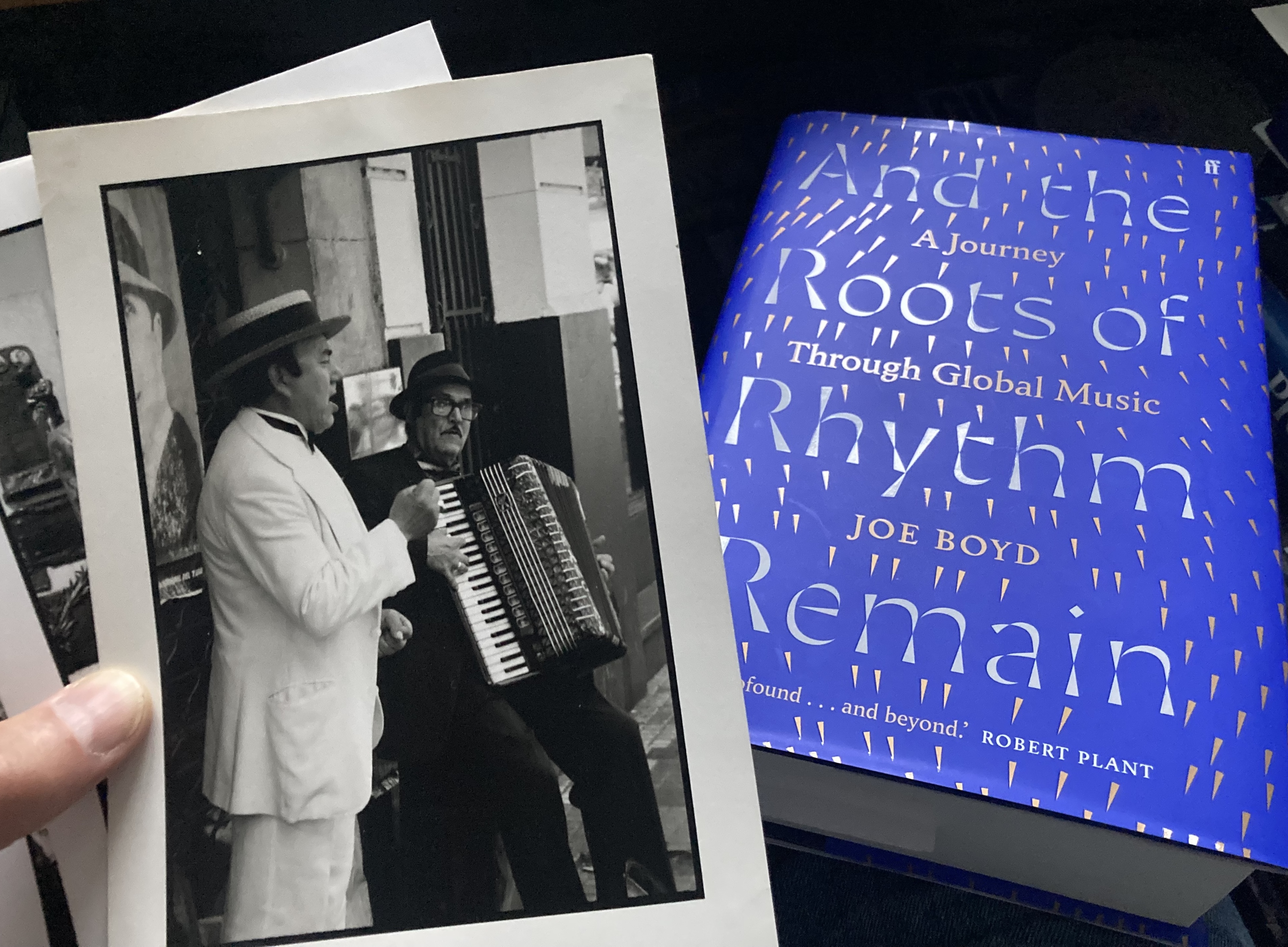
After buying the book at the Foyle’s event and getting it signed, I took it home and went straight to the chapter about tango. I like tango very much, although I once spent an evening in a bar in San Telmo, a Buenos Aires quarter then about to make the jump from funky to gentrified, proving to everyone’s satisfaction that I’ll never be able to dance it. I share Boyd’s enthusiasm for the singer Carlos Gardel to such an extent that I once visited the great man’s tomb in the cemetery of Chacarita in Buenos Aires, observing the ritual of leaving flowers at the base of his statue and placing a lit cigarette in the space left by the sculptor between the index and middle fingers of his raised right hand, because that’s how Gardel always sang until his untimely death in an air crash in 1935.

The photo above is one I took in 1994 on a sidewalk in Rosario, Argentina’s third largest city, the birthplace of Che Guevara and Lionel Messi. I was struck by the elegance and dignity of the street singer and his accordionist, who were serenading appreciative shoppers and other passers-by with a selection of songs made famous by Gardel.

Boyd traces the idiom’s origins in the bars and bordellos of Buenos Aires, examining its sources and tracking its destiny. He doesn’t share my fondness for the late composer and bandoneon virtuoso Astor Piazzolla, who became, he believes, “for tango what John Lewis and the MJQ were to jazz, ‘elevating’ it from the dancefloor and giving it concert-hall respectability.” He’s both right (in the comparison) and wrong (in the implicit criticism). Nobody who went, as I did, to see Piazzolla and his astonishing quintet for three out of their five nights in the intimate environment of the Almeida Theatre in London during the summer of 1985 could accuse them of forfeiting the sensual charms of tango in a pursuit of respectability. For a lot of worthwhile music with roots “in the mud”, the need to get people dancing is no longer a priority. But it’s a good and worthwhile argument to have, and I expect there’ll be many more as I work my way through what is shaping up to be not just an exceptionally enjoyable book but perhaps also an important one.

* Joe Boyd’s And the Roots of Rhythm Remain: A Journey Through Global Music is published by Faber & Faber (£30)

Sounds for summer

Tall enough to be unmissable in any environment, and with a truly remarkable fashion sense, Shabaka Hutchings had presence from day one of his career. To me, as an observer, that was the concert at the Royal Festival Hall in June 2009 at which he was one of several UK guests with Charlie Haden’s Liberation Music Orchestra (others included Robert Wyatt, Jason Yarde, John Parricelli and Andy Grappy). He had just one solo but when he stepped forward, the sounds coming from his tenor saxophone commanded everyone’s attention.

Since then, we’ve heard him with Sons of Kemet, The Comet Is Coming, the Ancestors and Louis Moholo-Moholo’s Five Blokes, and in a reinterpretation of Coltrane’s A Love Supreme at the Church of Sound a few weeks ago which I was very sorry to miss. And now he has enough presence to allow him to drop his surname and become just Shabaka.

He’s also dropped the saxophone, which is more of a surprise, in order to study the flute — specifically the Japanese shakuhachi and other iterations, including the Andean quena and the Slavic svirel. His new album — titled Perceive Its Beauty, Acknowledge Its Grace — is evidence of this turn of interest.

It’s a radical departure from anything he’s given us before. A series of sketches deploys varying personnel, including the pianists Nduduzo Makhathini and Jason Moran, the guitarist Dave Okumu, the singer Lianne La Havas, Moses Sumney, Laraaji and ESKA, the harpists Brandee Younger and Charles Overton, the drummers Marcus Gilmore and Nasheet Waits, the speakers Saul Williams, Miguel Atwood-Ferguson and Anum Iyupo, the rapper Elucid, the percussionist Carlos Niño and the bassists Esperanza Spalding and Tom Herbert.

That’s an impressive line-up, but as you listen to the album you’re never really thinking of individuals or their virtuosity. In that sense it’s a quite different experience from that of listening to a “jazz album”. But neither is it a kind of New Age tapestry of sound, slipping by without disturbance, merely a bit of aural decoration.

It has an overall charm and moments of great and singular beauty, too, such as the shakuhachi improvisation against Overton’s harp and the celestial layered voices of Sumney on “Insecurities”, La Havas’s vocal reverie on “Kiss Me Before I Forget”, or Spalding’s springy bass behind Elucid’s rap on “Body to Inhabit”, but it also has depth, and not just in the occasional verbal passages, which are carefully integrated into the quilt of sound. The overall impression is what counts, and somehow that goes beyond words.

The album contains one snatch of tenor saxophone, on a track called “Breathing”, in which Rajni Swaminathan’s mridangam — a Carnatic double-ended hand drum — backs first Shabaka’s treated and looped flutes, then his clarinet, and finally his saxophone, which briefly erupts in a gentle squall with an intonation recalling the great Ethiopian tenorist Getatchew Mekuria.

That little hint of Ethiopian music sent me to a new release in the name of Emahoy Tsege Mariam Gebru, who died this time last year at the age of 99. Born in Addis Ababa, she studied violin in Switzerland as a child, worked as a civil servant and sang for Haile Selassie, was imprisoned by the Italian occupiers during the Second World War, and spent a post-war decade as a nun in a hilltop monastery. The arrival of a new regime forced her to flee to Jerusalem, where she spent the rest of her life in an Ethiopian Orthodox convent and composed music for piano, organ, and various ensembles while running a foundation to encourage music education among children in her native land and elsewhere.

Like Mekuria, she had a volume of the producer Francis Falceto’s Ethiopiques series devoted to her music in 2006, and in the last couple of years there have been more albums on the Mississippi label. The latest is called Souvenirs, a collection of her songs apparently recorded between 1977 and 1985. It’s a primitive recording: the piano sounds like a poorly maintained upright and her voice was probably recorded on the same microphone, in a room that was almost certainly not a recording studio. But that does nothing to diminish the appeal of these songs, with titles such as “Where Is the Highway of Thought?” and “Like the Sun Shines on Meadows”, whose vocal melodies are doubled by the pianist’s right hand against left-hand figurations assembled from scraps of blues and rhumba and gospel tunes.

What’s so appealing, almost mesmerising, about this music? I think it’s the combination of transparent simplicity (and sincerity) with the unexpected guile of the rhythmic undertow, which is always playing appealing tricks on the western ear. There’s something about the distinctive melodic shapes and phrase lengths that is special to this kind of Ethiopian music, springing from some deeper root.

Something else to add pleasure to this summer is After a Pause, the new album of acoustic duo music by two brilliant Welsh musicians, the guitarist Toby Hay and the bassist and cellist Aidan Thorne. I got interested in Hay when he was filming himself outdoors playing ragas during the first Covid-19 lockdown in 2020 and putting the results on YouTube, and wrote a bit more about him when he released some duets recorded in an old chapel with his fellow guitarist David Ian Roberts later that same spring.

I try to avoid talking about what musicians are doing in terms of the work of other musicians, but I suppose a simple — and, I hope, enticing — way of describing the scope of these duets is to imagine what Davy Graham and Danny Thompson might have got up to if they were both in their prime in the 2020s and were able to spend three days together in a studio with no distractions, enhancing their compositions and improvisations with a sparing but highly effective use of overdubbing and electronics.

After living with this album for a few weeks, I’ve come to appreciate not just its surface beauty but the way it reveals more of itself and its spiritual essence the closer you listen. The 12-string arpeggios and bowed bass of the opener are a call to the attention that is never wasted as the music blooms and glows through 10 shortish but unhurried pieces, trajectories shifting and densities varying considerably from bare-bones to near-orchestral (on “Burden” or “Eclipse”) but mood sustained. The brief solo piano coda is a lovely way to finish.

A light shines through these three albums. I’ve a feeling they’re going to be among the summer’s best companions.

* Shabaka’s Perceive Its Beauty, Acknowledge Its Grace is on the Impulse! label. Emahoy Tsege Mariam Gebru’s Souvenirs is on Mississippi Records. Toby Hay and Aidan Thorne’s After a Pause is on Cambrian Records. Links here:

https://spibaig.bandcamp.com/album/perceive-its-beauty-acknowledge-its-grace

https://emahoytsegemariamgebru.bandcamp.com/album/souvenirs

https://cambrianrecords.bandcamp.com/

Summer books 2: ‘Pledging My Time’

I don’t imagine I’m alone in sometimes glancing at a stack of books about (or by) Bob Dylan and thinking, OK, that’s enough now. The last two new volumes, bought hot off the press in the past couple of years, turned out to be expensive time-wasters, prompting the thought that maybe I’d be better off re-reading some of the old ones. Anthony Scaduto’s early biography, maybe, or Suze Rotolo’s memoir, or The Nightingale’s Code. Or even the one Patrick Humphries and the late John Bauldie published in 1990, called Oh No! Not Another Bob Dylan Book. But there’s always an exception, and one such is Pledging My Time by Ray Padgett, subtitled “Conversations with Bob Dylan band members”.

All I know about Padgett is that he has an erudite and entertaining email newsletter called Flagging Down the Double E’s, on which he discusses topics related to Dylan’s live performances. The book is an outgrowth of that newsletter, consisting of interviews with 40 people who have played with Dylan, either in his band or in briefer encounters, or, in a handful of cases, worked with him in slightly different capacities, such as Betsy Siggins, who ran a folk club in Cambridge, Massachusetts in the late ’50s and early ’60s, Chris O’Dell, the Rolling Thunder tour manager, and Keith Dirks, a sound engineer in the early stages of the Never Ending Tour.

You don’t want big names in a book such as this. Most of them have already told their stories many times. You want Ramblin’ Jack Elliott, Happy Traum, David Mansfield, Spooner Oldham, Fred Tackett, Stan Lynch, Christopher Parker, Dickey Betts, Larry Campbell and Benmont Tench, whose impressions are not worn thin by overexposure. You want someone like Jim Keltner, with a lifetime of service to music and a deep love of how it feels to explore it in Dylan’s company: “The thing I love about Bob is his fearlessness. There’s a fearlessness from some artists that transmits to the musicians playing. When that happens, you get the best from the musicians, because the musicians are not worried about tempo or about whether they’re rushing or they’re dragging or whether they’re not in the pocket. It’s not about finding a pocket. It’s more about searching for the vibe, searching for the thing that makes the song live.”

Keltner is not the only one here who likens the experience of playing with Dylan to jazz. It’s not jazz, of course, but it shares some important characteristics. Gary Burke, who played percussion on the 1976 Rolling Thunder dates, says: “Dylan lived more in the present than most musicians I know. The most common question I get is, ‘What’s it like to play with Dylan?’ I say, ‘Oh, it was the greatest jazz gig I ever played.’ People look at me like I’m crazy. I don’t mean stylistically it was like a jazz gig, but in terms of the mindset. It was very spontaneous. You never know where he’s going to go. You weren’t given directions ahead of time.”

The pianist Alan Pasqua had played with the New Tony Williams Lifetime when he joined Dylan for the Street Legal sessions and the 1978 tour. “Bob was a great bandleader,” he says. “I was lucky enough to play with Tony Williams early on in my life. He learned from Miles Davis. Miles never told him what to play, but by how Miles played, he showed Tony what he needed to do. I found Bob to be quite a bit similar to Miles.” He adds: “I didn’t know at the time that Bob was a jazz fan.”

In 2017 Pasqua was asked, out of the blue, to provide piano music against which Dylan could read his Nobel Prize acceptance speech. And then, a couple of years later, he was invited to play on “Murder Most Foul”. “They were playing a demo. I heard it and I just couldn’t believe it. In rock music, things usually have a specific beat and pulse. This was free. The time was free. It was elastic. It wasn’t specific to a certain time, feel, or tempo. It just moved and flowed. When I was done listening to the track, I turned to Bob and I said, ‘My God, Bob, this sounds to me like A Love Supreme.’ He just stopped and looked at me.”

Sometimes other aspects of being Bob Dylan are sharply illuminated. Burke remembers the business that went on at the end of every gig, when Dylan’s security men took charge: “When we would leave a place on the tour, security would go into the room where he was staying and take everything out. Every piece of garbage, everything. They would put it in bags and take it with them so that nobody went in and tried to find the lost verse to ‘Tangled Up in Blue’ or something like that.” That’s a tough way to live, Padgett observes. “It is. You got the feeling he was rubbed raw by it all.”

To Billy Cross, who played guitar in the 1978 band, he seemed “very friendly and very warm. He was lovely, absolutely lovely, considering what he’d been subjected to through his life at that point. Everywhere he goes, someone thinks he’s got the answer that’s blowin’ in the wind. I thought it was unbelievable that he could be as normal and personable and pleasant as he was.”

Padgett is a marvellous interviewer: not just enthusiastic and sympathetic but alert and perceptive, equally good at prompting and just letting people talk. Of course, the testimony is mostly admiring. There’s nothing resembling the interview with the veteran soul singer Betty LaVette in the Daily Telegraph earlier this month, where she described her “contempt” for Dylan, five years after enjoying a warm reception for an excellent album of his songs titled Things Have Changed.

She was annoyed that he never told her how good it is, and to underline her irritation she mentioned an incident from several years earlier, when they encountered each other in Spain and “he ran over to me. He put my face in his hands and kissed me square in the mouth. I don’t offer Bob Dylan a kiss and I’m not a f—ing fan. I was not looking to be kissed. If he thinks I’m good enough to put his mouth on, then he should have opened it to say just one good word about my record. When you’re as big as he is, that can make a huge difference to sales.” She didn’t mention whether she’d ever got in touch to thank him for the songs.

More than most people, Bob Dylan presents himself to the world as a jigsaw puzzle, full of complexities and seeming contradictions and bits that are hard to fit together. Maybe some missing bits, too, and others that once fitted but no longer do. Each of us assembles the puzzle as best we can. The keyboards player Benmont Tench, who once found himself playing “Desolation Row” — which he had listened to “a million times” but never played — with its composer to a festival audience of tens of thousands, is among the most thoughtful interviewees in Padgett’s book. He’s allowed to close it with some words that seem to express the feelings of many who’ve worked with Dylan.

“You can read about Bob’s life,” he says, “and you can pay attention to what he says, and you can learn from it, but when you play music with somebody of that calibre, you learn something entirely different. It can only be passed on by that person. And those of us who have the opportunity to play with that person can pass on what we took away, but we only each take away a certain part of our experience with someone like that. Long may he live, because he’s something else.”

* Ray Padgett’s Pledging My Time is published in hardback and paperback by EWP Press. Padgett’s email newsletter is at dylanlive.substack.com

Songs of the Balkans

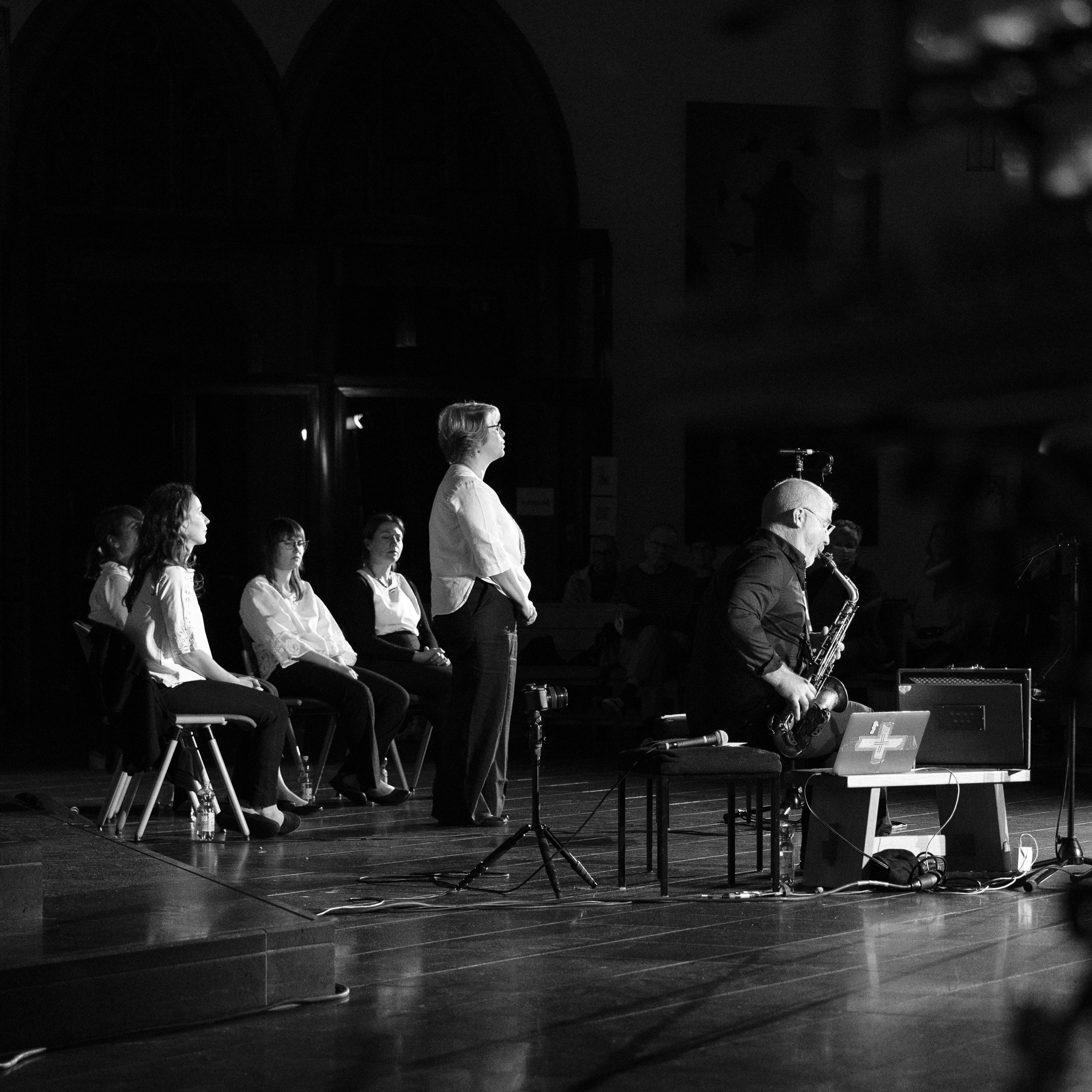
Its appeal somewhere between those of Le Mystère des Voix Bulgares, a leftfield favourite in the 1980s, and the collaboration between the saxophonist Jan Garbarek and the singers of the Hilliard Ensemble in the 1990s, Medna Roso is an album taken from a concert in a Cologne church in 2021 by PJEV, a quintet of female singers specialising in the traditional songs of Serbia, Kosovo, Croatia and Bosnia, with the alto saxophonist Hayden Chisholm and the organist Kit Downes.

Chisholm left his native New Zealand in the ’90s to explore the world of music: jazz at a conservatory in Cologne, Carnatic music in Chennai, and the music of the Balkans. I heard him at a festival in Berlin a few years ago, where I admired the distinctive personality of his playing, later enjoyed on a fine album called Breve which he made with the late pianist John Taylor and the bassist Matt Penman, released in 2015 on the Pirouet label.

Downes, of course, is the gifted English pianist known for his work with Empirical, ENEMY, Troyka and the cellist Lucy Railton, among others. His playing on church organs — which he studied at the Royal Academy of Music — has been heard on an album with the saxophonist Tom Challenger under the name Vyamanikal and on his ECM albums Obsidian and Dreamlife of Debris.

In collaboration with the singers Jovana Lukic, Zvezdana Ostojic, Gloria Lindeman, Lana Hosni and Julijana Lesic, the job of Downes and Chisholm (who also plays analogue synthesisers and shruti box and adds his own throat singing) is to create instrumental textures and interludes, counterpointing, underlining and separating the eight traditional songs that made up the programme for a concert held in St Agnes’ Church as part of Cologne’s JazzWeek.

The voices are plangent, not as lush as the Bulgarian choir, keening and ululating with an ardour and a harsher edge that seems to come from somewhere deep in human history. The songs are about life in mountain villages: families, lovers, the seasons changing (translations are provided in the accompanying booklet). Chisholm and Downes find ways of enhancing their inherent qualities, adding new dimensions and perspectives, providing connective tissue that swells and glows quite beautifully. In the eternal search for music suitable for quiet Sunday mornings, Medna Roso is a valuable discovery.

It’s also the third release on Red Hook, a label founded by the producer Sun Chung, the son of a classical conductor, who grew up in Europe and the US and studied at the New England Conservatory before spending several years at ECM, observing Manfred Eicher’s approach in the recording studio. His label’s debut, a final solo recording by the late pianist Masabumi Kikuchi, called Hanamichi, was one of the finest releases of 2021. Medna Roso will be on this year’s list, no doubt, and deserves a very wide hearing among those likely to respond to its special properties.

* The photograph of PJEV with Hayden Chisholm was taken by Niclas Weber during the concert in Cologne’s Agneskirche. The album is released on 5 May.