Skip to content

Posts from the ‘Fashion’ Category

Antony Price 1945-2025

Of course there was the shock of the music, exquisite to some and befuddling to others. But it was the list of credit on the cover of the first Roxy Music album that really got people going. Concept by Bryan Ferry. Art by Nicholas de Ville. Photography by Karl Stoecker. Clothes, make-up and hair by Antony Price. Something different was going on here.

A lot of it had to do with Antony Price, a Yorkshire-born former Royal College of Art student who got together with Bryan Ferry to devise the group’s look. Price died this week, aged 80, having made a significant contribution to the way the culture around the music evolved in the 1970s. Price made the ruffled satin swimsuit in which Kari-Ann Moller posed on the wraparound gatefold cover image of that debut album, the strapless sheath dress that Amanda Lear wore on the front of For Your Pleasure, and so on all the way through Roxy’s eight studio albums.

Here’s Phil Manzanera, talking to me a few years ago about joining the band in 1972. “I remember getting on the 137 bus from Clapham to go to the photo session for the first album and of course I had no idea about style. My mum sewed some diamante on to a white shirt and I turned up at the session and Antony takes one look at me and says, ‘No, no, no!’ He hands me the bug-eye glasses. ‘Stick these on! And here’s a leather jacket!’ Job done. Fantastic. Antony was a bloody genius.”

Here’s how Ferry remembered putting that first cover together: “I think it was after the recording. Either we were still making, it, or just about finished. I remember calling Antony from a red phone box, I think in the King’s Road, which makes sense because I used to hang around EG (Management)’s offices. I was living in Battersea with Andy Mackay. I remember Antony saying, in his gruff way, ‘I want to hear what it sounds like!’ So I guess I went round to see him.

“Antony had this photographer friend who he’d already done a couple of things with, called Karl Stoecker, married to Errol Flynn’s daughter – a very handsome man, a real ladies’ man. We went to his studio and did this picture. Antony and I talked about it… (he) had this girl called Kari-Ann who he thought was ideal – I wanted a woman, dressed by him. It turned out to be the perfect thing to go with the music.”

What was the cover image saying? “All the ’50s references in the music, late ’50s, early ’60s, were being reflected. It wasn’t that long gone, but it seemed like an age. But although it was a cheesecake kind of thing, it was a bit more knowing. It was all in the details, I think… the make-up, everything, the gold disc – that was a conceit, a cheeky little thing. Yes, it was challenging – and she was looking in a challenging way. It was in the (pre-digital) days when you didn’t know if you had the picture at all. A week later you’d look at the prints. I was so excited.

“Then Andy Mackay found this piece of fabric which we used on the inside cover. Nick de Ville, I got him involved, he was a friend from art college. Finding typefaces and fiddling around with that. Then we liked the idea of the (band) pictures looking like postcards. It was a cottage industry, really. We did a session with Karl Stoecker and Antony, dolling us all up. Eno’s girlfriend made a shirt for him – Carol McNicoll, who was a really brilliant artist working in ceramics – she also did his outfits, the feather things later on. Great, like theatre costumes. Andy’s things were a bit more raunchy. Wendy Dagworthy did Phil’s outfit. And Paul was dressed like a caveman – his sound was quite primitive.”

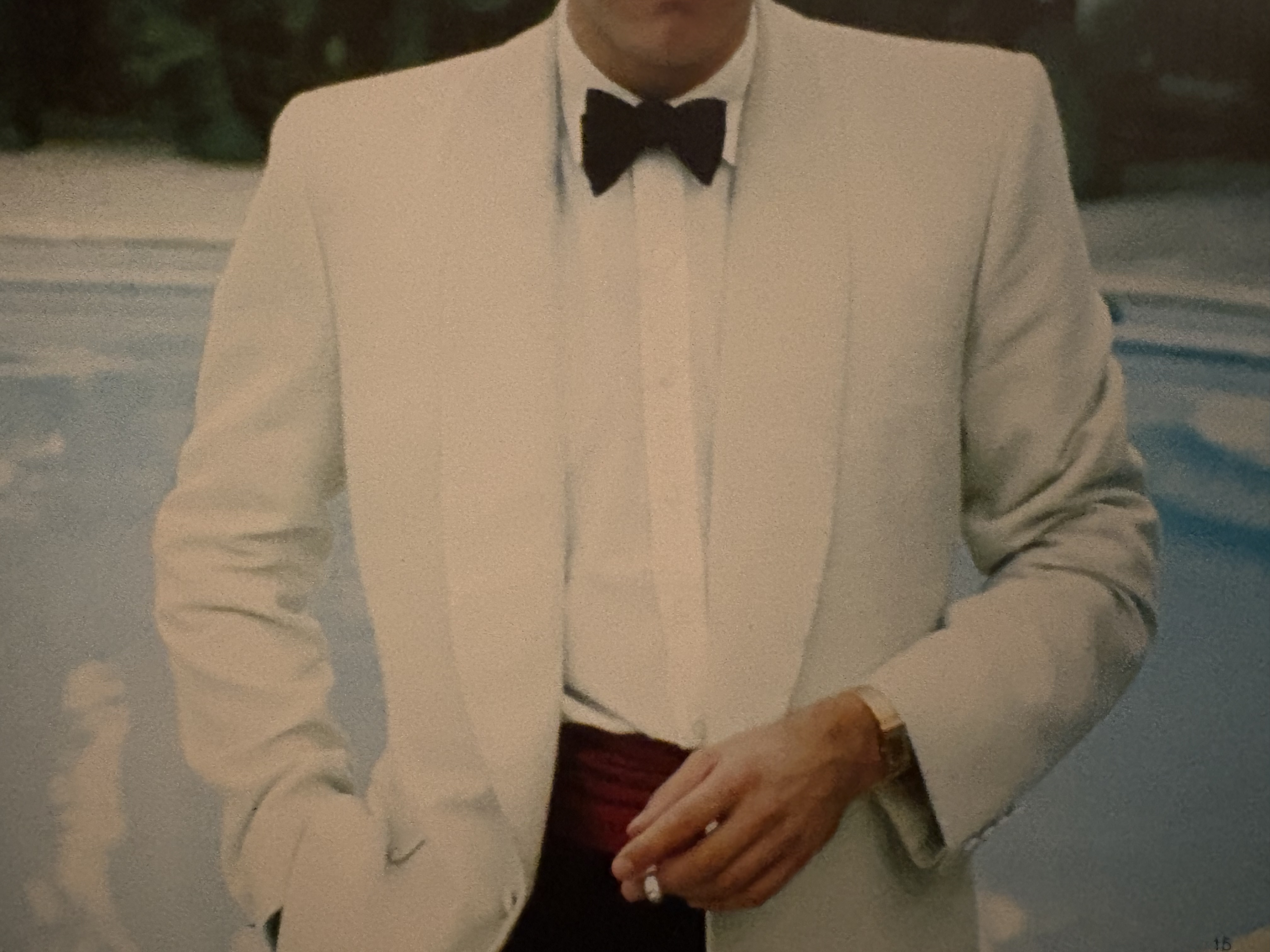
In 1974, for the cover of Another Time, Another Place, Ferry’s second solo album, Antony made two identical white dinner jackets — single-breasted, shawl-collared — for the cover shoot, taken by Eric Boman against a swimming pool, with elegant people in the background. That summer I was going to an Island Records party in the big studio at Basing Street and needed something to wear. Bryan lent me one of those jackets. Nothing has ever felt quite like it.

Mod dreams

Q: Were there ways of walking?

A: Yeh. You walked speed-wise which is you put your hands in your mod jacket, in your Tonik jacket, which had three-inch lapels and a seven-inch centre vent, and breast pleats to give it enough tuck. It was a very solid cloth, a very heavy cloth, so you’d tuck your hands in there and you’d have flaps on the pockets. You’d have your jeans turned up and you’d have Hush Puppies with a pair of white socks. You’d be walking with three other friends up Great Windmill Street or Wardour Street at five or six in the morning just as light is coming up. Your head is bent against the wind, you’ve got your head down…

That’s Peter Meaden talking, interviewed by the writer Steve Turner in 1975, three years before he died at the age of 36, felled by barbiturates and vodka in his parents’ house in North London, where he had dreamed his mod dreams many years earlier, finding the Who and turning them from the Detours into the High Numbers — turned them into mods, getting them the French crop haircuts and the correct clothes, and writing the words for their first single — before accepting £500 to hand over their management to Kit Lambert and Chris Stamp.

Meaden was one of those people, like Guy Stevens, Andrew Oldham and Tony Hall, who shaped the London music scene in those vital years between 1963 and 1965. He deserves a book of his own, and now he has it. Steve Turner’s King Mod is his story, in all its slender, obsessive, doomed glory.

Once asked to define modism, Meaden came up with a much repeated phrase: “Clean living in difficult circumstances.” He provides another version here: “Mod is another aphorism for precision in life.” Romantic nonsense, of course. But part of the legend.

“Modism was my dream,” Meaden says in the unedited transcript of the interview that constitutes the second half of the book, after Turner has taken us through a relatively conventional narrative. Meaden’s words are rambling, repetitive, sometimes inaccurately recalled, the strange and touching testimony of a man who had a dream and saw it come more or less true but lacked, as Turner says, the business acumen and ruthlessness to profit from his vision as others did.

Stevens, who played records from his collection of red-hot R&B obscurities at the Scene Club in Ham Yard, just off Great Windmill Street, and had the 45s from which Meaden borrowed the music for his High Numbers songs, went on to involvement with Island Records, Spooky Tooth, Mott the Hoople, Free and the Clash. Oldham, who had partnered Meaden in a short-lived PR company, managed the Stones until they were taken from him, and created the Immediate label. Hall was one of the great promotion men of the British music business, a cool cat who moved smooth from the bebop ’50s to whatever came next, and who once threw Meaden out of a reception for Ben E. King with the words, “You’re a pilled-up mod!”

Which Meaden certainly was, as he goes to some lengths to explain in his descriptions of the virtues of Drinamyl — “good old Purple Hearts” — particularly when mixed, as was his preference, with cider. “It was bliss. Cocaine they say is bliss these days but it’s not bliss like a bit of speed in you, a couple of pints of cider maybe, down there bopping round from Friday night through until Sunday morning. Say no more!” One of the things he liked about Drinamyl was that it suppressed the libido. “You no longer have to worry about pulling a chick and making it because that’s what you feel the world made you for.” With girls out of the picture, there would be more time for the purer pursuits of choosing the right shirt at Austin’s on Shaftesbury Avenue or the right boots from Anello and Davide on Charing Cross Road.

Then acid arrived on the scene, and the picture — once so sharp and precise — started to go fuzzy. Some, like Townshend, who gave Meaden his first trip, could cope. Meaden was one who couldn’t, spending chunks of the years before his death in psychiatric care, as much of a casualty as Nick Drake or Syd Barrett.

It’s a curious book. More meticulous editing would have removed a plethora of irritating misspellings and inconsistencies: Kingley Street, vocal chords, Petula Clarke, Roger Daltry and Rick Gunnell are just a few of them, while a Miracles song that the High Numbers covered appears on the same page as “You Gotta Dance to Keep from Crying” (in the text) and “I Gotta Dance to Keep from Crying” (in a caption). And there is the increasingly common habit, infuriating to me, habit of capitalising the definite article in references to The Who, The Beach Boys, The Goldhawk Social Club, and so on.

But it’s clearly a labour of love by an author whose previous works have dealt with the Beatles, U2, Marvin Gaye, Johnny Cash, Van Morrison and religion in rock, and it’s very well illustrated. For anyone to whom the all too short era of modism — to use Meaden’s term — was something precious, its historical value in unquestionable.

* Steve Turner’s King Mod: The Story of Peter Meaden, the Who, and the Birth of a British Subculture is published by Red Planet Books (£25).

The sound of style

John Simons, who turns 85 this Friday, remembers being 17 years old in 1956 and going to see Stan Kenton at the Albert Hall. He remembers the tall, imposing figure of the bandleader, and the thrilling sound of the music, one piece in particular: “‘Concerto to End All Concertos’!”

He also remembers that one of the band’s musicians had been sent home before they’d played a note on the hugely successful 53-date UK tour. It was the tenor saxophonist Spencer Sinatra, who’d been caught trying to score drugs soon after their arrival in London. Kenton packed him straight off back to the USA, along with his apparently blameless roommate, the baritone player Jack Nimitz. Simons claims that his memory for names isn’t so good any more, but he remembers the British replacements who were called in: Don Rendell and Harry Klein.

Perhaps less surprisingly, he also remembers how beautifully dressed the musicians were and the item of clothing he himself bought for the occasion: “It was a trenchcoat. Six guineas from Millet’s.” For John Simons, jazz and fashion have always been woven together.

A decent clothes shop that plays good music adds something to one of life’s pleasures. In Simons’ shop on Chiltern Street in Marylebone, the music is always good because it’s going to be something that refers in some way to the modern jazz on which the proprietor got seriously hooked as a young man in the 1950s. He’s not in the shop very often these days. His sons run it now, but they keep it on the Ivy League path he and his early partners established many years ago: button-down shirts, loafers, nice raincoats, soft-shouldered corduroy jackets, knitted ties. And the music, of course.

He was born into a tailoring family in 1939 and left school to study shop design and window dressing at St Martin’s School of Art. He was working at Cecil Gee in Shaftesbury Avenue when he was offered a job with Hope Brothers, whose stores included Burberry’s on Regent Street. Before long he and a friend started a business of their own, with a stall off Petticoat Lane and then a little shop called Clothesville next to Hackney Empire. He could design something, send it over to a tailor, and expect to have it back for sale the next day.

In the summer of 1964 he opened the Ivy Shop in Richmond, two doors up from L’Auberge, the café where the mod fans of the Stones and the Yardbirds would meet. His next venture was the Squire on Brewer Street in Soho. Then came the Village Gate, with branches on the King’s Road and Old Compton Street, named after the celebrated Greenwich Village jazz club, which he’d visited on a trip to New York. “I wrote to the owner of the Village Gate, Art D’Lugoff, for permission. He said, ‘As long as it’s not a jazz club, be my guest.'”

At the start of the 1980s he started a shop called J. Simons in Covent Garden, which became a haven for those to whom, in the words of Robert Elms, the classic modernist wardrobe represents “the only youth culture uniform that doesn’t look ridiculous in retrospect.” When the lease ran out he looked around before, in 2011, opening the current shop in a district which, as with Covent Garden, he has played a part in reshaping.

When I asked him to name some musicians whose work he really loves, he mentioned the Clifford Brown-Max Roach quintet, Chet Baker’s singing, the MJQ and Billie Holiday. And Thelonious Monk. “At the youth club I went to,” he said, “people danced to Monk. Can you believe that?”