Skip to content

Posts from the ‘Chanson’ Category

Songs for summer days and nights

I first got to know Philippe Auclair, a Frenchman living in London since 1986, as someone who wrote about football in both French and English with rigour, authority and elegance. His biographies of two celebrated fellow exiles, Eric Cantona and Thierry Henry, are unlikely to be bettered. The elegance I mentioned is the quality he brings to his other career as a musician, using the alias Louis Philippe.

The latest album by Louis Philippe & the Night Mail, The Road to the Sea, is a beauty. I’ve always known of his love for Brian Wilson and the Beach Boys, and that his past collaborators have included Sean O’Hagan of the High Lamas and Stuart Moxham of Young Marble Giants, which gives some idea of his orientation. So we have sunshine pop, chanson, a hint of the baroque (maybe with a nod to the Left Banke), and open ears in general, perhaps with a bit of Francis Lai and Paddy McAloon thrown in, but also with a strong enough personality to ensure freshness.

The strain of Beach Boys influence I get here is the period taking in Smiley Smile, Wild Honey and Friends, post-surf and mingling hippie serenity with a barely perceptible hint of unease. This isn’t retro music in any way — there are modern trimmings throughout, used sparingly — but Auclair’s carefully wrought arrangements sometimes throw in an unexpected tone or texture, like the sudden appearance of a Hammond organ on “Watching Your Sun Go Down”, a theremin effect on “All at Sea” and a melodica on “Always”.

Unfashionably, he writes chromatic melodies, like the shapely “Song for Paddy (Wings of Desire)”. Overall there’s a lightness of spirit that might represent the influence of Brazil, although perhaps I’m thinking that because I’m listening to “Where Did We Go Wrong”, which races along to a rapid samba rhythm.

His singing voice is calm and unaffected, sometimes rising effectively to the falsetto register; he could be the late Carl Wilson’s French penfriend. There are three songs in his native language, of which “Le Baiser” might well be the loveliest new song I’ll hear this year, with delicious, heartlifting background harmonies and an insouciant jazz piano playout. For sheer beauty, it’s almost matched by one of the English songs, “A Friend”.

The sun and the sea feature prominently in the lyrics, along with a feeling of life drifting along, as it can tend to do. As the days lengthen and June approaches, this is my album for summer days and summer nights.

* The Road to the Sea by Louis Philippe & the Night Train is released on the Tapete Records label: http://www.tapeterecords.com

Everybody Loves a Train

About twenty years ago, my friend Charlie Gillett was compiling a series of themed CDs for a Polygram label called Debutante, under the aegis of the former Island A&R head Nick Stewart. Charlie asked me if I’d like to put one together, and if so, what the theme might be. “Trains,” I said, after about ten seconds’ thought, and then I went away to assemble a running order. It took a while, because I enjoyed the process so much.

Sadly, the series came to a sudden end before my contribution could see the light of day. But I’d edited together a disc of how I wanted it to go. I called it Everybody Loves a Train, after the song by Los Lobos. It has all sorts of songs, some of which speak to each other in ways that are obvious and not. I avoided the most obvious candidates, even when they perfectly expressed the feeling I was after (James Brown’s “Night Train” and Gladys Knight’s “Midnight Train to Georgia”) and instrumentals, too (see the footnote).

Every now and then I take it out and play it, as I did this week, with a sense of regret that it never reached fulfilment. Here it is, with a gentle warning: not all these trains are bound for glory. Remember, as Paul Simon observes, “Everybody loves the sound of a train in the distance / Everybody thinks it’s true.”

  1. Unknown: “Calling Trains” (From Railroad Songs and Ballads, Rounder 1997) Forty-odd seconds of an unidentified former New Orleans station announcer, recorded at Parchman Farm, the Mississippi state penitentiary, in 1936, calling from memory the itinerary of the Illinois Central’s “Panama Limited” from New Orleans to Chicago: “…Ponchatoula, Hammond, Amite, Independence… Sardis, Memphis, Dyersburg, Fulton, Cairo, Carbondale…” American poetry.
  2. Rufus Thomas: “The Memphis Train” (Stax single, 1968) Co-written by Rufus with Mack Rice and Willie Sparks. Produced by Steve Cropper. Firebox stoked by Al Jackson Jr.
  3. Los Lobos: “Everybody Loves a Train” (from Colossal Head, 1996) “Steel whistle blowin’ a crazy sound / Jump on a car when she comes around.” Steve Berlin on baritone saxophone.
  4. Bob Dylan: “It Takes a Lot to Laugh, It Takes a Train to Cry” (from Highway 61 Revisited, 1965) “Don’t the brakeman look good, mama, flaggin’ down the Double E?”
  5. Joe Ely: “Boxcars” (from Honky Tonk Masquerade, 1978) A Butch Hancock song. Ponty Bone on accordion, Lloyd Maines on steel guitar.
  6. Counting Crows: “Ghost Train” (from August and Everything After, 1993) “She buys a ticket ’cause it’s cold where she comes from / She climbs aboard because she’s scared of getting older in the snow…”
  7. Rickie Lee Jones: “Night Train” (from Rickie Lee Jones, 1979) It was a plane she took from Chicago to LA to begin her new life in 1969, and an old yellow Chevy Vega she was driving before she cashed the 50K advance from Warner Bros ten years later. But, you know, trains.
  8. The Count Bishops: “Train, Train” (Chiswick 45, 1976) London rockabilly/pub rock/proto-punk. Written by guitarist/singer Xenon De Fleur, who died a couple of years later in a car crash, aged 28, on his way home from a gig at the Nashville Rooms. Note that comma. I like a punctuated title.
  9. Julien Clerc: “Le prochain train” (from Julien, 1997) My favourite modern chansonnier. Lyric by Laurent Chalumeau.
  10. Blind Willie McTell: “Broke Down Engine Blues” (Vocalion 78, 1931) Born blind in one eye, lost the sight in the other in childhood. Maybe he saw trains in time to carry their image with him as he travelled around Georgia with his 12-string guitar.
  11. Laura Nyro: “Been on a Train” (from Christmas and the Beads of Sweat, 1970) One song she didn’t do live, as far as I can tell. Too raw, probably.
  12. Chuck Berry: “The Downbound Train” (Chess B-side, 1956) When George Thorogood covered this song, he renamed it “Hellbound Train”. He didn’t need to do that. Chuck had already got there.
  13. Bruce Springsteen: “Downbound Train” (from Born in the USA, 1984) “The room was dark, the bed was empty / Then I heard that long whistle whine…”
  14. Dillard & Clark: “Train Leaves Here This Morning” (from The Fantastic Expedition of Dillard & Clark, 1968) Written by Gene Clark and Bernie Leadon: “1320 North Columbus was the address that I’d written on my sleeve / I don’t know just what she wanted, might have been that it was getting time to leave…”
  15. Little Feat: “Two Trains” (from Dixie Chicken, 1973) In which Lowell George extends the metaphor of Muddy Waters’ “Still a Fool (Two Trains Running)”: “Two trains runnin’ on that line / One train’s for me and the other’s a friend of mine…”
  16. B. B. King: “Hold That Train” (45, 1961) “Oh don’t stop this train, conductor, ’til Mississippi is out of sight / Well, I’m going to California, where I know my baby will treat me right”
  17. Paul Simon: “Train in the Distance” (from Hearts and Bones, 1983) Richard Tee on Fender Rhodes. “What is the point of this story? / What information pertains? / The thought that life could be better / Is woven indelibly into our hearts and our brains.”
  18. Vince Gill: “Jenny Dreams of Trains” (from High Lonesome Sound, 1996) Written by Gill with Guy Clark. Fiddle solo by Jeff Guernsey. Find me something more beautiful than this, if you can.
  19. Muddy Waters: “All Aboard” (Chess B-side, 1956) Duelling harmonicas: James Cotton on train whistle effects, Little Walter on chromatic.
  20. Darden Smith: “Midnight Train” (from Trouble No More, 1990) “And the years go by like the smoke and cinders, disappear from where they came…”
  21. The Blue Nile: “From a Late Night Train” (from Hats, 1989) For Paul Buchanan, the compartment becomes a confessional.
  22. Tom Waits: “Downtown Train” (from Rain Dogs, 1985) “All my dreams, they fall like rain / Oh baby, on a downtown train.” A New York song.

Closing music: Pat Metheny’s “Last Train Home” (from Still Life (Talking), 1987) to accompany the photo of the Birmingham Special crossing Bridge No 201 near Radford, Virginia in 1957 — taken, of course, by the great O. Winston Link. Other appropriate instrumentals: Booker T & the MGs’ “Big Train” (from Soul Dressing, 1962, a barely rewritten “My Babe”) and Big John Patton’s “The Silver Meter Pts 1 & 2” (Blue Note 45, 1963, a tune by the drummer Ben Dixon whose title is a misspelling of the Silver Meteor, a sleeper service running from New York to Miami).

Peter Hammill in lockdown

Some time in the future, academics will pore over the ways people found to make music despite the restrictions imposed during the various lockdowns. But there are things that don’t need the benefit of time to provide perspective. The knowledge that Peter Hammill’s In Translation was created in cruel and unusual circumstances may increase his listeners’ admiration, but its quality transcends such considerations.

Coming 50 years after the release of his first solo release, Fool’s Mate, in the summer of 1971, this is Hammill’s covers album, with a difference. Only three of the songs — “The Folks Who Live on the Hill”, “This Nearly Was Mine” and “I (Who Have Nothing)” — are likely to be well known to the Anglophone audience. The remainder are either Italian pop songs or melodies by classical composers with lyrics translated by Hammill. It’s the measure of the strength of his artistic character that the whole thing has the unity of a song cycle.

Working in his Wiltshire studio, he weaves his own guitars and keyboards together with samples to create orchestrations that are full of interesting textures — complementary and contrasting — while retaining a sense of economy and intimacy, finding common ground between material plucked from seemingly divergent sources. Perhaps the best way of putting it is that he creates a emotional microclimate within which songs as different as “The Folks Who Live on the Hill” and Gustav Mahler’s “Lost to the World” can thrive together.

Hammill’s vocal style, with its clear diction, complete absence of blues inflections and occasional use of a pronounced vibrato, has always emphasised the closeness of his music’s spirit to that of European art song, from the Weimar cabaret music of Kurt Weill to the chanson of Jacques Brel, filtered through the sensibility of British musicians who served their apprenticeships in the second half of the 1960s. You can hear this tendency at its most declamatory on “Ballad for My Death”, whose melody is by the tango master Astor Piazzolla but could easily be by Brel. Hammill dials back the drama on other songs, such as Fabrizio de Andre’s “Hotel Supramonte” and Gabriel Fauré’s “After a Dream”, that might have been submerged by similar treatment.

“The Folks” and “This Nearly” are songs he grew up with, so he’s not going to poke fun at their 1950s sentiments. He takes them seriously, delivering them in his ardent English semi-croon, relishing their shapely contours and allowing listeners to make up their own minds about what the lyrics represent. “I (Who Have Nothing)” comes with drama built in: you either sing it that way or you don’t sing it at all, and Hammill’s version adds a shadow second vocal to emphasise what he calls the song’s “somewhat creepy nature”, as well as the hallucinatory sound of a mellotron (I think) and a paranoid electric guitar.

Perhaps the most striking arrangement of all is provided for Piero Ciampi’s “Il Vino”, a late-night drinking song that sways to synthesised strings, a cheap organ and glockenspiel. Its finale reminded Hammill of Nino Rota and thus of a “Fellini-esque aesthetic” which, he thinks, suffuses the whole project.

In Translation is an exceptional album: warm, approachable, and betraying no sense of the isolation in which it was created. Rather the reverse, as Hammill suggests when, in his notes, he remarks that, as well as the coronovirus, he had Brexit on his mind while he was making it. “Now the free travel around Europe which has been such a feature, pleasure and education in my adult life has ended,” he writes, “and all the benefits of cultural exchange are gone with it. I wouldn’t have been able to approach or understand many of these songs without that experience and to lose it is piteous.” It’s hard to believe that one day, when our corner of the world has come to its senses, those borders will not be open again.

* Peter Hammill’s In Translation is released today on the Fie! label: http://www.sofasound.com. The photograph is from the album cover and was taken by James Sharrock.

Juliette Gréco paints her nails

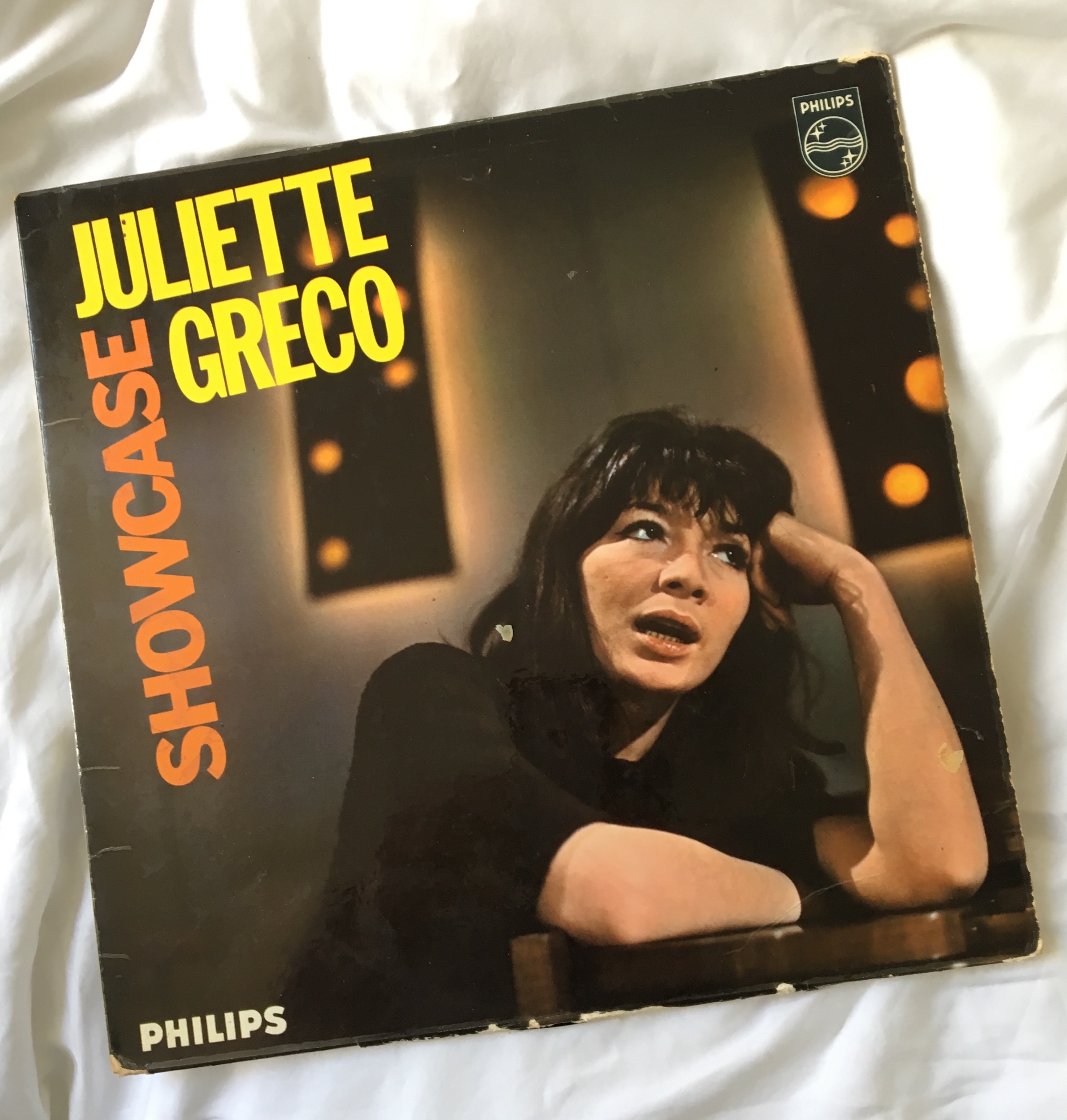
juliette-greco

Juliette Gréco is 90 today. When ill-health forced her to cancel last summer’s concert at the Barbican, I consoled myself with the memory of having seen her at the Royal Festival Hall in the early ’70s, when she was still in her compelling prime. I listened again to some of her countless recordings — the album (above) I bought when I was a teenager and  the early classics such as “Déshabillez-moi”, “Je hais les dimanches” and “Les Feuilles mortes”, from the era when she sang for Jean Cocteau and Albert Camus at the Tabou and her friends and admirers included Jean-Paul Sartre and Boris Vian, Jacques Prévert and Léo Ferré, Georges Brassens and Miles Davis.

And I listened to my all-time favourite, a wonderful song called “Mickey travaille”, which appeared on a 1993 album called just Juliette Gréco, written and produced for her by the great Étienne Roda-Gil, whom she had encountered in Paris at a meeting at the Ministry of Culture, where artists had been invited to discuss the imminent threat to the historic Olympia music hall (where she had sung for the first time in 1954). In her memoir, Je suis fait comme ça, published in 2012, she described the impression he made: “An outpouring of generosity and affection, a man of refinement and culture, attentive to others. But also fragile.” When she visited his apartment on the rue Cassini, he showed her the studio of his late wife, an artist. He had left it untouched since her death: “Even the roses, wilted, remained in their vases.”

She called him “a painter with words”, and for “Mickey travaille” he gave her an unforgettable entrance. Accompanied by the acoustic guitar of Caetano Veloso, strumming a light samba rhythm, she whispers: “Je peins mes lèvres et mes ongles en noir…” If the thought of Juliette Gréco painting her lips and nails black while awaiting her lover’s return doesn’t stir you, well…

* The version of “Mickey travaille” I’ve embedded here is not the one from the album, but a recording from a concert at the Olympia in Paris.