Skip to content

Posts from the ‘Brazilian music’ Category

Autumn books 1: Joe Boyd
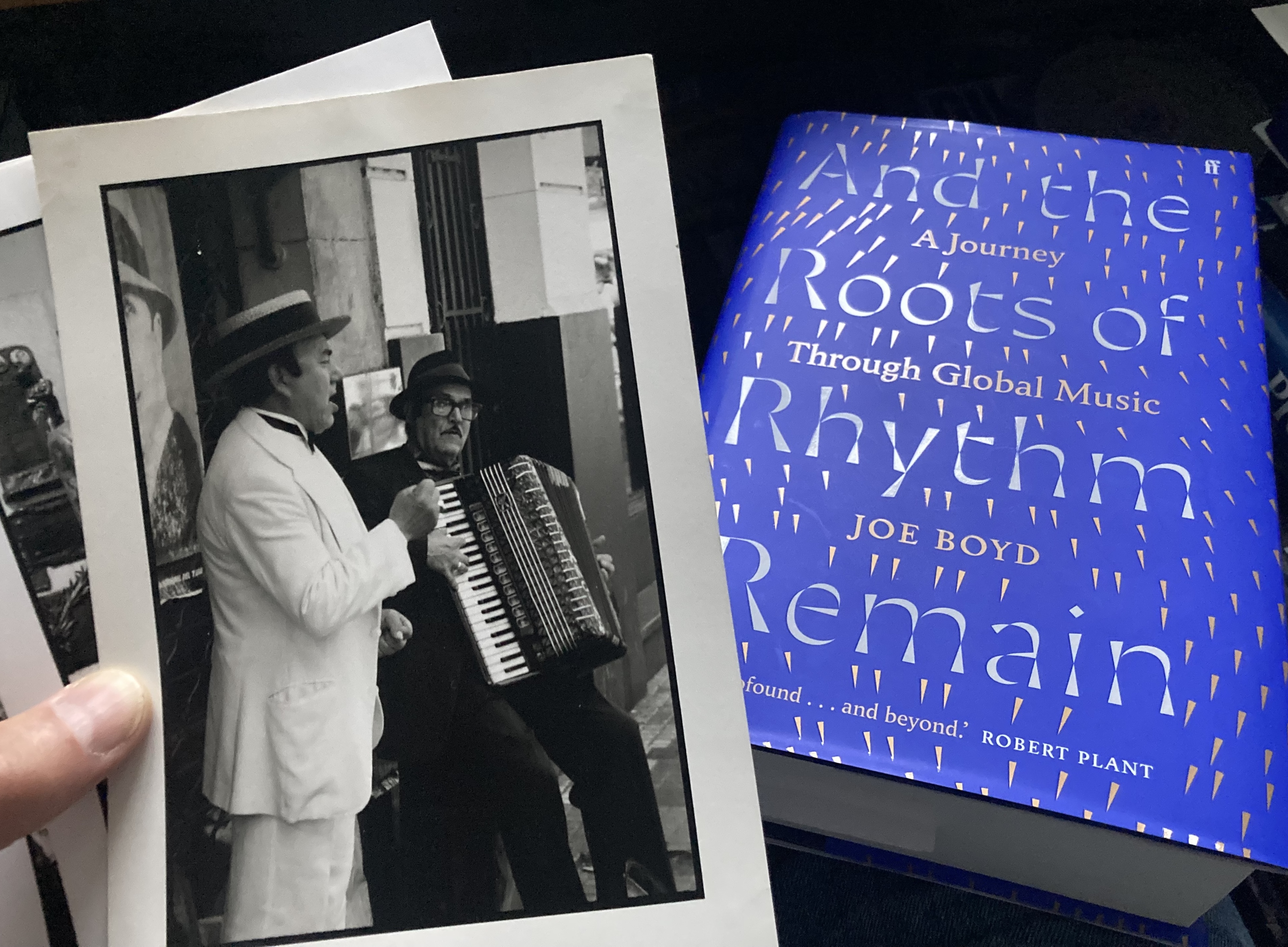
“Tango comes from the mud,” Brian Eno told an audience at Foyle’s bookshop the other night. He was conducting a public conversation with the author of And the Roots of Rhythm Remain, an 850-page examination of the forms of popular music with which Joe Boyd has engaged in Cuba, Jamaica, Brazil, Argentina, Bulgaria, Senegal, Albania and elsewhere during his six decades as a successful record producer and enlightened facilitator of musical projects.

For many years now it’s been rumoured that Boyd was writing a history of “world music”, a tale perhaps beginning with his presence at the famous meeting at a London pub in 1987 during which that rubric was invented, with the best of intentions and outcomes, as a way of persuading open-minded listeners to pay as much attention to music from other cultures as they did to their own western idioms. The result is much more interesting than a simple history; its eventual subtitle, “A Journey through Global Music”, conveys a much more accurate impression of what Boyd has taken on.

The quote about tango coming from the mud is to be found on page 483, where it’s identified as an Argentine saying. It was clever of Eno to spot it, because it says something larger about pretty much all the music Boyd considers here. How and when it happened, who made it happen, and to whom it happened are all part of his investigations, whether the music under consideration is Tropicália or townships jazz, Django Reinhardt or Béla Bartók.

I’m still working my way through the book, which will take a while even though Boyd writes in the easy, fluent, open-minded, anecdotal style familiar from White Bicycles, the relatively slender book about his adventures in the ’60s underground, published in 2005 to justified acclaim. Vast as his new one might seem, it’s worth reading with full attention, lest you miss some vital socio-cultural connection or valuable information on the roles played by, for example, the Ghanaian drummer Tony Allen, the Sudanese oud-player Abdel Aziz El Mubarak, Rodney Neyra of Havana’s Tropicana nightclub or the ballet impresario Sergei Diaghilev. (I didn’t know, for instance, that, according to Boyd, the names samba, rumba, mambo, tango and cha-cha all have their roots in Ki-Kongo, one of the languages of the Kongo people living in what are now the Republic of Congo, the Democratic Republic of Congo, Angola and Gabon.) Boyd’s enviable skill is to bring the reader an astonishing level of historical detail while wearing his research lightly and enlivening the narrative with exactly the right seasoning of his own views.

After buying the book at the Foyle’s event and getting it signed, I took it home and went straight to the chapter about tango. I like tango very much, although I once spent an evening in a bar in San Telmo, a Buenos Aires quarter then about to make the jump from funky to gentrified, proving to everyone’s satisfaction that I’ll never be able to dance it. I share Boyd’s enthusiasm for the singer Carlos Gardel to such an extent that I once visited the great man’s tomb in the cemetery of Chacarita in Buenos Aires, observing the ritual of leaving flowers at the base of his statue and placing a lit cigarette in the space left by the sculptor between the index and middle fingers of his raised right hand, because that’s how Gardel always sang until his untimely death in an air crash in 1935.

The photo above is one I took in 1994 on a sidewalk in Rosario, Argentina’s third largest city, the birthplace of Che Guevara and Lionel Messi. I was struck by the elegance and dignity of the street singer and his accordionist, who were serenading appreciative shoppers and other passers-by with a selection of songs made famous by Gardel.

Boyd traces the idiom’s origins in the bars and bordellos of Buenos Aires, examining its sources and tracking its destiny. He doesn’t share my fondness for the late composer and bandoneon virtuoso Astor Piazzolla, who became, he believes, “for tango what John Lewis and the MJQ were to jazz, ‘elevating’ it from the dancefloor and giving it concert-hall respectability.” He’s both right (in the comparison) and wrong (in the implicit criticism). Nobody who went, as I did, to see Piazzolla and his astonishing quintet for three out of their five nights in the intimate environment of the Almeida Theatre in London during the summer of 1985 could accuse them of forfeiting the sensual charms of tango in a pursuit of respectability. For a lot of worthwhile music with roots “in the mud”, the need to get people dancing is no longer a priority. But it’s a good and worthwhile argument to have, and I expect there’ll be many more as I work my way through what is shaping up to be not just an exceptionally enjoyable book but perhaps also an important one.

* Joe Boyd’s And the Roots of Rhythm Remain: A Journey Through Global Music is published by Faber & Faber (£30)


Passion / Compassion

Back in the early 1970s, Santana were my favourite live band. I saw the original line-up — more or less as heard at Woodstock — at the Albert Hall in 1970 and twice the following year, at Hammersmith Odeon and the Olympia in Paris. They were thrilling, and surrounded by a sense of excitement; before the show in Paris, I remember Mick Jagger and Bianca Pérez-Mora Macias sweeping through the backstage bar, a week ahead of their wedding.

Then the music changed, and they became even better. Carlos Santana and Michael Shrieve had been listening to John Coltrane and Elvin Jones and to Miles Davis’s Sketches of Spain and Bitches Brew. Santana’s fourth album, Caravanserai, brimmed over with the effect of those influences, starting with an unaccompanied solo by the saxophonist Hadley Caliman and culminating in the ecstatic nine-minute “Every Step of the Way”, a Shrieve composition. Clive Davis, the president of their record company, called it “career suicide”. At the Wembley Empire Pool in November 1972, just after the album’s release, an expanded line-up rose to a different level, musically and spiritually.

After Wembley they went off to play some concerts in Europe before returning towards the end of the month for dates in Manchester, Newcastle and Bournemouth. On Thursday, November 23 they had a day off in London, and, being American, arranged a small Thanksgiving Day dinner in the private room of a restaurant on Davies Street in Mayfair. I’d raved about Caravanserai in the Melody Maker, so they were kind enough to invite me to join them for what turned out to be a very pleasant evening.

While they were in London I interviewed Shrieve, who talked eloquently and passionately about the changes they’d made in the music, and about the jazz influences inspiring them. He spoke of his admiration for Elvin, Roy Haynes, Philly Joe Jones and Tony Williams and of studying their playing with his friend Lennie White, who had just joined Chick Corea’s Return to Forever. And he said something that struck me when I read the piece again the other day: “What’s so beautiful about the band, apart from the popularity which we know we’re fortunate to have and which we’re grateful for, is that right now it’s the perfect situation to be open. Specially at our age, because we realise that there’s still a lot of time.” Fifty years later, it’s clear the time hasn’t been wasted.

I loved Shrieve’s playing from the start, the way he meshed perfectly with the percussionists José “Chepito” Areas, Mike Carabello, Armando Peraza, Coke Escovedo and James Mingo Lewis. Since then I’ve followed his career mostly from a distance, although we reconnected when I was at Island Records in the mid-70s and he and Steve Winwood were part of Stomu Yamash’ta’s Go project, and then when the label signed Automatic Man, a rock band he was in with the singer/keyboards player Bayeté (Todd Cochran) and the guitarist Pat Thrall, and whose 1976 single “My Pearl” sounds today like a presentiment of Prince. Of his solo albums, I’ve always loved Stiletto, released in 1989 on RCA’s Novus imprint, in which he and a band including the trumpeter Mark Isham and the guitarists David Torn and Andy Summers created a very fine version of Gil Evans’s “Las Vegas Tango”.

If you have a copy of Lotus, the live triple album recorded in Osaka during the Caravanserai tour, you’ll know the 10-minute drum solo called “Kyoto” that shows what a superlative drummer he had already become, at the age of 23. It has none of the bombast of his rock contemporaries and much of the fluency of his jazz heroes. It’s music.

His new album, recorded over a period of years, is called Drums of Compassion — a reference to the hugely popular album titled Drums of Passion recorded in 1959 by the great Nigerian drummer Michael Babatunde Olatunji, who died at his home in Northern California 2003, aged 75, but whose voice is the one you hear first and again from time to time on an album that has been long in the making. Shrieve says that the title is also an acknowledgement of the Dalai Lama’s call for a Time of Compassion.

Of course, percussion instruments play an important role in this music. But the whole thing, although its 39 minutes are sub-divided into nine pieces, some with different composers, is like a lush, constantly shifting sound painting in which other instruments — guitar, saxophone, oud, electronic keyboards — emerge with utterances that seem less like solos than simply part of the fabric.

Shrieve can put together a multi-faceted track (“The Call of Michael Olantunji”) including himself, Jack DeJohnette, Airto Moreira and Zakir Hussain on various percussion instruments without making it sound for a second like an old-fashioned drum battle or a display of egos and techniques, even when Shrieve’s orchestral tom-toms come to the fore. The percussionists’ work is blended into the overall picture, here creating an armature for Olantunji’s voice and Trey Gunn’s guitar.

Shrieve can make the space for one performer alone on the eponymous “The Euphoric Pandeiro of Airto Moreira” (chanting and Brazilian percussion) and “Zakir Hussain” (tablas). He shares another track, the sultry, drifting “Oracle”, in a duet with another Brazilian, the electronic musician Amon Tobin. The ambience swirls and drifts without relaxing its subtle grip.

A steamy tone poem titled “On the Path to the Healing Waters” features the tenor saxophone of Skerik (Eric Walton), a Seattle-based musician who has played with Wayne Horvitz and Charlie Hunter, and who here plays a Wayne Shorter-ish less-is-more role. And I’m particularly happy to lose myself inside “The Breath of Human Kindness”, five minutes of one-chord jam in which the oud of Tarik Banzi makes its single eloquent appearance, a voice from ancient Al-Andalus amid the glistening keyboards of Pete Lockett and Michael Stegner, paced by Farko Dosumov’s stealthy bass guitar riff.

There’s a rare combination of majesty and humility at work in this music, something that speaks of the deep and lasting impact of Coltrane’s influence on Shrieve’s instincts and decisions. More than half a century after Caravanserai, this is an album for listeners who followed Shrieve and Santana on that journey into a wider world, one where frontiers and prejudices dissolve.

* Michael Shrieve’s Drums of Compassion is out now on the 7D Media label and available via Bandcamp: https://michaelshrieve7d.bandcamp.com/album/drums-of-compassion

Lio sings Caymmi

Lio

Every now and then an album wanders in and becomes part of the furniture, always there in times of need. Lio Canta Caymmi, an album of songs by the Brazilian composer Dorival Caymmi interpreted by the Portuguese singer Lio, seems likely to become one of those.

Curiously, its predecessors for me include two albums of Brazilian music by female singers: The Astrud Gilberto Album from 1965 and Paula Morelenbaum’s Berimbaum from 2004. It’ll take a couple of years before I can be sure that Lio Canta Caymmi shares their status, but on the basis of a few weeks’ listening to an advance copy, I’ve got a feeling that it will.

The album was the idea of Jacques Duvall, a French lyricist who has worked with Lio and many other artists. Caymmi, who died in 2008 at the age of 94, was a key figure in the establishment of Brazilian popular music in the twentieth century. Although not as well known outside Brazil as Tom Jobim, his songs — many of them written in his twenties — helped lay the foundations for the arrival of bossa nova in the 1960s. Duvall enlisted the aid of his compatriot Christophe Vandeputte to create new settings that employ modest means — guitar, accordion, bass, drums, percussion, the occasional wash of synthesised strings  — with great sensitivity.

Lio — born Vanda Maria Ribeiro Furtado Tavares de Vasconcelos in Lisbon — was a pop star in France and Belgium in the 1980s before becoming a film actress. Her earlier musical collaborators included Telex, Sparks and John Cale, but the extroversion apparent on YouTube clips from those days is held in check here. Her delivery of lovely songs such as “Tão Só” and “É Doce Morrer No Mar” (also a favourite of the late, great Cesária Évora) is restrained and unaffected, allowing the gentle, beautifully shaped melodies to shine through, along with the extra verse in French tacked on to each of the original Portuguese lyrics by Duvall. The arrangements include the occasional surprise: the beach sounds and laughter prefacing “Sábado em Copacabana”, a dab of organ making a late entry to underpin the delicate funky groove of “Nunca Mais”, hand-drums animating the humming bossa of “Samba da Minha Terra”.

Nothing here is going to rearrange your life, but it forms a graceful, imaginatively conceived and beautifully executed tribute to a great figure in Brazilian culture. And when you want to let a little sunlight into the room, it might be just the thing.

* Lio Canta Caymmi is released on March 30 by Crammed Discs. The photograph of Lio is by Jane Who.