Skip to content

Posts from the ‘Art’ Category

In memoriam

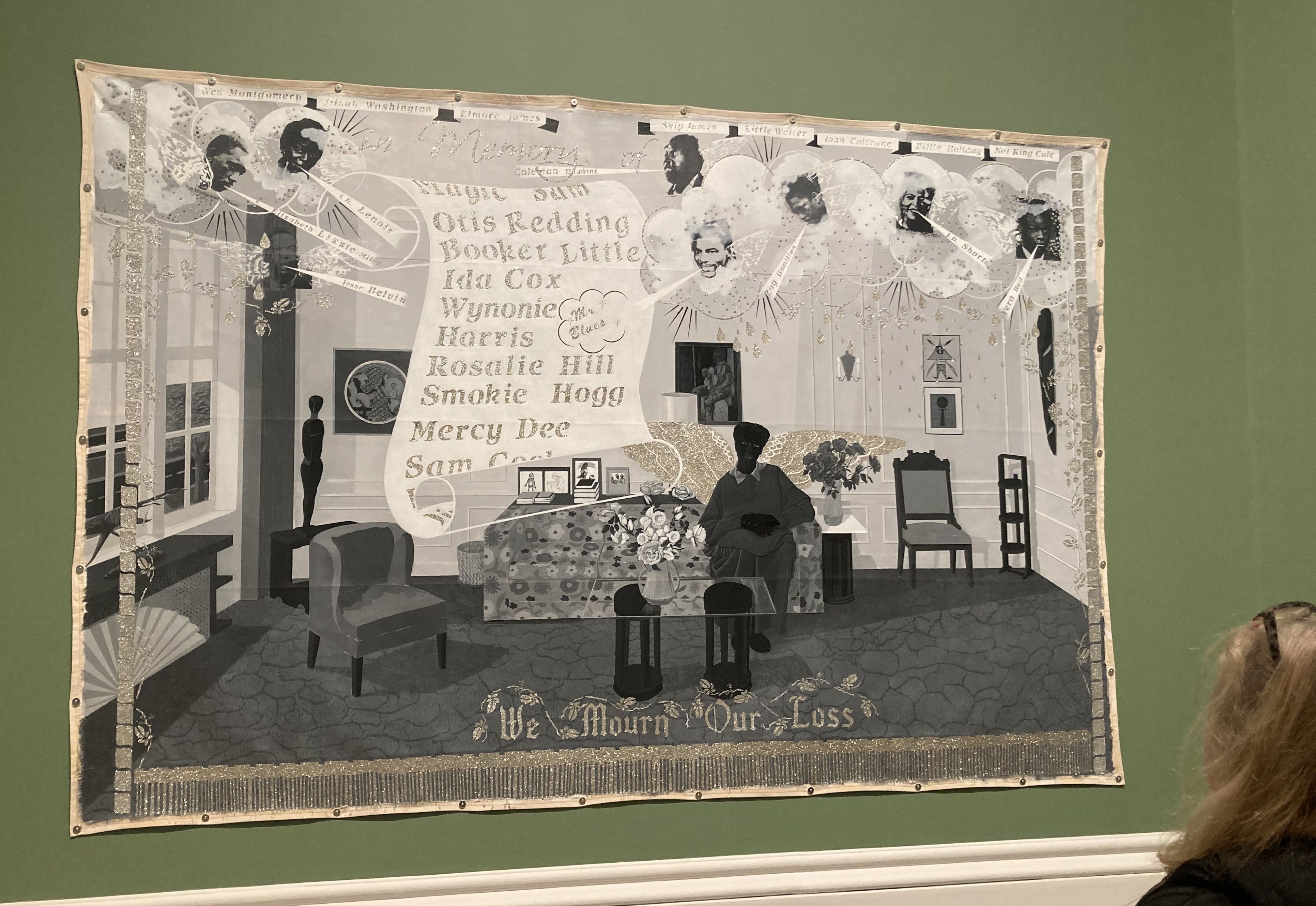
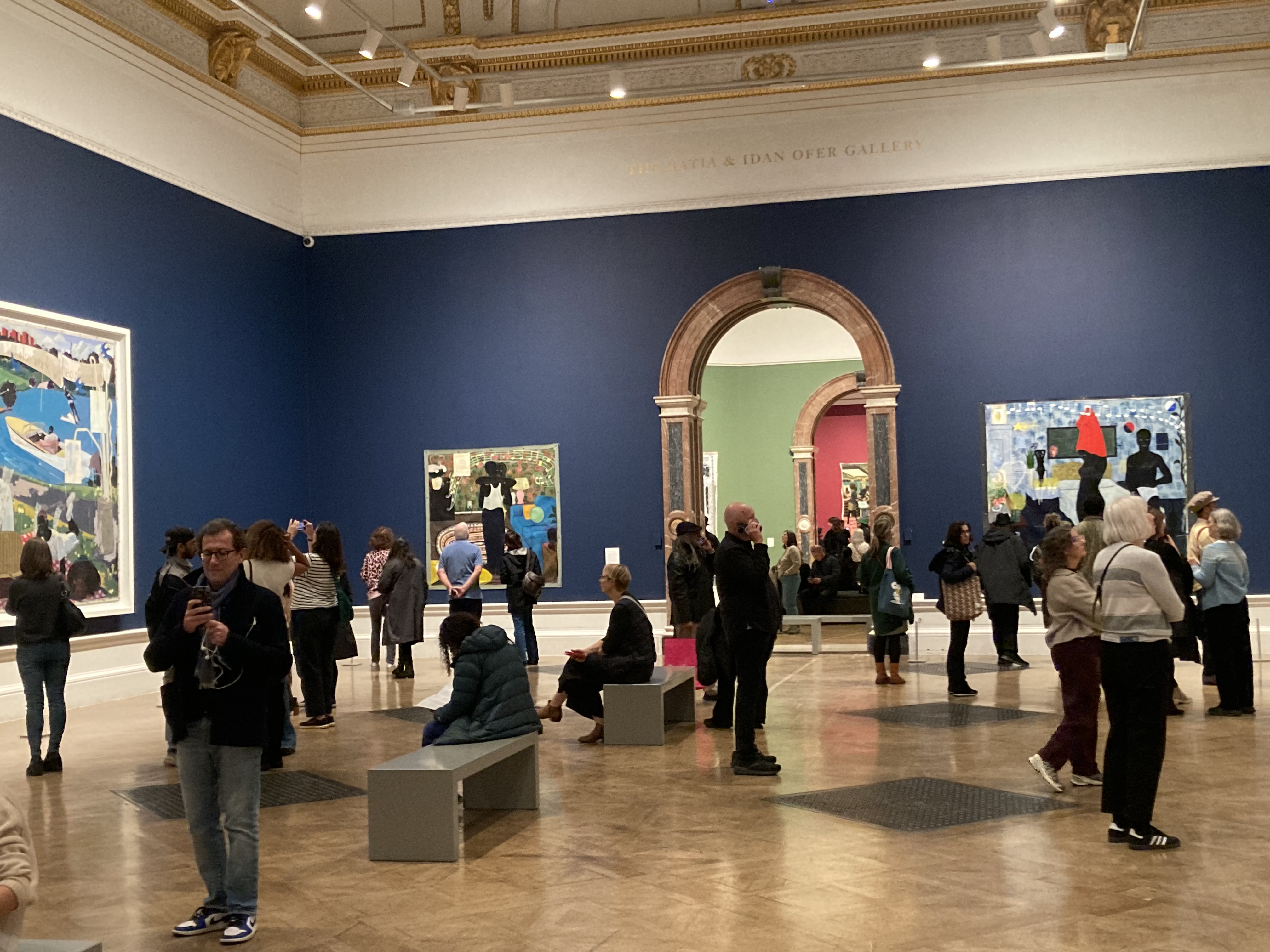
The Royal Academy’s current show of paintings by Kerry James Marshall, born in Birmingham, Alabama in 1955, is so full of colour and decoration (hard reds, electric blues, sizzling pinks, gold and silver braid), all contrasting with the fathomless black of his skin tones, that it might seem perverse to choose the most subdued piece on view. But when you examine “Souvenirs IV”, it’s not not surprising that it should have made an impact on me.

Each of the four large (13ft wide by 10ft high) works in this 1998 series occupies a wall of the octagonal room at the centre of the gallery. Executed in acrylic, glitter and screenprint on paper on tarpaulin, attached to the walls by visible grommets, they are memorials to dead heroes, their domestic settings subtly adorned with African symbols. Three of them feature Martin Luther King, Jack and Bobby Kennedy, and a variety of political and literary figures from black history. But “Souvenirs IV”, painted in grisaille, is dedicated to music, and includes some interesting figures.

Across the top we see the names of Wes Montgomery, Dinah Washington, Elmore James, Skip James, Little Walter, John Coltrane, Billie Holiday and Nat King Cole. Beneath the frieze of those names are their pictures, each with a kind of speech trumpet giving the name of another musician: Jesse Belvin, Lizzie Miles, J. B. Lenoir, Coleman Hawkins, Roy Hamilton, J. D. Short, Vera Hall. And streaming down the centre of the painting is a banner containing more names: Magic Sam, Otis Redding, Booker Little, Ida Cox, Wynonie Harris, Rosalie Hill, Smokie (sic) Hogg, Mercy Dee (Walton), Sam Cooke.

What a very intriguing selection, running from country blues and Chicago blues through gospel, R&B and soul to jazz from New Orleans to the avant-garde. As well as the obvious greats, some of my long-time lesser-known favourites are there: Lenoir, Belvin, Little. There are others I’ll have to look into. One is Lizzie Miles (1895-1963), born Elizabeth Landreaux in New Orleans, who sang with Freddie Keppard and visited Europe in the 1920s, performed throughout the US with Paul Barbarin, Fats Waller and George Lewis, and retired from secular music in 1959 to live among an order of black nuns in her home city. Another is Rosalie (Rosa Lee) Harris (1910-68), a Mississippi hill country blues singer and guitarist recorded by Alan Lomax in 1959. A third is J. D. Short (1902-62), a cousin of his fellow Mississippi blues singer-guitarists Big Joe Williams and Honeyboy Edwards.

There are other fine things in the exhibition, which is titled The Histories. I spent quite a lot of time looking at a spectacular painting called “Untitled (Club Scene)” and at the enigmatic “Black Painting”, which reveals its story only when the eyes have become accustomed to its tonal grading. But “Souvenir IV” is the one that spoke to the importance of black culture in my own life, and the great debt thus incurred.

* Kerry James Marshall’s The Histories is at the Royal Academy, London W1, until January 18, 2026.
Noah Davis at the Barbican

Sometimes painting really does, as the saying goes, approach the condition of music. Today I had that feeling pretty well all the way round the Barbican’s exhibition of work by Noah Davis, the African American artist who died of cancer aged 32 in Los Angeles, where he’d spent his last years setting up the Underground Museum, a place for showing art — not just his own — to people who’re not exposed to it on a regular basis. It occupied four adjacent storefronts on a street in Arlington Heights, a historically black and Latino/Latina district in Central LA.

Thinking about his own work, and his desire to “make something normal”, he said: “Does it have to be about hip-hop and that stuff to get people interested?” But also: “I wanted it to be more magical, not stuck in reality.” So you get a man reading the paper, or people splashing around in a pool, or three young people clustered in a doorway. Normal. But because of what Davis brings, painting over a base layer of rabbit-skin glue like Mark Rothko did, creating a kind of transparency even when the paint is dense, moving blocks of colour like blocks of sound, also magical.

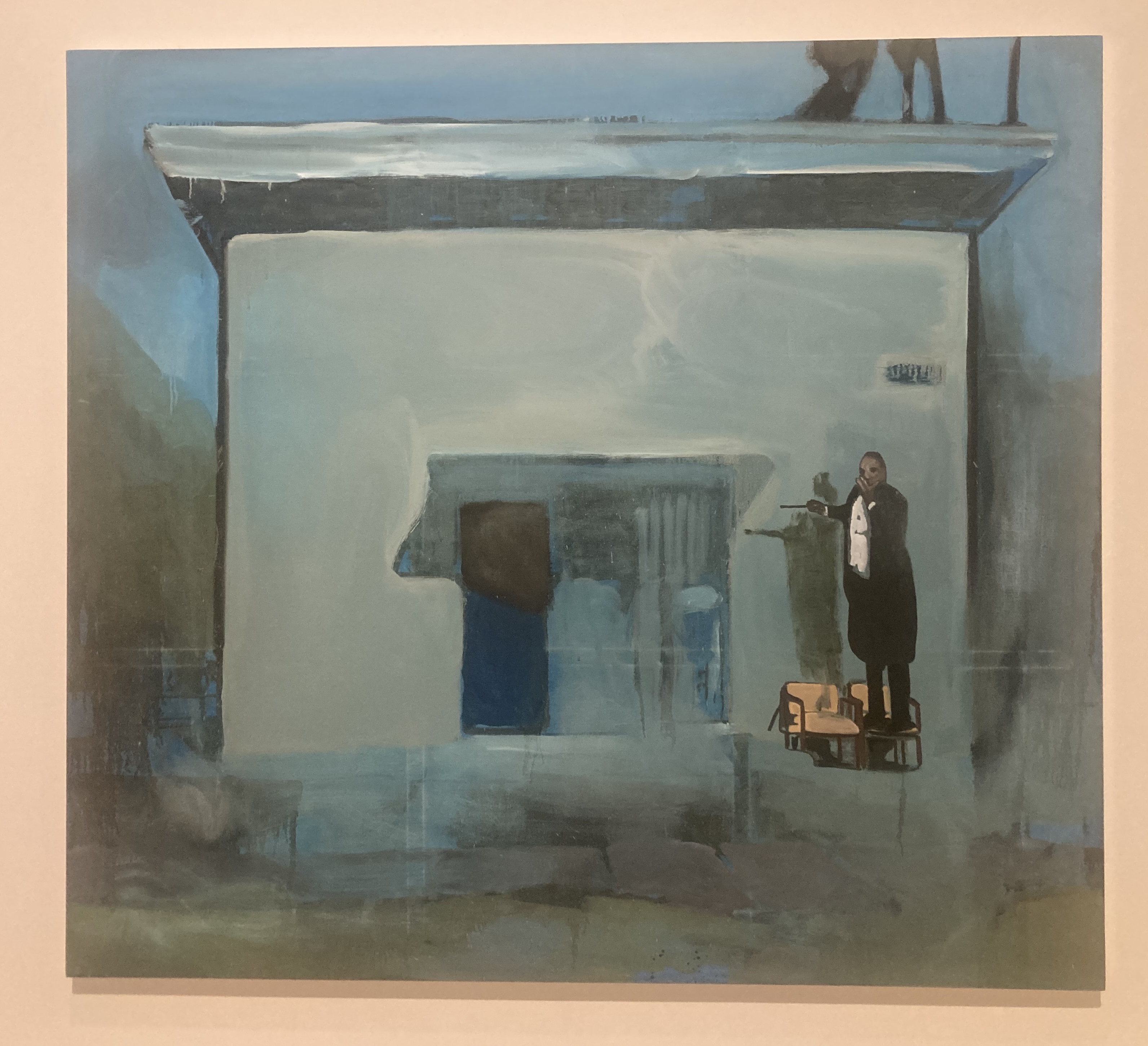
There are explicit references to music in some of the paintings, like the one above, which is called “Conductor”; it stopped me in my tracks. Magical realism right there. He painted it in 2014, the year before he died. Or there’s one called “The Year of the Coxswain”, from 2009, which shows oarsmen carrying a boat out of the water; behind and alongside them is a black-clad figure holding a trumpet.

If you want to see and know more, there’s a Barbican trailer for the exhibition here and an Art News piece here. I’m afraid you only have until May 11, which is this coming Sunday, to see it in London. Sorry about that. Thereafter it can be seen at the Hammer Museum in Los Angeles (June 8-August 31).

I found it unforgettable. I could show you another picture, probably the three young people in the doorway, but because “Conductor” struck me so hard, here’s a closer look.

The art of Peter Till

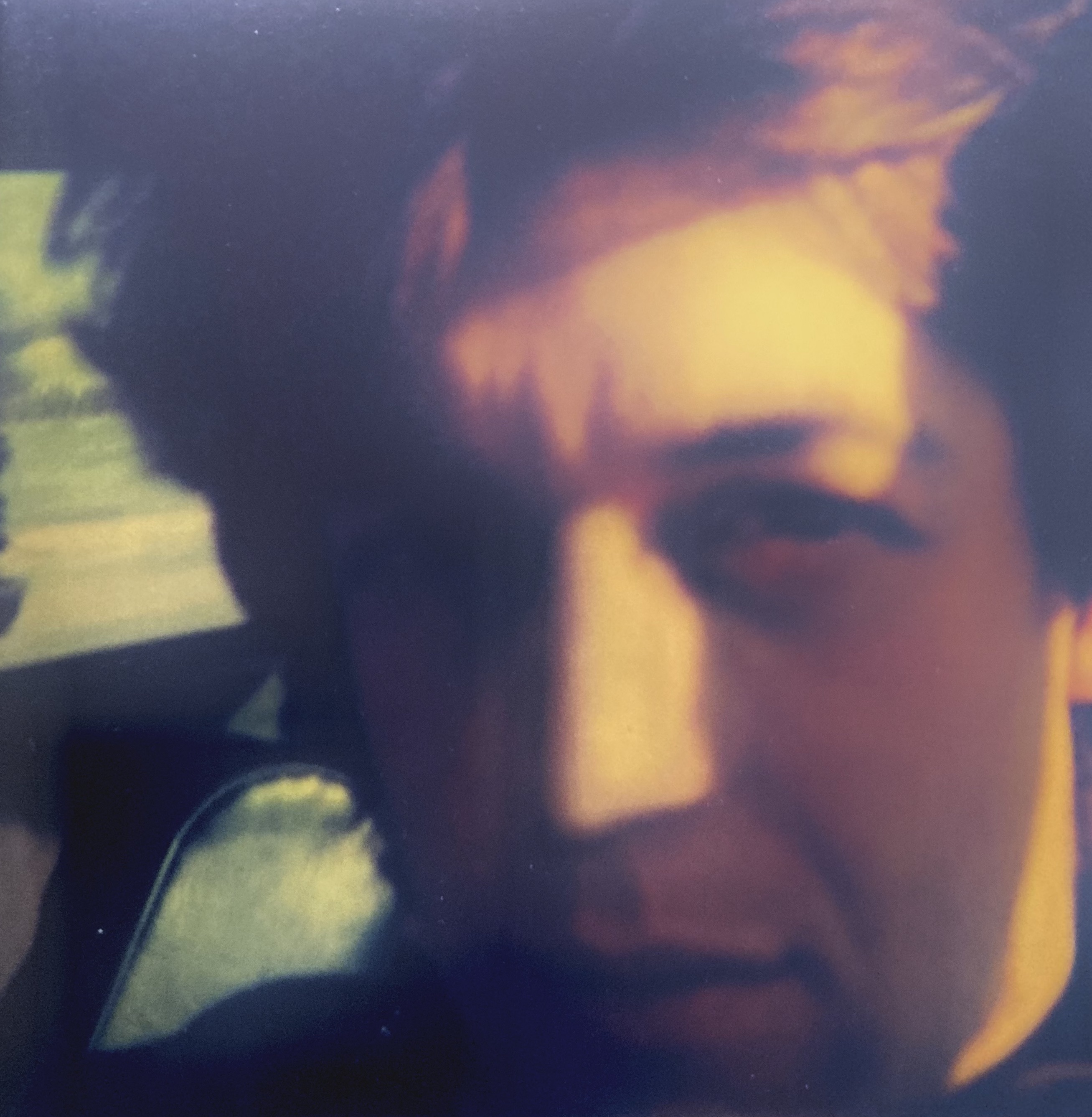
Back in 1978, when I was editing Time Out, Bob Dylan came to play at Earl’s Court, his first London concerts in 12 years. As part of a preview, Jenny Fleet, the magazine’s art director, and I commissioned several illustrations. The one above was by the great Peter Till. I had a special fondness for it and a few years later he was kind enough to offer me the original. Yesterday I collected it.

The opportunity for the handover came at a private view of Peter’s exhibition at Hornsey Library, near his North London home. It’s a selling exhibition of his brilliant work over the years for many publications, including the Guardian, The Times, the New Scientist, the Radio Times and the New York Times. The money raised will go to supporting the Shepherd Hill allotment. That seems a worthy cause and I was glad to make a donation. The show is on until April 15 (see below).

The Pauline Boty film

The restoration of the painter Pauline Boty to her rightful place in the pantheon of British pop art took a further step this week with the screening of an hour-long biographical documentary on BBC4. I enjoyed Pauline Boty: I Am the Sixties, despite its rather silly title, which it didn’t really attempt to justify, although the programme was certainly suffused with aspects of the spirit of that decade.

It justified the increased attention Boty been receiving in recent years, and the producer, Vinny Rawding, and the director, Lee Cogswell, deserve credit for their persistence in getting it made. If the inclusion of so many talking heads sometimes makes it feel rather old-fashioned, they do take a chance on inserting, between the clips of Boty from various sources and the testimony from talking heads, a handful of sequences of an actress (Hannah Morrish) resembling Boty, overlaid by passages from an imagined memoir written by Rawding. Perhaps devised as a solution to cost and copyright problems, it just about comes off.

Some of the talking heads are not worth their space. Among the exceptions is the artist Derek Boshier, who appeared with Boty, his fellow student at the Royal Academy, in Pop Goes the Easel, the film made by Ken Russell for the BBC’s Monitor series in 1962. Boshier, who died last year, says something interesting about the culture from which they sprang: “The ideal art college should be one where all departments integrate.” That was certainly the case at the English art college where some of my friends went in the early ’60s: Students of fine art, photography and fashion all took part in each other’s projects.

It was to Boshier that I turned, a few months before his death, when I found myself wondering about Boty’s taste in music. Apparently she listened to music while she painted. What could it have been?

In Pop Goes the Easel, she and Boshier are seen doing the Twist at a party to the record of “Twist Around the Clock” by Clay Cole and the Capris. In another scene the pair, with their fellow students Peter Blake and Peter Phillips, are seen walking through a street market to the Chicago doo-wop of Gene Chandler’s “Duke of Earl”. I got a mutual friend to ask Boshier what Boty might have been playing on the Dansette while she worked. Sadly, he couldn’t remember.

Boty died in 1966, aged 28, so maybe she’d have liked the Beatles and the Stones and the Yardbirds. She’d danced at the very first edition of Ready Steady Go! in 1963 — presumably not, by then, still doing the Twist — and made a painting called 5-4-3-2-1, after the Manfred Mann signature tune.

She also met Bob Dylan, thanks to her relationship with the film-maker Peter Saville. In 1962 Saville directed Evan Jones’s play Madhouse on Castle Street for the BBC, casting the unknown Dylan as “Bobby”. This was Dylan’s first trip abroad, and according to Marc Kristal’s very good Boty biography, the couple picked him up at London Airport.

I imagine her liking Dusty Springfield and the Walker Brothers. But the pop references in her paintings generally came from a different vector: Marilyn Monroe, Jean-Paul Belmondo, Monica Vitti and — in her portrait of her friend Celia Birtwell — Elvis and the Everlys. Other figures were drawn from outside the world of the arts, such as Christine Keeler and Fidel Castro.

In 1964-65 Boty painted a diptych titled “It’s a Man’s World I and II”. Where the first panel has images of masculinity (Muhammad Ali, El Cordobes, a B52 bomber, the dying JFK, Elvis, Ringo and Lennon, Einstein, Proust), the second depicts what Boty sees as going on inside men’s heads: images of naked young women in sexualised poses. At the centre is the dominant image of a full frontal nude, cut off above the shoulders and below the knee.

Caroline Coon, one of the film’s talking heads, hints at a greater significance behind this woman’s lack of a face, and therefore of an individual identity. But later on the film also includes a brief clip from a film called The Day of Ragnarok, a nuclear-scare drama written and directed by John McGrath for BBC2 in 1965, in which Boty made one of her appearances as an actress. It shows her in her studio, working on “It’s a Man’s World II”. At that stage, as can be seen in the screen-grab above, the figure originally had a head, which must later have been painted over. Nobody comments on this in the film, but it’s an interesting decision for the artist to have made.

Inevitably Boty’s career was affected by the attitudes of the time, particularly the assumption that, as a woman, her work couldn’t possess a significance equal to that of her male contemporaries. Perhaps that prejudice lay behind her decision to diversify into modelling and acting (there’s a brief scene in Alfie with Michael Caine). If her looks and her exuberance were attracting more attention than her art, then why not exploit the opportunities?

We’ll never know what might have happened had her progress to a full career in painting not been affected by passive (and perhaps active) obstruction. Nor what she might have done had she not, while pregnant and in what seems to have been a good marriage to the literary agent Clive Goodwin, been told that she had cancer. She declined treatment rather than risk damage to the unborn baby. Four and a half months after giving birth to a daughter, she died. Her renaissance continues.

* Pauline Boty: I Am the Sixties is on BBC iPlayer: https://www.bbc.co.uk/programmes/m0028nyw

A Soho creative

Tot Taylor has an interesting history. Back in the mid-’80s, from an office near Oxford Circus, his Compact Organisation threatened to become to the London pop scene what Brooklyn’s Daptone outfit would be to R&B in the next century: a clever, occasionally brilliant re-imagining of past euphoria, creating music that could sometimes rival the sounds from which it took its inspiration. Compact’s founders, Tot Taylor and Paul Kinder, released records by Mari Wilson, Virna Lindt and Cynthia Scott that recalled the great days of the ’60s girl groups, while “The Beautiful Americans”, the sole 45 released by a non-existent group called the Beautiful Americans, evoked the early Walker Brothers in their semi-operatic prime.

Then Taylor and Kinder went their separate ways, the former diversifying his career. He composed music for film, TV and theatre (including the eight-hour Picasso’s Women for the National Theatre). From 2004-19 he co-ran a cutting-edge Soho art gallery called Riflemaker (after the business that had once occupied the premises on Beak Street). And in 2017 he published a 900-page novel titled The Story of John Nightly, a kind of Carnaby Street War and Peace, set amid the Swinging London music scene, its protagonist a pop star called “the most beautiful man in England” by the Sunday Times. And then he started making records again.

A confession: although I was sent an early proof copy of The Story of John Nightly, I haven’t read it properly. But I extracted it from the unread pile the other day. The reason is that I’ve been listening to his last two albums, Frisbee (2021) and Studio Sounds (2023), and falling for them to the extent that I’ve started thinking that if a bloke capable of this music has written a novel, it’s probably going to be worth reading.

Taylor makes records with a (sometimes deceptive) air of light-hearted whimsy and a deft, flexible craftsmanship that seem to have disappeared from contemporary pop music, overwhelmed by the prevailing modes of communal ecstasy and personal trauma. Crudely, you could place what he does somewhere between the Beatles of 1965-66 and the Beach Boys of Sunflower, maybe the last evolutionary step in songwriting terms before the art-rock of Kevin Ayers and Syd Barrett, but nothing he does sounds dated.

Every song has to have its own subject, shape and mood, just like a Beatles album. The humour is wry, never far away in things like “This Boy’s Hair” and “Vanity Flares”, both from the new album, on which he sings in his light, pleasant voice while playing pretty much everything except for drums (Shawn Lee), some of the guitars (Paul Cuddeford and Lewis Durham) and harp (Alina Brhezhinska).

Studio Sounds is a very good album, but the earlier Frisbee is, I think, the classic. The opener came about when the Guardian asked him to write a song for National Music Day, which is what the song is called. “Fortune’s Child” is a great slice of power pop. “Do It the Hard Way” opens with the sort of quatrain you don’t find much in a pop lyric any more (except maybe from Taylor Swift): “I drive my car up a one-way street / Dirty looks from everyone I meet / I ask the Lord my soul to keep / No reply — must be asleep.” Then there’s something called “Yoko, Oh”: a homage to John Lennon in the form of a gentle, loving pastiche of the ex-Beatles at his most blissed-out. Titles like “The Action-Painting Blues”, “Baby, I Miss the Internet” and “Sunset Sound” suggest the breadth of the topics that get him writing. A song called “This New Abba Record” lives up to its title.

The eight-minute “American Baby (Two-Part Invention in C)” is the one to which I keep returning, hooked by a minor-key electric piano riff that finds the ground between the Zombies’ “She’s Not There” and the Doors’ “Riders on the Storm”, achieving a momentum almost as subtly relentless as Steely Dan’s “Do It Again”. As a song, there’s not much to it. But you could say that about many of the greatest pop records. And the potency of the groove somehow turns the blankness of its lyric into something mysterious and compelling.

* Tot Taylor’s Frisbee and Studio Sounds are on the Campus label. The photograph of Taylor is from the sleeve of Studio Sounds. The Story of John Nightly is published by Unbound.

Oh, Yoko

The first time I met Yoko Ono, at the Apple HQ in Savile Row in September 1969, I was impressed by her obvious engagement. She and John Lennon were doing a day of interviews, and I got my couple of hours on behalf of the Melody Maker. At that stage she was being treated by the media as a bit of a sour joke. The film she’d made of people’s bottoms got her in the papers, and her relationship with Lennon rendered her, in the eyes of many, what we would nowadays call toxic. Not only did she look weird, she thought weird. But at that first meeting, it was impossible to ignore the way the two of them shared the burden of the interview as equal voices.

The second time, two years later, was just after they’d moved to New York and temporarily sequestered themselves in a suite in the St Regis Hotel on East 55th Street. I spent a few days with them in the hotel, at the Record Plant studio a dozen blocks south, and on a trip to the West Village during their hunt for a permanent address. And that time I could see, much closer up, what it was that he liked so much about her: she was funny, and physical, and assertive, and full of life and ideas — all the characteristics that are currently on very clear display at Tate Modern in Yoko Ono: Music of the Mind, an exhibition of her life’s work.

The wittiest T-shirt around just now carries the message JOHN LENNON BROKE UP FLUXUS — a play on the belief that Yoko destroyed the Beatles. Her work while a member of Fluxus, the informal avant-garde art movement founded in New York by her friend George Maciunas in 1961, also involving La Monte Young, John Cage, Joseph Beuys, Nam June Paik, Jonas Mekas and many others in events often held in her downtown loft, is to me the most interesting part of the show, occupying several rooms.

It features documentation of the notorious Cut Piece of 1964, in which she sat on a chair in the Carnegie Recital Hall while members of the audience cut off her clothes, and Bag Piece of the same year, which I saw her re-enact with Lennon at the ICA in London in 1969, and Ono’s Sales List of 1965, in which she offered such items as a blank tape labelled “Sound tape of snow falling at dawn”, a Light House constructed from light, and custom-made underwear, including “special defects underwear for men — designed to accentuate your special defects: in cotton $10, in vicuna $175.”

Like a lot of people wandering through the rooms, I found myself smiling a lot, and occasionally laughing out loud at something like a 1962 work called Audience Piece to La Monte Young, in which the 20 performers simply lined up across the stage and stared at the audience until the audience left, and Smoke Piece of 1964: “Smoke everything you can / Including your pubic hair.”

The exhibition shows off her imagination and her indefatigability, as well as the way she was influenced by pre-existing Japanese culture (Zen koans, haiku, kabuki theatre) and the experience of living, as a child evacuated from her family home in Tokyo, through the final stages of World War Two.

On the morning I spent there, the show was full of women and small children who were having a good time with the all-white chess set, the wall-hung board into which visitors are invited to hammer a nail, and the room called Add Colour (Refugee Boat), whose walls, floor and eponymous centrepiece are covered in blue graffiti. In the final room, many people had accepted another of her invitations: to write something about their mothers on a small piece of paper and tape it to the wall.

I thought of Yoko’s own mother, a descendant of an aristocratic family forced — in the absence of her captured husband — to scuffle for her family’s existence amid the postwar ruins before, reunited, they left to resume a comfortable existence in the US. And, too, of the scar tissue of Lennon’s “Mother” (“You left me, but I never left you…”), written after he and Yoko had undergone a course of Arthur Janov’s Primal Therapy. That’s something else they were mocked for, along with the bottoms movie and the riddles and the naked cover of Two Virgins and the Bed Peace event in Amsterdam.

Ah, peace. Remember that? WAR IS OVER!, they announced in 1969 via the medium of billboards plus a concert at at the Lyceum. All we are saying is GIVE PEACE A CHANCE. Send a bag of ACORNS FOR PEACE to world leaders. You can mock all that, too, if you want, but it wouldn’t really seem right in 2024.

I don’t mean to sound patronising when I say that I was surprised by how much the exhibition made me think, even when those thoughts were not necessarily the sort that can be followed to a conclusion. The first thing to do with a mind is open it.

* Yoko Ono: Music of the Mind, curated by Julia Bingham and Patrizia Dander, is at Tate Modern until 1 September. There’s an illustrated book of the same name to accompany the exhibition, its selection of short essays including a good one on Yoko’s relationship to sound and silence by David Toop (Tate, £32).

A portrait of Bud

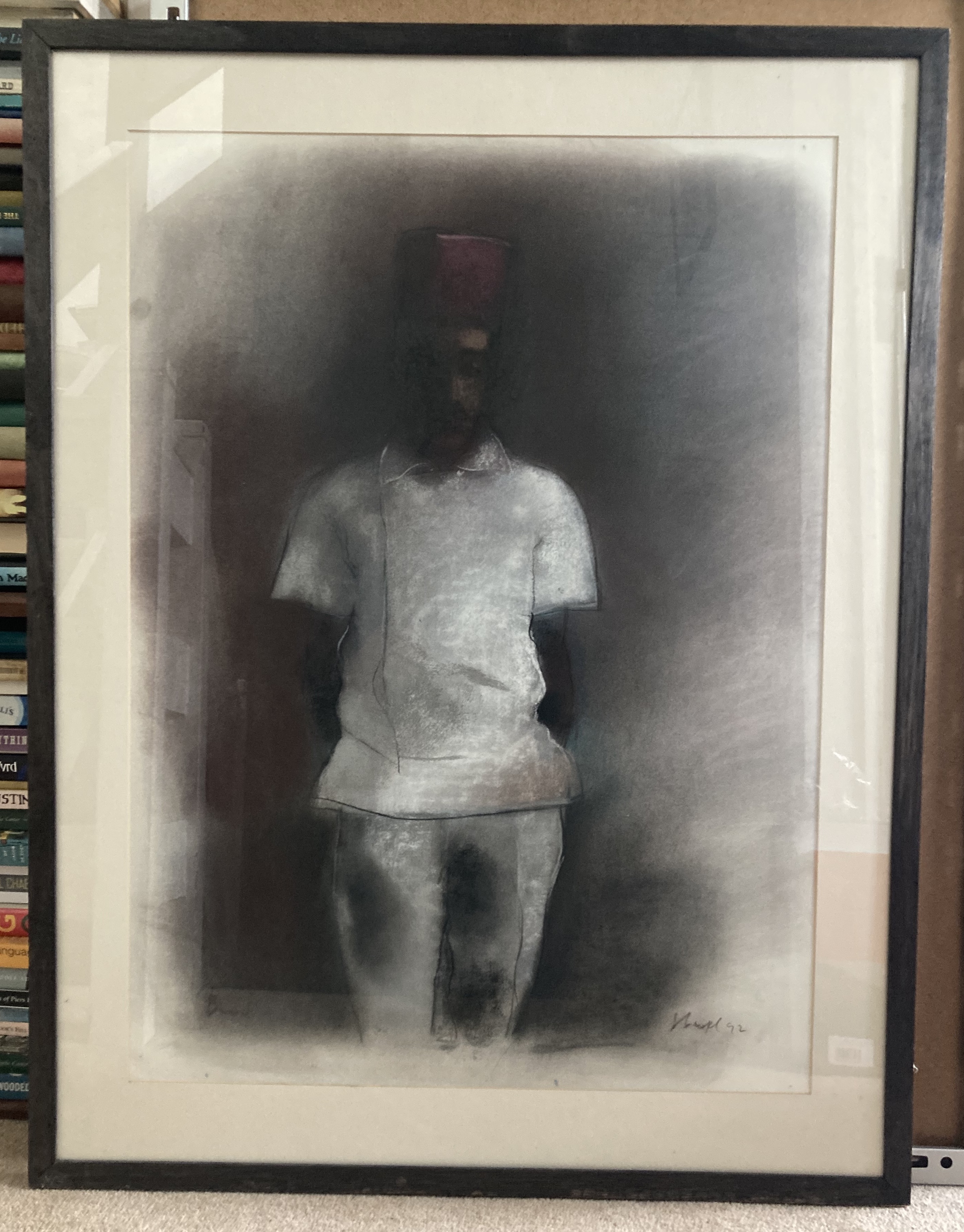
There’s this portrait that I bought about 30 years ago from an English artist called Johnny Bull. At the time, he was concentrating on jazz musicians: Miles, Coltrane, Monk. I liked his work, so I invested a couple of hundred quid in one of the less obvious subjects, a large pastel portrait of the bebop piano master Bud Powell. It hung on a wall in the house for a while but then I got uncomfortable with it and put it away. It emerged recently and I’ve been thinking about it a lot.

Bud was one of jazz’s great tragedies as well as one of its great masters. He was a classically trained prodigy from a highly musical family. But in 1945, aged 20, after being arrested while drunk on the streets of Philadelphia one night after a gig with the trumpeter Cootie Williams’s big band, he was beaten on the head. The effect was to change his personality, putting him in and out of mental institutions, where he was subjected to electro-convulsive therapy.

Some of those who heard him in his teens said his playing was never quite the same after the beating. But still it was good enough to make him the leader among modern jazz pianists in the late ’40s and early ’50s, the only one who could take the stage with Charlie Parker, Fats Navarro and Max Roach and exist absolutely on their level, matching their creativity. At his best — in his 1947 trio session released as a 10-inch LP on the Roost label, for example — he was incomparable, although drugs prescribed for what was then known as manic depression sometimes dulled his mind and his edge. But he remained capable of composing, alongside bop standards like “Wail” and “Bouncing with Bud”, such extraordinary pieces as “Parisian Thoroughfare” and “Glass Enclosure”.

After several years in Paris, where he had a trio with the great Kenny Clarke on drums and the French bassist Pierre Michelot and was looked after for a while by the writer, commercial artist and amateur pianist Francis Paudras, he returned to New York in 1964. He died there two years later, aged 41, of the effects of tuberculosis, exacerbated by alcoholism and general neglect.

If you want to know about Bud, there are several good biographies, including Paudras’s Dance of the Infidels (Da Capo, 1998) and Peter Pullman’s exhaustively researched Wail (available on Kindle). And I recommend an hour-long documentary called Inner Exile, made for French television in 1999 and now on YouTube, directed by Robert Mugnerot and featuring marvellous performance footage as well as interviews with those close to him. (The great René Urtreger, who made an album of Powell’s compositions in Paris in 1955, says of his hero: “He was not made to live in this society.”)

I contacted Johnny Bull via email a few days ago, wanting to talk about his portrait. As you can see, it shows Bud wearing a fez and what looks like some kind of hospital uniform. When I first saw it, it seemed a powerful way of dramatising the pathos of his story. So, after we’d become reacquainted, I told Johnny about my dilemma. It’s a very fine piece of art, and quite beautiful, but it brings too much sadness to a domestic setting. Exhibiting it in a public environment, like a gallery or museum, might not be the right way to introduce Bud to people who don’t know anything about him. It illustrates one aspect of his life with great sensitivity but gives no indication of what he brought to the world, which is why it wouldn’t really work on the wall of a jazz club, either.

The artist agreed. “It’s a distressing picture,” he said. “He looks such a lost soul. I made a painting of Lester Young once, towards the end of his life, and it was too disturbing to keep looking at, so I quite understand your feeling.”

Johnny Bull loves and understands the music. His intentions when he made the portrait were beyond reproach, his response to the subject was anything but superficial, and his execution was impeccable. I bought it because it moved me. But I have no clear idea of what its fate should be now. It seems wrong for it to spend any more years stacked away in my house. Maybe I’m writing this in the hope that someone will propose a solution. Failing a better idea, I’ll probably just give it back to the artist, who can put it in his archive. Then, one day, someone else will have to make the decision.

Picasso & Monk in Paris

In a room devoted to Pablo Picasso in the 1950s, there’s something unexpected: the sound of Thelonious Monk, alone at the piano, ruminating on “I’m Getting Sentimental Over You”. The rest of Thelonious Himself, the 1957 album consisting of seven solo tracks plus “Monk’s Mood” with John Coltrane and Wilbur Ware, is playing on a continuous loop, quietly and unobtrusively, conditioning the mood in which a handful of masterpieces, including Jacqueline aux mains croisées (1954), can be examined as part of a new exhibition in the Musée Picasso in Paris.

It’s one of several surprises introduced by the British designer Paul Smith, invited by the museum’s director to create a show commemoraing the fiftieth anniversary of Picasso’s death. His brief was to bring a fresh eye to bear on the selection and presentation of items from the 5,000 assorted artworks in the permanent collection, most of them acquired by the nation as part of an inheritance-tax settlement with the artist’s family.

I first met Paul in 1965, when we were still in our teens and he’d just begun managing the menswear department on the upper floor of a boutique in Nottingham. Called Birdcage, it was a minute’s walk away from the tiny premises in which, five years later, he would open the first shop bearing his own name. Now there are more than 120 Paul Smith shops in 60 countries around the world. Back then he was full of imagination, enthusiasm and a love of silly humour, all qualities that time, a knighthood and membership of the Légion d’honneur have done nothing to erode.

His instinctive response to the museum’s invitation was to emphasise the role of colour in the artist’s career, from the pink period of 1904-1906 to the blue and white stripes of the Breton sailors’ shirt Picasso was wearing when the photographer Robert Doisneau turned up to capture some famous images at his house in Vallauris in Provence in 1952, including the shot where sausage-shaped bread rolls — petits pains — take the place of his fingers.

Mounted with wit and zest, avoiding the reverence with which such retrospectives are traditionally mounted, some of the show is eye-popping. In one of the 24 themed rooms, originals are mounted on walls papered with posters from Picasso exhibitions around the world. His variations on Manet’s Le Dejeuner sur l’herbe are ranged in the greenest green room you’ve ever seen. A wall of pale blue and yellow lozenges echoes the harlequin costume worn by the painter’s three-year-old son Paul as he posed for his father in 1924. The abundance of floral and striped wallpaper makes the rooms in which a more sober approach is appropriate — the Blue and Rose periods, or the poignantly understated finale of Le Jeune peintre, from Picasso’s last year on earth, in a room washed in pale sunlight — even more effective.

Not just paintings, either. A dozen of Picasso’s one-off decorated dinner plates are mounted in the middle of a wall of plain white plates, which seem to be waiting for him to get up in the morning, grab his paints and start daubing fishbones or minotaur’s heads. The famous bull’s head fashioned in 1942 from a discarded pair of dropped handlebars and a bicycle saddle is hung high on one wall of the very first room, confronting a herd of cows on the opposite wall assembled from their modern equivalents, with the bars turned downwards, presumably to signify bovine submission in the face of taurean power. There’s a sense of semi-surrealistic comedy at work here that mirrors Picasso’s own sense of humour but also offers a quiet comment.

Perhaps purists will be relieved to have their Picassos restored to more neutral surroundings after the exhibition in the beautiful hôtel particulier in the Marais ends in August, but Paul’s inclusion of the sound of Monk’s piano — apart from giving me an excuse to devote a piece to the show in a blog about music — seemed to symbolise the benign and sympathetic creativity at work in the exhibition as a whole.

* Célébration Picasso: Le collection prend ses couleurs! is at the Musée Picasso, 5 Rue de Thorigny, Paris 75003, from 7 March to 27 August 2023.

The arts of Bob Crewe

Perhaps the greatest week of Bob Crewe’s life was the one in 1975 when Frankie Valli’s “My Eyes Adored You”, which he had produced and co-composed with Kenny Nolan, fell from the No 1 position in the Billboard Hot 100 and was immediately replaced by Labelle’s “Lady Marmalade”, which he and Nolan had also written together.

Or perhaps it wasn’t. Maybe it was the one in 1994 when the first retrospective show of his paintings and mixed-media artworks opened at a gallery in West Hollywood, after he had left the music business behind and climbed out of the valley into which his addictions had led him.

Crewe must have had a lot of great weeks in his life, as the man whose credits as a co-writer and/or producer, running all the way from doo-wop to disco, included the Rays’ “Silhouettes”, Diane Renay’s “Navy Blue”, Freddy Cannon’s “Tallahassie Lassie”, Mitch Ryder and the Detroit Wheels’ “Jenny Take a Ride/See See Rider”, Norma Tanega’s “Walkin’ My Cat Named Dog” and Disco Tex and the Sex-O-Lettes’ “I Wanna Dance Wit’ Choo”. And, of course, towering above everything, that fabulous string of hits he produced and co-wrote with Bob Gaudio for the Four Seasons and Frankie Valli, including “Big Girls Don’t Cry”, “Walk Like a Man”, “Rag Doll”, “The Sun Ain’t Gonna Shine (Any More)”, “You’re Ready Now”, “The Proud One” and “Can’t Take My Eyes Off You”.

Born in 1930 in Newark, New Jersey, Crewe was a blond Adonis in the Tab Hunter mould. He looked like a star, custom-built for American Bandstand, and he had a decent voice, as Jerry Wexler recognised when he persuaded him to record a solo album in Muscle Shoals in 1977. But the studio was where he expressed himself. He couldn’t read a note of music but he had well tuned ears and an instinct for a great hook, musical or lyrical, and he knew how to hire the best arrangers, men like Charlie Calello and Hutch Davie. The idiom didn’t matter. As Andrew Loog Oldham put it: “No one spoke more dialects of ‘hit’ than Bob Crewe.”

But there was another side to his talent, and it was one he seemed to have abandoned after ending his studies at the Parsons School of Design in Greenwich Village after only a year. Mentored by two older gay men, Austin Avery Mitchell, who showed him the art galleries of New York, Paris and Rome, and the photographer Otto Fenn, an early Warhol collaborator, he had begun painting and had his first show in 1950. Soon, however, music took over and ruled his life for the next quarter of a century, first as a crooner and then as a writer-producer. But a love of the visual media was merely dormant, and after being knocked over by a car in Los Angeles in 1977 he began to rededicate himself to art.

Influenced by Jean Dubuffet, Antoni Tàpies, Robert Rauschenberg and Jasper Johns, he made abstract pieces out of a variety of materials, characterised by a love of texture acquired from Dubuffet and a feeling for outline and repetition that may have come from Johns. Leafing through Bob Crewe: Sight and Sound, a new book about his artworks, it’s easy to respond to his instinct for shape and surface. Here’s one of his pieces, Excavation 8/3/96, juxtaposed with one of the hit singles for which he’s remembered:

I chose that painting because, like many of his pieces, it contains the motif of a perfect circle — in this case three of them, half-hidden within the complex surface markings inscribed on three wooden panels, 7ft tall by 9ft wide. Whether those circles reminded him of all the hits he’d helped to make, I have no idea. I’m not a psychologist. And I am not, of course, an art critic; that side of things is explored by the painter Peter Plagens in one of the book’s three essays. But I do like much of what I see here, and it would be interesting to be able to examine it in a gallery one day.

Crewe’s role in the Four Seasons story was brought back to public attention in Jersey Boys, the musical that opened its run on Broadway in 2005 before enjoying success around the world. He died in 2014, in the retirement home where he had lived after receiving serious injuries from a fall down a flight of stairs in the home of his younger brother Dan, who had been his business partner in the 1960s.

In the first of the book’s essays, Andrew Loog Oldham locates Crewe within the rapid evolution of post-war American popular culture, alongside such figures as Hugh Hefner, Lenny Bruce and James Dean. Oldham knew him in the hit-making days and watched him at work, making and selling his music in the days when he could start a song with lines like “Loneliness is the cloak you wear / A deep shade of blue is always there.” And, linking Crewe’s two artistic preoccupations, he observes: “He liked to think of music in terms of colour and challenged his musicians to think that way along with him.” Alone with his paints and his brushes and his palette knives, he challenged himself.

* Bob Crewe: Sight and Sound: Compositions in Art and Music, edited by Dan Crewe, is published in the US by Rizzoli Electa ($55). The photograph of Crewe in the studio in 1966 is from the book. The 45 is “Music to Watch Girls By” by the Bob Crewe Generation (DynoVoice, 1967).

Fantoni’s Sixties

Fantoni Beatles

It’s fair to say that Barry Fantoni had a good Sixties. Now we can read all about it in A Whole Scene Going On, his memoir of the time when he wrote gags for Private Eye, appalled the Royal Academy with a pop-art painting of a Pope, a judge and a general, created the visual backdrops for Ready, Steady, Go!, had a girlfriend who shared a flat with Jane Asher, presented a TV youth programme of his own (from which his book adapts its title), had an abortive stab at becoming a pop star, became a brilliant cartoonist, and did all the other things that people did in that blessed time. He mentions finding an address book from 1966 that begins with Annie (Nightingale) and ends with Zoot (Money).

Others who passed through his life during that period, with varying degrees of intimacy, include Paul McCartney, Marianne Faithfull, Ray Davies, Ralph Steadman, Peter Osgood, John Mayall, Terence Donovan, Pete Townshend, Jimmy Page (and his mum), and Felicity Innes, who wore a mini-skirt before Mary Quant. There are great stories about all of them, and about the early Private Eye gang: Ingrams, Booker, Rushton, Cook, Wells and so on. I loved the affectionate evocations of the brilliant designer Robert Brownjohn, the journalist Penny Valentine, the Nova art director Harri Peccinotti, a bloke called Bob who invented Gonks, the art critic John Russell, and Keith Goodwin, Fantoni’s press agent.

Goodwin also looked after Paul and Barry Ryan, Donovan, Cat Stevens, the Temperance Seven and Dusty Springfield, the subject of a chilling vignette: “You needed to know Dusty offstage to get the real picture. To see the face beneath the heavy makeup, back-combed hair and black eyeliner. What I saw was a rather frightened and plain-looking girl from the London suburbs with a bad temper and a desperate need to be loved.” Among those also sideswiped along the way are Tariq Ali, Robert “Groovy Bob” Fraser, Jeff Beck and Gerald Scarfe. The grudges, as is usually the case, add significant value: his resentment of David Hockney’s success is nothing short of epic.

I met him at the very end of this period, when he was contributing cartoons to accompany the wonderful Melody Maker column in which Chris Welch chronicled the adventures of an imaginary pop star called Jiving K. Boots, who was usually either getting banned from the Speakeasy or getting it together in the country: it was Spinal Tap avant la lettre, with a dash of Beachcomber’s random whimsy. I remember greatly coveting the Fantoni portrait of Denis Law that another friend, Geoffrey Cannon, had on the wall of his house in Notting Dale. Apparently that’s now lost, like the large quantity of Barry’s early paintings — including the famously scandalous “The Duke of Edinburgh in His Underpants” — taken off in 1963 to be shown in Los Angeles and never returned. “I have no idea where my work is now,” Fantoni writes of that episode. “Covered in goose shit, I expect.”

This was the Sixties, so not all the detail of Fantoni’s recollections is 100 per cent accurate. But that doesn’t matter. He brings alive a world in which dinner would be at a King’s Road trattoria one night and the all-night Golden Egg on Oxford Street the next, and when making art and having fun seemed to be all that mattered.

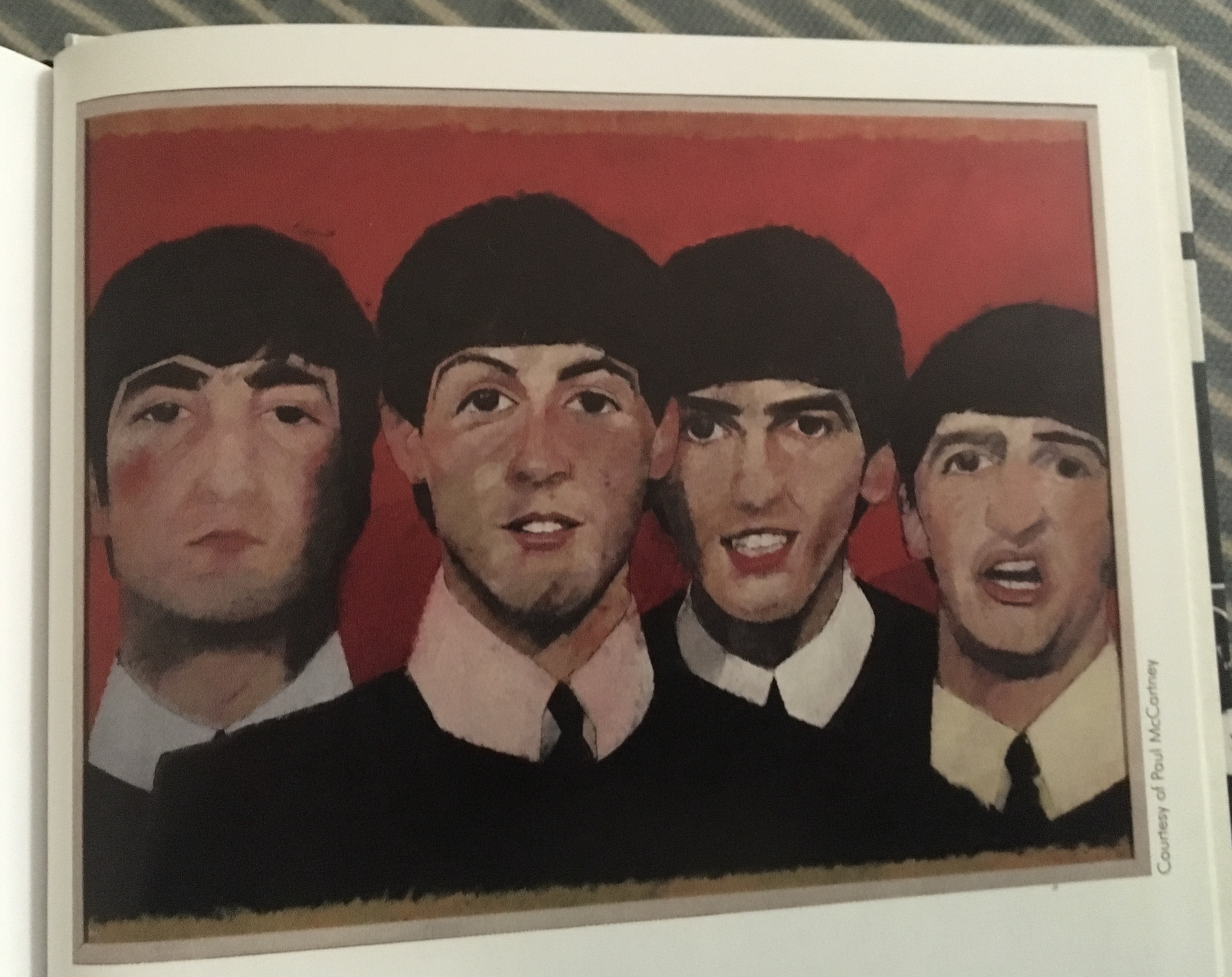
* Barry Fantoni’s A Whole Scene Going On: My Inside Story of Private Eye, the Pop Revolution and Swinging Sixties London is published by Polygon. His painting of the Beatles, first exhibited in January 1963 and reproduced above from the book, is now owned by Paul McCartney.