Skip to content

Posts by Richard Williams

The music of Gatsby

The moon had risen higher, and floating in the Sound was a triangle of silver scales, trembling a little to the stiff, tinny drip of the banjoes on the lawn.

Coinciding with the first publication of The Great Gatsby a hundred years ago (April 10, 1925), a new musical version of F. Scott Fizgerald’s masterpiece opens shortly in the West End of London. The trailer for this latest iteration of Gatsby makes it look like an all-singing, all-dancing, good-time entertainment. It would be unfair to prejudge, but the songs by Jason Howland and Nathan Tysen certainly sound as though they adhere to the Rice/Lloyd-Webber template for modern musical theatre.

Not much room there, one imagines, for the darker undertones beneath the careless rapture, for the portrayal of the corruption of extreme wealth (and the swipe at racism) that gave Fitzgerald’s narrative a resonance which has kept it alive in the minds of its readers for a hundred years.

The musical aspect of the original novel is hardly its most significant feature, but it does provide the story with an intermittently intriguing soundtrack. Early on, for instance, there’s a band at Jay Gatsby’s house playing something he describes as “yellow cocktail music” — and even though you may not be able to define it, you know exactly how it might sound. And that “stiff, tinny drip”: I can’t hear a banjo in a band playing early jazz without those words — as good as Whitney Balliett or Philip Larkin — coming to mind.

At another of Gatsby’s summer parties on his estate, where “in his blue gardens men and girls came and went like moths among the whisperings and the champagne and the stars,” is something titled “Vladmir Tostoff’s Jazz History of the World”. A composition on a grand scale, we’re told that it was first performed at Carnegie Hall, where it created a sensation. Now it’s delivered on the lawn to Gatsby’s guests by an orchestra that was “no five-piece affair, but a whole pitful of oboes and trombones and saxophones and viols and cornets and piccolos, and low and high drums.”

Nick Carraway, Fitzgerald’s narrator, doesn’t tell us what Mr Tostoff’s work actually sounds like, at least not in the final published version. In a passage Fitzgerald deleted from a draft manuscript, Nick describes it as “starting with a weird spinning sound, mostly from the cornets. Then there would be a series of interruptive notes which coloured everything that came after them, until before you knew it they became the theme and new discords were opposed outside. But just as you’d get used to the new discord one of the old themes would drop back in, this time as a discord, until you’d get a weird sense that it was a preposterous cycle, after all. Long after the piece was over it went on and on in my head — whenever I think of that summer I can hear it yet.”

The year before the book appeared, George Gershwin’s “Rhapsody in Blue” had received its première at the Aeolian Hall in New York, performed by the 23-piece Paul Whiteman Orchestra, with the composer at the piano. Scott and Zelda Fitzgerald were living in Great Neck, Long Island at the time. Whiteman had commissioned the piece, orchestrated by Ferde Grofé, for a concert called “An Experiment in Modern Music”. It’s what I imagine Tostoff’s music must have resembled.

A few chapters later there’s also young Ewing Klipspringer, Gatsby’s house guest, roused from his sleep one afternoon and reluctantly acceding to his host’s request to play the piano, despite claiming to be out of practice. He responds with “The Love Nest”, a song by Louis A. Hirsch and Otto Harbach from a 1920 George M. Cohan musical titled Mary, while thunder rumbles and summer rain falls outside on Long Island Sound.

Three years after The Great Gatsby‘s publication, Paul Whiteman would assemble his orchestra in New York to record an arrangement of “The Love Nest”. It’s nothing special until, just before the end, Bix Beiderbecke steps forward for a sublime eight-bar cornet solo that perfectly evokes what we imagine to be the spirit of the Jazz Age.

Finally, when Daisy Fay is enjoying the social life of Louisville, Kentucky while Gatsby, her besotted swain, is making his way back from army service in the Great War, she is “young and her artificial world was redolent of orchids and pleasant, cheerful snobbery and orchestras which set the rhythm of the year, summing up the sadness and suggestiveness of life in new tunes. All night the saxophones wailed the hopeless comment of the ‘Beale Street Blues’ while a hundred pairs of golden and silver slippers shuffled the shining dusk.” Written by W. C. Handy in 1917, the song was a hit in 1921 for Marion Harris, who recorded many blues songs and was perhaps the first white female vocalist to achieve success by imitating (rather than caricaturing) the style of black singers.

In a wonderful piece for the FT at the weekend, seeking Gatsby‘s echoes in our present condition, the author Sarah Churchwell concluded that the book “anticipates precisely the kind of society that would find Trumpism appealing: a culture losing its imaginative capacity, surrendering its ideals… The Great Gatsby captures a truth that repeats across generations: the powerful consolidate their control even as the dream of something better gleams ahead. Again and again, those with wealth and privilege fortify themselves against the possibility of a more just or democratic world, transforming progress into another cycle of entrenched power.”

Oh, well. Roll over, Vladmir Tostoff, and tell George Gershwin the news.

* The passage of musical description deleted from a draft of Gatsby is quoted from Some Sort of Epic Grandeur, Matthew J. Bruccoli’s biography of Fitzgerald, published in the UK by Hodder & Stoughton in 1981.

Stories old and new

“That was a young man’s song,” Paul Brady said as the applause began to fade at the Bush Hall last night. He’d just sung “Nothing But the Same Old Story”, written at the start of the 1980s to inhabit the world of a narrator who’d arrived in London from Ireland as a teenager looking for work and confronted by hostility in the time of the Troubles: “Living under suspicion / Putting up with the hatred and fear in their eyes…” It’s a song of resistance, one to drink and dance and cry to, and although only a few weeks from turning 78, Brady invested it with all its original innocence and rage.

This was the second of his two nights in Shepherd’s Bush, and he talked a little about how, arriving from Ireland as a member of a folk quartet called the Johnstons in 1969, they’d settled into a flat close by. He spoke fondly of how he’d learned from traditional musicians at pub sessions in west and north London.

I hadn’t seen him live since a gig at the Half Moon in Putney in 1981, when I was blown away by the material from his second solo album, Hard Station. Since then he’s had great success as a songwriter, his work recorded by Bonnie Raitt, Tina Turner and others. But today you can put him on stage alone with a guitar, a mandolin and a keyboard, and it’s the same old storyteller, now with a bit more of a growl but with wit and warmth and enough edge to lift you from your seat.

Sometimes, as in the gorgeous “Wheel of Heartbreak” and “The Long Goodbye”, he seemed like the most accomplished of adult rockers. During “Mother and Son” and “Follow On” (“a dark song that ended up in a butter commercial”) I started thinking that maybe what he was was a modern chansonnier, in the mould of Léo Ferré or Julien Clerc. And then there were the traditional songs that harked back to his time with the Johnstons and Planxty: the brilliant mandolin work on “The Jolly Soldier”, the sheer historical weight beneath the lilt of “Arthur McBride”.

The shows were arranged to greet the release of Paul Brady: The Archive, a four-CD, 63-track set of demos, one-off collaborations (with Dolores O’Riordan, Cara Dillon and Carole King, for example), interesting alternative versions of most of his best-known songs, and other fascinating bits and pieces, copiously illustrated with tickets, posters, photos and newspaper cuttings.

Curiously, the first two CDs begin with two songs that he didn’t write, both from the 1960s, which express polar opposites of the spirit of the time. One is the lovely hippie anthem “Get Together”, written by the American musician best known as Dino Valenti and containing a line I’ve never wanted to get out of my head: “We are but a moment’s sunlight / Fading in the grass.” Brady recorded it in 1999 for a set of songs associated with Greenwich Village in the ’60s, and his is a beautiful version, which he reprised last night. The other is “Gimme Shelter”, a song of a very different complexion: his treatment, recorded in 2009 with Bob Thiele Jr’s Forest Rangers for a TV series, Sons of Anarchy, loses nothing by comparison with the Stones’ original.

Those are among the many treasures in the box set. I’m still absorbing it, but I can say that the version of “Paddy’s Lamentation” for voice, piano, tin whistle and military drums, recorded in Dublin in 1980 for a long-vanished compilation album, might alone be worth the 50 quid.

Brady came back for an encore last night and of course it was “The Lakes of Pontchartrain”, the song he recorded in 1978 on his first solo album, Welcome Here Kind Stranger, and which he later taught to Bob Dylan. It’s a traditional song, but it’s his really, and The Archive has a fine version in Gaelic, translated by Prionnsias O’Maonaigh: “Bruach Loch Pontchartrain”.

Last night he sang it in English and gestured to us to sing the last two lines of the final verse with him, acappella: “So fare thee well my bonny o’ girl l’ll never see no more / But I’ll ne’er forget your kindness and the cottage by the shore…” Every heart melted, all over again.

* Paul Brady: The Archive is released by The Last Music Company: http://www.lastmusic.co.uk

All this beauty

So much wrong in the world, and yet so much wonderful new music. How to explain the existence, amid the trauma and violence and chaos agents and the encroachment of threat, of all this beauty? Here are five new albums I wouldn’t want to be without: Billy Hart’s Just (ECM), Yazz Ahmed’s A Paradise in the Hold (Night Time Stories), Nels Cline’s Consentrik Quartet (Blue Note), Vilhelm Bromander’s Jorden vi ärvde (Thanatosis), and — most of all — Ambrose Akinmusire’s Honey From a Winter Stone (Nonesuch). Each of them offers jazz pushing the edge of its current possibilities, moving forward as it has always done, drawing influences from wherever it sees potential, respecting the past, suggesting futures.

Hart’s album is full of beautifully balanced and flexible interplay between four masters: the drummer with Ethan Iverson (piano), Ben Street (bass) and Mark Turner (tenor saxophone). Ahmed explores her Bahraini heritage in lustrous tunes with the help of singers including Natacha Atlas and Brigitte Beraha. Cline’s quartet, completed by the saxophonist Ingrid Laubrock, the bassist Chris Lightcap and the drummer Tom Rainey, explores the guitarist’s bracing and multi-faceted compositions which, while offering nothing specifically unfamiliar, create an original and constantly stimulating sound-world. Bromander’s Unfolding Orchestra, featuring the fantastic bass clarinetist Christer Bothén, extends the vision of Charlie Haden’s Liberation Music Orchestra with great success.

But for some time now Ambrose Akinmusire has moving towards a music that sounds completely new, finding ways of incorporating elements of hip-hop and contemporary classical music into his compositions. It could be gruesome. Instead, with Honey From a Winter Stone, it’s a quiet revelation.

Has anyone yet used the term Fourth Stream to describe such music? If not, its time might have come. Akinmusire takes the post-Bartókian astringency of the Mivos Quartet and brings to it an improvising musician’s fluency. He draws in a rapper, Kokayi, whose words, tone and rhythms make a flow lucid and persuasive enough to convert any sceptic. And weaving in and out is his own trumpet work, representing in its liquid grace and constant unpredictability a kind of celestial marriage of Booker Little and Don Cherry, supported by two familiar accomplices, the pianist Sam Harris and the drummer Justin Brown, plus the synthesiser and vocals of Chiquitamagic.

Akinmusire has found a way to make all this work, to create from it a coherent and entirely contemporary statement. The longest track, the 29-minute s-/Kinfolks, cycles through various dimensions, from an exploratory opening trumpet flight of sumptuous inventivness through deep grooves, a dramatic change of temperature as Kokayi freestyles, and a passage for the strings that sounds effortless but strikes deep.

As I listened, I found myself thinking back to 1969 and the Art Ensemble of Chicago’s People in Sorrow. What s-/Kinfolks shares with that epic from half a century ago is a combination of rarified beauty, emotional heft (its elegantly understated play of mourning and defiance), and relevance to the present condition. Probably the album of the year already, with the others not far behind.

Portrait of the artists

Bryan Ferry might have made a career for himself as a painter or ceramicist, and he had a go at both. Instead he chose music. But everything he’s done since has been about being an artist in a very particular sense. Roxy Music worked best when seen as an art project: “Re-make / Re-model”, “In Every Dream Home a Heartache”. The same could be said of his solo work: the readymades of These Foolish Things, the more-than-homage of Dylanesque, the ’30s glide and swoon of As Time Goes By, the brazen charm of The Jazz Age, the wintry covers of “Back to Black” and “Johnny and Mary”.

I’ve been thinking about that while listening to his latest release, Loose Talk, created in partnership with the poet and painter Amelia Barratt, which is immediately interesting because it’s a collaboration between artists at very different stages of their careers (she is in her thirties, he will be 80 in September). It’s also the first Ferry album on which someone else is responsible for the words and their delivery.

He’s a great assembler of words himself, of course, as his collected Lyrics underlined when it was published by Chatto & Windus three years ago, but it’s often been a painful business for him. I remember stories from the ’70s of his then-manager, the department store heir Mark Fenwick, sitting in an armchair sighing and tapping his fingers like an exam invigilator while Bryan struggled to carve out the words of the final verse to the last song for a new album, its release date already postponed by a record company impatient for product.

Loose Talk is an album in which Barratt reads eleven of her poems to Ferry’s musical settings, some using material set aside from his earlier projects. It would be flippant — and wrong — to suggest that he’s solved a problem by delegating the job of providing the words to a collaborator. It’s a legitimate artistic project, from both perspectives.

Barratt is a slender young woman with the sort of looks Cecil Beaton captured in his photographs of the pre-war Bright Young Things. Her voice is quiet, reserved, unemphatic. It’s a voice you might overhear amid the gush and babble at a party — a gallery opening or a book launch, perhaps — and look around to discover its source.

Her verses are not song lyrics: they’re poems, allusive and enigmatic and unresolved, filled with fleeting exchanges that hint at narrative but yield impressions rather than stories, occasionally threaded with contemporary images: “Wasting her time / she’s flipping channels with the remote control” or “My sneakers now washed / hang by their laces.” When combined with Ferry’s music, they take us to familiar territory: “She’s one to watch” is the first line of a track called “Stand Near Me”, a prime Ferry opening if I ever heard one, while “Pictures on a Wall” provides a neon-splashed groove that might have come from any Ferry session from Horoscope/Mamouna in the early ’90s to Avonmore in 2014.

There are decayed pianos being played in abandoned ballrooms, a mood that Ferry has explored with and without Roxy Music. Often the accompanying cadences descend with slow, muted elegance: the echoing piano on “Florist”, the bass on “Orchestra”. That’s another Ferry signature.

Barratt’s poems work for me, mostly, because her delivery sounds like a modern way of speaking and sometimes she produces a sketch whose images and emotions provide a satisfying coherence. “Florist” has an intriguing arc and a moment of piercing disquiet: “Imagine one day / he comes to me and says / There is nothing more I want than this / He gestures to the tulips / that look out from a bucket, bunched / in the passenger seat of the van / To his apron / To his diary with nothing in / and I say / That’s perfectly fine / Perfectly alright / Perfectly without the need to tell me all the time.”

There are some familiar names in the credits — the guitarists Neil Hubbard and Ollie Thompson, the bassists Neil Jason and Alan Spenner, the drummers Paul Thompson and Andy Newmark — but their individual presences are never noticeable: these tracks are stripped back to form a watchful background. The most assertive music comes in the final piece, the title track, where Barratt’s economical verses are accompanied by a subdued but baleful 12-bar blues, somewhat in the manner of “Let’s Stick Together”, Ferry’s 1976 solo hit.

Ferry’s own voice is allowed to peep through two or three times as a kind of palimpsest, probably leftover guide vocals from the demos, notably on “Orchestra”, where the atmospherics are at their most languid and dream-like. But in this collaboration he’s found another way to extend his expressive reach. It’s the latest episode in a long life full of interesting creative decisions. Another twist in an artist’s career.

* Loose Talk by Amelia Barratt and Bryan Ferry is out on Dene Jesmond Records on March 28. The photograph of Ferry and Barrett was taken in Los Angeles by Albert Sanchez.

Silencing the Voice of America

Time for jazz… Willis Conover speaking… This is the Voice of America Jazz Hour…

When, as a schoolboy in the late 1950s, I started to discover the music I love and write about, that process took some work. The music wasn’t easy to find, which of course added to the sense of its value. One priceless resource was the nightly Jazz Hour on the Voice of America station, beamed around the world from studios in Washington DC as a tool of the US State Department’s soft-power policy.

Willis Conover, a white man in early middle age, spoke slowly and clearly in an Eisenhower-era sort of voice, so that listeners in other countries with perhaps only a smattering of English could get his meaning. It wasn’t a voice that indulged in hip vernacular, but somehow it conveyed a love of the music, as did the fact that the show’s signature tune was Duke Ellington’s “Take the A Train”.

As I recall, the Jazz Hour was part of a nightly two-hour strand labelled Music USA. The first hour was devoted to the last knockings of the Swing Era. What followed, I think at 10pm UK time, was 60 minutes of what interested me. This was where, in late 1959, I first heard “All Blues”, that mesmerising track from Miles Davis’s Kind of Blue, igniting a relationship that would lead 50 years later to the writing of the book that gave this blog its title. I can still remember the first time I heard those little syncopated muted trumpet figures that Miles laid over the fade. A whole new world was opening up, right there on the family radio.

Similarly, I remember being hypnotised again a few months later when Gil Evans’s “La Nevada” came over the VOA airwaves. It was the lead track from Evans’s latest album, Out of the Cool, and Conover played all 15 minutes of it, complete with solos from the trumpeter Johnny Coles, the bass trombonist Tony Studd, the tenor saxophonist Budd Johnson, the bassist Ron Carter and the guitarist Ray Crawford, all propelled by Charlie Persip’s restlessly propulsive snare-drum accents and Elvin Jones’s maraccas, with Evans’s piano and Crawford’s guitar and the background tapestry of semi-improvised woodwind and brass figures adding a commentary to what is still the richest and most compelling extended piece of jazz I know.

To be honest, I haven’t listened to VOA since the ’60s. I don’t even know whether it still broadcasts jazz alongside its news and other programming. But I have a lot for which to thank the Jazz Hour, even though its true intended audience during the years I listened was much further to the east, behind the Iron Curtain, where it reached people in Poland and Russia and East Germany who were even hungrier for the music and the culture for which it seemed to stand, one of freedom from repression.

I remember one particular sign of VOA’s effectiveness. On many nights the music on the Jazz Hour would obliterated by a loud and sometimes prolonged burst of static. The Soviet bloc’s jamming stations were doing their job.

This past weekend, the 1,300 employees of the Voice of America were told of an executive order signed by President Trump stripping the station of its resources. The document instructed its managers to reduce its output “to the minimum presence and function required by law” in order to “ensure taxpayers are no longer on the hook for radical propaganda.”

The knowledge that VOA was launched in 1942 to beam anti-Nazi propaganda to Germany and its occupied territories adds a layer of irony that would be funny were it not essentially tragic. Among those likely to be gratified by the decision are Elon Musk, who called for it to be shut down, and Vladimir Putin, who blocked its broadcasts to Russia after the invasion of Ukraine.

Willis Conover died in 1996, aged 75. He’s buried in Arlington National Cemetery. I imagine he’d be glad not to be around for all this.

* The photograph of Willis Conover interviewing Louis Armstrong was taken in 1955.

A change in the weather

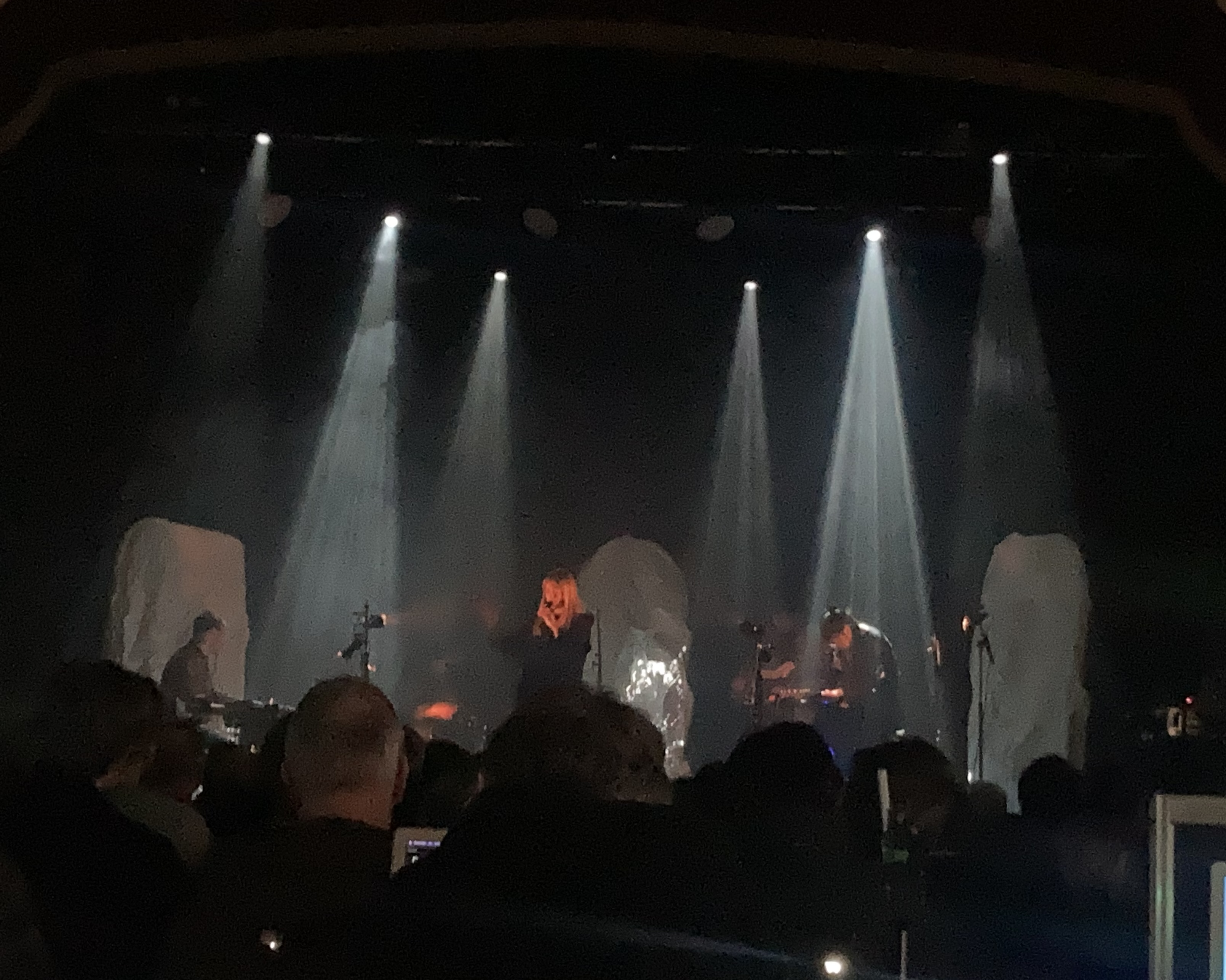
It took a while for me to get from admiration to love for the Weather Station’s new album, Humanhood. At Islington Assembly Hall last night, Tamara Lindeman and her four musicians — Ben Boye (keyboards), Karen Ng (alto saxophone, flute, keyboards), Ben Whiteley (bass guitar) and Dom Billett (drums) — brought its songs fully to focus, in combination with several from its great 2021 predecessor, Ignorance.

This was, as Lindeman had promised, a show designed for theatres, with subtle lighting and a set consisting of three tall, pale, rough-hewn standing stones on which were projected fragments of elemental images: flickers of light from stars and fires, avalanches, drowning forests, all counterpointing the cool but never disengaged clarity of the songs.

The musicianship was exemplary. Whiteley anchored the sometimes irresistible grooves, Billett graded his volume with great care, Ng added the occasional free-jazz flurries on alto that bring the music into a different atmosphere, Boye provided synth mood-setters and lovely spare unaccompanied piano passages, Lindeman contributed economical electric lead guitar.

Together they established moods that were sustained and allowed to evolve through clusters of half a dozen songs at a time, the dynamic ranging from reflecting near-silence on “Lonely” and “Sewing” to that gentle but irresistible gallop in which Lindeman specialises on songs such as Humanhood‘s title track and “Neon Signs” and Ignorance‘s “Loss” and the sublime “Parking Lot”.

Her lyrics are extraordinary: non-repeating snatches of thought and conversation that somehow came through more clearly in live performance, along with her concern for a threat to the environment renewed by the events of the last few months. After starting out as an acoustic singer-songwriter, she has now, with her musicians’ help, developed a carefully textured, agile and quietly resilient hybrid genre that is the ideal setting for her words.

On the last night of a European tour, this was pretty much a perfect concert, one likely to live long in the memory of a warmly appreciative audience.

* The Weather Station’s Humanhood is on the Fat Possum label.

The world and Don Cherry

Wherever, whenever and by whomsoever the idea of “world music” was invented, it had no finer exponent, explorer and exemplar than Don Cherry. In a few months’ time it will be 30 years since Cherry died in Malaga of liver cancer, aged 58, leaving a world in which he was, to quote Steve Lake’s happy phrase, “a trumpet-playing lyric poet of the open road, whose very life was a free-flowing improvisation.” I suppose it was fitting that he should have died in Andalucia, a region where many cultural influences met in the Middle Ages to create a foundation of song.

Cherry’s life and work demand a full-scale biography, along the lines of Robin D. G. Kelley’s standard-setting study of Thelonious Monk. In the meantime, it’s worth welcoming Eternal Rhythm: The Don Cherry Tapes and Travelations, a new book consisting mostly of interviews conducted in various locations around the world by the author Graeme Ewens, who met the trumpeter in the 1970s and became his “confidant, travel companion, witness and friend” over the subsequent two decades. They are augmented by Ewens’ memories of their times spent together from Bristol to Bombay, by biographical notes, and by an interesting selection of photos and other visual material.

A useful addition to Blank Forms’ The Organic Music Societies, a Cherry compendium published in 2021, it’s full of worthwhile stuff. Here’s Cherry on playing with Ornette Coleman in the great quartet that changed the direction of jazz: “Ornette would never count a song off: ‘One, two, three, four, go.’ We would feel each other in the silence before playing and then we would play. And the first accent, or the first attack, would determine the tempo and temper of the composition.” And this, which goes to the heart of Cherry’s conception: “One day when Ornette was working on notation, we talked about how you couldn’t notate human feelings. For me, there was always this problem of notated music sounding like notated music. In the older days you never saw black musicians playing with music stands. They learnt it by heart, which is important. For me, when I learn a song with notes it will take time for me to really memorise it, but it’s important to learn it by heart because then you will know it.”

Cherry tells a story about Miles Davis coming to sit in with him and Billy Higgins at the Renaissance in Hollywood and borrowing his pocket trumpet. And then, later in the ’60s, Miles invites Cherry to sit in with his quintet at the Village Vanguard: “So I played something, the changes from ‘I Got Rhythm’ — AABA — and I stopped my solo right before the bridge, which is the B part, and Miles said, ‘You’re the only man I know who stops his solo at the bridge.’ Then later on I heard him doing the same thing. And the next time I saw him he said to me, ‘Hey, Cherry, I play a little like you now,’ which was a big compliment.” Particularly, one might point out, coming from a man who had initially scorned Cherry’s playing.

In an offical note telexed after a concert in Yaoundé in 1981, during a tour of Cameroon sponsored by the US State Department, a consular official writes: “Cherry and companions were real good-will ambassadors: courteous, patient, curious about country, irrepressibly friendly… (the) only problems arose in trying to move them from place to place as they kept striking up conversations in the street.” On page 132 we learn that the pocket trumpet Cherry was playing at the time of his conversation had once belonged to Boris Vian, the writer and critic, and possibly before that to Josephine Baker. On the very next page Cherry mentions an occasion in the 1950s when he and Ornette went to hear a Stockhausen performance at UCLA.

The book doesn’t duck the question of the social conditions under which the music came into being, or the heroin addiction that began for Cherry in the 1950s and continued on and off for the rest of his life. Here, as part of a lengthy disquisition on changes in the heroin trade, is an insight, from the perspective of 1981: “…you always try and keep some morals. There were certain influential white people who were messing with drugs and so I’d be copping for them, and that’s the way I’d survive. But now on the Lower East Side anybody can go and cop. Anybody. Sometimes they’ll ask you to show them your marks before they let you in the building. That world is another kind of world. You cannot compare that world with the people who just smoke grass, because you’re fighting for your life to survive.”

World music hadn’t been invented — or codified as a marketing category — when Cherry moved on from his jazz background. He’d become famous through his association with Coleman, followed by three wonderful albums of his own for Blue Note (Complete Communion, Symphony for the Improvisers and Where Is Brooklyn?), and his work with Albert Ayler, the New York Contemporary Five, the Jazz Composers Orchestra and Charlie Haden’s Liberation Music Orchestra. His new direction denied nothing of his past but incorporated elements drawn from other cultures, exemplified by his use of bamboo flutes, gamelan and the doussn’ gouni, the six-stringed hunter’s harp from West Africa.

His concert at the Berlin Jazz Festival in 1968, released by MPS under the title Eternal Rhythm, gave a clear indication of where his music was heading. Further evidence came with collaborations with the Turkish drummer Okay Temiz (Orient on BYG and Organic Music Society on Caprice), his duo albums with Ed Blackwell (Mu Pts 1 & 2 on BYG, El Corazón on ECM), his guest appearance on the Swedish drummer-composer composer Bengt Berger’s essay in African ritual modes and rhythms, Bitter Funeral Beer (also ECM), and the three ECM albums by Codona, a trio with the multi-instrumentalists Collin Walcott and Nana Vasconcelos, recorded in 1978-82 (and reissued in 2008 as The Codona Trilogy).

Elsewhere, refusing to be limited by notions of idiom and genre, he turned up on Lou Reed’s The Bells, Rip Rig & Panic’s I Am Cold and a lovely half-hour improvised duet with Terry Riley, bootlegged from a 1975 Riley concert in Cologne. In the early ’80s he toured with Sun Ra’s Arkestra and Ian Dury’s Blockheads.

I want to pass on a pithy little description of Cherry’s playing that I’ve just read in a Substack post celebrating Ornette’s 1972 album Science Fiction by the pianist Ethan Iverson: “Folk music, surrealism, the blues, the avant-garde, deep intelligence, primitive emotion.” That’s good. And, as much as I love his work with Coleman, Albert Ayler and Gato Barbieri, my favourite Cherry albums are probably those that best encapsulate the full range of those qualities, and of his imagination.

They would be Eternal Rhythm, Relativity Suite from 1973 (with the JCOA, never reissued in any form since its its first appearance on vinyl), and the wonderful Modern Art: Stockholm 1977, a concert at the city’s Museum of Modern Art, which appeared on the Mellotronen label in 2014, featuring Cherry and a nine-piece band played marvellously rich acoustic versions of the material from his then-recent album Hear & Now, produced by Narada Michael Walden. It includes a spellbound duet with the Swedish guitarist Georg Wadenius on a graceful Coleman ballad called “Ornettunes” and an ecstatic transition from the gentle groove of “California” (a take on Donald Byrd’s “Cristo Redentor”, with Cherry on piano) to the miniature prayer for transcendence of “Desireless” (first composed as “Isla (The Sapphic Sleep)” for Alexander Jodorowsky’s 1973 film The Holy Mountain and then re-recorded under its new title for Relativity Suite).

It’s easy to imagine that there probably isn’t any music ever played by anyone, anywhere, at any time, from prehistoric hunters on the Eastern Steppe to whatever Kendrick Lamar, Billie Eilish or Nils Frahm are doing next, to which Don Cherry could not have made a worthwhile contribution. And the secret to that must have been his openness.

“I’m self-taught in a way,” he says in the book, “but I’ve always been open to learn, because one lifetime I don’t feel is long enough to really learn music.”

* Graeme Ewens’ Eternal Rhythm: The Don Cherry Tapes and Travelations is published by Buku Press: bukupress@gmail.com. The photograph of Cherry on the Lower East Side of Manhattan in 1988 was taken by Val Wilmer and is used by her kind permission.

The Pauline Boty film

The restoration of the painter Pauline Boty to her rightful place in the pantheon of British pop art took a further step this week with the screening of an hour-long biographical documentary on BBC4. I enjoyed Pauline Boty: I Am the Sixties, despite its rather silly title, which it didn’t really attempt to justify, although the programme was certainly suffused with aspects of the spirit of that decade.

It justified the increased attention Boty been receiving in recent years, and the producer, Vinny Rawding, and the director, Lee Cogswell, deserve credit for their persistence in getting it made. If the inclusion of so many talking heads sometimes makes it feel rather old-fashioned, they do take a chance on inserting, between the clips of Boty from various sources and the testimony from talking heads, a handful of sequences of an actress (Hannah Morrish) resembling Boty, overlaid by passages from an imagined memoir written by Rawding. Perhaps devised as a solution to cost and copyright problems, it just about comes off.

Some of the talking heads are not worth their space. Among the exceptions is the artist Derek Boshier, who appeared with Boty, his fellow student at the Royal Academy, in Pop Goes the Easel, the film made by Ken Russell for the BBC’s Monitor series in 1962. Boshier, who died last year, says something interesting about the culture from which they sprang: “The ideal art college should be one where all departments integrate.” That was certainly the case at the English art college where some of my friends went in the early ’60s: Students of fine art, photography and fashion all took part in each other’s projects.

It was to Boshier that I turned, a few months before his death, when I found myself wondering about Boty’s taste in music. Apparently she listened to music while she painted. What could it have been?

In Pop Goes the Easel, she and Boshier are seen doing the Twist at a party to the record of “Twist Around the Clock” by Clay Cole and the Capris. In another scene the pair, with their fellow students Peter Blake and Peter Phillips, are seen walking through a street market to the Chicago doo-wop of Gene Chandler’s “Duke of Earl”. I got a mutual friend to ask Boshier what Boty might have been playing on the Dansette while she worked. Sadly, he couldn’t remember.

Boty died in 1966, aged 28, so maybe she’d have liked the Beatles and the Stones and the Yardbirds. She’d danced at the very first edition of Ready Steady Go! in 1963 — presumably not, by then, still doing the Twist — and made a painting called 5-4-3-2-1, after the Manfred Mann signature tune.

She also met Bob Dylan, thanks to her relationship with the film-maker Peter Saville. In 1962 Saville directed Evan Jones’s play Madhouse on Castle Street for the BBC, casting the unknown Dylan as “Bobby”. This was Dylan’s first trip abroad, and according to Marc Kristal’s very good Boty biography, the couple picked him up at London Airport.

I imagine her liking Dusty Springfield and the Walker Brothers. But the pop references in her paintings generally came from a different vector: Marilyn Monroe, Jean-Paul Belmondo, Monica Vitti and — in her portrait of her friend Celia Birtwell — Elvis and the Everlys. Other figures were drawn from outside the world of the arts, such as Christine Keeler and Fidel Castro.

In 1964-65 Boty painted a diptych titled “It’s a Man’s World I and II”. Where the first panel has images of masculinity (Muhammad Ali, El Cordobes, a B52 bomber, the dying JFK, Elvis, Ringo and Lennon, Einstein, Proust), the second depicts what Boty sees as going on inside men’s heads: images of naked young women in sexualised poses. At the centre is the dominant image of a full frontal nude, cut off above the shoulders and below the knee.

Caroline Coon, one of the film’s talking heads, hints at a greater significance behind this woman’s lack of a face, and therefore of an individual identity. But later on the film also includes a brief clip from a film called The Day of Ragnarok, a nuclear-scare drama written and directed by John McGrath for BBC2 in 1965, in which Boty made one of her appearances as an actress. It shows her in her studio, working on “It’s a Man’s World II”. At that stage, as can be seen in the screen-grab above, the figure originally had a head, which must later have been painted over. Nobody comments on this in the film, but it’s an interesting decision for the artist to have made.

Inevitably Boty’s career was affected by the attitudes of the time, particularly the assumption that, as a woman, her work couldn’t possess a significance equal to that of her male contemporaries. Perhaps that prejudice lay behind her decision to diversify into modelling and acting (there’s a brief scene in Alfie with Michael Caine). If her looks and her exuberance were attracting more attention than her art, then why not exploit the opportunities?

We’ll never know what might have happened had her progress to a full career in painting not been affected by passive (and perhaps active) obstruction. Nor what she might have done had she not, while pregnant and in what seems to have been a good marriage to the literary agent Clive Goodwin, been told that she had cancer. She declined treatment rather than risk damage to the unborn baby. Four and a half months after giving birth to a daughter, she died. Her renaissance continues.

* Pauline Boty: I Am the Sixties is on BBC iPlayer: https://www.bbc.co.uk/programmes/m0028nyw

Brutalised

Maybe you saw Daniel Blumberg’s acceptance speech for the best soundtrack award during the Academy Awards ceremony at the weekend. Honoured for his work on The Brutalist, he finishes off with a mention of Cafe Oto, which is less of a surprise when you’ve noticed, among the musical credits, the names of such Oto-adjacent improvisers as the saxophonists Seymour Wright and Evan Parker, the pianist John Tilbury and the trumpeter Axel Dörner.

After seeing Brady Corbet’s ambitious film at the IMAX in London today, I came away with mixed feelings. Sometimes it feels like three different and much shorter films, maybe four, trapped together in a very large sack and left to fight it out for three and a half hours.

But the real reason I went was to find out what use Blumberg had made of Evan Parker’s unique qualities. The saxophonist is featured in a sequence filmed amid the marble quarries at Carrara, in the hills above the Tuscan coast, the source of the material from which Michelangelo’s David was wrought, along with Rome’s Pantheon and London’s Marble Arch.

As a camera hovers over the spectacularly gorgeous hewn terraces of white stone, the air is filled with the sound of Parker’s soprano saxophone. Unbroken skeins of squiggling multiphonic sound are shaped with a sound-sculptor’s skill and imagination, soaring like birds above a sombre low-brass chorale.

Given the film’s narrative requirements, it’s a moment of audio-visual magic that can’t last long. But I could happily have taken three and a half hours of that alone, without all the plot-driven drama that surrounds it. Right there, perhaps, was yet another film struggling to escape: a potential classic of slow cinema.

Data mining with Maria Schneider

“It’s kind of nightmarish, what’s happening,” Maria Schneider said during her performance with the Oslo Jazz Ensemble at the Barbican last night. She was introducing the title piece from her most recent Grammy-winning double-album. And since 2019, when she wrote and recorded Data Lords, the nightmares have got a whole lot darker.

Half of the album is about the threat to humanity from the people who are scraping and exploiting our data, whether relating to consumer patterns or creative imaginations. In the past six years we’ve all grown more aware of the activities of people like Elon Musk, Peter Thiel, Mark Zuckerberg, Sundar Pichai and Jeff Bezos. More aware, yes, but seemingly powerless (or unwilling) to halt the tightening of their grip.

The contrasting theme of the other half is the importance of the natural world and its phenomena, from birdsong to handmade objects to poetry. Again, it’s necessary only to read the news to appreciate the individually varying but generally increasing levels of threat.

She mixed up the pieces last night, starting with the powerful lyricism of “Bluebird”, its tone set by the accordion of Kalle Moberg. More sardonic and disquieting was “Don’t Be Evil”, which takes its title from Google’s extraordinary instruction to staff. As waves of brass were finessed down to a chamber trio, this was a demonstration of Schneider’s love of dynamic contrast.

Although she spent several early years as Gil Evans’s protégée, Schneider truly belongs to the genre of composer-arrangers who worked for Stan Kenton in the 1950s: people such as Pete Rugolo, Gene Roland and Bob Graettinger, creators of dramatic charts with plenty of space for fine, characterful soloists. In Schneider’s hands, such music doesn’t have the built-in flexibility associated with Fletcher Henderson, Ellington, Basie, Carla Bley, Mike Gibbs or, for that matter, Gil Evans, but its musicality and integrity are impeccable. Maybe Kenny Wheeler’s big-band writing is the closest comparison, but Schneider’s music is imbued with her own personality.

Last night’s selection of pieces was well served not just by the ensemble but by all the soloists, given outstanding support throughout from the supple double bass of Trygve Waldemar Fiske. It was amusing to note that the two women members of the 18-piece ensemble were playing bass trombone and baritone saxophone: between them, Ingrid Utne and Tina Lægrid Olsen were holding up the earth.

Olsen was memorably featured on “Sputnik”, her softly ruminating baritone charged with evoking the innocent wonder once felt by those old enough to remember going outside to see the first satellites (the forerunners of the Starlink system with which Musk can now, should he so wish, control world wars). As she brought her spellbinding solo gently back down from its low orbit, the tone poem closed with one of those tapered endings — a sort of whispered catharsis — in which the composer specialises.

“I don’t want to leave you with the annihilation of humanity,” Schneider said, introducing the encore, the sweet waltz of “Braided Together”, which she prefaced by reading Ted Kooser’s short poem “december 29”: a flicker of candlelight offering hope amid the gathering gloom.

* Maria Schneider’s Data Lords is on the crowdfunded ArtistShare label. I took the photograph above after the performance had ended.