Skip to content

Posts by Richard Williams

Mike Westbrook’s Band of Bands

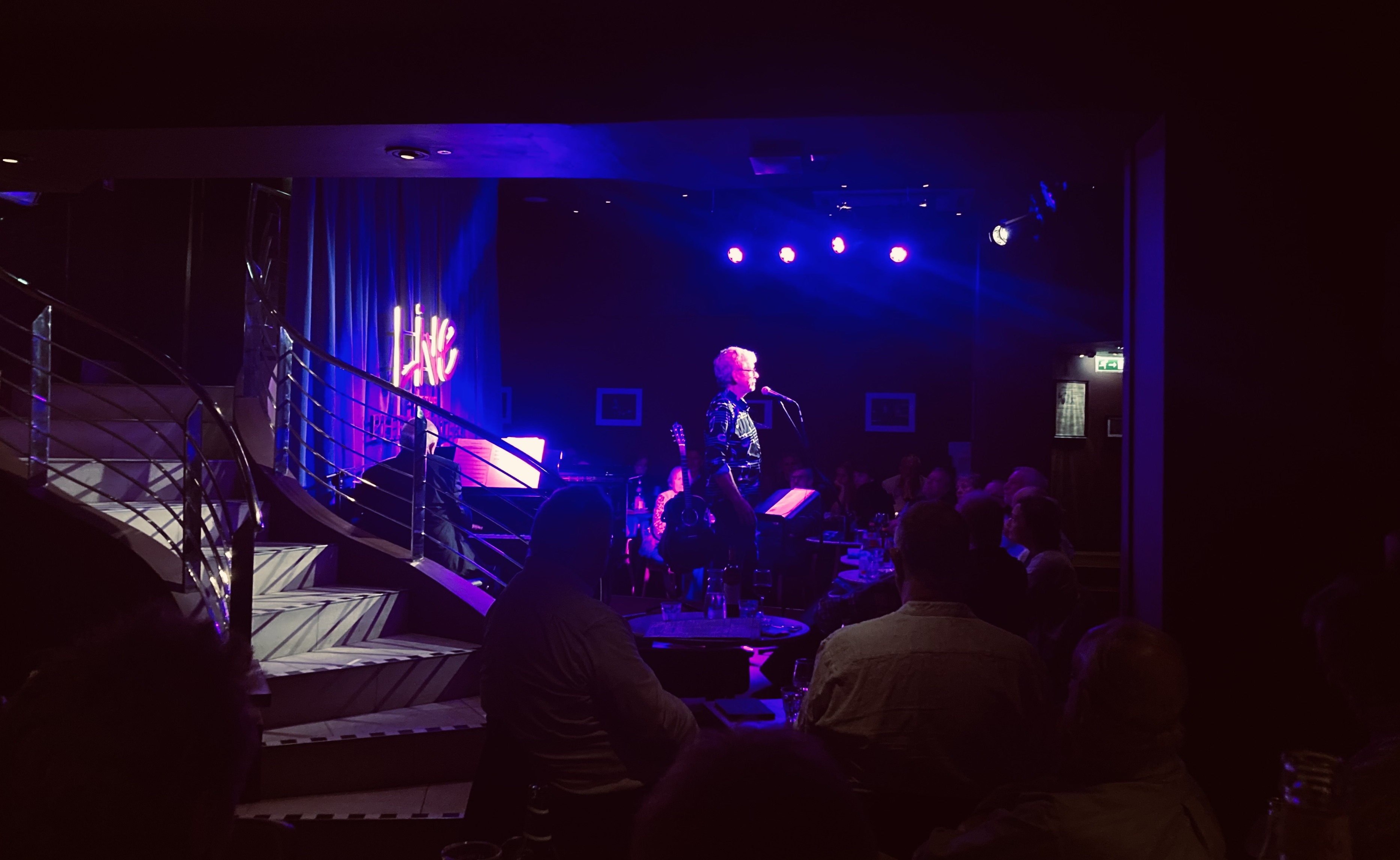
From left: Mike Westbrook, Kate Westbrook, Karen Street, Pete Whyman, Chris Biscoe, Marcus Vergette (out of shot: Coach York)

You might have noticed, Mike Westbrook said as the second of today’s two lunchtime sets at the Pizza Express drew to a close, that a lot of this music we’ve been playing has something to do with the blues. And then he quoted Duke Ellington: “When times get tough, I write another blues.” That, Westbrook said, is what he found himself doing rather a lot these days. And then he and the new septet he calls his Band of Bands played “Gas, Dust, Stone”, which he described as “a blues for the planet”.

Its slowly wandering theme, first sung by Kate Westbrook and then voiced for the alto saxophones of Chris Biscoe and Pete Whyman and the accordion of Karen Street, reminded me at times of Ellington’s world-weary “4:30 Blues” before the mood switched, charging into the 12/8 of Charles Mingus’s “Wednesday Night Prayer Meeting”, powered by Marcus Vergette’s bass and Coach York’s drums, with a beautiful Street solo.

Westbrook, who is 87, formed his first band in Plymouth in 1958, and the Band of Bands celebrates longevity. Mike and Kate have been working, writing and performing together for 50 years. Biscoe first joined them 40 years ago, to create the Westbrook Trio. Street and Whyman have been with them on various projects for 30 years. Vergette and York, the newcomers, were called to the colours a mere 20 years ago, and are now the heartbeat of the Uncommon Orchestra.

The septet is both an expansion of the trio and a reduction of the big band, capable of handling everything from the fast bebop of the opening “Glad Day”, one of Westbrook’s pieces inspired by William Blake, through a brilliantly recast version of Billy Strayhorn’s “Johnny Come Lately” to the slow-rolling gospel cadences of “Blues for Terenzi” and the open spaces of “Unsigned Panorama”, with marvellous unaccompanied solos by Whyman (on clarinet) and Street.

Several songs from Fine ‘n’ Yellow, their 2010 song cycle, made an impression. Throughout “Yellow Dog”, York maintained a pulse (on his beautifully clear Murat Diril ride cymbal) three times that of the rest of the band, allowing Biscoe to float in his typically expressive solo between the drummer’s tempo, the much slower one being paced by Vergette, and the unstated one in between. “My Lover’s Coat”, finely sung, seemed to have “Blue Monk” in its bones.

If there were frequent reminders of how thoroughly Westbrook has metabolised his love of Ellington, Mingus and Monk, there was also evidence of a new enthusiasm for the songs of Frederick Hollander, a German composer of film music. Born Friedrich Hollaender in London in 1896 and brought up in Berlin, he wrote for Max Reinhardt’s theatre productions, accompanied artists in the Weimar-era cabarets, and wrote the music for Josef von Sternberg’s The Blue Angel, including “Falling in Love Again”, delivered by the film’s star, Marlene Dietrich. Leaving Germany when the Nazis took power, he arrived in Hollywood in 1934, anglicised his name, and had written for more than 100 films before his return to Germany in 1956, where he died in 1976.

One of those Hollywood films was A Foreign Affair, a 1948 comedy-drama set in post-war Berlin, directed by Billy Wilder and again starring Dietrich. Kate Westbrook delivered two of Hollander’s songs from that film, both concerned with the perils of emotional and sexual transactions: the sardonic “Black Market”, a Weill-esque piece on which she departed from the text to display her command of vocal effects, and “Illusions”, a gorgeous ballad on which she was exquisitely supported by Street and Biscoe.

Pointing out to the audience that this was the first public appearance of the Band of Bands, Westbrook expressed the hope that there would many more. An album devoted to the music of Frederick Hollander might not be such a bad next step*.

* See a comment below.

Fire of London

The flight of Mike Osborne’s alto saxophone was like that of the swift: its entire existence was spent on the wing, soaring high or swooping in shallow dives, twisting back on itself before arcing again towards the heavens, as if desperate to avoid contact with the ground.

Something remarkable was happening in London in the early ’70s, at places like the 100 Club, the Phoenix in Cavendish Square, the Plough in Stockwell, and Peanuts, a regular session run by Osborne at a place near Liverpool Street station. A few dozen young musicians, most of whom had emerged late in the previous decade as sidemen in the bands of Mike Westbrook, Chris McGregor, Graham Collier and John Stevens, were now playing together in shifting combinations. The economics of jazz dictated a preference for small groups, and one of the most remarkable was Osborne’s trio, completed by two South African emigrés, Harry Miller on bass and Louis Moholo on drums.

What I remember from that scene is the absolute lack of pretension. There was no interest in surfaces or self-presentation. The musicians appeared before the audience wearing the clothes they’d arrived in. There wasn’t much in the way of introducing or explaining — but neither was there the kind of self-conscious detachment that even someone as natural as the bassist Dave Holland, once a member of that London scene, felt compelled to adopt on stage when he crossed the Atlantic and joined Miles Davis.

On the bandstand, the Mike Osborne Trio was typical of its time and milieu in that there was only one priority: to burn. Strategies learnt from Coltrane, Coleman and Ayler were bent to their own ends, creating a platform for their own individual voices. Osborne loved Ornette and Jackie McLean, his fellow altoists (I remember a copy of the latter’s great Blue Note LP Destination…Out! propped beside the record player in his flat when I interviewed him in 1970), but he became one of the era’s great originals on his instrument.

Sadly, his own era didn’t last long. In 1959 he arrived from Hereford as an 18-year-old to study at the Guildhall in London. Fifteen years later he suffered a breakdown at the end of a six-week gig at the Paris Opéra, where he had played onstage for a ballet alongside the other two members of the group SOS, his fellow saxophonists Alan Skidmore and John Surman. Prolonged treatment meant that there would be only sporadic gigs until 1982, when he returned to Hereford, his playing days at an end. He died of cancer in 2007, aged 65.

His discography is not huge, but it is of extraordinary quality, whether in sessions with Westbrook, SOS, the one-off quartet of the trumpeter Ric Colbeck, Surman’s octet, the big bands of Kenny Wheeler and John Warren, Miller’s Isipingo, McGregor’s Brotherhood of Breath, or a duo with Stan Tracey. And now there’s a wonderful addition in the shape of a session said to have been recorded (surprisingly well) at the 100 Club in December 1970, where Ossie, Harry and Louis were joined by Skidmore to make a fire-breathing quartet of ferocious intensity but immaculate balance.

As I remember him, Ossie always played with his eyes closed, everything else shut out. His tone is at its most beautiful on this session, whether making an assembly of staccato phrases or, more frequently, sliding through faster-than-light near-glissandi that never lose coherence or a sense of proportion. At this stage of his life, his emotions had located the perfect musical register. No wonder, after he had dropped out of SOS, Surman and Skidmore found him impossible to replace, and the group’s own short life was over.

On a winter’s night in an Oxford Street basement in 1970, Skidmore, Miller and Moholo matched him every step of the way, and Starting Fires is a very appropriate title for an album containing 40 minutes of music that never lacks light and shade but is driven by its unwavering sense of purpose. Short, epigrammatic themes appear and then dissolve, giving shape to the performance. Near the beginning and again towards the end, the two horns improvise together quite brilliantly, twining and tangling with complete commitment. It’s life-and-death stuff, which is how so much of this music felt at the time, and never more so than when Mike Osborne was on the stand.

* Mike Osborne’s Starting Fires: Live at the 100 Club 1970 is out now on the British Progressive Jazz label. I don’t know who took the photograph. My Guardian obituary of Osborne is here.

The voices of Thom Bell

On November 5 in Brooklyn, the Spinners will be be inducted into the Rock and Roll Hall of Fame. Known to British fans first as the Motown Spinners and then as the Detroit Spinners, in order to distinguish them from a Liverpool folk group active between 1958 and 1989 under the same name, their string of hits began with “I’ll Be Around”, “Could It Be I’m Falling in Love”, “Ghetto Child” and “One of a Kind (Love Affair)”. All four were plucked from their self-titled first album for the Atlantic label, after they had moved from Motown and came under the supervision of the producer, arranger, pianist, songwriter and genius Thom Bell. Subsequent successes included “Mighty Love”, “I’m Coming Home”, “The Rubberband Man”, “Then Came You” (with Dionne Warwick) and “They Just Can’t Stop It (The Games People Play)”.

Only one member survives from the original quintet, formed in 1954, and its Bell-produced incarnation of the 1970s. Henry Fambrough, their baritone singer, will have to stand in for the rest of them: Pervis Jackson, Billy Henderson, C. P. Spencer, Bobbie Smith, Philippé “Soul” Wynne and John Edwards are all gone, along with several others who passed through the ranks at other times (and, of course, Bell himself, who died in December 2022: obit here). There is still a group of younger men legitimately touring as the Spinners, but Fambrough, who is 85, retired earlier this year.

Several other R&B vocal groups of their era, such as the Dells and the Temptations, used more than one lead singer, occasionally within the same song. None, however, pulled it off with as much ease and elegance as the Spinners. On “Could It I’m Falling in Love” and “Mighty Love”, the smooth-toned Smith started off before Wynne took over to add a rougher, more gospel-hued and improvisatory delivery. Such combinations were still working in 1976 when Jackson’s bass introduction gave way first to Smith and Henderson and finally to Wynne on “I Must Be Living for a Broken Heart” on their sixth album, Yesterday and Today.

This sophisticated update of a 1950s doo-wop vocal strategy was typical of Bell, who made great records with the Delfonics and the Stylistics before reaching his peak with the Spinners. The early hits were characterised by an adaptation of the thudding tom-tom backbeat heard on Al Green’s Willie Mitchell-produced hits, again given an extra coat of luxury varnish. Recorded at Sigma Sound in Philadelphia, with the great studio engineer Joe Tarsia, they benefitted from the musicians who became known known as MFSB: Roland Chambers, Bobby Eli and Norman Harris on guitars, Ronnie Baker on bass guitar, Earl Young on drums, Larry Washington on percussion and Vince Montana on vibes, with Bell himself on piano.

One of his trademarks was a subtle use of syncopation and uneven meters: the clipping of a beat from a single bar here, the addition of a couple of extra beats at the end of a line, or the shuffling of stresses that could make it sound, on the choruses of “Then Came You” and “Are You Ready For Love” (written for Elton John), as though he’d turned the beat around when in fact he hadn’t. These little things both seized and satisfied the ear. And no one, not even Burt Bacharach, could integrate a concert harp or an oboe into an R&B record as smoothly as Bell.

Smoothness without blandness was his trademark, as can be heard throughout the eight albums he made with the group, now included intact on a seven-CD box compiled by Joe Marchese and the veteran British journalist David Nathan. You can hit the button on just about any track and find something nourishing (perhaps with the exception of an ill-advised big band jazz version of “Don’t Let the Green Grass Fool You” on that first album, an experiment not repeated). And occasionally you’ll find a masterpiece.

Two of them are on the second album, Mighty Love. The first, written by Charles Simmons, Joseph Jefferson and Bruce Hawes, three of Bell’s regular songwriters is “Love Don’t Love Nobody”, Wynne’s finest seven minutes on a deep-soul track I’ve written about at some length before (here). The second, penned by Bunny Sigler, James Sigler and Morris Bailey, is “He’ll Never Love You Like I Do”, one of those songs about a poor boy pressing his claim on the object of his affection: “His standard of living, his social rating / There’s nothing he can’t afford / He made you think I ain’t it / But when it’s love, I can give you more…”

It opens with an octave guitar, Wes Montgomery-style, accompanied by piano, soon doubled by a muted trumpet and cushioned by a purring bass and Don Renaldo’s gentle strings. Bobbie Smith begins the song, delivering the opening lines in a confiding croon before Wynne takes over halfway through the first verse, the two reversing the sequence in the second verse, with the joins at first barely audible (although Wynne’s ad libs give him away). And just as Motown’s Holland-Dozier-Holland had used the female chorus of the Andantes to lend an extra emotional dimension to the Four Tops’ records in the ’60s, so Bell adds the voices of Barbara Ingram, Yvette Benson, Carla Benton and Linda Creed, his frequent co-composer, to create a refined blend with those of the Spinners themselves.

Like so much of Bell’s output, this track demonstrates the power of restraint, a quality evident throughout these fine albums. Even after the advent of disco, bringing adjustments to rhythmic emphases and the occasional flicker of wah-wah guitar, and with the arrival of John Edwards to replace Wynne halfway through the making of Yesterday and Today in 1977, the combination remained, and remains, exemplary.

* The Spinners’ Ain’t No Price on Happiness: The Thom Bell Studio Recordings (1972-79) is out on 29 September on SoulMusic Records. If anyone knows who took the fine photograph of Bell at the top of this piece, I’d be very pleased to add a credit.

Re-Focus

No single organisation has exerted a more profound or beneficial influence on jazz in Britain than Tomorrow’s Warriors, founded as an outgrowth of the Jazz Warriors big band 30 years ago by Janine Irons and her husband, the bassist Gary Crosby, with the ambition of giving young people from diverse and usually unprivileged backgrounds a chance to play and learn about this music. A few days after the historic Mercury Prize win by Ezra Collective, whose five members first came together in their free workshops, another celebrated Tomorrow’s Warriors graduate, the tenor saxophonist Nubya Garcia, took the stage at the Royal Festival Hall last night in front of a 32-piece all-string version of the Nu Civilisation Orchestra, TW’s shape-shifting large ensemble. Their mission was to perform the music written by Eddie Sauter for Stan Getz in 1961, recorded by Creed Taylor for the Verve label and released as the album titled Focus, instantly setting a new standard for the creative use of a string orchestra in jazz.

Crosby told me that the idea came to him soon after his first encounter with Garcia, 14 or 15 years ago, when she was in her teens. Something about her sound, he said, made him think the combination would work on a reinterpretation of work he’d long admired. Garcia knew about Getz but had never heard Focus. Last night she filled what Sauter called “the holes I left for Stan” with her own sound and style, while fully respecting the tone and approach of the original, a task probably eased by her own early training as a classical violinist.

The suite in seven movements begins with the hectic flurry of “I’m Late, I’m Late”, one of the most arresting album openings imaginable. Last night the part of Roy Haynes, whose urgent brushwork so memorably sparred with Getz, was deftly taken by Romana Campbell. Garcia grew into the performance, adding weight and character to her improvisations as the sequence flowed through “Her”, “Pan”, “I Remember When”, “Night Rider”, “Once Upon a Time” and “A Summer Afternoon”. Her sound reminded me less of Getz’s feathery ethereality than of the firmer tone of his fellow Lester Young disciple Jimmy Giuffre; there was even a passage — during “Pan”, I think — when the combination of the tenor with a folkish motif unexpectedly reminded me of a greatly expanded version of Giuffre’s celebrated “Train and the River” trio. Led by the violinist Rebekah Reid, the strings were immaculate, remarkably so considering that a family illness had prevented the scheduled conductor, Peter Edwards, from taking part. Scott Stroman, the Guildhall School’s professor of jazz, stepped into the breach.

Maybe Focus doesn’t sound as bracingly different today as it did 60 years ago, when it so boldly broke away from the conservative tradition that had dominated the string arrangements for Charlie Parker (by Jimmy Carroll and Joe Lipman) and Clifford Brown (by Neal Hefti). Like George Handy, George Russell, the film composer Bernard Herrmann and one or two others, Sauter’s study of Bartók and Stravinsky had inspired the desire to bring some of their techniques to his own writing. But the result still sounds spectacular, and the London crew more than did it justice in a performance that mixed care and joy in admirable proportion.

* A few days before the concert, Nubya Garcia and the Nu Civilisation Orchestra recorded two of the pieces for Jamie Callum’s Jazz Show on BBC Radio 2. They can be heard here (interview from 17:00, music from 37:00): https://www.bbc.co.uk/sounds/play/m001q5gy — and if you want to give money to help Tomorrow’s Warriors with their valuable work, go here: tomorrowswarriors.org/iamwarrior

Defying gravity

It’s easy to imagine the director Dorsay Alavi going all the way through an alphabetical list of Wayne Shorter’s compositions while looking for a suitable title for her three-part documentary on the life and work of the great saxophonist and composer, and knowing when she reached “Zero Gravity” that she’d got it. As such bio-docs on jazz musicians go, Wayne Shorter: Zero Gravity is something of a masterpiece. The title expresses the subject’s unique characteristic, present in his music and in his conversation, as I found while interviewing him in his London hotel room for the Melody Maker in 1972, during Weather Report’s three-week season at Ronnie Scott’s. Here’s how the piece started:

“I hate to talk about music,” Wayne Shorter said. So we didn’t — at least, not really. For instance, we talked about the navigation of ships. Wayne showed me several large books on the subject, told me he was hoping to study it seriously, and then unrolled a sheet of score-paper on which he’d written a new composition called “Celestial Navigator”, based on the feelings gathered from his discoveries.

We talked about the sacred figures of Brazil — like the Lady of the Sea. If you see her, Wayne said, she she sees you, then you don’t live to tell the tale. But she serves people from the sea, too, and every Brazilian home contains her picture. And he showed me another piece, named after her.

And so it went on, through an hour or so of conversation which I can only compare to the experience of talking to Ornette Coleman, Don Van Vliet (Captain Beefheart) or Van Dyke Parks. The interviewee is operating on a different plane of thought and expression, and your best plan is to keep out of the way and let their logic take its own trajectory. Of course that doesn’t always work. Sometimes you can’t help trying to drag them back to earth. Yet at such moments Shorter remained gracious. Here’s more:

Although he didn’t really want to discuss it, I asked him why he left Miles Davis. “After six years with Miles it was becoming… that living cycle, that seven-year itch thing, came around. I knew had to take a year off, at least. My wife and I moved around, spending the summer in a town house in New York, where I could think about how to get rid of that sound I had with Miles, to get the sound of the musicians, and the compositions I wrote during that time, out of my head.

“I wanted to rid myself of any one association — so that people can look at anything new that I do with a bit of objectivity, without connecting me with Miles or Art Blakey, as everyone always has.” It wasn’t always easy for him to take his sabbatical. “Miles would call me up and ask if I wanted to make a record date, or write something for his band, and I had to refuse because it was necessary for me to break that connection completely.”

He talked about his most recent Blue Note album, Super Nova, and its projected successor, Odyssey of Iska, dedicated to his younger daughter, and about his enthusiasm for the Brazilian singer Milton Nascimento (who would be featured on Native Dancer, his first album for Columbia, in 1975). And he spoke warmly, of course, about Weather Report:

“I’d always had the feeling that it would be nice to have a band in which everybody would hold their own and have a leader’s responsibility. We’re all responsible to many different obligations, which is much better than when one man is responsible for everyone’s obligations. We can do more, musically. It was hard to find a bunch of musicians who were prepared to stop playing like they used to.”

That last remark is the kind of thing that pops up throughout Zero Gravity: little maxims, like Zen koans, that open the mind to new ways of thinking about old subjects, some of them adapted from Davis, his former boss. “Play like you don’t know how to play” is one. Search for “music that doesn’t sound like music” and “Jazz means, ‘I dare you'” are others. Danilo Perez, the pianist with his quartet, remembers being given a large pile of new compositions, and on asking Shorter when they were going to find the time to rehearse them, getting the reply: “You can’t rehearse the unknown.”

The first of Zero Gravity‘s three hour-long episodes deals with his early years, from a New Jersey childhood to the great Davis Quintet, the director taking the chance of using two young actors in wordless imaginative reconstructions of his boyhood with his brother Al. The second part examines with the period of Weather Report’s great success, the reasons behind the group’s dissolution, his work with Joni Mitchell, and the personal tragedies he encountered during those years, including the deaths of Iska and her mother, Ana Maria Patricio, his second wife, and of Al, his brother.

The final part deals with the music of his last 20 years: the wonderful quartet with Perez, the bassist John Patitucci and the drummer Brian Blade, the orchestral pieces, and the opera, Iphigenia, written and performed with Esperanza Spalding. Her presence in the film, along with that of Mitchell and the drummer Terri Lyne Carrington, reminds us that few jazz musicians of his generation were as comfortable as Shorter with the idea that female musicians could have equal standing within the music.

Shorter’s love of fairy tales and science fiction, in part ignited by early exposure to Charles Kingsley’s The Water Babies, is also featured as part of an exploration of the character of a man who retained a child’s sense of wonder throughout the life that ended last March, in his 90th year on the planet. The animations and flights of visual imagination that appear throughout the film, alongside many fine clips of the Jazz Messengers, the Davis band and the Shorter quartet, make complete sense. Filmed and edited while he was still alive, and thus preserving him in the present tense. Zero Gravity is pretty much the perfect tribute to an extraordinary human being.

* The film Wayne Shorter: Zero Gravity is available on Amazon Prime.

Tension and release

While writing about Nik Bärtsch recently, I mentioned his practice of giving all his compositions the same title — each is called “Modul”, with a distinguishing number attached, thereby establishing no preconceptions in the listener’s mind. In that respect Darcy James Argue, the Canadian-born, New York-based composer, could hardly be more different. In the past, the pieces on his albums with his big band, Secret Society, have variously directed our attention towards an imagined dystopian Brooklyn, a philosopher of ancient Greece and a distinctly realistic dystopian deep state. His latest, a 2CD set called Dynamic Maximum Tension, consists of pieces inspired by specific individuals, ideas and events, bearing dedications clearly signposting their themes, and reflecting those origins in their sound and structures.

This can be almost literal in something like “Codebreaker”, dedicated to Alan Turing, in which the staccato brass phrases evoke the chatter of an Enigma decoding machine, opening up for a lovely soft-toned alto saxophone solo by Rob Wilkerson. Or it can be implied, as in “Tensile Curves”, a multipart work dedicated to Duke Ellington, with seven individual soloists and lasting 35 minutes, which in past times would have been a respectable length for a single long-playing album. It was inspired by the unorthodox extended structure of Ellington’s “Diminuendo and Crescendo in Blue”; there is nothing particularly Ducal about the sound, but he would surely have appreciated the grace with which the piece, having opened with shrill brass fanfares against Jon Wiken’s galloping drums, creates a kaleidoscope of moods before it winds down through a passage featuring Sara Caswell’s hardanger d’amore (a modern Norwegian fiddle with 10 strings, five of them sympathetic), Adam Birnbaum’s sombre piano chords and a Mingus-like passage of collective polyphony, with Sam Sadigursky’s clarinet closing a darkly glowing coda.

More unexpected is “Last Waltz for Levon”, a tribute to Levon Helm — the only member of the Band, of course, who was not Canadian — which summons as much backwoods spirit as a 20-piece band can, with the trombonist Mike Fahle as its featured soloist (over mellow writing for clarinets) and incorporating sidelong quotes from “The Night They Drove Old Dixie Down”, introduced by Mike Clohesy’s bass guitar. Cécile McLorin Salvant pops up to do a turn on “Mae West: Advice”, singing a jolly lyric based on a sort-of-Dadist poem by Paisley Reckdal: Ban tobacco: do bacon abed, be delectable, collectible, a decent debacle. Décolleté don’t conceal; acne, do...

The title of the opening track, “Dymaxion”, is the short form of Dynamic Maximum Tension, the principle on which the engineer-architect Buckminster Fuller, the dedicatee, created his structures, including the geodesic dome before which Argue is standing in the picture above. You can sense in the writing the measured use of tension to ensure that an unreinforced structure retains its shape, while Carl Maraghi’s gorgeous baritone saxophone improvisation reminds us that Fuller worked with people and nature as well as geometric formulae in mind. At times such as this, Argue’s confident manipulation of his resources makes me think that finally someone has taken the theory behind Bob Graettinger’s controversial modernistic Third Steam pieces of the early ’50s (such as City of Glass, written for Stan Kenton) and turned it into actual music.

But out of this densely packed sequence of 11 compositions and 110 minutes of music, “Your Enemies Are Asleep” is the piece that will stay with me longest. Here Argue metabolises his debt to Gil Evans quite brilliantly in the opening passage: a slow, well-spaced string bass figure to set an ominous mood, spare woodwind voicings, a half-concealed bass clarinet beneath lightly sketched brass. Then the bass figure is augmented, the brass becomes a choir, and Ingrid Jensen — another Canadian — enters for a solo which, for the subtlety of its entry and the enthralling development of its trajectory over an increasingly dense and emphatic orchestration, reminds me of nothing less than the way Evans turned “The Barbara Song” into a concerto for Wayne Shorter 60 years ago. Jensen’s improvisation is a masterpiece in its own right: flaring, squeezing, dodging, soaring and fluttering around the contours of the writing. The closing passage is another example of Argue’s gift for ending a piece on a quietly dramatic note of reflection.

Oh yes, and Martin Johnson’s sleeve essay informs us that “Your Enemies Are Asleep” is dedicated to Ukraine’s resistance to Russia’s invasion, its title taken from a 19th century Ukrainian poem set to music by Vasyl Ovchynnikov, a bandura player who disappeared during the Stalinist terror of the 1930s. The notes beyond the notes add another layer of resonance to this outstanding album of completely modern music whose precision — whether of conception or execution — never excludes the human component.

* Dynamic Maximum Tension by Darcy James Argue’s Secret Society is released on the Nonesuch label: https://darcyjamesargue.bandcamp.com/album/dynamic-maximum-tension. The photograph of Argue is by Lindsay Beyerstein.

A Lifetime ago

Here, out of the blue, is something of historical importance: a piece of film showing Tony Williams’ Lifetime — with Larry Young, John McLaughlin and Jack Bruce — in Bremen, recording for the popular Beat Club TV show during their European tour in late 1970 but never broadcast. This nine-minute extract from that 30-minute performance, which appeared on the programme’s YouTube channel this week, is the only filmed record of the existence of one of the key bands of its decade.

It’s particularly important to me since I saw them twice that year, and it provides evidence, up to a point, of what I’ve been saying ever since. They were extraordinary both times, but the second appearance — at the Marquee on Tuesday 6 October — still lives in the memory as the most electrifying gig I’ve ever attended.

The first time was at Ungano’s, a club on West 70th Street in NYC, where they spent most of August, having done a week at Slugs’ Saloon in the East Village in April and then played concerts in Pennsylvania, Detroit, Cincinnati and elsewhere. They were still a three-piece, just drums, organ and guitar, as they had been on Emergency!, their remarkable debut album, and already they were staggeringly different from anything else around. (One thing I remember about that night is Miles Davis leaning against the bar, wearing a tan patchwork suede suit, listening hard. Outside his silver Lamborghini Miura was parked at the kerb.)

The next day I went to interview Tony at the office of Polydor, his record company. The conversation was not productive. He was reading the New York Times while I asked my questions, and he carried on reading while he gave his answers in surly monosyllables. I don’t think I even wrote it up. His manager later conveyed his apologies. As it happened, I didn’t mind. A lot of the younger musicians who’d worked with Miles in the ’60s had picked his refusal to be ingratiating, either with audiences or journalists. Being cool was the priority. That was kind of all right with me.

And anyway I’d more or less worshipped Tony Williams since he’d joined Miles in 1963, aged 17. He was 15 months older than me, and I was trying to be a drummer at the time. To have someone of just about my age joining Miles was mindblowing. The dimension of his genius — and genius is what it was — somehow softened the blow when I decided that I wasn’t going to make a career of it. I was happy just to listen to him, whatever he did and whoever he did it with. And however he chose to conduct his public relations, which was really not important.

Bruce had joined to make it a quartet by the time they arrived in Europe for two months later for a 40-date tour. The Marquee was the third of those dates; they’d already played at Lancaster University and the Roadhouse in Dagenham. I stood there with Robert Fripp among the audience of about 200 as they played and he was as blown away as I was by the cascades and tidal waves of sound they produced. That’s what the Beat Club clip, magnificent though it is, doesn’t capture: it gets the complexity of the music but not the intensity, which had less to do with volume — although they were very loud — than with intention. The overriding sensation was that they were on a collective journey of discovery, there and then.

Larry Young was the least known of the four to a British rock audience, but in a way his playing defined the music that night. His Blue Note albums — Into Somethin’ and Unity — had shown that he had a very different approach to the Hammond organ from Jimmy Smith, Jack McDuff or John Patton. He brought the instrument into the sphere of the New Thing. But with Lifetime he took it somewhere completely different, into a realm of almost pure texture (although that’s not an adequate word).

I’m indebted to the drummer Vinnie Sperrazza for teasing out, in his excellent Chronicles blog, the identity of the snatches of four themes heard in the clip: three McLaughlin pieces, “Devotion” and two that he would later record with the Mahavishnu Orchestra,”Trilogy” and “The Dance of Maya”; and the Jack Bruce/Pete Brown “Smiles and Grins”, which would appear on Jack’s solo album Harmony Row a year later. There’s a lot of 7/4 in there.

For me, this was the band of the era. To a far greater extent than Weather Report, Return to Forever, Headhunters or Mahavishnu, they realised the promise of In a Silent Way and Bitches Brew. Only Hendrix, at his very best, could match them. And they were together not even a year. It’s painful to think of what they might have gone on to achieve. But sometimes, even now, you can hear a band clearly marked by their influence, and it still sounds like the future.

The return of Pete Atkin

It’s often said, with an air of puzzled regret, that Britain lacks the equivalent of chanson. We certainly had an influential Anglo-Scottish folk tradition, and we had the Beatles and Radiohead. But we didn’t exactly have a Georges Brassens, a Léo Ferré or a Jacques Brel. There never seemed to be a market for that kind of grown-up, ballad-based popular music. Some might say that Jake Thackray, the sardonic, saturnine Yorkshireman who died 20 years ago, came the closest. Others would make the case for Pete Atkin, who emerged at the end of the 1960s singing songs in which he put the melodies to the lyrics of Clive James, and who returned to live performance at the Pheasantry in Chelsea on Saturday night.

For a few years at the beginning of the ’70s, it looked as though Atkin and James, who had met as members of the Cambridge Footlights, might be on the brink of some sort of commercial success with albums such as Beware of the Beautiful Stranger, Driving Through Mythical America and A King at Nightfall. But things tended to get in the way. One example would be Kenny Everett getting sacked from the BBC for making a joke about a cabinet minister just as he was playing one of their songs every week on his Radio 1 show.

Another might be James becoming famous for his weekly Observer TV review, in which he found his comic voice. Polyglot, polymathic, he translated Dante, wrote a series of best-selling memoirs, hosted an annual Formula 1 review on TV, befriended Princess Di, and took tango lessons in Buenos Aires. Atkin, for his part, had a long and award-winning career with BBC Radio as a script editor, producer and head of network radio in Bristol — as well as voicing the part of Mr Crock in a Wallace & Gromit movie. In the early 2000s they reunited and toured together, writing new songs before James succumbed to leukaemia in 2019.

Atkin’s dry, classless English voice was always a long way from the tone of his male singer-songwriter contemporaries produced by the English folk scene, from Ralph McTell to Nick Drake. Lacking any hint of assumed American inflection, his delivery suited James’s agile, witty and erudite lyrics, even though James took so much of his subject matter from American popular culture. Together they aimed for a modern take on the great Broadway songwriting partnerships, absorbing the pop-culture influences of their own time alongside historical references just as their predecessors had. Cole Porter’s “You’re the Top” — “You’re an old Dutch master / You’re Mrs Astor” — might have been their template.

It’s a combination that appealed to a certain sensibility, one well represented at the Pheasantry, where Atkin was making a rare appearance in order to launch a new CD, The Luck of the Draw, the second volume of revisions of some of the old songs and a handful of hitherto unrecorded collaborations (the first, Midnight Voices, was released in 2007).

He sang and played guitar, accompanied for much of the time by Simon Wallace’s beautifully fluent piano. Wallace is one of the musicians on the new album, along with an A-team of Nigel Price on guitar, the bassist Alec Dankworth, Rod Youngs on drums, Gary Hammond on percussion and the saxophonist Dave O’Higgins, together reupholstering the older songs with care and imagination. (Atkin and James always had good taste in musicians: Chris Spedding, Kenny Clare, Alan Wakeman, Tony Marsh and Herbie Flowers were among the supporting cast on the early albums.)

The dramatic highlights of the live set were “Beware of the Beautiful Stranger” and “The King at Nightfall”, two songs for which Atkin, as was his underrated habit, found melodies at least the equal of the beguiling lyrics. The latter’s portrayal of a fallen and hunted despot, its title taken from a line in Eliot’s “Little Gidding”, seems even more resonant today than it was in 1973.

Sometimes James’s erudition could be stretched a bit thin in pursuit of wittiness, as in “I’ve seen landladies who lost their lovers at the time of Rupert Brooke / And they pressed the flowers from Sunday rambles and then forgot which book” (from “Laughing Boy”). During the show Atkin mentioned that the lyricist had self-critically dismissed “The Only Wristwatch for a Drummer” as an example of his own tendency to show off, and I suppose the same charge could be levelled at things like “Screen-Freak”, with its kaleidoscope of Hollywood images, or “Together At Last”, which plays games with pairs (“Two-gether at last / Hearts that beat as one / Swift and Stella, Perry and Della / Dombey and Son”). But they’re audience-pleasers, a facet of a talent that incorporated the audacity required to attempt something like “Canoe”, in which two time-frames, pre-technology and space age, are seamlessly blended.

In my view, James was at his very best at a provider of song lyrics when he was expressing deep emotion in relatively simple language. This was perfectly displayed in three songs Atkin performed at the Pheasantry, each of them a lament for love departed or unanswered. Atkin described the first of them, “An Empty Table”, as resembling a film, shot part in black and white and part in colour, the unadorned lyric perfectly matched by a tune which begins from an unexpected trajectory, then soars and settles with unassuming elegance. The second, “The Trophies of My Lovers Gone”, takes its title from Shakespeare’s Sonnet XXXI, its search for a complex emotional truth reflected in a melody that wanders gracefully. The third, “Girl on a Train”, more typical of James in that the girl he’s yearning after is absorbed in a volume of Verlaine, was presented on Saturday as a final encore, finishing the evening with an elegiac cadence of guitar and piano, drifting into silence.

* Pete Atkin’s The Luck of the Draw is released on the Hillside label (www.peteatkin.com). Ian Shircore’s book Loose Canon: The Extrordinary Songs of Clive James & Pete Atkin, first published in 2016 by RedDoor and now in paperback, is also recommended.

A man of wealth and taste

It’s rather charming when someone who spent most of his life signing autographs for fans turns out to have been a collector of famous signatures himself. In Charlie Watts’s case, they’re a bit different from the one he signed for me on a paper napkin in 1964. They’re the signatures of F. Scott Fitzgerald, Agatha Christie, Samuel Beckett, James Joyce, Tennessee Williams, H.G. Wells and Raymond Chandler on their own first editions (including, respectively, The Great Gatsby and Tender Is the Night, The Murder of Roger Ackroyd, Waiting for Godot, Ulysses, A Streetcar Named Desire, The War of the Worlds, The Lady in the Lake), of Charlie Parker on a pleading letter to the American Federation of Musicians and menu cards from Birdland and the Royal Roost, of John Coltrane on the front cover of a copy of Giant Steps, of Duke Ellington on a set of acetates containing the premiere of Black Brown and Beige at Carnegie Hall in 1943.

All these, and much, much more of the same, are included in the catalogue for Christie’s aucxtion of some of Charlie’s possessions, due to take place in London on 28 September. The £40, 200-page catalogue is a lovely thing in itself: if you want to know what Dean Benedetti’s acetates of Parker recorded at the Hi-De-Ho club in Los Angeles in 1947 look like, or the ones Boris Rose recorded in 1950 that became Bird at St Nick’s, here they are, along with notes scribbled by Parker to Chan Richardson, his partner. Here are an autograph lyric (“Looking at You”) by Cole Porter, a letter from George Gershwin to his music teacher and autographed copies of the piano scores of An American in Paris and Rhapsody in Blue, a first edition of Langston Hughes’s The Weary Blues inscribed to Gershwin, and a first edition of a book of Picasso engravings dedicated by the artist to the jazz impresario Norman Granz (with added caricature of the dedicatee).

I could go on, and on, and on. Agatha Christie first editions by the dozen. Ditto Dashiell Hammett. Hemingway. Waugh, Waugh and more Waugh. Ditto Wodehouse. Orwell. Dylan Thomas’s first book of poems. All signed. John and Alan Lomax’s Negro Folk Songs as Sung by Lead Belly, signed by Huddie Ledbetter himself. A Miles Davis doodle and a first edition of trumpeter’s autobiography, with a lengthy dedication to a cousin.

Charlie was a collector who could indulge all his desires. Now he’s gone and other people will have the pleasure of owning the precious objects he so lovingly assembled — people in a position to contemplate the estimates ranging from £200,000-£300,000 for the signed first edition of Gatsby, dedicated to a fellow screenwriter at MGM, down to £1,000-£1,500 for a signed photograph of Chet Baker in 1956.

If you saw his episode of the recent TV series of profiles of the individual Rolling Stones (My Life As a Rolling Stone, 2022), you’ll know that this catalogue doesn’t tell the whole story. Where is the beautiful pre-war Lagonda, kept in perfect running order despite the fact that Charlie couldn’t drive? Where are the 78s that he bought in bulk but never played? Where are the kits of famous drummers from the swing and bop eras? Where are the Savile Row suits and the handmade shirts and shoes?

Anyway, Charlie deserved it all, and much joy it must have given him. He also deserved a catalogue editor capable of spelling “Thelonious”, but that’s another matter.

Summer books 3: Ray Connolly

It would surely surprise anyone familiar with London’s Evening Standard only in its shrivelled, almost content-free current version to learn that it was once a substantial newspaper, a proper reflection of the city’s vitality. In the days when it was edited by Charles Wintour, its pages thrummed with big names as well with as the classified ads for flats and cars that paid their salaries: the likes of Alexander Walker, the film critic, Suzy Menkes, the fashion editor, and Sam White, the Paris correspondent, who filed his column from the bar of the Hôtel de Crillon. And, of course, Ray Connolly, who succeeded Maureen Cleave as the byline attached to interviews with the pop stars and other showbiz celebrities of the time. On billboards outside newsagents, “BEATLE TO RETURN MBE” would inevitably refer to one of Connolly’s stories. It was an enviable gig, and he made the most of it.

Although he never gave up journalism, he moved beyond it in the early 1970s when he wrote the screenplays for two films, That’ll Be the Day and Stardust, which examined the years of his own youth with a fondly nostalgic eye and made a star out of David Essex. He went on to write TV and radio plays, novels, and books about John Lennon and Elvis Presley (his radio plays included a smart counterfactual called Sorry, Boys, You Failed the Audition, which imagined a future for the four Beatles had their stars not aligned with success).

Three years ago he caught Covid-19 in a very serious way, spending six months in hospital, most of that time in intensive care. When he emerged alive, somewhat to his own surprise, he needed to relearn some of the things he had previously taken for granted, such as how to walk. He also set to work on a memoir, just published under the title Born at the Right Time.

The story of his journey from a post-war Lancashire childhood (he was born in 1940) to Fleet Street is interesting for the sharp contrasts it draws with today’s world, in which such priority is given to ambition and career planning. But the real value of the book comes when he raids his own cuttings file for excerpts from his interviews with the celebrities of his era. Ray was an exceptionally good interviewer at a time when there were no filters between journalist and subject. A PR person would set the time and place of the appointment, and then retire gracefully. Ray’s gentle but persistent stammer was, he believes, a help in enlisting the sympathy of those answering his questions.

He was the person to whom Ringo Starr described the Maharishi’s ashram in Rishikesh as being “just like Butlin’s”, and to whom Cynthia Lennon confessed that she “didn’t know the tricks” of how to stimulate John. When Ray asked Bob Dylan in 1969 why he always looked so moody, he got this reply: “When I ask photographers how to look, they always say, ‘Don’t smile.’ So I don’t.” Interestingly, when Dusty Springfield spoke to him for the first time about being attracted to girls (and afterwards he drove her back to the house where she was living with Norma Tanega), he and his editor decided not to highlight her responses in a piece that appeared under the headline “Dusty at 30”.

Don and Phil Everly — among his great heroes — talk to him about the origins of their hits. Don on writing “Till I Kissed You” on a place returning from Australia: “I’d fallen in love with a French girl called Liliane and I was afraid I’d never see her again. In those days Australia seemed like the end of the world.” Phil on performing “The Price of Love” in concert: “While Donald plays to the band, I like to look around the audience and maybe pick up a pretty face, a girl I’ll never see again. ‘You talk too much, you laugh too loud. You see her face in every crowd.'”

Away from music, Peter Fonda and Edward Fox behave as if still in character for Easy Rider and Edward and Mrs Simpson. Michael Caine talks while returning to London from Shepperton Studios in his chauffeured Rolls-Royce about his command of French and German and of the craft of acting: “Somehow I seem to have got the image of the world’s luckiest half-wit. But in my view, I’m not half-witted and I’ve never had an ounce of luck in my life.” Well, maybe just a bit when Terence Stamp and Anthony Newley turned down the lead role in Alfie.

Sharp assessments are made without leaving the subjects lying in a pool of blood, as would later become the Fleet Street fashion. Marc Bolan, the teenybop hero of 1972, sits in his flat in Maida Vale and claims that he can fly and make himself invisible. “Bolan was one of those stars who bubbled up in the vacuum left after the Beatles’ dissolution,” Connolly remarks.

There are stories about failures as well as successes in the movie business, the best of them being the protracted and painful saga of trying to get Bianca Jagger to star in the film version of Trick or Treat?, Ray’s 1975 novel, produced by David Puttnam and directed by Michael Apted. “A sort of erotic Chabrol piece about sexual relationships and emotional ambivalences”, it turned into a disaster both predictable and expensive.

Ray’s father was lost at sea during the 1944 landings in France. Unsurprisingly he developed an interest in talking to famous people about their war experiences, from Harry Secombe and Paul Raymond to Tony Benn, Karlheinz Stockhausen and Group Captain Leonard Cheshire, who won the VC for bravery after flying 200 bombing missions to Germany and tells Connolly about being sent by Churchill to observe the nuclear explosion that destroyed Nagasaki: “One part of me was thinking in relief, ‘That’s it. The killing of six years is finished. And another part was thinking about the people who had just died.” Cheshire devoted the rest of his life to charitable work.

In part, this is the sort of memoir you might write because you want your children and grandchildren to know who you really were, trying answer the questions they might never get around to asking. At 80-odd, too, your recall is unlikely to be flawless, and it’s not worth quibbling here about the year Dylan performed in the UK with the Hawks or whether it was Stormy Tempest and the Hurricanes that Ringo played with before the Beatles. The value of the book is elsewhere: in the reminder of how a fine journalist got people to talk, and what happened when he spread his wings.

* Ray Connolly’s Born at the Right Time is published by Malignon.