Skip to content

Archive for

A salute to Tom Lehrer

Once the rockets are up, who cares where they come down? / That’s not my department,’ says Wernher von Braun.

The songs of Tom Lehrer presented me, in my early teens, with my first exposure to the art of modern satire. He was some kind of genius, a Randy Newman with sharper teeth, achieving popularity in the 1950s and ’60s and then giving it all up to pursue his career as a teacher of mathematics at Harvard, MIT and elsewhere. In 2020 he announced that all his work was henceforward free from copyright considerations; anybody could do whatever they wanted with it.

He died the other day, aged 97, at his home in Cambridge, Massachusetts. I’ve read some good obituaries, particularly one in the Guardian by Francis Beckett, whose play Tom Lehrer Is Teaching Math and Doesn’t Want to Talk to You will be performed at the OSO Arts Centre in Barnes, south-west London, in November. But none of those I’ve seen mentioned the couplet at the top of this piece. It comes from his song “Wernher von Braun”, about the German scientist who helped create the V2 for Hitler before working on ballistic missiles for the US Army and rockets for NASA. These lines have stayed with me all my life, helping in a small but not insignificant way to form a view of the world.

The return of Larry Stabbins

Not often does a jazz club dedicate an evening to the memory of a regular customer. Last night’s show at the Vortex was dedicated to Shirley Thompson, who died earlier this year, aged 87. For many years Shirley and her partner, John Jack, the founder of Cadillac Records, were fixtures at a table for two alongside the left-hand wall; the seating arrangements have recently changed, but a photograph of the couple and a bottle of wine were placed on a table in their old location.

As it happens, a lot of emotions were floating around the Vortex last night. The event also commemorated the late Louis Moholo-Moholo by functioning as the launch of a new CD, recorded live in Foggia during a short Italian tour 40 years ago, by a special trio: Louis on drums, Keith Tippett on piano, and Larry Stabbins on tenor and soprano saxophones and flute.

Stabbins was the featured attraction last night, leading a trio completed by the most suitable replacements possible: Alexander Hawkins on piano and Mark Sanders on drums. Having made his reputation alongside Tippett, his fellow Bristolian and mentor, in Centipede and Ark, and confirmed it with the the SME, the LJCO and others, as well the band Working Week, the saxophonist left music for 20 years. His return to activity is greatly to be applauded.

Last night he led off with “Ismite Is Might”, a beautiful Chris McGregor composition that he remembered from his experience of depping for Alan Skidmore in the Brotherhood of Breath. A sober, hymn-like piece, it displayed the strength of his tenor tone and the sharp focus of his phrasing: stronger and sharper than I remembered, indeed. There were other evocations of the South African influence throughout the set I heard, most obviously in a marvellously powerful Hawkins solo. Sanders kept the pots boiling throughout in a way that Louis would have admired. This was life-enhancing music.

* Live in Foggia is out now on the Ogun label (Ogunrecording.co.uk). There will be a full-scale tribute to Louis Moholo-Moholo at the 100 Club on August 27, featuring many musicians with whom he worked, including Claude Deppa, Evan Parker and Shabaka Hutchings, and members of his band Four Blokes (tickets: https://wegottickets.com/event/669285).

Olie Brice at the Vortex

Almost a year ago I wrote warmly about the debut of the bassist and composer Olie Brice’s new quartet at Cafe Oto, noting that they’d be going into a studio the following day to record an album. That album — titled All It Was — is now out, its release celebrated at the Vortex last night with an evening of powerfully emotional music.

The tenor saxophonist Rachel Musson, the pianist Alexander Hawkins and the drummer Will Glaser are Brice’s accomplices in a project that takes all the lessons the four of them have ever learnt about how to play this music and puts the result at the service of a set of distinctive and memorable compositions.

Brice tends to lead off in the way Charles Mingus used to, with solo bass statements of attention-grabbing clarity and strength before the others dive into the structures of pieces such as “Listening Interntly to Raptors” (which began the set with a Monkish prowl), the soaring, hard-swinging “Happy Song for Joni”, the hypnotic “And We Dance on Firm Earth”, and the pointilliste “After a Break”.

A couple of of the pieces referred to recent losses. “Morning Mourning” was an elegy for Brice’s father, while Don Cherry’s “Awake Nu” was included as a tribute to Louis Moholo-Moholo, who died in South Africa last month. Fittingly, Glaser’s playing throughout the evening was lit by Louis’s fire: dense but never oppressive, building to ecstatic climaxes, particularly in several duet passages with Hawkins, who occasionally infiltrated almost subliminal elements of barrelhouse and boogie-woogie into his strongly percussive inventions.

Once again Musson impressed as one of the most creative saxophonists on the UK scene, employing a striking variety of tone and trajectory, from jagged outbursts at full throttle to the delicate altissimo phrases with which she brought one piece to its final rest.

That combination of grace and strength typified the assimilation of individual assets into the work of a truly extraordinary quartet. All It Was will be one of the records of the year, and this was a gig to match its excellence.

* The Olie Brice Quartet’s All It Was is on West Hill Records and available via Bandcamp: https://westhill.bandcamp.com/

Café Society in wartime

`

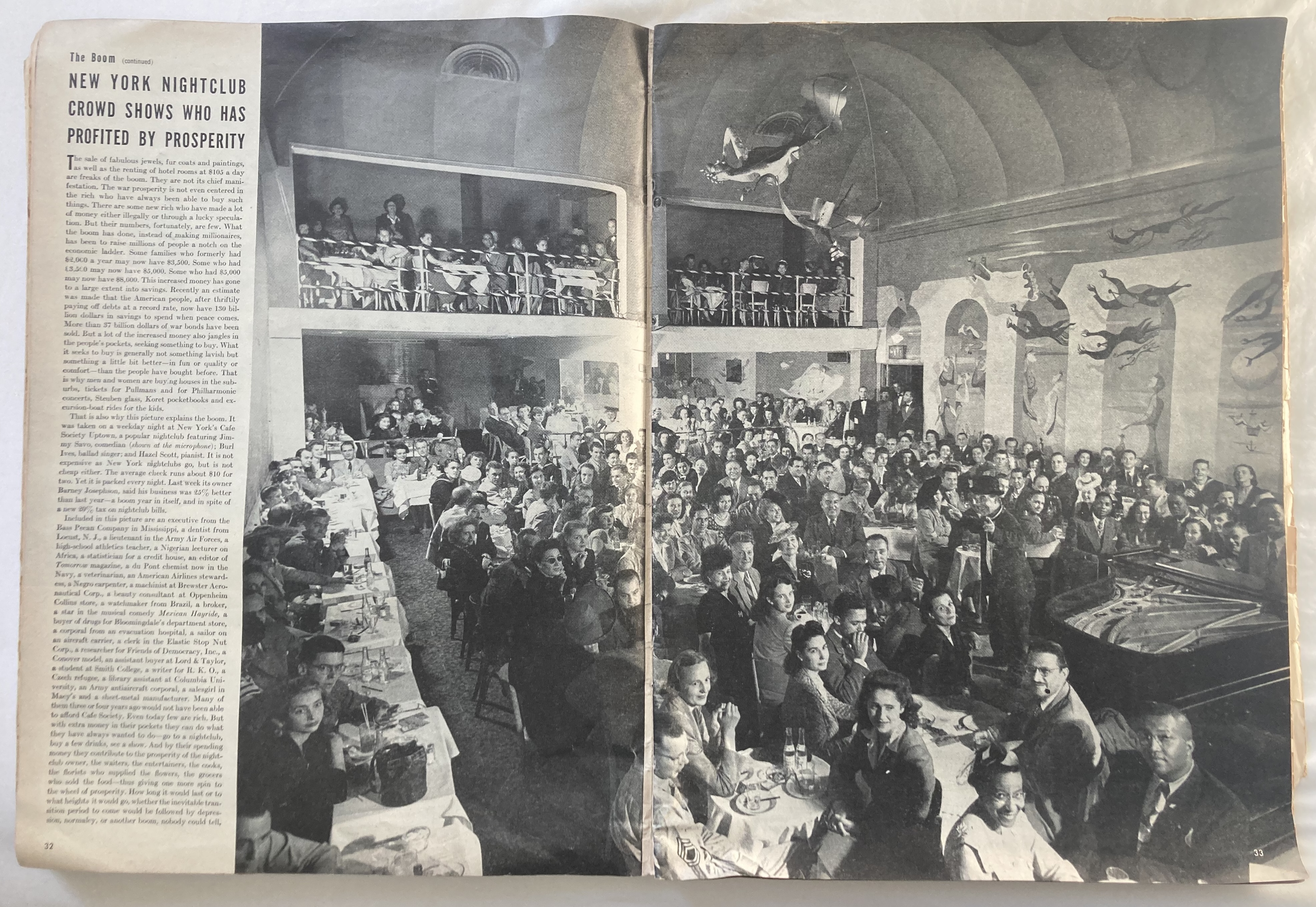
I imagine I picked up a copy of Life magazine’s edition of October 16, 1944 from a flea market many years ago because its cover featured the 20-year-old Lauren Bacall, making her screen debut in To Have and Have Not opposite Humphrey Bogart: “Midway through the first reel the sulky-looking girl shown on the cover saunters with catlike grace into camera range and in an insolent, sultry voice says, ‘Anybody got a match?'”

But along with that, I got something that now seems much more interesting.

Between full-page ads for Packard and Pontiac cars, Texaco oil, Budweiser beer, National Dairy, Stromberg-Carlson radios and Chesterfield cigarettes, all using the military as a motif and/or urging citizens to buy war bonds, there’s a story describing how, in New York, “hotels are booked solid for weeks in advance and guests spend more money” and “the boom reaches a peak in the sale of luxury goods at department stores.” In a month when Allied troops are fighting their way into Germany, this is part of report on the vigorous economic upsurge created by the US participation in the Second World War.

To illustrate the upbeat mood, the editors present a double-page spread on a flourishing nightclub, Café Society Uptown. Located on East 58th Street, between Lexington and Park Avenues, it’s an adjunct to the original Café Society on Washington Square in Greenwich Village. Both were run by Barney Josephson, who booked Billie Holiday for opening night in 1938 at the Village establishment, where she would sing “Strange Fruit” for the first time a year later. The second club opened in 1940. Both were notable for the welcome they extended to all races.

The current attractions at the East 58th Street joint in the autumn of 1944 were the fine jazz pianist Hazel Scott, the folk singer Burl Ives and the comedian Jimmy Savo, who can be seen at the microphone. Higher wartime wages meant that business was up 25 per cent on the previous year, so Josephson told the magazine, and patrons were spending an average of $10 a head.

I could spend hours scanning the faces looking up at the lens deployed at a high angle by Herbert Gehr, a German-Jewish photographer who had escaped Nazism and photographed the Spanish Civil War before arriving in the US, where he joined the staff of Life. I wish there were a key giving the details of each individual in the teeming frame. But the magazine’s caption writers do their best in giving us an anonymised but still vivid snapshot of the diversity of the evening’s audience:

“Included in this picture are an executive from the Bass Pecan Company in Mississippi, a dentist from Locust, N. J., a lieutenant in the Army Air Forces, a high-school athletics teacher, a Nigerian lecturer on Africa, a statistician for a credit house, an editor of Tomorrow magazine, a du Pont chemist now in the Navy, a veterinarian, an American Airlines stewardess, a Negro carpenter, a machinist at Brewster Aeronautical Corp., a beauty consultant at Oppenheim Collins store, a watchmaker from Brazil, a broker, a star in the musical comedy Mexican Hayride, a buyer of drugs for Bloomingdale’s department store, a corporal from an evacuation hospital, a sailor on an aircraft carrier, a clerk in the Elastic Stop Nut Corp., a researcher for Friends of Democracy, Inc., a Conover model, an assistant buyer at Lord & Taylor, a student at Smith College, a writer for R. K. O., a Czech refugee, a library assistant at Columbia University, an Army anti-aircraft colonel, a salesgirl in Macy’s and a sheet-metal manufacturer.”

I’ve been trying to spot the “Conover model”, who would have been someone on the books of the agent Harry Conover. His roster included Eugenia “Jinx” Falkenburg, a former Hollywood High School student who posed for Edward Steichen, was named “Miss Rheingold” in a series of beer ads, and by 1944 had became famous enough to play herself alongside Rita Hayworth and Gene Kelly in Charles Vidor’s romantic comedy Cover Girl, with songs by Jerome Kern and Ira Gershwin. Four years later her younger brother Bob would win the Wimbledon men’s singles title. Maybe Jinx is there in the crowd.

But the conclusion reached by the caption writers, pursuing the theme of a wartime boom, is this: “Many of them three or four years ago would not have been able to afford Café Society. Even today few are rich. But with extra money in their pockets they can do what they have always wanted to do — go to a night club, buy a few drinks, see a show. And by their spending money they contribute to the prosperity of the night-club owner, the waiters, the entertainers, the cooks, the florists who supplied the flowers, the grocers who sold the food — thus giving one more spin to the wheel of prosperity. How long it would last or to what heights it would go, whether the inevitable transition period to come would be followed by depression, normalcy or another boom, nobody could tell.”

‘Quadrophenia: A Mod Ballet’

For me, if for no one else, the Who completed the important phase of their work in the period that began at the start of 1965 and ended in the middle of 1966, encompassing their magnificent first four singles: “I Can’t Explain”, “Anyway Anyhow Anywhere”, “My Generation” and “Substitute”. I’d add “The Kids Are Alright”, recorded for their first LP but released as a 45 after they’d skipped labels from Brunswick to Reaction. And I can’t dismiss the later “I Can See For Miles” and “Won’t Get Fooled Again”. But I could never enjoy Pete Townshend’s rock operas in the same way, much as I admired his ambition.

So I was surprised by how much I liked the version of Quadrophenia presented at Sadler’s Wells this week: a full-blown ballet production, directed by Rob Ashford, with Townshend’s music rendered in pre-recorded orchestral arrangements by the composer Rachel Fuller, who has been his partner for more than a quarter of a century. No lyrics or dialogue, of course. I liked that. Show, don’t tell.

The dancing, choreographed by Paul Roberts, is wonderful, led by the nervily agile Paris Fitzpatrick as Jimmy and the lustrous Serena McCall as Mod Girl (the roles taken by Phil Daniels** and Lesley Ash in Franc Roddam’s famous 1979 movie version). There’s a warmly welcomed cameo for Matthew Ball as the Godfather, while the peroxide-rinsed Dan Baines takes Sting’s role as the Ace Face.

On stage, in this format, Townshend’s creation seems much closer to West Side Story than in its previous incarnations, particularly when the two gangs sweep back and forth in a recreation of the Mods versus Rockers battles on Brighton sea front, using a freeze-frame technique now familiar from war films. Equally stunning is a sequence evoking the PTSD nightmares suffered by Jimmy’s intolerant working-class dad as a result of his wartime experiences.

All of it is enabled by Christopher Oram’s brilliant set design, sliding back and forth in conjunction with video projections to recreate an office, a suburban home, a coffee bar, a Soho club (the Marquee), train compartments and the Brighton beach and promenade. On my rare outings to the theatre and the ballet these days I’m usually struck by the creativity with which modern resources are deployed, and this was a fine example. The climax, with Jimmy alone on a jetty against the sweeping tide, is something that won’t fade quickly.

Two instrumental bits of original Who recordings are used: “I Can’t Explain” and an extended mix of “My Generation”. Otherwise Fuller’s orchestrations are lush and brassy, and do the job satisfactorily, although they were actually a bit too loud, which might seem a strange thing to say about something based on the music of the Who, in their prime the loudest band I ever heard.

The other criticism would be that the individual identities of the characters playing the four elements of Jimmy’s character — the Tough Guy, the Lunatic, the Romantic and the Hypocrite — are never fully established, however well they’re expressed by the quartet of dancers. Of course they all have to be wearing the same kind of three-button Tonik suits as Jimmy (designed, at Townshend’s request, by Paul Smith), but even subtle colour variations can’t make it clear.

I never thought Quadrophenia contained Townshend’s best music, but this ballet may be its most satisfying iteration. It’s on at Sadler’s Wells until this Sunday (July 13), and it wasn’t quite full earlier in the week, so there may be a few seats left.

* Box office: sadlerswells.com. It’s also at the Lowry in Salford from July 15-19: thelowry.com.

** Thanks to all those who corrected my original mention of Paul, not Phil, Daniels…

Under the same sky

In the 55 years since the discreet arrival of the first ECM album, Mal Waldron’s Free At Last, Manfred Eicher’s label has released somewhere north of a thousand albums. Contrary to a cynical early view, they don’t all sound the same. They are, however, distinguished by the presence of set of qualities — musical, aesthetic and philosophical — that appear, in varying proportions, in just about every one of them. You can detect those qualities in four of their recent releases, each of which exemplifies a certain characteristic taken to the very highest level.

1 Vijay Iyer / Wadada Leo Smith: Defiant Life

American jazz from the tradition continues to make its presence central to ECM’s output. Smith’s trumpet and Iyer’s keyboards and electronics weave their way through spellbinding duets subtextually infused with a sense of history. Smith’s “Floating River Requiem” is a dedication to Patrice Lumumba, the Congolese independence leader murdered by colonial forces in 1961, while Iyer’s “Kite” acknowledges Refaat Alareer, a leading Palestinian poet killed along with two siblings and four nephews during an Israel air strike on Gaza in late 2023. Sorrow and outrage are present in this music, but it also serves, in Iyer’s words, as a statement of “faith in human possibility.”

2 Anouar Brahem: After the Last Sky

Modes from all over the world find their way into the ECM matrix. The Tunisian oud player and composer Anouar Brahem first recorded for the label 35 years ago. On his latest album he is in the company of three of the company’s regulars: the cellist Anja Lechner, the pianist Django Bates and the bassist Dave Holland. Taking its title from a book by the late Edward Said, this album, too, is driven by reflections on the suffering, recent and historic, of the people of Gaza, as outlined in Adam Shatz’s fine sleeve essay. Unfolding with patience and elegance, metabolising elements from Arabic maqam, jazz and European classical music, these quartet pieces ache with grief.

3 Alexander Knaifel: Chapter Eight

By cultivating a widespread audience for the work of the Estonian composer Arvo Pärt via its New Series offshoot, ECM helped create the genre known as “holy minimalism”. Alexander Knaifel (1943-2024), born in Tashkent, studied cello with Rostropovich in Moscow in the 1960s before making a reputation writing operas and film music. A kind of an Uzbek version of Anthony Braxton, he also wrote an extended piece for 17 double basses and another for 35 Javanese gongs. But the pieces on this album, performed by an ensemble of three Latvian choirs and the Swiss cellist Patrick Demenga, are settings of verses from the Song of Solomon. Proceeding with great deliberation under the baton of Andres Mustonen, they achieve the required meditative glow to very satisfying effect, fully exploiting the acoustic resonance of the Jesuit church in Lucerne, where they were recorded in 2009.

4 Arve Henriksen / Trygve Seim / Anders Jormin / Markku Ounaskari: Arcanum

The crucial role played by ECM in the emergence of Nordic jazz needs no acknowledgement. Here are four leading players — the trumpeter Henriksen and the saxophonist Seim from Norway*, the bassist Anders Jormin from Sweden, and the Finnish drummer Ouaskari — at the height of their powers, taking memories of Ornette Coleman’s quartet as a starting point from which to develop conversations of great beauty and originality. All four of these albums are outstanding, but this is the one that sounds to me like a future classic.

* Due to a moment of brain-fade, this piece originally claimed that Henriksen and Seim are Finnish. My thanks to those who noticed and gently pointed out the error.