Skip to content

Archive for

Brian Wilson meets his fans (1988)

On September 24, 1988, at the parish hall of Our Lady of the Visitation in Greenford, a West London suburb, Brian Wilson paid an unannounced visit to the annual convention of Beach Boys Stomp, a UK fanzine founded a decade earlier. This is a photograph I took that afternoon, unearthed while I was looking through some boxes of old stuff recently.

Brian was in London to promote his first solo album, with his notorious shrink, Eugene Landy, by his side. Somehow the convention’s organisers, Mike Grant and Roy Gudge, persuaded him to attend their event, overriding Landy’s objections, while managing to keep it a secret from the 325 attendees until the curtains parted on the small stage to reveal him seated at a Yamaha DX7 keyboard.

The pandemonium and applause lasted several minutes. Brian absorbed it all with equanimity before giving us solo performances of three songs. Two of them, “Love and Mercy” and “Night Time”, were from the new album. The first, though, was “Surfer Girl”. Yes, really. “Surfer Girl”. The song he’d written and recorded in 1963. Later he claimed it was actually his first attempt at songwriting. The Beach Boys’ first hit ballad, it reached the top 10 in the US and became the title track of their third album. Its doowop-influenced coda gave a clue to the riches of harmony singing to come, with a repeated question — “Do you love me, do you, surfer girl?” — that could much later be read as a hint of insecurities beneath the sunkissed surface.

His voice was a little unsteady to start with, but the falsetto was still in working order. “Thought we’d give you a little surprise today,” he said after that opening song. The other two were performed with increasing confidence and, in the case of “Night Time”, the encouragement of a steady 4/4 handclap from the audience.

The photo tells the rest of the story. Physically in decent shape, far removed from the heavily bearded 300lb creature he had been, Brian shook many hands before making his departure. In a troubled life, in that humble setting, it seemed like an unexpected but real moment of grace.


‘The Ballad of Wallis Island’

It’s a phenomenon you don’t hear a lot about because it’s slightly embarrassing, but many top artists play ludicrously well-paid private gigs for rich people. In the business such shows are known, with a suitable lack of poetry, as “corporates”. The Ballad of Wallis Island is about one such engagement, in which a slightly barmy middle-aged widower uses his lottery-jackpot winnings to persuades a British folk-pop duo, long acrimoniously sundered, to reunite for a single gig at his home on a small Welsh island, at which the audience will consist of him alone.

Tim Key plays the widower with gentle charm. He wrote the story and the screenplay with Tom Basden, who plays the male half of the duo with a barely suppressed resentment at his treatment by the music business. His erstwhile partner is played by Carey Mulligan, who manages to be both beatific and beady-eyed and turns up from Portland, Oregon, where she makes chutney, with her American husband, played by Akemnji Ndifornyen (who doesn’t say much but, close to the end, has the film’s most striking speech).

I saw it the other night and came out of the cinema having been charmed to bits by the whole thing but particularly struck by a scene in which the spectre of the duo’s former romantic engagement is evoked, summoning a sudden irruption of old artistic jealousies and resentments, all unresolved. It reminded me of so many music business stories. And the songs we hear, written by Basden, are very precisely not-quite-good-enough, making you understand how, in a different era, the duo could have enjoyed a brief, perhaps almost accidental popularity without managing to turn it into anything more substantial.

Apparently the film, directed by James Griffiths, cost just over a million and a half dollars to make. There should be many more like it: modest in scope and scale, formally unadventurous but intellligent, witty and well made, and aimed at no particular niche. Go and see it; you won’t be wasting your time.

* The Ballad of Wallis Island came out at the end of May and is still in cinemas. The photo shows Carey Mulligan and Tom Basden.

The last of the Blue Notes

Louis Moholo-Moholo died on Thursday at his home in Cape Town, aged 85. He was the last survivor of the Blue Notes, the group — also including the trumpeter Mongezi Feza, the alto saxophonist Dudu Pukwana, the pianist Chris McGregor and the bassist Johnny Dyani — who arrived in Europe in 1964, fleeing South Africa’s apartheid regime. Once settled in London, they infused the British jazz scene with the warmth and directness of their playing, leaving an impression that continues to be heard in the music of later generations. Now they’re all gone.

Nobody cracked the whip from the drum stool like Louis, with the most benign of intentions. Until you saw him live, you could have only the haziest impression of his invigorating and sometimes electrifying effect on those around him — whether the other member of a duo (perhaps the pianists Keith Tippett, Livio Minafra or Alexander Hawkins) or the massed ranks of McGregor’s Brotherhood of Breath or Pino Minafra’s Canto Generàl. I treasure memories of Mike Osborne’s incendiary trio with Louis and the bassist Harry Miller, another of the South African emigré cadre. Miller’s sextet, Elton Dean’s Ninesense and later on, the extraordinary quartet Foxes Fox were other bands whose fires he stoked.

And, of course, there was Four Blokes, his own final band, with Hawkins, Jason Yarde on saxophones and the bassist John Edwards. I had the thrill, when presenting the quartet at JazzFest Berlin in 2015, of hearing them start a fire the instant Louis was settled behind his kit. The effect, as always, was indescribably exhilarating. Because that’s what Louis did: he showed you what this music could do, where it could go, how it could touch your soul. Now may he rest in peace.

* The photograph of Louis Moholo-Moholo was taken at the Haus der Berliner Festspiele in 2015 by Camille Blake.

A point of stillness

There is a balm in Gilead, according to an African American spiritual whose lines were borrowed from the Old Testament Book of Jeremiah, and there is a profound sense of healing in Solace of the Mind, the new solo album by the pianist and organist Amina Claudine Myers.

Born 83 years ago in Blackwell, Arkansas, Myers moved to Chicago after graduating from music college and became a member of the Association for the Advancement of Creative Musicians in 1966. Ten years later she moved to New York. Before this new album, her last one was as a duo with the trumpeter Wadada Leo Smith, a dedication to Central Park, released a year ago. Her early albums for the Leo label, Song for Mother E and a tribute to Bessie Smith, recorded in 1979 and 1980 respectively, were recently made available on Bandcamp.

She is a musician of great sophistication, rich in imagination and technical resources, but in this recital she pares everything back to the essence and what we hear is her soul. Like Abdullah Ibrahim, she can take an ancient structures and allow it to glow from somewhere deep within. The simpler the hymn and the more straightforwardly it’s played, the great the inner strength it exudes. As long, of course, as the playing is done by an Ibrahim or a Myers.

There are nine original pieces here, starting with a delicately surging reinterpretation of “Song for Mother E”. Others include the brief and stately “Hymn for John Lee Hooker” — more hymn than Hooker — and the rhapsodic “Twilight”. On “Ode to My Ancestors”, recorded at her home, she moves to her Hammond B3 and recites a poem over sustained organ notes which, thanks to a phasing effect, seem to be fluttering in a breeze. The only non-original is the lovely spiritual “Steal Away”, which gently summons a whole world of African American culture; the whole recital seems to pivot around it. The closing benediction is a study in patience and exquisite phrasing titled “Beneath the Sun”.

What you won’t find here is anything remotely resembling a display of virtuosity. What you might discover, amid an increasingly maddened world, is a welcome point of stillness. Highly recommended.

* Amina Claudine Myers’ Solace of the Mind is released on June 20 on the Red Hook label (redhookrecords.com). The uncredited photograph is borrowed from Myers’ website.

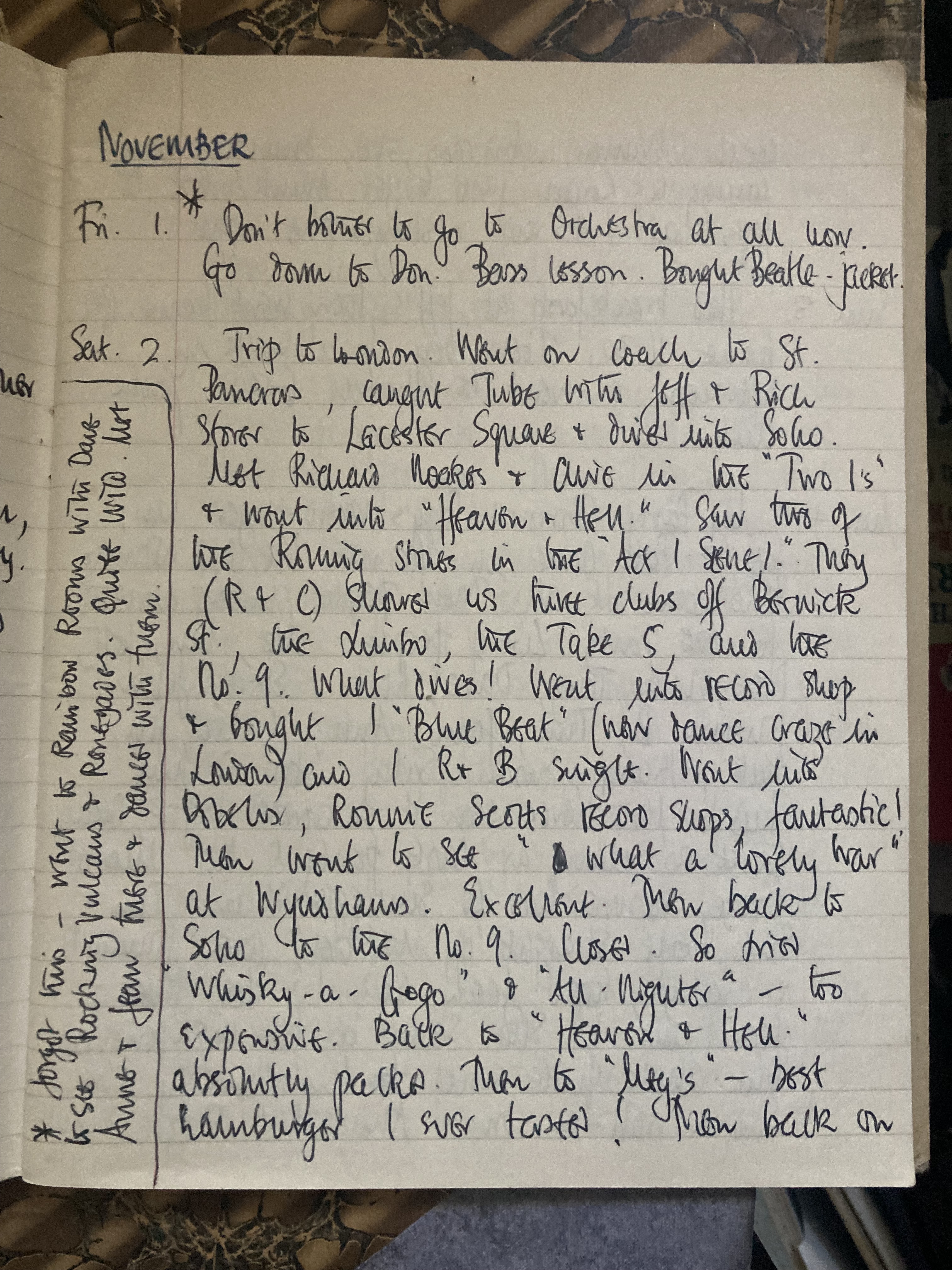
‘What dives!’ Soho, 2/11/63

While clearing out the other day, I came across a brief attempt to keep a narrative diary during the winter of 1963/64. I was 16 years old and a few months away from being invited to leave school, to put it politely. Most of the diary was about girls, so toe-curling that it went straight to the shredder. But this page seemed worth preserving. It describes a school trip from Nottingham to London, arranged by one of our English masters, to see Joan Littlewood’s new musical Oh, What a Lovely War!, which had had just transferred from its first run at the Theatre Royal Stratford East to Wyndham’s Theatre on Charing Cross Road, Soho’s eastern border. As the diary entry describes, we arrived in Soho and were left to our own devices. Samuel Pepys it is not, but it is a little snapshot of something. Further notes below.

As you’ll see, the day before the trip I skipped the school orchestra rehearsal, visited a local coffee bar whose full name was the Don Juan, had a double bass lesson, and bought a Beatle jacket (brown, round neck, some kind of decorative buttons, 19/6d or thereabouts from C&A, I think). That night a friend and I went to the Rainbow Rooms, an occasional venue for beat groups, to see the Renegades, a band from Birmingham, and the Rocking Vulcans, a local outfit, and to dance with a couple of girls called Anne and Jean.

Once in Soho, the ambition seemed to be to visit as many coffee bars as possible, notably the 2i’s and Heaven & Hell, next door to each other on Old Compton Street. I remember (but didn’t write down) that as we stood outside, a couple naked from the waist up (at least) poked their heads out of a first floor window to chat with someone across the road; this, I thought, must be the life. We also visited Act 1 — Scene 1, directly across the road, and Le Macabre, on Meard Street, where the customers sat on coffins.

And there were record shops, including Ronnie Scott’s short-lived effort on Moor Street and, inevitably, Dobell’s. It must have been at Harlequin on Berwick Street (opened two years earlier) that I bought a Prince Buster 45 on the Blue Beat label (which gave its name to the idiom later known as ska) and “Orange Street” b/w “JA Blues” by the Blue Flames. That was on the R&B label, which I now know to have been named after its founders, Rita and Benny King (formerly Isen or Issel), who ran a record shop in Stamford Hill and had a label on the side, catering to the many West Indians who had recently populated the area.

After the brilliant and very moving show at Wyndham’s, performed by the original cast, including Barbara Windsor and Victor Spinetti, we wandered to the bottom end of Wardour Street to discover that the Whisky A Go-Go and the Flamingo’s All Nighter were out of our price range. But somewhere called Meg’s provided the “best hamburger I ever tasted” — almost certainly the first one that wasn’t a Wimpy.

The “Jeff” who accompanied me on these little adventures was Jeffrey Minson, a fellow member of our folk trio and eventually the author of Genealogies of Moral: Nietzsche, Foucault, Donzelot and the Eccentricity of Ethics. I just wish I could remember which two members of the Rolling Stones we spotted in Act 1 — Scene 1 that afternoon; their second single, “I Wanna Be Your Man”, had been released the day before.

(The missing word at the end of the page is “coach.”)