I first got to know Philippe Auclair, a Frenchman living in London since 1986, as someone who wrote about football in both French and English with rigour, authority and elegance. His biographies of two celebrated fellow exiles, Eric Cantona and Thierry Henry, are unlikely to be bettered. The elegance I mentioned is the quality he brings to his other career as a musician, using the alias Louis Philippe.
The latest album by Louis Philippe & the Night Mail, The Road to the Sea, is a beauty. I’ve always known of his love for Brian Wilson and the Beach Boys, and that his past collaborators have included Sean O’Hagan of the High Lamas and Stuart Moxham of Young Marble Giants, which gives some idea of his orientation. So we have sunshine pop, chanson, a hint of the baroque (maybe with a nod to the Left Banke), and open ears in general, perhaps with a bit of Francis Lai and Paddy McAloon thrown in, but also with a strong enough personality to ensure freshness.
The strain of Beach Boys influence I get here is the period taking in Smiley Smile, Wild Honey and Friends, post-surf and mingling hippie serenity with a barely perceptible hint of unease. This isn’t retro music in any way — there are modern trimmings throughout, used sparingly — but Auclair’s carefully wrought arrangements sometimes throw in an unexpected tone or texture, like the sudden appearance of a Hammond organ on “Watching Your Sun Go Down”, a theremin effect on “All at Sea” and a melodica on “Always”.
Unfashionably, he writes chromatic melodies, like the shapely “Song for Paddy (Wings of Desire)”. Overall there’s a lightness of spirit that might represent the influence of Brazil, although perhaps I’m thinking that because I’m listening to “Where Did We Go Wrong”, which races along to a rapid samba rhythm.
His singing voice is calm and unaffected, sometimes rising effectively to the falsetto register; he could be the late Carl Wilson’s French penfriend. There are three songs in his native language, of which “Le Baiser” might well be the loveliest new song I’ll hear this year, with delicious, heartlifting background harmonies and an insouciant jazz piano playout. For sheer beauty, it’s almost matched by one of the English songs, “A Friend”.
The sun and the sea feature prominently in the lyrics, along with a feeling of life drifting along, as it can tend to do. As the days lengthen and June approaches, this is my album for summer days and summer nights.
* The Road to the Sea by Louis Philippe & the Night Train is released on the Tapete Records label: http://www.tapeterecords.com
(For the last decade and a half, Kate Mossman has written clever, funny, perceptive and quite candid interviews with ageing rock stars. They are, she admits, her speciality. Discussing Journey’s Steve Perry, she says: “I was drawn to him for his ageing vulnerability, his giant ego and his extreme oddness… the perfect combination for me.” She’s just published a collection of the interviews, with commentary and reflections. But I wasn’t very interested in my own opinion of her book. I wanted to know what a woman music journalist of my generation, who interviewed some of the same musicians when they were in their young prime, and for whom being hit on by male musicians was a largely unremarked fact of life, made of the views of a woman born in 1980. So I invited a friend whom I first met in 1969, when I’d just arrived at the Melody Maker andshe was already well established along the corridor at Disc & Music Echo, to read the book and, if so moved, to give me her thoughts. She said yes, and here they are. — RW)
By CAROLINE BOUCHER
Is it a good idea to meet your heroes? I’ve met most of mine and the jury’s still out, and I think it’s probably the same for Kate Mossman.
In Men of a Certain Age Mossman meets 19 of them – pieces previously published in The Word and the New Statesman. The subjects are all elderly, as were those chosen by Rolling Stone’s founding editor, Jann Wenner, when he published a selection of interviews claiming, justifiably, that only in their senior years do rock stars attain articulacy and eloquence (and, rather more controversially, that no women at all qualified under those criteria).
Mossman kicks off with the unashamed obsession with Queen’s drummer, Roger Taylor, that meant her teenage family holidays in Cornwall became a pilgrimage to every site connected with him, so that when she was finally granted an interview at his house she could have found it blindfold. Fortunately she reeled away from that confrontation still enamoured.
As she points out: “Rock journalism is unique in that it’s the only place where writers are also obsessive fans, though part of the art is pretending not to be.” A chunk of her early wages was spent on airfares to America where she’d travel to gigs by Greyhound buses or, in the case of a 5,000-mile pilgrimage to meet Glen Campbell in California, walking for three hours down the edge of a freeway.
I’m in awe of her fluid writing style, and jealous of the editorial freedom that now allows her to tell it like it is. By the time she meets Gene Simmons, Kiss have been in the business for 44 years. She likens his hair to “loft insulation”. Or on Trans-Siberian Orchestra’s Paul O’Neill (I know, who he?), who has amassed an extraordinary collection of first-edition books (one signed by Queen Victoria to Kitchener): “He wanders out on to the patio, where the sun beats down so strongly that he must be melting in his leathers… and for a moment he epitomises the contradiction at the heart of rock ‘n’ roll wealth: the baby boomers who bought the lifestyles of the landed aristocracy but insist on looking like pickled versions of the boys they were when they first picked up a guitar.”
Her subjects are a fascinating mix – not all of them out front onstage. For me, the most interesting was Cary Raditz, Joni Mitchell’s former lover and “mean old daddy” from “Carey”, the song named after him. It’s a vivid and fascinating portrayal of the two characters– who initially lived in a cave, and drifted in and out of each other’s lives as Mitchell’s star ascended.
When I was on a music paper in the late Sixties we helped peddle lies. I can still feel the boiling disappointment after an interview with the Byrds who were rude, arrogant and condescending, yet I wrote a bland piece. Syd Barrett was slumped out cold for the entire hour of my interview slot; he couldn’t utter a word. I can’t remember how I got round it, but my editor insisted on filling half a page and afterwards EMI sent me a congratulatory telegram.
An Engelbert Humperdinck review bore no mention of his chauffeur chasing me down the seafront to bring me back for some “entertainment’” Nor did a Mick Jagger interview betray my difficulty taking shorthand notes as his head was resting on my (fully clothed) chest.
As Mossman is meeting her idols in the twilight of their careers the testosterone has ebbed somewhat, although Kevin Ayers gives it a half-hearted try at his dusty French home. His self-belief seemed to be as strong as ever and I can wholeheartedly attest to how irritating he was when I had briefly turned gamekeeper from poacher and was doing PR for Elton John’s office. At the time Elton’s manager, John Reid, signed Ayers, so I flew some journalists out to Paris to see him perform and then talk to him over supper. I knew things were about to go spectacularly wrong when, from my balcony seat, I could see a blonde, cloaked figure at the side of the stage and recognised Richard Branson’s wife, Kristen, with whom Ayers was having an affair. We were spared a Daily Mail front page as fortunately none of the hacks knew who she was and were anyway spared interviews as he went straight back to the hotel with her.
Mossman’s original interviews are pre-Covid, each topped with an explanatory introduction, and many of the subjects have since died, but it’s an excellent read. Previously I had had no interest in many of her heroes — Terence Trent D’Arby, Bruce Hornsby, Jon Bon Jovi, and I’d never even heard of the Trans-Siberian Orchestra — yet those, for me, were the most interesting and insightful pieces.
* After Caroline Boucher left Disc, she worked at Rocket Records and was then for many years at the Observer. Kate Mossman’s Men of a Certain Age is published by Nine Eight Books (£22). The photograph of Mossman with Kiss is from the book jacket.
Terry Riley has been living in Japan for the past few years, passing on the teachings of Pandit Pran Nath in Kamakura, the country’s medieval capital, and Kyoto, the city of temples. Ahead of his 90th birthday on June 24, he announced this week that he’ll be scaling back his activities, handing his classes over to an acolyte while restricting himself to private lessons with advanced pupils.
On Thursday night the New York ensemble Bang on a Can All Stars, longtime performers of Riley’s work, arrived at the Barbican to celebrate his birthday by presenting two of his most famous compositions, with the help of several guests. Riley, of course, was 6,000 miles away, but he welcomed the audience warmly with a recorded video message transmitted via large screens.
The evening began with the basic band — keyboard, clarinet/bass clarinet, electric guitar, cello, double bass and drum kit/vibes — performing A Rainbow in Curved Air, such a strong influence when it appeared in 1969 on the likes of Pete Townshend, Brian Eno and others experimenting with early synthesisers, although the original work itself was performed by Riley on organ, electric harpsichord, rocksichord, dumbec and tambourine, via overdubs.
Arranged for the sextet by Gyan Riley, Terry’s son, and slightly stretched from the original 19 minutes to 25, it preserved the sense of genially interlocking patterns, although Riley’s 14-beat measures seemed to have become a distinct 7/4, strongly articulated by the group’s drummer, David Cossin, before he switched to vibes for the later passages. The sudden halts and resumptions were as gently startling as they seemed on the album five and a half decades ago.
In C, first performed in 1964 and recorded in 1968, is the piece that made Riley’s reputation in the world of contemporary classical music. A remarkably versatile composition, open to any number of players and all musical instruments in any combination, its 53 modules — short musical phrases using all 12 tones of the tempered scale except C sharp and E flat — must be played in order but can be repeated according to each performer’s feeling for the piece’s overall collective development. For last night’s 65-minute performance, Bang on a Can were joined by Shabaka on flutes, Valentina Magaletti on marimba, Soumik Datta on sarod, Portishead’s Adrian Utley on guitar, Raven Bush on violin, Gurdain Rayatt on tablas and Jack Wyllie on soprano saxophone. (Pete Townshend was billed to appear but withdrew following a knee operation.)
I found the result entirely true to the original spirit of the composition, preserving the constant momentum and the sense of conversation without the presence of a conductor. The instrumentation produced wonderful fluctuations of density and shifting polyrhythmic layers; there were beautiful isolated moments, like a brief sarod/cello combination and the emergence of a clarinet melody, and the general lightness of tone brought the closing passage close to the texture of baroque music.
It was like lying on your back and watching clouds moving at a variety of altitudes across a busy but unthreatening sky, endlessly mutating and utterly absorbing until it was brought, with an act of intuitive collective decision, to the most graceful close. Happy birthday, Mr Riley.
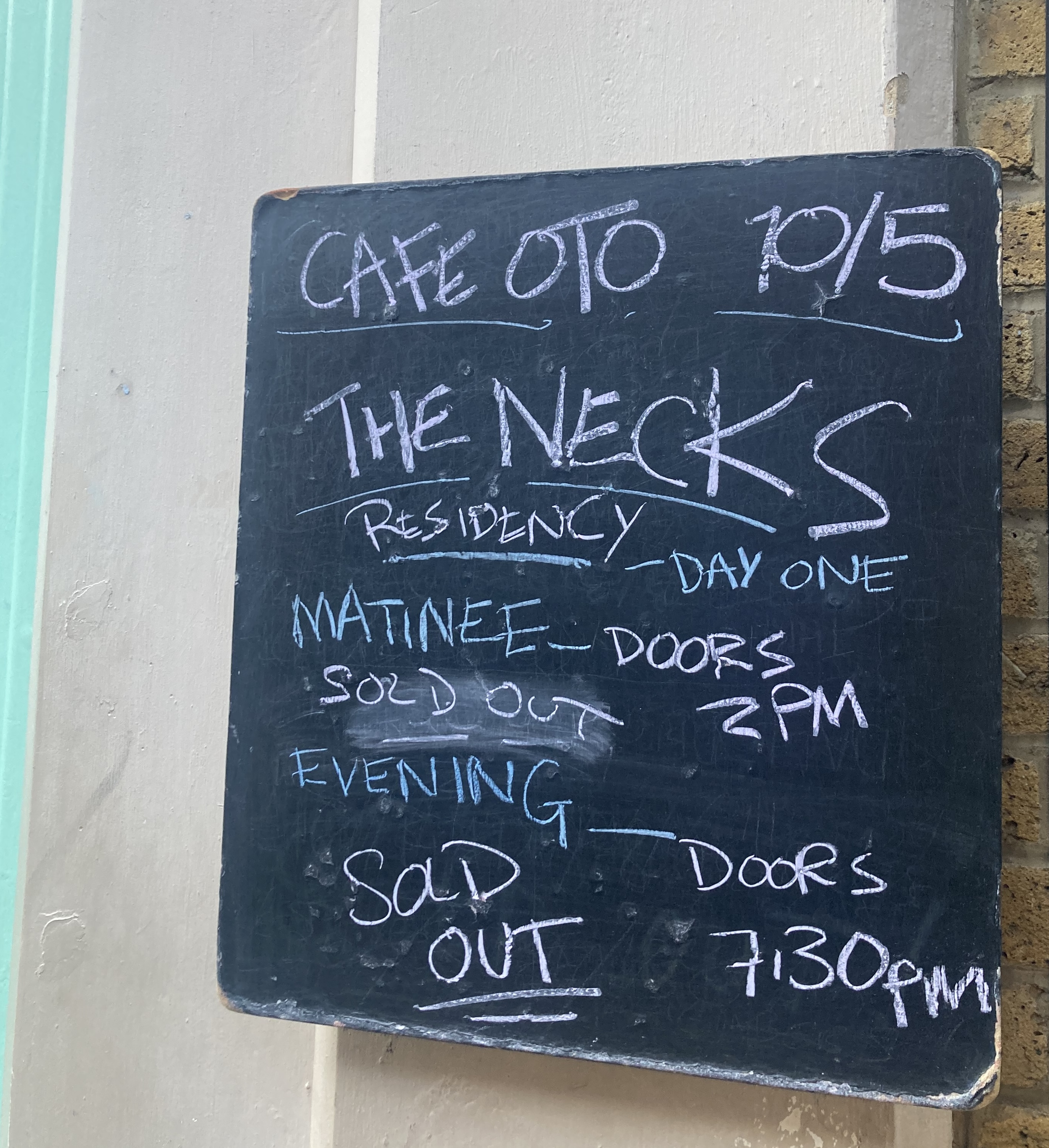
Before the evening show on the first of their two days at Cafe Oto on Saturday, the Necks were announced to the audience as “the house band”. We laughed, and so did they. But it seemed to fit. The Australian improvising trio have played in many London venues, but the little space on Ashwin Street in Dalston seems to suit them best.
Once the house was quiet, they began with Chris Abrahams picking out short melodic phrases in the piano, lightly hammering each note with the two fingers: the index finger of each hand. It was a lovely effect, almost like a santur or cimbalom. The phrases sounded vaguely Moorish, which might seem a bit vague and superficial as a description but is intended to suggest that they felt like fragments of ancient wisdom, conveyed without adornment.
Tony Buck was rubbing two old cymbals on the heads of his snare drum and floor tom-tom. They he began playing a medium fast 1-1-1-1 rhythm with his left hand on the top cymbal of his hi-hat, using a long slender stick. That cymbal stroke formed the basis of his contribution over the next 40 minutes, building in volume and density but retaining a silvery delicacy.
Meanwhile Lloyd Swanton plucked the open D string on his bass with emphasis, letting it ring. That became the tonal centre of the entire collective improvisation, the only fixed point as each of the three explored his own avenue of rhythmic and melodic creation, the symbiosis built up over 30 years enabling them to operate in seeming independence of each other and yet in complete communion. It takes the idea of listening to each other to a different place: listening without listening.
As is usual, but not inevitable, the music gathered power and volume until, by some unspoken intuition, the musicians broke it down, stripping back all the chosen materials until we were returned to the silence.
It’s always tempting to search for analogies and metaphors. Tempting, but unnecessary. Still, on Saturday I thought of the sea breaking on a shore, composed of countless waves and wavelets, all surging and cresting according to their own individual strengths and sub-trajectories, yet responding to a single tidal pulse. It’s an amazing thing to witness in person, when you see how these musicians never even look at each other in performance (Abrahams actually sits side-on, facing offstage) but are linked by something unique.
* The Necks are at Band on the Wall in Manchester tomorrow night (May 13), the Empire, Belfast (14), the Sugar Club, Dublin (15), and thereafter in Switzerland, Portugal, the Netherlands, Croatia, Greece, Poland, Spain, Italy and Belgium: https://shop.thenecks.com/tour-dates
Sometimes painting really does, as the saying goes, approach the condition of music. Today I had that feeling pretty well all the way round the Barbican’s exhibition of work by Noah Davis, the African American artist who died of cancer aged 32 in Los Angeles, where he’d spent his last years setting up the Underground Museum, a place for showing art — not just his own — to people who’re not exposed to it on a regular basis. It occupied four adjacent storefronts on a street in Arlington Heights, a historically black and Latino/Latina district in Central LA.
Thinking about his own work, and his desire to “make something normal”, he said: “Does it have to be about hip-hop and that stuff to get people interested?” But also: “I wanted it to be more magical, not stuck in reality.” So you get a man reading the paper, or people splashing around in a pool, or three young people clustered in a doorway. Normal. But because of what Davis brings, painting over a base layer of rabbit-skin glue like Mark Rothko did, creating a kind of transparency even when the paint is dense, moving blocks of colour like blocks of sound, also magical.
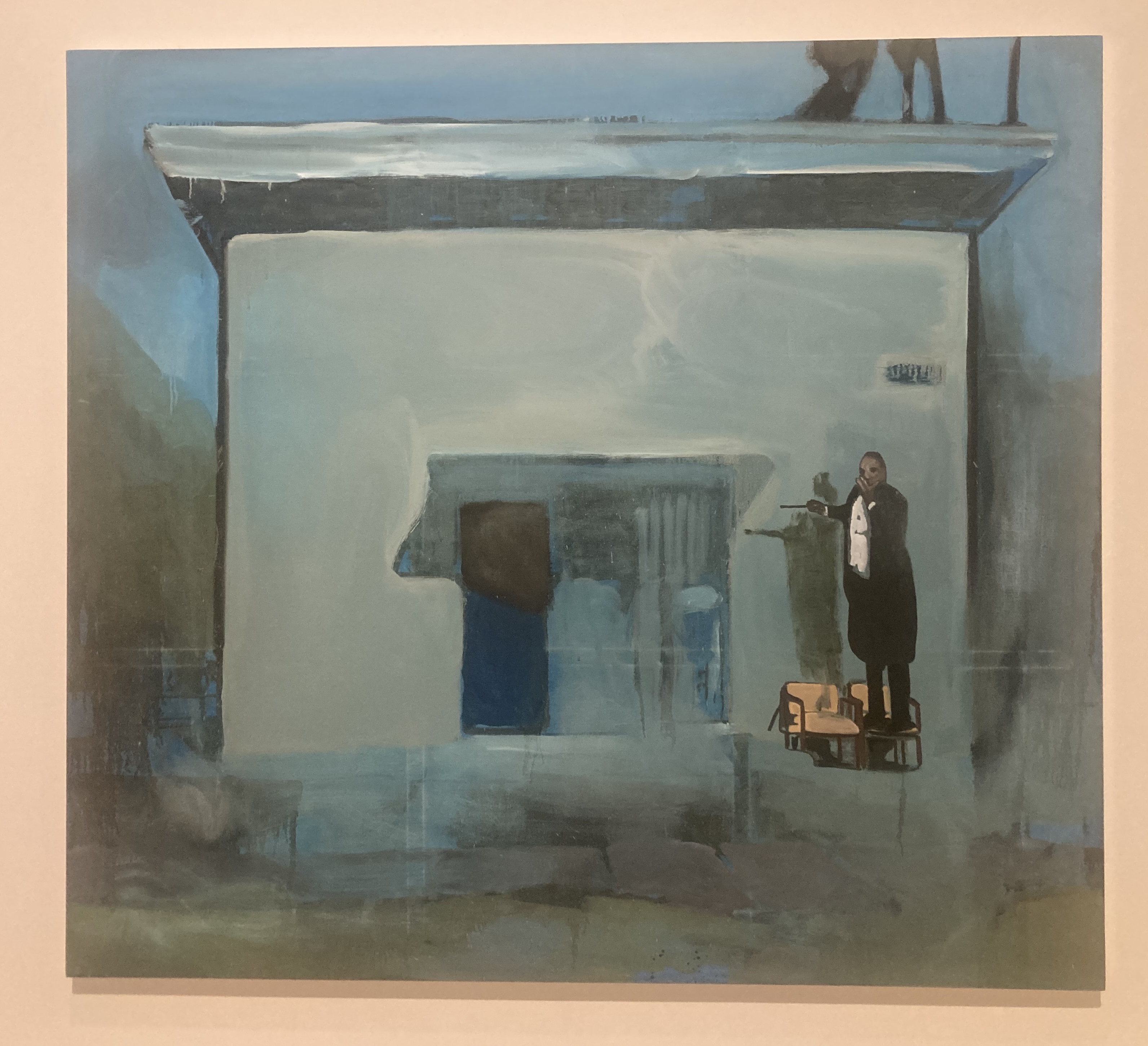
There are explicit references to music in some of the paintings, like the one above, which is called “Conductor”; it stopped me in my tracks. Magical realism right there. He painted it in 2014, the year before he died. Or there’s one called “The Year of the Coxswain”, from 2009, which shows oarsmen carrying a boat out of the water; behind and alongside them is a black-clad figure holding a trumpet.
If you want to see and know more, there’s a Barbican trailer for the exhibition here and an Art News piece here. I’m afraid you only have until May 11, which is this coming Sunday, to see it in London. Sorry about that. Thereafter it can be seen at the Hammer Museum in Los Angeles (June 8-August 31).
I found it unforgettable. I could show you another picture, probably the three young people in the doorway, but because “Conductor” struck me so hard, here’s a closer look.





 thebluemoment.com