Skip to content

Archive for

Monday at the Cockpit

Empirical’s Shaney Forbes at the Cockpit (photo: Steven Cropper)

I was pretty horrified over the new year to see, in the guides to the arts in Britain in 2025 produced by the Guardian and The Times, no mention at all of anything that might be happening in the world of jazz. Both papers have a long tradition of covering the music in an informed way, but that seems to have been set aside by the current generation of arts editors.

It’s more than a pity, particularly at a time when jazz, although its household names have gone, is showing such vitality at all levels, and particularly among a younger generation. That was an unmissable feature of Monday’s Jazz in the Round gig at the Cockpit Theatre, not just among the musicians taking part but in the audience.

Sure, the usual jazz listeners with decades of experience were well represented. But there were also lots of people of student age, a few with instrument cases, settling on the tiered benches surrounding the players on all sides. Some of them were obviously friends of the pianist Emily Tran’s very spirited quintet, featured in the opening slot nowadays reserved for JITR’s Emergence new-talent programme, but they and the other younger listeners in the room effectively reinvigorated the whole ambiance.

After Tran’s group, its front line of alto saxophone and trombone recalling Jackie McLean’s Blue Note albums with Grachan Moncur III, came the Portuguese guitarist Pedro Valasco, 20 years a London resident, building loops and effects with his elaborate pedal board, exploring the sort of territory John Martyn might have entered, given a couple of extra booster rockets. And finally came Empirical, a long-established but perennially creative quartet, with Jonny Mansfield replacing Lewis Wright at the vibraphone.

I’ve said before that Jazz in the Round is my favourite live listening environment, and during Empirical’s set there was a good example of why that might be. It happened while Shaney Forbes was carefully unfolding a drum solo on “Like Lambs”, his own composition, against overlapping rhythm patterns played by Mansfield, altoist Nathaniel Facey and bassist Tom Farmer in what sounded like three different time signatures.

Suddenly Forbes’s concentration was abruptly broken when the bass-drum beater flew off its pedal, landing at the feet of the front row. In many decades of watching drummers, I don’t think I’ve ever seen that happen before. Anyway, the nearest member of the audience was able to lean across and hand it back to the drummer, who quickly refitted it and screwed it up tight while the other three maintained their patterns without disruption, before resuming his train of thought and taking it to a conclusion.

There was, of course, a special roar of applause when the piece ended, but that in itself is not unusual for Empirical. Their music is complex, and sometimes knotty, but they consistently engage their listeners’ emotions in a straightforward way which demands a response. That in itself is quite unusual in this kind of jazz. You could analyse what they do in terms of pacing and projection but there never seems to be anything calculating about it.

They have the spontaneity that is the propellant of jazz and the warmth that is its lubricant, qualities for which Jazz in the Round, programmed and presented by Jez Nelson and Chris Phillips, provides a consistently rewarding environment.
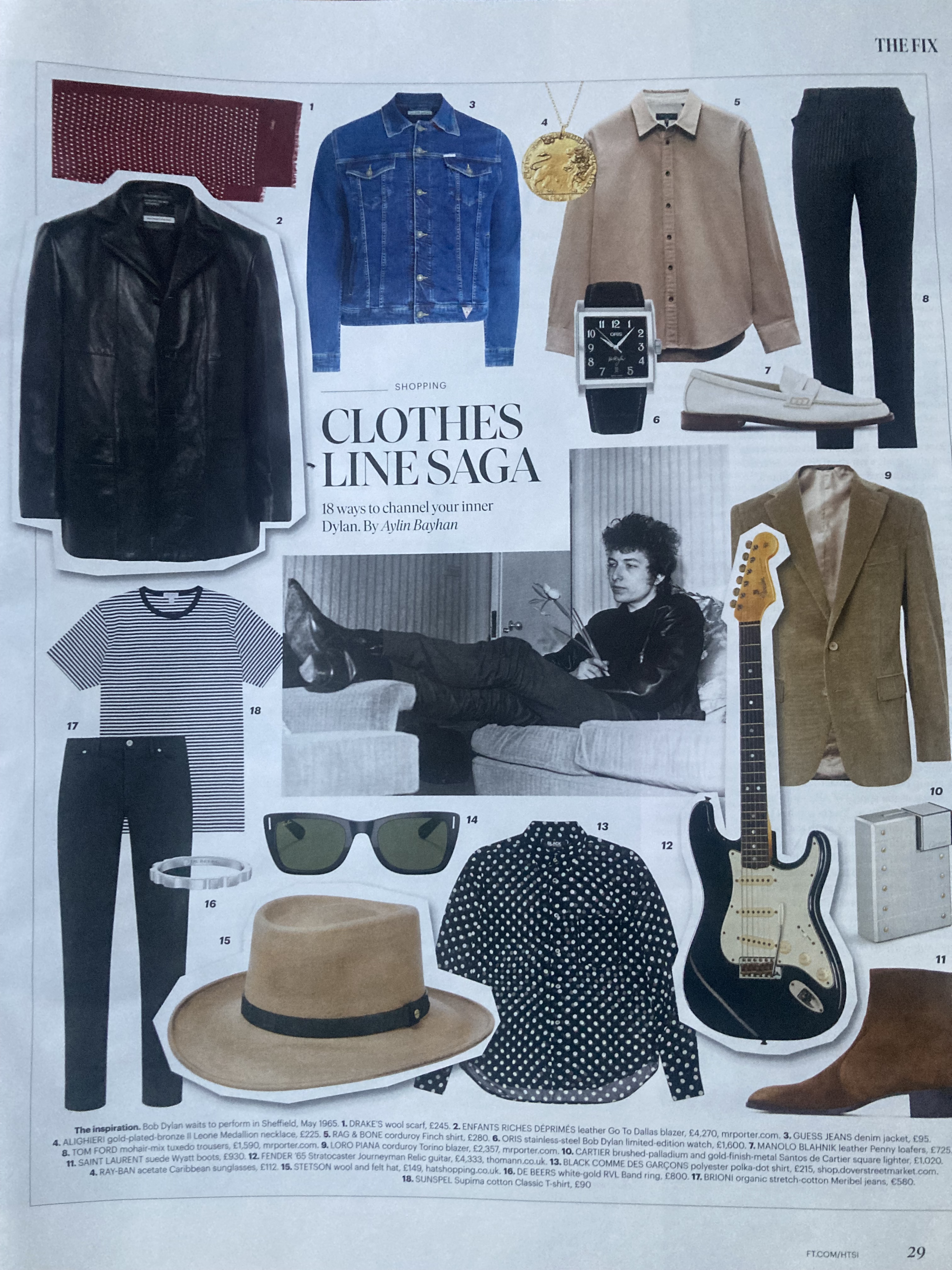
The Bob look

In her 2008 memoir, A Freewheelin’ Time, Suze Rotolo described how Bob Dylan, her boyfriend between 1961 and 1964, developed his look. Apparently it was Dave Van Ronk, a slightly older Greenwich Village folkie, who urged the 21-year-old Dylan to start paying attention to his image.

In Rotolo’s words: “Such things might have been talked about in jest, but in truth they were taken quite seriously. Much time was spent in front of the mirror trying on one wrinkled article of clothing after another, until it all came together to look as if Bob had just gotten up and thrown something on. Image meant everything. Folk music was taking hold of a generation and it was important to get it right, including the look — be authentic, be cool, and have something to say.”

The result was the transfixing sight of Dylan and Rotolo wrapped around each other on the cover of Freewheelin’ in 1963. If you were, say, 16 years old at the time, Don Hunstein’s shot of the couple on Jones Street in Greenwich Village opened up a whole world, and his suede jacket, denim shirt, jeans and boots seemed to offer an easy way in. If you could get hold of them, that is. And now, just six decades later, the Financial Times is telling you how. What you see above is a guide, published in its HTSI (How to Spent It) magazine, showing you to how to look like Bob Dylan.

It’s pegged to the release of A Complete Unknown, James Mangold’s film of Dylan’s life between 1961 and 1965, and it made me laugh quite a lot, for several reasons. The polka-dot shirt they recommend is black and white, which is how it looked in the monochrome photos from the soundcheck at the Newport Folk Festival in 1965; the real thing was green and white — and it was actually a blouse rather than a shirt (the film gets that right). And have you ever seen Dylan in white loafers, never mind 700-quid ones by Manolo Blahnik? The black leather blazer they recommend retails at £4,270. Mine cost a fiver in 1964 from the harmonica player in our band, who was skint at the time and needed rent money. I wish I still had it.

But it’s not just a matter of looking like Bob Dylan. You can try to sound like him, too. The rock critic of The Times went off to the vocal coach who did such good work with Timothée Chalamet in order to try and achieve that distinctive nasal whine. Again it sent me back to 1964 and sitting in my bedroom, strumming an acoustic guitar acquired very cheaply from a girl called Celia and bellowing the words of “The Times They Are A-Changin'” loud enough for my blameless parents to hear: “Come mothers and fathers throughout the land / And don’t criticise what you can’t understand / Your sons and your daughters are beyond your command…”

That was in real time. So was the £5 leather jacket. It was all part of growing up and finding out who you were, and it seems weird now to watch people turn it into a novelty, however good the cause.

As it happens, I enjoyed A Complete Unknown a lot, with only a very few reservations. When Chalamet-as-Dylan sings “The Times They Are A-Changin'” to a festival crowd, Mangold orchestrates the audience’s response in a way that precisely evokes how it felt to experience that song in 1964, with all the emotion of realising that it spoke for you. It was a relief to come out of the screening with the knowledge that I wouldn’t have to be explaining to younger people that it really wasn’t like that at all. Mostly, it was.

Three in one

It felt like a great privilege to be at Cafe Oto last night to hear the Schlippenbach Trio — Alexander von Schlippenbach (piano), Evan Parker (tenor saxophone) and Paul Lytton (drums) — make a rare appearance in London in front of a capacity crowd. This is a group that has existed since 1972, with one personnel change: Lytton’s arrival some years ago to replace his great friend Paul Lovens, who stopped touring.

At 77, Lytton is the youngster of the group. Parker is 80, Schlippenbach 86. Although their group is one of the enduring monuments of European free jazz, they continue play as though the music is being invented every night — which it is, albeit with its foundations in their vast experience, both individual and collective. Last night’s 50-minute set was a further exploration of the spaces between them: a true conversation of equal voices, merging and separating and merging again with a perfect sense of spontaneous form and balance.

Bird lives, dies, flies

Coming up to the 70th anniversary of his death (on March 12, 1955), Charlie Parker can still stop you in your tracks. His sound may be as familiar as the head on a postage stamp, his style imitated with greater or lesser success by thousands of saxophone players, but that unquenchable inventiveness retains all its singular potency, particularly when caught on the wing.

By that I mean not in a recording studio. I revere the studio classics — the hurtling audacity of “Ko Ko”, the sombre perfection of “Parker’s Mood” — as much as anyone, but Bird really flew highest in more informal or spontaneous environments, when the natural assumption of its evanescence drove his improvising into an extra dimension. That’s what impelled the devoted fan Dean Benedetti to record him in jazz clubs night after night on concealed equipment, and what made the posthumous release of such quasi-bootlegs as Bird at St Nick’s and One Night at Birdland (with Fats Navarro and Bud Powell) so vital to a true appreciation of Parker’s genius.

And now there’s more evidence of the brilliance of the uncaged Parker: an album called Bird in Kansas City, an official release on the Verve label. It’s worthy of a place alongside any of Bird’s output thanks mostly to the seven tracks with which it begins, captured during informal sessions in July 1951 at the house of a friend.

Prevented by the loss of his cabaret card from working in New York after being busted for heroin earlier in the year, Parker was staying with his mother, Addie, in Kansas City, where he had grown up. He played a few gigs at a local nightspot, Tootie’s Mayfair Club, and earned $200 for a stunning guest appearance with the Woody Herman Orchestra at the Municipal Auditorium.

But at the invitation of his friend Phil Baxter, a barber who had a pleasant habit of hosting regular soirées at his house on Kensington Avenue in the city’s Eastside district, Bird could play without pressure of any kind. Accompanied by an unidentified but more than competent bassist and drummer, he displays on these seven pieces the genius that flowed through him even in the most relaxed circumstances.

The first three pieces, each without a formal title, draw on various familiar bebop themes and motifs. The fourth, “Cherokee”, is jet-propelled. “Body and Soul” is taken at its usual ballad pace, slipping gracefully in and out of a double-time section as it proceeds to an ending in which a coruscating single phrase is followed by a particularly arch version of his favourite whimsical coda: a quote from “In an English Country Garden”. “Honeysuckle Rose” and “Perdido” swing at a mellow tempo, just on the bright side of medium, with eye-watering semi-quaver runs in the former leavened by some amusing quotes (“Fascinating Rhythm”, “Cheek to Cheek”).

For 24 minutes on these seven tracks we’re allowed to hear Parker as we became used to hearing Ornette Coleman and sometimes Sonny Rollins: an improvising saxophonist without the support of a chording instrument. It’s not a revelation — nothing conceptually different is happening — but it does allow an unusually clear sight of what he could do.

There are another four tracks recorded seven years earlier at a transcription studio in Kansas City, with two friends: the guitarist Efferge Ware, a useful witness in the first volume of the late Stanley Crouch’s sadly never-to-be-completed Parker biography, and the drummer “Little Phil” Phillips. The songs are standards — “Cherokee”, “My Heart Tells Me”, “I Found a New Baby” and “Body and Soul” — and the difference is remarkable: this is pre-bop music, belonging to the swing era, with bags of composure and fluency, completely charming in its own right while conveying barely a hint of what is to come.

The album’s compilers, Chuck Haddix and Ken Druker, go back even further for the pair of tracks that complete the set. These are two pieces recorded by the Jay McShann Orchestra informally in Kansas City in January 1941, apparently in preparation for a Decca session in Dallas a week or two later. Parker has a rather diffident eight-bar solo to close a loose-limbed “Margie” (see comment below) and a much more expressive full chorus on a smoochy “I’m Getting Sentimental Over You”, in which his tart sound and triple-time flurries must have pinned back the ears of the unwary. As they still do.

Island Records: The Greatcoat Years

No record label has ever had its history subjected to the sort of minutely detailed scrutiny on show in the first two volumes of Neil Storey’s The Island Book of Records, the second of which was published just before Christmas. The initial volume examined the label’s earliest years, 1959-68, from the family background of its founder, Chris Blackwell, to the breakthrough into the new rock mainstream with the debuts of Traffic, Jethro Tull and Fairport Convention. The new one deals with just two years, 1969 and 1970. Their successors will, I gather, each focus on a single year**.

The format is that of an LP-size hardback of considerable heft (432 pages of high-grade paper in case of the new one), an oral history with testimony from participants and interested bystanders lavishly illustrated with photos, sleeve artwork, press cuttings, documents, ads and other ephemera. What 1969-70 means is loads of background (and foreground) material beginning with Steve Winwood’s involvement in Blind Faith and ending with King Crimson’s third album, Lizard. Among those featuring heavily are Spooky Tooth, Free and Mott the Hoople, three classic early Island rock bands whose largely student and mostly male following tended to sport ex-army greatcoats, along with plimsolls, loon pants and cheesecloth shirts.

You get their stories in jigsaw form, pieced together with great diligence in mostly bite-sized chunks of testimony. A good example is the treatment of Nick Drake’s Five Leaves Left: the producer Joe Boyd, the engineer John Wood, the bass player Danny Thompson, the guitarist Richard Thompson and the arranger Robert Kirby help describe its making, while Blackwell and his Island colleagues David Betteridge, Tim Clark, Bob Bell and Barry Partlow and the record shop owners John Clare and Eugene Manzi try to explain why it didn’t sell. (When Boyd sold his Witchseason production company to Blackwell in the ’70, it was with the stipulation in the contract that Drake’s three albums should never be deleted.) Others providing testimony include Gabrielle Drake, Nick’s sister, and Victoria Ormsby-Gore, a well connected friend.

There’s too much stuff here for me to begin to do it justice, but the riches include the triumph of King Crimson’s first album, helped by the fact that their two managers, David Enthoven and John Gaydon, were, like Blackwell, Old Harrovians; the debut album by Quintessence, a quintessentially Island band (i.e. Notting Hill hippies) that it turns out nobody in the company really seemed to like; the Fotheringay debacle, which derailed Sandy Denny’s career; the emergence of two ex-Alan Bown Set singers, Jess Roden and Robert Palmer, respectively with Bronco and Vinegar Joe; and the huge success of Cat Stevens, reinvented as a singer-songwriter with Tea for the Tillerman, and of Emerson, Lake & Palmer.

Alongside epochal releases like Traffic’s John Barleycorn Must Die and Fairport’s Unhalfbricking and Liege & Lief, the book features such bit-part players as Dr Strangely Strange (“a poor man’s Incredible String Band”), Blodwyn Pig and McDonald & Giles (respectively offshoots of Jethro Tull and King Crimson), and White Noise’s somewhat prophetic An Electric Storm, which seemed to typify Island’s propensity, in the early days, for backing weird stuff. Nothing is neglected, including the hugely popular and influential compilations, particularly what might be called the greatcoat anthologies: You Can All Join In, Nice Enough to Eat and Bumpers.

The two years covered by this volume pivot around the move from offices on Oxford Street to a former Congregational church on Basing Street in Notting Hill, converted around the time of the First World War into a factory making dressmakers’ showroom busts and wax figures for Madame Tussaud’s. Blackwell bought it and, with the aid of the acoustic engineer Michael Glickman and the studio technician Dick Swettenham, set about converting into a headquarters that incorporated not just offices for the label’s staff but two studios, No 1 on the ground floor, capable of accommodating 80 musicians, and the more intimate No 2 in the basement. This was where a bunch of talented young engineers set to work with Helios 16-track desks and Studer two-inch tape machines, and we hear from some of those hitherto best known as names the bottom of the list of album credits: Brian Humphries, Phill Brown, Richard Digby-Smith (“Diga”) and Phil Ault.

This was a turning point. Basing Street became a creative hub, a 24-hour hang-out, the office business conducted at round tables seating executives and secretaries in a non-hierarchical environment. Guy Stevens, the former DJ at the Scene Club in Ham Yard, for whom Blackwell had created the Sue label, was a maverick A&R presence, introducing Ian Hunter to a bunch of guys from Hereford and giving them the name Mott the Hoople. Lucky Gordon was the resident chef.

I visited Basing Street quite a lot during those early years, sometimes interviewing various people and other times just hanging out, occasionally in the studios. The buzz was terrific. It was, I suppose, a perfect example of hip capitalism in action. Nothing so perfect lasts for ever, but in this volume of his epic and invaluable series — expensive but, to those with an interest, worth every penny — Neil Storey catches it in glorious ascent.

* The Island Book of Records Vol 2: 1969-70, edited by Neil Storey, is published by Manchester University Press / Hidden Masters (£85)

** Not quite right. Apparently Vol 3 (out in the spring of ’26, all being well) will deal with 1971-72. Vol 4 is 1973-76, Vol 5 is probably 1977-79, and Vol 6 could be 1980-83. Neil Storey says he has always thought of the series as consisting of 10 to 12 volumes, so we’ll see.

Barre Phillips 1934-2024

Barre Phillips, who died in Las Cruces, New Mexico on December 28, aged 90, was a poet of the double bass, a member of a generation of players who, building on the achievements of Jimmy Blanton, Oscar Pettiford, Charles Mingus and Paul Chambers, lifted the instrument to new levels of flexibility and expression.

One of jazz’s great contributions to music has been to extend instrumental vocabularies, a process accelerated by the idiom’s rapid stylistic evolution through the last century. No instrument developed more spectacularly than the bass, and Barre — who was born in San Francisco but lived in Europe between 1968 and 2023 — played a significant role in that process.

His first album of unaccompanied solo improvisations was recorded in London in November 1968 in the church of St James Norlands in Notting Hill. Originally released as Journal Violone in an edition of 500 on the Opus One label, it came my way the following year when it was reissued, again in an edition of 500, as Unaccompanied Barre on the Music Man imprint. I think my copy may have come from the producer Peter Eden.

It was a pioneering effort, and a very striking one. I seem to remember making it the Melody Maker‘s jazz album of the month, which raised a few eyebrows. Entirely solo albums by improvising instrumentalists (other than piano players) weren’t yet a thing. Now look how many there are. Among bassists alone, Barre’s album paved the way for unaccompanied recordings by Gary Peacock, Dave Holland, Barry Guy, William Parker, Henry Grimes, John Edwards and others, including, most recently, Arild Andersen.

Barre made several more albums in the same format, including Call Me When You Get There (1984) and End to End (2018) for the ECM label. That’s where Peacock, Holland and Andersen’s solo efforts also appeared, which is hardly surprising, since the label’s founder, Manfred Eicher, started out as a bassist.

I first heard Barre’s playing on Bob James’s ESP album, Explosions, and Archie Shepp’s On This Night. He came to Europe for the first time in 1964 with George Russell’s sextet and returned later in the decade, staying first in London before eventually making France his home. Evidence of his early collaborations with British or British-based musicians can be found on John Surman’s How Many Clouds Can You See?, Mike Westbrook’s Marching Song, and his two sessions with Chris McGregor’s sextet (Up to Earth) and trio (Our Prayer), all recorded in 1969.

In 1970 he joined Surman and the drummer Stu Martin in The Trio, recording a self-titled debut with the basic combo and Conflagration! with an augmented line-up. Thereafter he played with all kinds of partners, from Derek Bailey to Robin Williamson, and was a regular member of his friend Barry Guy’s London Jazz Composers Orchestra. Two ECM albums with Paul Bley and Evan Parker, Time Will Tell (1995) and Sankt Gerold (2000), are favourites. His last release was ECM’s Face à Face, a duo recording with the electronics of György Kurtág Jr, released in 2022.

He was intense about music and what it meant to create it, as became obvious when I interviewed him in London in 1970.

“I’m interested in the process of making music,” he said. “I’m not really interested in the product at all, because I’ve got enough confidence to know that if I’m into it the product is really going to be OK anyway. That’s my personal reason — to have something to communicate to an audience besides the product. If I can show my process to people, perhaps they can understand themselves a lot better.””

The conventional role of the bass, he said, was of little interest to him.

“That’s product-producing. I’m coming from somewhere were the product was important, and I worked and worked until I could get on stage and produce it. But what’s really important is: how did I get from birth to the product? If I go on to a deeper level where the responses are reflecting off my central nervous system, then I’m living my whole life with every instant. Because you’re living in the process of making the music, and to me the biggest thing I’m playing is my birth.”

* The photograph, by an unknown photographer, is taken from Traces: Fifty Years of Measured Memories, a career summary in the form of an illustrated discography, a DVD, and the only CD reissue of Journal Violone. It was published by Kadima Collective in 2012.