Skip to content

Archive for

2024: The best bits

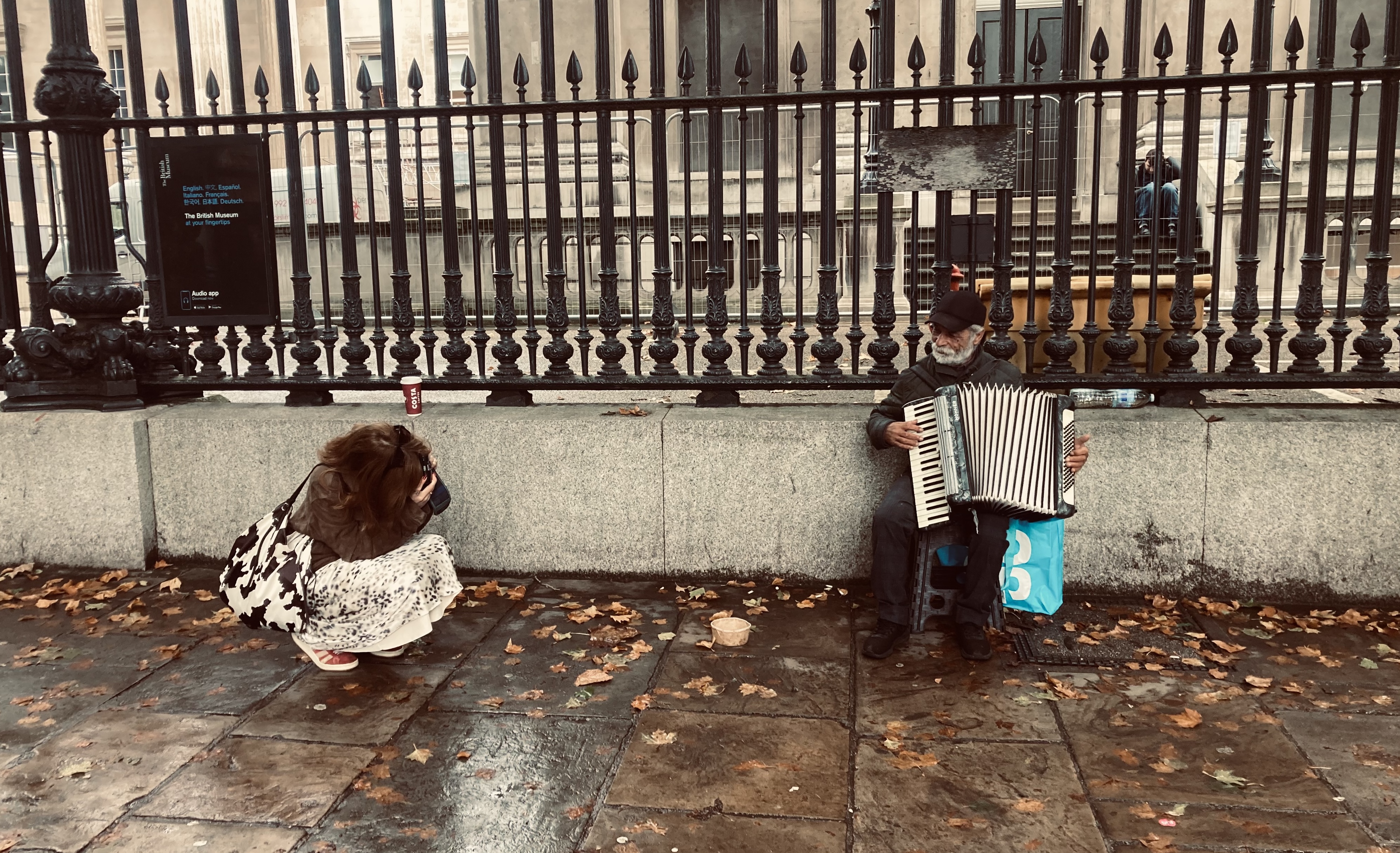
I like street musicians, as long as they’re not using amplification or pre-recorded assistance. Some of them live on in my head. A clarinetist in a tiny garden near Taksim Square in Istanbul in 1968. A singer and an accordionist paying tribute to Carlos Gardel outside a Rosario shopping mall in 1994. A fluently boppish alto saxophonist outside a hamburger joint in downtown Atlanta that same year. An elderly quartet in a park in Sofia 25 years ago.

The accordionist pictured above has a regular pitch outside the British Museum in Bloomsbury. He’s from Romania. One day this autumn I heard him while on my way from a quick lunch at Caffè Tropea, the Italian restaurant inside the park in Russell Square. Probably my favourite un-fancy eating place in London, it’s been run for 40-odd years by a family with roots in Calabria. Immigrants, eh?

On this day the accordionist was playing Nino Rota’s theme from The Godfather. While I was listening, a young woman walked past, stopped, took a small camera out of her bag, and crouched down to take his photograph with a swift economy of movement that suggested she knew what she was doing. I took a single frame with my iPhone and it records one of the year’s happier moments.

NEW ALBUMS

1 Michael Shrieve: Drums of Compassion (7D Media)

2 Meshell Ndegeocello: No More Water: The Gospel of James Baldwin (Blue Note)

3 Wadada Leo Smith / Amina Claudine Myers: Central Park (Red Hook)

4 Beth Gibbons: Lives Outgrown (Domino)

5 Bill Frisell: Orchestras (Blue Note)

6 Alice Zawadski / Fred Thomas / Misha Mullova-Abbado: Za Górami (ECM)

7 Ohad Talmor: Back to the Land (Intakt)

8 Manu Chao: Viva Tu (Radio Bemba)

9 Silkroad Ensemble w/ Rhiannon Giddens: American Railroad (Nonesuch)

10 Giovanni Guidi: A New Day (ECM)

11 Pat Thomas: The Solar Model of Ibn Al-Shatir (Otoroku)

12 The Smile: Wall of Eyes (XL)

13 Mike Westbrook: Band of Bands (Westbrook Music)

14 Daniel Sommer / Arve Henriksen / Johannes Lundberg: Sounds & Sequences (April)

15 The Henrys: Secular Hymns & Border Songs (bandcamp)

16 Gillian Welch & David Rawlings: Woodland (Acony)

17 Lady Blackbird: Slang Spirituals (BMG)

18 Shabaka: Perceive Its Beauty, Acknowledge Its Grace (Impulse)

19 Johnny Blue Skies (Sturgill Simpson): Passage du Desir (High Top Mountain)

20 Kit Downes: Dr Snap (Bimhuis)

REISSUE / ARCHIVE

1 Miles Davis Quintet: Miles in France 1963 & 1964 (Sony Legacy)

2 Art Tatum: Jewels in the Treasure Box (Resonance)

3 Alice Coltrane: The Carnegie Hall Concert (Impulse)

4 Charlie Parker: Bird in Kansas City (Verve)

5 Anne Briggs: Anne Briggs (Topic)

6 Peter Hammill: Incoherence (Esoteric)

7 Bob Dylan and the Band: The 1974 Live Recordings (Sony Legacy)

8 The History of Les Cousins (Cherry Red)

9 Vanilla Fudge: Where Is My Mind? (Esoteric)

10 The Waterboys: 1985 De Luxe Edition (Chrysalis)

SUI GENERIS

Evan Parker: The Heraclitean Two-Step, etc. (False Walls)

LIVE PERFORMANCE

1 Manu Chao (Brixton Academy, September)

2 Bob Dylan (Royal Albert Hall, November)

3 Steve Lehman / Orchestre National de Jazz (Vortex, June)

4 The Necks (Cafe Oto, April)

5 Django Bates (Vortex, January)

6 Sylvie Courvoisier’s Poppy Seeds (JazzFest Berlin, November)

7 Bruce Springsteen (Wembley Stadium, July)

8 Marilyn Crispell (JazzFest Berlin, November)

9 Bill Frisell Trio (St George’s, Bristol, May)

10 Alexander Hawkins / Marco Colonna (Vortex, October)

MUSIC BOOKS

1 Joe Boyd: And the Roots of Rhythm Remain (Faber & Faber)

2 Brad Mehldau: Formation: Building a Personal Canon Vol. 1 (Equinox)

3 Neneh Cherry: A Thousand Threads (Vintage)

4 David Toop: Two-Headed Doctor: Listening for Ghosts in Dr John’s Gris-gris (Strange Attractor Press)

5 Philip Freeman: In the Brewing Luminous (Wolke)

FICTION

Samantha Harvey: Orbital (Vintage)

AUTOBIOGRAPHY

Al Pacino: Sonny Boy (Century)

NON-FICTION

Ekow Eshun: The Strangers (Faber & Faber)

FILMS

1 La Chimera (dir. Alice Rohrwacher)

2 About Dry Grasses (dir. Nuri Bilge Ceylan)

3 Conclave (dir. Edward Berger)

DOCUMENTARIES

1 Dahomey (dir. Mati Diop)

2 Soundtrack to a Coup d’Etat (dir. Johan Grimonprez)

3 Road Diary: Bruce Springsteen & the E Street Band (dir. Thom Zimny)

RADIO

Composer of the Week: Bud Powell (BBC Radio 3/BBC Sounds)

PODCAST

Kate Lamble’s Grenfell: Building a Disaster (BBC Sounds)

THEATRE

Carwyn by Owen Thomas (London Welsh RFC, October)

EXHIBITIONS

1 Pauline Boty (Gazelli Art House)

2 Yoko Ono: Music of the Mind (Tate Modern)

3 John Singer Sargent: Sargent & Fashion (Tate Britain)

4 Gerhard Richter (Neue Nationalgalerie, Berlin)

5 Beyond the Bassline (British Library)
Evan Parker at 80

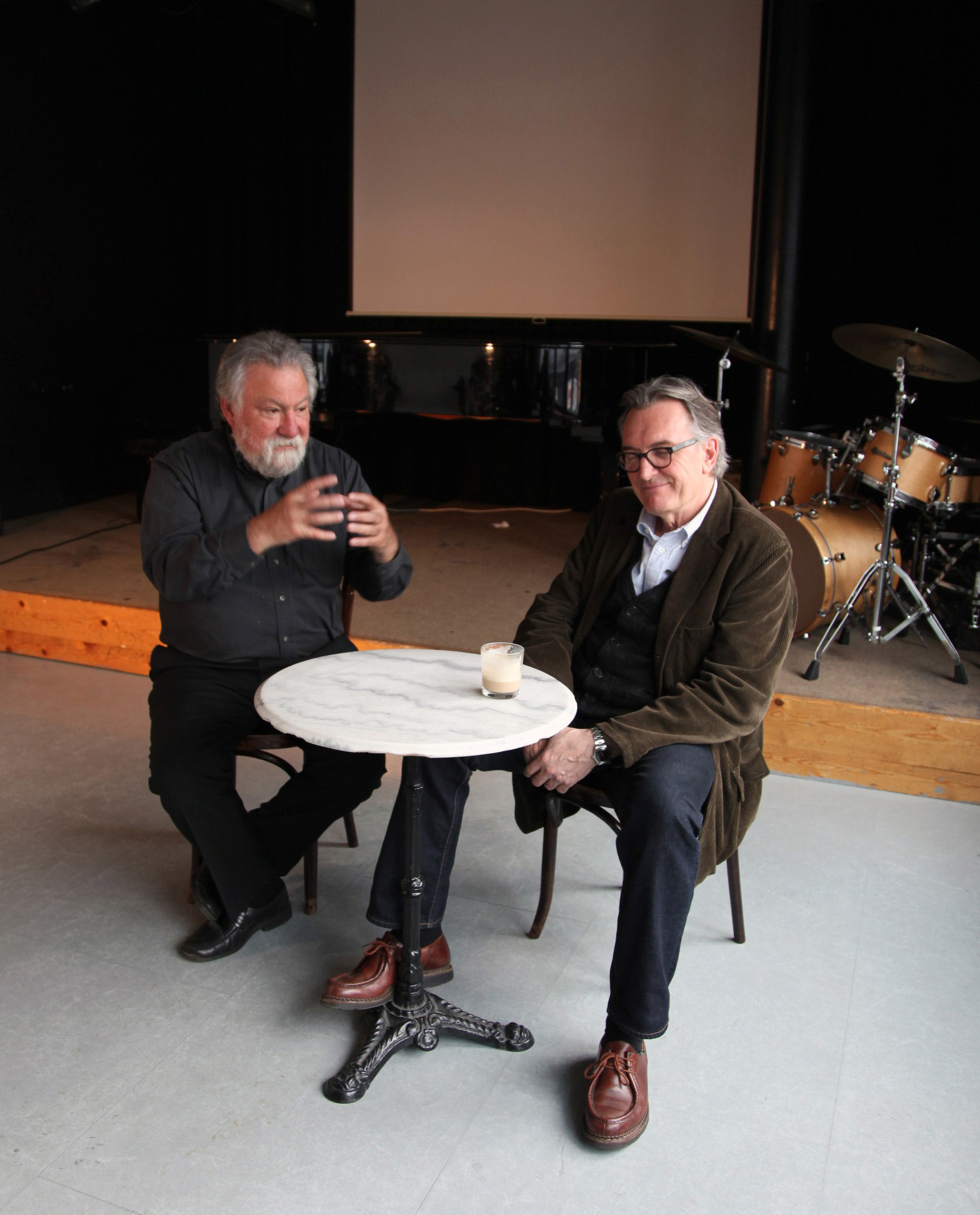
Evan Parker (left) explains the meaning of the universe to the author of this blog

If I write often about Evan Parker in this space, it’s because he’s one of the most original and compelling musicians of my lifetime. He’s also one of the most prolific, always up to something, usually something new. He turned 80 earlier this year, and by way of a slightly belated celebration comes a box set titled The Heraclitean Two-Step, etc., based around four CDs of previously unreleased solo soprano saxophone improvisations with a book containing interviews, musings, his own and other people’s memories, and a section devoted to his very nice collages, made during lockdown on the blank pages of a necessarily unused Musicians’ Union diary.

The first CD opens with a continuous 22-minute improvisation, an extract from a concert in 1994 at the Unitarian Chapel in Warwick. Parker remembered liking it, and decided to pair it on the disc with 40 minutes of new and shorter pieces recorded in 2023 at the same venue. That gave him the idea for the title of the box: it was the Greek philosopher Heraclitus who was reported to have said that you never step in the same river twice. The Unitarian Chapel was indeed not quite the same river: the floor had been renewed. But you get the higher point.

The second of those new pieces, titled “Orwell”, winds itself up to a pitch at which it almost blows your head off. And there are many such outstanding moments throughout these discs, the rest of which were recorded between 2018 and this year at Filipe Gomes’s Arco Barco studio, a converted old harbourside building in Ramsgate, Kent (Parker lives not far away, in Faversham). During “Blériot’s Handshake”, for example, I seemed to feel the ground sliding under my feet — the sensation I sometimes get when listening to Carlo Gesualdo’s choral music.

But the one that I loved most is the 31-minute piece taking up the whole of the second disc, in which Parker approaches the improvisation from several different trajectories, taking his time to pause before switching angle or pace. It’s called “The Path Is Made By Walking”: a most appropriate choice for a man who has followed his own route through the trackless expanses of improvised music for 60 years.

Although the accompanying book isn’t an autobiography, we do learn a lot throughout its various sections. We hear about his relationship with his saxophones, from the first purchase of an old alto at the age of 14, and there’s a semi-technical passage which gives even a non-professional a glimpse of the discipline and study it took to achieve his virtuosity, and still takes to maintain and deepen it. On relationships with other musicians, there are vignettes of Phil Seaman, Dudu Pukwana, Paul Rutherford, Henry Lowther and others, sometimes only a sentence or two but always memorable (“Eat when you can, sleep when you can” was Henry’s valuable early advice about life on the road). When I told Evan he’d made me think about John Stevens, who welcomed him into the SME and the world of the Little Theatre Club in 1967, soon after his arrival in London, and who died 30 years ago, he said: “I think about him just about every day.”

Since Evan has a wider conversational range than almost anyone I know, it’s hardly a surprise to find the text sprinkled with quotes from Borges, Buckminster Fuller, Simone Weil, Idris Shah, Dag Hammarskjöld, Kafka, Iain Sinclair, Chesterton, Koestler, Marcus Aurelius, Hogarth, De Quincey and the Iroquois nation’s address to the 1977 UN Conference on Indigenous Peoples, as well as Eric Dolphy, Steve Lacy and Booker Little. They’re used to support conclusions that are sometimes contentious, always stimulating.

Then I go back and listen again to “The Path Is Made By Walking”. In this wonderful half-hour we hear not just the use he’s made of his evolving technique to create fantastic, mindbending patterns of sound, often mesmerising and sometimes transcendent, but also how he can so fruitfully exploit the acoustical properties of his environment, in this case Arco Barco, and particularly its resonance; he really is “playing the room”, and the result is spellbinding.

Of course I love hearing Evan playing tenor, whether it’s on Tony Oxley’s classic 1969 recording of Charlie Mariano’s “Stone Garden”, or with Spring Heel Jack (John Coxon and Ashley Wales), or with the Necks, or in a big ensemble like the Globe Unity Orchestra. But I’m pretty sure it’s for the solo work on soprano that he’ll be most lastingly remembered. Here, in a fine package benefiting from David Caines’ elegantly austere design, is the evidence of his singularity.

* The photograph of Evan Parker and me was taken by Miranda Little. The Heraclitean Two-Step, etc. is on the False Walls label: http://www.falsewalls.co.uk

Remaining Intakt

Independent record labels are one of jazz’s indispensible support systems, fuelled by the brave willingness of the enthusiasts who run them to buck the odds. My own early tastes were largely shaped in the 1960s by the work of Alfred Lion and Francis Wolff at Blue Note, Bob Weinstock at Prestige, Dick Bock at Pacific Jazz, Lester Koenig at Contemporary and Orrin Keepnews at Riverside. It’s now more than 50 years since Manfred Eicher reimagined what an independent jazz label could be in terms of focus, identity and appeal, and today we have International Anthem, Pi, Rune Grammofon, Hubro, ACT and others swimming lustily against the current.

And there’s the outstanding Intakt Records, founded in 1984 by Patrik Landolt, who stepped back in 2021 after 37 years of producing records and, in retirement, has just received the honorary award of the Deutsche Schallplattenkritik — the organisation of German record critics. His story of those years is contained in a new book, (A)tonal Adventures, containing short extracts from his journals, vividly describing the pleasures and problems of running such a label, travelling between Europe and America.

Intakt’s catalogue of about 400 releases captures a hefty slice of the creative music of our time, from the first release by the great Swiss pianist Irene Schweizer through many recordings by Barry Guy’s London Jazz Composers Orchestra, Cecil Taylor’s epic Willisau concert, the Globe Unity Orchestra and the great solo sessions of its leader, Alexander von Schlippenbach, plus Anthony Braxton, Oliver Lake and Elliott Sharp and a galaxy of drummers including Pierre Favre, Gunter Baby Sommer, Andrew Cyrille, Louis Moholo, Han Bennink and Lucas Niggli, to newer generations of artists including Ingrid Laubrock, Chris Speed, Sylvie Courvoisier, Alexander Hawkins, James Brandon Lewis, Angelika Niescier, Tomeka Reid and the mindbending trio Punkt.Vrt.Plastik (Kaja Draksler, Petter Eldh and Christian Lillinger).

In presentational terms, Intakt’s releases conform to no house style (à la Blue Note or ECM), but the sense of strong graphic design is very evident. Despite the absence of visual uniformity, somehow they speak with the same voice. And equal care is taken with the sound. Again, there’s no equivalent here of the signature (and very effective) reverb penumbra of Blue Note or ECM. Just clarity.

Among the newer artists there’s Ohad Talmor, the American/Swiss tenor saxophonist whose new album, Back to the Land, is one of the highlights of the year. Over two CDs, Talmor reimagines compositions and motifs from the work of Ornette Coleman in a variety of settings: trios for tenor, bass (Chris Tordini) and drums (Eric McPherson), quartets (one with tenor, two trumpets and drums), the duo of Joel Ross on vibes and David Virelles on piano, and a couple of tracks for a septet including sparing use of electronics.

The music is full of air and light, evoking without mimicry some of the south-western feeling Ornette brought to the music. Joy and pain are both present, always delineated with subtlety. The playing is sensationally good by all concerned (particularly Tordini), and the programming retains the listener’s attention without resorting to tricks. In his short preface to the sleeve notes, Talmor mentions the influence on his own playing of Lee Konitz, Dewey Redman and Wayne Shorter; his solos are extruded without apparent effort but with a notable richness of melodic and rhythmic ideas. This is his third album for the label, and it would be a surprise if he were not to become one of the artists to whom Intakt’s commitment is for the long term.

Since Landolt’s retirement, the label’s reins have passed to a team including Florian Keller, whose postscript to (A)tonal Adventures takes us out on a note of optimism. “Intakt Records has never been an ivory tower,” he writes. “It is about setting topicality to music, where the political and social issues framing the music are also considered.” With albums as thoughtful and eloquent as Back to the Land, it’s fair to assume that the mission is in safe hands.

* Ohad Talmor’s Back to the Land was released in October: https://www.intaktrec.ch/408.htm. (A)tonal Achievements is published in English and German editions by Versus Verlag: bit.ly/49rIjla