Skip to content

Archive for

Autumn books 4: Up and down in Croydon

By the time I first set eyes on Croydon, in the opening week of 1970, it had already achieved its new status as the symbol of high-rise architecture in Britain. To one who had yet to visit America’s big cities, it was an extraordinary sight. Amid the tower blocks and the urban motorways, I got lost and thus missed a big chunk of the Soft Machine’s first set at the Fairfield Halls. The venue itself was worth the visit: a monument to postwar modernism, opened eight years earlier.

The second time I made my way through South London to Croydon — and the last, as far as I remember — was just under two and a half years later, when I went to the Greyhound pub to see Roxy Music supporting David Bowie. Because it was Roxy I wanted to see on June 25, 1972, and since they were on first, I was on time. It was nine days after the release of their debut album, and also of Bowie’s The Rise & Fall of Ziggy Stardust and the Spiders from Mars. I’d been to some of Roxy’s recording sessions at Command Studios in Piccadilly, and I wanted to see how the songs sounded live. (I stayed to hear Bowie and his band, but I’m afraid the songs and the presentation didn’t interest me much, and still don’t.)

Croydon’s close links with popular music form one of the themes of a new book by Will Noble, the editor of the Londonist website. Croydonoplis: A Journey to the Greatest City That Never Was tells the story of a place whose initial renown came as the location of Croydon Palace, first erected as a manor house more than a thousand years ago as a staging post for the Archbishop of Canterbury on his journeys from Canterbury Cathedral to his London residence, Lambeth Palace. The present Croydon Palace was mostly built in the 14th and 15th centuries.

The place has a surprisingly rich history. Elizabeth I visited several times a year, for the horse racing. In the 19th century it had a popular spa and a pleasure park (where Pablo Fanque — remember him? — walked the tightrope). It became a railway hub, its population increasing as a result from 5,700 in 1801 to 134,000 in 1901. In 1928 it became the location of the original London airport, where a well appointed terminal featured the world’s first airport shop. And although those postwar towers were built for offices, a large part of the town’s history has to do with entertainment, from medieval fairs and variety theatres to the era of the Fairfield Halls and the Greyhound.

The great actress Peggy Ashcroft was a local product, as were the film director David Lean, the black classical composer Samuel Coleridge-Taylor, and Francis Rossi of Status Quo. There were many theatres, at which Louis Armstrong, Paul Robeson, Ella Fitzgerald, Gracie Fields, Bill Haley and Buddy Holly all performed. Bernstein, Boulez, Boult conducted at the then-new Fairfield Halls, as did Stravinsky. The American Folk & Blues Festival concerts featured Muddy Waters, Sister Rosetta Tharpe, Lonnie Johnson, Big Mama Thornton and Howlin’ Wolf. Ornette Coleman made his British debut there with a famous concert in 1965 (where a sceptic shouted “Now play ‘Cherokee’!”), followed 10 years later by Kraftwerk.

Malcolm McLaren studied at Croydon School of Art, as did Bridget Riley and Ray Davies, although McLaren’s Sex Pistols were banned from the Greyhound because the promoter didn’t like the idea of gobbing. Captain Sensible and Rat Scabies of the Damned first met at the Fairfield Halls, where they were cleaning the toilets. Croydon also the location of the Brit School, the alma mater of Amy Winehouse, Katie Melua, Adele, FKA Twigs, Jessie J and Kae Tempest. Most recently, it’s been the breeding ground of Dubstep and Grime, via local boy Stormzy and Rinse FM.

The tale of how Sir James Marshall, a former mayor and the chairman of the town planning committee, looked at the wartime bomb damage and dreamed up the idea of rebuilding the place in a very different form is extremely absorbing and well told, starting with the notion that the scheme was conceived as a response to the refusal in 1954 by the recently crowned Elizabeth II to grant Croydon the much-coveted city status. The vaulting ambition, the collateral damage and the ultimate failure of Marshall’s dream make for a fascinating read, even if you’ve only been there twice. Or not at all.

* Will Noble’s Croydonopolis is published by Safe Haven Books.
Manu Chao in London

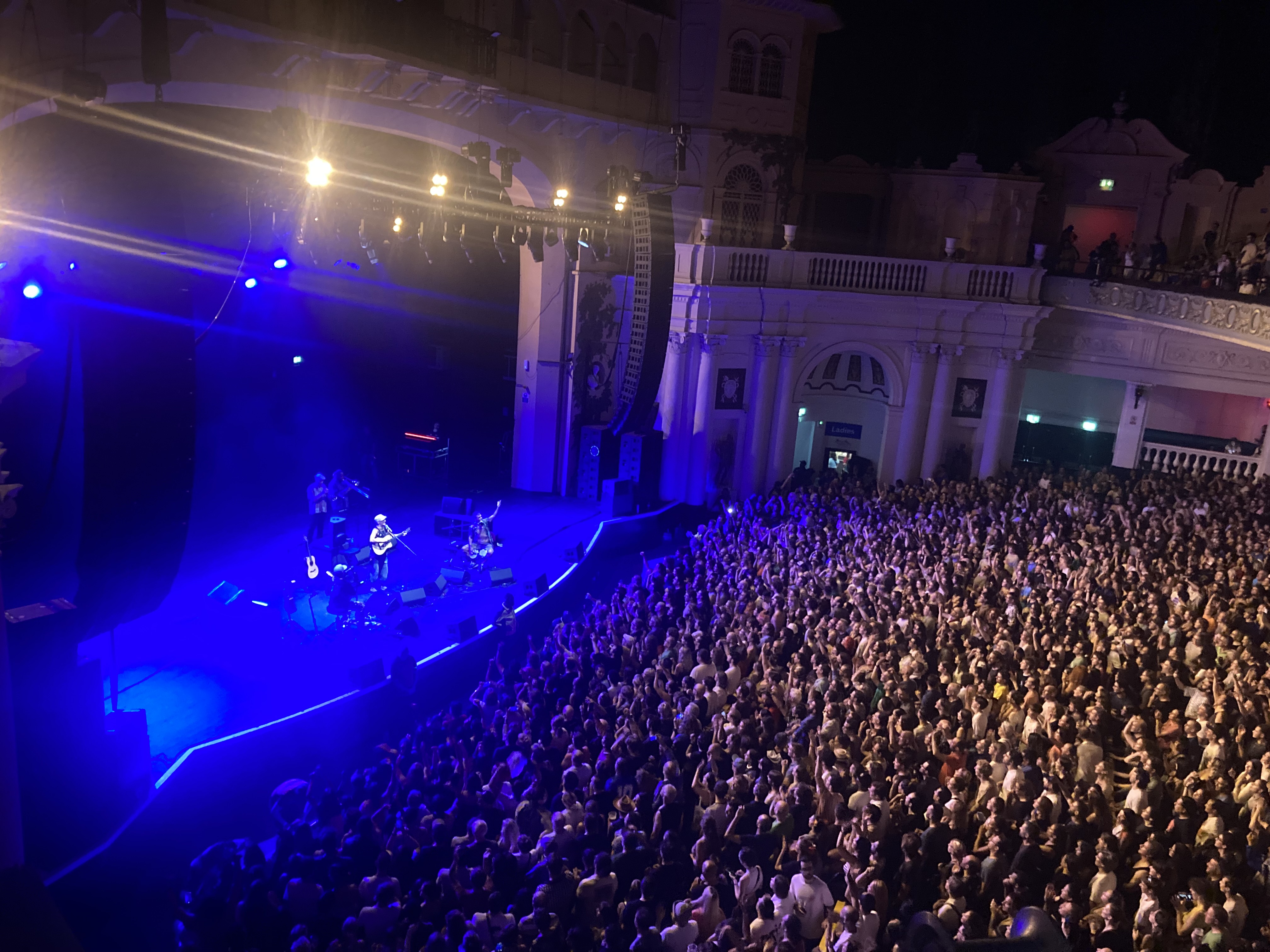
The advance publicity described Manu Chao’s show at Brixton Academy last night as an acoustic set, but if that suggests some kind of gentle fireside recital, forget it. The energy was peaking from the moment the 63-year-old Franco-Spanish singer-guitarist appeared — with Lucky Salvadori from Argentina playing what I think was a Colombian tiple and Miguel Rumbao from Havana playing bongos and activating a little black box that triggered the whistles, sirens and other effects that are the essential ambient noise of Chao’s music.

Actually, the energy was high well before the band showed up, thanks to a capacity audience whose anticipatory chatter set the vibe. It was a polyglot crowd, predominantly made up of expatriates and exiles and perhaps even refugees, speaking at least as many languages as those in which Chao sings — Spanish, French, Italian, Portuguese, English — and the richness of the sound they made while waiting for the music to start was an audible manifestation of that multicultural make-up.

Chao’s second or third song in a two-hour set was “La Vida Tombola”, his wonderful ode to Diego Maradona. He sang it, then paused, and sang it again, and paused, and sang it again. And so on. It may have continued in that fashion for 20 minutes. Long enough for me to suggest to my companion that perhaps he was going to carry on singing it all night. We agreed that this would be fine with us.

He didn’t, but many of the other songs got a similar treatment. “Clandestino”, “Me Gusta Tu”, “El Viento”, “Bongo Bong” — each seemed full of false endings and fresh starts. It was as though every song, some of them featuring a two-man horn section of trumpet and trombone, came with its own built-in encores. And each time the strumming began again, your own heartbeat seemed to restart itself.

There was a lot of audience participation, of the sort that happens at a Bruce Springsteen concert, when everyone sings the first verse of “Hungry Heart”. Unlike me, most of last night’s audience seemed to be word-perfect on every song. In the immediate aftermath, as we made our way slowly down the stairway to the exit, all bathed in Chao’s special warmth, a happy throng burst into the last nonsense chant we’d been singing with him.

This was his first show in London in 14 years, which perhaps explains some of the fervour with which he was greeted. For once, I got home not wanting to play the recorded versions of the songs I’d just been enjoying live but instead to listen again to his new album, Viva Tu, his first since La Radiolina in 2014.

It’s a gentler and more intimate version of his usual approach, reflecting his words in the accompanying press release, in which he mentions the influence skiffle had on him. Whatever, it’s full of beautiful songs, including two duets — the lilting “Tu Te Vas” with Laeti and “Heaven’s Bad Day” with Willie Nelson, an inveterate duetter even in his 10th decade — and the gorgeous “Cuatro Calles”. Like last night’s concert, it draws you in, making you — and the whole world — feel included.

* Manu Chao’s Viva Tu is out now, released through Because Music.

Giovanni Guidi in Fitzrovia

As Giovanni Guidi sat at a grand piano in the Rosenfeld Gallery in London last night, amid a carefully spaced hang of abstract works by the Spanish painter Enrique Brinkmann, the Italian and his audience could be seen through the plate-glass window forming the gallery’s frontage. The occasional stroller along the narrow street in Fitzrovia would stop to look, and the sound must have leaked out to them, because at one point towards the end of the unbroken hour-long recital a young women glanced inside and, barely breaking stride, raised her arms and twirled in a perfect fouetté.

It’s easy to imagine how, even heard through plate glass, Guidi’s music might make a person want to do such a thing. Lyrical, romantic and rhapsodic, his playing reaches great emotional heights without ever lapsing into melodrama or self-indulgence. On this occasion he was playing solo, filling the acoustic spaces normally occupied by the fellow members of his sublime trio, the bassist Thomas Morgan and the drummer João Lobo, but the denser arpeggios and the more intense strumming came without penalising the sense of space and weightlessness he conjures.

Guidi is sparing in his use of standard tunes. When he approaches one, he tends to come at it sideways and by stealth, examining its parts individually and fitting them back together according to a scheme of his own spontaneous devising. To bring this set to a long, tapering close, he nudged phrases from “Over the Rainbow” into view, letting them merge seemingly in their own time, allowing them to settle, then speeding and slowing the process of reassembling Harold Arlen’s melodic components into waves of quietly glowing sound. The yearning of Yip Harburg’s unheard lyric can seldom have found a more powerful echo.

“My Funny Valentine” is the standard similarly anatomised in Guidi’s excellent new album, which finds the trio joined on a few of the seven tracks (the other six are original compositions) by the tenor saxophonist James Brandon Lewis, a New Yorker with a rapidly growing reputation. Lewis fits his playing beautifully into the group’s habitual matrix, adding an extra dimension of careful lyricism. And, as has become customary in Guidi’s series of ECM releases, the album’s cover presents an abstract by another of Ian Rosenfeld’s artists, the French painter Emmanuel Barcilon. A worthwhile partnership all round.

* Giovanni Guidi’s A New Day is out now on the ECM label. Enrique Brinkmann’s paintings are on view until tomorrow (September 20) at the Rosenfeld Gallery, 37 Rathbone Street, London W1T 1NZ.

Autumn books 3: Brad Mehldau

The first time I saw the pianist Brad Mehldau in person, playing with a pick-up rhythm section at the Pizza Express in the early 1990s, I was astonished by the intellectual and technical power of his playing, and by its emotional impact. The version of “Moon River” he played that night lives with me still. He was in his early twenties, still with boyish looks, and he sounded like the next thing in jazz piano. A couple of dozen years later I booked him and the tenor saxophonist Joshua Redman, his contemporary, colleague and friend, to play at JazzFest Berlin, where they gave a duo performance sensational in its virtuosity, interplay and, again, emotional depth. I had no real idea of the back-story to these two performances.

Back in the ’90s, Mehldau was in the grip of heroin addiction. By the end of the decade he had freed himself from that prison without bars and found a new life. Sharing a stage with Redman in 2016, he was reunited with a contemporary who had finally lost patience with him 10 years earlier, kicking him out of his quartet just when they were achieving recognition. That rejection was one of the factors that eventually forced the pianist to take the action that saved him.

On the subject of addiction and the jazz life, the first volume of Mehldau’s autobiography, titled Formation: Building a Personal Canon, is as harrowing as anything I’ve read in a genre that includes Hampton Hawes’ Raise Up Off Me, Art Pepper’s Straight Life and Peter King’s Flying High. Here’s how he introduces it: “There are detailed descriptions of drug and alcohol abuse in this book. I want to stress that, although I describe the pleasure of using them, I hope I will have shown that they were a mistaken path, one that injured me and almost took my life. They are part of my story. I do not know why I survived when close friends of mine did not. Perhaps because of that, I feel an obligation to tell that story honestly.”

The book is dedicated to three of those young friends who did not survive, and whose stories — using only their first names — are interwoven into the tale of his own childhood, upbringing, schooling and early experiences in the jazz world.

It’s a serious book, sometimes obsessive in pursuit of its themes, in which Goethe, Rilke and Kierkegaard are often quoted as the author describes his search for meaning and beauty. He is sufficiently comfortable with such concepts as gnosis and teleology to deploy them without explanation. Dream sequences are occasionally reconstructed to illustrate his youthful anxieties, particularly those concerning his sexual identity. A publisher wanting a more commercial book would have winnowed many of these passages, removing repetition, but one imagines the accumulated weight of testimony is what Mehldau wanted, perhaps as an additional form of therapy — or as part of that obligation “to tell that story honestly”. For a sympathetic reader, it works.

There’s music, of course. No shortage of it, starting with a description of his youthful tastes, which incorporated an unaffected love of several kinds of pop music — particularly British prog-rock, on which he is clearly an expert — alongside his developing interest in jazz. There’s an abundance of how it felt while he was discovering his musical character, absorbing his influences while at school and college and eventually learning directly from the elders. The rewards of first-hand exposure to pianists of an earlier generation, such as Hank Jones, Tommy Flanagan, Barry Harris and Cedar Walton, makes good reading, as does his veneration of another one in particular.

“There was a whole swath of us piano players who were trying to play like Wynton Kelly,” he says. “Sometimes, someone would simply play a whole stretch of one of his solos, transcribed from a beloved record. Normally, that kind of thing would be frowned on, because it went against the principle of improvisation, but here the fellow piano-players who knew the solo as well would nod in approval. I did this with several choruses of (his) solo on ‘No Blues’ from Smokin’ at the Half Note. I still quote from that solo regularly. It’s a bedrock of joyous swing, melody and badassed fire all at once.”

Drummers have always been important to him. Listening to Elvin Jones and Ed Blackwell, playing with Billy Higgins and Jimmy Cobb, he’s alert to the attitude and the nuances of their playing, to the way it sits within the beat. “Blackwell’s drumming changed everything for me,” he notes. “He showed how you could play in a formally unhinged context, yet create your own shifting grid, one with simplicity and integrity which nevertheless moved easily within the free current of the music.” He makes the point that while listening to such great jazz musicians on record is one thing, hearing them in person is quite another.

He dives into deeper currents, too, employing his appreciation of aesthetic theory drawn from the likes of Theodor Adorno and the literary critic Harold Bloom (compiler of The Western Canon). “Where to find oneself as an over-thinking, aspiring jazz musician? Music, in its steady abtractness, would not supply a road map. Literature has been the closest analogue thus far. At its best, it used language to break out of language, into something more like music.”

Characteristically, he uses the example of James Joyce and Thomas Mann to discuss the dichotomy between music of the flesh and music of the spirit, embodied in the contrast between Miles Davis’s In a Silent Way and John Coltrane’s A Love Supreme, both of which he quite properly venerates, just as he does Joyce’s Ulysses and Mann’s Dr Faustus.

“Of course, Miles wasn’t only carnal any more than Coltrane was only spiritual.” he writes. “Yet each led to one pole in my experience of listening to them. I began to have an aspiration for my own output: to close the gap between the divine and flesh, to reconcile sexual and spiritual ecstasy in the musical expression.” He finds an answer in Ulysses.

In jazz-historical terms, he’s fascinating on how it felt to come up in the late ’80s and early ’90s, working alongside the Marsalis-led revival that was supposed to use tradition to blow away the allegedly stale irrelevances of the avant-garde and fusion music.

“‘Postmodernism’ was an explanation for anything and everything,” he remembers, “but it was a term that seemed to eat itself, as it tried to account for the breakdown of linear history in linear, historical terms. In a way, it had no utility, by its own definition. Perhaps that lack of utility was embedded in its meaning, though, and the idea was to start from a place of no meaning. The old set of integral tools did not work. They no longer constructed anything whole. The ’90s were all about coming to terms with that. In that process of reckoning, there was ultimately a strong creative input from all quarters. But it took a minute.” And there was certainly a resentment, directed at the Marsalis brothers, to be worked through.

The narrative ends with Mehldau on the brink of rescue from the fate that had long been beckoning. You know it’s coming, of course, but on the way to his redemption he spares us nothing of the squalor into which his life descended in just about all its aspects — including, for a while, even the music. It’s a gruelling narrative, and a brave one.

* Brad Mehldau’s Formation: Building a Personal Canon, Part One is published by Equinox (www.equinoxpub.com)

Autumn books 2: Chris Charlesworth

Chris Charlesworth has a good memory and loves to tell stories, which makes Just Backdated — subtitled “Melody Maker: Seven Years in the Seventies” — very good value for those with an interest in the rock scene of that era in the UK and the USA, and in the contemporaneous history of the British music press.

He was recruited to the MM in June 1970, shortly after its editor, Jack Hutton, had left and taken many of the younger members of staff with him to start a rival weekly called Sounds. Chris Welch, Alan Lewis and I were among those who rejected his invitation to join them, as did our photographer, Barrie Wentzell. Ray Coleman, a former MM writer, was appointed editor in Jack’s place and set about the job of filling the empty desks and rewarding those who’d stayed put with swift promotions.

Just as Welch, Lewis and I had all come from local papers, so had Ray. He wanted properly trained young journalists, so among his hires were Michael Watts from the Walsall Observer, Roy Hollingworth from the Derby Evening Telegraph, and Charlesworth from the Bradford Telegraph & Argus. We had two things in common: we’d all been in bands, and we’d all written weekly pop columns for our respective local newspapers.

I think their experience was like mine at the Nottingham Evening Post & News: the editors were older men who knew that teenagers were up to something, hadn’t a clue what it was, and so decided that the best people to write about it would be the teenagers on their staff. After that, they tended to leave us to it. So when I showed a sheaf of cuttings to Hutton during my own job interview in 1969, it included pieces on Albert Ayler and the Velvet Underground.

Charlesworth remembers arriving for his first day at our offices on the second floor of 161-166 Fleet Street, the headquarters of IPC Specialist and Professional Press. We were at the far end of a long corridor also housing several other publications: Rugby World, Cage and Aviary Birds, Cycling Weekly and Disc & Music Echo. The last-named, which had been edited by Coleman until his return to the MM, was the home of two female journalists, Penny Valentine and Caroline Boucher, who were great friends and very good company.

On that first day, Charlesworth remembers being told by Laurie Henshaw, the veteran news editor, to call Ginger Baker to ask him about personnel changes with his band, Air Force. He was soon in the swing of things, and in his first full week he interviewed the singer of Free, whose “All Right Now” was heading up the charts.

“I met Paul Rodgers in his poky little flat in a big old redbrick block in Clerkenwell and we chatted in a nearby greasy spoon café,” he writes. “The same issue featured my interview with Don Everly, done in his suite at the Inn on the Park. After I left him, my head spinning at meeting an old hero, I found myself sharing an elevator with Dustin Hoffman.”

That week he also interviewed Cliff Richard on the phone, reported on Jethro Tull adding the keyboards player John Evan, and reviewed gigs by Pete Brown’s Piblokto! and Status Quo. A few days later, he was at the Shepton Mallet festival, listening to Pink Floyd and Frank Zappa and to Led Zeppelin, with whom he was soon spending quite a lot of time. Not as much, however, as he would soon be spending with the Who, once Keith Moon had rung him up to thank him for a kind review of their show at Dunstable Civic Hall.

As we all did, Chris was soon going on the road with these and other bands, and his anecdotes are amusingly illustrative of the rock and roll lifestyle of the time. There’s plenty of drinking, a certain amount of drugging, and plenty of sex — although at the Status Quo gig, in his first week, he turns down their publicist’s offer to bring along “a bird” for him for the night. That PR man was the later-to-be-notorious Max Clifford. As he makes clear, Chris was perfectly capable of finding companionship without assistance.

A quick promotion to news editor was followed in 1973 when Coleman invited him to become the MM‘s man in North America. The paper was selling 200,000 copies a week and could afford such an appointment, although the technology of the day meant that copy had to be typed up and handed to a courier — in a package that also included 10×8 prints of photographs to go with the stories — to be transported by air to London in order to meet the weekly deadline.

Most of the book is taken up by his American adventures, starting with a few months in Los Angeles (where he stayed first in the Chateau Marmont and then in Phil Ochs’s apartment) before he relocated to New York, where he would spend the next three years. From an apartment on the Upper East Side he ventured out to interview Lou Reed, Donald Fagen and Walter Becker, Sly Stone, John Lennon, Paul Simon, David Bowie, John Hammond, Bruce Springsteen, Alice Cooper, the Bay City Rollers and countless others, including testy encounters with Neil Diamond and Rod Stewart, and to attend shows ranging in scale from Madison Square Garden to CBGBs, where he encountered the fledgling Ramones, Talking Heads and Blondie (and went on a date with Debbie Harry).

The front page pictured above, from the MM of August 7, 1976, features a story about Lennon winning his fight to stay in the US. That was Chris’s, with his full report inside of the New York hearing and the subsequent press conference. Just another day’s work from an era when you interviewed stars from the next seat in a plane, or in the back of a stretch limo, or in a hotel room with no PR in attendance. There were lots of post-gig parties or album launches where musicians and journalists mingled.

To his regret, at the beginning of 1977 he was told that his US posting would be coming to an end. A revived NME was winning the circulation war, and budgets were being cut. Soon he would be leaving the MM and eventually returned to London to work at RCA, where his duties included Bowie’s public relations. In 1983 he embarked on three decades as the editorial director of Omnibus Press, where he was responsible for commissioning and editing countless music books, including such best sellers as Dear Boy, Tony Fletcher’s biography of Keith Moon, and Bright Lights Dark Shadows: The Real Story of Abba, by Carl Magnus Palm.

There was never anything pretentious or verbose about Charlesworth’s own writing. His memoir reflects the extraordinary boom of the music business in the rock era, the guilt-free hedonism of the time, and the excesses — sometimes amusing, occasionally grotesque — for which somebody else would always be picking up the tab. That somebody, we assumed, would be the record company. In our naivety, we had yet to understand that the bill for all of it — the flights, the hotels, the drinks, the canapes, probably the drugs, too — would eventually be presented to the musicians.

I’ve never been quite sure what I think of the 1970s. When you remember Watergate and Thatcher, not to mention loon pants and mullets, it seems almost as worthy as the 1930s of Auden’s withering dismissal — “a low dishonest decade”. But there was the music, and with the music came fun and games, exactly as my old colleague describes it.

* Chris Charlesworth’s Just Backdated is published by Spenwood Books. His blog is justbackdated.blogspot.com

Autumn books 1: Joe Boyd

“Tango comes from the mud,” Brian Eno told an audience at Foyle’s bookshop the other night. He was conducting a public conversation with the author of And the Roots of Rhythm Remain, an 850-page examination of the forms of popular music with which Joe Boyd has engaged in Cuba, Jamaica, Brazil, Argentina, Bulgaria, Senegal, Albania and elsewhere during his six decades as a successful record producer and enlightened facilitator of musical projects.

For many years now it’s been rumoured that Boyd was writing a history of “world music”, a tale perhaps beginning with his presence at the famous meeting at a London pub in 1987 during which that rubric was invented, with the best of intentions and outcomes, as a way of persuading open-minded listeners to pay as much attention to music from other cultures as they did to their own western idioms. The result is much more interesting than a simple history; its eventual subtitle, “A Journey through Global Music”, conveys a much more accurate impression of what Boyd has taken on.

The quote about tango coming from the mud is to be found on page 483, where it’s identified as an Argentine saying. It was clever of Eno to spot it, because it says something larger about pretty much all the music Boyd considers here. How and when it happened, who made it happen, and to whom it happened are all part of his investigations, whether the music under consideration is Tropicália or townships jazz, Django Reinhardt or Béla Bartók.

I’m still working my way through the book, which will take a while even though Boyd writes in the easy, fluent, open-minded, anecdotal style familiar from White Bicycles, the relatively slender book about his adventures in the ’60s underground, published in 2005 to justified acclaim. Vast as his new one might seem, it’s worth reading with full attention, lest you miss some vital socio-cultural connection or valuable information on the roles played by, for example, the Ghanaian drummer Tony Allen, the Sudanese oud-player Abdel Aziz El Mubarak, Rodney Neyra of Havana’s Tropicana nightclub or the ballet impresario Sergei Diaghilev. (I didn’t know, for instance, that, according to Boyd, the names samba, rumba, mambo, tango and cha-cha all have their roots in Ki-Kongo, one of the languages of the Kongo people living in what are now the Republic of Congo, the Democratic Republic of Congo, Angola and Gabon.) Boyd’s enviable skill is to bring the reader an astonishing level of historical detail while wearing his research lightly and enlivening the narrative with exactly the right seasoning of his own views.

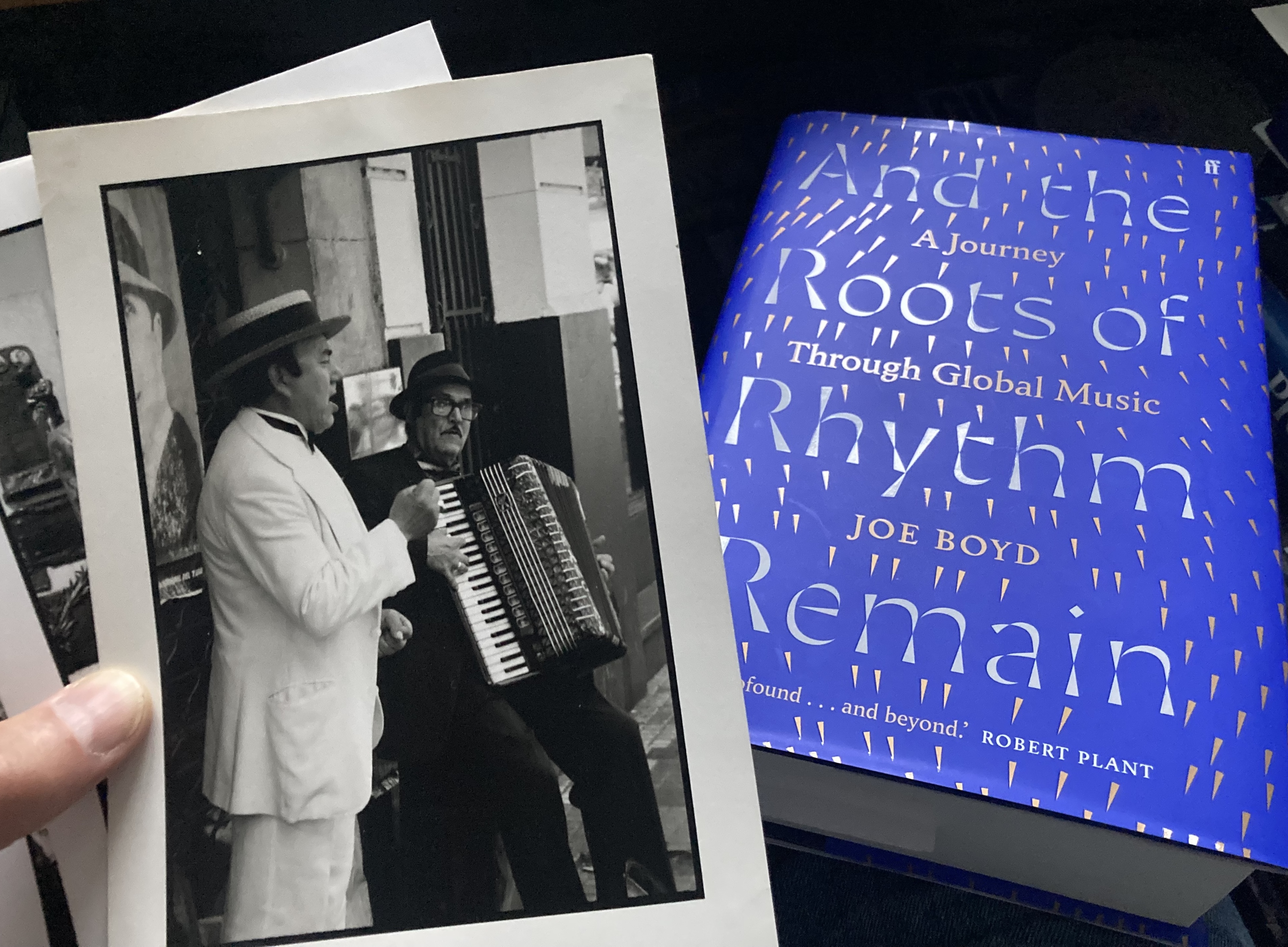
After buying the book at the Foyle’s event and getting it signed, I took it home and went straight to the chapter about tango. I like tango very much, although I once spent an evening in a bar in San Telmo, a Buenos Aires quarter then about to make the jump from funky to gentrified, proving to everyone’s satisfaction that I’ll never be able to dance it. I share Boyd’s enthusiasm for the singer Carlos Gardel to such an extent that I once visited the great man’s tomb in the cemetery of Chacarita in Buenos Aires, observing the ritual of leaving flowers at the base of his statue and placing a lit cigarette in the space left by the sculptor between the index and middle fingers of his raised right hand, because that’s how Gardel always sang until his untimely death in an air crash in 1935.

The photo above is one I took in 1994 on a sidewalk in Rosario, Argentina’s third largest city, the birthplace of Che Guevara and Lionel Messi. I was struck by the elegance and dignity of the street singer and his accordionist, who were serenading appreciative shoppers and other passers-by with a selection of songs made famous by Gardel.

Boyd traces the idiom’s origins in the bars and bordellos of Buenos Aires, examining its sources and tracking its destiny. He doesn’t share my fondness for the late composer and bandoneon virtuoso Astor Piazzolla, who became, he believes, “for tango what John Lewis and the MJQ were to jazz, ‘elevating’ it from the dancefloor and giving it concert-hall respectability.” He’s both right (in the comparison) and wrong (in the implicit criticism). Nobody who went, as I did, to see Piazzolla and his astonishing quintet for three out of their five nights in the intimate environment of the Almeida Theatre in London during the summer of 1985 could accuse them of forfeiting the sensual charms of tango in a pursuit of respectability. For a lot of worthwhile music with roots “in the mud”, the need to get people dancing is no longer a priority. But it’s a good and worthwhile argument to have, and I expect there’ll be many more as I work my way through what is shaping up to be not just an exceptionally enjoyable book but perhaps also an important one.

* Joe Boyd’s And the Roots of Rhythm Remain: A Journey Through Global Music is published by Faber & Faber (£30)

The vision of Scott LaFaro

Invited to talk about the bassist Scott LaFaro, Ornette Coleman came up with a typically gnomic insight. “Scotty could change the sound of a note just by playing another note,” Coleman told LaFaro’s biographer in 2007. “He’s the only one I’ve ever heard who could do that with a bass.”

There’s a chance to consider what Ornette might have meant while listening to a new three-CD set that compiles work from throughout LaFaro’s sadly abbreviated career, which ended when he was killed in a car crash in 1961, aged 25. Starting with tracks from a 1958 trio album by the pianist Pat Moran, it continues through sessions with the pianists Victor Feldman and Hampton Hawes, the clarinetists Buddy DeFranco and Tony Scott, the trumpeter Booker Little, the arranger Marty Paich, the altoist Herb Geller, the composer John Lewis and the tenorist Stan Getz, as well as Coleman — and, of course, the pianist Bill Evans, with whose celebrated trio he came to fame.

In New York in 1960 Coleman called LaFaro to play alongside his usual bassist, Charlie Haden, in the famous double-quartet session called Free Jazz. Although the two young bassists were friends (LaFaro was then aged 24, Haden 23), it would be hard to imagine a single generation producing two exponents of the instrument with more contrasting styles: Haden darkly thrumming, happy to dig in and walk a basic 4/4, never using two notes where one would do, LaFaro all lightness and velocity and complex phrases executed with quicksilver grace.

When Haden was soon thereafter taken off the scene by drug problems, LaFaro assumed his place in Coleman’s working band and recorded again with him on the album titled Ornette!. But by the summer of that year he was back in his regular place with the Evans trio, playing a summer engagement in a 7th Avenue South basement club that produced two live albums which had an extraordinary impact on jazz: Waltz for Debby and Sunday at the Village Vanguard.

Together with two studio sessions, Portrait in Jazz and Explorations, these albums effectively turned the piano trio from “piano with rhythm accompaniment”, as it used to say on the labels of 78s, to three-way exchanges between creative equals, with the drummer Paul Motian as the third voice. Booker Little, with whom LaFaro recorded in 1960, described him admiringly as “much more of a conversationalist behind you than any bass player I know.”

Little died of uraemia in October 1961, aged 23. Three months earlier, three days after appearing with Stan Getz at the Newport Jazz Festival, LaFaro had died in an accident while visiting family in upstate New York, seemingly after falling asleep at the wheel. Both were prodigies, serious-minded young musicians equally determined to avoid the traps set by the jazz life, with golden creative futures ahead of them. (LaFaro had just begun to compose, and the legacy of the Evans trio to jazz impressionism is unthinkable without his only two recorded pieces, “Jade Visions” and “Gloria’s Step”.)

There were great bass players in jazz before LaFaro. Some of them — Jimmy Blanton, Oscar Pettiford, Ray Brown, Charles Mingus, Ray Brown, Red Mitchell — helped to change how the instrument was played, just as Coleman Hawkins or Charlie Parker changed the saxophone and Louis Armstrong or Miles Davis changed the trumpet, in ways that no classical player could ever have imagined. So when LaFaro arrived on the scene at the end of the 1950s, in his early twenties, he was firmly in a tradition of extending and influencing an instrumental vocabulary.

In the biography, many musicians describe the shock they felt at his death and try to describe what it was that made him so remarkable: the way that he took such a big step in helping to free the bass from the subservient role of walking a steady 4/4 at whatever the tempo might be. Gary Peacock, another friend and contemporary, who later took on his mantle with the trios of Evans and Keith Jarrett, describes him as “anchoring the time without playing it”.

That’s a beautiful way of explaining his effect, and it ties in with a simple but very telling observation made by the bassist and educator Phil Palombi in an essay on LaFaro’s playing included in the biography: “LaFaro rarely began a phrase on the downbeat of a bar.” He avoided the obvious, playing games with symmetry, leaving space for others (and for silence), created a feeling of suspense and suspension, mobilising the music and making it float in new ways. Evans and Motian were his willing and brilliant accomplices, but he was the one who set the tone and made it happen.

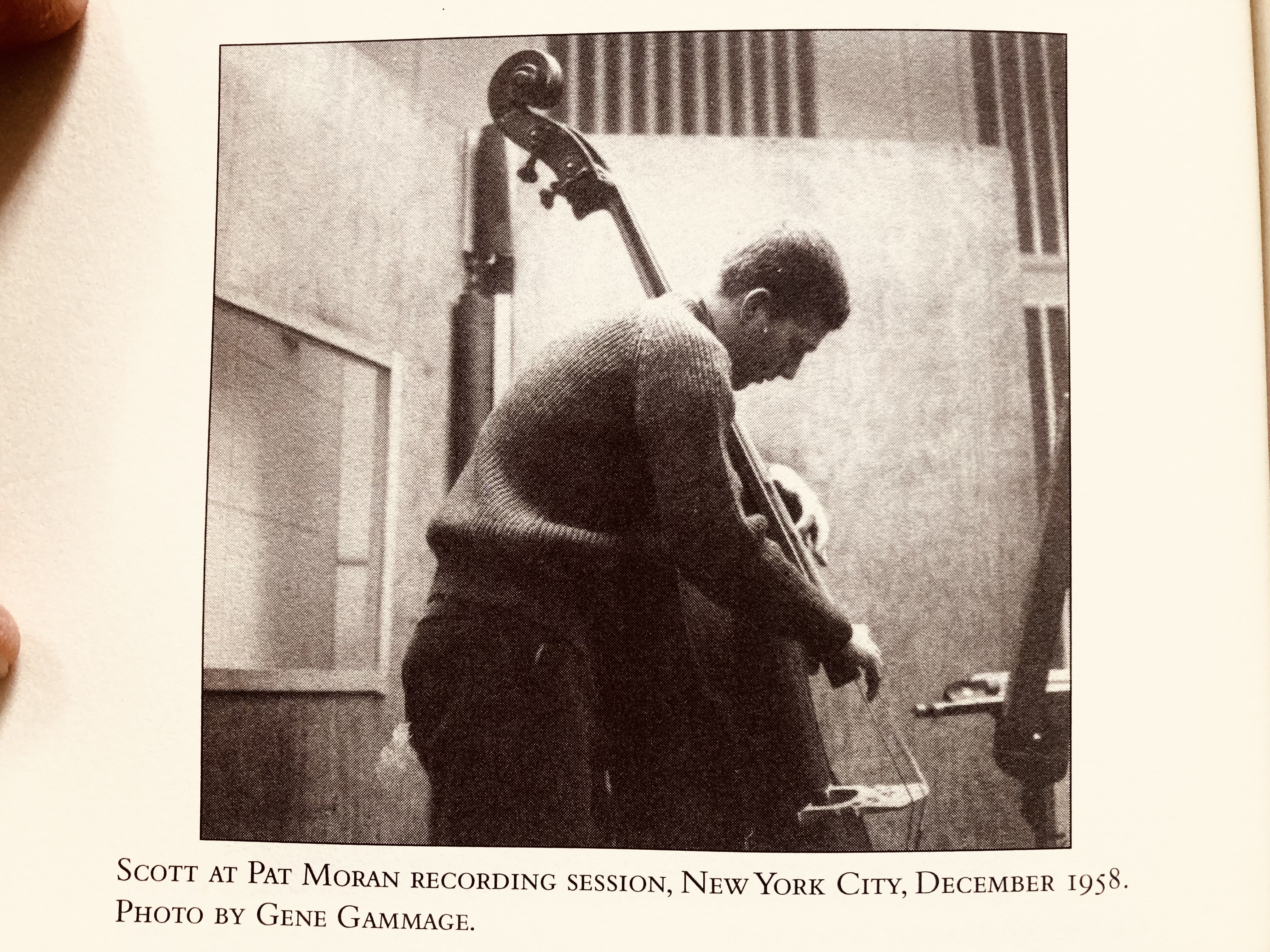
He played a three-quarter size bass built around 1825 by Abraham Prescott of Concord, New Hampshire, found for him in Los Angeles by Red Mitchell. Another great bass player, George Duvivier, helped him to get it rebuilt in New York. (Badly damaged by impact and fire in the fatal car accident, it was completely restored 20 years later.) The height of the bridge was adjusted to lower the action and LaFaro was a pioneer in the technique of plucking the strings with the index and second fingers of his right hand, like a finger-picking guitarist, giving him the ability to articulate phrases of great complexity.

The new set of CDs includes some beauties, such as a couple of cool-as-a-breeze tracks by a sextet co-led by Getz and the vibraphonist Cal Tjader with Billy Higgins on drums, Paich’s characteristically intriguing and beautifully swinging arrangement of “It’s All Right With Me” as a bass feature, a lovely version of “Wrap Your Troubles in Dreams” by a Hawes-led quartet with Harold Land on tenor, and the whole 37 minutes of “Free Jazz”. “Gloria’s Step” and “Jade Visions” are there, as are other Evans classics, including “My Man’s Gone Now” and “My Foolish Heart”.

There’s the occasional oddity, like John Lewis’s arrangement of his classic “Django” for a group including Evans, the guitarist Jim Hall and a string quartet. There’s a version of Dizzy Gillespie’s “BeBop” from The Arrival of Victor Feldman in which Feldman, LaFaro and the drummer Stan Levey flail away at a tempo of 96 bars per minute (that’s bars, not beats), making it to the end without having achieved anything beyond a demonstration of youthful ambition and athleticism (and one that the session’s A&R man, Lester Koenig of Contemporary Records, should have quietly binned).

Out of everything I’ve ever heard of LaFaro’s work, my favourite piece is the Evans trio’s Village Vanguard recording of “Milestones”. Miles Davis’s modal tune received a flawless and historic interpretation when the composer recorded it in 1958 with a sextet (the Kind of Blue band with Red Garland on piano and Philly Joe Jones on drums), but Evans, LaFaro and Motian re-examined, dissected, anatomised and reassembled it in a completely different way.

Curiously, it’s not included in the new set. So here it is. One masterpiece fashioned from another. LaFaro in full flow. Animating and driving the conversation. Rhythmically, melodically, harmonically and conceptually astonishing. Each note changing the one before it. And, in some weird and inexplicable way, only enhanced by the random guffaw from an audience member with which it concludes.

* The Alchemy of Scott LaFaro: Young Meteor of Bass is released on September 20 by Cherry Red. The biography, Jade Visions: The Life and Music of Scott LaFaro by Helene LaFaro-Fernández, was published by University of North Texas Press in 2009 and is the source of the photograph above, taken by the Pat Moran trio’s drummer, Gene Gammage.