Skip to content

Archive for

Matana Roberts at the Roundhouse

Note: After this piece was first posted, Matana pointed out to me that her pronouns are “they/them”. I’ve rewritten it to take account of that preference.

Matana Roberts did a lot of talking at the Roundhouse last night. A lot more talking than playing, in fact. Alone on the stage, opening the show for Lonnie Holley with an hour-long set, they restricted the saxophone — a soprano, rather than her usual alto — to the occasional short phrase or two, often prefaced with the words “This is an improvisation.” We heard a handsome tone on the straight horn, and an ardent delivery, but nothing was allowed to build or cohere into a greater scheme.

Instead we were addressed with verbal riffs on a variety of topics, from the general reaction to the artist’s wild new hair to what a border control officer said about their tattoos. They spoke of a photo of a recent protest in which students had barricaded their doors and windows in the manner taught in “active shooter” drills. “I’m from the Mid-West,” Matana said. “We only had tornado drills.”

That provoked their observations on protest songs, during which we were encouraged to hum a single tonic note in accompaniment as they sang “Wade in the Water” in a pleasant, unemphatic voice. Eventually we were persuaded to join in “I Shall Not Be Moved”.

There was also a story to tell about being invited to play at the Whitney Museum on the day in 2015 when Michelle Obama, a fellow Chicagoan, was opening a new wing. Matana was invited to perform on the roof while the First Lady was doing the ribbon-cutting thing, so that the music would cascade down. The surprise discovery up there was the presence of a detachment of snipers.

“They were surrounding me,” Matana remembered. “Three of them. And they were kind of happy-go-lucky. They wanted to show me their guns. ‘I don’t want to see your guns!'” The ceremony over, Michelle Obama was taken away in an armoured vehicle.

“That was really a symbol of America today,” Matana observed, before returning to the business of singing and playing and musing, trying to summon the better spirits of our troubled world.

Chan Romero 1941-2024

There was a time when Chan Romero’s “The Hippy Hippy Shake” was a song you had know. It was to the Beat Boom as “I Got My Mojo Workin'” was to the R&B scene. When Paul McCartney got hold of a copy and started singing it with his then-unknown group at the Star Club in Hamburg and the Cellar Club in Liverpool, it caught on fast. And when the Swinging Blue Jeans, another Liverpool group, recorded it in 1963, they took it to the top of the UK charts.

Like “I Got My Mojo Workin'”, it was basically a 12-bar blues — as was “Hound Dog”, the song that, when the 15-year-old Romero saw Elvis Presley singing it on the Ed Sullivan Show on his family’s black and white TV at home in Billings, Montana in 1956, introduced him to his destiny. “It just took me over,” he remembered. “I said, this is what I want to do.”

Romero, who has died aged 82, was born in Billings to a father of Spanish and Apache heritage and a mother of mixed Mexican, Cherokee and Irish descent. His mother sang and his brothers played guitars. He followed their example, and began writing songs. During his summer holiday from Billings Senior High School, he hitchhiked to East Los Angeles to stay with some relatives. A cousin drove him to Specialty Records in Hollywood, where the A&R man, Sonny Bono, liked his song “My Little Ruby” and told him to come back when he’d polished it up.

Back in Billings, Romero auditioned for a local DJ, Don “The Weird Beard” Redfield, who became his manager and sent a demo to Bob Keane at Del-Fi Records in Hollywood. Keane had recorded the Chicano singer Richie Valens, enjoying hits with “Donna” and “La Bamba”. It seemed a good match and Keane promptly signed Romero.

When Valens was killed at 19 years of age, along with Buddy Holly and the Big Bopper, in the February 1959 air crash in Iowa, Romero must have seemed his logical heir. Indeed, Keane introduced him to Valens’s grieving parents, with whom he later often stayed at their home in Pacoima, East LA.

“The Hippy Hippy Shake” was his first release on Keane’s label. It didn’t make much impact in the US, but it went down well in Canada and Australia. In the UK it was released on EMI’s Columbia label. “My Little Ruby” was the B-side of the the follow-up, “I Don’t Care Now”, and that was pretty much that, although Romero toured with his backing band, the Bell Tones, and found himself turning away girls. “I haven’t got a girlfriend,” he told the Billings Gazette, “because I can’t tell if a girl likes me for myself or because I’m a singer.”

The original version of “The Hippy Hippy Shake” has everything you’d want from a rock and roll record in 1959: the urgent teenage voice, the twangy guitar, the rackety drums, all wrapped up inside a minute and 45 seconds. Thank you, Chan Romero, for your moment in history.

Sounds for summer

Tall enough to be unmissable in any environment, and with a truly remarkable fashion sense, Shabaka Hutchings had presence from day one of his career. To me, as an observer, that was the concert at the Royal Festival Hall in June 2009 at which he was one of several UK guests with Charlie Haden’s Liberation Music Orchestra (others included Robert Wyatt, Jason Yarde, John Parricelli and Andy Grappy). He had just one solo but when he stepped forward, the sounds coming from his tenor saxophone commanded everyone’s attention.

Since then, we’ve heard him with Sons of Kemet, The Comet Is Coming, the Ancestors and Louis Moholo-Moholo’s Five Blokes, and in a reinterpretation of Coltrane’s A Love Supreme at the Church of Sound a few weeks ago which I was very sorry to miss. And now he has enough presence to allow him to drop his surname and become just Shabaka.

He’s also dropped the saxophone, which is more of a surprise, in order to study the flute — specifically the Japanese shakuhachi and other iterations, including the Andean quena and the Slavic svirel. His new album — titled Perceive Its Beauty, Acknowledge Its Grace — is evidence of this turn of interest.

It’s a radical departure from anything he’s given us before. A series of sketches deploys varying personnel, including the pianists Nduduzo Makhathini and Jason Moran, the guitarist Dave Okumu, the singer Lianne La Havas, Moses Sumney, Laraaji and ESKA, the harpists Brandee Younger and Charles Overton, the drummers Marcus Gilmore and Nasheet Waits, the speakers Saul Williams, Miguel Atwood-Ferguson and Anum Iyupo, the rapper Elucid, the percussionist Carlos Niño and the bassists Esperanza Spalding and Tom Herbert.

That’s an impressive line-up, but as you listen to the album you’re never really thinking of individuals or their virtuosity. In that sense it’s a quite different experience from that of listening to a “jazz album”. But neither is it a kind of New Age tapestry of sound, slipping by without disturbance, merely a bit of aural decoration.

It has an overall charm and moments of great and singular beauty, too, such as the shakuhachi improvisation against Overton’s harp and the celestial layered voices of Sumney on “Insecurities”, La Havas’s vocal reverie on “Kiss Me Before I Forget”, or Spalding’s springy bass behind Elucid’s rap on “Body to Inhabit”, but it also has depth, and not just in the occasional verbal passages, which are carefully integrated into the quilt of sound. The overall impression is what counts, and somehow that goes beyond words.

The album contains one snatch of tenor saxophone, on a track called “Breathing”, in which Rajni Swaminathan’s mridangam — a Carnatic double-ended hand drum — backs first Shabaka’s treated and looped flutes, then his clarinet, and finally his saxophone, which briefly erupts in a gentle squall with an intonation recalling the great Ethiopian tenorist Getatchew Mekuria.

That little hint of Ethiopian music sent me to a new release in the name of Emahoy Tsege Mariam Gebru, who died this time last year at the age of 99. Born in Addis Ababa, she studied violin in Switzerland as a child, worked as a civil servant and sang for Haile Selassie, was imprisoned by the Italian occupiers during the Second World War, and spent a post-war decade as a nun in a hilltop monastery. The arrival of a new regime forced her to flee to Jerusalem, where she spent the rest of her life in an Ethiopian Orthodox convent and composed music for piano, organ, and various ensembles while running a foundation to encourage music education among children in her native land and elsewhere.

Like Mekuria, she had a volume of the producer Francis Falceto’s Ethiopiques series devoted to her music in 2006, and in the last couple of years there have been more albums on the Mississippi label. The latest is called Souvenirs, a collection of her songs apparently recorded between 1977 and 1985. It’s a primitive recording: the piano sounds like a poorly maintained upright and her voice was probably recorded on the same microphone, in a room that was almost certainly not a recording studio. But that does nothing to diminish the appeal of these songs, with titles such as “Where Is the Highway of Thought?” and “Like the Sun Shines on Meadows”, whose vocal melodies are doubled by the pianist’s right hand against left-hand figurations assembled from scraps of blues and rhumba and gospel tunes.

What’s so appealing, almost mesmerising, about this music? I think it’s the combination of transparent simplicity (and sincerity) with the unexpected guile of the rhythmic undertow, which is always playing appealing tricks on the western ear. There’s something about the distinctive melodic shapes and phrase lengths that is special to this kind of Ethiopian music, springing from some deeper root.

Something else to add pleasure to this summer is After a Pause, the new album of acoustic duo music by two brilliant Welsh musicians, the guitarist Toby Hay and the bassist and cellist Aidan Thorne. I got interested in Hay when he was filming himself outdoors playing ragas during the first Covid-19 lockdown in 2020 and putting the results on YouTube, and wrote a bit more about him when he released some duets recorded in an old chapel with his fellow guitarist David Ian Roberts later that same spring.

I try to avoid talking about what musicians are doing in terms of the work of other musicians, but I suppose a simple — and, I hope, enticing — way of describing the scope of these duets is to imagine what Davy Graham and Danny Thompson might have got up to if they were both in their prime in the 2020s and were able to spend three days together in a studio with no distractions, enhancing their compositions and improvisations with a sparing but highly effective use of overdubbing and electronics.

After living with this album for a few weeks, I’ve come to appreciate not just its surface beauty but the way it reveals more of itself and its spiritual essence the closer you listen. The 12-string arpeggios and bowed bass of the opener are a call to the attention that is never wasted as the music blooms and glows through 10 shortish but unhurried pieces, trajectories shifting and densities varying considerably from bare-bones to near-orchestral (on “Burden” or “Eclipse”) but mood sustained. The brief solo piano coda is a lovely way to finish.

A light shines through these three albums. I’ve a feeling they’re going to be among the summer’s best companions.

* Shabaka’s Perceive Its Beauty, Acknowledge Its Grace is on the Impulse! label. Emahoy Tsege Mariam Gebru’s Souvenirs is on Mississippi Records. Toby Hay and Aidan Thorne’s After a Pause is on Cambrian Records. Links here:

https://spibaig.bandcamp.com/album/perceive-its-beauty-acknowledge-its-grace

https://emahoytsegemariamgebru.bandcamp.com/album/souvenirs

https://cambrianrecords.bandcamp.com/

The Necks at Cafe Oto

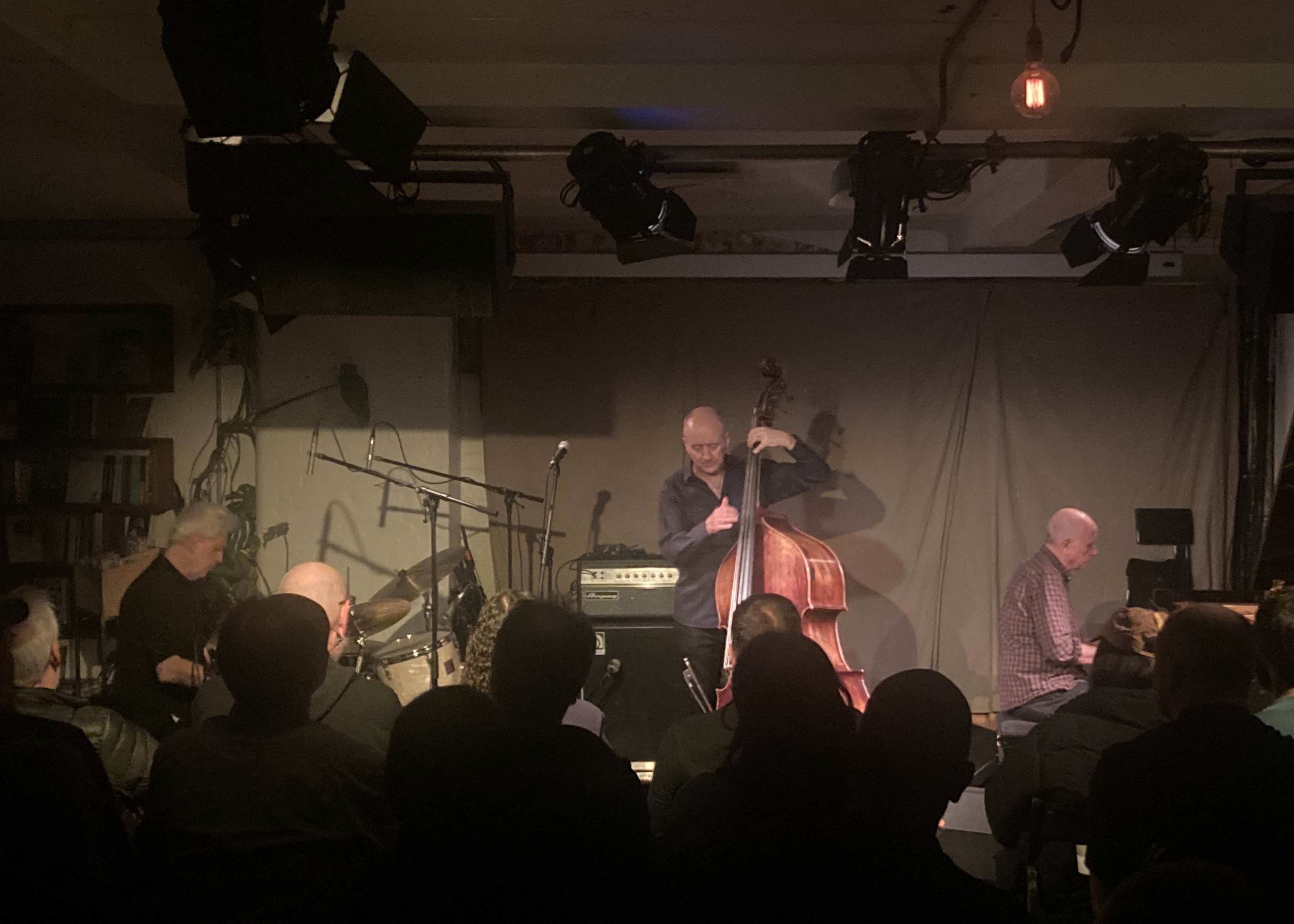
“We’ve never really been an emotional band,” Lloyd Swanton observed drily after the first set on the last of the Necks’ four nights at Cafe Oto in London this week, “but it seems to be creeping in.”

I’d been trying to tell him, somewhat incoherently, how moved I’d been by what they’d just played, and in particular how it seemed to express something about the current state of the world. His reflexive response indicated that what he and his colleagues in the Australian trio do is principally about the notes, about the process of three musicians improvising together with no preset material and certainly with no programmatic content in mind. Which is not to say that listening to them isn’t an emotional experience. It is, almost invariably, but the emotions they generate are usually non-specific.

To me, at least, it seemed that there was something different about Thursday’s first set. It started out normally enough, after they and the audience had settled, with one member — Swanton, on this occasion — breaking the silence. As he plucked an isolated note on his double bass, repeating it and echoing it an octave down, sometimes switching to his bow, and initially with long pauses, Tony Buck joined in with mallets gently rolling around his tom-toms and cymbals, followed by Chris Abrahams picking out pensive Moorish figures in the middle-upper octaves of the piano.

For a while, not much seemed to be happening. No surprise there, necessarily. Later Buck said that he’d worried it had started out “a bit washy”. But in 20 years of attending their performances I’ve learnt to wait, to show the kind of patience as a listener that they show as players, in the knowledge that the surprise will come. In fact, they are the proof that the sound of surprise can emerge slowly, by gradual accretion.

This time the process of accretion led to something extraordinary. As the playing of all three grew busier, the textures thickened, the spaces closed and the volume increased, all of it occurring almost imperceptibly, you began to feel that you were hearing things: bells, cries, gunfire. It was an illusion. They weren’t there, and neither was anyone trying to produce them. But somehow they were present — for me, anyway — in the harmonics reflecting off the piano lid, the scrabbling and keening of the bass, and the hard crack of the bass drum against the overlapping splashes of the cymbals.

Eventually it reached a pitch of intensity that was sustained for maybe 15 minutes before being gradually wound down through a collective diminuendo into silence once again. And in those 15 minutes I couldn’t help replaying the images we’ve been seeing on the TV news every night for months — images of buildings, streets, whole cities lying in ruins, of the dead being counted and the living in flight, the sort of total war we may stupidly have believed was safely consigned to a distant past.

That’s not, I’m sure, what the members of the Necks were thinking of while they were summoning the music into being. It’s more the sort of thing the pianist Vijay Iyer had in mind when, with the bassist Linda May Han Oh and the drummer Tyshawn Sorey, he recorded a new trio album whose title, Compassion, explicitly indicates its theme. “Music is always about, animated by, and giving expression to the world around us: people, relations, circumstances, revelations,” Iyer writes in the sleeve note, describing the responsibility, as he sees it, of making art in a time of suffering.

I’ve heard the Necks play music unafraid of ugliness before (a hair-raising triple-forte set at Café Oto in 2013 stands out in the memory), but never anything in which the kind of responses they normally evoke — including but not restricted to euphoria and elevation — were so strikingly replaced by this very different kind of transcendence, a sustained howl expressing something beyond words yet somehow very specific.

So that was the fifth of the six sets I heard them play this week, and the sixth was, as usual, quite different. Abrahams opened it with a reversion to the sort of thing that provokes the use of adjectives like “luminous” and “lambent”. But again there was a surprise when the piece evolved into an essay in the use of asynchronous rhythms, a field they’ve opened up in recent years, in which each one establishes his own pulse or metre and, without forfeiting closeness of listening to the others, maintains it as the piece develops. At its best, it leads to a kind of higher interplay — and this was the practice at its very best, creating a rhythmic maelstrom that activated a very different response in the audience.

All a long way from the sort of passive music for Zen meditation with which they are sometimes erroneously associated, and irrefutable evidence of their commitment, now extending well into its fourth decade, to a constant self-regeneration of which we are the fortunate beneficiaries.

* The Necks continue their European tour at Peggy’s Skylight in Nottingham on Monday (already sold out) and the Tung Auditorium in Liverpool on Tuesday, April 8 and 9 respectively. Their most recent album, Travel, was released in 2022 on the Northern Spy label. Compassion, by Vijay Iyer, Linda May Han Oh and Tyshawn Sorey, was released earlier this year by ECM.